
Life, 1911-01-05 · page 30 of 104
Life — January 5, 1911 — page 30: what you’re looking at
What you’re looking at
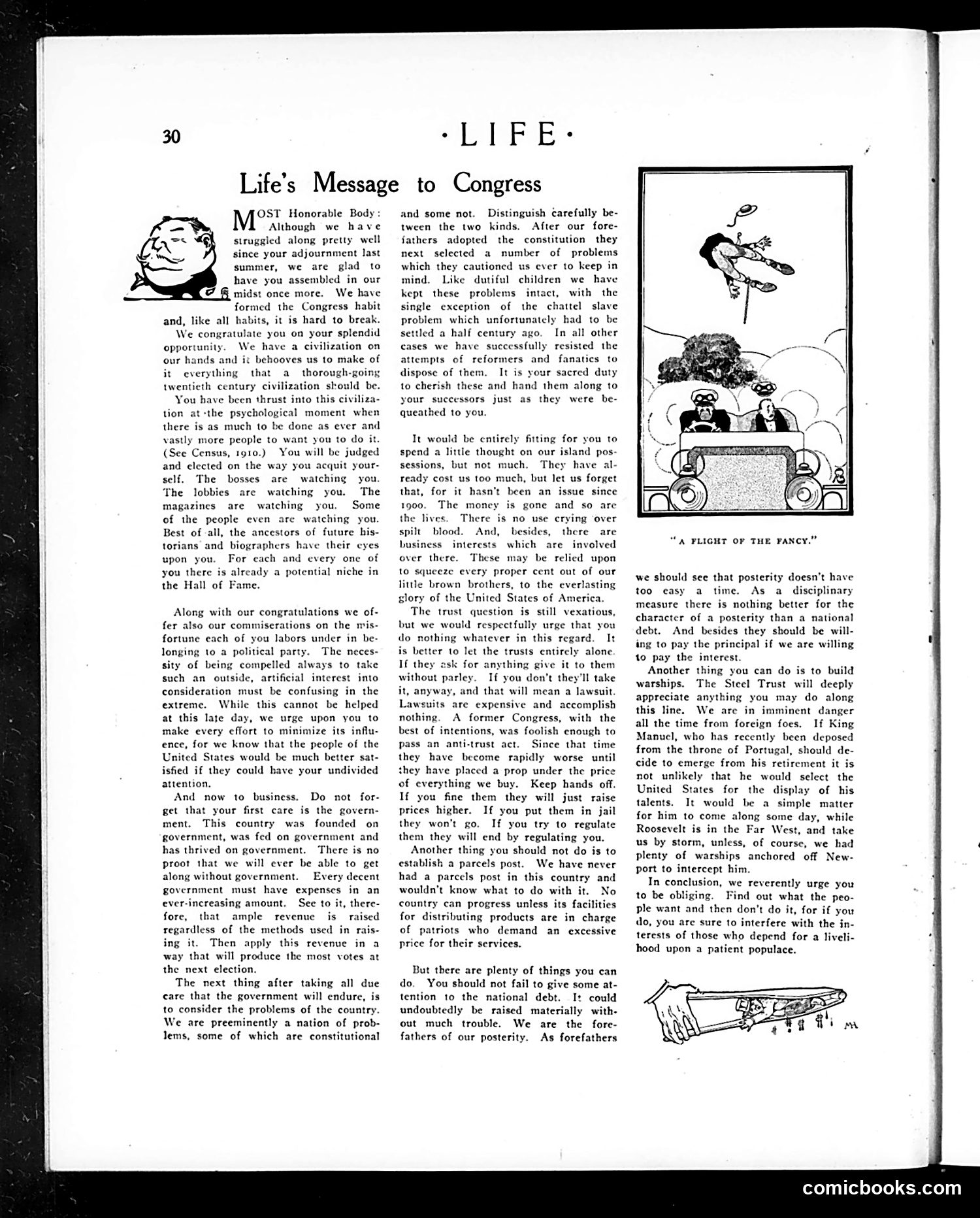
This satirical piece mocks Congress through faux-respectful advice. The cartoon labeled "A FLIGHT OF THE FANCY" depicts congressmen in a car, likely satirizing their reckless or frivolous nature. The text uses ironic praise to criticize major issues: **Political pressure**: Congress is urged to minimize party loyalty, though the author knows it's impossible—exposing how partisan interests corrupt governance. **Colonial exploitation**: The passage cynically dismisses American imperial possessions ("little brown brothers"), acknowledging their cost in money and lives while endorsing business interests' profit-extraction as "glory." **Trust monopolies**: Congress is advised to do *nothing* about trusts, sarcastically suggesting inaction protects corporate interests. **Constitutional problems**: The piece mockingly celebrates Congress's success in preserving old constitutional problems (like slavery's aftermath) rather than solving them. The overall message: Congress serves political machines, lobbies, and business interests rather than the public good—all wrapped in mock-patriotic language that exposes the hypocrisy.
📄 Transcribed text from this page (OCR, searchable)
Machine-transcribed from the original scan — historical spelling and the odd misread are preserved.
od Cal Gel ca) oe Life’s Message to Congress OST Honorable Body: Although we have fn -. struggled along pretty well x EO since your adjournment last summer, we are glad to have you assembled in our midst once more. We have formed the Congress habit and, like all habits, it is hard to break. We congratulate you on your splendid opportunity. We have a civilization on our hands and it behooves us to make of it everything that a thorough-going twentieth century civilization skould be. You have been thrust into this civiliza- tion at-the psychological moment when there is as much to be done as ever and vastly more people to want you to do it. (See Census, 1910.) You will be judged and elected on the way you acquit your- self. The bosses are watching you. The lobbies are watching you. The magazines are watching you. Some of the people even are watching you. Best of all, the ancestors of future his- torians and biographers have their cyes upon you. you there is already a potential niche in the Hall of Fame. For each and every one of Along with our congratulations we of- fer also our commiserations on the mis- fortune each of you labors under in be- longing to a political party. The neces- sity of being compelled always to take such an outside, artificial interest into consideration must be confusing in the extreme. While this cannot be helped at this late day, we urge upon you to make every effort to minimize its influ- ence, for we know that the people of the United States would be much better sat- isfied if they could have your undivided attention. And now to business. Do not for- get that your first care is the govern- ment. This country was founded on government, was fed on government and has thrived on government. There is no proot that we will ever be able to get along without government. Every decent government must have expenses in an ever-increasing amount. See to it, there- fore, that ample revenue is raised regardless of the methods used in rais- ing it. Then apply this revenue in a way that will produce the most votes at the next election. The next thing after taking all due care that the government will endure, is to consider the problems of the country. We are preeminently a nation of prob- lems, some of which are constitutional Distinguish carefully be- tween the two kinds. After our fore- fathers adopted the constitution they next selected a number of problems which they cautioned us ever to keep in mind. Like dutiful children we have kept these problems intact, with the single exception of the chattel slave problem which unfortunately had to be settled a half century ago. In all other es we have successfully resisted the attempts of reformers and fanatics to dispose of them. It is your sacred duty to cherish these and hand them along to your successors just as they were be- queathed to you. and some not. It would be entirely fitting for you to spend a little thought on our island pos- sessions, but not much. They have al- ready cost us too much, but let us forget that, for it hasn't been an issue since 1900. The money is gone and so are the lives. There is no use crying over spilt blood. And, besides, there are business interests which are involved over there. These may be relied upon to squeeze every proper cent out of our little brown brothers, to the everlasting slory of the United States of America. The trust question is still vexatious, but we would respectfully urge that you do nothing whatever in this regard. It is better to let the trusts entirely alone. If they ask for anything give it to them without parley. If you don’t they'll take anyway, and that will mean a lawsuit awsuits are expensive and accomplish nothing. A former Congress, with the best of intentions, was foolish enough to pass an anti-trust act. Since that time they have become rapidly worse until they have placed a prop under the price of everything we buy. Keep hands off. If you fine them they will just raise prices higher. If you put them in jail they won't go. If you try to regulate them they will end by regulating you. Another thing you should not do is to establish a parcels post. We have never had a parcels post in this country and wouldn't know what to do with it. No country can progress unless its facilities for distributing products are in charge of patriots who demand an excessive price for their services. But there are plenty of things you can do. You should not fail to give some at- tention to the national debt. It could undoubtedly be raised materially with- out much trouble. We are the fore- fathers of our posterity. As forefathers “A PLIGHT OP THE FANCY.” we should see that posterity doesn’t have too easy a time. As a disciplinary measure there is nothing better for the character of a posterity than a national debt. And besides they should be will- ing to pay the principal if we are willing to pay the interest Another thing you can do is to build warships. The Steel Trust will deeply appreciate anything you y do along this line. We are in imminent danger all the time from foreign foes. If King Manucl, who has recently been deposed from the throne of Portugal, should de- cide to emerge from his retirement it is not unlikely that he would select the United States for the display of his talents. It would be a simple matter for him to come along some day, while Roosevelt is in the Far West, and take us by storm, unless, of course, we had plenty of warships anchored off New- port to intercept him. In conclusion, we reverently urge you to be obliging. Find out what the peo- ple want and then don’t do it, for if you do, you are sure to interfere with the in- terests of those who depend for a liveli- hood upon a patient populace. comicbooks.com