
Life, 1911-01-05 · page 66 of 104
Life — January 5, 1911 — page 66: what you’re looking at
What you’re looking at
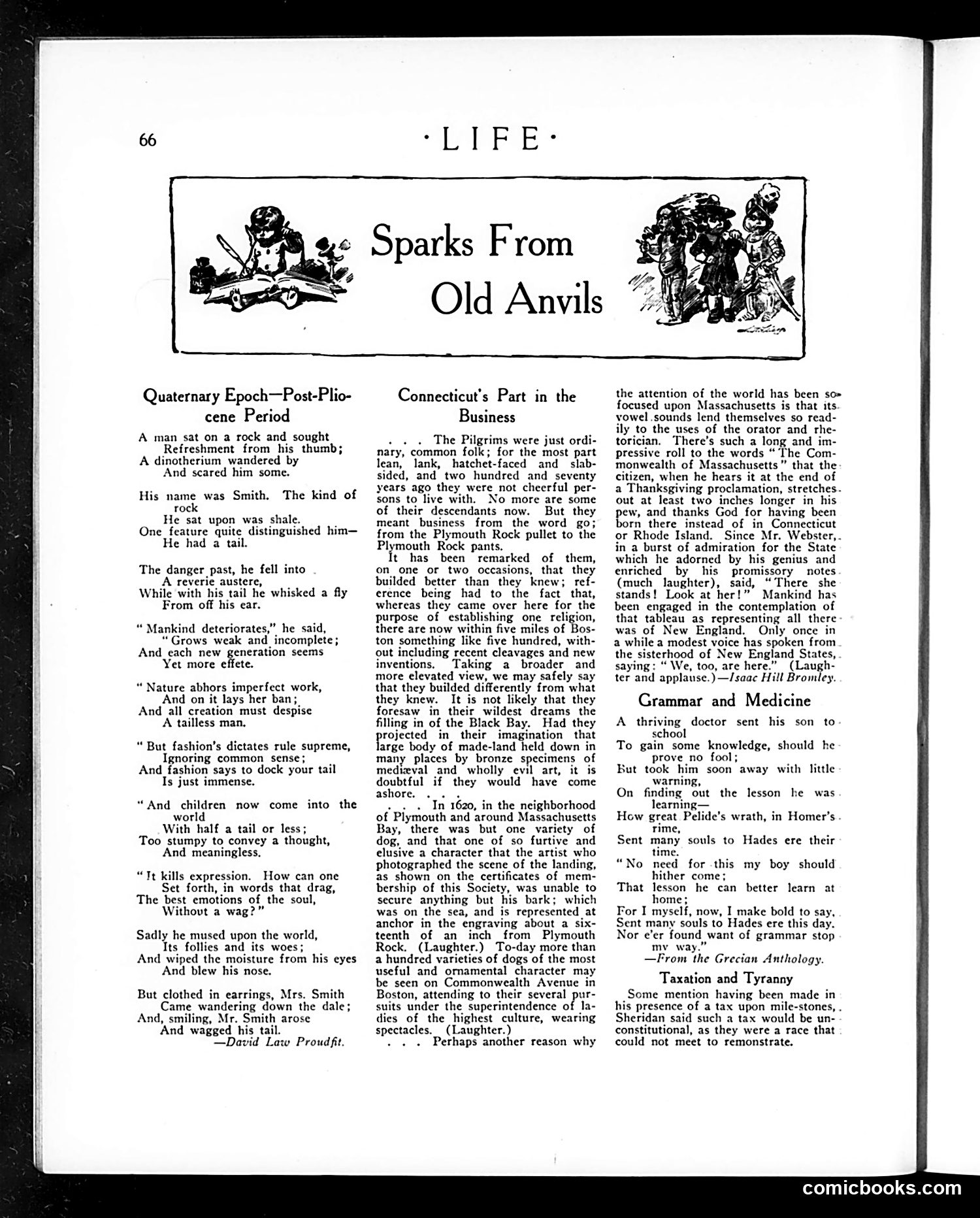
This page contains two satirical pieces: **Left column:** A humorous poem by David Law Proudfit depicts a prehistoric man with a tail lamenting that modern humans have lost theirs due to fashion. He argues that tails are necessary for proper emotional expression ("How can one / Set forth, in words that drag, / The best emotions of the soul, / Without a wag?"). The joke mocks evolutionary "progress" and blind adherence to fashion—until Mrs. Smith appears, whereupon he immediately "wagged his tail," suggesting that courtship instincts override his philosophical complaints. **Right column:** An article praising Connecticut's (specifically Massachusetts's) historical and cultural importance, particularly regarding the Pilgrims and their descendants. It humorously notes that the Pilgrims' Massachusetts vowels make civic pronouncements like "Commonwealth of Massachusetts" sound impressively grand, causing citizens to sit up straighter in church pews. The satire gently mocks regional pride and rhetorical bombast. Both pieces use exaggeration and absurdist humor typical of Life's satirical style.
📄 Transcribed text from this page (OCR, searchable)
Machine-transcribed from the original scan — historical spelling and the odd misread are preserved.
Quaternary Epoch—Post-Plio- cene Period A man sat on a rock and sought Refreshment from his thumb; A dinotherium wandered by And scared him some. His name was Smith. The kind of rock He sat upon was shale. One feature atte distinguished him— He had a tail. The danger past, he fell into A reverie austere, While with his tail he whisked a fly From off his ear. “Mankind deteriorates,” he said, “Grows weak and incomplete; And_each new generation seems Yet more effete. “Nature abhors imperfect work, And on it lays her ban; And all creation must despise A tailless man, “ But fashion’s dictates rule supreme, Ignoring common sense; And fashion says to dock your tail Is just immense. “And children now come into the wor With half a tail or less; Too stumpy to convey a thought, And meaningless. “Tt kills expression. How can one Set forth, in words that drag, The best emotions of the soul, Withovt a wag?” Sadly he mused upon the world, Its follies and its woes; And wiped the moisture from his eyes And blew his nose. But clothed in earrings, Mrs. Smith Came wandering down the dale; And, smiling, Mr. Smith arose And wagged his tail. —David Law Proudfit. Sparks From Old Anvils Connecticut's Part in the Business oe The Pilgrims were just ordi- nary, common folk; for the most part lean, lank, hatchet-faced and slab- sided, and two hundred and seventy years ago they were not cheerful per- sons to live with. No more are some of their descendants now. But they meant business from the word go; from the Plymouth Rock pullet to the Plymouth Rock pants. t has been remarked of them, on one or two occasions, that they builded better than they knew; ref- erence being had to the fact that, whereas they came over here for the purpose of establishing one religion, there are now within five miles of Bos- ton something like five hundred, with- out including recent cleavages and new inventions. Taking a broader and more elevated view, we may safely say that they builded differently from what they knew. It is not likely that they foresaw in their wildest dreams the filling in of the Black Bay. Had they projected in their imagination that large body of made-land held down in many places by bronze specimens of medixval and wholly evil art, it is doubtful if they would have come ashore. .. . “In 1620, in the neighborhood of Piymouth and around Massachusetts Bay, there was but one variety of dog, and that one of so furtive and elusive a character that the artist who photographed the scene of the landing, as shown on the certificates of mem- bership of this Society, was unable to secure anything but his bark; which was on the sea, and is represented at anchor in the engraving about a six- teenth of an inch from Plymouth Rock. (Laughter.) To-day more than a hundred varieties of dogs of the most useful and ormamental character may be seen on Commonwealth Avenue in Boston, attending to their several pur- suits under the superintendence of la- dies of the highest culture, wearing spectacles. (Laughter.) . « « Perhaps another reason why the attention of the world has been so» focused upon Massachusetts is that its. vowel.sounds lend themselves so read- ily to the uses of the orator and rhe- torician, There's such a long and im- pressive roll to the words “The Com- monwealth of Massachusetts” that the citizen, when he hears it at the end of a Thanksgiving proclamation, stretches. out at least two inches longer in his pew, and thanks God for having been born there instead of in Connecticut or Rhode Island. Since Mr. Webster, . in a burst of admiration for the State which he adorned by his genius and enriched by his promissory notes (much laughter), said, “There she stands! Look at her!” Mankind has been engaged in the contemplation of that tableau as representing all there was of New England. Only once in a while a modest voice has spoken from the sisterhood of New England States, saying: “ We, too, are here.” (Laug! he ter and applause. )—/saac Hill Bromley. Grammar and Medicine A thriving doctor sent his son to school To gain some knowledge, should he prove no fool; But took him soon away with little warning, finding out the lesson he learning— How great Pelide’s wrath, in Homer’s rime, Sent many souls to Hades ere their time. “No need for this my boy should hither come; That lesson he can home; For I myself, now, I make bold to say, Sent many souls to Hades ere this day. Nor e’er found want of grammar stop my way.” —From the Grecian Anthology. On was better learn at Taxation and Tyranny Some mention having been made in his presence of a tax upon mile-stones, . Sheridan said such a tax would be un- constitutional, as they were a race that could not meet to remonstrate. comicbooks.com