
Life, 1911-01-05 · page 62 of 104
Life — January 5, 1911 — page 62: what you’re looking at
What you’re looking at
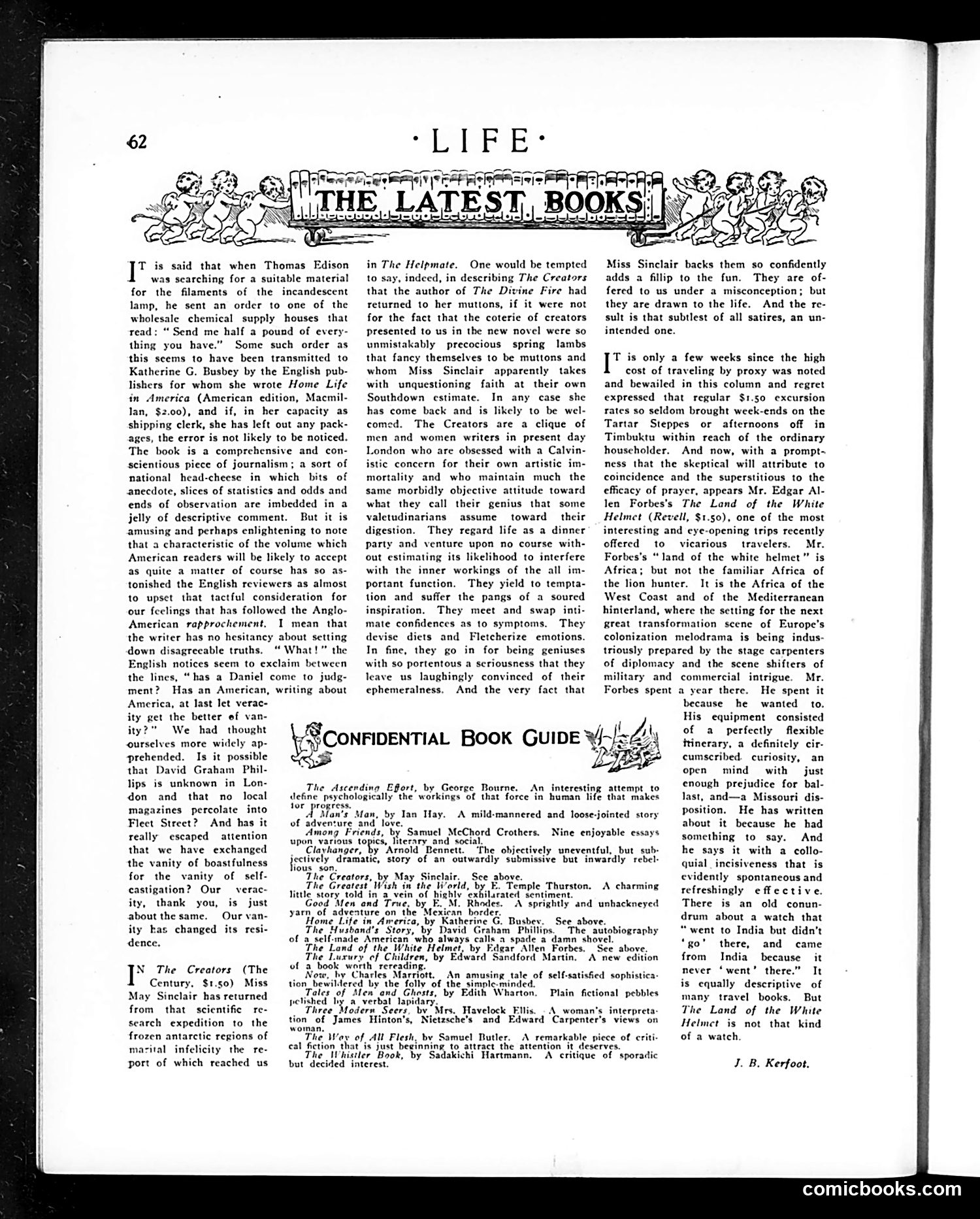
This is a book review section from Life magazine (page 62), not a political cartoon. It discusses several newly published books: **Main content:** A lengthy review of Katherine G. Busbey's *Home Life in America*, praising it as comprehensive journalism but noting that English reviewers were shocked by the author's willingness to state "disagreeable truths" bluntly—something American readers would accept as routine. **Secondary reviews** cover: - May Sinclair's *The Creators*, satirizing London literary circles obsessed with their own artistic immortality - Edgar Allen Forbes's *The Land of the White Helmet*, a travel book about colonial Africa The page demonstrates Life's role as a literary periodical offering sophisticated cultural criticism alongside humor. The "Confidential Book Guide" section provides brief notices of additional titles. There are no political cartoons visible on this page.
📄 Transcribed text from this page (OCR, searchable)
Machine-transcribed from the original scan — historical spelling and the odd misread are preserved.
T is said that when Thomas Edison was searching for a suitable material for the filaments of the incandescent lamp, he sent an order to one of the wholesale chemical supply houses that read: “Send me half a pound of every thing you have.” Some such order as this scems to have been transmitted to Katherine G. Busbey by the English pub- lishers for whom she wrote Home Life in America (American edition, Macmil- lan, $2.00), and if, in her capacity as shipping clerk, she has left out any pack- ages, the error is not likely to be noticed. The book is a comprehensive and con- scientious piece of journalism ; a sort of national head-cheese in which bits of anecdote, slices of statistics and odds and ends of observation are imbedded in a jelly of descriptive comment. But it is amusing and perhaps enlightening to note that a characteristic of the volume which American readers will be likely to accept as quite a matter of course has so as- tonished the English reviewers as almost to upset that tactful consideration for our feclings that has followed the Anglo- American rapprochement. I mean that the writer has no hesitancy about setting down disagrecable truths. “ What!” the English notices seem to exclaim between in The Helpmate. One would be tempted to say, indeed, in describing The Creators that the author of The Divine Fire had returned to her mutions, if it were not for the fact that the coterie of creators presented to us in the new novel were so unmistakably precocious spring lambs that fancy themselves to be muttons and whom Miss Sinclair apparently takes with unquestioning faith at their own Southdown estimate. In any case she has come back and is likely to be wel- comed. The Creators are a clique of men and women writers in present day London who are obsessed with a Calvin- istic concern for their own artistic im- mortality and who maintain much the same morbidly objective attitude toward what they call their genius that some valetudinarians assume toward their digestion. They regard life as a dinner party and venture upon no course with- out estimating its likelihood to interfere with the inner workings of the all im- portant function. They yield to tempta- tion and suffer the pangs of a soured inspiration. They meet and swap inti- mate confidences as to symptoms. They devise diets and Fletcherize emotions. In fine, they go in for being geniuses with so portentous a seriousness that they Miss Sinclair backs them so confidently adds a fillip to the fun. They are of- fered to us under a misconception; but they are drawn to the life. And the re- sult is that subtlest of all satires, an un- intended one. T is only a few weeks since the high cost of traveling by proxy was noted and bewailed in this column and regret expressed that regular $1.50 excursion rates so seldom brought week-ends on the Tartar Steppes or afternoons off in Timbuktu within reach of the ordinary houscholder. And now, with a prompt- ness that the skeptical will attribute to coincidence and the superstitious to the efficacy of prayer, appears Mr. Edgar Al- len Forbes's The Land of the White Helmet (Revell, $1.50), one of the most interesting and eye-opening trips recently offered to vicarious travelers. Mr. Forbes’s “land of the white helmet” is Africa; but not the familiar Africa of the lion hunter. It is the Africa of the West Coast and of the Mediterranean hinterland, where the setting for the next great transformation scene of Europe's colonization melodrama is being indus- triously prepared by the stage carpenters of diplomacy and the scene shifters of the lines, “has a Daniel come to judg- Has an American, writing about ment? America, at last Iet verac- ity get the better ef van- ity?" We had thought ourselves more widely ap- prehended. Is it possible that David Graham Phil- lips is unknown in Lon- don and that no local magazines percolate into Flect Street? And has it really escaped attention that we have exchanged the vanity of boastfulness for the vanity of self- castigation? Our ity, thank you, is just about the same, Our van- ity kas changed its resi- dence. verac- N The Creators (The Century, $1.50) Miss May Sinclair has returned from that scientific re- search expedition to the frozen antarctic regions of macital infelicity the re- port of which reached us ephemeralness. And the very fact that yBigonnnenriat Book Guwe yy gy The Ascending Effort, by George Bourne. An interesting attempt to define psychologically the’ workings of that force in human life that makes tor J Man, by Ian Hay. of adventure and’ love, Among Friends, by Samuel McChord Crothers. upon various topics, literary and_ social ae Clavkanger, by ‘Arnold Bennett. ‘The objectively uneventful, but sub- jectively dramatic, story of an outwardly submissive but inwardly rebel- ious son, The Creators, by May Sinclair, Sce above. The Greatest’ Wish in the livorld, by E. Temple Thurston. little story told in a vein of highly exhilarated sentiment. Good Men and True, by FE. M. Rhodes. A sprightly and unhackneyed yarn of adventure on the Mexican border. Home Life in America, by Katherine G. Busbev. See above. The Husband's Story, by David Graham Phillips. The autobiography of a self-made American ‘who always calls a spade a damn shovel. The Land of the White Helmet, by Fdgar Allen Forbes. See above. The Luxury of Children, by Edward Sandford Martin, A new edition of a book worth rereading. Now, by Charles Marriott. An amusing tale of self-satisfied sophistica- tion bewildered by the folly of the simple-minded, Tales of Men and Ghosts, by Edith Wharton. pelished hy a verbal lapidary, __ Three Modern Seers, by. Mrs. Havelock Ellis. A woman's interpreta: tion of James Hinton's, Nietzsche's and Edward Carpenter's views on woman, The Wov of All Flesh, by Samuel Butler. A remarkable piece of criti cal fiction that is just beginning to attract the attention it deserves. The Whistler Book, by Sadakichi Hartmann. A critique of sporadic but decided interest. A mild-mannered and loose-jointed story Nine enjoyable essays A charming Plain fictional pebbles leave us laughingly convinced of their military and Forbes spent a year there. commercial intrigue. Mr. He spent it because he wanted to. His equipment consisted of a perfectly flexible ftinerary, a definitely cir- cumscribed. curiosity, an open mind with just enough prejudice for bal- last, and—a Missouri dis- position. He has written about it because he bad something to say. And he says it with a collo- quial_incisiveness that is evidently spontaneous and refreshingly effective. There is an old conun- drum about a watch that “went to India but didn’t ‘go’ there, and came from India because it never ‘went’ there.” It is equally descriptive of many travel books. But The Land of the White Helmet is not that kind of a watch. J. B. Kerfoot. comicbooks.com