
Life, 1911-01-05 · page 34 of 104
Life — January 5, 1911 — page 34: what you’re looking at
What you’re looking at
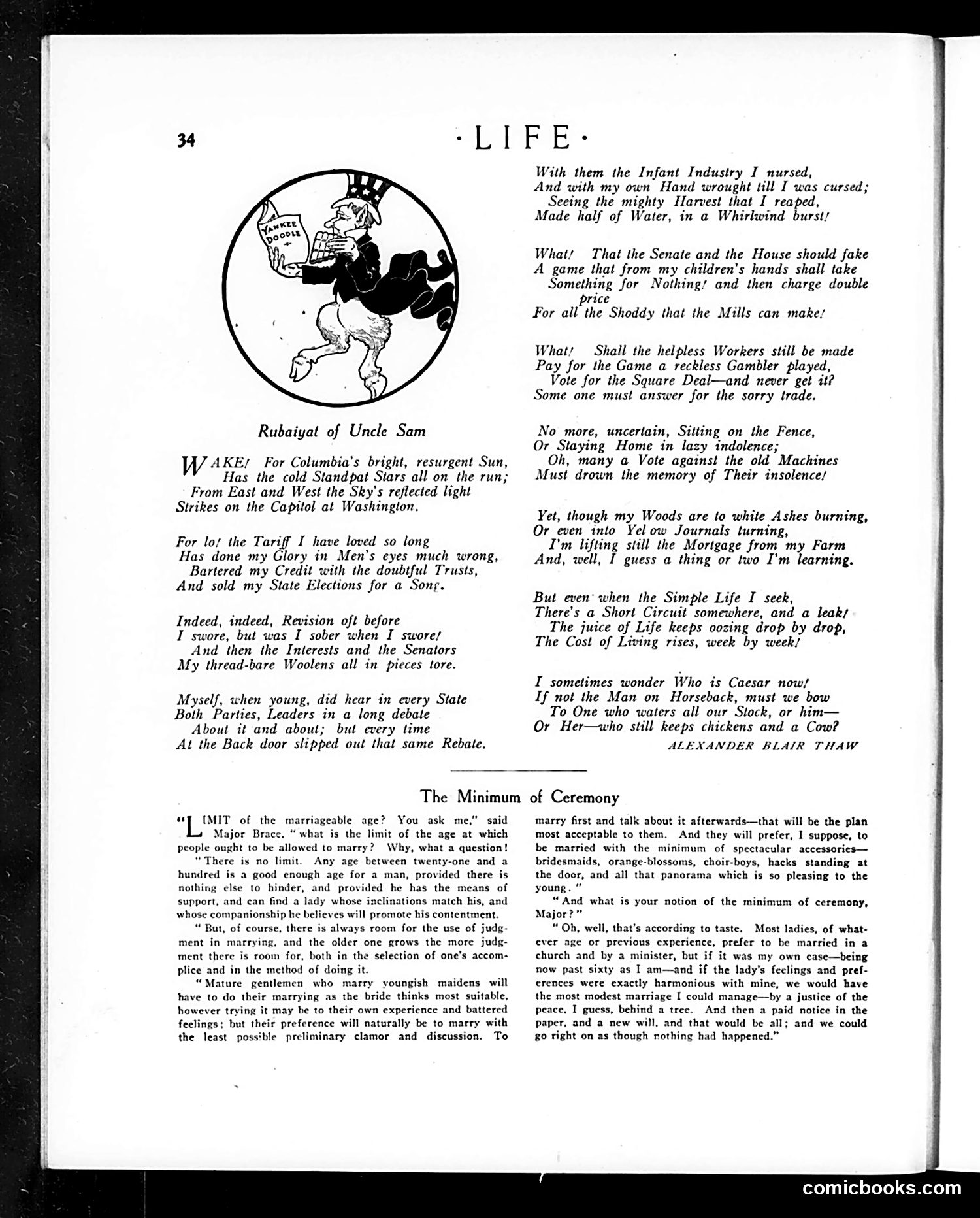
This political satire parodies Omar Khayyam's *Rubaiyat*, reimagining America ("Uncle Sam") as a disillusioned figure. The cartoon depicts Uncle Sam as a caricatured fool, supporting the poem's tone of regret and anger. The satire attacks: - **Protective tariffs** that harmed America's global reputation and credit - **Corporate corruption**: senators and "Interests" favoring big business over workers - **False prosperity**: "shoddy" goods and watered-down value from mills - **Political betrayal**: promises of tariff reform repeatedly broken via "rebates" and backroom deals - **Worker exploitation**: ordinary people paying for "reckless" corporate gambling while promised a "Square Deal" they never receive - **Rising costs of living** despite economic activity The author (Alexander Blair Thaw) expresses frustration with political machines, corporate control of elections, and economic inequality—themes of early 20th-century American progressivism. The imagery of burning woods and mortgages suggests widespread economic hardship.
📄 Transcribed text from this page (OCR, searchable)
Machine-transcribed from the original scan — historical spelling and the odd misread are preserved.
TPE Rubaiyat of Uncle Sam WAKE! For Columbia's bright, resurgent Sun, Has the cold Standpat Stars all on the run; From East and West the Sky's reflected light Strikes on the Capitol at Washington. For lof the Tariff I have loved so long Has done my Glory in Men's eyes much wrong, Bartered my Credit with the doubtful Trusts, And sold my State Elections for a Song. Indeed, indeed, Revision oft before I swore, but was I sober when I sworet And then the Interests and the Senators My thread-bare Woolens all in pieces tore. Myself, when young, did hear in every State Both Parties, Leaders in a long debate About it and about; but every time At the Back door slipped out that same Rebate. With them the Infant Industry I nursed, And with my own Hand wrought till I was cursed; Seeing the mighty Harvest that I reaped, Made half of Water, in a Whirlwind burst’ What! That the Senate and the House should fake A game that from my children's hands shall take Something for Nothing! and then charge double price For all the Shoddy that the Mills can make/ What! Shall the helpless Workers still be made Pay for the Game a reckless Gambler played, Vote for the Square Deal—and never get it? Some one must answer for the sorry trade. No more, uncertain, Sitting on the Fence, Or Staying Home in lazy indolence; Oh, many a Vote against the old Machines Must drown the memory of Their insolence/ Yet, though my Woods are to white Ashes burning, Or even into Yel ow Journals turning, I'm lifting still the Mortgage from my Farm And, well, I guess a thing or two I'm learning. But even’ when the Simple Life I seek, There's a Short Circuit somewhere, and a leak/ The juice of Life keeps oozing drop by drop, The Cost of Living rises, week by week! I sometimes wonder Who is Caesar now! If not the Man on Horseback, must we bow To One who waters all our Stock, or him— Or Her—who still keeps chickens and a Cow? ALEXANDER BLAIR THAW The Minimum of Ceremony 4s] (MIT of the marriageable age? You ask me," said Major Brace. “what is the limit of the age at which people ought to be allowed to marry? Why, what a question! “There is no limit. Any age between twenty-one and a hundred is a good enough age for a man, provided there is nothing else to hinder, and provided he has the means of support, and can find a lady whose inclinations match his, and whose companionship he believes will promote his contentment. “ But, of course, there is always room for the use of judg- ment in marrying, and the older one grows the more judg- ment there is room for, both in the selection of one’s accom- plice and in the method of doing it. “Mature gentlemen who marry youngish maidens will have to do their marrying as the bride thinks most suitable, er trying it may be to their own experience and battered gs; but their preference will naturally be to marry with the least possible preliminary clamor and discussion. To marry first and talk about it afterwards—that will be the plan most acceptable to them. And they will prefer, I suppose, to be married with the minimum of spectacular accessories— bridesmaids, orange-blossoms, choir-boys, hacks standing at the door, and all that panorama which is so pleasing to the young.” “And what is your notion of the minimum of ceremony, Major?” “Oh, well, that’s according to taste. Most ladies, of what- ever age or previous experience, prefer to be married in a church and by a minister, but if it was my own case—being now past sixty as I am—and if the lady’s feelings and pref- erences were exactly harmonious with mine, we would have the most modest marriage I could manage—by a justice of the peace, I guess, behind a tree. And then a paid notice in the paper, and a new will, and that would be all; and we could go right on as though nothing had happened.” comicbooks.com