
Life, 1911-01-05 · page 68 of 104
Life — January 5, 1911 — page 68: what you’re looking at
What you’re looking at
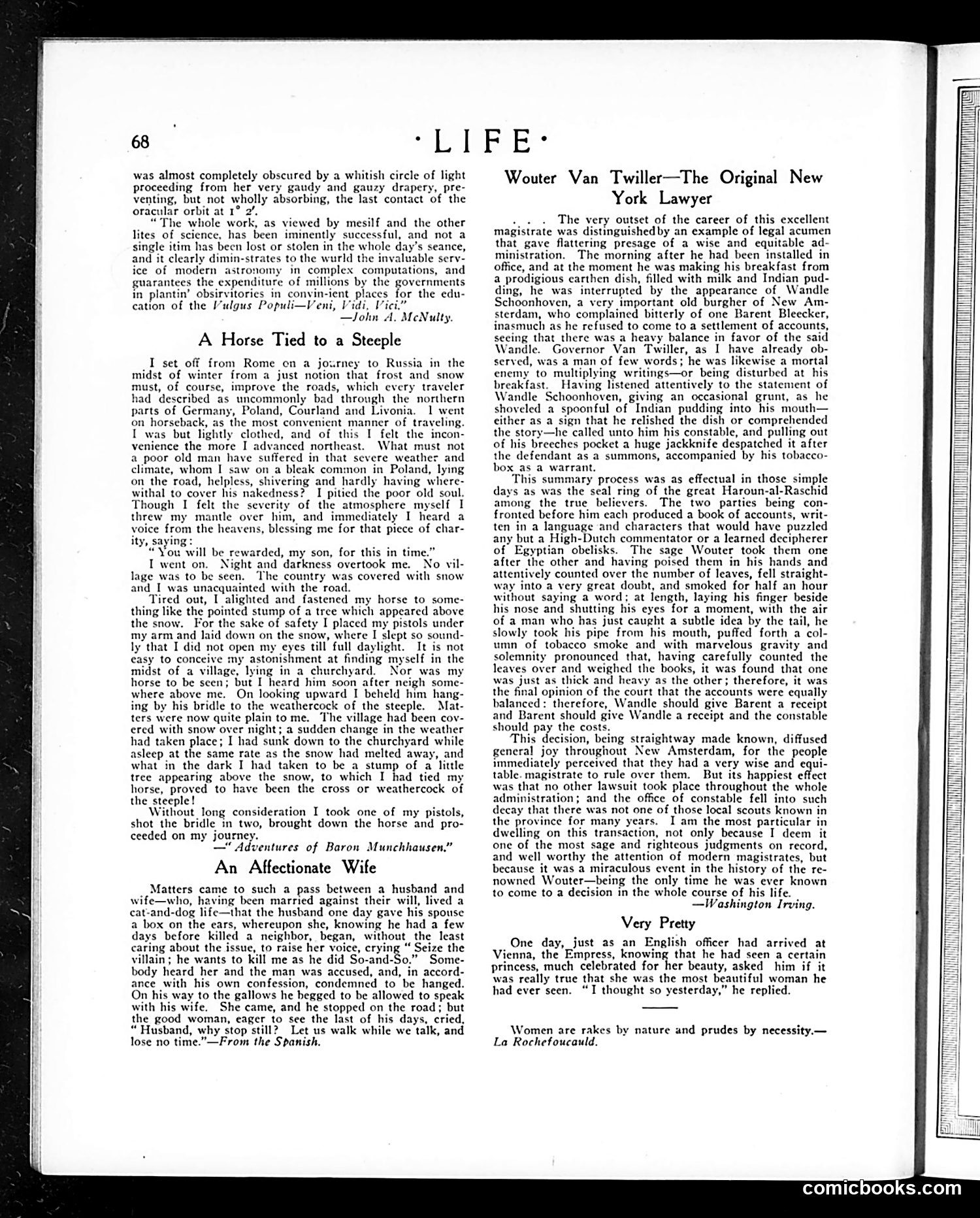
This page from *Life* magazine contains three unrelated satirical stories rather than political cartoons: 1. **"A Horse Tied to a Steeple"** (attributed to Baron Munchhausen tales): A tall tale about a traveler who unknowingly ties his horse to a church steeple's weathercock during a snowstorm, then discovers it when the snow melts overnight. 2. **"An Affectionate Wife"**: A darkly comedic Spanish anecdote about a quarreling married couple where a wife falsely accuses her husband of murder to escape blame for her own provocation, leading to his execution. 3. **"Wouter Van Twiller—The Original New York Lawyer"** and **"Very Pretty"**: Brief humorous sketches about historical figures and romantic encounters. The page exemplifies *Life*'s 19th-century satirical format: mixing absurdist humor, folk-tale adaptations, and social commentary through short, witty narratives rather than visual cartoons.
📄 Transcribed text from this page (OCR, searchable)
Machine-transcribed from the original scan — historical spelling and the odd misread are preserved.
68 “LIFE was almost completely obscured by a whitish circle of light proceeding from her very gaudy and gauzy drapery, pre- venting, but not wholly absorbing, the last contact of the oracular orbit at 1° “The whole work, as viewed by mesilf and the other lites of science, has been iminently successful, and not a single itim has been lost or stolen in the whole day’s seance, and it clearly dimin-strates to the wurld the invaluable serv ice of modern astronomy in complex computations, and guarantees the expenditure of millions by the governments in plantin’ obsirvitories in cony nt_ places for the edu- cation of the Vulgus Populi—Veni, Vidi, Vici.” —John A. McNulty. A Horse Tied to a Steeple I set off from Rome cn a journey to Russia in the midst of winter from a just notion that frost and snow must, of course, improve the roads, which every traveler had described as uncommonly bad through the northern parts of Germany, Poland, Courland and Livonia. 1 went on horseback, as the most convenient manner of traveling. I was but lightly clothed, and of this I felt the incon- venience the more I advanced northeast. What must not a poor old man have suffered in that severe weather and climate, whom I saw on a bleak common in Poland, lying on the road, helpless, shivering and hardly having where- withal to cover his nakedness? I pitied the poor old soul. Though I felt the severity of the atmosphere myself I threw my mantle over him, and immediately I heard a voice from the heavens, blessing me for that piece of char- ity, saying: “You will be rewarded, my son, for this in time.” T went on. Night and darkness overtook me. No vil- lage was to be seen. The country was covered with snow and I was unacquainted with the road. Tired out, I alighted and fastened my horse to some- thing like the pointed stump of a tree which appeared above the snow. For the sake of safety I placed my pistols under my arm and laid down on the snow, where I slept so sound- ly that I did not open my eyes till full daylight. It is not éasy to conceive my astonishment at finding myself in the midst of a village, lying in a churchyard. Nor was my horse to be seen; but I heard him soon after neigh some- where above me. On looking upward I beheld him hang- ing by his bridle to the weathercock of the steeple. Mat- ters were now quite plain to me. ‘The village had been cov- ered with snow over night; a sudden change in the weather had taken place; I had sunk down to the churchyard while asleep at the same rate as the snow had melted away, and what in the dark I had taken to be a stump of a litle tree appearing above the snow, to which I had tied my horse, proved to have been the cross or weathercock of the steeple! Without long consideration I took one of my pistols, shot the bridle in two, brought down the horse and pro- ceeded on my journey. —“ Adventures of Baron Munchhausen.” An Affectionate Wife Matters came to such a pass between a husband and wife—who, having been married against their will, lived a cat-and-dog life—that the husband one day gave his spouse a box on the ears, whereupon she, knowing he had a few days before killed a neighbor, began, hou the least caring about the issue, to raise her voice, cr: “ Seize the villain; he wants to kill me as he did So-and- g" Some- body heard her and the man was accused, and, in accord- ance with his own confession, condemned to be hanged. On his way to the gallows he begged to be allowed to speak with his wife. She came, and he stopped on the road; but the good woman, eager to see the last of his days, cried, “Husband, why stop still? Let us walk while we talk, and lose no time.”—From the Spanish. Wouter Van Twiller—The Original New York Lawyer +. « The very outset of the career of this excellent magistrate was distinguished by an example of legal acumen that gave flattering presage of a wise and equitable ad- ministration. The morning after he had been installed in office, and at the moment he was making his breakfast from a prodigious earthen dish, filled with milk and Indian pud- ding, he was interrupted by the appearance of Wandle Schoonhoven, a very important old burgher of New Am- sterdam, who complained bitterly of one Barent Bleecker, inasmuch as he refused to come to a settlement of accounts, seeing that_there was a heavy balance in favor of the said Wandle. Governor Van Twiller, as I have already ob- served, was a man of few words; he was likewise a mortal enemy to multiplying writings—or being disturbed at his breakfast. Having listened attentively to the statement of Wandle Schoonhoven, giving an occasional grunt, as he shoveled a spoonful of Indian pudding into his mouth— either as a sign that he relished the dish or comprehended the story—he called unto him his constable, and pulling out of his breeches pocket a huge jackknife despatched it after the defendant as a summons, accompanied by his tobacco- box as a warrant. This summary process was as effectual in those simple days as was the seal ring of the great Haroun-al-Raschid among the true believers. The two parties being con- fronted before him each produced a book of accounts, writ- ten in a language and characters that would have puzzled any but a High-Dutch commentator or a learned decipherer of Egyptian obelisks. The sage Wouter took them one after the other and having poised them in his hands and attentively counted over the number of leaves, fell straight- way into a very great doubt, and smoked for half an hour without saying a word; at length, laying his finger beside his nose and shutting his eyes for a moment, with the air of a man who has just caught a subtle idea by the tail, he slowly took his pipe from his mouth, puffed forth a col- umn of tobacco smoke and with marvelous gravity and solemnity pronounced that, having carefully counted the leaves over and weighed the books, it was found that one was just as thick and heavy as the other; therefore, it was the final opinion of the court that the accounts were equally balanced: therefore, Wandle should give Barent a receipt and Barent should give Wandle a receipt and the constable should pay the costs, This decision, being straightway made known, diffused general joy throughout New Amsterdam, for the people immediately perceived that they had a very wise and equi- table. magistrate to rule over them. But its happiest effect was that no other lawsuit took place throughout the whole administration; and the office of constable fell into such decay that there was not one of those local scouts known in the province for many years. I am the most particular in dwelling on this transaction, not only because I deem it one of the most sage and righteous judgments on record, and well worthy the attention of modern magistrates, but because it was a miraculous event in the history of the re- nowned Wouter—being the only time he was ever known to come to a decision in the whole course of his life. —Washington Irving. Very Pretty One day, just as an English officer had arrived at Vienna, the Empress, knowing that he had seen a certain princess, much celebrated for her beauty, asked him if it was really true that she was the most beautiful woman he had ever seen. “I thought so yesterday,” he replied. Women are rakes by nature and prudes by necessity.— La Rochefoucauld. comicbooks.com