
Life, 1911-01-05 · page 29 of 104
Life — January 5, 1911 — page 29: what you’re looking at
What you’re looking at
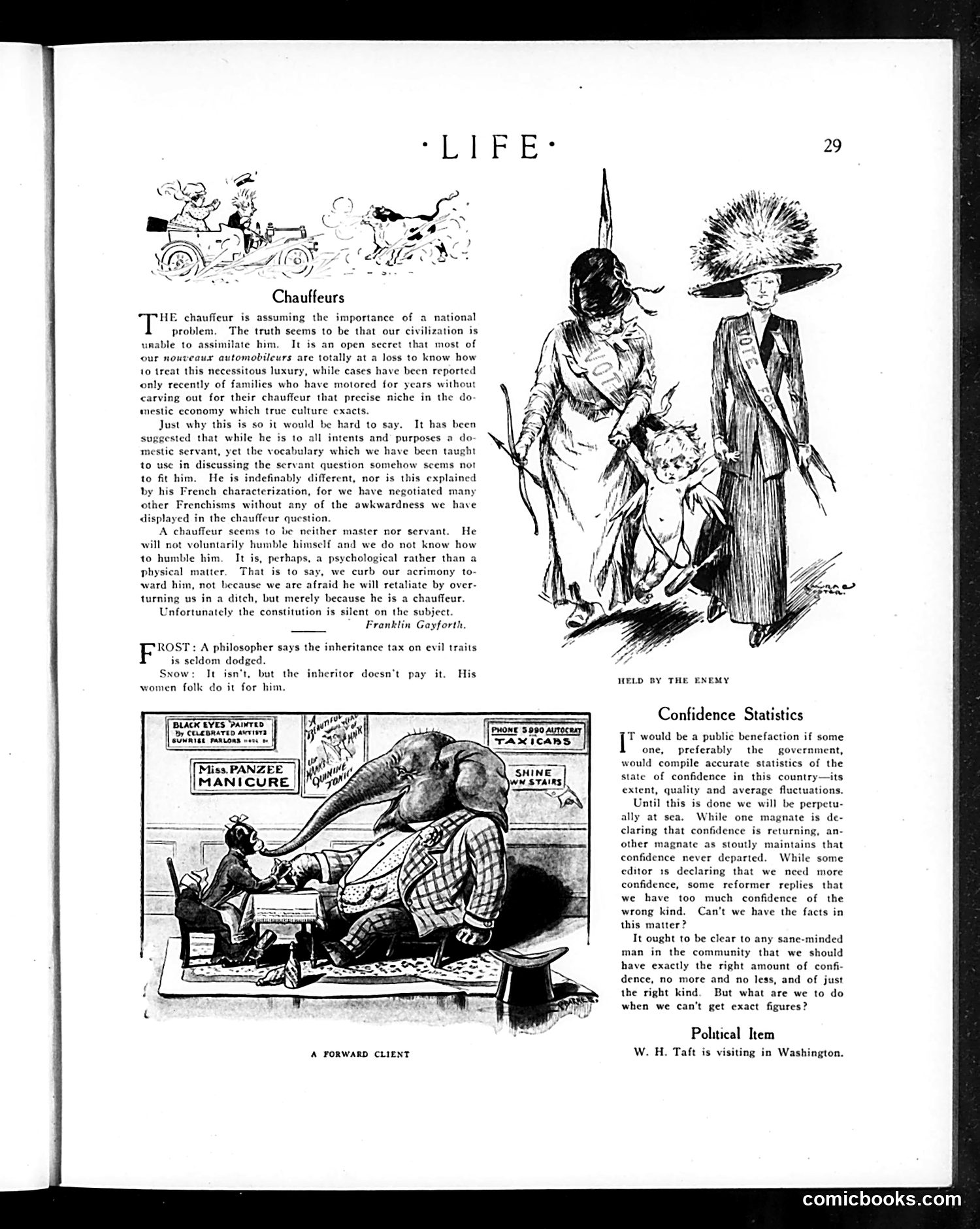
This page contains three distinct pieces of satire: **"Chauffeurs"** (top): A social commentary by Franklin Gayfarth on the awkward class position of automobile chauffeurs in early 20th-century America. The essay argues that chauffeurs occupy an undefined social status—neither true servants nor equals—creating psychological discomfort for their employers. This reflects anxieties about new technology and changing domestic hierarchies as automobiles became common among the wealthy. **"A Forward Client"** (bottom left): A cartoon mocking manicure and beauty services. A client with exaggerated features sits while workers attend to her nails and other grooming tasks. The joke appears to satirize women's vanity and the commercialization of beauty treatments. **"Confidence Statistics"** (right): Political commentary (attributed to a "Political Item" about W.H. Taft) criticizing vague public discourse about "confidence" in the economy. The writer sarcastically argues we need exact statistics on confidence levels—highlighting how politicians and editors make contradictory claims without evidence. The page reflects Progressive-era concerns about class, consumerism, and political rhetoric.
📄 Transcribed text from this page (OCR, searchable)
Machine-transcribed from the original scan — historical spelling and the odd misread are preserved.
Chauffeurs HE chauffeur is assuming the importance of a national problem. The truth seems to be that our civilization is unable to assimilate him. It is an open secret that most of our noureaus automobileurs are totally at a loss to know how to treat this necessitous luxury, while cases have been reported only recently of families who have motored for years without carving out for their chauffeur that precise niche in the do mestic economy which truc culture exacts. Just why this is so it would be hard to say. It has been suggested that while he is to all intents and purposes a do mestic servant, yet the vocabulary which we have been taught to use in discussing the servant question somehow scems not to fit him. He is indefinably different, nor is this explained by his French characterization, for we have negotiated many other Frenchisms without any of the awkwardness we have displayed in the chauffeur question. A chauffeur seems to be neither master nor servant. He will not voluntarily humble himself and we do not know how to humble him. It is, perhaps, a psychological rather than a physical matter. That is to say, we curb our acrimony to- ward him, not because we are afraid he will retaliate by over- turning us in a ditch, but merely because he is a chauffeur. Unfortunately the constitution is silent on the subject. Franklin Gayforth. ROST: A philosopher says the inheritance tax on evil traits is seldom dodged. Sxow: It isn’t, but the inheritor docsn't pay it. His women folk do it for him. \[etack eves banereo Dy CELEDRATEO AtrisT3 | || suwmree ax \| Miss. PANZEE [MANICURE | A FORWARD CLIENT MELD BY THE ENEMY Confidence Statistics T would be a public benefaction if some one, preferably the government, would compile accurate statistics of the state of confidence in this country—its extent, quality and average fluctuations. Until this is done we will be perpetu- ally at sea. While one magnate is de- claring that confidence is returning, an- other magnate as stoutly maintains that confidence never departed. While some editor 18 declaring that we need more confidence, some reformer replies that we have too much confidence of the wrong kind. Can't we have the facts in this matter? It ought to be clear to any sane-minded man in the community that we should have exactly the right amount of confi- dence, no more and no less, and of just the right kind. But what are we to do when we can’t get exact figures? Political Item W. H. Taft is visiting in Washington. comicbooks.com