
Life, 1911-01-05 · page 70 of 104
Life — January 5, 1911 — page 70: what you’re looking at
What you’re looking at
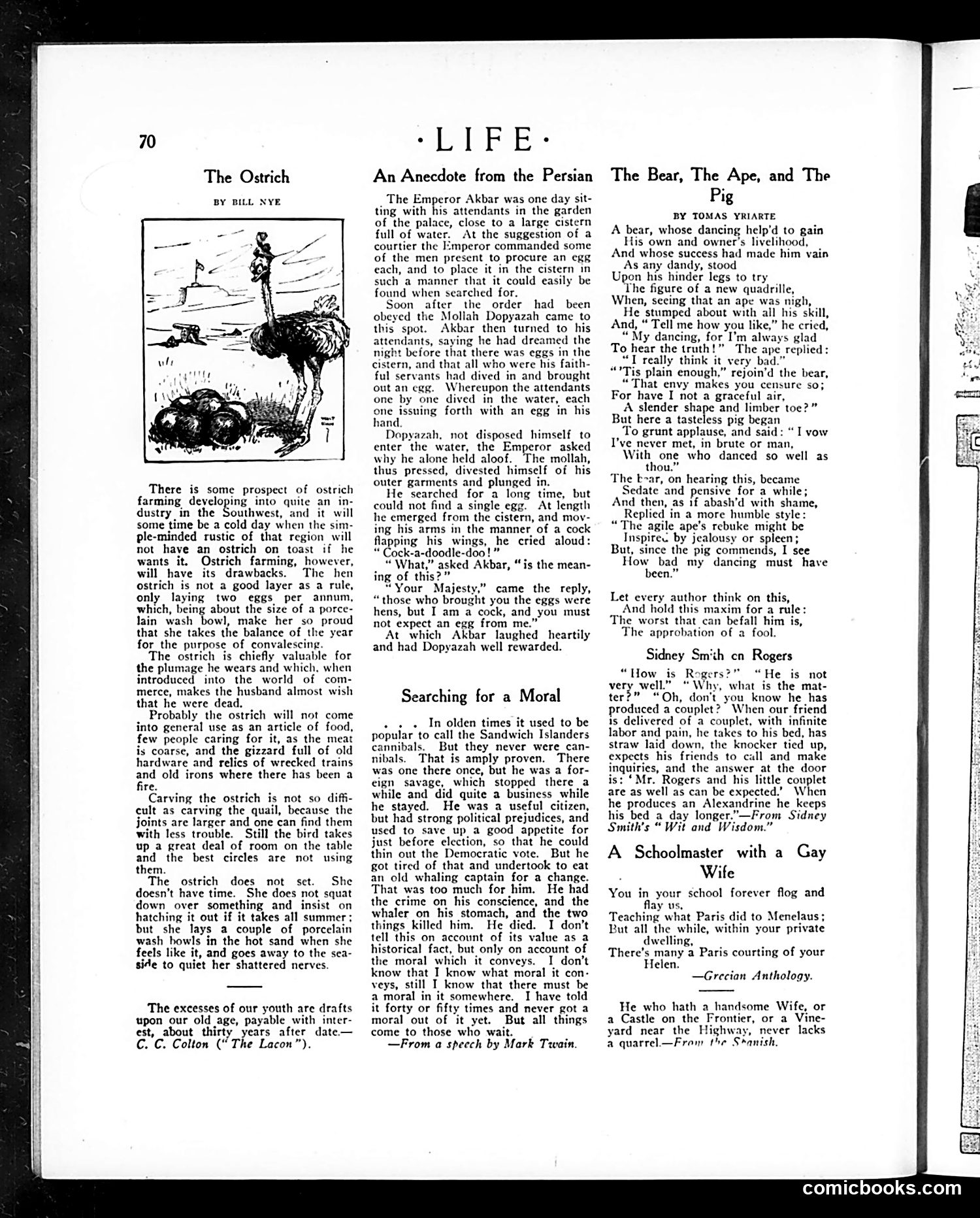
This page contains three separate pieces of satirical humor typical of Life magazine's format: **"The Ostrich" by Bill Nye** is humorous commentary on a potential new industry. Nye satirizes the impracticality of ostrich farming in the American Southwest, mocking both the bird (it lays only two eggs yearly and acts vain about it) and wealthy society's adoption of ostrich plumes in fashion. The joke centers on the bird's uselessness as food and fashion's absurd demands on husbands' wallets. **"An Anecdote from the Persian"** presents a clever court story where Emperor Akbar tests his courtiers' loyalty. The Mollah (Islamic scholar) outwits the emperor by honestly admitting he cannot produce an egg—he's a "cock, not a hen"—turning apparent failure into wisdom through wordplay. The emperor rewards his honesty and wit. **"Searching for a Moral"** appears to be incomplete text addressing cannibalism stereotypes about Pacific Islanders, debunking myths while satirizing political appetite (literally and figuratively). The page exemplifies Life's blend of American frontier humor, classical literature, and social commentary.
📄 Transcribed text from this page (OCR, searchable)
Machine-transcribed from the original scan — historical spelling and the odd misread are preserved.
The Ostrich BY BILL NYE There is some prospect of ostrich farming developing into quite an in- dustry in the Southwest, and it will some time be a cold day when the sim- ple-minded rustic of that region will not have an ostrich on toast if he wants it. Ostrich farming, however, will have its drawbacks. The hen ostrich is not a good layer as a rule, only laying two eggs per annum, which, being about the size of a porce- lain wash bowl, make her so proud that she takes the balance of the year for the purpose of convalescing. The ostrich is chiefly valuable for the plumage he wears and which, when introduced into the world of com- merce, makes the husband almost wish that he were dead. Probably the ostrich will not come into general use as an article of food, few people caring for it, as the meat is coarse, and the gizzard full of old hardware and relics of wrecked trains and old irons where there has been a fire. Carving the ostrich is not so diffi- cult as carving the quail, because the joints are larger and one can find them with less trouble. Still the bird takes up a great deal of room on the table and the best circles are not using them. The ostrich does not set. She doesn’t have time. She does not squat down over something and insist on hatching it out if it takes all summer; but she lays a couple of porcelain wash bowls in the hot sand when she feels like it, and goes away to the sea- side to quiet her shattered nerves. The excesses of our youth are drafts upon our old age, payable with inter- est, about thirty years after date— C.C. Colton (“The Lacon”). LIP E An Anecdote from the Persian The Emperor Akbar was one day sit- ting with his attendants in the garden of the palace, close to a large cistern full of water. At the suggestion of a courtier the Emperor commanded some of the men present to procure an egg each, and to place it in the cistern in such a manner that it could easily be found when searched for. Soon after the order had been obeyed the Mollah Dopyazah came to this spot. Akbar then turned to his attendants, saying he had dreamed the night before that there was eggs in the cistern, and that all who were his faith- ful servants had dived in and brought out an egg. Whereupon the attendants one by one dived in the water, each one issuing forth with an egg in his ah, not disposed himself to enter the water, the Emperor asked why he alone held aloof. The mollah, thus pressed, divested himself of his outer garments and plunged in. He searched for a long time, but could not find a single egg. At length he emerged from the cistern, and mov- ing his arms in the manner of a cock flapping his wings, he cried aloud: “ Cock-a-doodle-doo!” “What,” asked Akbar, “is the mean- ing of this?” “Your Majesty,” came the reply, “those who brought you the eggs were hens, but I am a cock, and you must not expect an egg from me.” At which Akbar laughed heartily and had Dopyazah well rewarded. Searching for a Moral . « In olden times it used to be popular to call the Sandwich Islanders cannibals. But they never were can- nibals. That is amply proven. There was one there once, but he was a for- eign savage, which stopped there a while and did quite a business while he stayed. He was a useful citizen, but had strong political prejudices, and used to save up a good appetite for just before election, so that he could thin out the Democratic vote. But he got tired of that and undertook to cat an old whaling captain for a change. That was too much for him. He had the crime on his conscience, and the whaler on his stomach, and the two things killed him. He died. I don’t tell this on account of its value as a historical fact, but only on account of the moral which it conveys. I don’t know that I know what moral it con- veys, still I know that there must be a moral in it somewhere. I have told it forty or fifty times and never got a moral out of it yet. But all things come to those who wait. —From a speech by Mark Twain. The Bear, The Ape, and The Pig BY TOMAS YRIARTE A bear, whose dancing help'd to gain His own and owner's livelihood, And whose success had made him vain As any dandy, stood Upon his hinder legs to try The figure of a new quadrill When, seeing that an ape was nigh, He stumped about with all his skill, And, “Tell me how you Eke 5 he cried, “My dancing, for I’m always glad To hear the truth The ape, ‘replied : “T really think it very bad. “Tis plain enough,” rejoin'’d the bear, “That envy makes you censure so; For have I not a graceful air, A slender are and limber toe?” But here a tasteless pig began To grunt applause, and said: I’ve never met, in brute or man, With one who danced so well as thou.” The tear, on hearing this, became Sedate’and pensive for a while; And then, as 1f abash’d with shame, Replied in a more humble style: “The agile ape’s rebuke might be Inspiree, by jealousy or spleen; But, since the pig commends, I see How bad my dancing must have been.” “Tvow Let every author think on this, And hold this maxim for a rule: The worst that can befall him is, The approbation of a fool. Sidney Smith cn Rogers “How is Rogers?" “He is not very well.” “Why, what is the mat- ter?” “Oh, don't you know he has produced a couplet? When our friend is delivered of a couplet, with infinite labor and pain, he takes to his bed, has straw laid down, the knocker tied up, expects his friends to call and make inquiries, and the answer at the door is: ‘Mr. Rogers and his little couplet are as well as can be expected.’ When he produces an Alexandrine he keeps his bed a day longer.”—From Sidney Smith's “Wit and Wisdom.” A Schoolmaster with a Gay Wife You in your school forever flog and flay us, Teaching what Paris did to Menelaus; But all the while, within your private dwelling, There’s many a Paris courting of your Helen. —Grecian Anthology. He who hath a_handsome Wife, or a Castle on the Frontier, or a Vine- yard near the Highway, never lacks A quarrel.—From the Sanish. comicbooks.com