
Life, 1911-01-05 · page 26 of 104
Life — January 5, 1911 — page 26: what you’re looking at
What you’re looking at
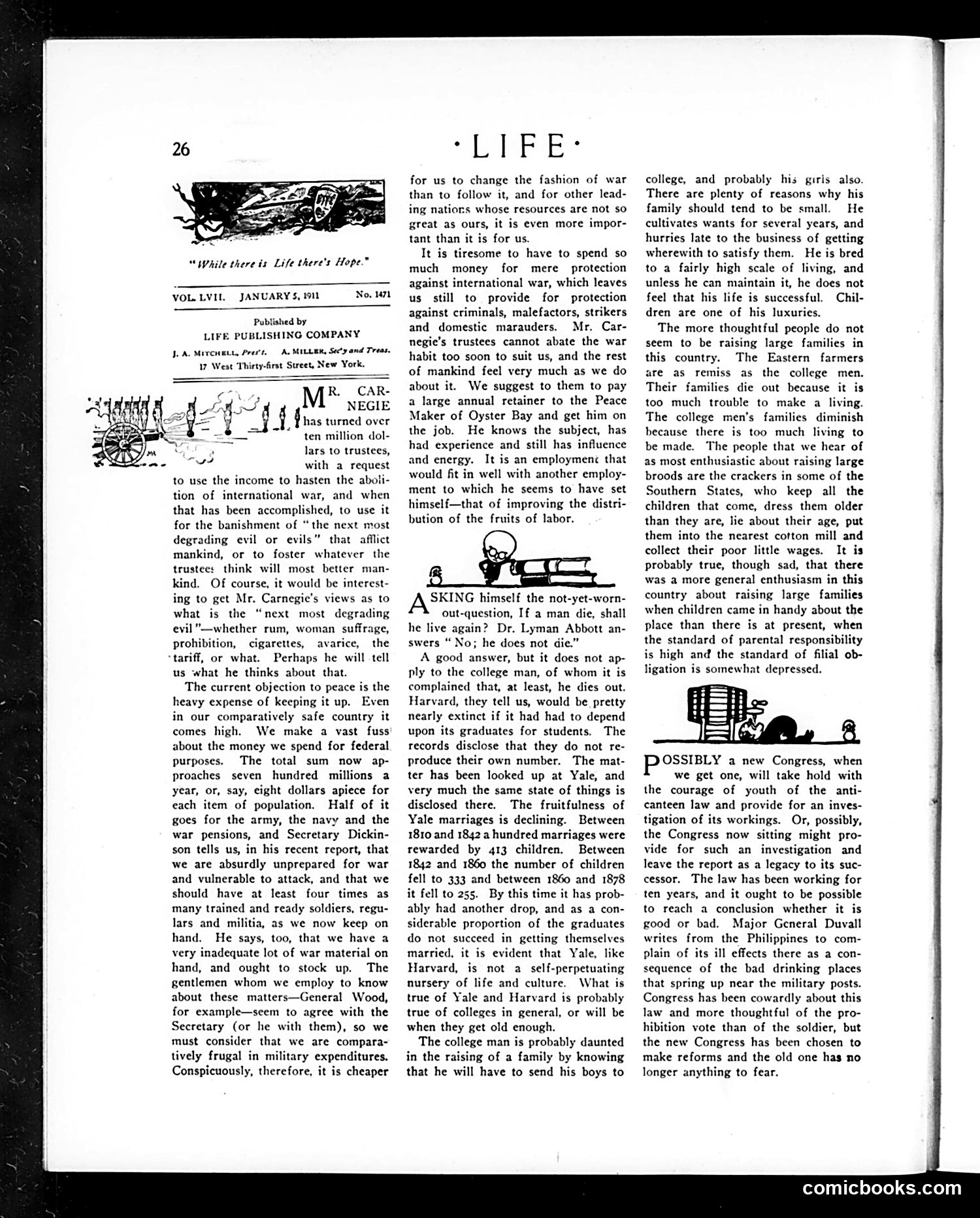
This page discusses Andrew Carnegie's $10 million donation to trustees for abolishing international war—and afterward, unspecified "degrading evils." The satirical commentary suggests the real challenge isn't changing war policy but identifying what evil should come next (rum, women's suffrage, prohibition, etc.). The piece also critiques the paradox: America spends heavily on military preparedness while claiming poverty prevents peace. It jokingly suggests hiring Theodore Roosevelt ("Peace Maker of Oyster Bay"—a reference to his 1906 Nobel Peace Prize for mediating the Russo-Japanese War) as a permanent peace consultant. The second section discusses declining birth rates among college graduates, particularly at Harvard and Yale, using marriage records to show fewer children per graduate over time. The implication is that educated men produce insufficient offspring to replace themselves, a concern reflecting early-20th-century anxieties about demographic decline among the educated classes.
📄 Transcribed text from this page (OCR, searchable)
Machine-transcribed from the original scan — historical spelling and the odd misread are preserved.
“While there is Life there's Hope.” VOL.LVIL, JANUARY, 1911 ——_— Published by LIFE PUBLISHING COMPANY JA MuvOHRLt, Prert, A. MILLER, Secty and Treas, 17 West Thirty-first Street, New York. CA R. CAR- A ak | NEGIE = ¥ { has turned over oh ten million dol- lars to trustees, with a request to use the income to hasten the aboli- tion of international war, and when that has been accomplished, to use it for the banishment of “the next most degrading evil or evils” that afflict mankind, or to foster whatever the trustees think will most better man- kind. Of course, it would be interest- ing to get Mr. Carnegie’s views as to what is the “next most degrading evil "—whether rum, woman suffrage, prohibition, cigarettes, avarice, the ‘tariff, or what. Perhaps he will tell us what he thinks about that. The current objection to peace is the heavy expense of keeping it up. Even in our comparatively safe country it comes high. We make a vast fuss’ about the money we spend for federal. purposes. The total sum now ap- proaches seven hundred millions a year, or, say, eight dollars apiece for each item of population. Half of it goes for the army, the navy and the war pensions, and Secretary Dickin- son tells us, in his recent report, that we are absurdly unprepared for war and vulnerable to attack, and that we should have at least four times as many trained and ready soldiers, regu- lars and militia, as we now keep on hand. He says, too, that we have a very inadequate lot of war material on hand, and ought to stock up. The gentlemen whom we employ to know about these matters—General Wood, for example—seem to agree with the Secretary (or he with them), so we must consider that we are compara- tively frugal in military expenditures, Conspicuously, therefore, it is cheaper = LASPE * for us to change the fashion of war than to follow it, and for other lead- ing nations whose resources are not so great as ours, it is even more impor- tant than it is for us. It is tiresome to have to spend so much money for mere protection against international war, which leaves us still to provide for protection against criminals, malefactors, strikers and domestic marauders. Mr. Car- negie’s trustees cannot abate the war habit too soon to suit us, and the rest of mankind feel very much as we do about it. We suggest to them to pay a large annual retainer to the Peace Maker of Oyster Bay and get him on the job. He knows the subject, has had experience and still has influence and energy. It is an employmenc that would fit in well with another employ- ment to which he seems to have set himself—that of improving the distri- bution of the fruits of labor. ASENG himself the not-yet-worn- out-question, If a man die, shall he live again? Dr. Lyman Abbott an- swers “No; he does not die.” A good answer, but it does not ap- ply to the college man, of whom it is complained that, at least, he dies out. Harvard, they tell us, would be pretty nearly extinct if it had had to depend upon its graduates for students. The records disclose that they do not re- produce their own number. The mat- ter has been looked up at Yale, and very much the same state of things is disclosed there. The fruitfulness of Yale marriages is declining. Between 1810 and 1842 a hundred marriages were rewarded by 413 children. Between 1842 and 1860 the number of children fell to 333 and between 1860 and 1878 it fell to 255. By this time it has prob- ably had another drop, and as a con- siderable proportion of the graduates do not succeed in getting themselves married, it is evident that Yale, like Harvard, is not a_ self-perpetuating nursery of life and culture. What is true of Yale and Harvard is probably true of colleges in general, or will be when they get old enough. The college man is probably daunted in the raising of a family by knowing that he will have to send his boys to college, and probably his giris also. There are plenty of reasons why his family should tend to be small. He cultivates wants for several years, and hurries late to the business of getting wherewith to satisfy them. He is bred to a fairly high scale of living, and unless he can maintain it, he does not feel that his life is successful. Chil- dren are one of his luxuries. The more thoughtful people do not seem to be raising large families in this country. The Eastern farmers are as remiss as the college men. Their families die out because it is too much trouble to make a living. The college men’s families diminish because there is too much living to be made. The people that we hear of as most enthusiastic about raising large broods are the crackers in some of the Southern States, who keep all the children that come, dress them older than they are, lie about their age, put them into the nearest cotton mill and collect their poor little wages. It is probably true, though sad, that there was a more general enthusiasm in this country about raising large families when children came in handy about the place than there is at present, when the standard of parental responsibility is high and the standard of filial ob- ligation is somewhat depressed. PossiBLy a new Congress, when we get one, will take hold with the courage of youth of the anti- canteen law and provide for an inves- tigation of its workings. Or, possibly, the Congress now sitting might pro- vide for such an investigation and leave the report as a legacy to its suc- cessor. The law has been working for ten years, and it ought to be possible to reach a conclusion whether it is good or bad. Major General Duvall writes from the Philippines to com- plain of its ill effects there as a con- sequence of the bad drinking places that spring up near the military posts. Congress has been cowardly about this law and more thoughtful of the pro- hibition vote than of the soldier, but the new Congress has been chosen to make reforms and the old one has no longer anything to fear. comicbooks.com