
Life, 1911-01-05 · page 65 of 104
Life — January 5, 1911 — page 65: what you’re looking at
What you’re looking at
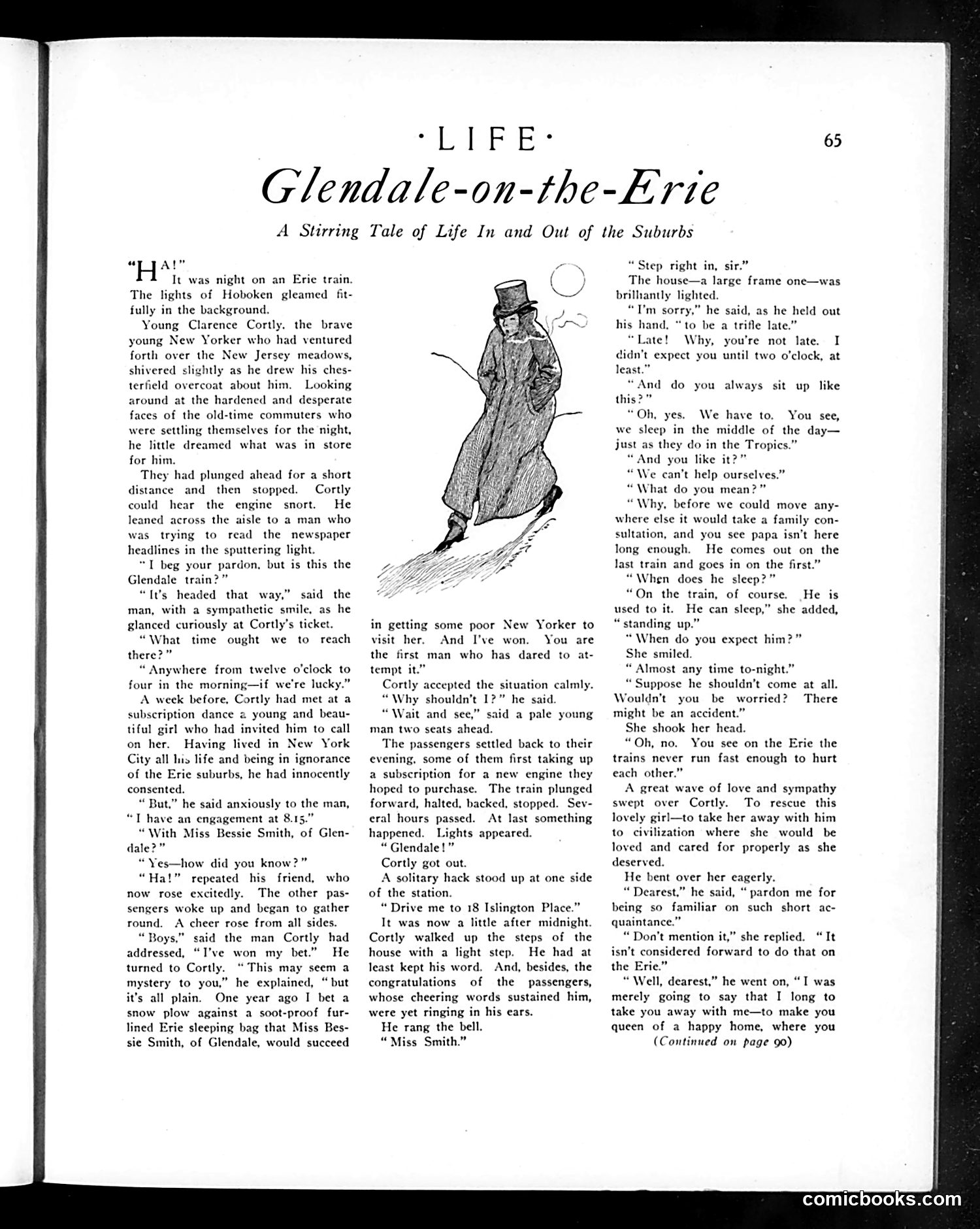
This is a humorous short story satirizing the Erie Railroad's notoriously unreliable service to suburban New Jersey. The protagonist, a naive Manhattan bachelor named Clarence Cortly, accepts a dinner invitation from a Glendale girl without understanding the logistical nightmare involved. The joke centers on the Erie train's legendary delays and unpredictability—passengers bet whether any New Yorker would actually attempt the journey. The story mocks suburban commuting culture: families surviving on reversed sleep schedules (sleeping midday, awake at night), fathers commuting so frequently they sleep standing up on trains, and the expectation that women stay up past midnight waiting for delayed arrivals. The illustration shows a man in a topcoat boarding the notoriously problematic Erie train. This appears to target early 20th-century frustrations with suburban rail service and the growing absurdity of commuter life.
📄 Transcribed text from this page (OCR, searchable)
Machine-transcribed from the original scan — historical spelling and the odd misread are preserved.
“ H It was night on an Erie train. The lights of Hoboken gleamed fit- fully in the background. Young Clarence Cortly, the brave young New Yorker who had ventured forth over the New Jersey meadows, shivered slightly as he drew his ches- terfield overcoat about him. Looking around at the hardened and desperate faces of the old-time commuters who were settling themselves for the night, he little dreamed what was in store for him. They had plunged ahead for a short distance and then stopped. Cortly could hear the engine snort. He leaned across the aisle to a man who was trying to read the newspaper headlines in the sputtering light. “TL beg your pardon, but is this the Glendale train?” “It's headed that way,” said the man, with a sympathetic smile, as he glanced curiously at Cortly’s ticket. “What time ought we to reach there?” “Anywhere from twelve o'clock to four in the morning—if we're lucky.” A week before, Cortly had met at a subscription dance 2 young and beau- tiful girl who had invited him to call on her, Having lived in New York City all lis life and being in ignorance of the Erie suburbs, he had innocently consented. “ But,” he said anxiously to the man, “T have an engagement at 8.15.” “With Miss Bessie Smith, of Glen- dale?” “Yes—how did you know?” “Hal” repeated his friend, who now rose excitedly. The other pas- sengers woke up and began to gather round. A cheer rose from all sides. “Boys,” said the man Cortly had addressed, “I’ve won my bet.” He turned to Cortly. “ This may seem a mystery to you,” he explained, “ but it’s all plain. One year ago I bet a snow plow against a soot-proof fur- lined Erie sleeping bag that Miss Bes- sie Smith, of Glendale, would succeed “LIFE: Glendale-on-the-Erie A Stirring Tale of Life In and Out of the Suburbs in getting some poor New Yorker to visit her. And I've won. You are the first man who has dared to at- tempt it.” Cortly accepted the situation calmly. “Why shouldn't 1?” he said. “Wait and see,” said a pale young man two seats ahead. The passengers settled back to their evening, some of them first taking up a subscription for a new engine they hoped to purchase. The train plunged forward, halted, backed, stopped. Sev- eral hours passed. At last something happened. Lights appeared. “Glendale!” Cortly got out. A solitary hack stood up at one side of the station. “Drive me to 18 Islington Place.” It was now a little after midnight. Cortly walked up the steps of the house with a light step. He had at least kept his word. And, besides, the congratulations of the passengers, whose cheering words sustained him, were yet ringing in his ears. He rang the bell. “Miss Smith.” “Step right in, sir.” The house—a large frame one—was brilhantly lighted. “I'm sorry,” he said, as he held out his hand, “to be a trifle late.” e! you're not late. I didn't expect you until two o'clock, at least.” And do you always sit up like this?” “Oh, yes. We have to. You see, we sleep in the middle of the day— just as they do in the Tropics.” “And you like it?” “We can’t help ourselves.” “What do you mean?” “Why, before we could move any- where else it would take a family con- sultation, and you see papa isn’t here long enough. He comes out on the last train and goes in on the first.” “When does he sleep?” “On the train, of course. He is used to it. He can sleep,” she added, “standing up.” “When do you expect him?” She smiled. “ Almost any time to-night.” “Suppose he shouldn't come at all. Wouldn't you be worried? There might be an accident.” She shook her head. “Oh, no. You see on the Erie the trains never run fast enough to hurt each other.” A great wave of love and sympathy swept over Cortly. To rescue this lovely girl—to take her away with him to civilization where she would be loved and cared for properly as she deserved. He bent over her eagerly. “Dearest,” he said, “ pardon me for being so familiar on such short ac- quaintance.” “Don't mention it,” she replied. “It isn't considered forward to do that on the Erie.’ “Well, dearest,” he went on, “I was merely going to say that I long to take you away with me—to make you queen of a happy home, where you (Continued on page 90) comicbooks.com