
Life, 1911-01-05 · page 39 of 104
Life — January 5, 1911 — page 39: what you’re looking at
What you’re looking at
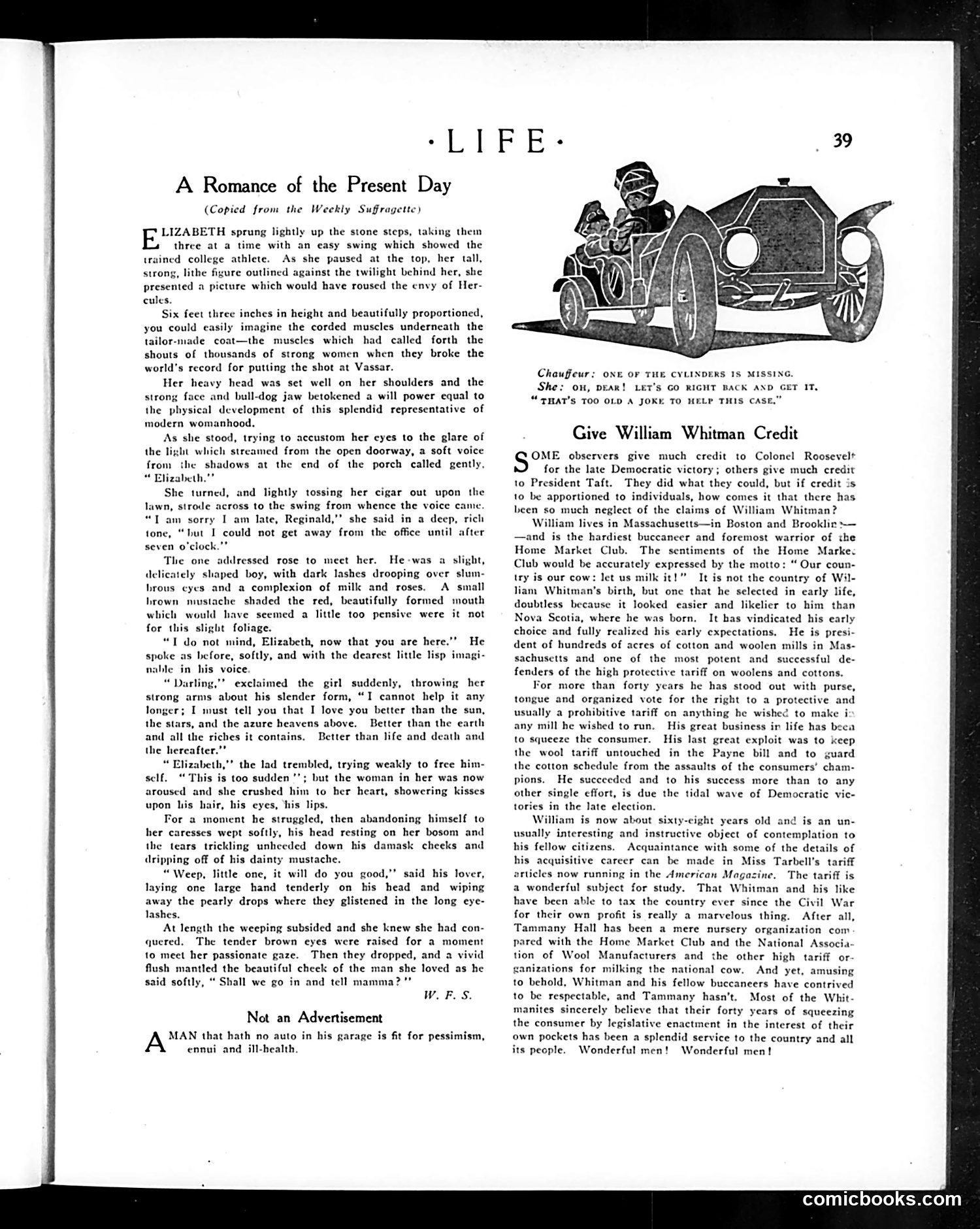
This is satirical fiction mocking the "New Woman" movement of the early 1900s. The story inverts traditional gender roles: Elizabeth is a tall, muscular athlete (shot-putter at Vassar) with a deep voice who smokes cigars and works late at the office, while her suitor Reginald is delicate, feminine, with "milk and roses" complexion and a lisp—he weeps easily and asks "Shall we go in and tell mamma?" The satire targets early feminism and women's education by depicting role-reversal as absurd. The exaggerated descriptions ("six feet three inches," "bull-dog jaw," "strong arms") and the credited source—"the Weekly Suffragette"—indicate this mocks suffragette aspirations. The illustration shows a couple in a car where the female chauffeur announces a missing cylinder; the woman's eager response to "get it" represents another joke about women's mechanical incompetence or absurd priorities. The accompanying article praises William Whitman's labor advocacy, providing contrasting serious political content on the same page.
📄 Transcribed text from this page (OCR, searchable)
Machine-transcribed from the original scan — historical spelling and the odd misread are preserved.
‘LIF E* A Romance of the Present Day (Copied from the Weekly Sufragette) LIZABETH sprung lightly up the stone steps, taking them three at a time with an easy swing which showed the trained college athlete. As she paused at the top, her tall, strong, lithe figure outlined against the twilight behind her, she presented a picture which would have roused the envy of Her- cules. Six feet three inches in height and beautifully proportioned, you could easily ine the corded muscles underneath the tailor-made coat—the muscles which had called forth the shouts of thousands of strong women when they broke the world’s record for putting the shot at Vassar. Her heavy head was set well on her shoulders and the strong face and bull-dog jaw betokened a will power equal to the physical development of this splendid representative of modern womanhood. As she stood, trying to accustom her cyes to the glare of the light which streamed from the open doorway, a soft voice from the shadows at the end of the porch called gently, “ Elizabeth.”” She turned, and lightly tossing her cigar out upon the lawn, strode across to the swing from whence the voice came. “Tam sorry I am late, Reginald,’’ she said in a deep, rich tone, “but I could not get away from the office until after seven o'clock.”” The one addressed rose to mect her. He-was a slight, delicately shaped boy, with dark lashes drooping over slum- brous cyes and a complexion of milk and roses. A small hrown mustache shaded the red, beautifully formed mouth which would have seemed a little too pensive were it not for this slight foliage. “TI do not mind, Elizabeth, now that you are here.’’ He spoke as before, softly, and with the dearest little lisp imagi- nable in his voice. “ Darling,’’ exclaimed the girl suddenly, throwing her strong arms about his slender form, “I cannot help it any longer; I must tell you that I love you better than the sun, the stars, and the azure heavens above. Better than the earth and all the riches it contains, Better than life and death and the hereafter.’ “ Elizabeth,"’ the lad trembled, trying weakly to free him- self, “ This is too sudden '’; but the woman in her was now aroused and she crushed him to her heart, showering kisses upon his hair, his eyes, his lips. For a moment he struggled, then abandoning himself to her caresses wept softly, his head resting on her bosom and the tears trickling unheeded down his damask cheeks and dripping off of his dainty mustache, “Weep, little one, it will do you good,” said his lover, laying one large hand tenderly on his head and wiping away the pearly drops where they glistened in the long eye- lashes. At length the weeping subsided and she knew she had con- quered, The tender brown eyes were raised for a moment 1o meet her passionate gaze. Then they dropped, and a vivid flush mantled the beautiful cheek of the man she loved as he said softly, “ Shall we go in and tell mamma? ’"" W. F. S. Not an Advertisement MAN that hath no auto in his garage is fit for pessimism, ennui and ill-health. Chauffeur: ONE OF THE CYLINDERS 18 MISSING. She: om, DEAR! LET'S GO RIGHT BACK AND GET IT, “THAT'S TOO OLD A JOKY TO HELP THIS CAS Give William Whitman Credit OME observers give much credit to Colonel Roosevelt for the late Democratic victory; others give much credit to President Taft. They did what they could, but if credit is to be apportioned to individuals, how comes it that there has been so much neglect of the claims of William Whitman? William lives in Massachusetts—in Boston and Brookliz \— —and is the hardiest buccancer and foremost warrior of the Home Market Club. The sentiments of the Home Marke: Club would be accurately expressed by the motto: “ Our coun- try is our cow: let us milk it!” It is not the country of Wil- liam Whitman's birth, but one that he selected in early life, doubtless because it looked easier and likelier to him than Nova Scotia, where he was born. It bas vindicated his early choice and fully realized his early expectations. He is presi- dent of hundreds of acres of cotton and woolen mills in Mas- sachusetts and one of the most potent and successful de- fenders of the high protective tariff on woolens and cottons. For more than forty years he has stood out with purse, tongue and organized vote for the right to a protective and usually a prohibitive tariff on anything he wished to ma any mill he wished to run. His great business in life has beea to squeeze the consumer. His last great exploit was to keep the wool tariff untouched in the Payne bill and to guard the cotton schedule from the assaults of the consumers’ cham- pions, He succeeded and to his success more than to any other single effort, is due the tidal wave of Democratic vie- tories in the late election. William is now about sixty-eight years old and is an un- usually interesting and instructive object of contemplation to his fellow citizens. Acquaintance with some of the details of his acquisitive career can be made in Miss Tarbell’s tariff articles now running in the American Magazine, The tariff is a wonderful subject for study. That Whitman and his like have been able to tax the country ever since the Civil War for their own profit is really a marvelous thing. After all, Tammany Hall has been a mere nursery organization com pared with the Home Market Club and the National Associa- tion of Wool Manufacturers and the other high tariff or- ganizations for milking the national cow. And yet, amusing to behold, Whitman and his fellow buccaneers have contrived to be respectable, and Tammany hasn't. Most of the Whit- manites sincerely believe that their forty years of squeezing the consumer by legislative enactment in the interest of their own pockets has been a splendid service to the country and all its people. Wonderful men! Wonderful men! comicbooks.com