
Life, 1911-01-05 · page 49 of 104
Life — January 5, 1911 — page 49: what you’re looking at
What you’re looking at
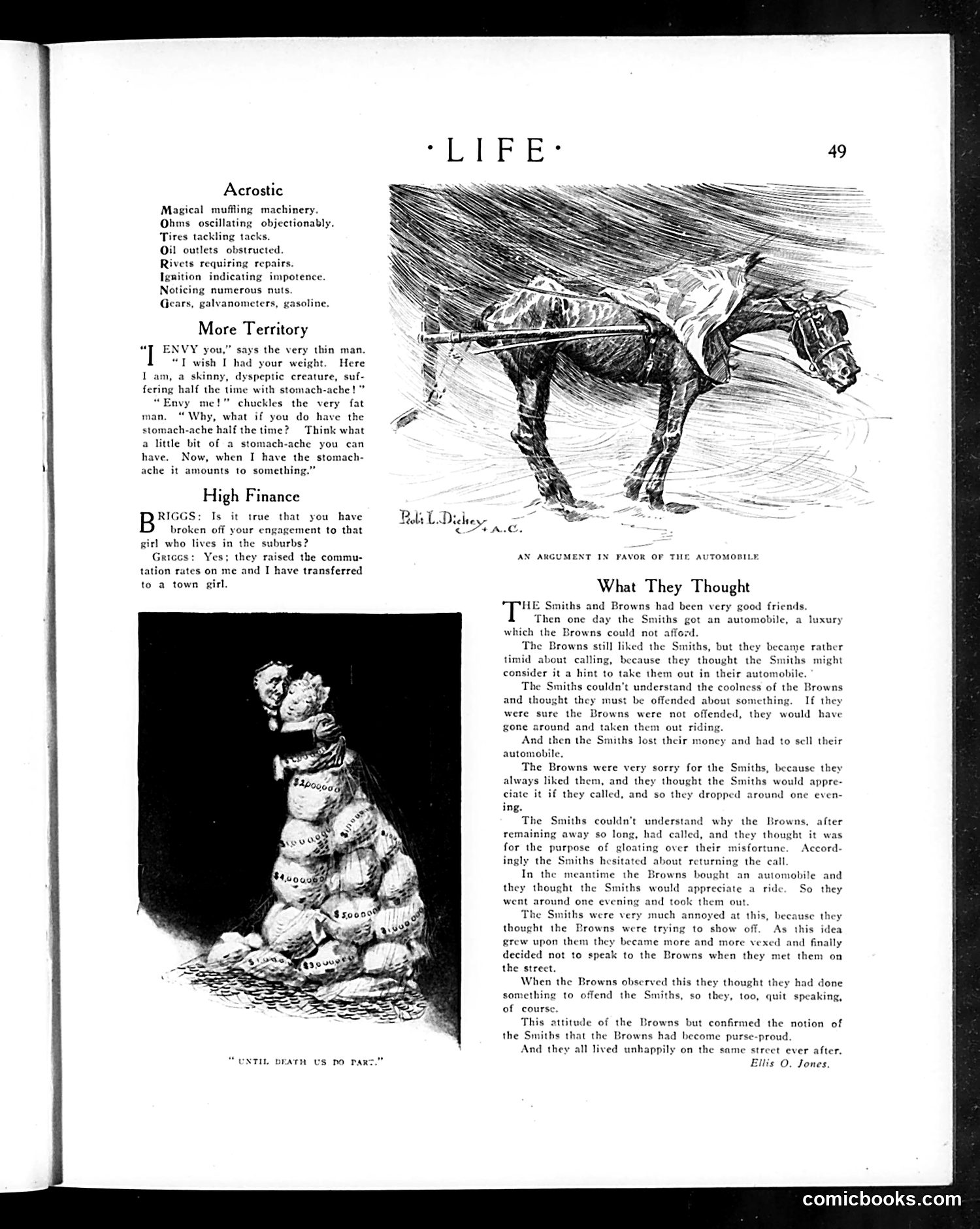
This page satirizes early-20th-century anxieties around automobiles and class. The main story, "What They Thought," depicts two neighboring families whose friendship collapses due to automobile ownership—a symbol of wealth disparity. When the Smiths buy a car, the Browns avoid them from shame. Later, when positions reverse and the Browns acquire an auto, the Smiths suspect mockery. Both families misinterpret each other's motives, ultimately severing ties over a luxury item. The sketch at top illustrates a horse pulling an automobile, captioned "An Argument in Favor of the Automobile"—sarcastically suggesting horses outlast cars mechanically (the "Acrostic" lists common auto failures: faulty ignition, broken rivets, etc.). The page mocks how automobiles, despite promised progress, actually damaged social bonds by creating resentment and suspicion based on consumer status—a common Progressive-era critique of materialism and class consciousness.
📄 Transcribed text from this page (OCR, searchable)
Machine-transcribed from the original scan — historical spelling and the odd misread are preserved.
Acrostic Magical mufiling machinery. Ohms oscillating objectionably. Tires tackling tacks. Oil outlets obstructed. Rivets requiring repairs. Ignition indicating impotence. Noticing numerous nuts Gears, galvanometers, gasoline. More Territory ‘I ENVY you,” says the very thin man. “T wish I had your weight. Here I am, a skinny, dyspeptic creature, suf- fering half the time with stomach-ache!” “Envy me!" chuckles the very fat man. “Why, what if you do have the stomach-ache half the time? Think what a little bit of a stomach-ache you can have. Now, when I have the stomach- ache it amounts to something. High Finance RIGGS: Is it true that you have BULDik broken off your engagement to that < girl who lives in the suburbs? Grices: Yes; they raised the commu- AN ARGUMENT IN FAVOR OF THE AUTOMOBILE 4 A. tation rates on me and I have transferred to a town girl. What They Thought HE Smiths and Browns had been very good friends. Then one day the Smiths got an automobile, a luxury which the Browns could not afford. The Browns still liked the Smiths, but they became rather timid about calling, because they thought the Smiths might consider it a hint to take them out in their automobile. The Smiths couldn't understand the coolness of the Browns and thought they must be offended about something. If they were sure the Browns were not offended, they would have gone around and taken them out riding. And then the Smiths lost their money and had to sell their automobile. The Browns were very sorry for the Smiths, because they liked them, and they thought the Smiths would appre- if they called, and so they dropped around one even- The Smiths couldn't understand why the Browns, after remaining away so long, had called, and they thought it was for the purpose of gloating over their misfortune. Accord- ingly the Smiths hesitated about returning the call In the meantime the Browns bought an automobile and they thought the Smiths would appreciate a ride. So they went around one evening and took them out The Smiths were very much annoyed at this, because they thought the Browns were trying to show off. As this idea grew upon them they became more and more vexed and finally decided not to speak to the Browns when they met them on the strect. When the Browns observed this they thought they had done something to offend the Smiths, so they, too, quit speaking, of course. This attitude of the Browns but confirmed the notion of the Smiths that the Browns had become purse-proud. And they all lived unhappily on the same street ever after. Ellis O. Jones comicbooks.com