A complete issue · 118 pages · 1912
The Medea
# This Page This is a **title or cover page** for a work titled *Medea*, printed in gold lettering on a dark green cloth binding. The page shows only the title and a library barcode/call number (visible on the left spine label), with no other text or illustrations. The OCR text is largely corrupted and unreadable, suggesting the scanning captured mostly the book's texture rather than legible content. Based on the formal binding and minimal presentation, this appears to be the cover of a bound edition rather than interior narrative prose.

This appears to be a blank or nearly blank page from a Victorian penny dreadful, with only minimal, heavily corrupted OCR text visible. The image shows a cream-colored page with a white binding strip on the right edge and black tape or marker at the top corner. The OCR has failed to capture any coherent text, producing only fragmentary characters and symbols. This is likely either a blank page, a title page, or a page whose text has degraded too severely for reliable transcription. No legible narrative content, illustration, or advertisement can be discerned from either the image or the OCR output.

# Page Description This is a blank or near-blank page from what appears to be the inside of a bound book. The page itself contains no visible text or illustrations—it is predominantly cream-colored and aged. The only marking is a library or preservation stamp in the lower portion reading "PHOTOCOPIED BY PRESERVATION" with a date of "APR 02 1997." This stamp indicates the page was part of a document that underwent microfilm or photocopying preservation efforts in the late twentieth century, likely by an archive or library institution. The page appears to be either endpaper, a blank interleaf, or the back of a title page from the original Victorian publication.

This appears to be a blank or nearly blank page from a Victorian penny dreadful, likely serving as an end paper, verso, or transition page between installments. The visible OCR text consists only of scattered characters and symbols that appear to be formatting artifacts or printing errors rather than actual content. There is no discernible narrative text, illustration, or meaningful printed material visible on this page. The aged, slightly discolored paper suggests this is an authentic Victorian-era publication, but the page itself contains no readable story content, advertisements, or identifying information that would clarify its specific purpose within the serialized work.
This is the title page or cover of a Victorian penny dreadful. The word "MEDEA" appears centered on an aged, textured page with visible discoloration and wear marks in purple, brown, and green tones. The page shows significant foxing and deterioration consistent with aged paper from the Victorian era. At the bottom, a watermark or credit reads "comicbooks.com," suggesting this is a digitized reproduction. Beyond the single title word, no other text is legible on this page. "Medea" likely refers to the classical Greek tragic figure, though the specific nature of this penny dreadful's adaptation or narrative remains unclear from this page alone.

This is a title page or cover page of a digitized book. The visible text indicates that the work was digitized by the Internet Archive in 2007 with funding from Microsoft Corporation. The page displays a faint architectural illustration of what appears to be a classical building with columns and a pediment at the top. The URL provided points to an archive entry, and the reference to "medeatranslated" in the URL suggests this is a translation of a classical work—likely Euripides' *Medea*. The page itself contains minimal original content, serving primarily as a digitization metadata page rather than part of the original publication's text or illustrations.
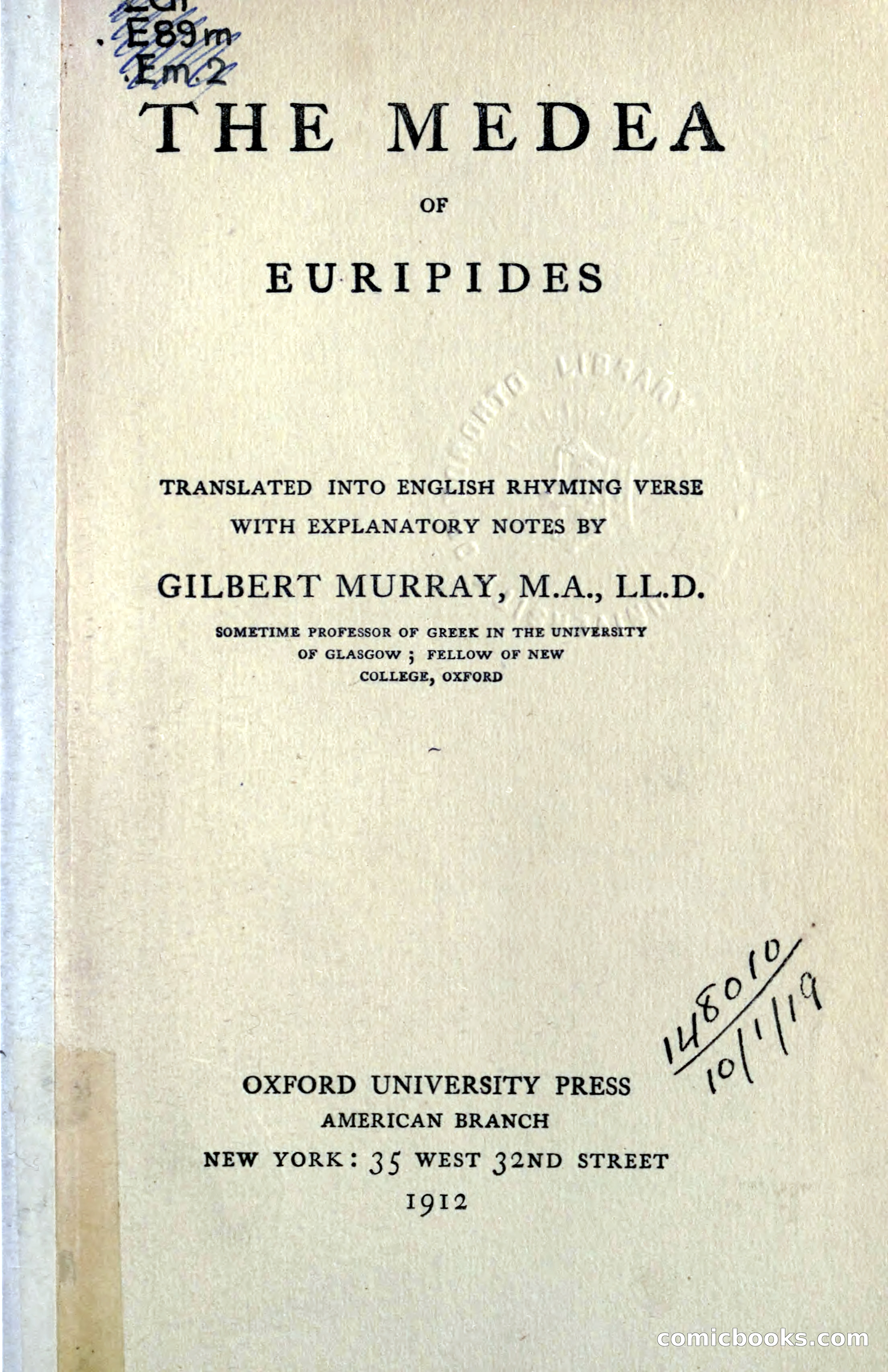
This is a title page from a 1912 Oxford University Press edition. Despite your framing, this is not a Victorian penny dreadful but rather a scholarly classical translation. The page announces "The Medea of Euripides," translated into English rhyming verse with explanatory notes by Gilbert Murray, identified as a former professor of Greek at the University of Glasgow and Fellow of New College, Oxford. The publisher information indicates the American branch in New York. The visible handwritten marks appear to be library cataloging notations.
This is a copyright/publication page from a book published by Oxford University Press in 1906. The page displays the publisher's circular seal or emblem at the top, with printed text below stating "Copyright, 1906, by OXFORD UNIVERSITY PRESS" and "AMERICAN BRANCH." The page itself is largely blank cream-colored paper with visible aging and wear marks. The OCR text appears heavily corrupted and unreadable, suggesting the scanning captured mostly noise rather than legible printed content from this largely empty page.
This is the introduction page to what appears to be a scholarly or literary edition (not a penny dreadful, despite the prompt's framing). The prose discusses Euripides' *Medea*, arguing it is fundamentally a tragedy of character rather than romance. The text traces the legendary background of Jason and Medea through Greek literature—from early Corinthian lays through Pindar and Apollonius Rhodius—before summarizing Jason's origins: son of the exiled King Aeson of Thessaly, raised by the Centaur Chiron, who later descends to reclaim his ancestral throne, famously appearing one-sandalled in the marketplace.
# Analysis This is a **running prose page** from an introduction section (marked "vi" at top left), presenting a narrative summary rather than original text or illustration. The visible text recounts the myth of Jason and the Argonauts in Victorian prose style. It describes Jason's quest to Colchis, his mission to retrieve the Golden Fleece and his kinsman's soul, his journey with the ship Argo, and his encounter with King Aiétés. The passage emphasizes how Médéa, the king's enchantress daughter, fell in love with Jason, aided him through impossible trials, killed her own brother Absyrtus to ensure Jason's escape, and fled with him—expecting perfect love in return. The text then shifts to questioning Jason's character and whether he truly reciprocated her devotion or merely valued her as an addition to his glory.
# Description This is a page of running prose from an introduction (page vii). The text discusses the Greek mythological figures Jason and Medea, specifically their return home after the voyage of the Argonauts. It describes how Medea, a "barbarian princess" from Colchis, could not legally marry Jason in fifth-century Athens, and recounts her actions upon their arrival—particularly how she killed King Pelias by tricking his daughters into attempting a rejuvenation ritual. The passage explains the consequences: forced to flee, Jason and Medea escaped to Corinth, where the ruler Creon (described as aging with only a daughter) might desire a son-in-law. The text presents Medea as increasingly problematic to Jason's ambitions in civilized Greek society.
This is a page of running prose from an introduction to a classical text. The page discusses Euripides' *Medea*, analyzing the play's artistic approach and comparing its austere, truth-seeking style to the romantic conventions of works like *Romeo and Juliet*. The text explains how Euripides restrains the story's natural romance, offering minimal poetic concessions—a single reference to Medea's serpent, mentions of the Clashing Rocks, and a glimpse of Jason's true love (the ship Argo)—while maintaining a merciless commitment to realism and skeptical inquiry.
# Analysis This is a page of running prose from an **Introduction** (marked "ix" at top right), not a title page, cover, or illustration. The text discusses the characters and dramatic qualities of a classical play called the *Medea*. It characterizes Jason as a career-focused middle-aged man for whom love is merely inconvenient, and Medea as a foreigner whose passionate devotion has curdled into hatred. The passage notes that despite the *Medea*'s intense dramatic power, it won only third prize at its first production in Athens around 432 B.C., perhaps because Athenians found its originality difficult to accept. The author suggests the play's initial failure was not due to subject matter novelty.
# Analysis of Page Content This is a running prose page from an **Introduction** section (likely to a classical text or scholarly edition). The text is printed in traditional book format with justified columns. The visible prose discusses Euripides' play *Medea*, analyzing how the drama's psychological scheme—centered on oppression and revenge—differs from typical treatments of the subject. The author argues that Euripides depicts revenge not as triumphant justice but as a corrupting force that degrades both victim and perpetrator. The passage then references other Euripidean plays (*Trojan Women*, *Hecuba*, *Orestes*) to illustrate this recurring thematic pattern in the playwright's work. **Note:** Despite the header's mention of "penny dreadful," this appears to be an actual scholarly introduction to classical drama, not sensational fiction.
# What This Page Is This is an introduction page (marked "xi," indicating front matter) from what appears to be a scholarly or literary edition, not a penny dreadful. The page contains running prose commentary on Greek tragedy, specifically discussing Euripides' *Medea* and *Electra*. The text analyzes how these plays create dramatic tension through vengeance and suffering. The author argues that in *Medea*, the protagonist becomes a kind of supernatural curse rather than a human character—a "deus ex machina" herself—whose judgment on Jason comes not from a disinterested god but from his own victimized and transformed enemy. The passage concludes that such tragic events ultimately resist rational explanation and can only be expressed through the Latin phrase "lacrime rerum" (tears of things). The text is signed "G. M."

This appears to be a blank or nearly blank page from a Victorian penny dreadful, with only minimal visible text. The OCR output is largely illegible, consisting mainly of fragmented characters and symbols that don't form coherent words or sentences. The image itself shows what looks like aged paper with a slightly textured, off-white surface and some discoloration along the edges. There is no clear title, illustration, or running prose visible on this particular page. It may be a verso (blank back page), a separator page between installments, or a page where the original text has faded beyond legibility.
This is a title page for a work called "MEDEA," displayed in black serif typeface at the center of the page. The page itself shows significant age and wear, with a mottled, textured surface in browns, greens, and purples characteristic of aged paper. The OCR text appears largely corrupted or illegible, suggesting the original document's poor print quality or heavy deterioration. No additional descriptive text, publication information, author attribution, or illustrations are visible on this page—only the single word "MEDEA" is clearly readable, indicating this is the opening or cover page of the work.
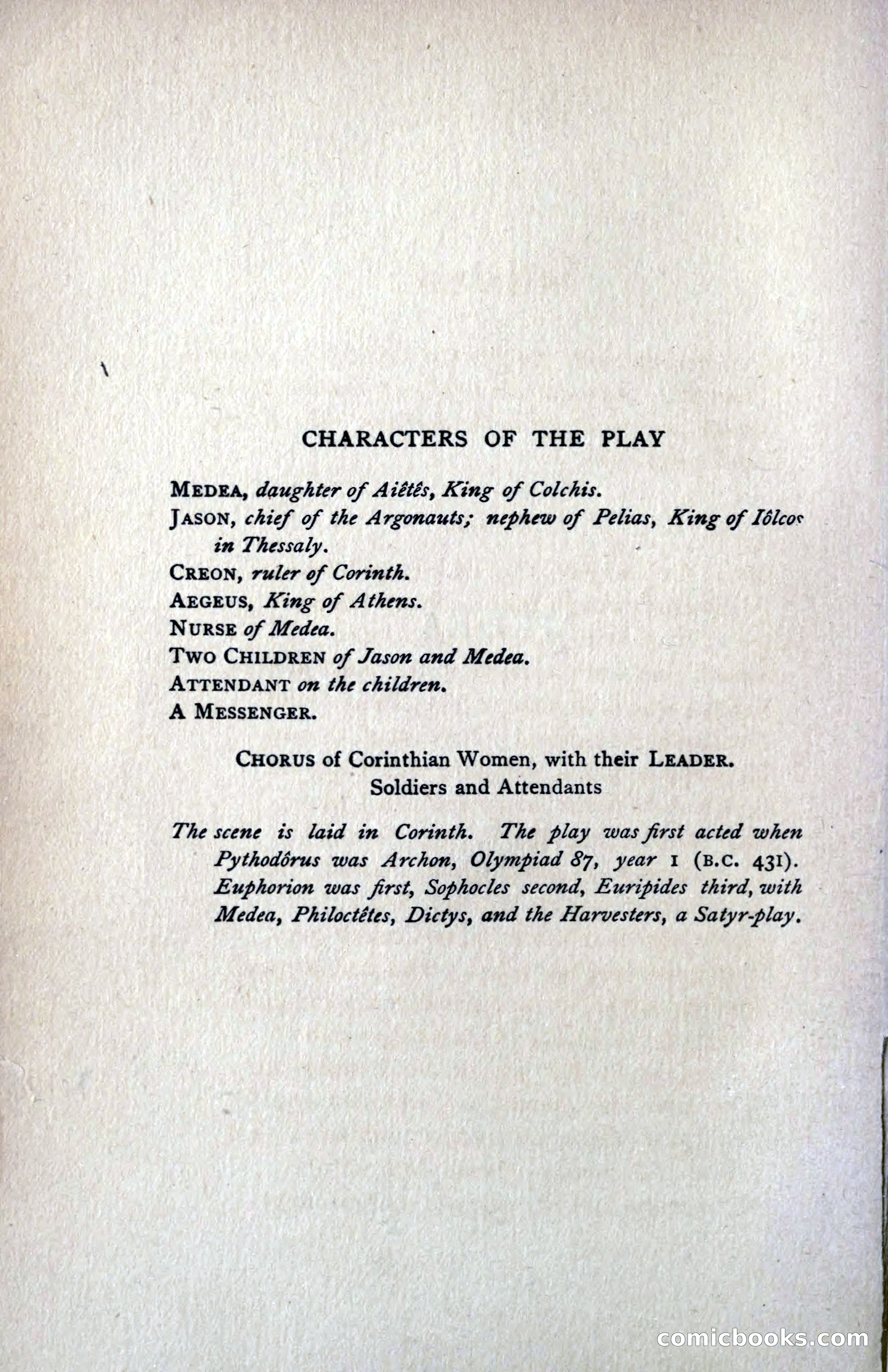
# Analysis of Page This is a **cast list and production note page** from a dramatic work, not a penny dreadful. The page lists the "Characters of the Play," identifying figures from classical mythology: Medea, Jason, Creon, Aegeus, and various attendants and a chorus of Corinthian women. Below the character list, italicized text indicates the play is set in Corinth and notes its first performance occurred in 431 B.C. during the archonship of Pythodorus, when it competed alongside works by Sophocles and other playwrights. This appears to be a Victorian-era edition of Euripides' *Medea*, a classical Greek tragedy, not a sensational popular fiction serial.
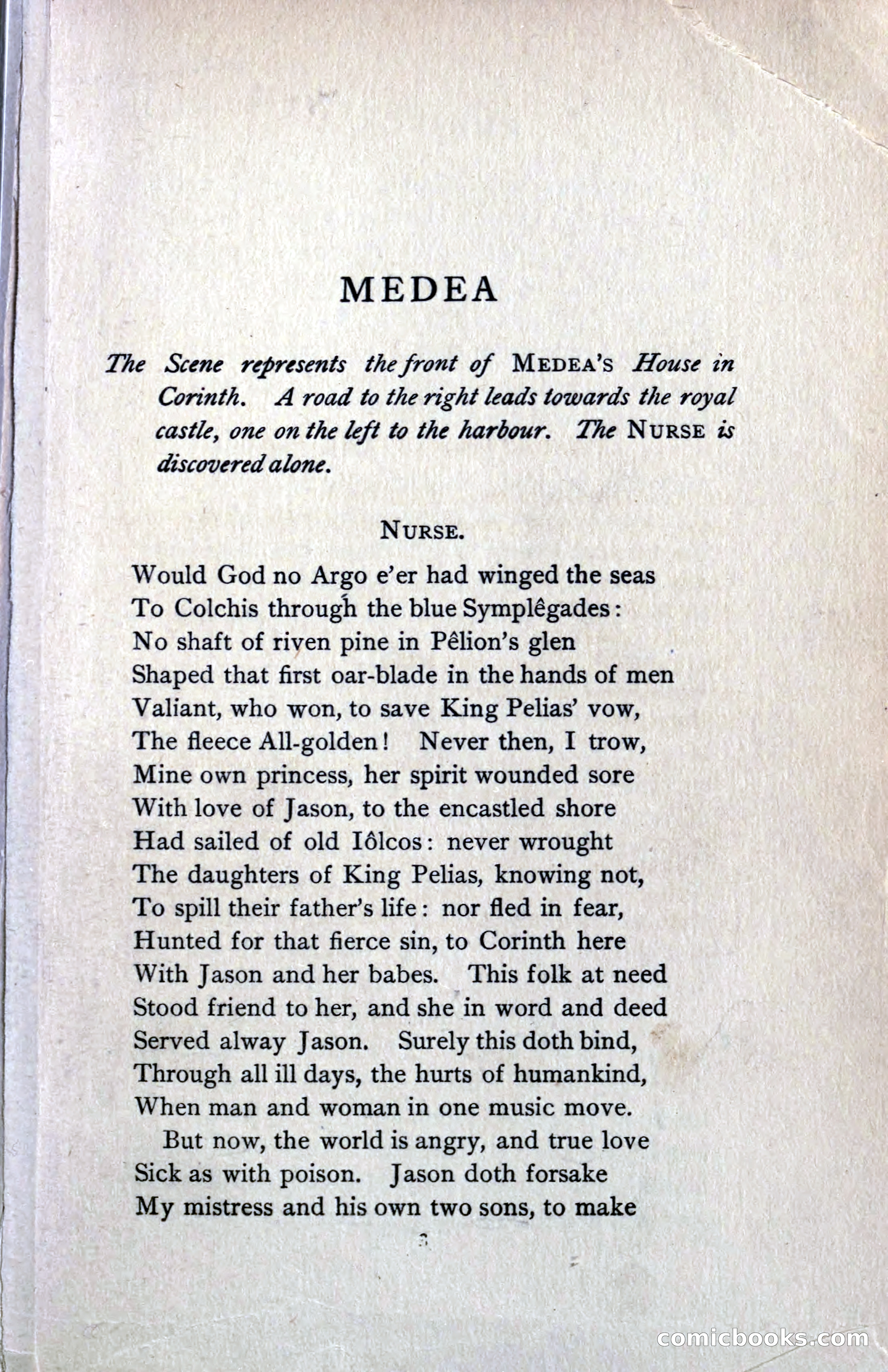
This is a page of running prose from a dramatic adaptation, specifically the opening scene of *Medea*. The page shows stage directions indicating the setting is outside Medea's house in Corinth, followed by a soliloquy spoken by the Nurse. The verse monologue recounts the mythological background of Medea's arrival in Corinth with Jason and their children, then laments that Jason has now abandoned his family. The text is written in blank verse with classical allusions to the Argonauts and the Golden Fleece.
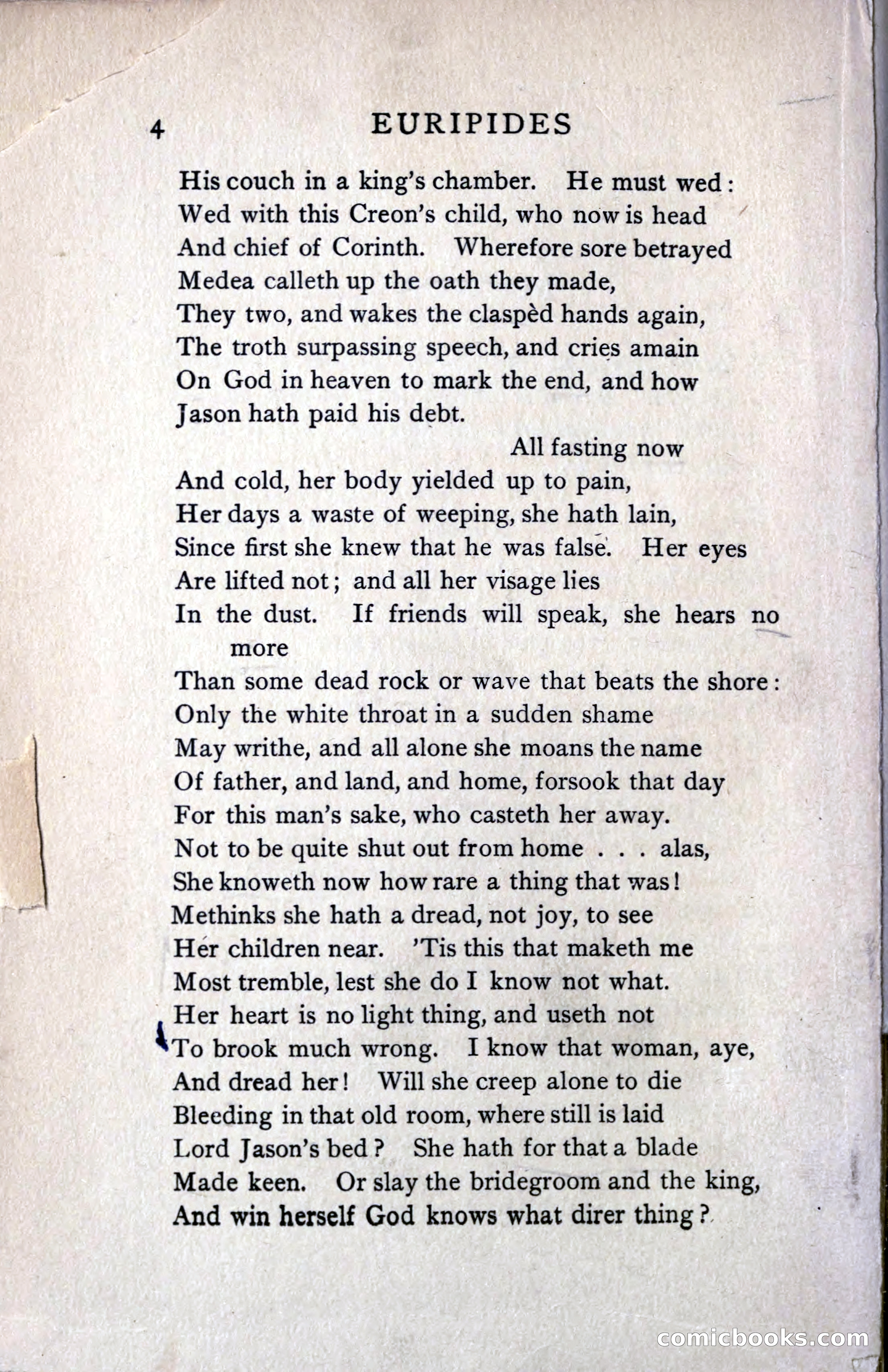
# Analysis of Page 4 from a Victorian Edition This is a page of running prose—specifically, dramatic verse from what appears to be a Victorian translation or adaptation of Euripides' *Medea*. The text depicts Medea's emotional devastation after Jason abandons her to marry Creon's daughter. The passage describes her fasting, weeping, and despair at being cast away from home and family, while a speaker (likely the Chorus or a confidant) expresses growing dread about what desperate act—suicide or violent revenge—the wronged woman might commit. The tone is intensely melodramatic, emphasizing her suffering and the threat she poses to Jason, his new bride, and the king.
# Page 5 of a Victorian Penny Dreadful: *Medea* This is a page of running dramatic dialogue (theatrical script format) from what appears to be a Victorian adaptation of the classical tragedy *Medea*. The scene shows a Nurse speaking with an Attendant about Medea's emotional state—her dangerous "fell spirit" and deep sorrow over wrongs committed against her. The dialogue reveals that Medea's children have returned from play, seemingly unaware of their mother's anguish, while the Nurse contemplates the brewing danger of Medea's unawakened rage. The text emphasizes Medea's festering grief and hints at impending calamity ("not half its perils wrought").
This is a page of running dramatic prose—specifically a scene from what appears to be a theatrical adaptation or translation of Euripides' *Medea*. The page shows dialogue between an Attendant, a Nurse, and references to Jason and Creon. The Attendant relays overheard gossip that Creon has ordered a woman and her two sons into banishment, while the Nurse expresses concern that Jason will not tolerate his own sons being banished, despite his anger toward their mother. The text deals with themes of exile, family conflict, and impending tragedy.
# Page Analysis This is a text page from a dramatic work titled "Medea" (page 7), presenting dialogue in verse between an Attendant, Nurse, and implied other characters. The passage depicts a conversation about a man who has abandoned his family for a new bride—the Nurse expresses concern for children and warns against letting their mother meet them while emotionally distressed, while the Attendant philosophizes cynically about male nature and self-interest. The theatrical format and classical subject matter suggest this is likely a Victorian-era adaptation or staging of Euripides' Greek tragedy, presented as serialized popular drama rather than scholarly text.
# Analysis This is a page of running dramatic prose—specifically, a scene from a theatrical work attributed to Euripides (page 8). The text consists of dialogue between a Nurse and an unseen Voice (appearing to be a woman in extreme distress), with stage directions. The visible content depicts a woman consumed by rage and suffering, whose "frozen heart" and "uncontrollable / Tempestuous spirit" threaten harm. A Voice from within curses unfathered children and those responsible for her misery. The dramatic language emphasizes her dangerous emotional state and vengeful despair, though the specific plot context remains unclear from this page alone.
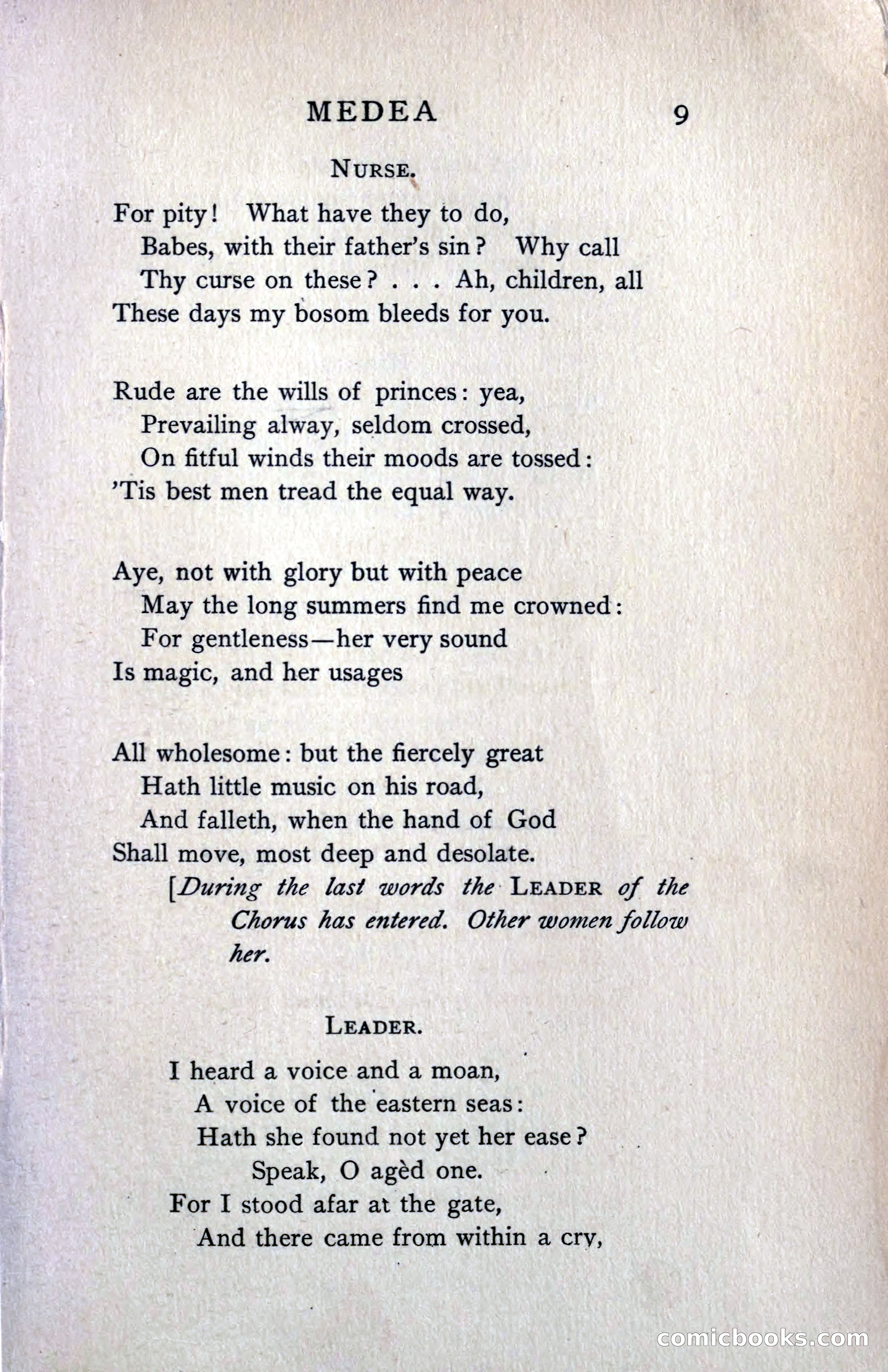
# Page 9 of "Medea" This is a page of dramatic dialogue from what appears to be a theatrical adaptation or translation of the classical play *Medea*. The page shows a scene between the Nurse and the Leader of the Chorus, with the Nurse lamenting the fate of children cursed by their father's sin and offering philosophical reflections on the dangers of princely power and the virtue of gentleness. The Leader then enters with other women, having heard mysterious cries from within. The text is formatted as a stage play with character names and stage directions in brackets.
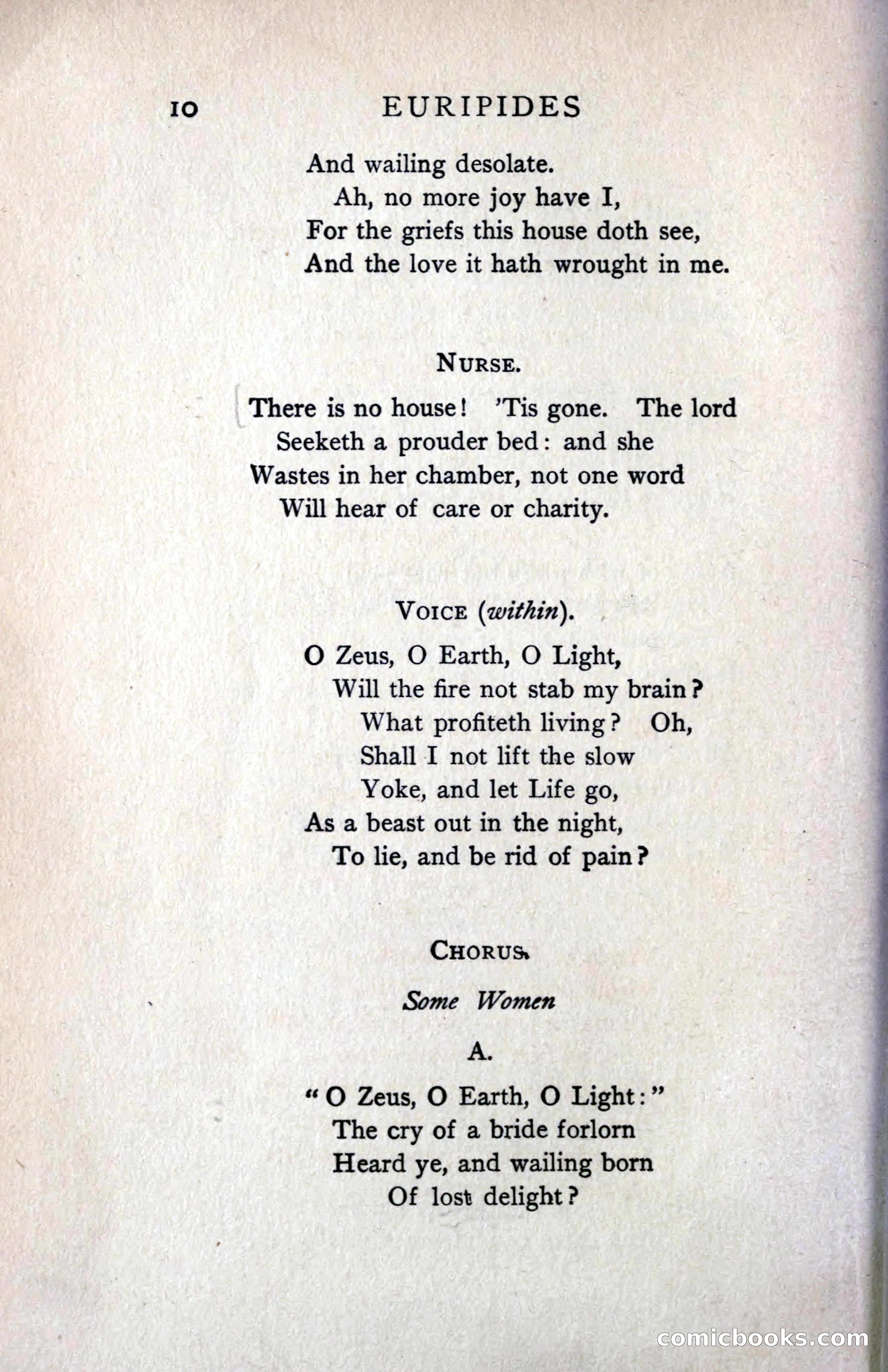
# Page Description This is a page of running dramatic dialogue and verse from what appears to be a classical theatrical adaptation (attributed to Euripides). The text consists of speeches from a Nurse, an unidentified Voice (from within), and a Chorus of Women. The content depicts a woman in deep distress—abandoned by her husband for another bed—confined to her chamber in despair and contemplating suicide. The Chorus echoes her anguished invocation of the gods, lamenting her fate as a "bride forlorn." The page contains no illustrations or advertisements, only formatted stage dialogue in blank verse.
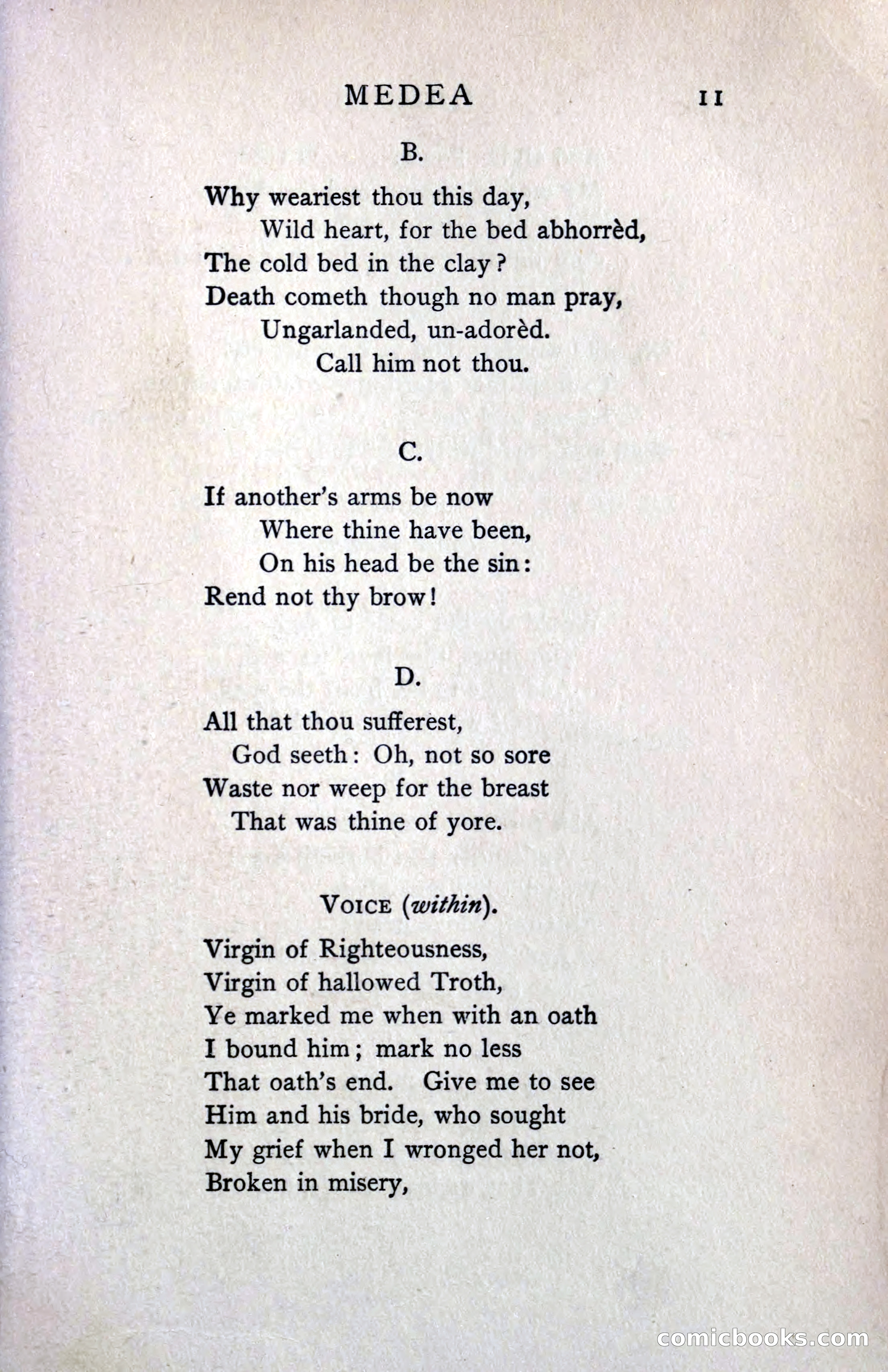
This is a page of running verse dialogue from what appears to be a dramatic work titled "Medea." The page presents several short poetic speeches (labeled B, C, D, and a "Voice within") that address themes of death, suffering, and betrayal. The speakers counsel against despair over lost love and a rival's embrace, while a mysterious inner voice invokes "Virgin of Righteousness" and "Virgin of hallowed Troth," requesting to witness a former lover's misery with his new bride. The archaic language and melodramatic tone are typical of Victorian theatrical or serialized fiction.
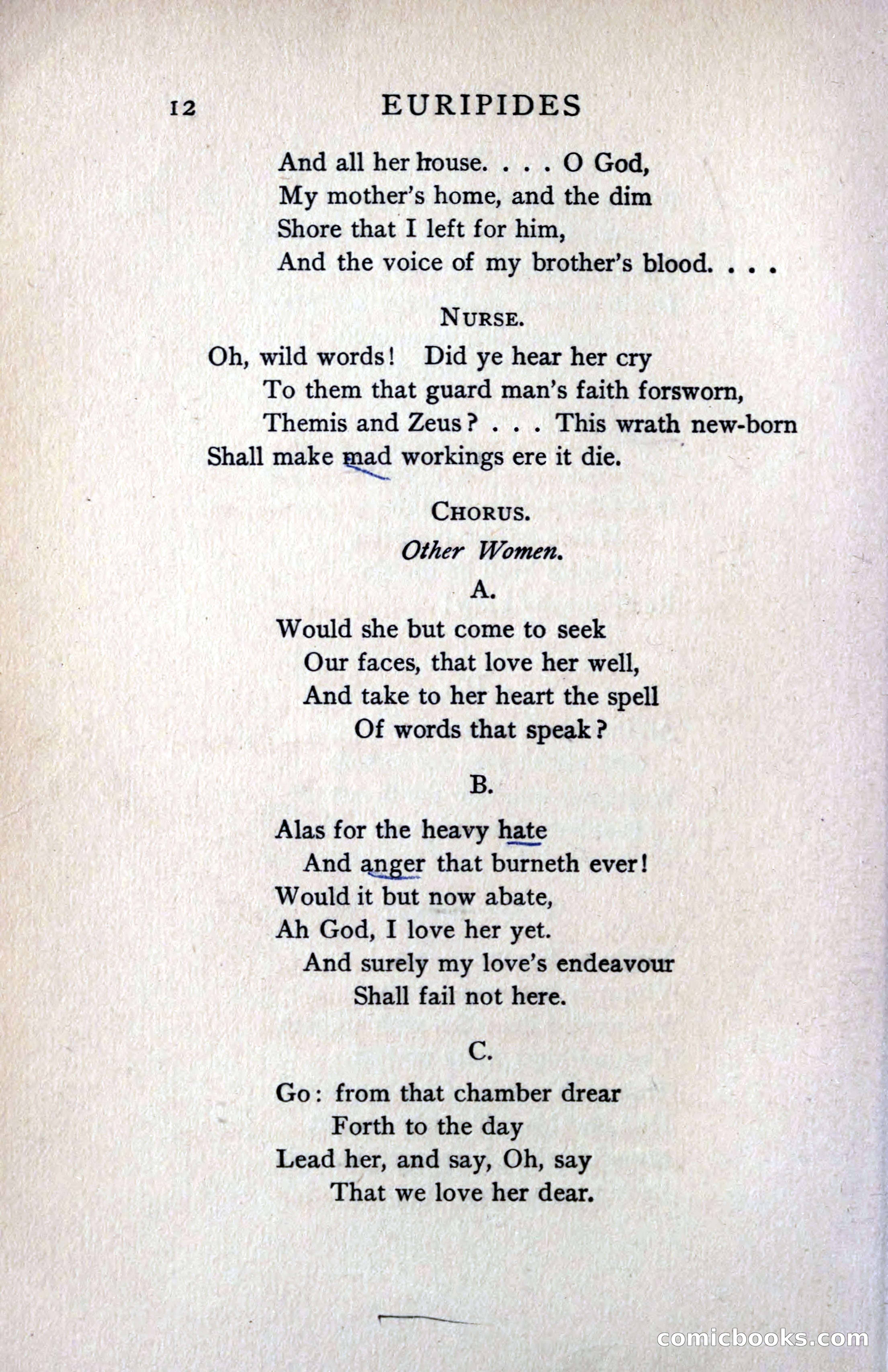
This is a page of running dramatic text from what appears to be a theatrical translation rather than a penny dreadful—specifically, it's from Euripides' classical Greek play. The page shows dialogue among a Nurse, Chorus, and "Other Women" discussing a female character's passionate distress about her mother's home, her brother's death, and expressions of love and concern for her welfare. The text is formatted as stage dialogue with speaker labels and poetic verse.
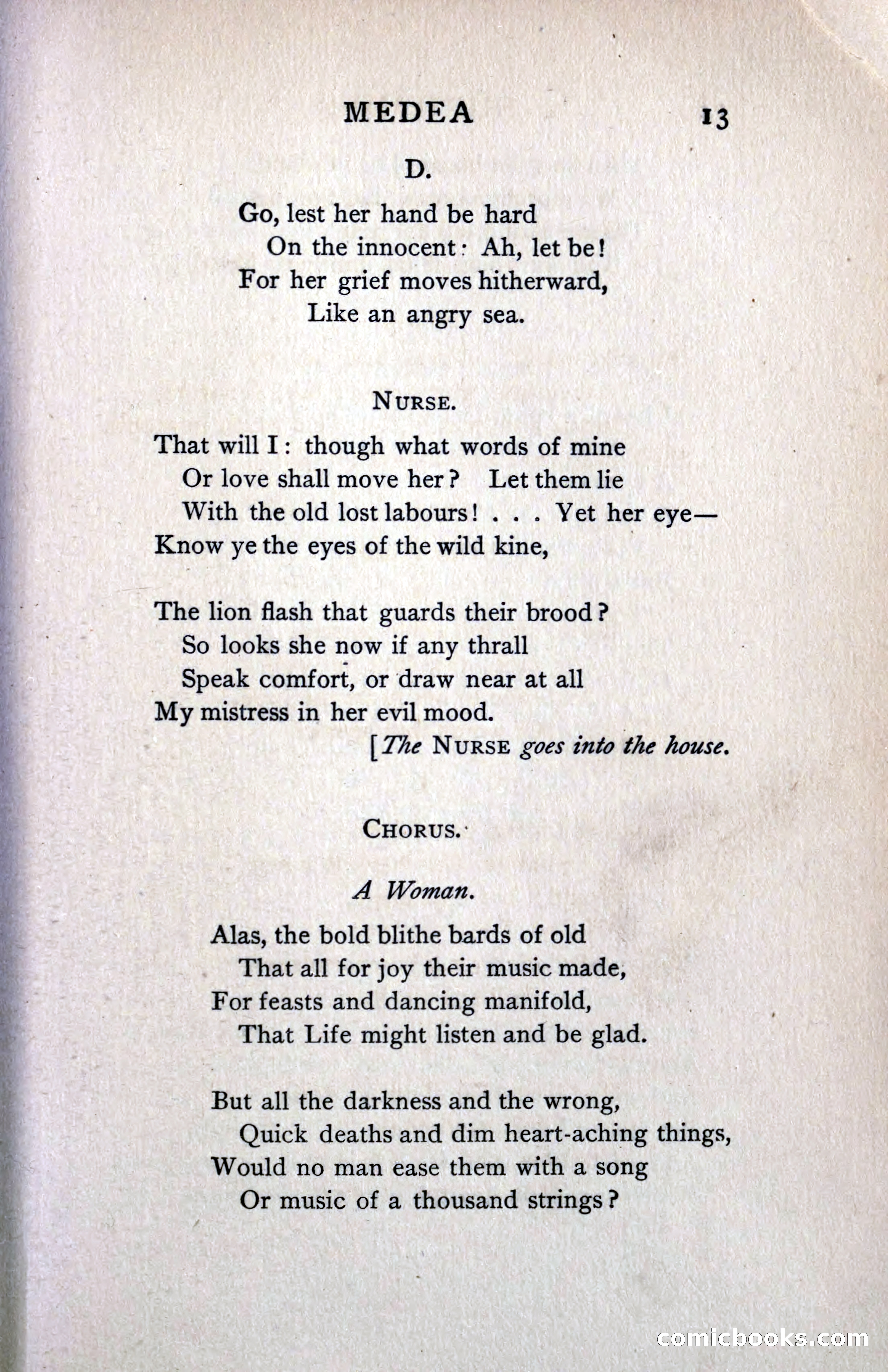
# Page Description This is a text page from a dramatic work titled "Medea" (page 13), presenting theatrical dialogue in verse. The page contains exchanges between characters labeled D. (likely a male character), the Nurse, and a Chorus member identified as "A Woman." The dialogue concerns Medea's dangerous emotional state—her grief described as "like an angry sea"—and warnings against approaching her in her "evil mood." The Chorus member then reflects philosophically on ancient bards and music's inability to ease human suffering and darkness. This appears to be a Victorian-era dramatic adaptation rather than original penny dreadful fiction.
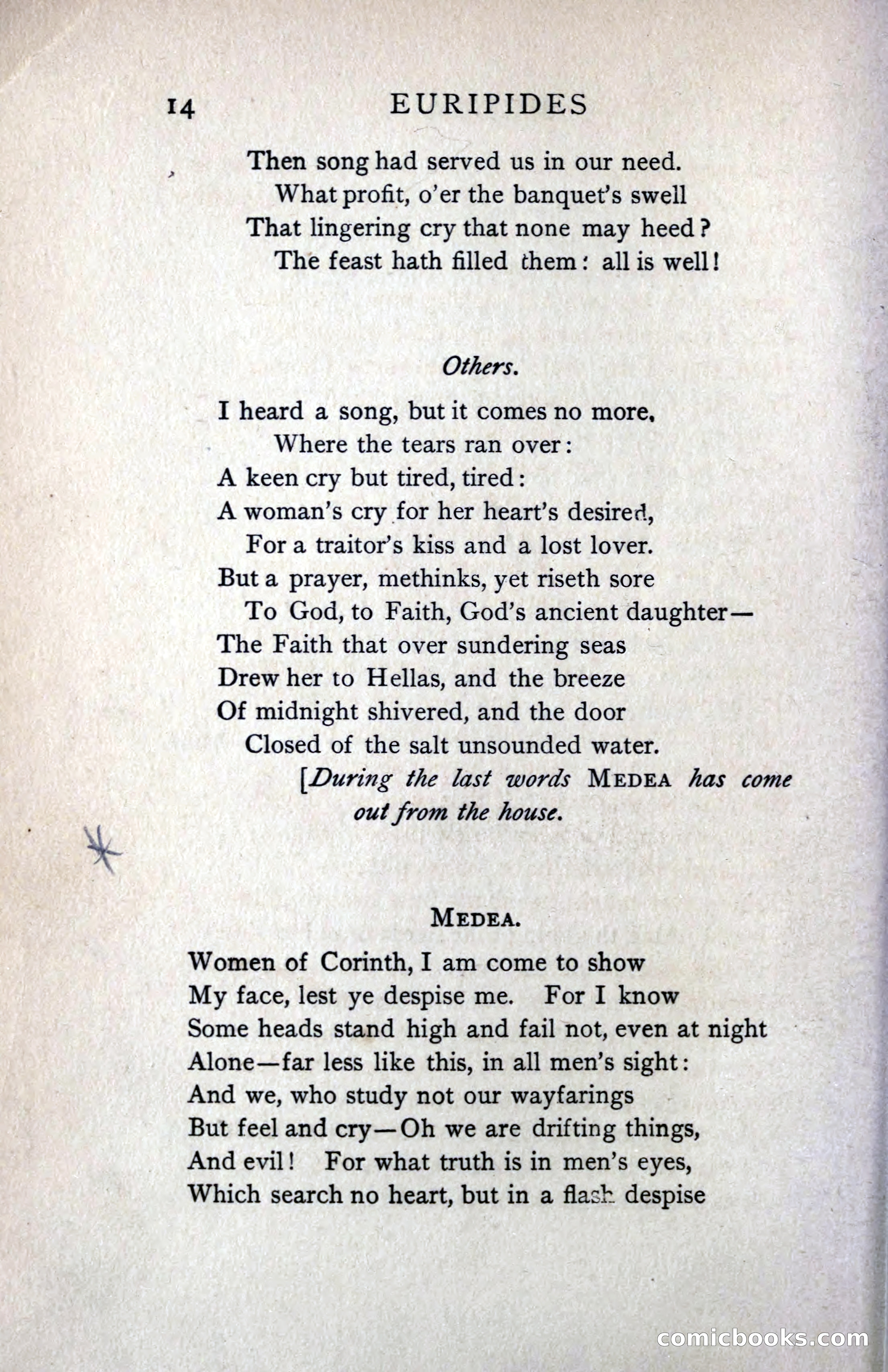
# Page 14: Running Prose from *Euripides* This is a page of running dramatic text—likely from a Victorian theatrical or literary adaptation rather than a penny dreadful proper. It contains verse dialogue from what appears to be a classical play adaptation, featuring a chorus ("Others") lamenting a woman's suffering and lost love, followed by the entrance of **Medea**, who addresses the "Women of Corinth." Medea speaks of shame and societal judgment, arguing that women are emotional and "drifting things" despised by men who judge by appearance alone rather than truth. The page is numbered 14 and printed in standard book format with stage directions in italics.
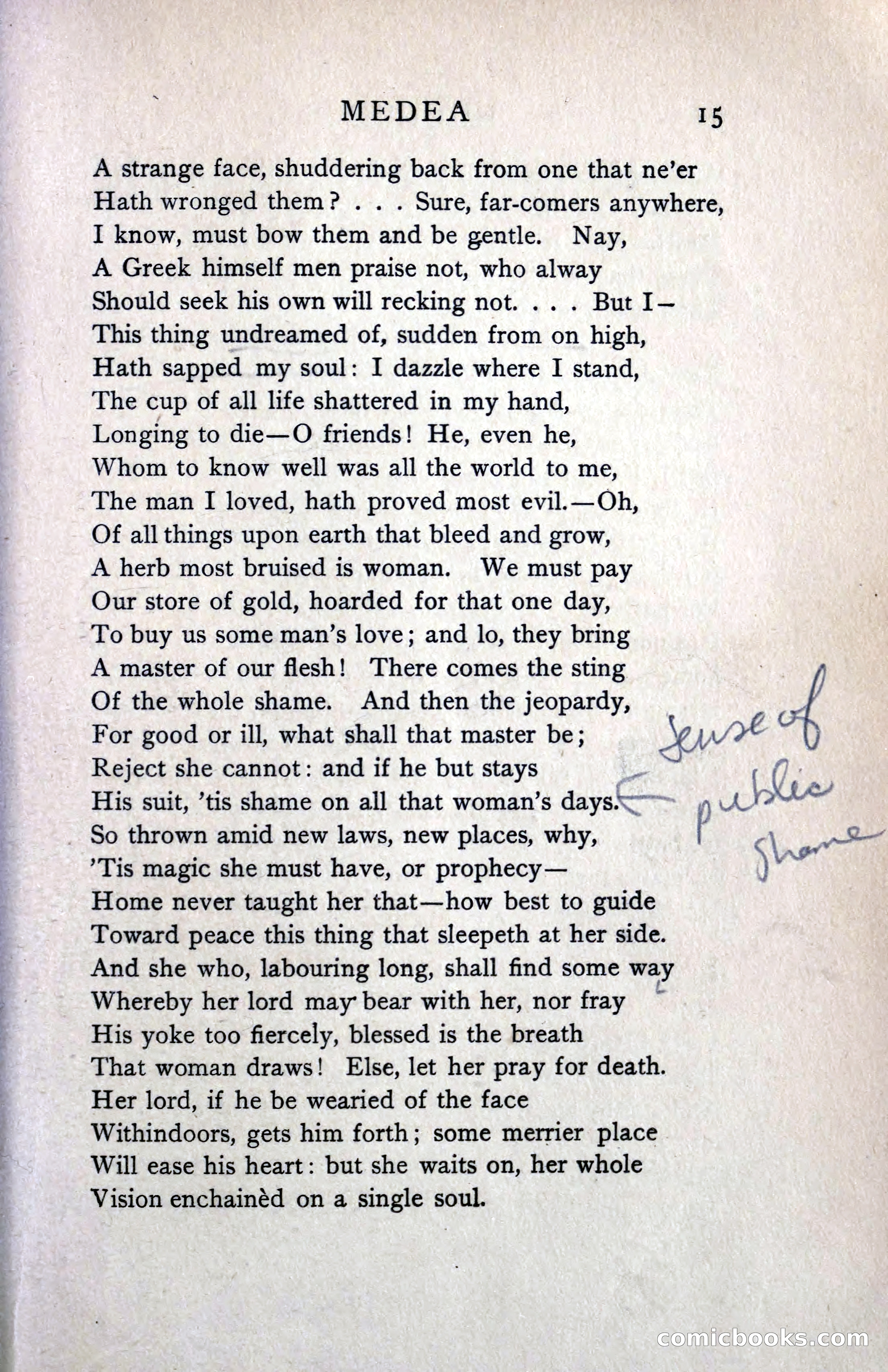
# Page Description This is a page of running dramatic verse (page 15) from what appears to be a theatrical adaptation or translation of Euripides' *Medea*. The text shows a female character's monologue expressing bitter despair over male betrayal and the powerless condition of women, who must purchase a man's love with their dowry only to become his possession, unable to reject him or escape their bondage to a single person. The verse is marked with handwritten annotations in the margin ("sense of public shame" appears visible).
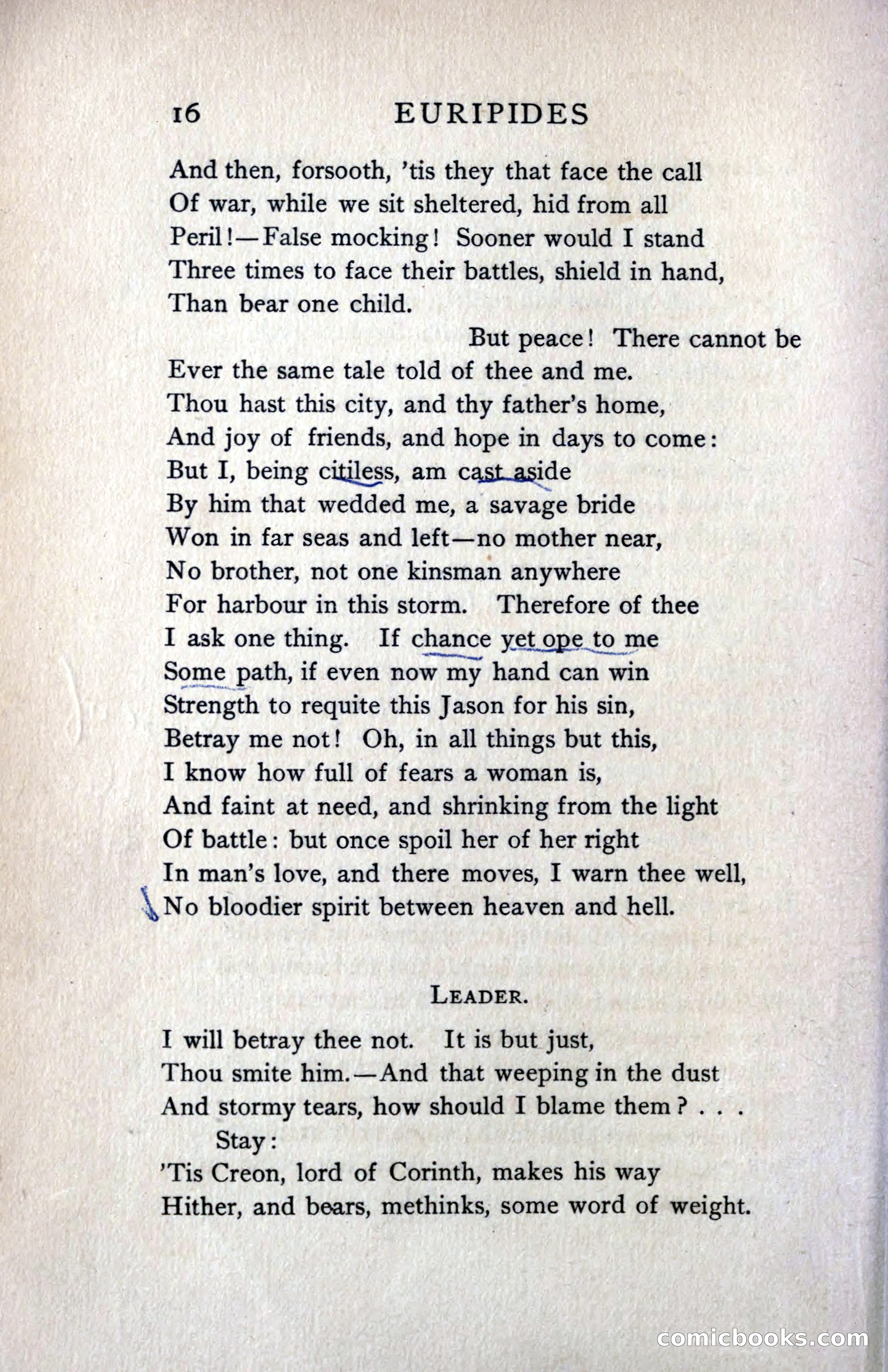
This is a page of running dramatic verse from what appears to be a classical translation rather than a Victorian penny dreadful. The text is labeled "EURIPIDES" at the top and presents a passionate monologue by a woman (likely Medea) addressing a Leader character, in which she contrasts her own exile and abandonment with another woman's secure position, declares her willingness to face battle rather than endure childbirth, and warns that a woman wronged in love becomes dangerously vengeful. The Leader responds briefly, and the page ends with stage directions indicating the arrival of Creon, lord of Corinth.
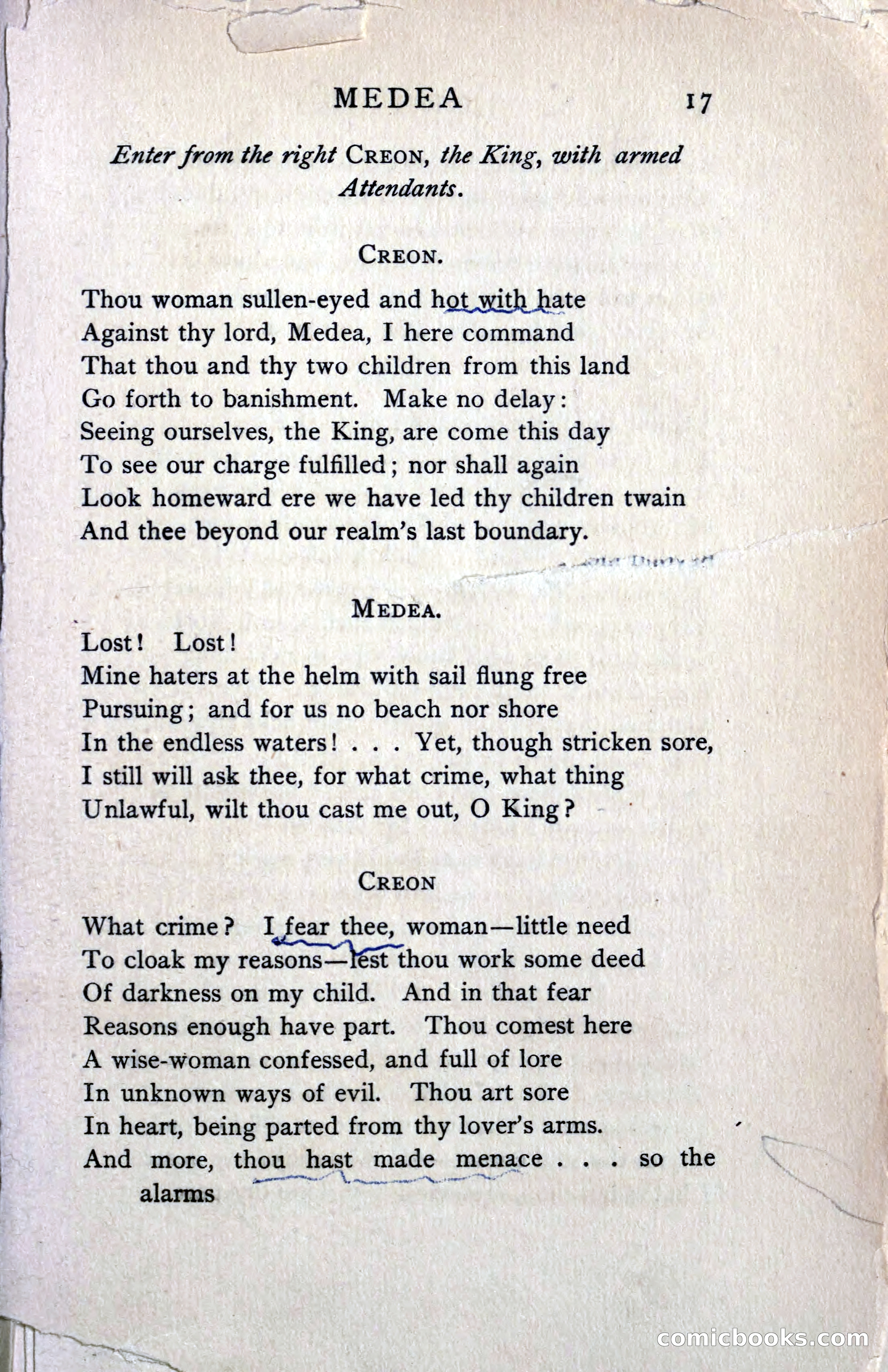
# Analysis This is a page of running theatrical dialogue from what appears to be a dramatic adaptation titled "Medea" (page 17). The text consists entirely of verse dialogue between King Creon and the character Medea: Creon orders Medea and her two children into banishment from his realm, and Medea protests, asking what crime justifies her exile. Creon responds by accusing her of being a wise-woman skilled in evil magic, emotionally unstable from separation from her lover, and a threat to his child. The page contains no illustrations, title page elements, or advertisements—only dramatic text formatted with character names and their spoken lines.
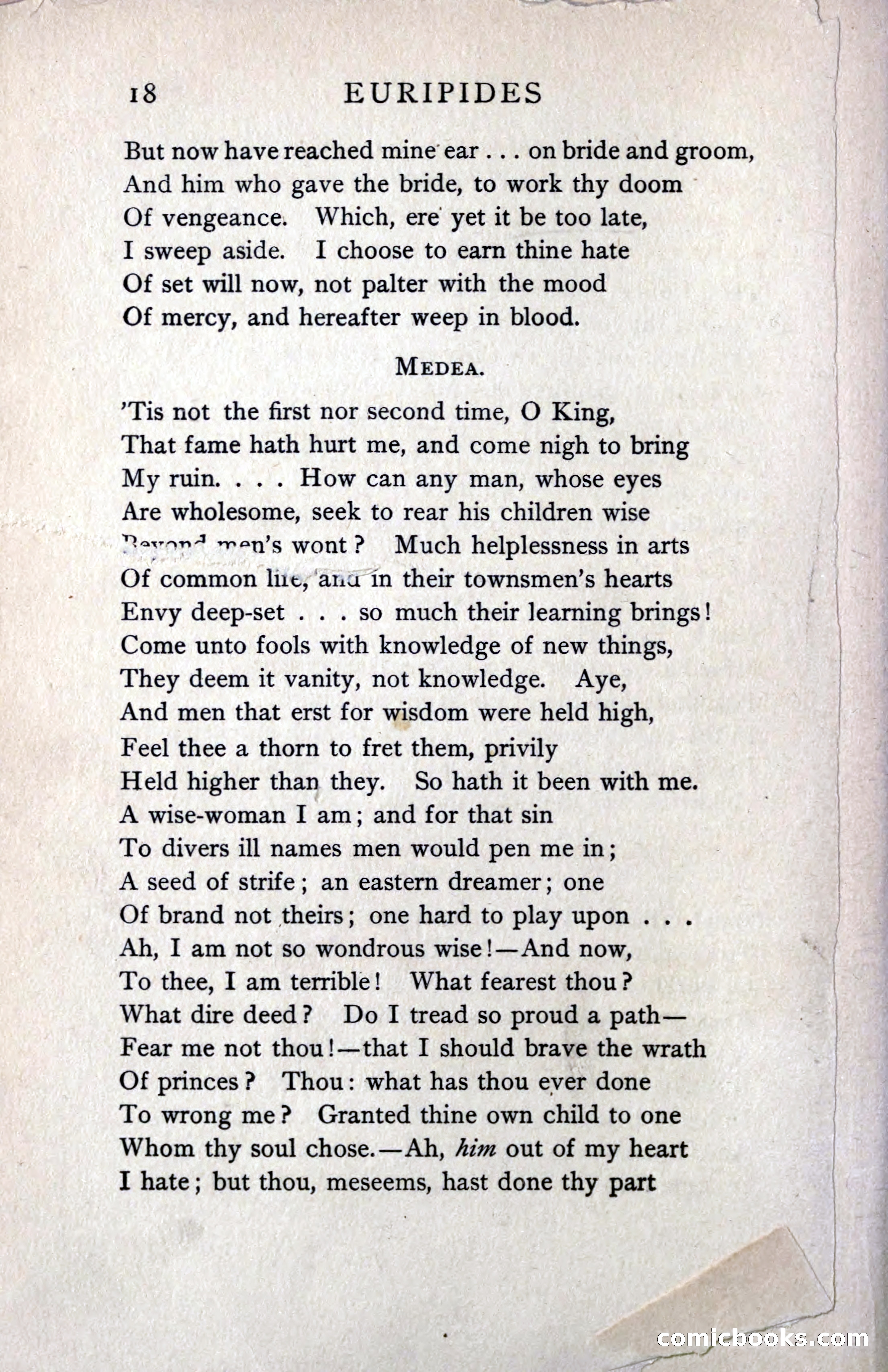
# Victorian Page Analysis This is a page of running prose from what appears to be a dramatic text. The page number is 18, and it contains dialogue attributed to "Euripides" at the top, followed by speeches by characters identified as "Medea" and apparently a King. The text presents Medea's lengthy monologue expressing her rage over a betrayal involving a bride and groom, her resentment of how society has treated her for her wisdom and foreign origins, and her accusation toward the King for giving his child to someone else. The language and style suggest this is a Victorian-era translation or adaptation of the classical Greek play *Medea*.
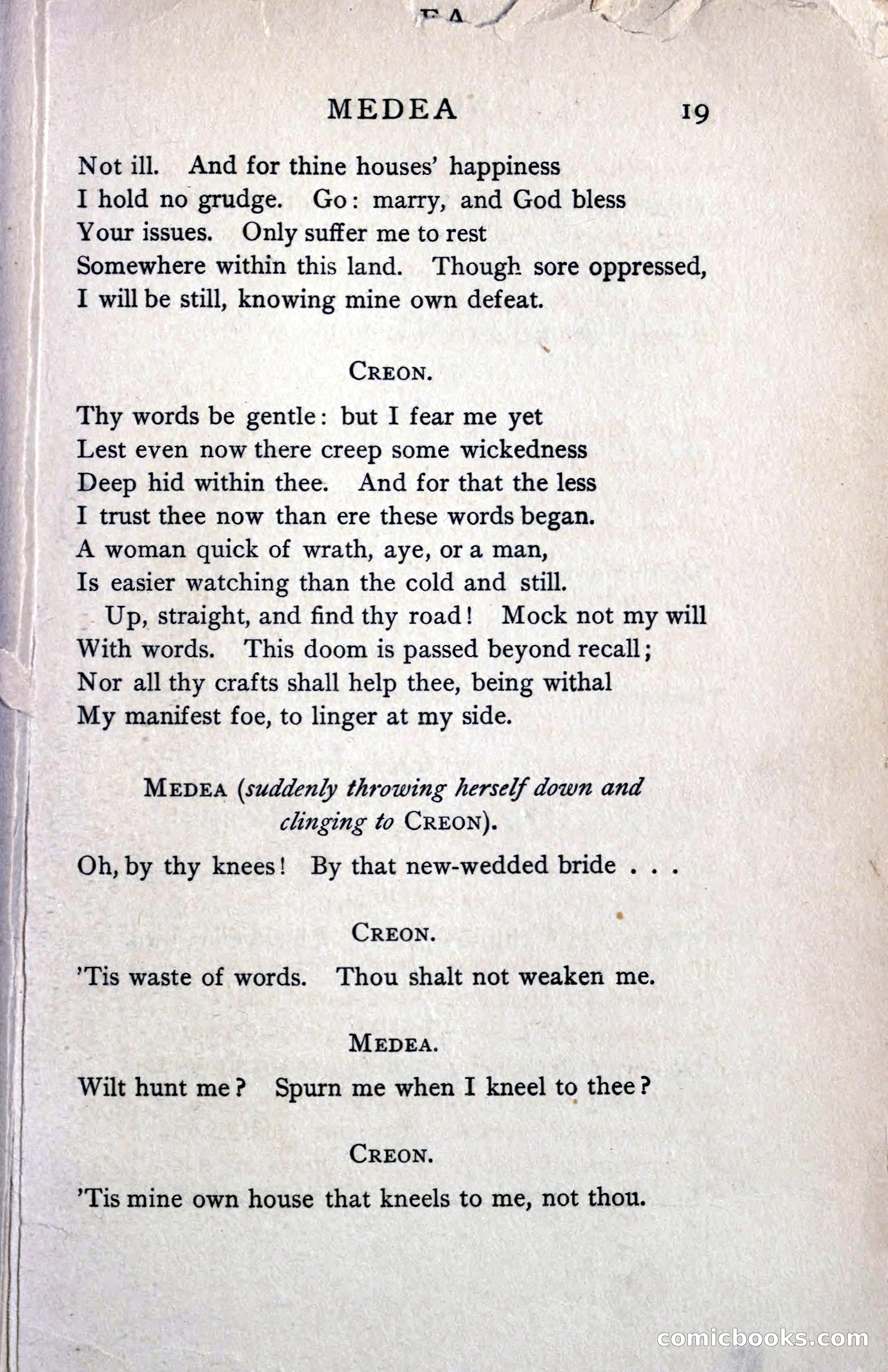
# Page Description This is a page of running dramatic prose—specifically dialogue from what appears to be a theatrical adaptation titled "Medea" (page 19). The text shows an exchange between the characters Medea and Creon, written in verse. Creon orders Medea to leave his kingdom, refusing to be swayed by her pleas; he expresses distrust of her despite her gentle words and warns that her doom is "passed beyond recall." Medea attempts to appeal to him by kneeling, but Creon remains unmoved, declaring that his own house answers to him, not to her.
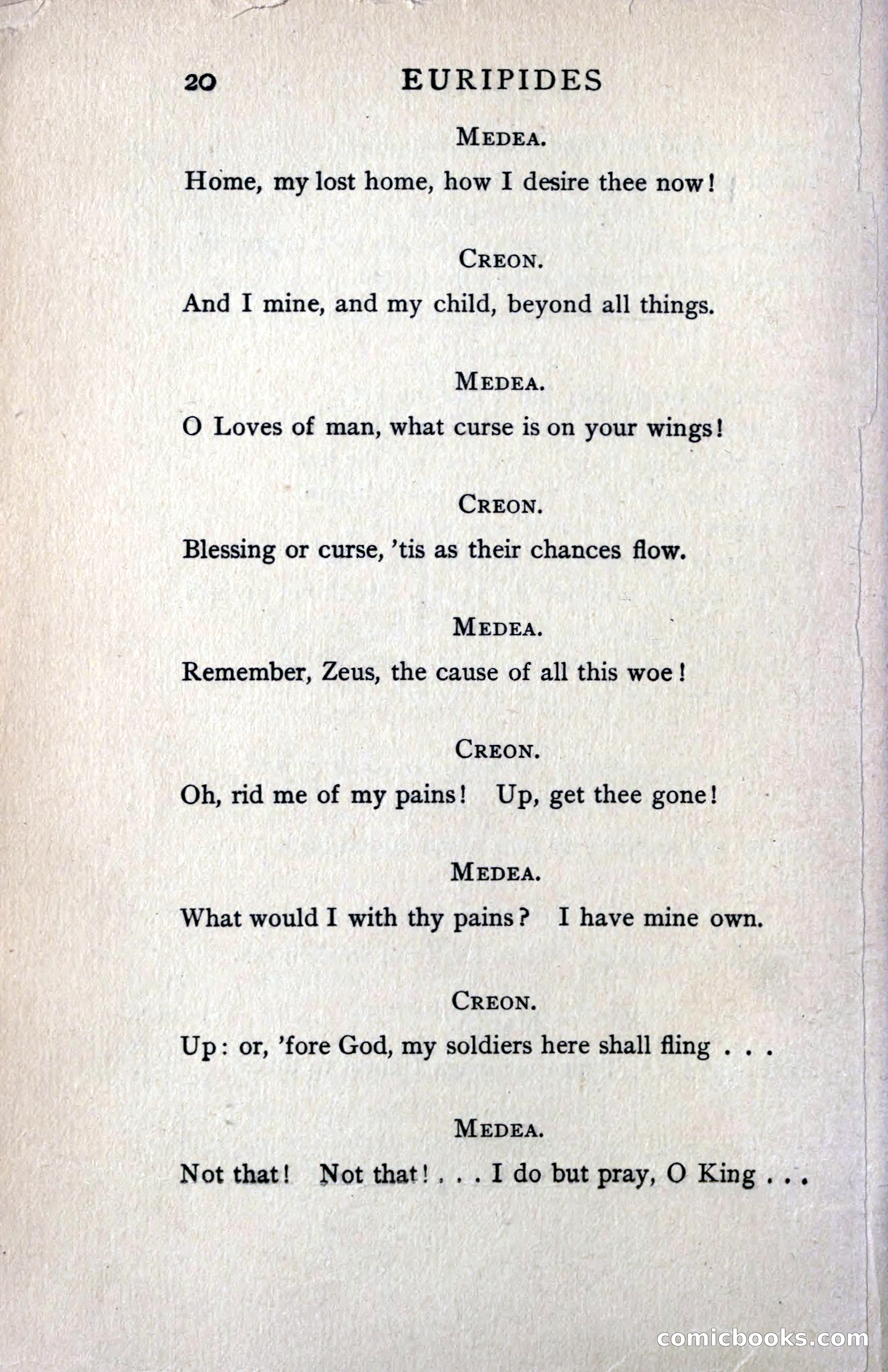
# Page Description This is a page of running dialogue text (page 20) from a dramatic work. It presents a scene from Euripides' *Medea*, formatted as a play script with character names in capitals followed by their spoken lines. The dialogue shows an exchange between Medea and Creon, touching on themes of exile, loss, love's curse, and suffering. Creon demands Medea leave, threatening his soldiers, while Medea pleads with him. This appears to be a standard dramatic text rather than the sensational penny dreadful promised by the earlier description.
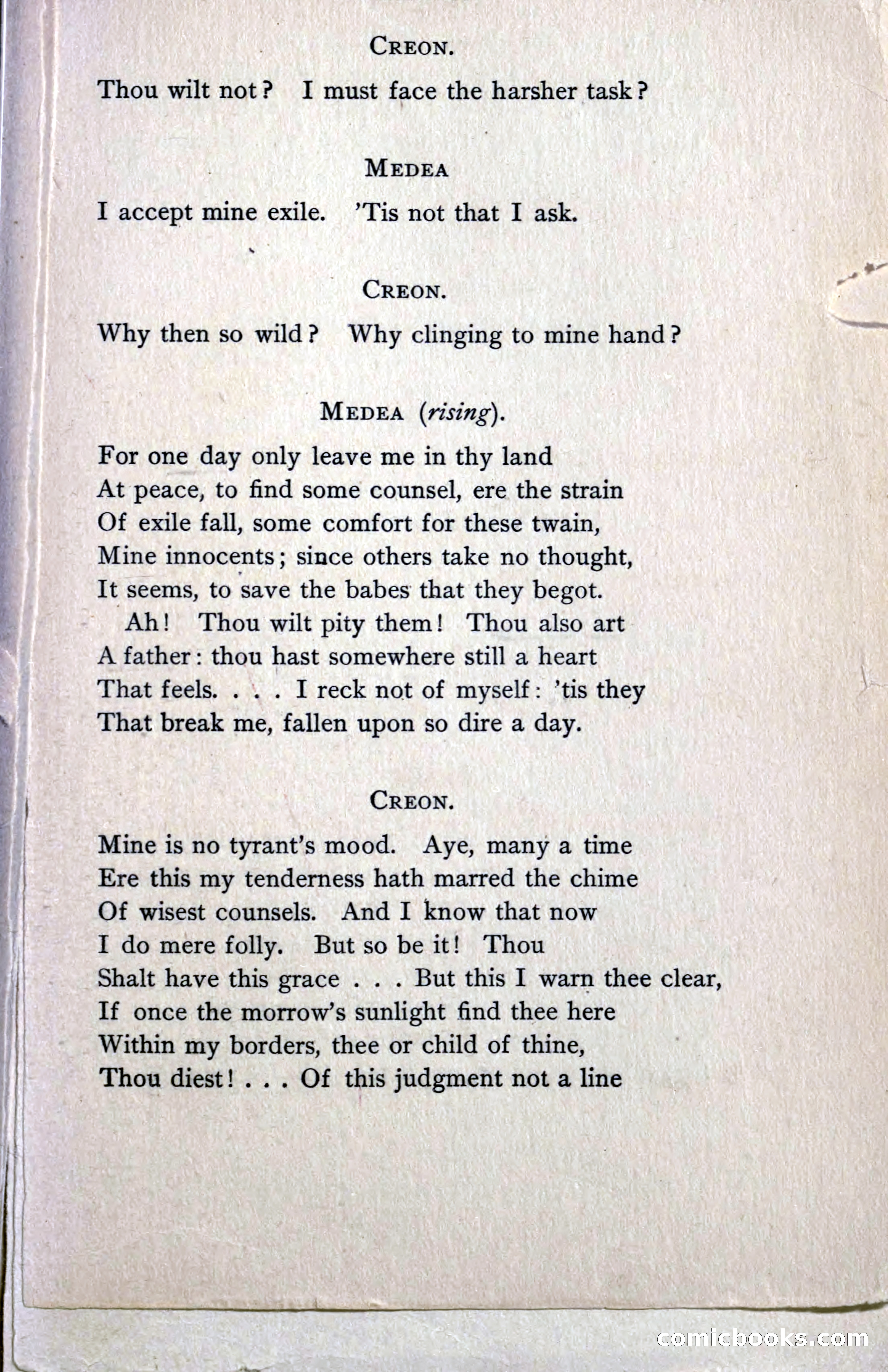
This is a page of running dramatic prose—specifically, a dialogue scene in verse from what appears to be a theatrical adaptation of the classical tragedy *Medea*. The exchange shows Creon refusing Medea's initial plea for exile, then relenting when she appeals to his sympathy as a father, offering her one day to arrange for her children's welfare before banishment—but threatening death if she and her child remain within his borders past tomorrow's sunrise. The text is printed in a plain, aged typeface on yellowed paper typical of Victorian serialized literature.
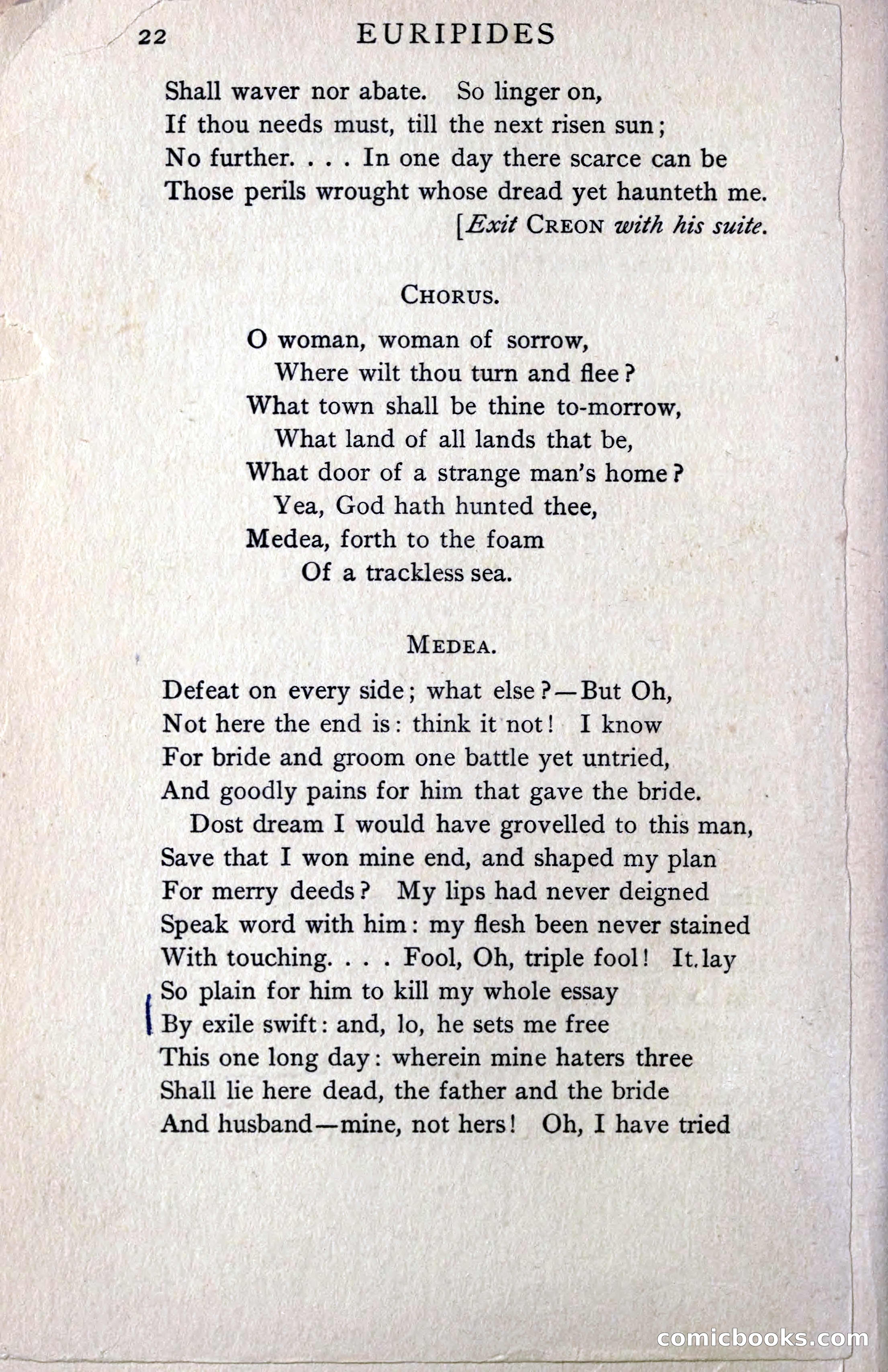
This is a page of running prose text from what appears to be a theatrical work—specifically, a translation of Euripides' *Medea*. The page contains dialogue between the Chorus and Medea, in which the Chorus laments Medea's exile and uncertain fate, while Medea responds with dark resolve, revealing her intention to murder three enemies (the bride, the father, and her husband) within a single day of freedom granted to her. The text is printed in a classical dramatic format with character names and stage directions.
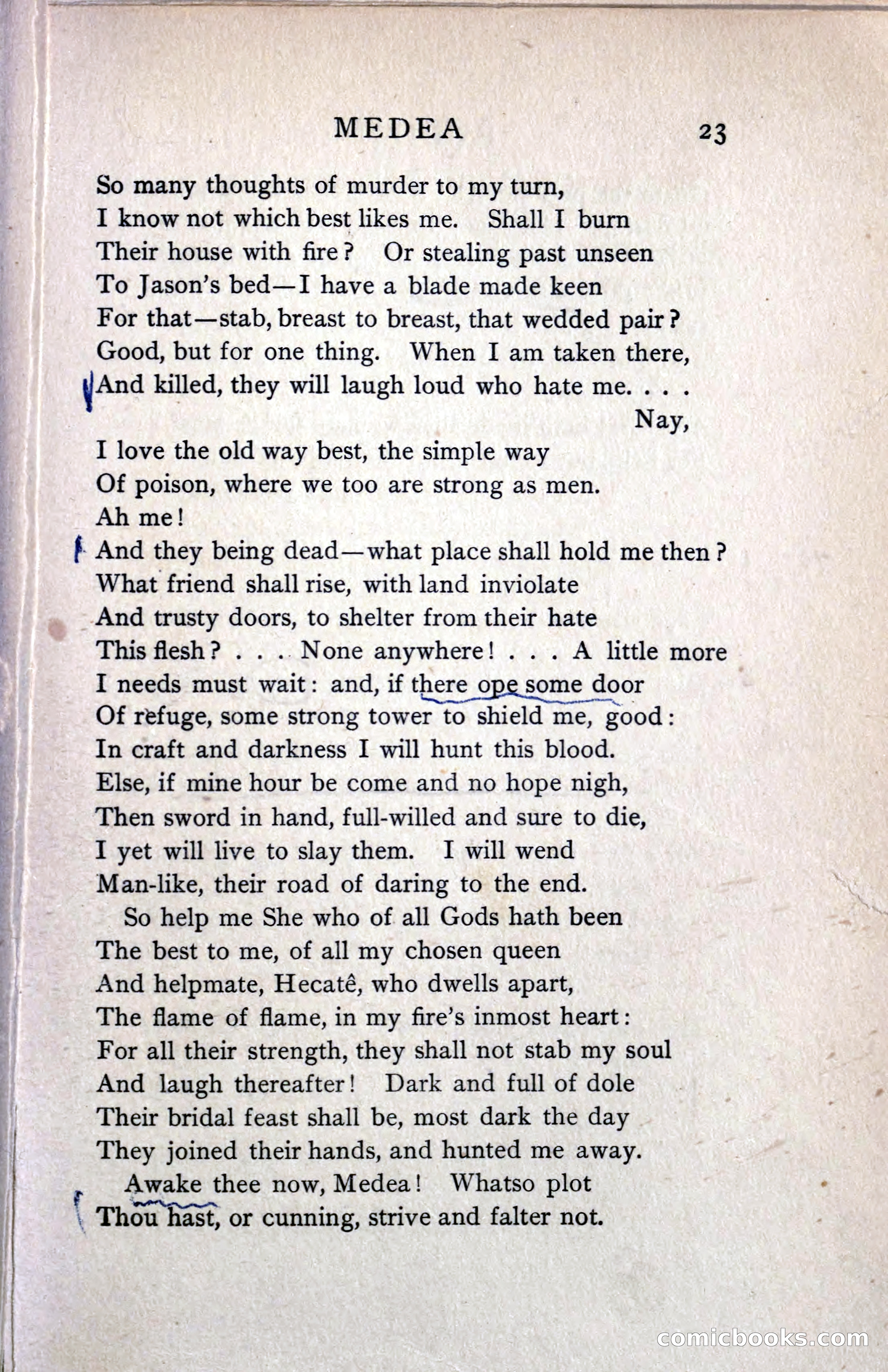
# Page 23 of "Medea" This is a page of running dramatic verse—specifically, a soliloquy from what appears to be a Victorian adaptation of the classical tragedy *Medea*. The text presents Medea's anguished deliberation over how to murder Jason and his new bride, weighing options like arson and stabbing before settling on poison as her preferred method. She invokes the goddess Hecaté for aid and resolves to commit the murders despite knowing she will face exile and death as a consequence. The passage is marked with marginal brackets indicating stage directions or emphatic moments.
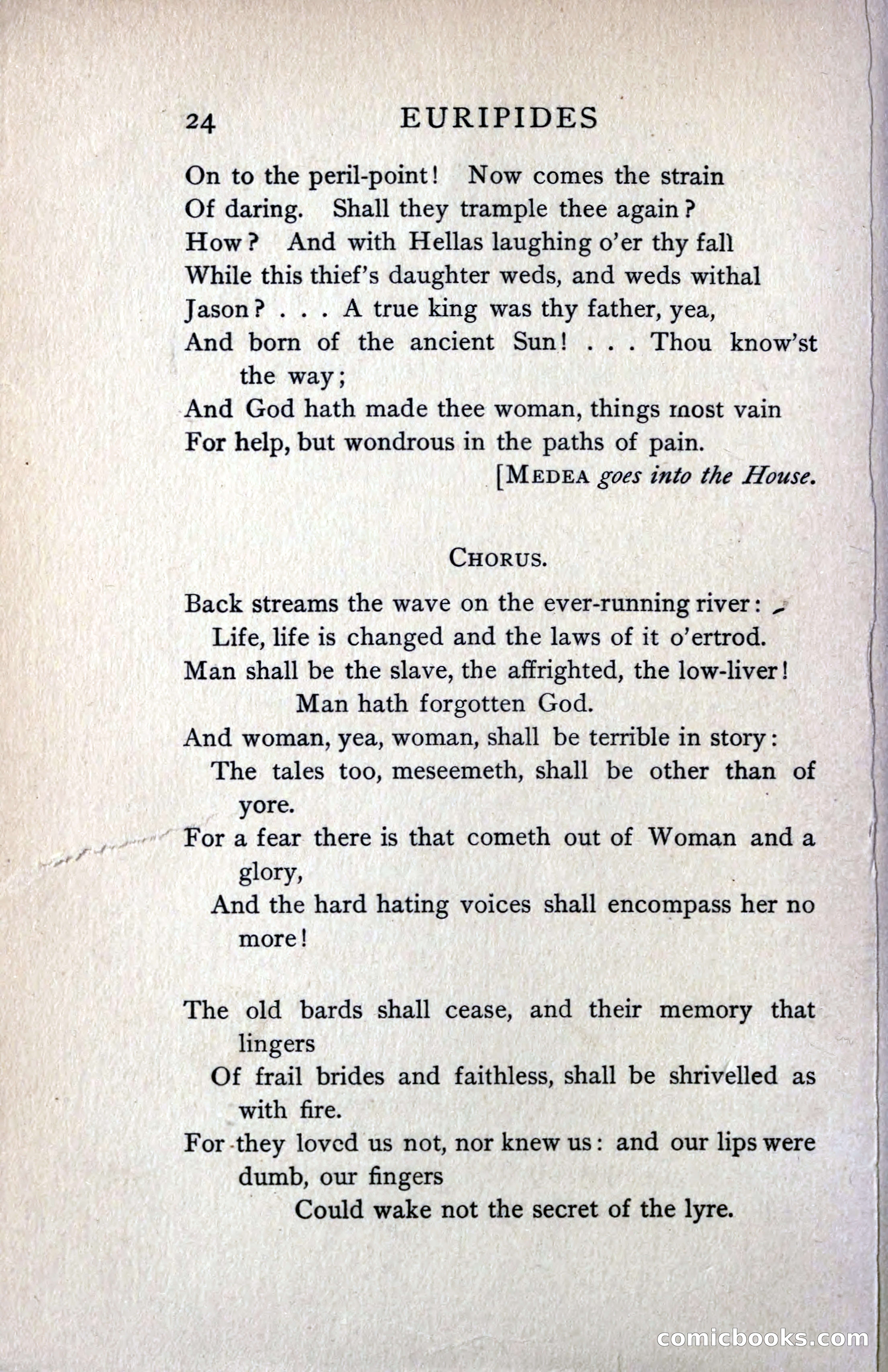
# Page Description This is a page of running dramatic verse from what appears to be a Victorian translation or adaptation of Euripides' *Medea*. The page contains the final lines of a character's speech (mentioning Jason and a thief's daughter), followed by the stage direction "[MEDEA goes into the House," and then an extended choral passage. The Chorus predicts a reversal of fortune: men will become enslaved and forgotten by God, while women—previously slandered in old tales—will become powerful and terrible. The old poets' stories of faithless women will be erased, since those bards never truly understood or loved women. The text suggests an impending transformation in how women's stories will be told.
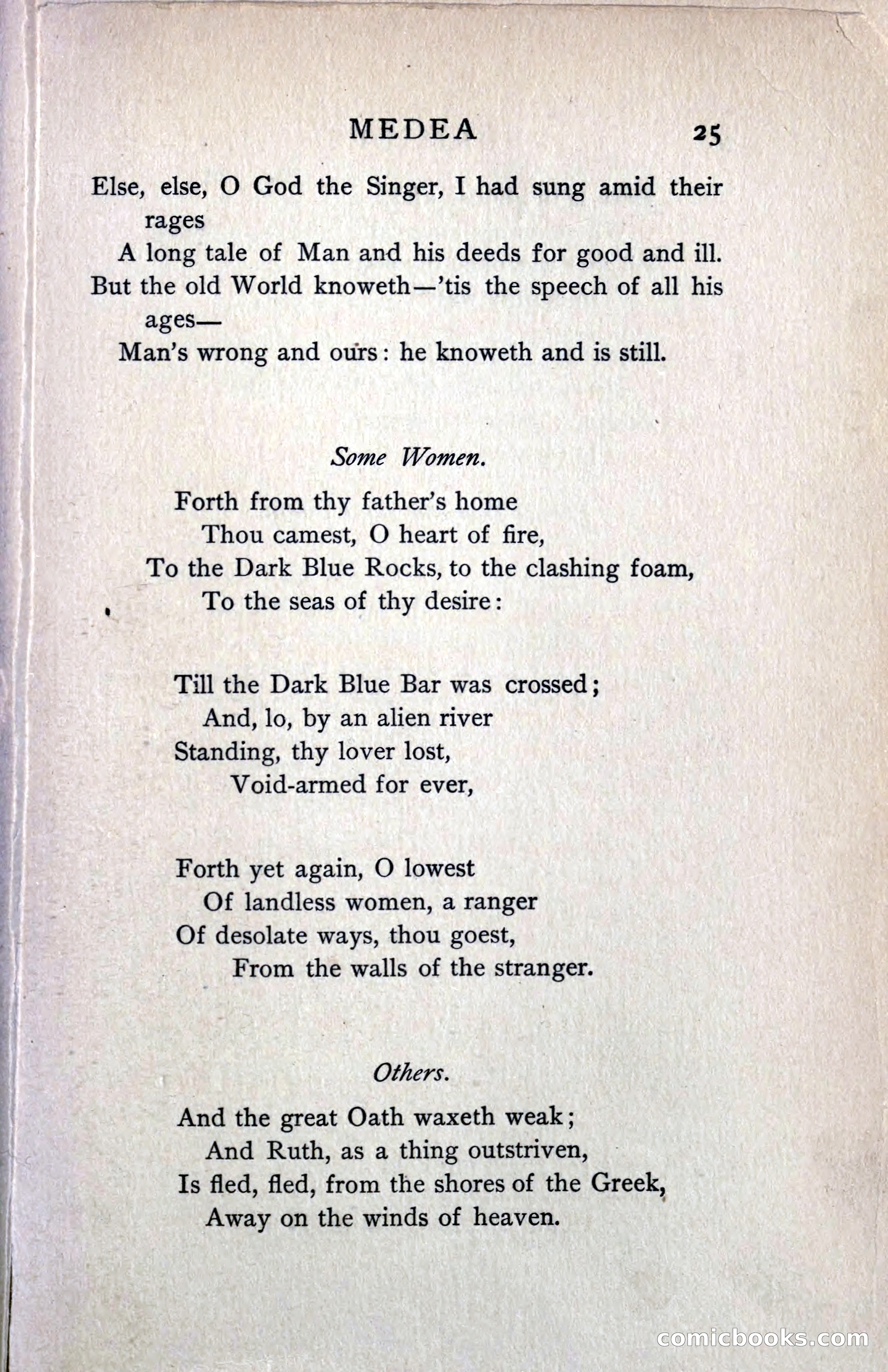
This is a page of running dramatic verse from page 25 of a work titled *Medea*. The text presents poetic dialogue spoken by different groups—identified as "Some Women" and "Others"—addressing a female character who has journeyed from her father's home across seas to a foreign land, lost her lover, and now wanders as a homeless exile. The verses employ archaic language ("knoweth," "waxeth") and reference classical elements like "the Dark Blue Rocks" and "the shores of the Greek," suggesting this is a Victorian dramatic adaptation or reimagining of the classical Medea myth.
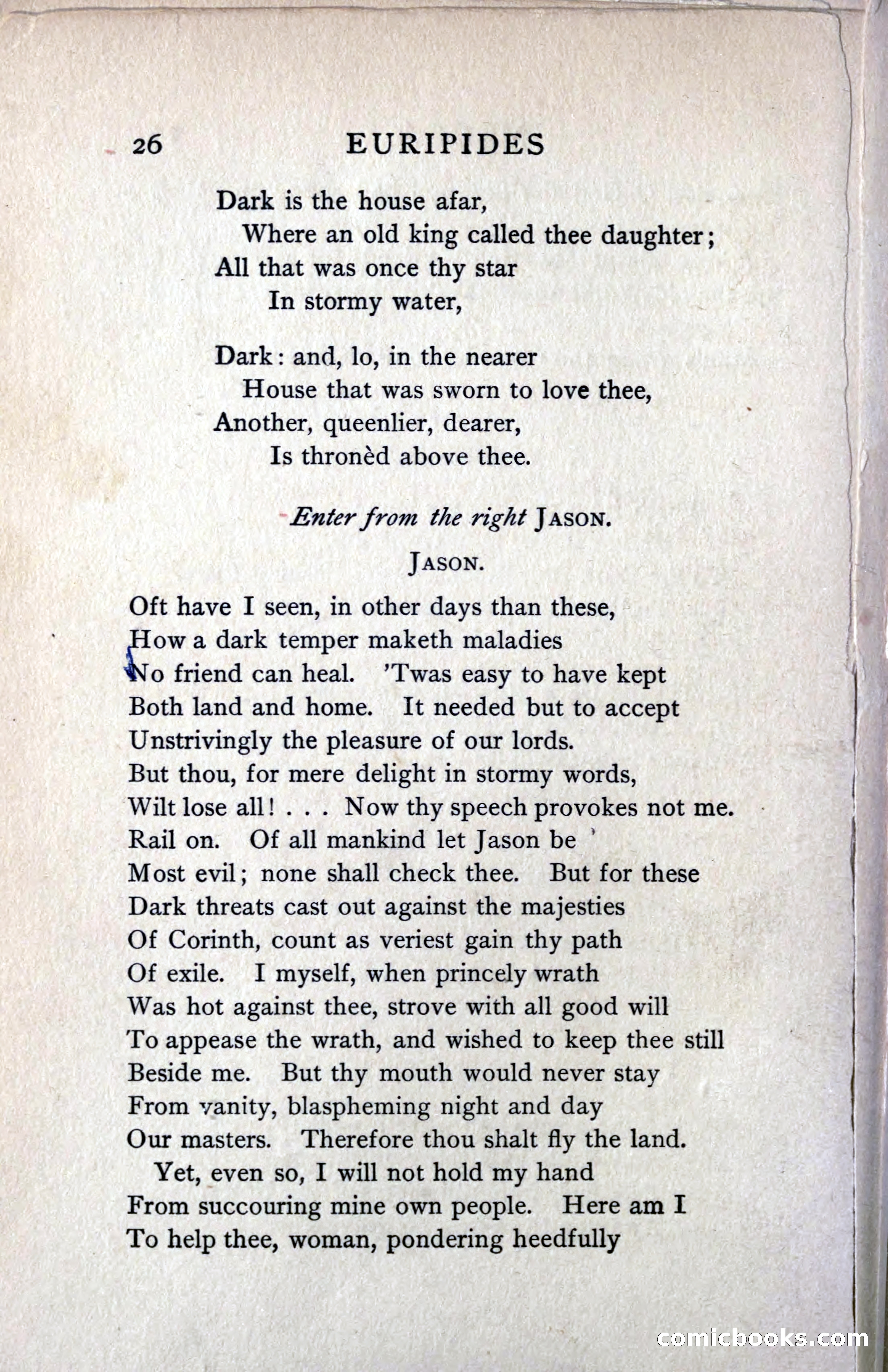
# Victorian Page Analysis This is a page of running dramatic dialogue from what appears to be a theatrical adaptation of a classical work. The page header identifies it as "EURIPIDES" (page 26), and the text consists of poetic dialogue between characters, with a stage direction indicating "Enter from the right JASON." Jason then delivers an extended speech addressing a woman, discussing her exile from Corinth, his past efforts to protect her despite her outspoken criticism of their rulers, and his current willingness to assist her despite their conflict. The verse employs blank verse and rhyming couplets in a Victorian dramatic style.
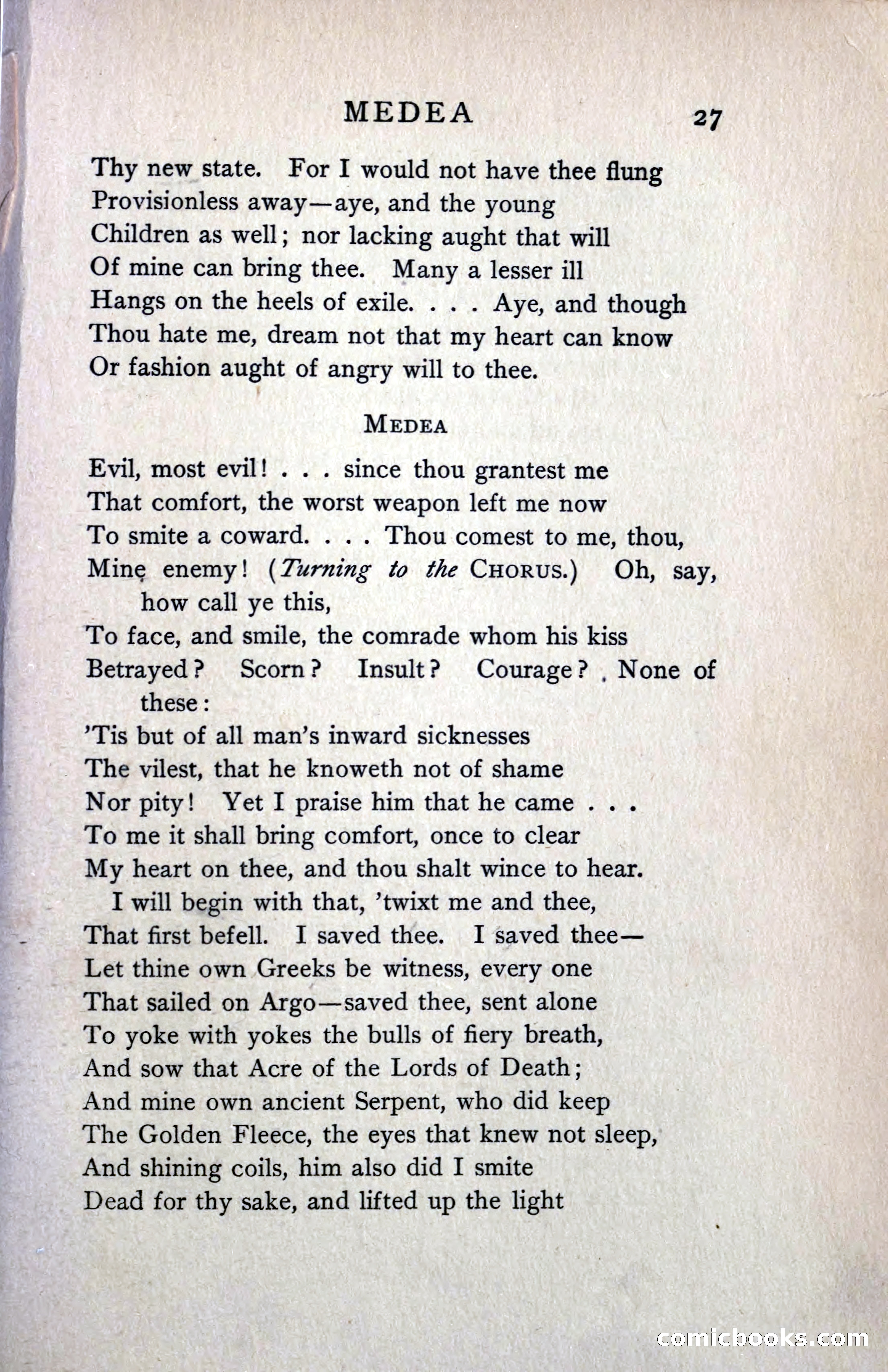
# Page Description This is a running prose page from what appears to be a dramatic text—specifically a Victorian theatrical adaptation of the classical Greek myth of Medea (page 27). The page contains dialogue between Medea and a male character (likely Jason, though not named here), in which Medea responds to his offer of financial support by turning to the Chorus and delivering a bitter monologue. She catalogs her past sacrifices for him—saving him from the Argo's trials, slaying the serpent guarding the Golden Fleece—while condemning his shamelessness in approaching her after his betrayal. The language is blank verse, typical of nineteenth-century dramatic adaptations of classical subjects.
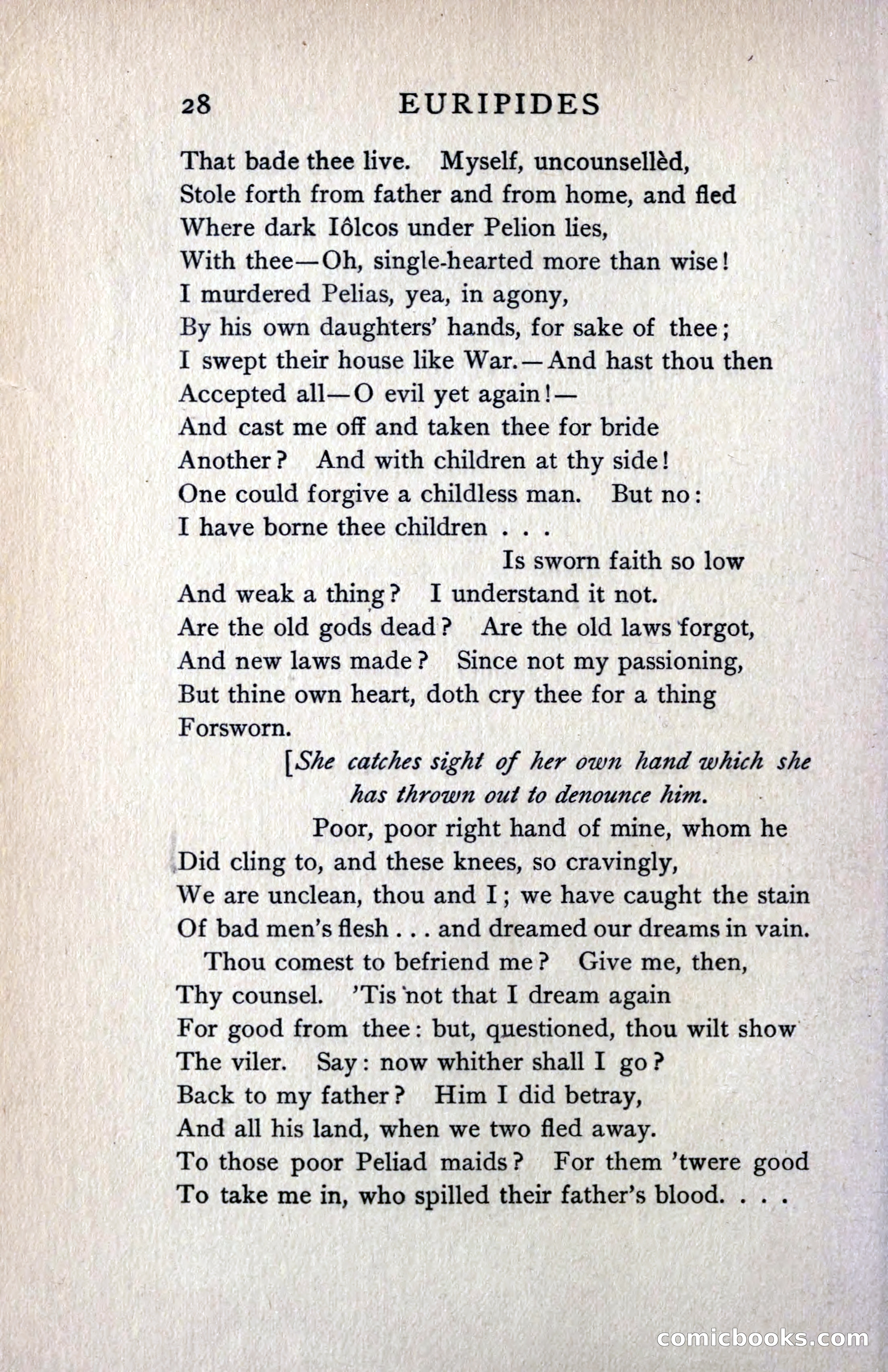
This is a page of running prose—specifically, a dramatic monologue from what appears to be a translation of a classical Greek play. The speaker (a woman, based on context clues) addresses someone who has betrayed her: she recalls abandoning her father and home to flee with him, murdering King Pelias through his own daughters to help him, and now finding herself cast aside for another bride with children. She questions whether oaths and divine law mean nothing, contemplates her own "unclean" hands that clung to him, and despairs over where she can turn—unable to return to her betrayed father or seek shelter with the Peliad maids whose father she killed. The page header identifies it as from "Euripides."
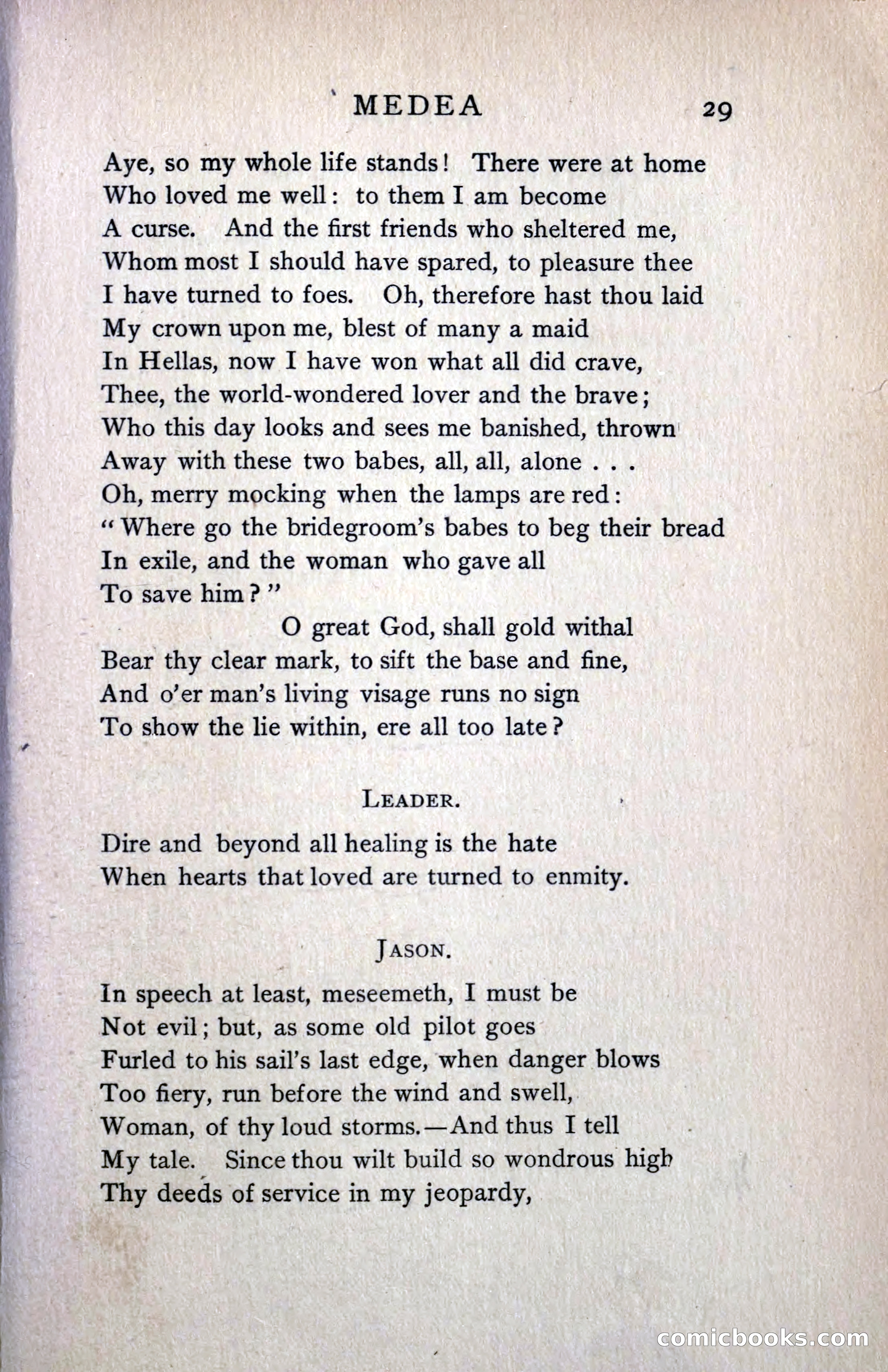
# Page Description This is a page of running theatrical dialogue from "Medea" (page 29), presenting verse drama rather than prose fiction. The page contains speeches from multiple characters—Medea, the Leader (chorus), and Jason—in which Medea laments her abandonment and exile after sacrificing everything for Jason, while Jason attempts to justify himself. The text appears to be a Victorian dramatic adaptation rather than a penny dreadful proper, though it may have been serialized in such publications.
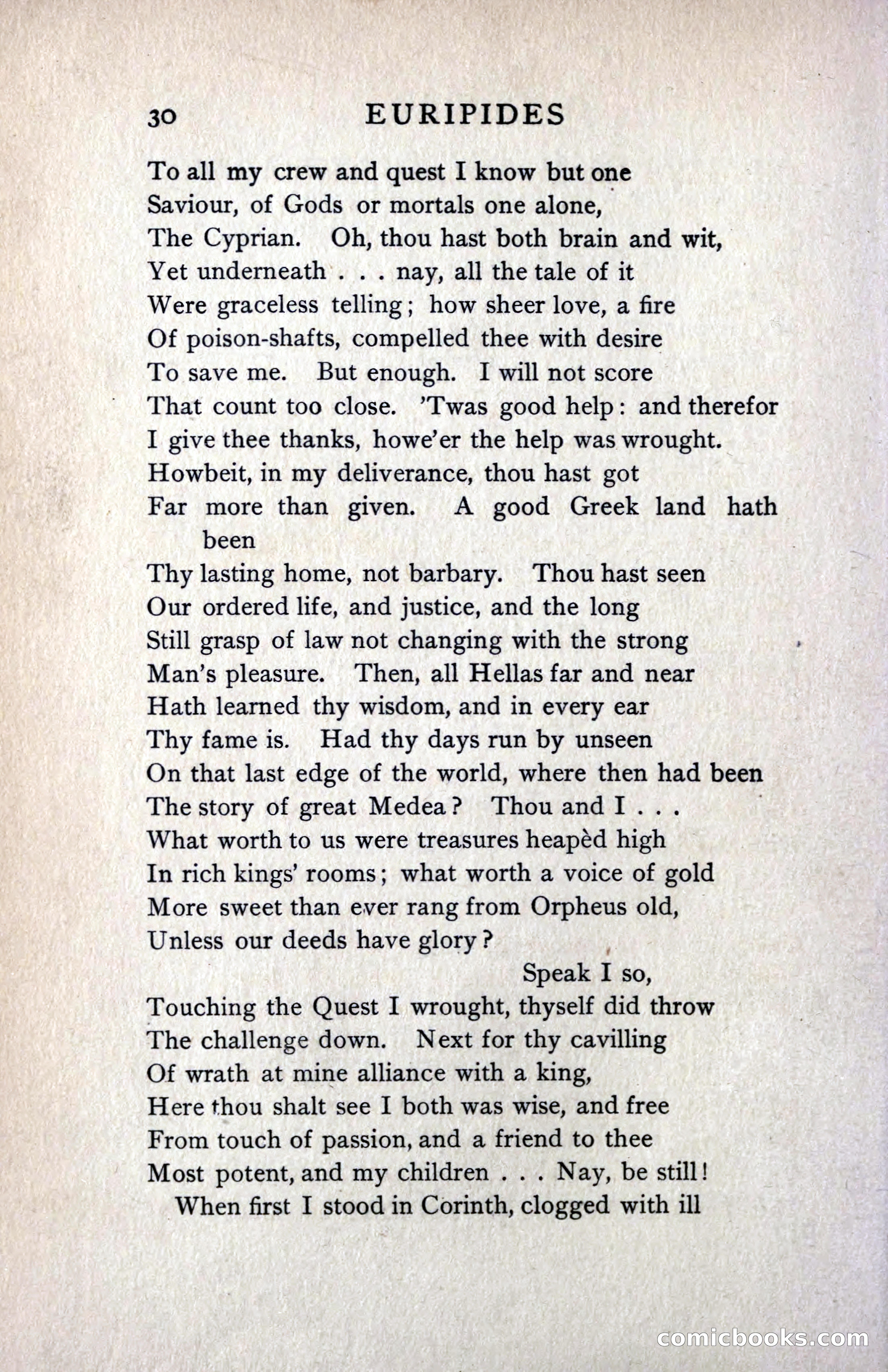
# Page Analysis This is a page of running prose—specifically, dramatic verse from what appears to be a Victorian translation of Euripides' *Medea* (the page header confirms "EURIPIDES"). The text shows a character addressing another, discussing gratitude for help received, the benefits of Greek civilization, and the importance of glorious deeds. The speaker then shifts to defending their own actions regarding a quest and an alliance with a king, while addressing concerns about passion and their children. This is classical dramatic dialogue rendered in English verse, not a penny dreadful at all—the OCR identification appears erroneous.
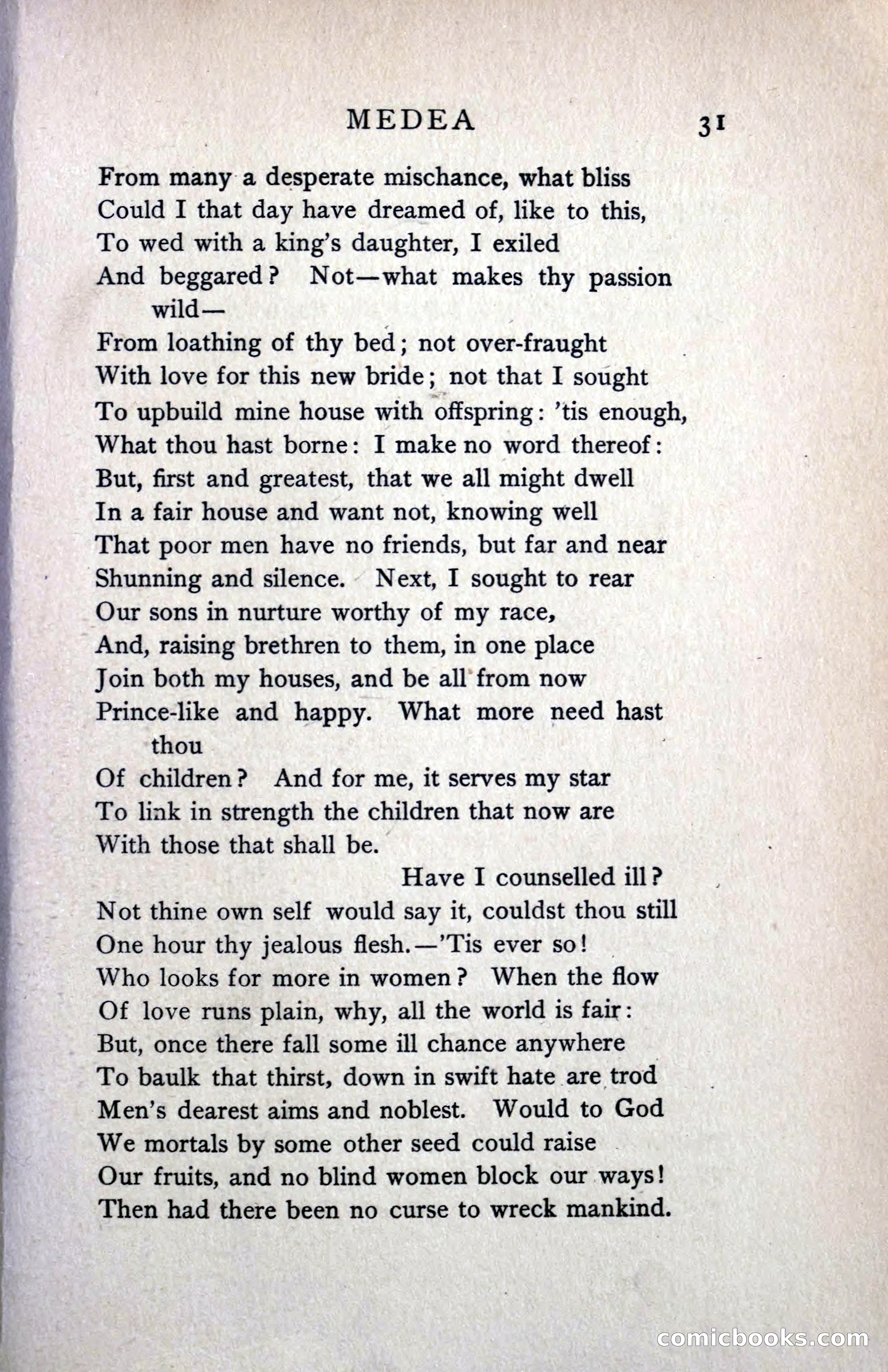
# Page Description This is a page of running dramatic verse from what appears to be a theatrical adaptation or translation of the classical play *Medea* (page 31). The text is a monologue in which a male character—likely Jason—justifies his remarriage to a king's daughter, arguing his motives were practical (securing wealth and status for his family) rather than lustful. He concludes with a misogynistic tirade blaming women's jealousy for mankind's destruction. The passage is printed in standard Victorian book format with no illustrations.
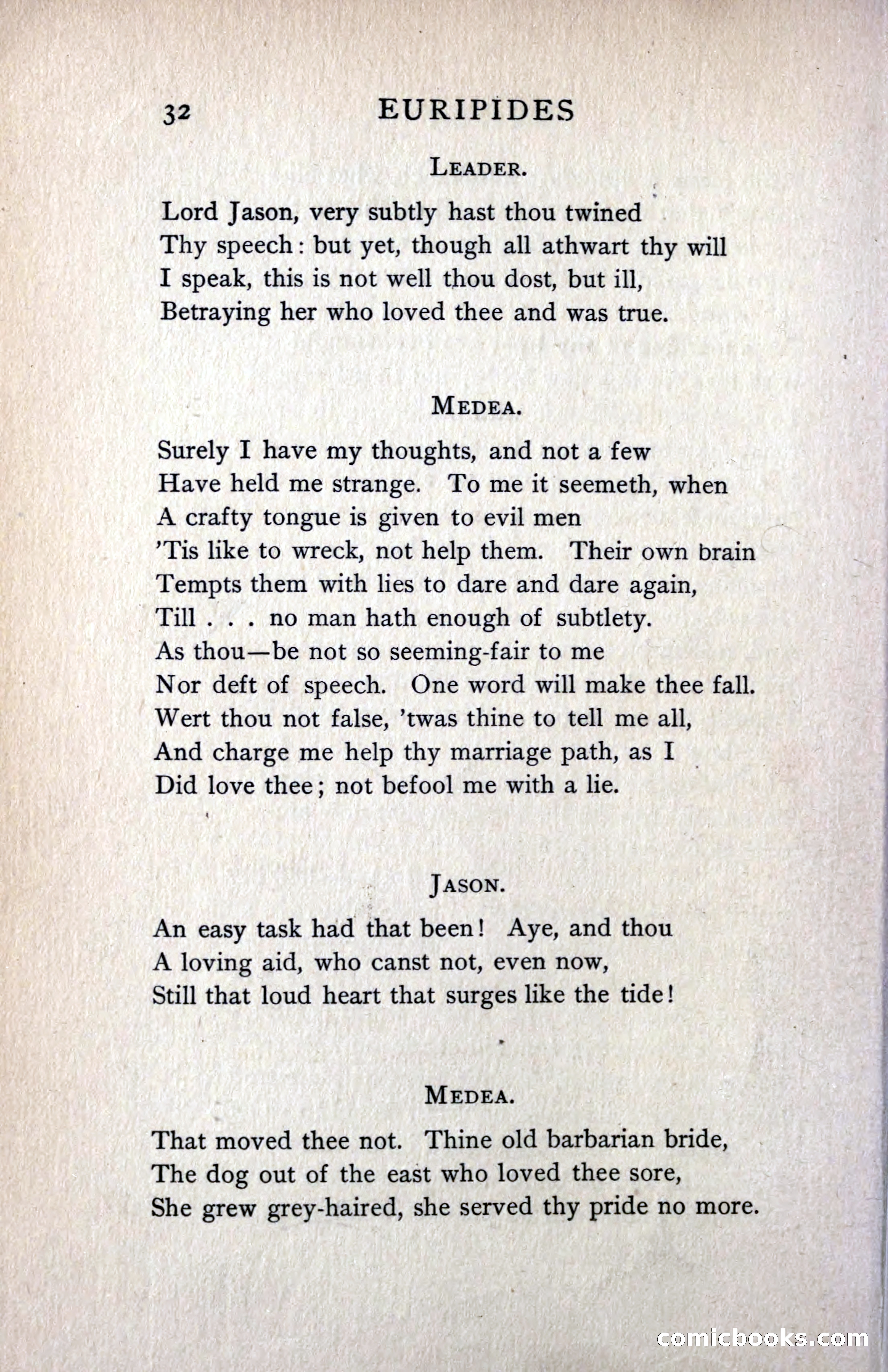
This is a page of running dramatic dialogue from what appears to be a classical translation rather than a Victorian penny dreadful. The page presents a confrontation between Jason and Medea, with a Leader (chorus) interjecting. Medea accuses Jason of betrayal and deceit in his marriage, while Jason defends himself and Medea responds with bitter recriminations about his abandonment of his aging foreign wife. The text is formatted as stage dialogue typical of dramatic literature, numbered page 32, with character names in capitals preceding their speeches.
# Page Description This is a page of running dramatic dialogue (page 33) from what appears to be a stage adaptation or theatrical version titled "Medea." The page contains alternating speeches between two characters, Jason and Medea, written in blank verse. Jason argues that the girl means nothing to him and that he seeks only to save Medea and produce sons; Medea responds bitterly about her exile and suffering, while Jason blames her for her own misfortune. The exchange ends with Medea sarcastically asking whether she has caused her downfall by "seducing and forsaking" Jason. The text is printed in standard Victorian typography on aged paper.
# Page Content Analysis This is a running prose page from what appears to be a dramatic text. The page displays dialogue between two characters—Jason and Medea—from Euripides' classical play *Medea*. Jason offers financial aid and assistance to the exiled Medea and their children, while Medea refuses his help, declaring she will accept nothing from him, calling the fruits of their union "unholy" and incapable of bringing blessing. The page number 34 appears at top left, suggesting this is from a longer published edition rather than a penny dreadful installment.
# Page 35 of *Medea* This is a text page from what appears to be a dramatic adaptation of the classical *Medea* story. The page contains dialogue and a chorus section in verse form. Medea speaks bitterly to her departing husband, cursing him with suffering, while the Chorus that follows philosophizes extensively on the nature of love—describing it as both destructive ("falleth like a flood") and potentially gentle, before appealing to Cyprian (Venus) not to afflict them with love's poisonous arrows. The page number indicates this is part of a larger serialized work.
# Victorian Page Analysis This is a page of running prose from what appears to be a dramatic work — specifically a translation or adaptation of Euripides' *Medea*. The page contains poetic dialogue attributed to a chorus ("Others") lamenting exile, homelessness, and the betrayal of friendship, followed by a stage direction describing Medea waiting at her doorstep as a traveler approaches her. The text emphasizes themes of displacement ("A woman without a city"), family bonds, and emotional betrayal, presented in blank verse typical of Victorian dramatic translations.
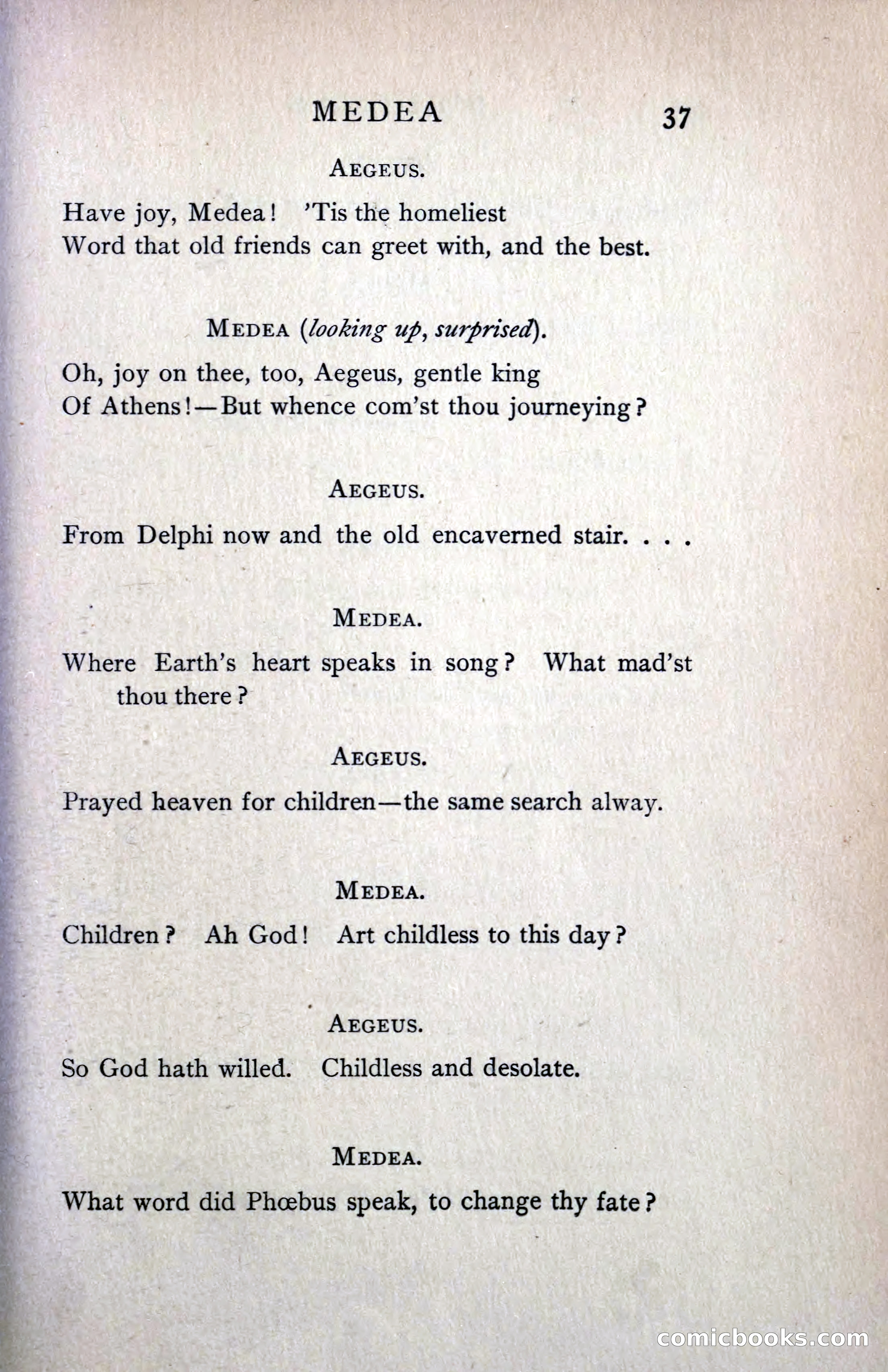
This is a page of running dramatic dialogue from what appears to be a theatrical adaptation of the classical tragedy *Medea*. The scene shows a conversation between the character Medea and Aegeus, king of Athens, who has just arrived from Delphi. Aegeus reveals he traveled to the oracle to pray for children, as he remains childless and desolate. Medea responds with surprise and asks what prophecy Phoebus (Apollo) delivered regarding his fate. The page number is 37, and the text uses stage directions in italics (e.g., "looking up, surprised").
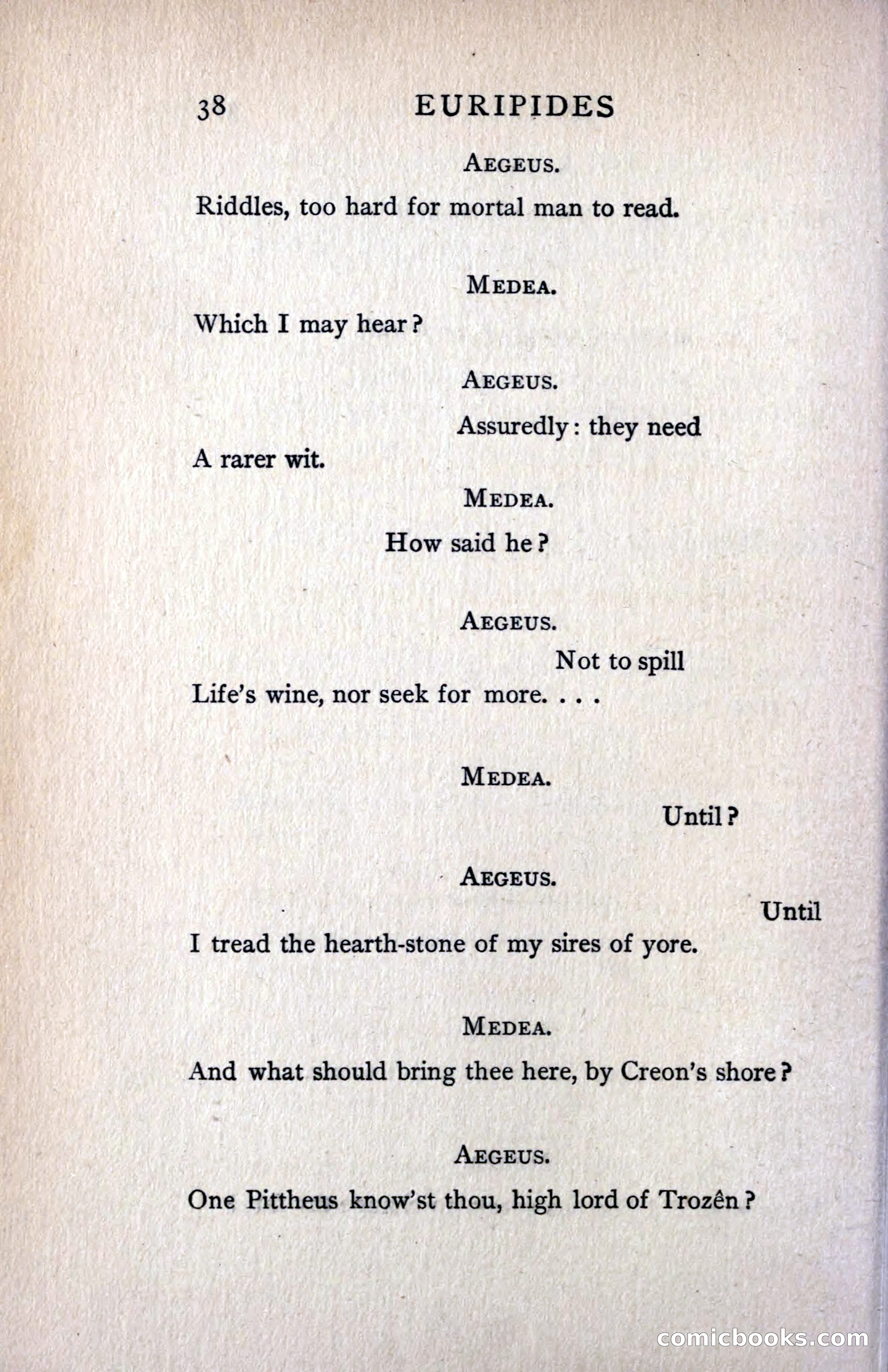
This is a page of running dialogue from a dramatic text, specifically a Victorian-era translation of Euripides' *Medea*. The page shows a conversation between the characters Aegeus and Medea, where Aegeus speaks in riddles about not spilling "Life's wine" and treading upon his ancestors' hearth-stone, while Medea questions him about his purpose and his knowledge of Pittheus, lord of Trozen. The text is formatted as dramatic verse dialogue with character names in capitals preceding their lines.
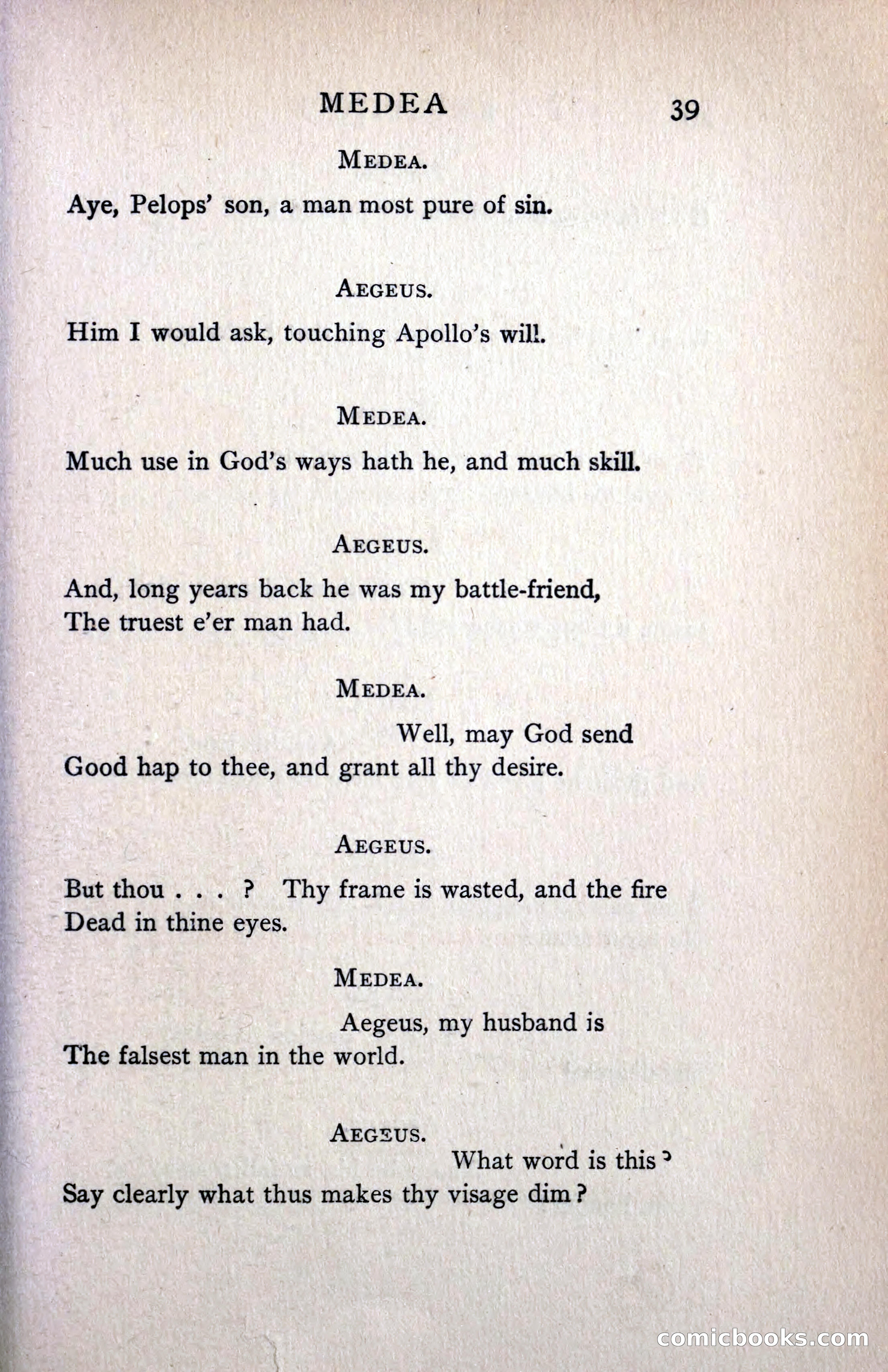
# Page Description This is a page of running dialogue from what appears to be a dramatic adaptation or translation of the classical play *Medea*. The page shows a conversation between the characters Medea and Aegeus, presented in verse form. Medea complains that her husband is "the falsest man in the world," while Aegeus expresses concern about her wasted appearance and dimmed eyes, asking her to explain what troubles her. The dialogue employs archaic language typical of Victorian-era theatrical or literary adaptations ("e'er," "hath," "thy visage").
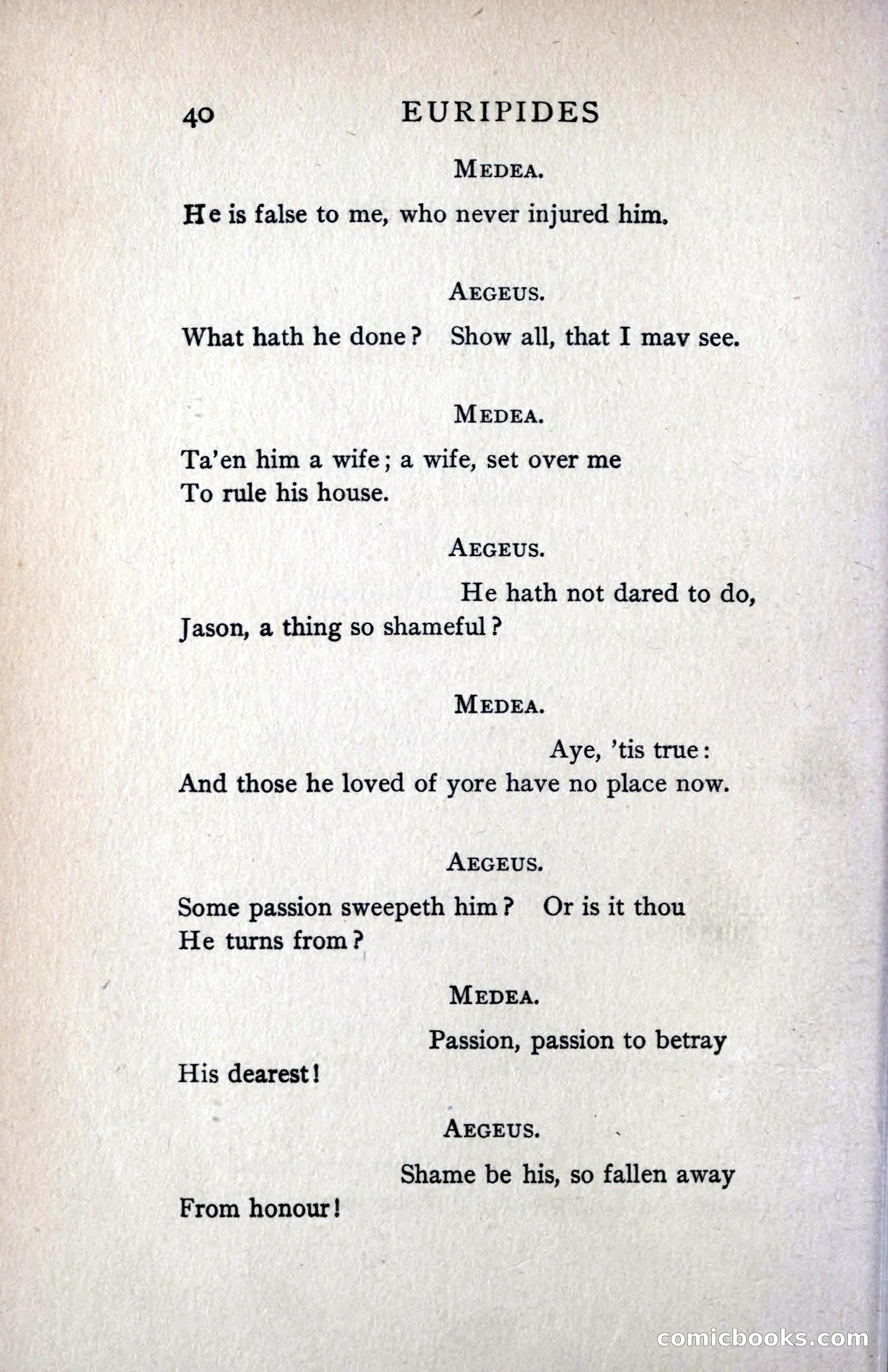
This is a page of running dramatic dialogue from Euripides' *Medea*, presented as a Victorian edition or translation (page 40). The text shows a conversation between Medea and Aegeus in which Medea accuses Jason of betrayal—specifically, of taking a new wife to rule his house, thereby displacing Medea and abandoning those he formerly loved. Aegeus responds with shock and moral condemnation of Jason's infidelity and loss of honor. The dialogue is formatted as a stage play with character names in capitals preceding their lines.
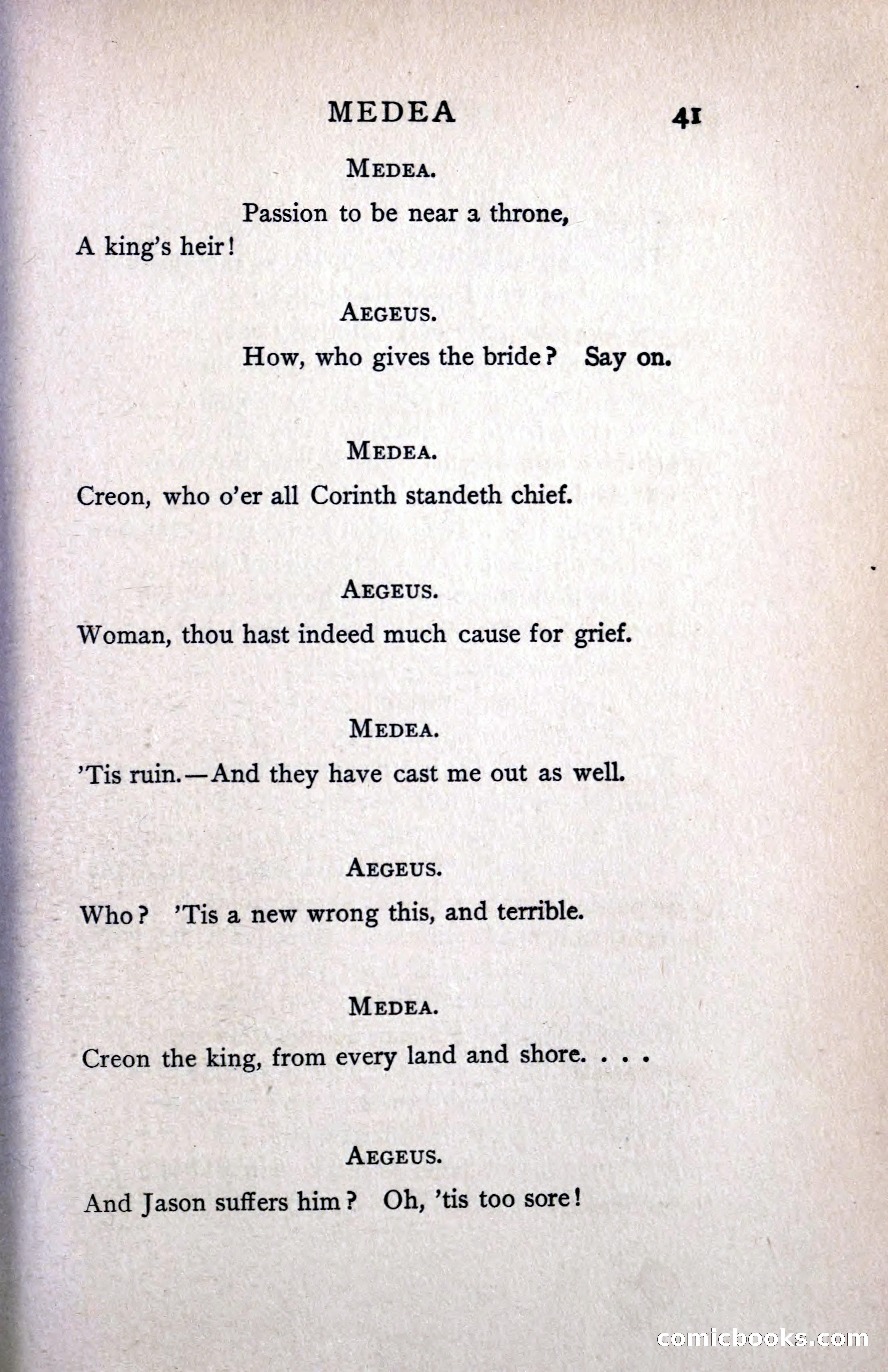
# Page Description This is a page of running dramatic dialogue from what appears to be a Victorian theatrical adaptation or version of the classical tragedy *Medea*. The page number is 41. It shows a conversation between the characters Medea and Aegeus in which Medea reveals her distress: Creon, ruler of Corinth, is giving his daughter (Medea's rival) to Jason in marriage, and has banished Medea from his kingdom. Aegeus expresses shock and sympathy at these injustices. The text is presented as simple stage dialogue with character names in capitals preceding their lines.
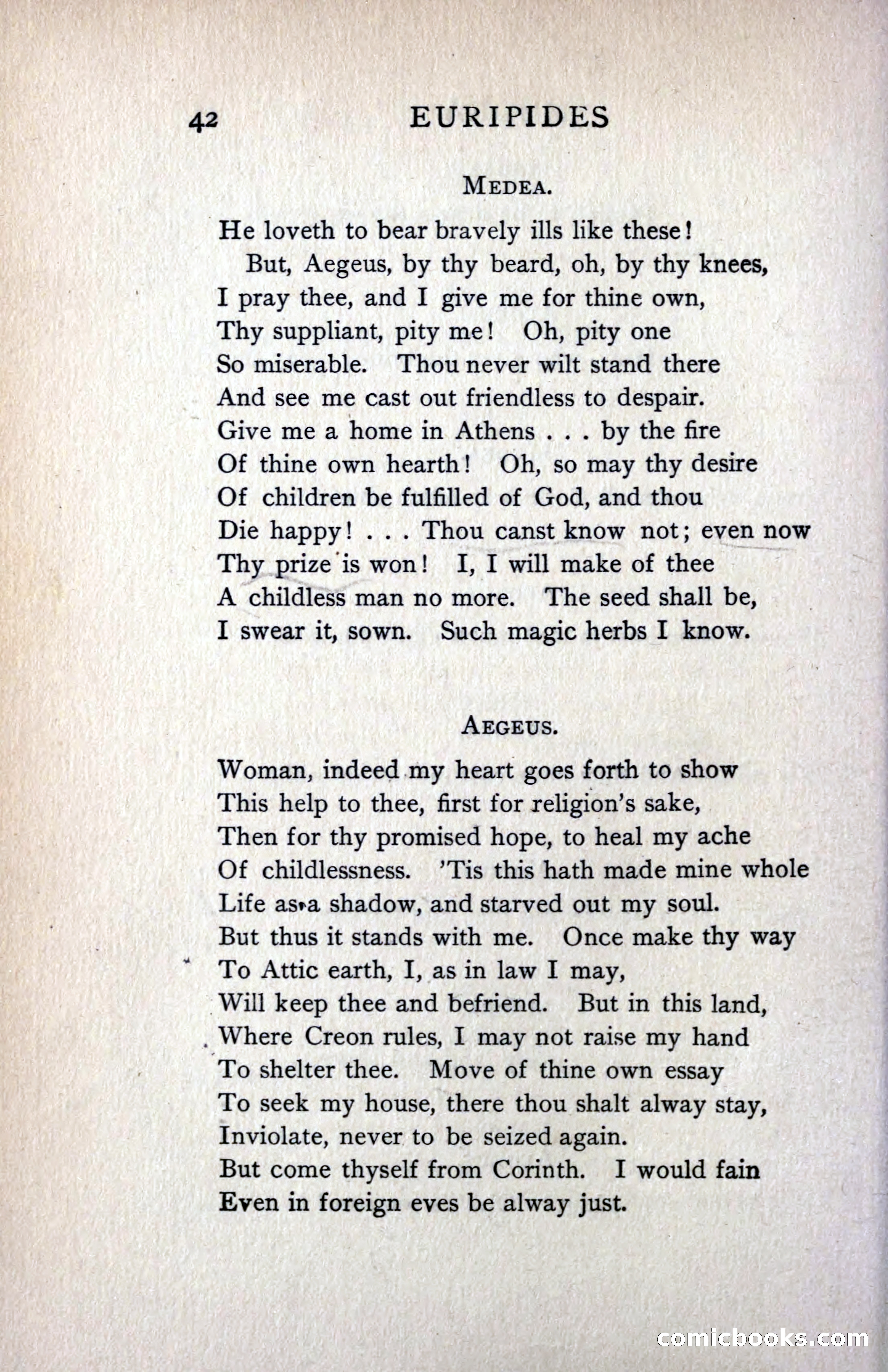
# Analysis This is a page of running dramatic dialogue—specifically, a scene from Euripides' *Medea* in English translation. The page shows two characters, Medea and Aegeus, in conversation. Medea pleads with Aegeus for refuge in Athens, promising him children through magical means in exchange for his protection. Aegeus responds sympathetically but cautiously, agreeing to shelter her in Athens only if she reaches his house of her own accord, since he cannot openly defy Creon's rule in Corinth. The text is printed prose dialogue formatted as drama, not a sensational penny dreadful narrative as initially suggested—this appears to be a classical dramatic text, not Victorian sensation fiction.
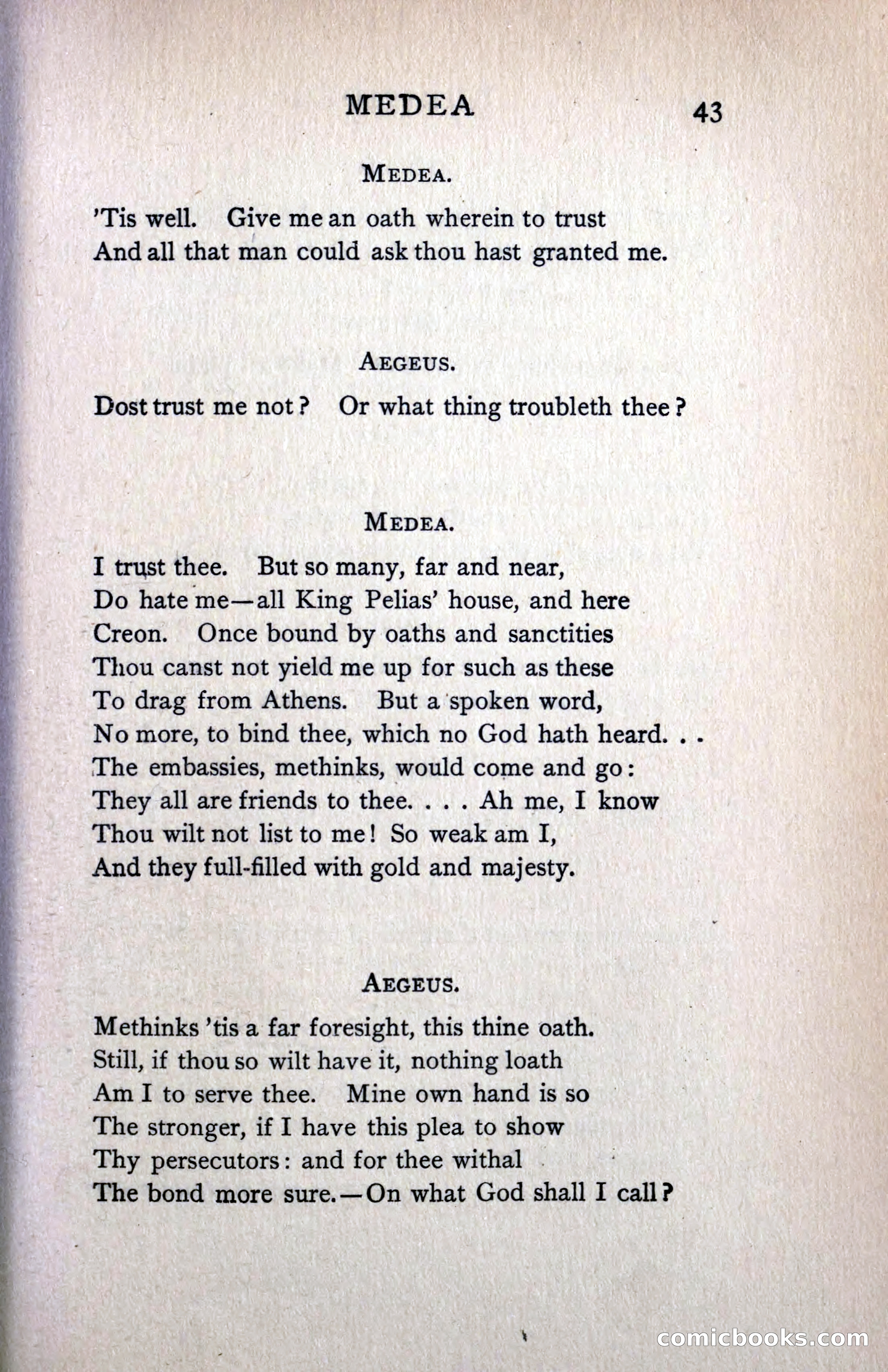
This is a page of running dramatic dialogue from what appears to be a theatrical adaptation of the classical tragedy *Medea*. The scene shows Medea negotiating with Aegeus for protection and asylum, requesting he swear an oath to shelter her from her enemies (King Pelias's house and Creon). Medea expresses doubt that Aegeus will honor a mere spoken word without divine sanction, fearing his more powerful allies will sway him. Aegeus responds by offering to swear a binding oath before the gods, willing to support her cause as protection against her persecutors.
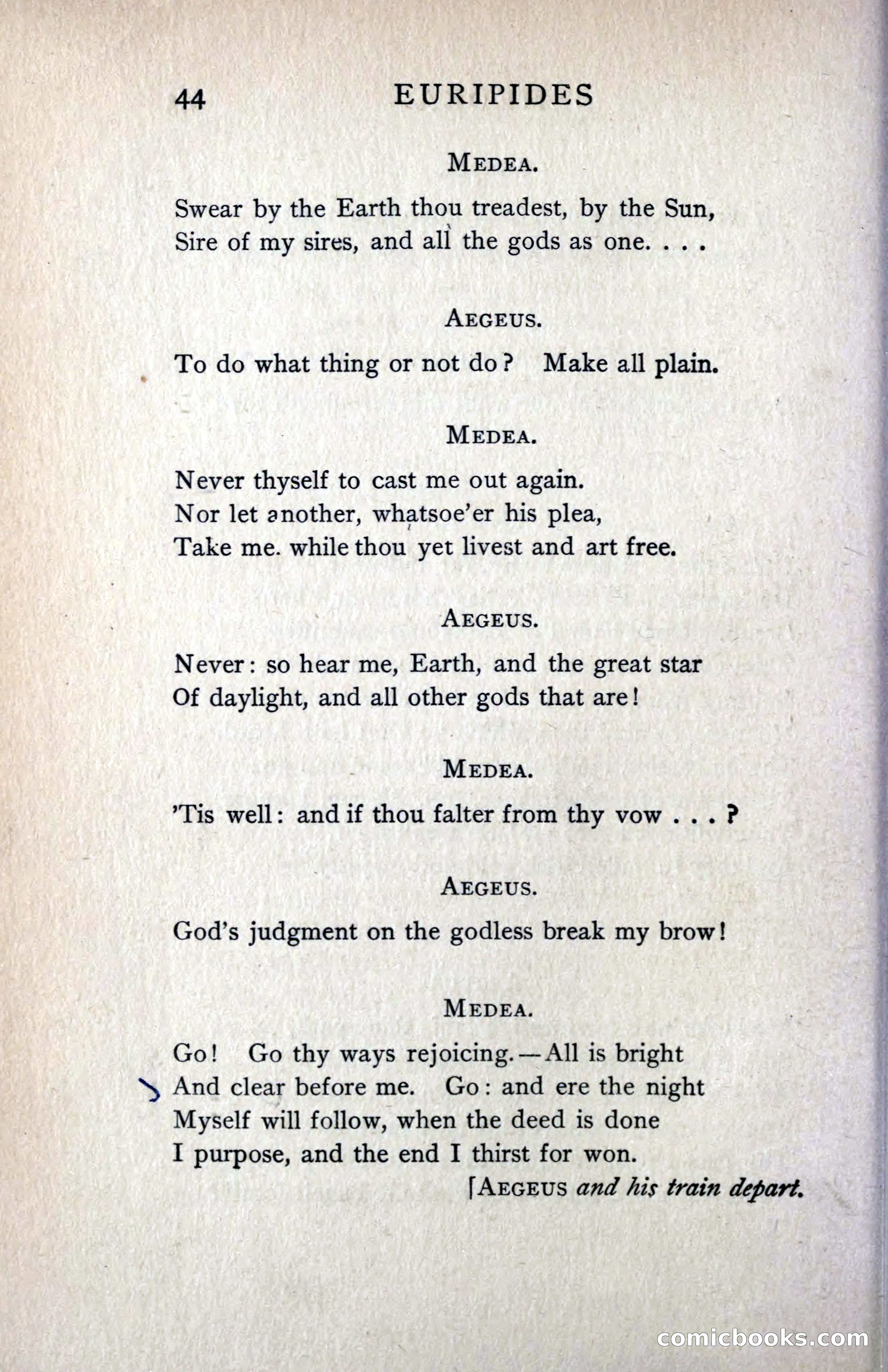
# Page Description This is a page of running dramatic dialogue from what appears to be a Victorian edition of Euripides' *Medea*. The text presents an exchange between the characters Medea and Aegeus in which Medea demands that Aegeus swear by the Earth, Sun, and gods never to cast her out or allow another to take her while he lives. Aegeus accepts the oath, invoking divine punishment if he breaks it. Medea then dismisses him, declaring she will follow after nightfall once she has completed an unspecified deed she is determined to accomplish. The page ends with a stage direction indicating Aegeus and his attendants exit.
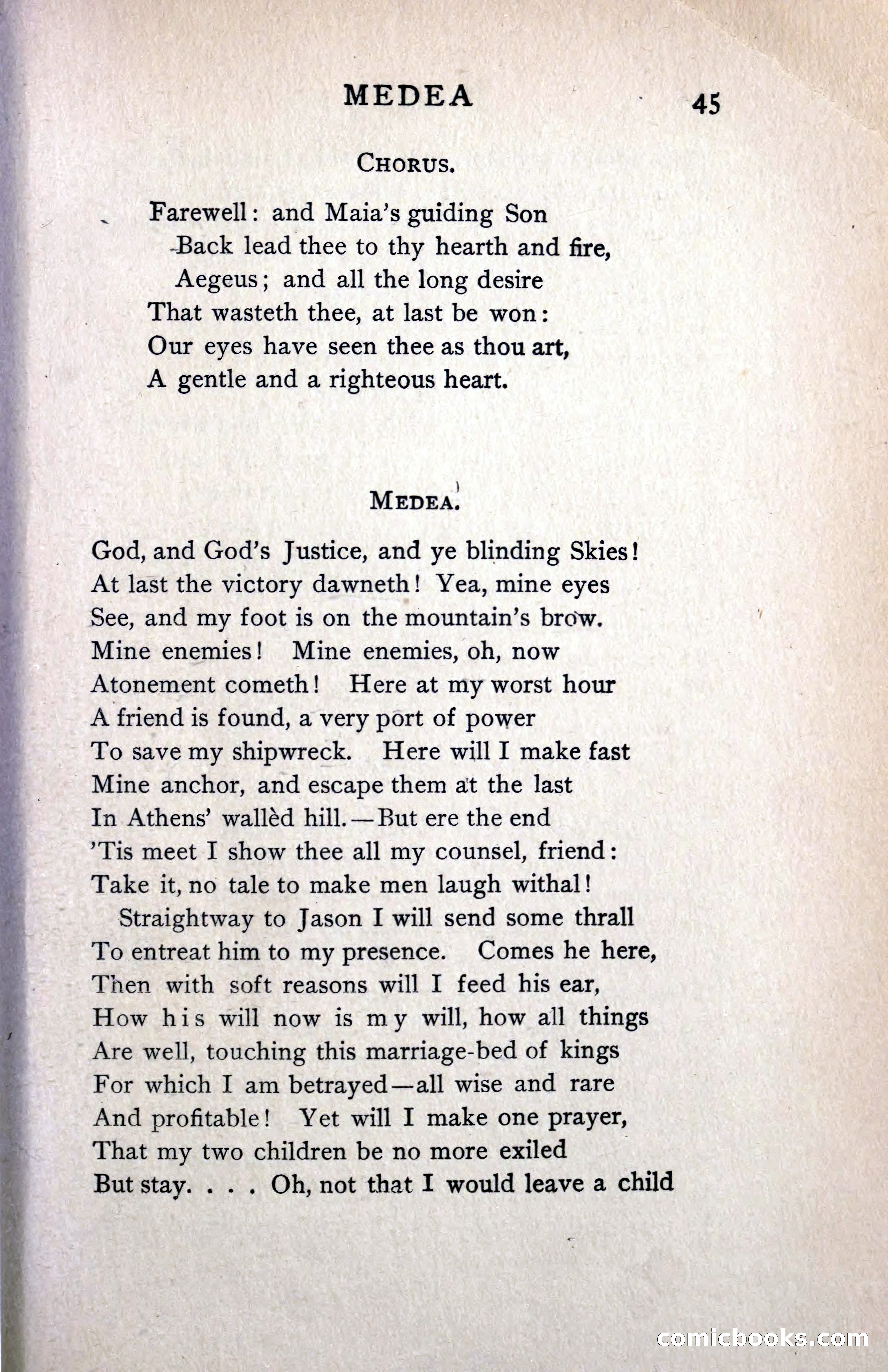
# Page 45 of "Medea" This is a text page of running prose drama, showing a theatrical scene. It contains a choral passage bidding farewell to Aegeus, praising his gentle and righteous heart, followed by a longer soliloquy from Medea herself. Medea exults over her victory against her enemies, announces her plan to escape to Athens, and reveals her intention to manipulate Jason through soft persuasion regarding their children. The passage suggests betrayal, exile, and Medea's internal conflict about leaving a child behind. The dialogue employs dramatic blank verse typical of stage drama, though the specific adaptation and playwright are not identified on this page.
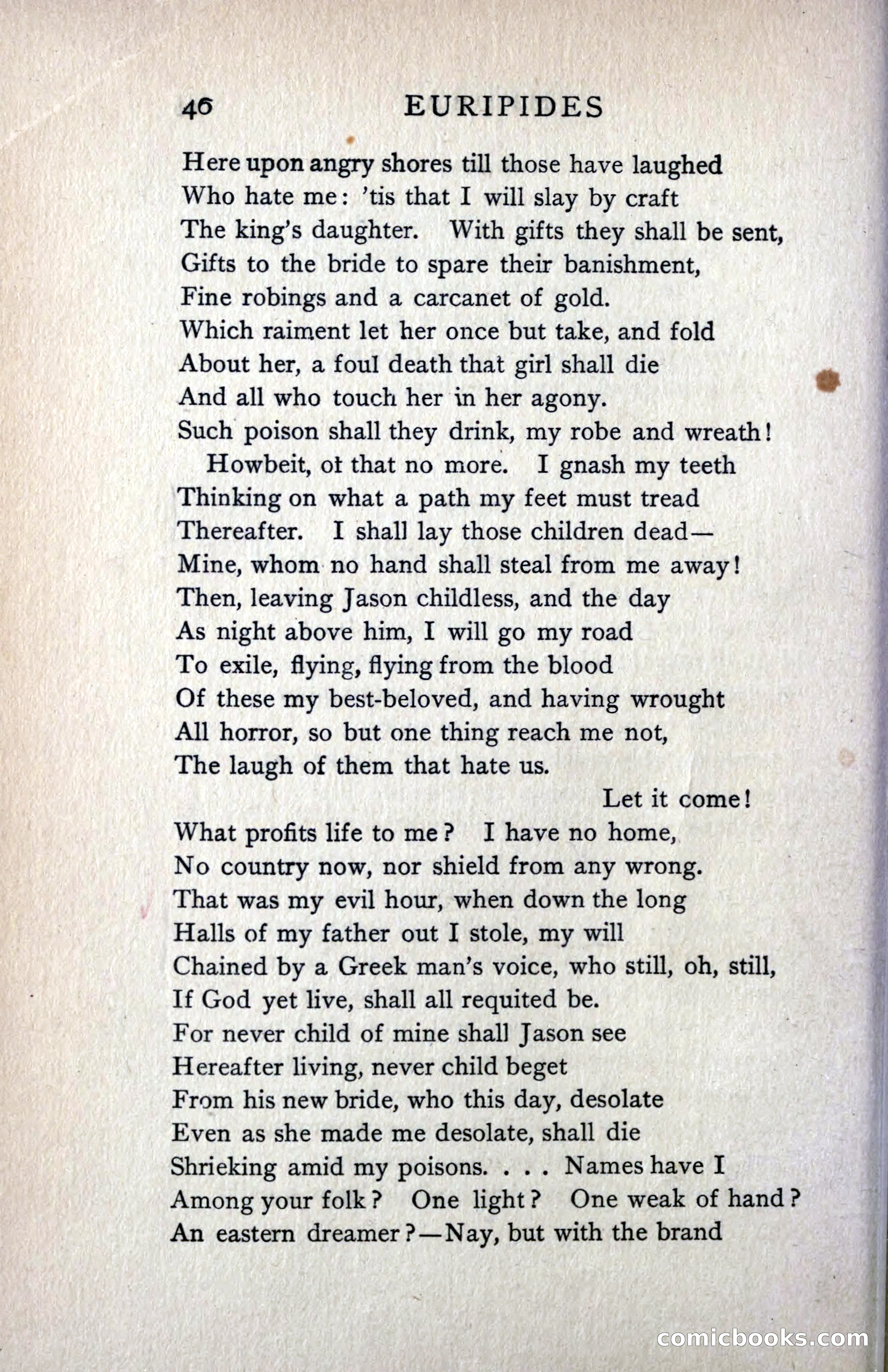
# Page 46: Running Prose from Euripides This is a page of running prose—specifically, a dramatic monologue translated from Euripides. The speaker (apparently a woman wronged by a Greek man named Jason) outlines her plan for revenge: she will poison the king's daughter with gifts, kill her own children to prevent Jason from having heirs, and then flee into exile. She expresses her desperation and rage, declaring she has no home or country, and demanding to know if anyone among the listeners possesses courage or cunning to aid her cause. The text appears to be a classical dramatic translation, not a penny dreadful original composition.
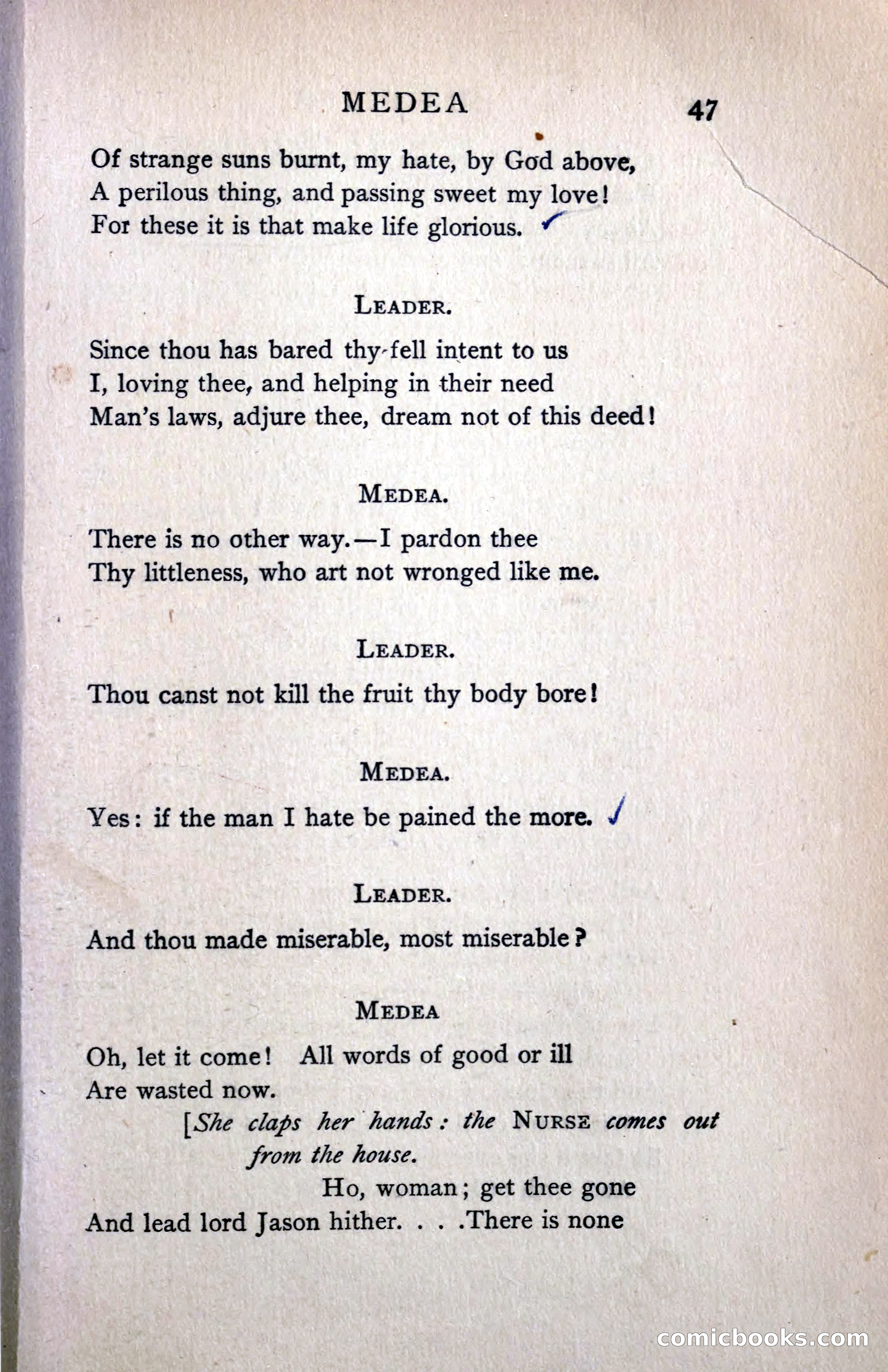
# Analysis of Page 47 This is a page of **dramatic dialogue in verse**, not a penny dreadful but rather a Victorian theatrical text—specifically from a classical play adaptation. The page shows dialogue between the character **Medea** and a **Leader** (likely a chorus figure), with stage directions in italics. Medea speaks of hatred and love, insisting there is "no other way," while the Leader attempts to dissuade her from an unstated but clearly terrible deed. A stage direction indicates Medea claps her hands, summoning a Nurse, and instructs that "lord Jason" be brought to her. The text suggests Medea is resolved to act despite moral objections from those around her.
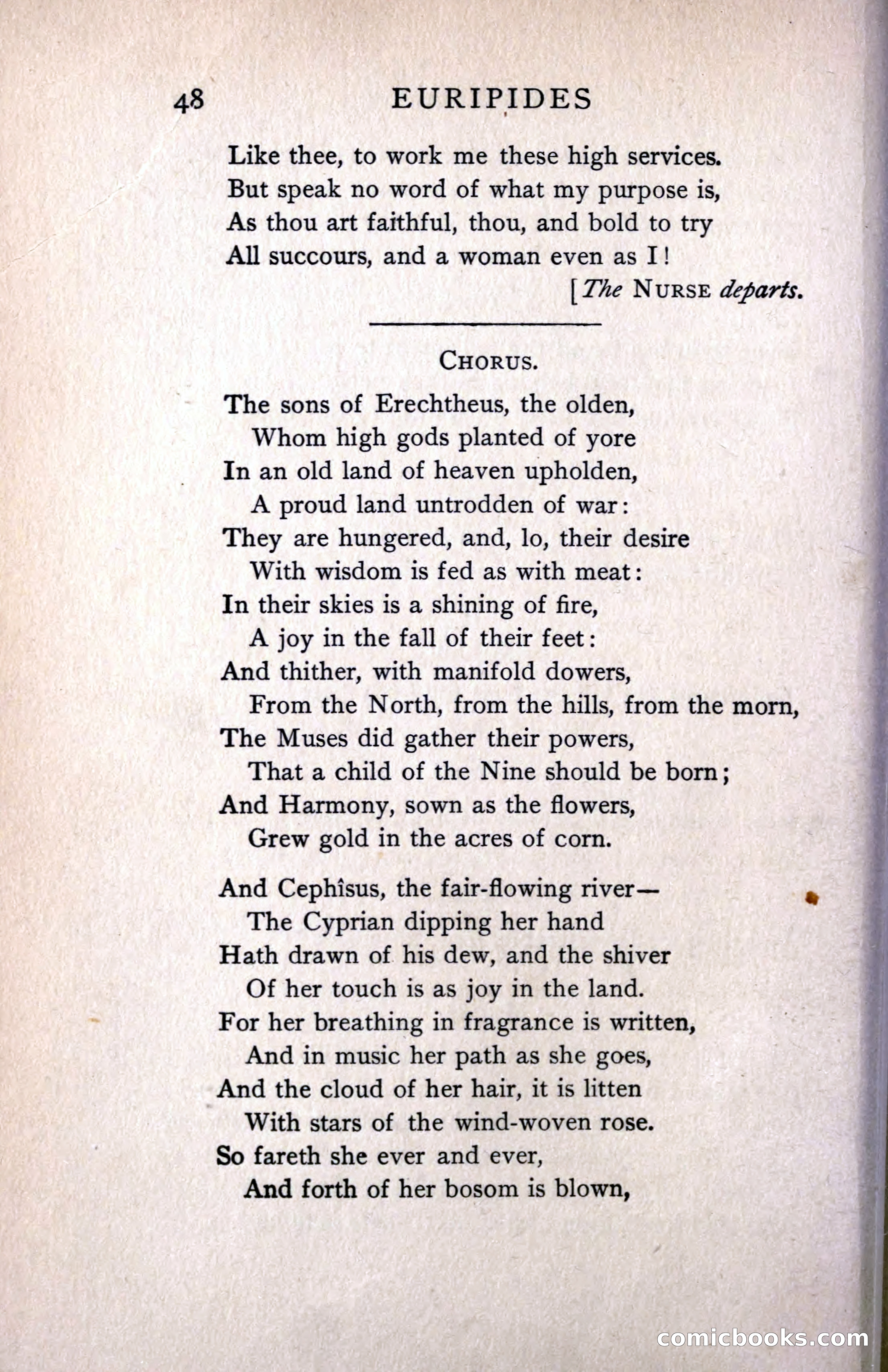
# Page 48 from a Victorian Edition of Euripides This is a page of dramatic text from a classical work—specifically a play by the ancient Greek playwright Euripides, presented in Victorian-era English translation. The visible content shows the end of a scene where the Nurse departs, followed by a lengthy Chorus passage praising the sons of Erechtheus and celebrating a divine child born through the Muses' intervention. The text employs elaborate poetic language describing natural beauty, godly patronage, and the mythological landscape of ancient Athens, with particular focus on the river Cephisus and a feminine divine figure. This is running dramatic verse, not a penny dreadful as initially suggested—it appears to be a scholarly or literary edition of classical drama.
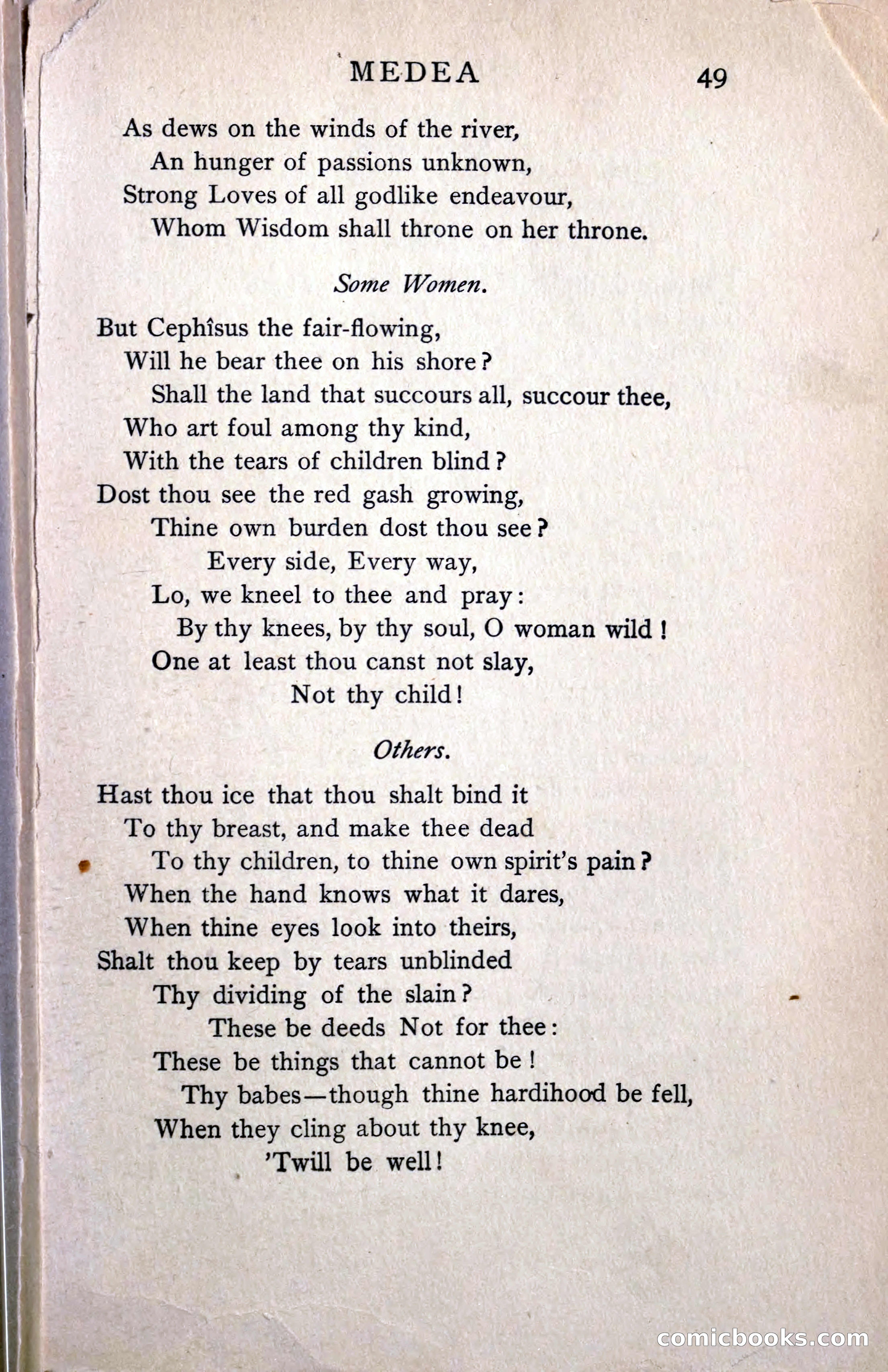
# Page Analysis This is a page of running dramatic verse from page 49 of what appears to be a stage adaptation or poetic rendering of *Medea*. The text consists of dialogue between grouped speakers—"Some Women" and "Others"—pleading with a female character (apparently Medea) not to harm her children. The speakers invoke imagery of rivers, tears, and maternal bonds, urging her to resist whatever dark deed she contemplates. The passage emphasizes the impossibility of a mother killing her own children, ending with reassurance that "when they cling about thy knee, / 'Twill be well!" The language is Victorian dramatic blank verse treating the classical myth.
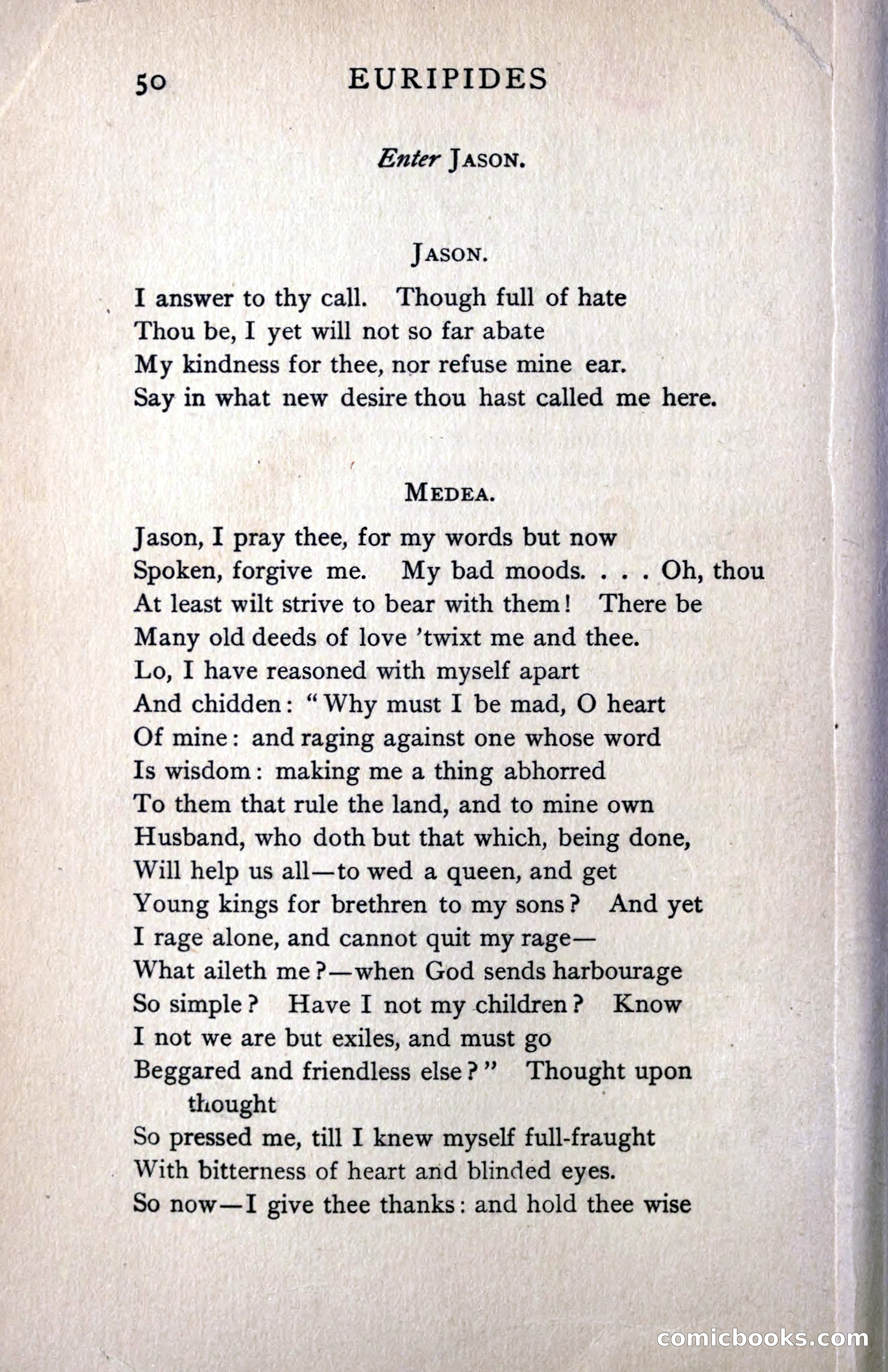
# Page Analysis This is a page of running dramatic dialogue, likely from a Victorian theatrical edition or adaptation rather than a penny dreadful. Page 50 presents a scene from Euripides' *Medea*, showing Jason's entrance and a lengthy speech by Medea. She apologizes for her earlier harsh words, describes her internal conflict about Jason's remarriage to a queen, and acknowledges her rage has blinded her judgment. The text is formatted as classical drama with character names and verse dialogue. This appears to be a printed play text rather than sensation fiction.
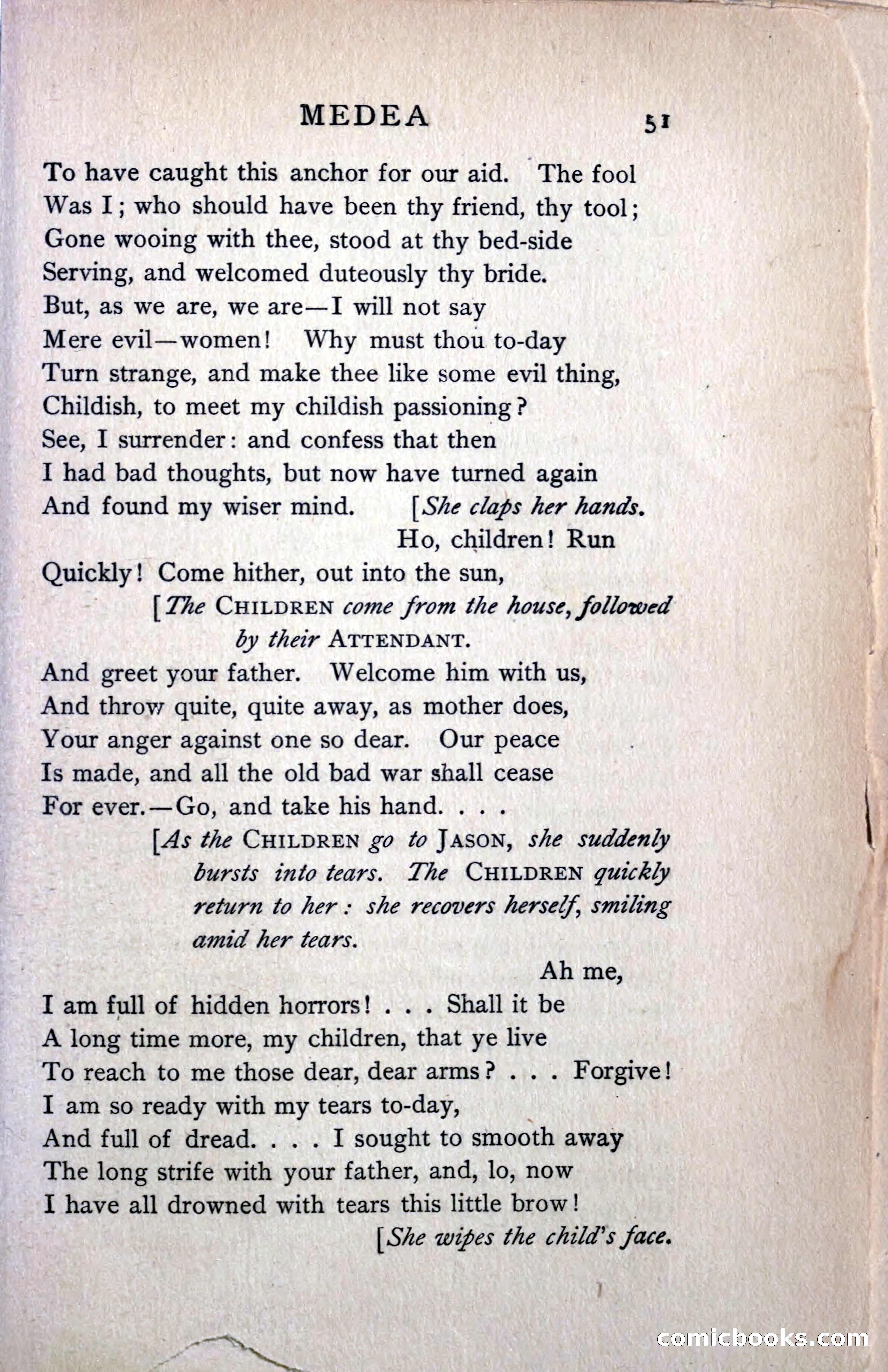
# Page Analysis This is a page of running dramatic prose from what appears to be a theatrical adaptation of the classical tragedy *Medea* (page 51). The text shows Medea reconciling with Jason and summoning their children to greet him, instructing them to abandon their anger. Stage directions in italics indicate the children's entrance and Medea's emotional breakdown as they approach their father. The passage depicts Medea's internal conflict—she attempts to compose herself while being overwhelmed by "hidden horrors" and dread, ultimately weeping over her child. The text is verse drama presented in a serialized fiction format typical of Victorian penny dreadful publications.
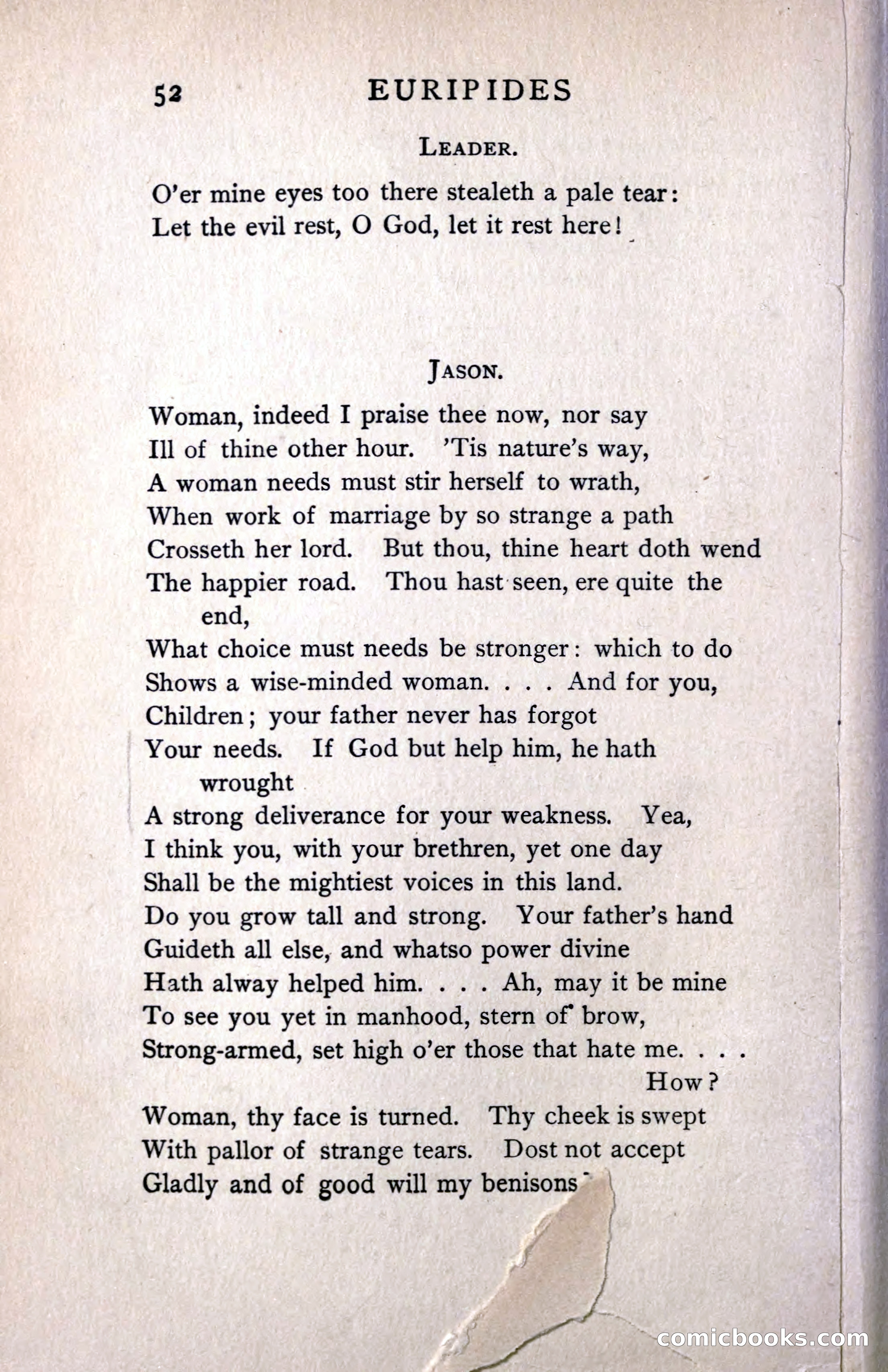
# Victorian Page Analysis This is a page of running prose dialogue from a classical dramatic text—specifically a scene from Euripides featuring the characters Leader, Jason, and a Woman. The page number is 52. Jason delivers a lengthy speech praising the Woman for her wisdom in accepting their separation, assuring their Children of his continued care and divine support, and expressing hope to see them grown strong. The Woman responds with visible emotion—her face turned away, tears on her cheek—and Jason questions whether she accepts his blessings. The text is formatted as dramatic verse with character names in caps preceding their speeches. This appears to be from a Victorian edition of classical drama, not a penny dreadful as initially suggested by the premise.
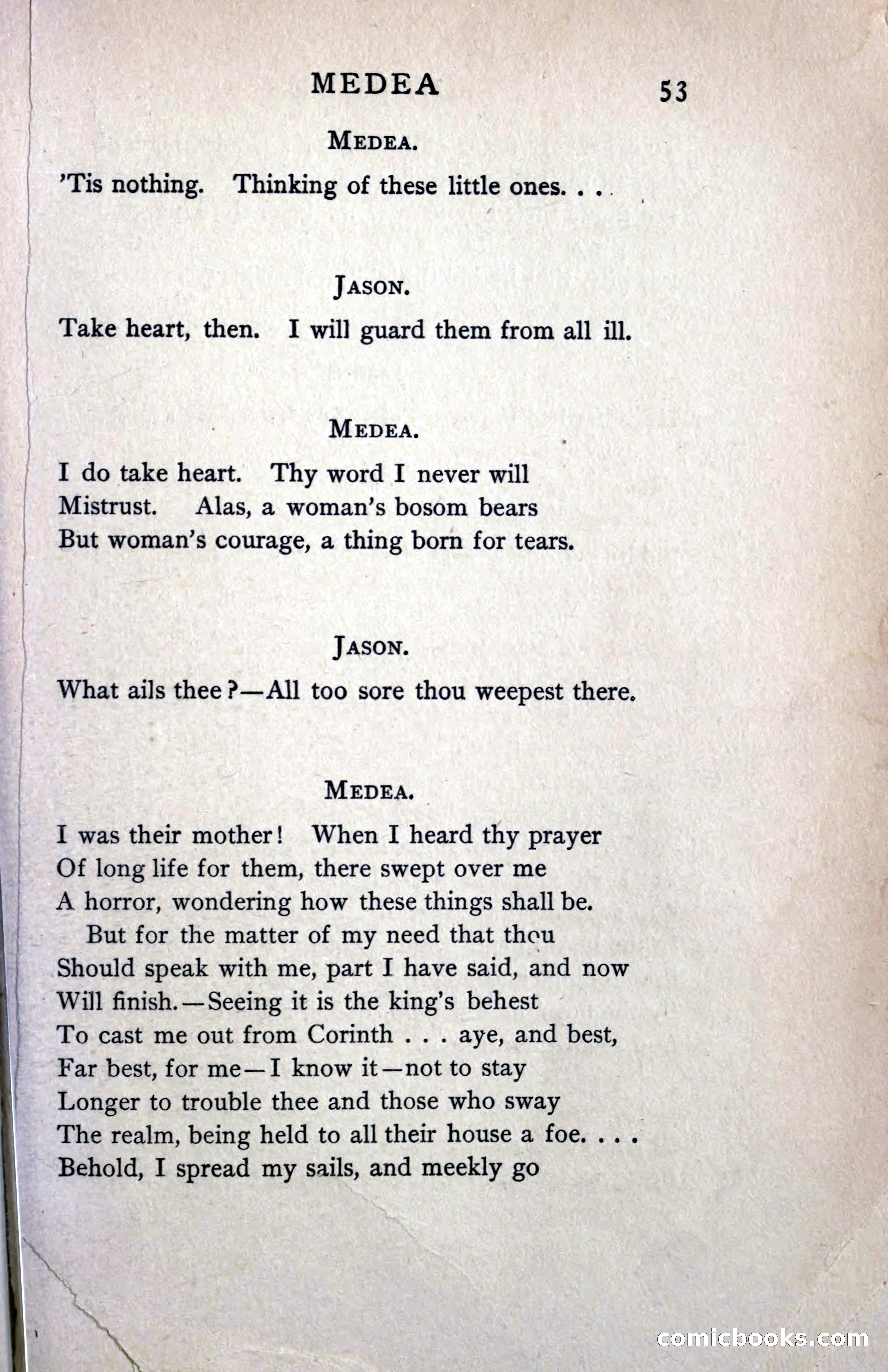
This is a page of running dramatic dialogue from what appears to be a theatrical adaptation or verse drama titled "Medea" (page 53). The text shows an exchange between the characters Medea and Jason, in which Medea expresses maternal anxiety about her children and then announces her intention to leave Corinth peacefully, saying she will "spread my sails, and meekly go." The dialogue is written in blank verse with classical tragic overtones, depicting Medea's apparent resignation to exile.
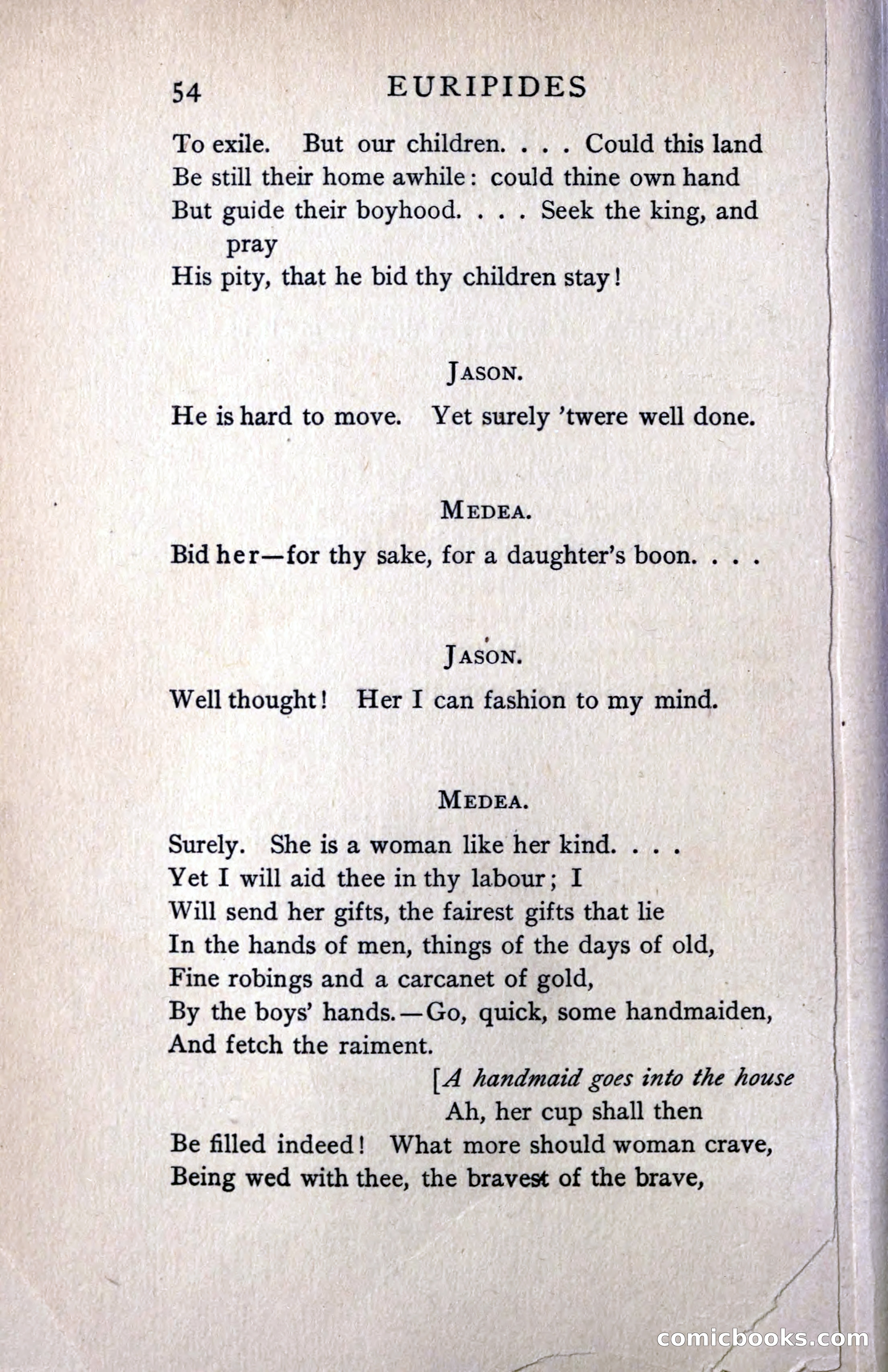
# Description This is a page of running dramatic prose—specifically a scene from Euripides' *Medea* in English translation. The page shows dialogue between Jason and Medea, numbered page 54. Medea proposes sending gifts (fine robes and a gold necklace) to Jason's new bride through the boys' hands, with a stage direction indicating a handmaid exits to fetch the garments. The text appears to be from a Victorian-era printed edition of classical drama, though the OCR note at bottom suggests this image may derive from digital scanning.
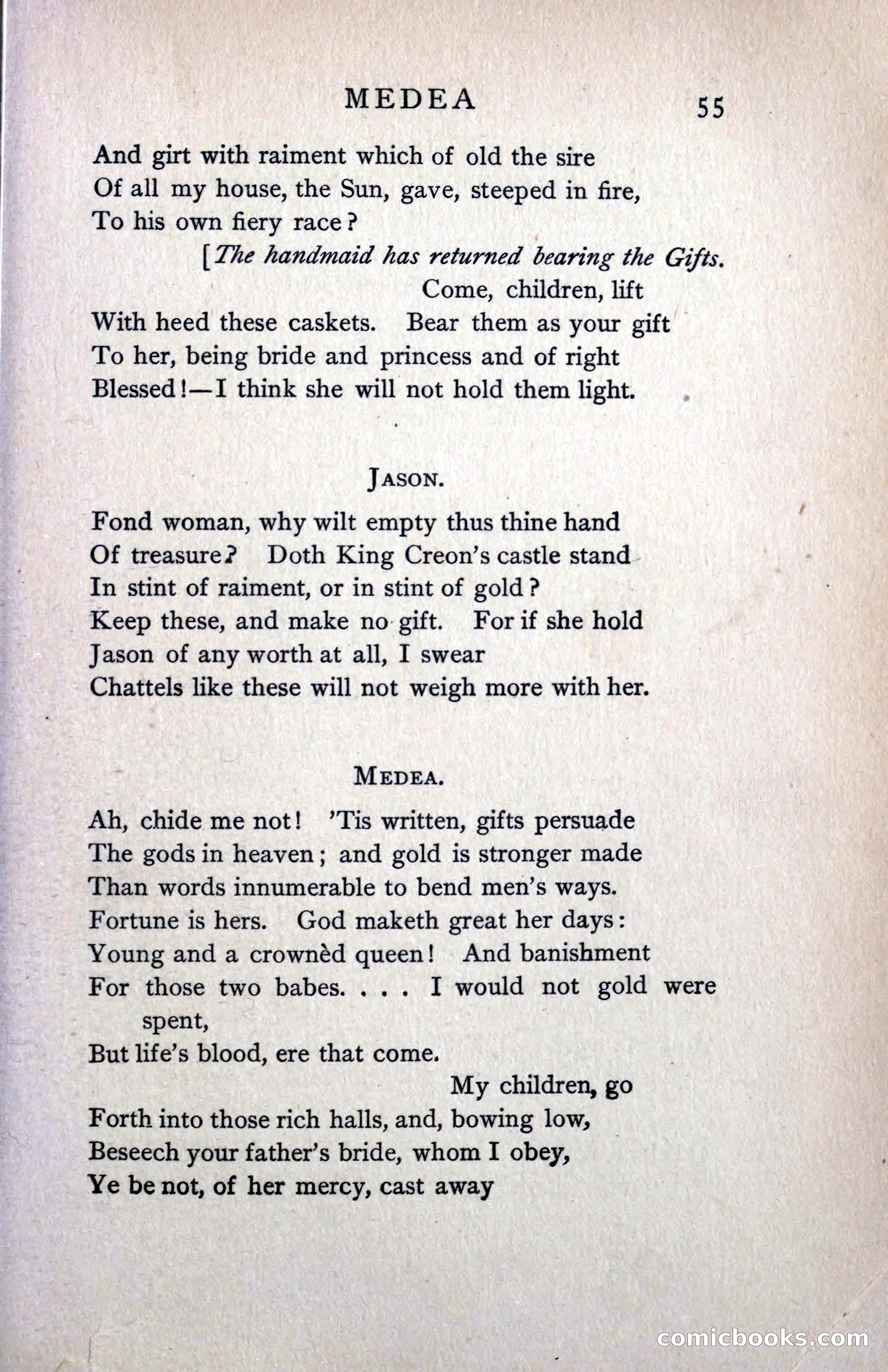
# Page Analysis This is a page of running dramatic verse from what appears to be a theatrical adaptation of the classical tragedy *Medea*. The page contains dialogue between the characters Medea and Jason, with a stage direction noting the handmaid's return with gifts. Medea insists her children present valuable gifts to Jason's new bride to secure the children's safety, while Jason argues the gifts are unnecessary. Medea then reveals her desperation—she would sacrifice her own blood rather than see her children face banishment. The page number indicates this is part 55 of a serialized work.
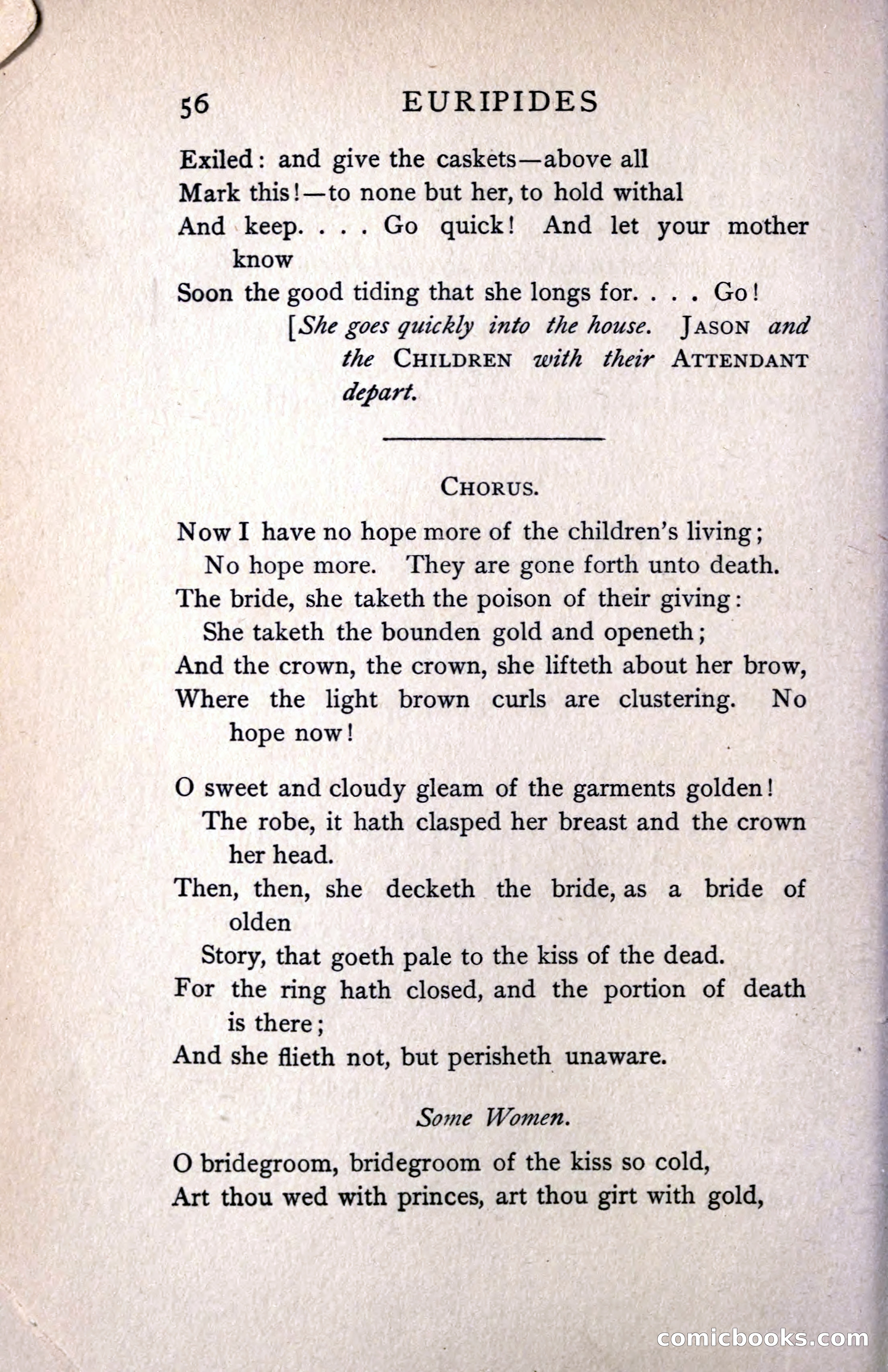
# Page Analysis This is a page of running prose from a classical dramatic text—specifically a translation of Euripides' *Medea*. The page contains dialogue and stage directions followed by a choral passage. The visible text depicts a tragic moment: a character exits to deliver poisoned gifts (a robe and crown) to a bride, while the chorus laments that the bride will unknowingly perish upon accepting them. The language is archaic English verse ("she taketh," "flieth not"), characteristic of Victorian-era translations of ancient Greek drama. This appears to be from a scholarly or literary edition rather than a penny dreadful, despite the page number (56) suggesting it's part of a larger serialized work.
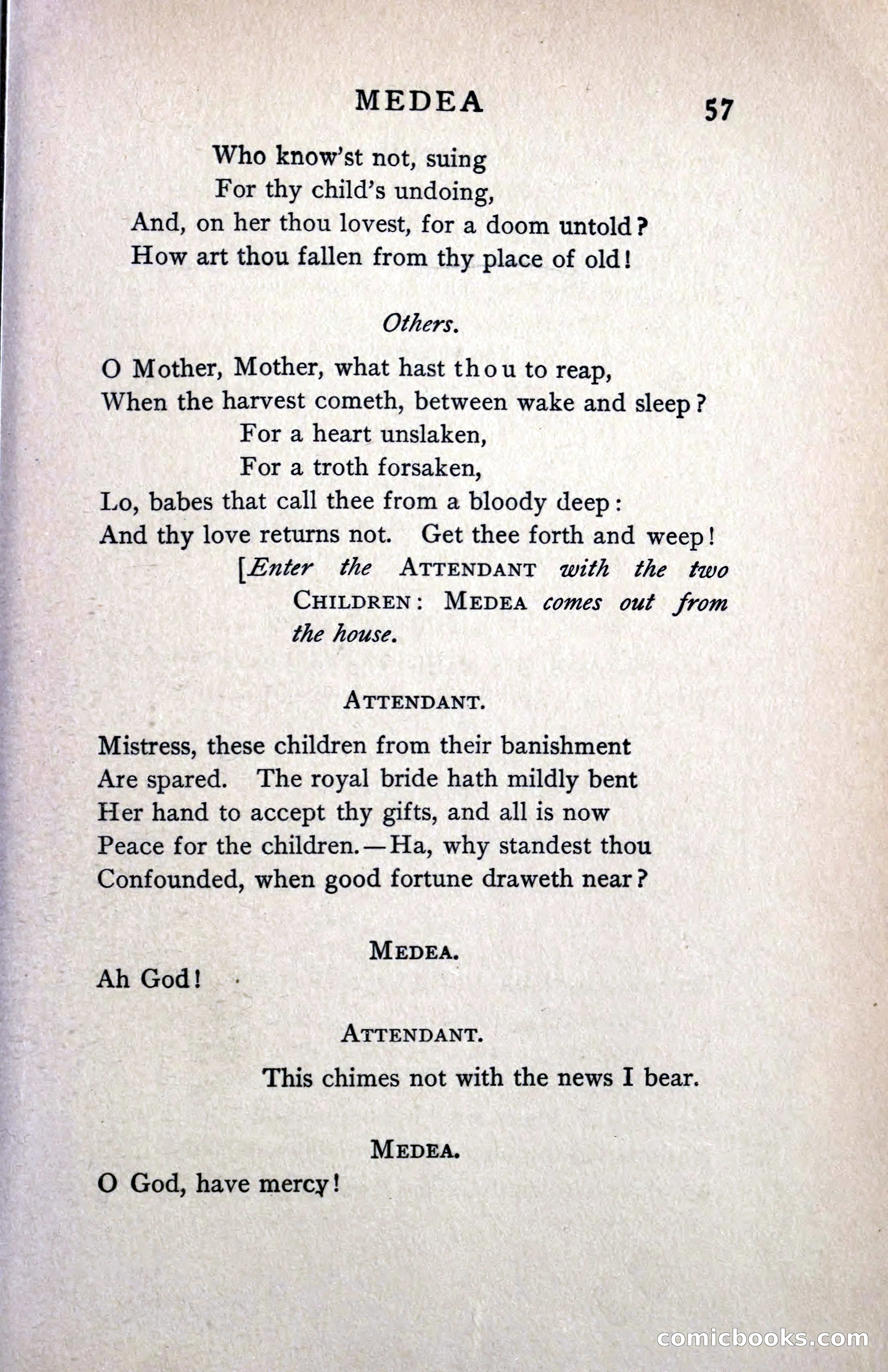
# Page Analysis This is a page of running dialogue from what appears to be a dramatic adaptation of the classical tragedy *Medea*. The text shows a scene where an Attendant enters with two children to inform Medea that her children have been spared banishment and the royal bride has accepted her gifts. Medea's responses—"Ah God!" and "O God, have mercy!"—suggest she receives this ostensibly good news with distress rather than relief, indicating dramatic irony typical of melodramatic sensation fiction. The page number "57" suggests this is mid-narrative in a serialized work.
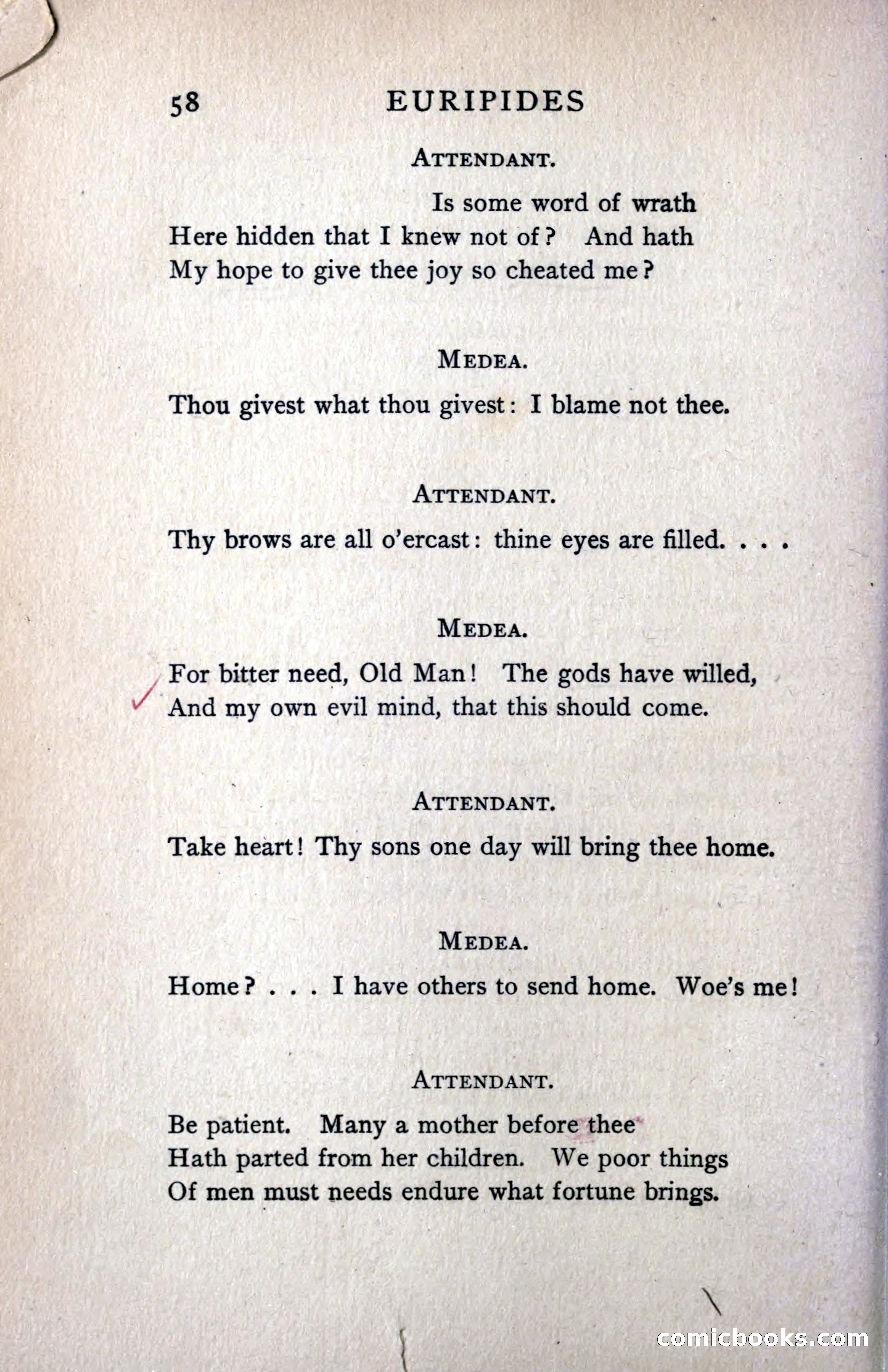
# Victorian Page Analysis This is a page of running dramatic dialogue from what appears to be a classical theatrical text rather than a penny dreadful. The page contains a scene from Euripides' *Medea*, featuring an exchange between Medea and an Attendant character. Medea expresses despair over her situation, acknowledging that the gods and her own "evil mind" have brought her suffering, while the Attendant attempts to console her by noting that many mothers have endured separation from their children. The dialogue is presented in verse form with character names in capitals preceding each speech.
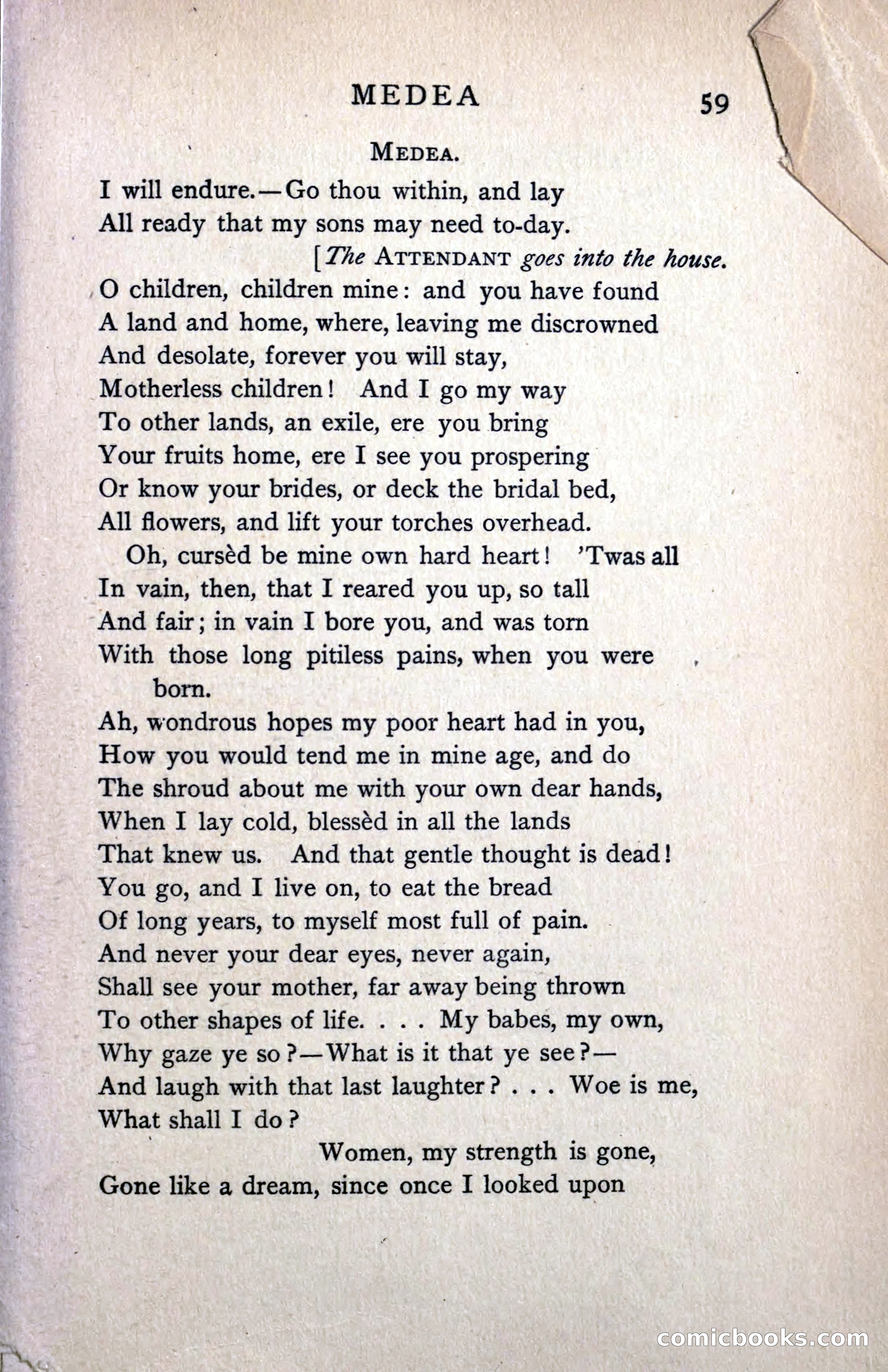
# Page Analysis This is a running text page (page 59) from what appears to be a dramatic work or theatrical adaptation titled *Medea*. The page contains verse dialogue spoken by the character Medea, a mother addressing her children before their separation. The text centers on her anguish at abandoning them—she will go into exile while they remain in a new land, and she laments that she will never witness their futures or receive their care in old age. The passage is emotionally intense melodrama, featuring Medea's expressions of maternal despair and self-recrimination, which aligns with the sensational tone typical of Victorian penny dreadful serials.
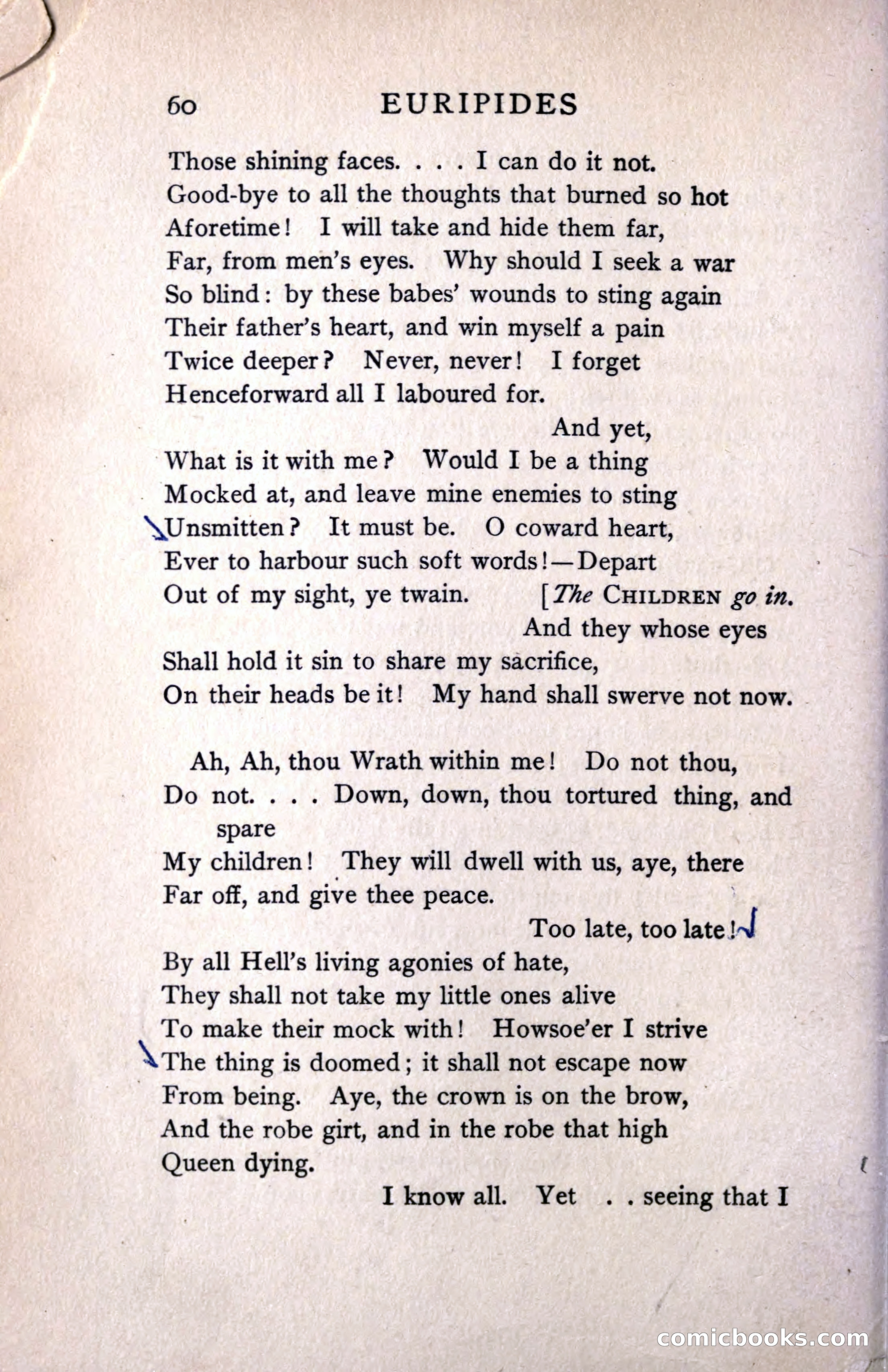
# Page Analysis This is a page of running dramatic verse (page 60) from a classical text attributed to Euripides, not a Victorian penny dreadful as the prompt suggests. The page contains a soliloquy in which a character struggles with violent impulses toward her children, initially resolving to spare them, then reversing that decision in escalating emotional turmoil. Stage directions indicate "The Children go in." The speaker invokes Hell and fate, declaring the deed is "doomed" and inevitable, while wearing royal regalia ("the crown is on the brow, / And the robe girt"). The text appears to be from a tragedy dealing with maternal conflict and tragic inevitability.
This is a page of running prose from what appears to be a dramatic adaptation of the classical tragedy *Medea* (page 61). The text presents Medea's farewell to her children before she leaves them, with stage directions in italics describing her emotional breakdown when she touches their hands. After the children exit, a Chorus reflects on the tragic power of a woman's conflicted heart torn between anger and the search for wisdom. The page contains dialogue, stage directions, and choral verse typical of theatrical works.
# Description of Page 62 This is a text page from what appears to be a Victorian edition, numbered 62 and headed "EURIPIDES." The page contains poetry in English—a philosophical meditation on childlessness versus parenthood. The speaker argues that women who never bear children live nearer to happiness, free from the cares and sorrows of raising offspring. The poem then shifts to contemplate those who do have children, describing the deep anxieties of parenthood and concluding with a dark reflection: that despite all effort to rear children to healthy, honest adulthood, death ultimately claims them. The final lines pose a rhetorical question about what benefit parenthood brings to someone whose life was once full.
# Page Analysis This is a page of running dramatic dialogue (page 63) from what appears to be a Victorian theatrical adaptation or poem titled "Medea." The scene depicts Medea learning that a king and princess have been murdered by her poison, and she responds with satisfaction rather than remorse. A messenger urgently warns her to flee, while Medea welcomes the news as enhancing her reputation among friends. The text consists entirely of dramatic verse dialogue between the characters Medea and the Messenger, with stage directions in brackets.
# Description This is a page of running dramatic prose—specifically, a scene from a classical play. Page 64 contains dialogue between a Messenger and Medea from Euripides' *Medea*. The Messenger describes how Medea's children arrived at the bridal chambers with their father Jason, and how the woman waiting there (Medea's rival) initially welcomed them with joy before seeing the children and turning away in distress. The text is formatted as a Victorian-era edition of classical drama, presented in verse form with character names in capitals.
# Page Description This is running prose (page 65) from what appears to be a dramatic or poetic adaptation titled "Medea." The visible text depicts a scene where a character persuades a young woman to accept decorative robes and a golden crown as gifts, urging her to reconcile with loved ones. The woman joyfully dons the finery and admires herself in a mirror, but then suddenly becomes pale and weak, struggling to return to her seat with "crooked steps." The passage ends as an elderly handmaid observes this strange affliction, suggesting something supernatural—possibly the influence of Pan—is occurring.
# Page Content Analysis This is a page of running prose poetry, numbered 66, titled "EURIPIDES" at the top. The text describes a woman's violent death by fire—her body convulsing with foam at her lips, her eyes rolling back, then a period of unconsciousness. Upon waking, she discovers that a golden crown (carcanet) fused to her head is burning her flesh, and fine robes are igniting. She writhes about attempting to remove the crown, but the burning gold holds fast; the fire only intensifies until she collapses and dies, leaving her face and features unrecognizable. The passage is written in blank verse and appears to be a dramatic translation or adaptation from classical Greek drama.
# Page Analysis This is a page of running verse poetry from page 67 of a work titled "Medea." The text describes a grotesque scene: a father discovers his daughter's poisoned corpse and, attempting to lift her, finds himself stuck to her dead body by the poison. In a horrifying struggle, he tears himself free but dies alongside her. The passage emphasizes graphic bodily horror—melting flesh, gnawing poisons, and the father's anguished death—typical of Victorian sensation literature's lurid melodrama. The verse appears to be a dramatic monologue recounting these tragic events.
This is a page of running prose from what appears to be a dramatic text—specifically a translation of Euripides' *Medea*. The page contains dialogue and stage directions featuring a Messenger, a Chorus of women, and Medea herself. The text shows Medea announcing her intention to kill her own children as revenge against Jason, speaking with grim resolve to the women around her. This represents a climactic moment in the classical tragedy, presented here in Victorian-era dramatic format.
# Analysis This is a page of running dramatic dialogue and verse from what appears to be a theatrical adaptation of Euripides' *Medea*. The page (numbered 69) contains Medea's soliloquy in which she steels herself to commit infanticide, followed by a choral response from "Some Women" who invoke Earth and the Sun to prevent the murder. The text depicts the moment of tragic decision—Medea resolves to kill her children despite her maternal love, then exits into the house as the chorus desperately appeals to cosmic forces for intervention. The language is blank verse and lyrical, presenting this classical tragedy in Victorian dramatic form.
# Page 70 of Euripides This is a page of running dramatic text—a theatrical translation rather than a penny dreadful. It presents dialogue from what appears to be a classical Greek play, with stage directions and multiple speakers identified as "Others," "A Woman," "Another," and "A Child within." The visible text depicts a tragic scene involving a woman who has come from a distant, dangerous place, with characters expressing horror at her presence and children crying out in fear, with one child concluding "I think she means to kill us."
# Page Description This is a page of running dramatic dialogue and stage directions from page 71 of what appears to be a theatrical adaptation of *Medea*. The text presents a scene of desperate urgency: a woman calls for help while being pursued with a sword, children cry out in fear, and women beat at a barred door. The dialogue includes a choral passage recounting the mythological madness of Ino, who killed her children and cast herself into the sea, before concluding with stage directions indicating Jason and attendants enter hurriedly. The page depicts a climactic moment of violence and maternal tragedy.
# Page Description This is a page of running dramatic dialogue from what appears to be a classical translation rather than a Victorian penny dreadful. The page presents a scene from Euripides featuring Jason and a Leader character. Jason initially expresses concern for his children's safety and indifference to a woman's fate, but the Leader then reveals devastating news: Jason's sons have been killed by their mother's hand. Jason's final lines express shock and anguish at this revelation. The text is formatted as stage dialogue with character names in capitals preceding their speeches.
# Analysis of Page 73 from "Medea" This is a page of running dramatic prose—specifically, a theatrical script adaptation of the classical tragedy *Medea*. The page depicts the climactic moment where Jason discovers that Medea has killed their children. The Leader and Jason speak in verse, with Jason demanding entry to see the bodies. A stage direction indicates that Medea then appears on the roof standing in a chariot drawn by winged dragons, carrying the children's corpses. Medea then addresses Jason from above, taunting him about the murders she has committed. The text reproduces classical dramatic language in a Victorian penny dreadful format, presenting sensational melodrama derived from ancient Greek theatre.
# Analysis This is a page of running prose—specifically, a dramatic dialogue from what appears to be a theatrical adaptation. The page number "74" and header "EURIPIDES" indicate this is from a Victorian edition of classical drama, likely a stage version rather than a penny dreadful. Jason delivers an extended curse against his wife (Medea, though unnamed here), accusing her of murdering their children and betraying him after he brought her from a foreign land to Greece. The language is archaic and melodramatic verse typical of Victorian theatrical adaptations of classical tragedy. This is classical literature repackaged for Victorian audiences, not original sensation fiction.
This is a page of running dramatic verse dialogue, numbered 75, from what appears to be a theatrical adaptation or translation of the classical tragedy *Medea*. The text shows an intense exchange between Medea and Jason: Medea accuses Jason of betrayal and declares her suffering over their lost children and marriage, while Jason responds with his own anguish. Medea's final statement—that she loves her pain and will ensure Jason suffers—suggests the dark, vengeful turn the narrative is taking. The page contains no illustrations or advertisements.
This is a page of running prose—specifically, a dramatic dialogue from Euripides' classical play *Medea*. The page shows an argument between Jason and Medea over the deaths of their children. Jason denies his hand murdered them; Medea blames his infidelity and pride. The exchange escalates with accusations about lust, love, and torment, ending with Medea's assertion that the Gods know who caused this tragedy. This appears to be a Victorian-era translation or edition of the ancient Greek tragedy, not a penny dreadful as initially suggested by the query's framing.
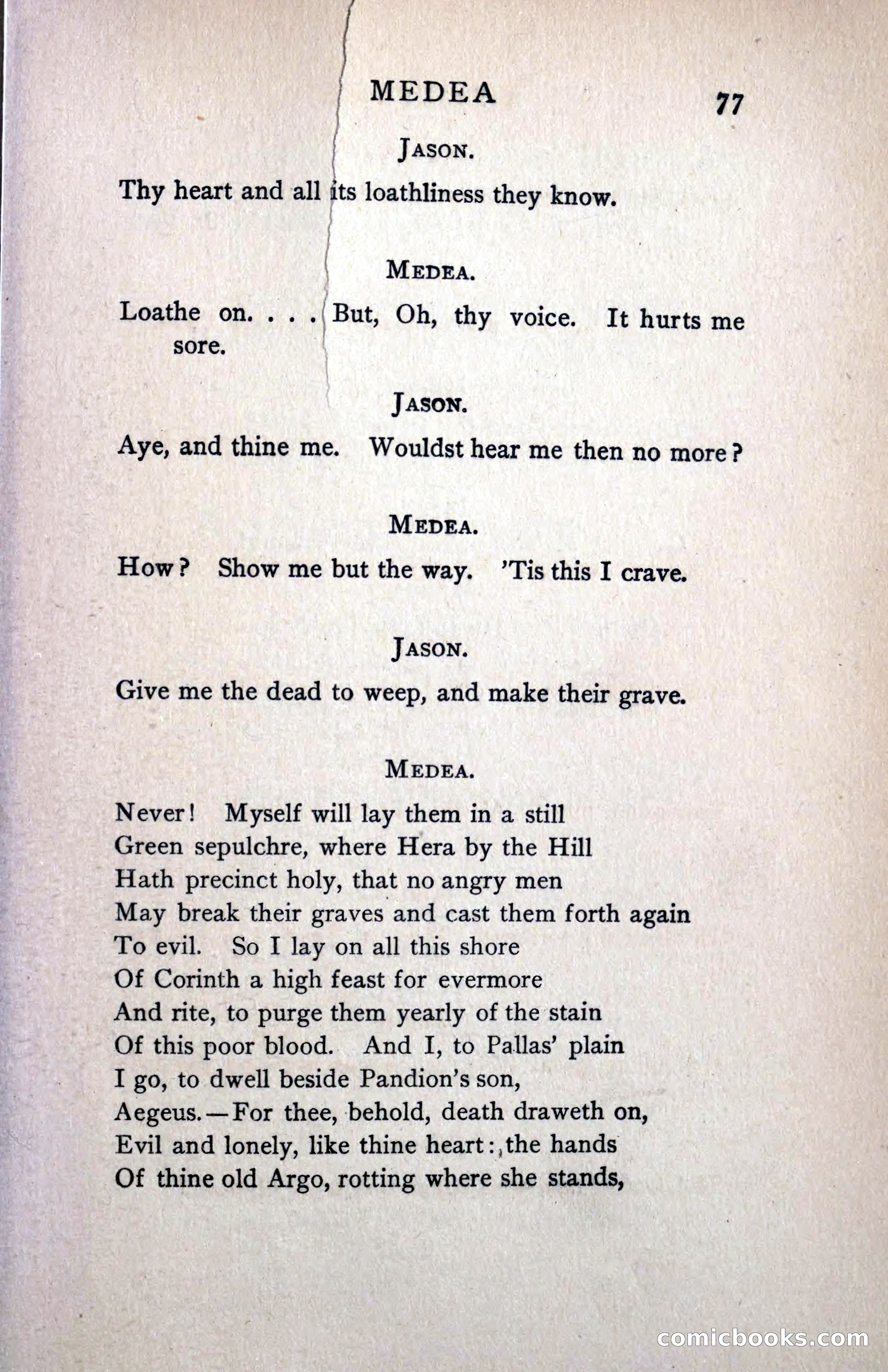
# Analysis This is a page of running dramatic dialogue from a theatrical work titled "Medea" (page 77). The text presents a scene between Jason and Medea in verse form, depicting their confrontation following tragic events. Medea declares she will bury the dead in a sacred sepulchre near Corinth, establish perpetual rituals to purge their blood-stain, and then depart to Athens to live with Aegeus. She concludes with a curse upon Jason, prophesying his lonely death while his ship Argo rots abandoned. The exchange reflects the classical myth adapted for Victorian dramatic performance, featuring heightened emotional language and tragic pronouncements typical of melodramatic stage works.
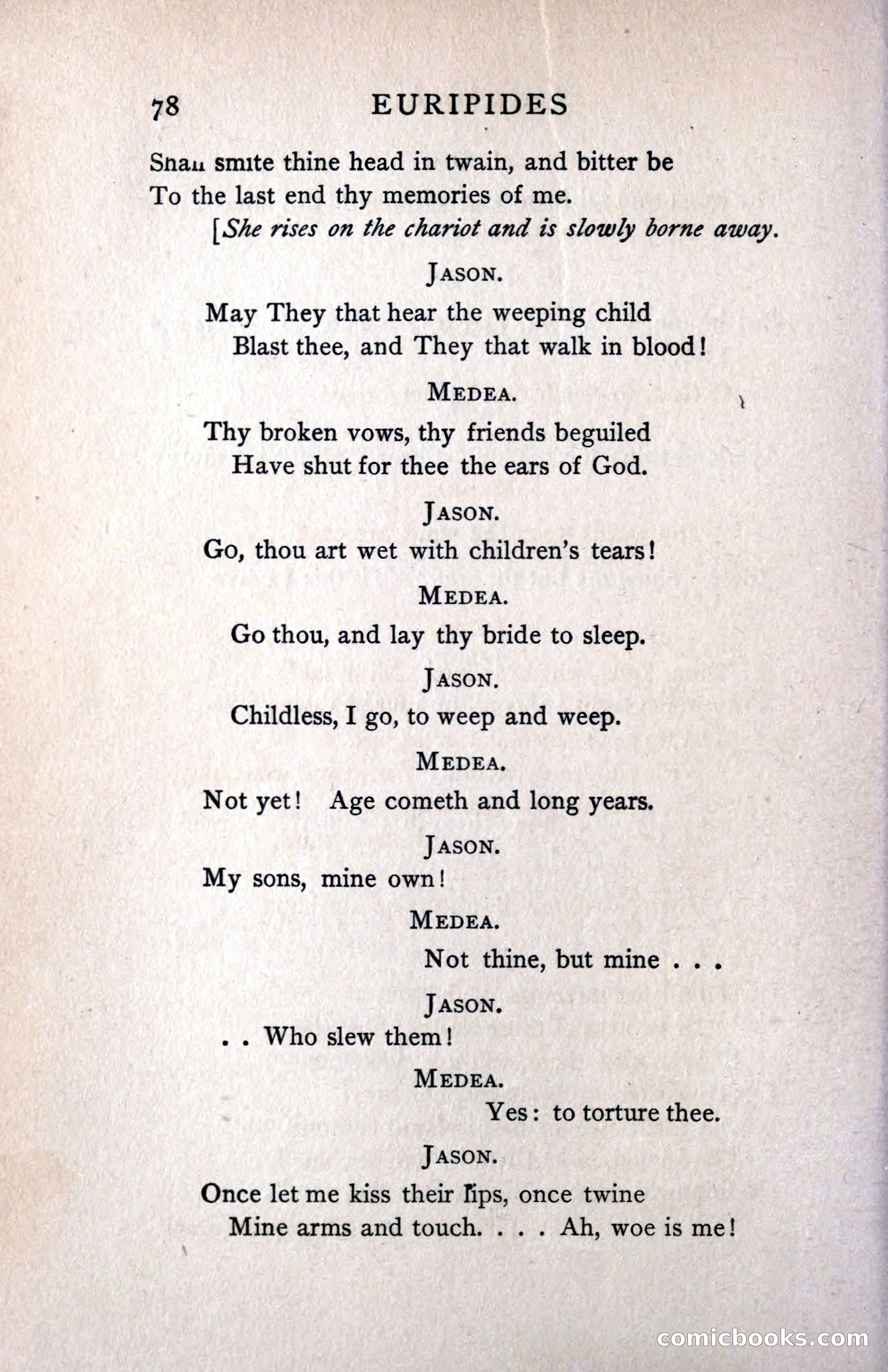
# Description This is a page of dramatic dialogue from a classical theatrical text—specifically from Euripides' *Medea*, as indicated by the header. The page presents the final exchange between Jason and Medea in verse form, with their names identifying each speaker. The text shows Medea departing by chariot while exchanging bitter accusations and laments with Jason; she reveals she has killed their children, and Jason responds with anguish at being denied even the chance to touch them. The only stage direction notes that "She rises on the chariot and is slowly borne away." This appears to be from a Victorian edition of classical drama, not a penny dreadful as initially suggested.
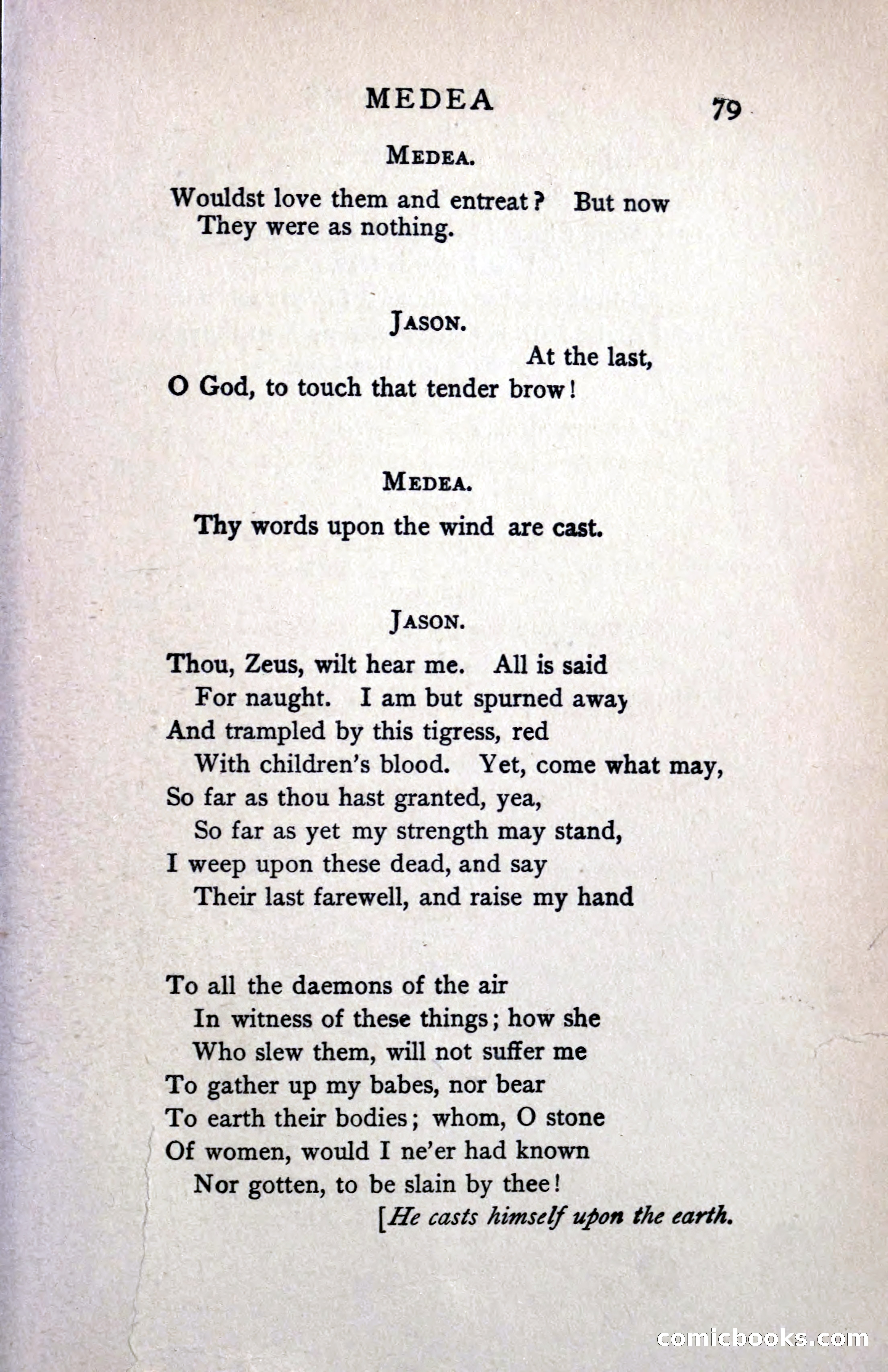
This is a page of running dramatic dialogue (page 79) from what appears to be a Victorian adaptation or translation of the classical play *Medea*. The text shows an exchange between the characters Medea and Jason in verse form. Jason laments that Medea has killed their children and curses her, calling on Zeus and the "daemons of the air" to witness her crime, while Medea dismisses his pleas. A stage direction at the bottom indicates Jason throws himself to the ground. The page contains no illustrations or advertisements.
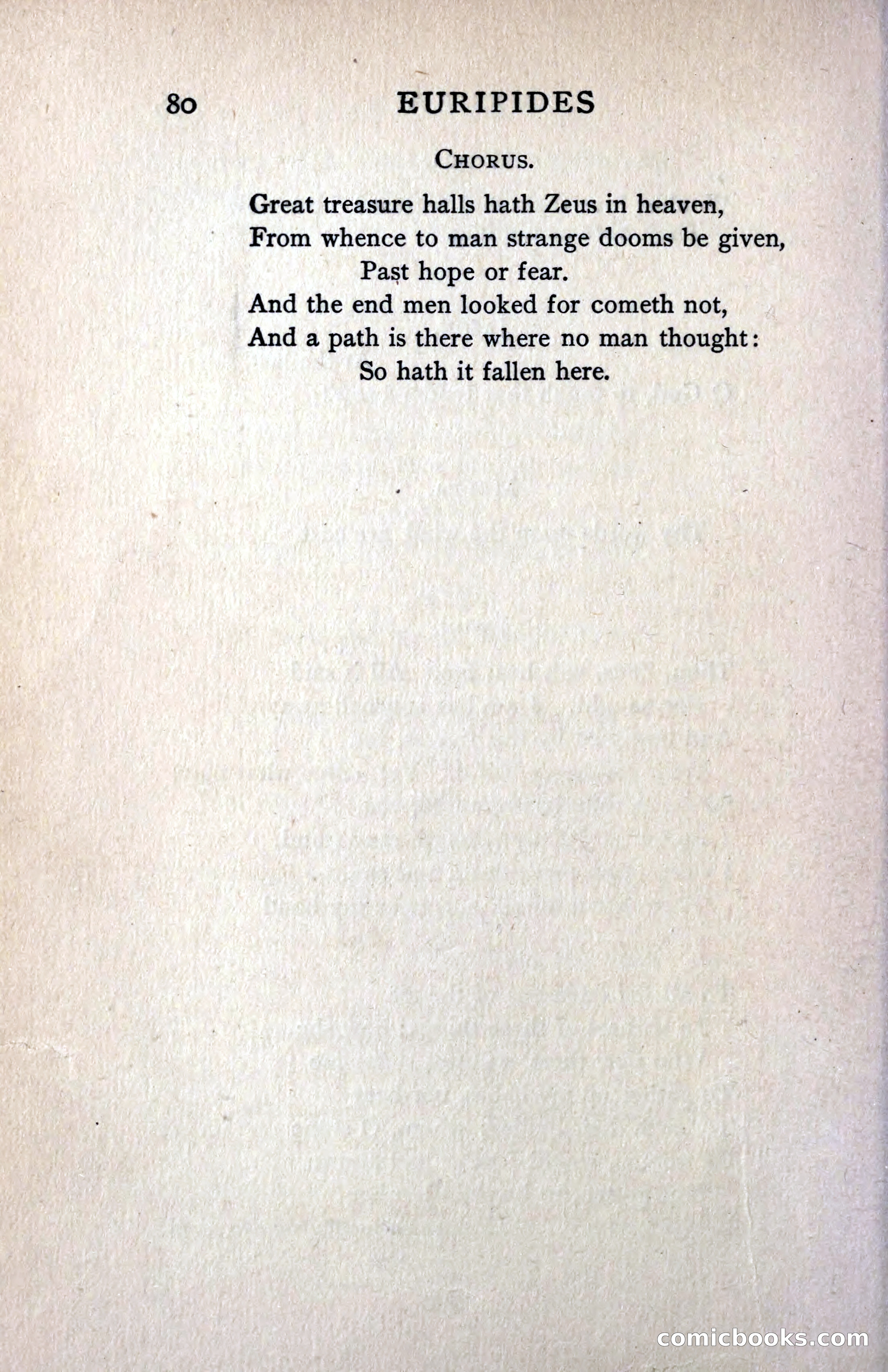
This is page 80 of running text from a literary work, specifically a chorus passage attributed to Euripides (the ancient Greek dramatist). The excerpt is a poetic monologue in English translation, discussing Zeus's power to send unexpected fates to mankind—outcomes beyond human hope or fear, arriving by unforeseen paths. The text appears to be from a classical drama translation rather than a penny dreadful proper, though it may be reprinted within a Victorian collection or serialized edition. The page contains no illustrations, only typography on aged paper.
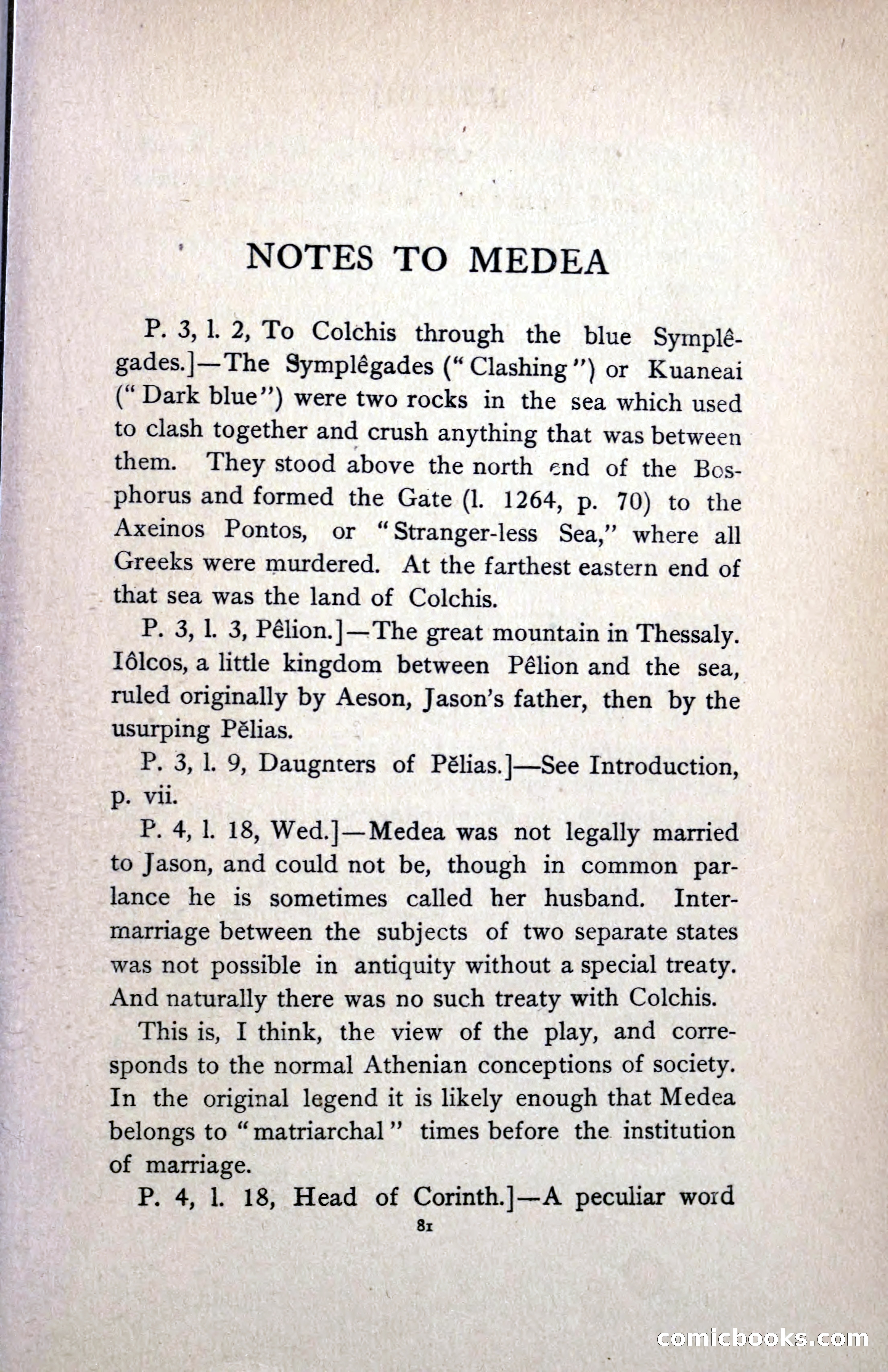
This page contains scholarly annotations—"Notes to Medea"—explaining classical references and textual details for readers. The notes gloss mythological locations (the Symplegades rocks, Mount Pelion, Colchis), historical context about the characters (Jason's father Aeson, Pelias), and importantly, a discussion of Medea's legal marital status to Jason, explaining that intermarriage between subjects of separate ancient states required treaties that never existed between Greece and Colchis. The annotations appear designed to accompany a dramatic text, likely a Victorian edition of Euripides' *Medea*.
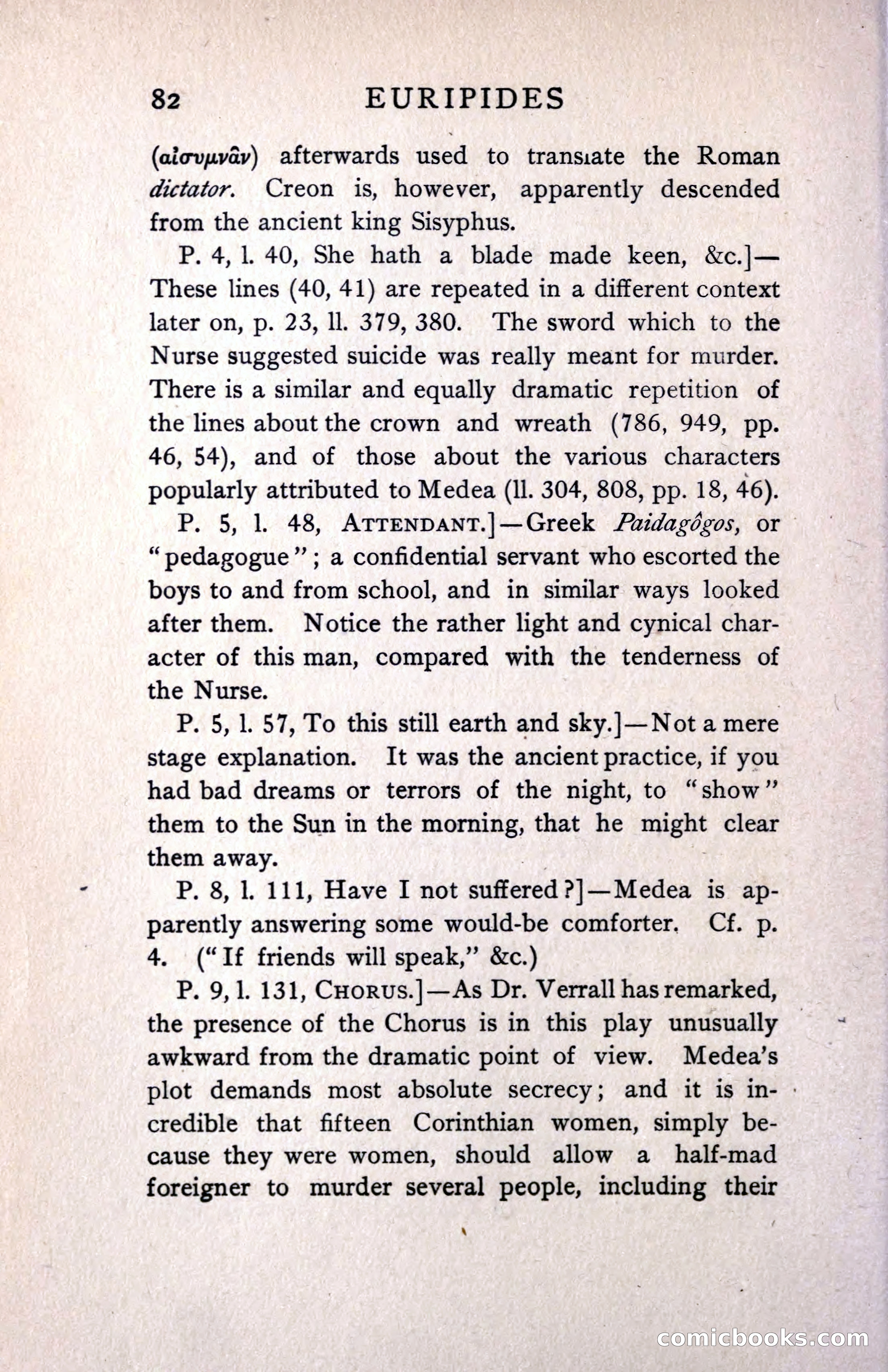
This page is running prose—scholarly annotations on Euripides' *Medea*. The text provides line-by-line commentary explaining textual details, character descriptions, and dramatic elements: the descent of Creon, repeated lines about a sword and crown, the role of the Greek pedagogue (attendant), an ancient practice of showing nightmares to the sun, and notably, Dr. Verrall's observation that the Chorus's presence is "unusually awkward" since Medea's murderous plot requires secrecy, yet fifteen Corinthian women inexplicably allow a "half-mad foreigner" to commit multiple murders.
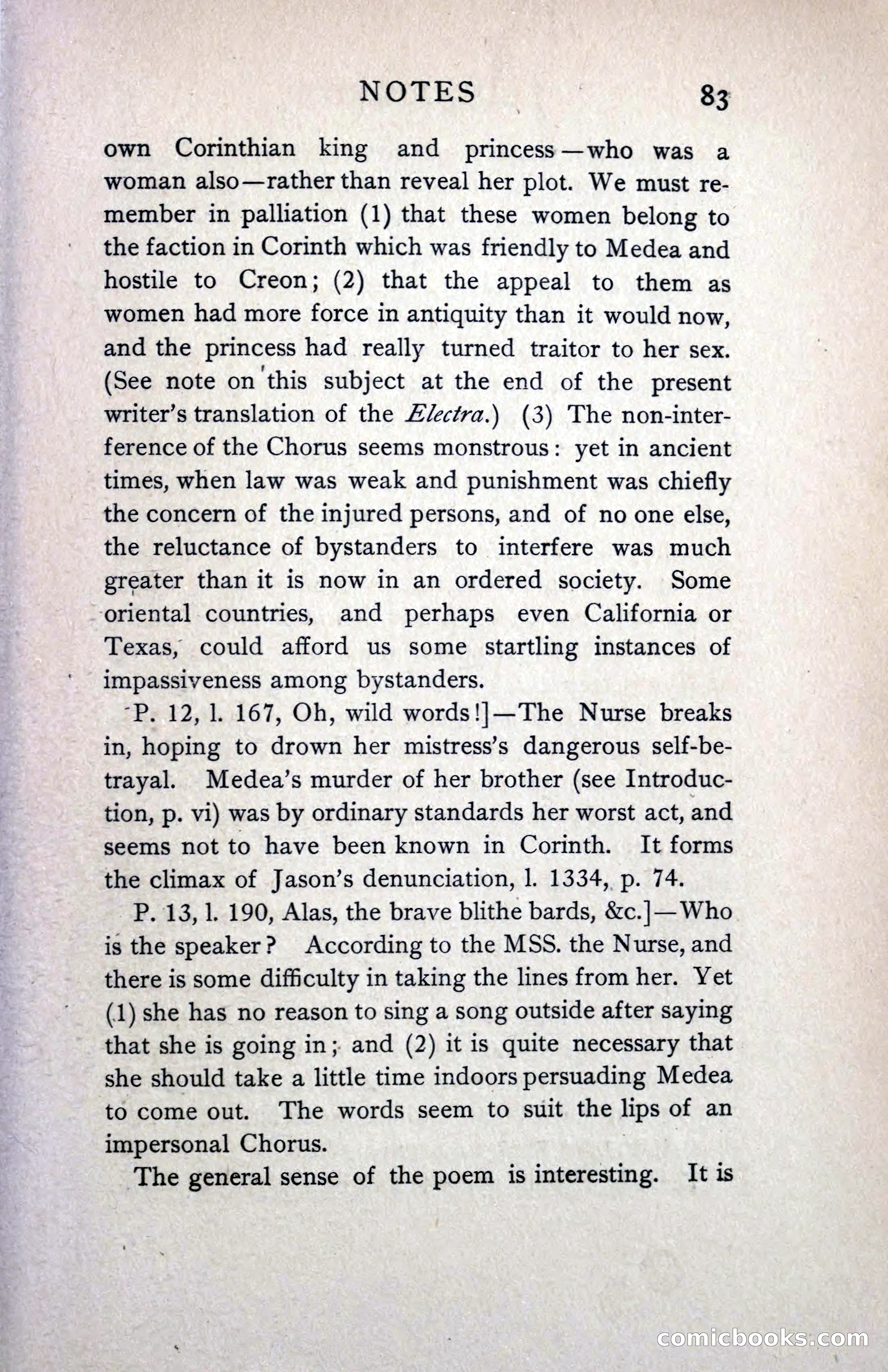
# This Page: Scholarly Notes on a Classical Text This is a notes page (page 83) from what appears to be a scholarly edition or translation of an ancient Greek play—specifically *Medea*. The text consists of numbered explanatory footnotes discussing textual and interpretative issues: the motivations of Corinthian women, the apparent inaction of the Chorus, the identity of speakers in particular lines, and references to murder, Jason's denunciation, and the Nurse character. The notes engage with manuscript variations and attempt to justify seemingly problematic dramatic choices through historical context. This is scholarly apparatus, not a penny dreadful.
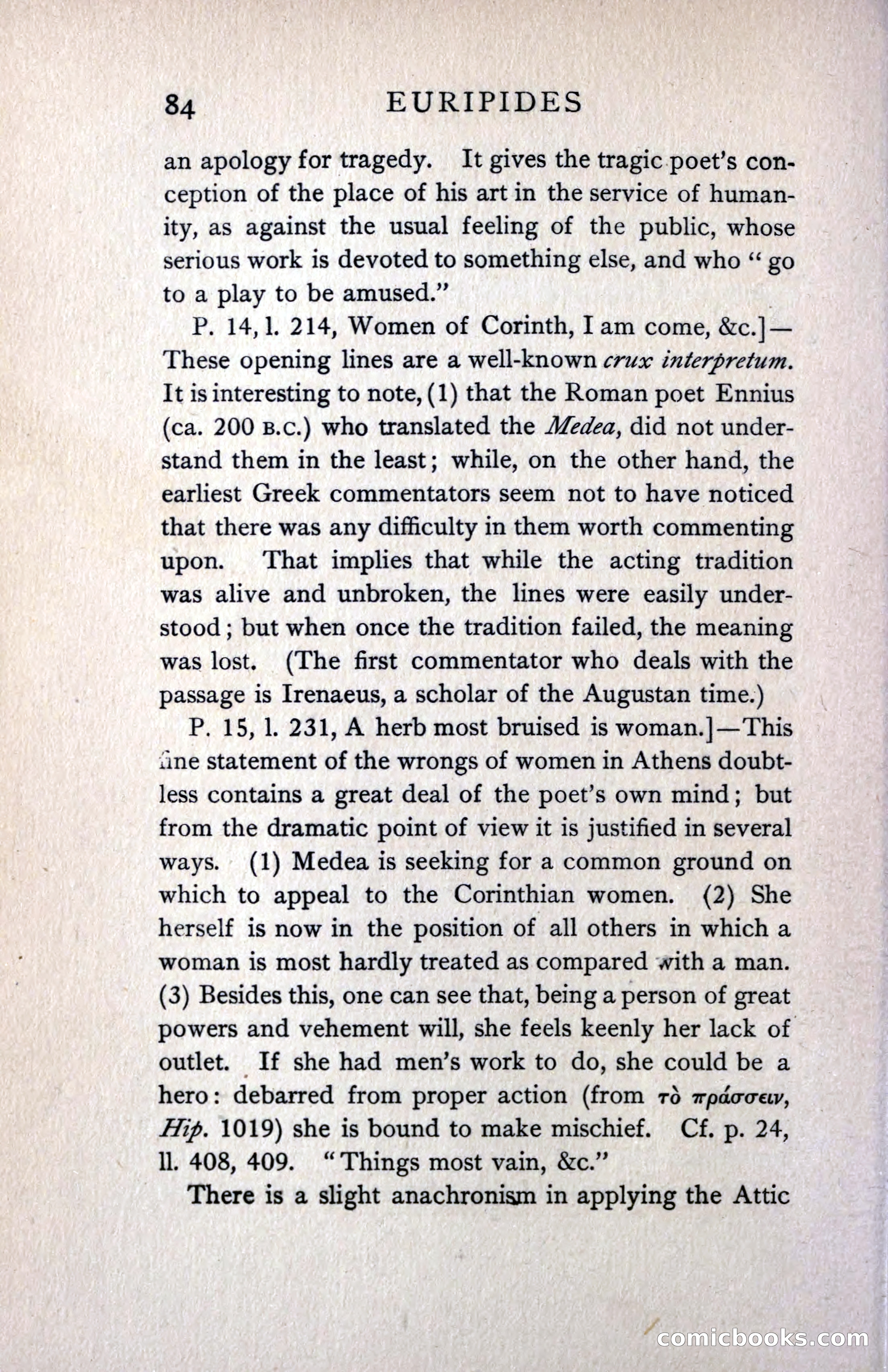
# Page Description This is a page of scholarly commentary (page 84) from a Victorian edition of Euripides, not a penny dreadful. It contains running prose—specifically, detailed textual annotations on Euripides' *Medea*. The commentary explains difficult passages, notes how ancient Roman and Greek scholars interpreted them differently, and discusses the dramatic justification for Medea's statements about women's oppression in Athens, arguing that her lack of proper action drives her toward mischief.
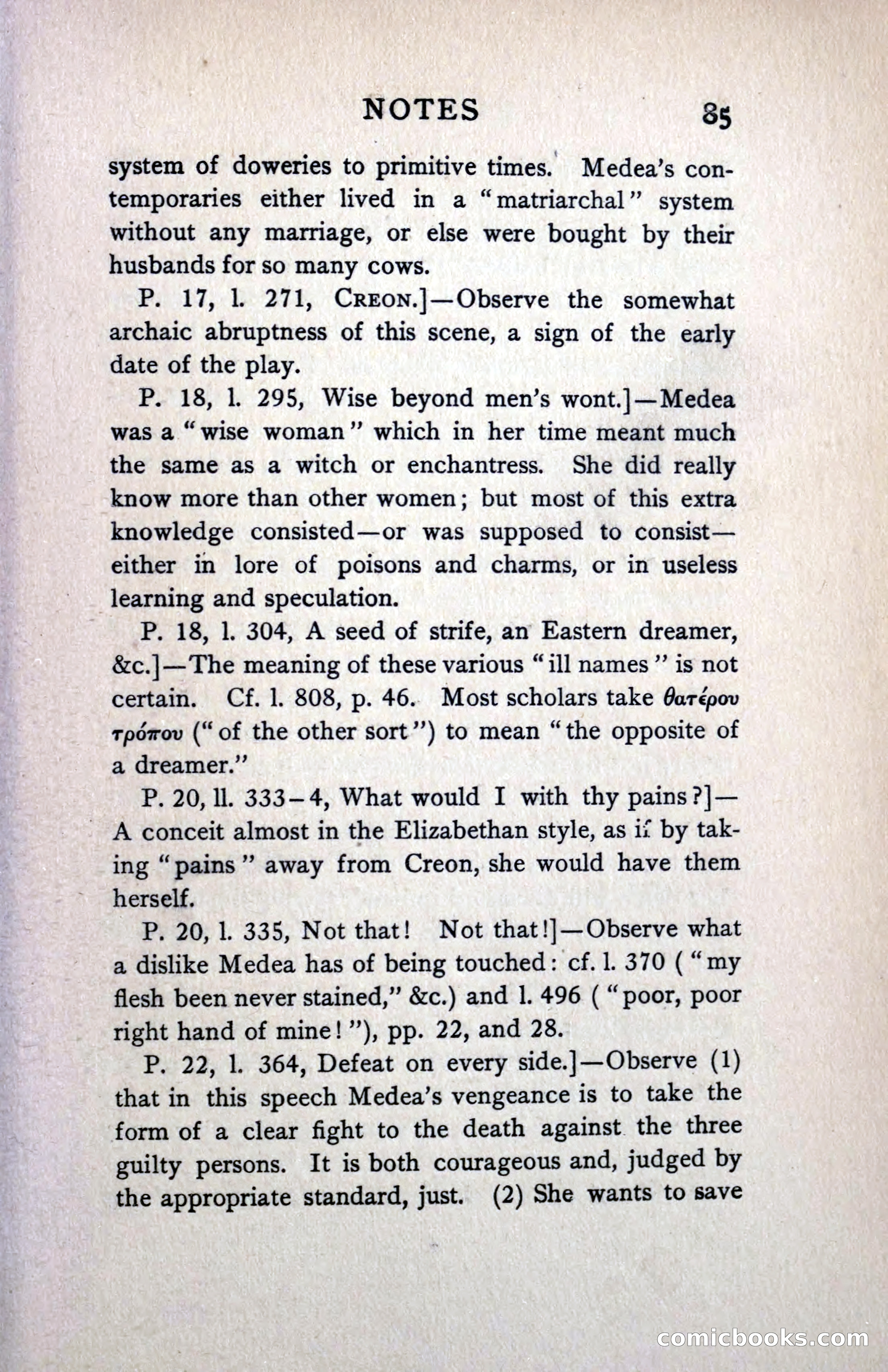
# Analysis This is a **notes/commentary page** from what appears to be a scholarly edition of a classical text—specifically annotations on Euripides' *Medea*. The page contains numbered textual notes explaining specific lines and passages from the play (referenced as "P." for page and "l." for line numbers). The notes discuss Medea's character traits (her knowledge of poisons and charms, her aversion to being touched) and interpret key dramatic moments, such as her declaration of vengeance against three guilty parties. The scholarly tone and classical references make clear this is **not** a penny dreadful, but rather an educational commentary, likely from a Victorian-era school or university edition of Greek drama.
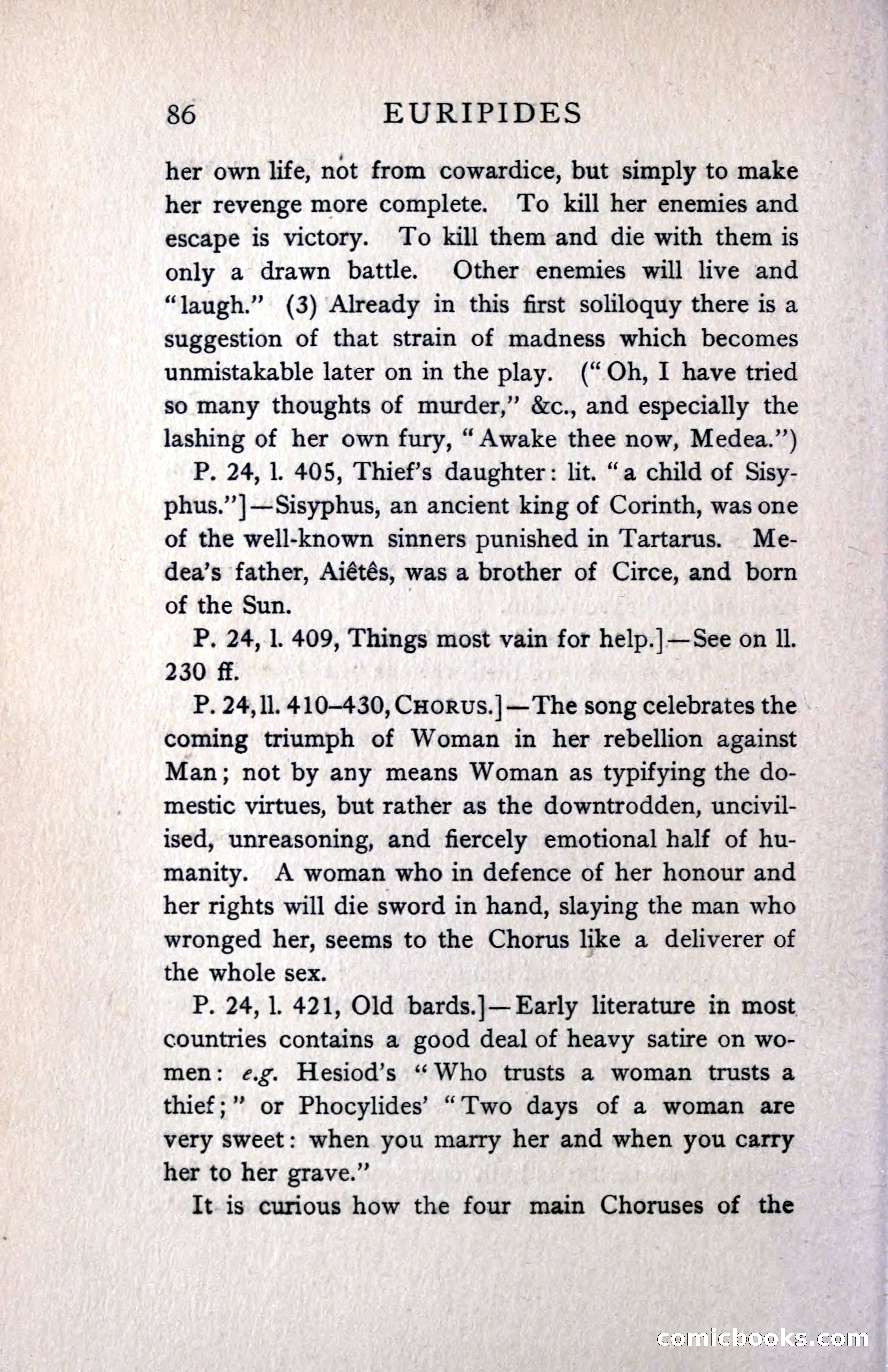
# Analysis of Page 86 This is a page of scholarly **running prose and annotations**—specifically, academic commentary on Euripides' *Medea*. The text consists of numbered footnotes and explanatory notes analyzing specific lines and passages from the play (pages and line numbers cited throughout). The visible content discusses Medea's murderous intentions, classical mythological references (Sisyphus, Aiétés, Circe), and the Chorus's celebration of woman's rebellion against man—notably depicting woman not as domestically virtuous but as "downtrodden, uncivilised, unreasoning, and fiercely emotional." The page concludes with examples of misogynistic satire from classical literature (Hesiod, Phocylides).
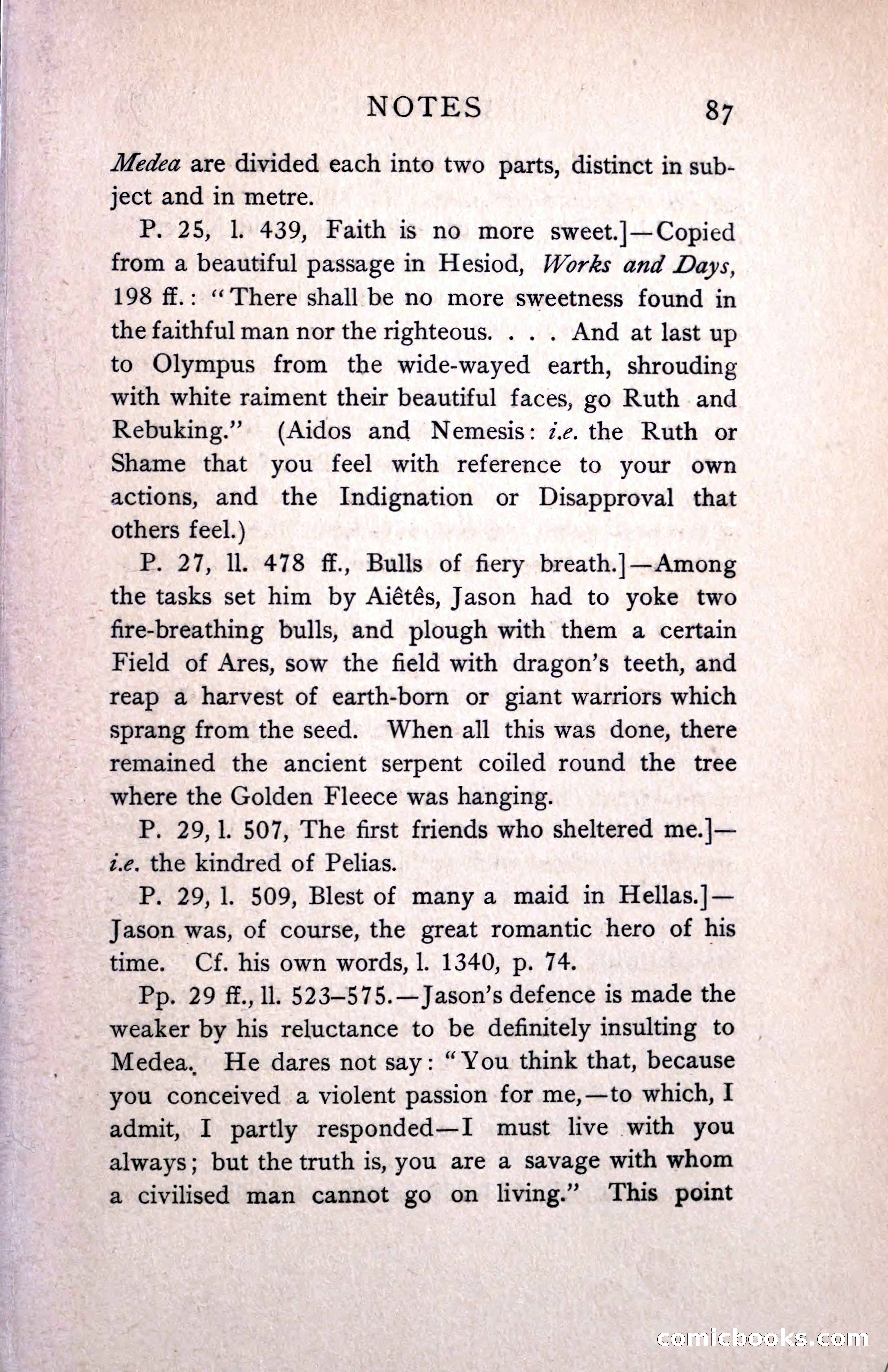
This is a notes page (page 87) from a scholarly edition, likely of a classical text. The page provides explanatory annotations for passages in what appears to be a dramatic work about Medea and Jason. The notes reference specific line numbers and pages, explaining classical allusions (to Hesiod's *Works and Days*, the myth of Jason and the Argonauts) and offering interpretive commentary on character motivations, particularly Jason's reluctance to directly insult Medea in his defense. This is academic apparatus rather than penny dreadful fiction.
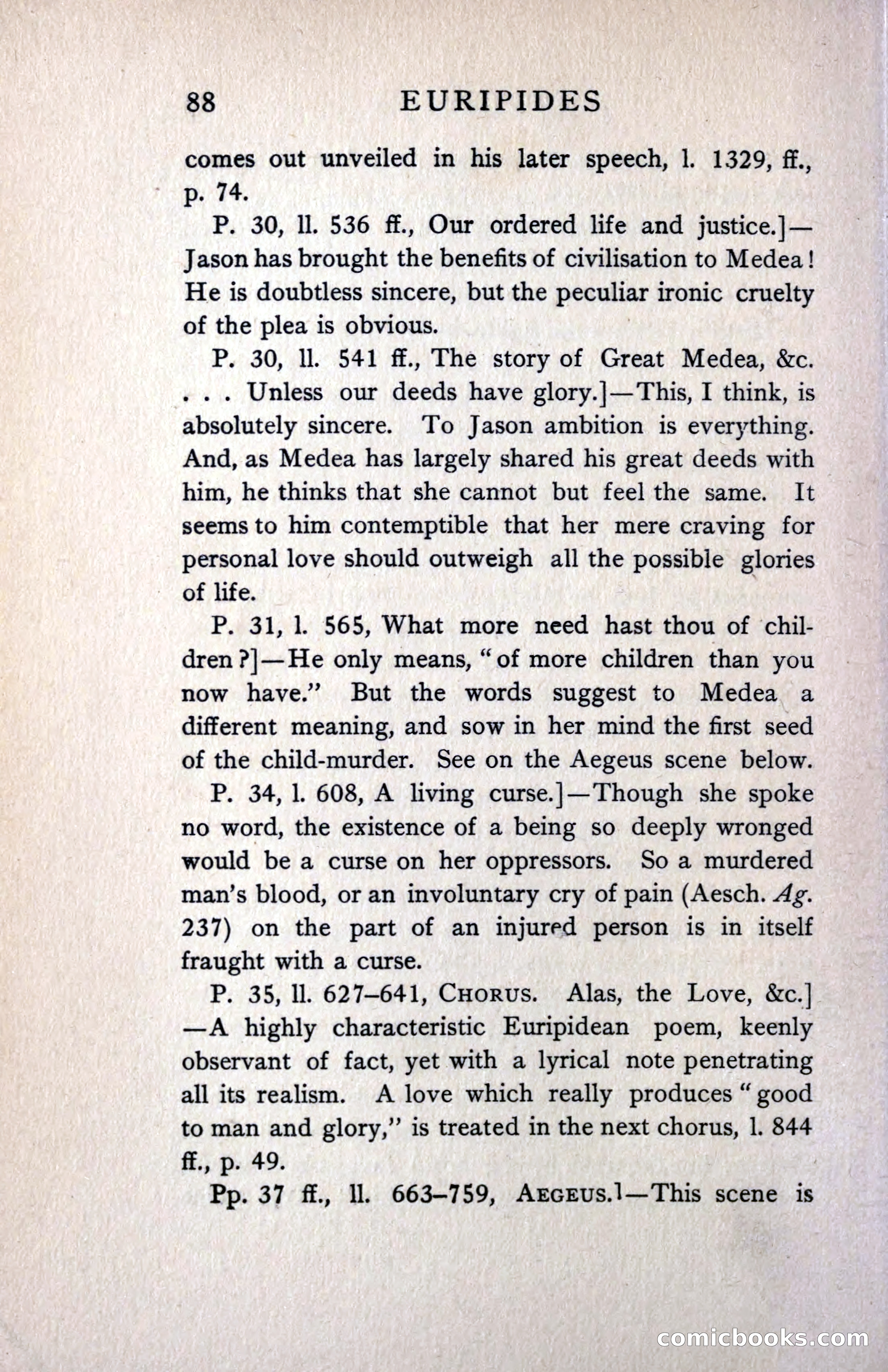
# Page Content Analysis This is a page of scholarly annotation and literary criticism, not a Victorian penny dreadful. It appears to be from an academic edition of Euripides' *Medea*, offering detailed commentary on specific lines and passages. The text analyzes Jason's dialogue with Medea, examining the irony and psychological implications of his statements about civilization, ambition, and children. The annotations reference specific line numbers and page numbers, and discuss how Jason's words inadvertently plant the "first seed of the child-murder" in Medea's mind. The commentary is interpretive and philosophical rather than narrative or sensational.
# This is a Notes page from scholarly criticism This is page 89 from a scholarly work's notes section—not a penny dreadful, but classical literary criticism. The page contains running prose discussing Greek tragedy, specifically addressing criticisms of Euripides' *Medea*. The text argues that apparent coincidences in the play (such as Aegeus's convenient arrival) are acceptable because Greek tragedies were based on historical traditions (*Logoi*) rather than pure fiction, and therefore could include actual historical coincidences. The author distinguishes between ancient tragedy and later works, noting that Aristotle's time saw a shift toward fiction-based tragedy. The passage also references rituals performed by Corinthians at the Grave of Medea's Children.
# Analysis This is a page of **running scholarly prose**, not a penny dreadful. The page number indicates this is from a critical academic text about Euripides' *Medea*. The visible text analyzes the dramatic function of Medea's meeting with Aegeus in the play, explaining how this encounter—likely derived from earlier sources rather than Euripides' invention—serves his dramatic purposes: it suggests to Medea a form of revenge (making Jason childless), and it wounds her pride, pushing her toward committing murder. The passage discusses how Euripidean heroines characteristically cross moral lines after experiencing sudden shame or humiliation.
# Analysis This page contains scholarly **notes and commentary**, not a title page, illustration, or narrative fiction. The text consists of line-by-line textual annotations explaining passages from what appears to be Euripides' *Medea*. The notes discuss the plot mechanics of Medea's deception of Aegeus, analyze the character of the Nurse, and provide historical context comparing the play's portrayal of Athens to Pericles' famous funeral oration in Thucydides. The commentary treats the dramatic text as a classical work requiring scholarly explanation rather than as penny dreadful entertainment, suggesting this page comes from an annotated edition or study guide to the Greek play.
# Analysis of Page 92 This is a page of scholarly **running prose commentary**, not a penny dreadful but rather an annotated scholarly edition of Euripides. The text provides detailed literary analysis of *Medea*, discussing Euripides' portrayal of the goddess Eros and examining Medea's character, particularly her emotional complexity in a scene with Jason. The commentary critiques ancient critics (Dicaearchus and Aristotle) for finding fault with Medea's tears, arguing instead that her behavior—keen-sighted yet passionate—reflects authentic psychological depth. The page references specific line numbers and earlier passages, suggesting this is from an academic edition with textual notes rather than serialized popular fiction.
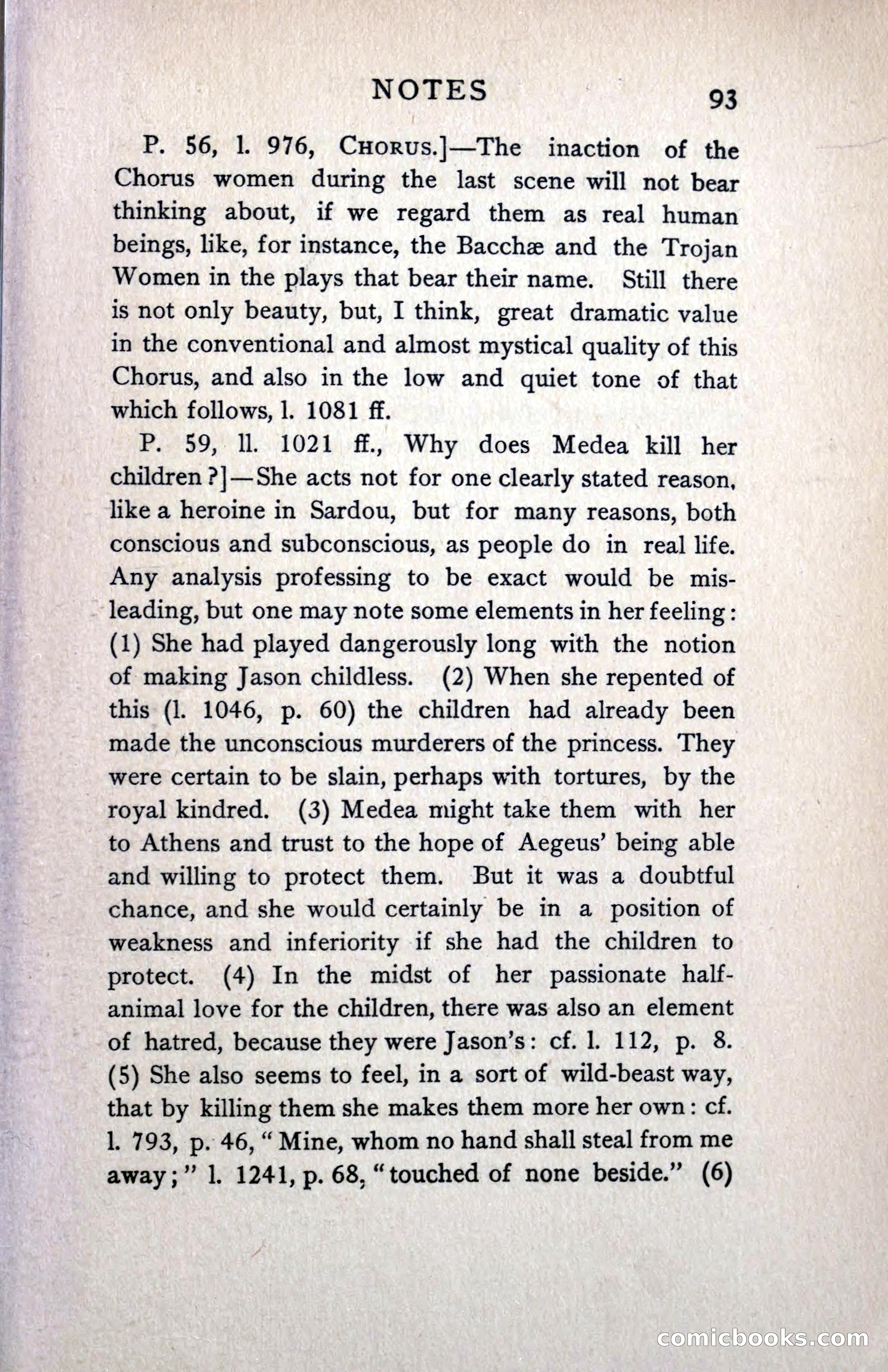
This is a notes page (page 93) from what appears to be a scholarly edition or commentary on a classical Greek play—likely Euripides' *Medea*, based on the references. The text consists entirely of running prose annotations explaining two passages: first, a note on the Chorus's inaction in the final scene, and second, a detailed analytical note examining the multiple psychological and emotional motivations behind Medea's decision to kill her children. The commentary argues that her actions stem from many conscious and subconscious reasons rather than a single stated cause, citing specific line numbers and page references throughout.
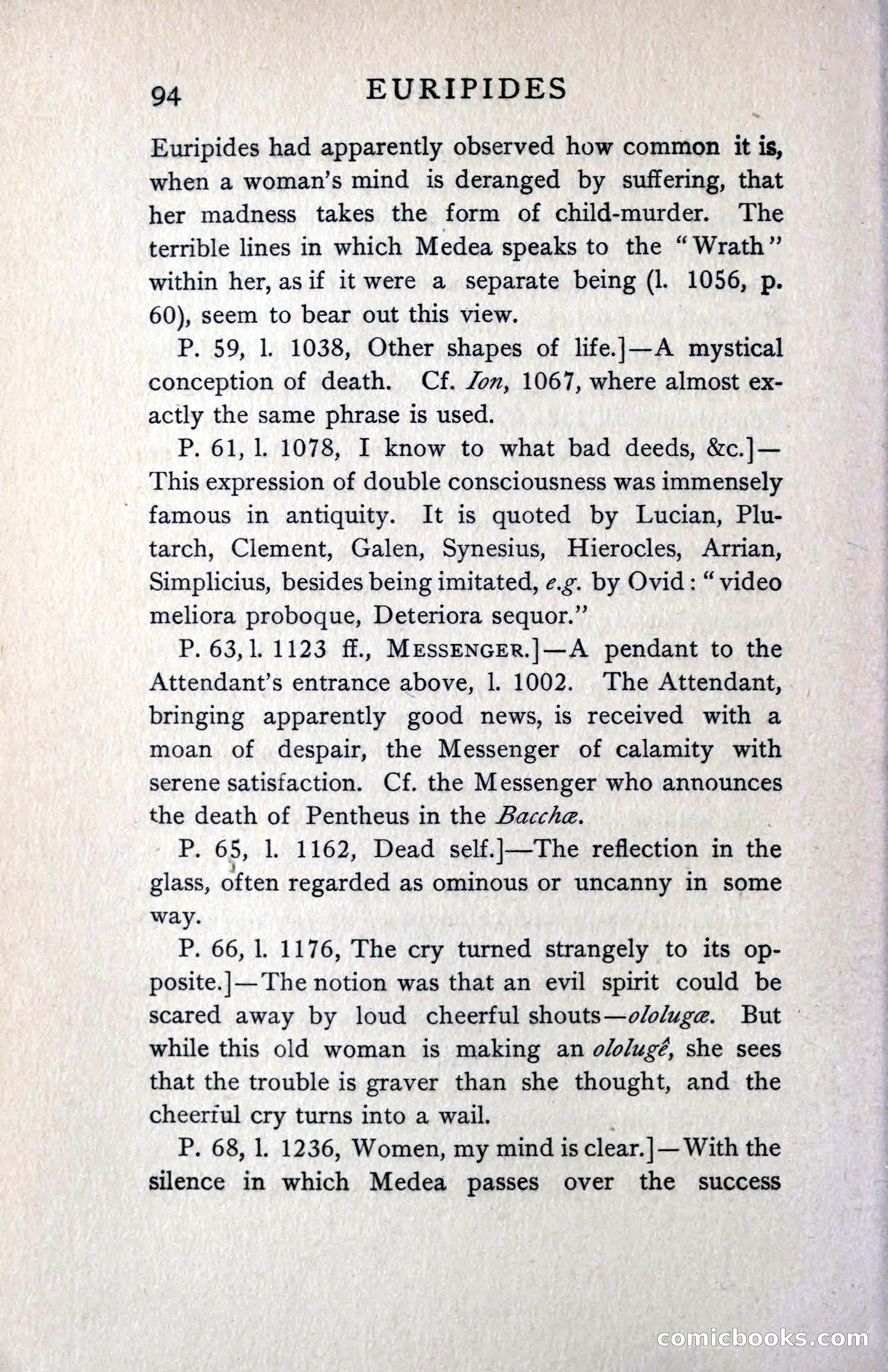
# Analysis This is a **scholarly annotations page**, not a penny dreadful. The page contains running prose in the form of footnotes or commentary on Euripides' *Medea*, explaining specific lines and classical references. The text discusses Medea's psychological state, the famous "double consciousness" passage, and various dramatic moments in the play—including messenger scenes and the significance of certain words. It appears to be from an annotated classical edition rather than sensation fiction, making the initial premise incorrect.
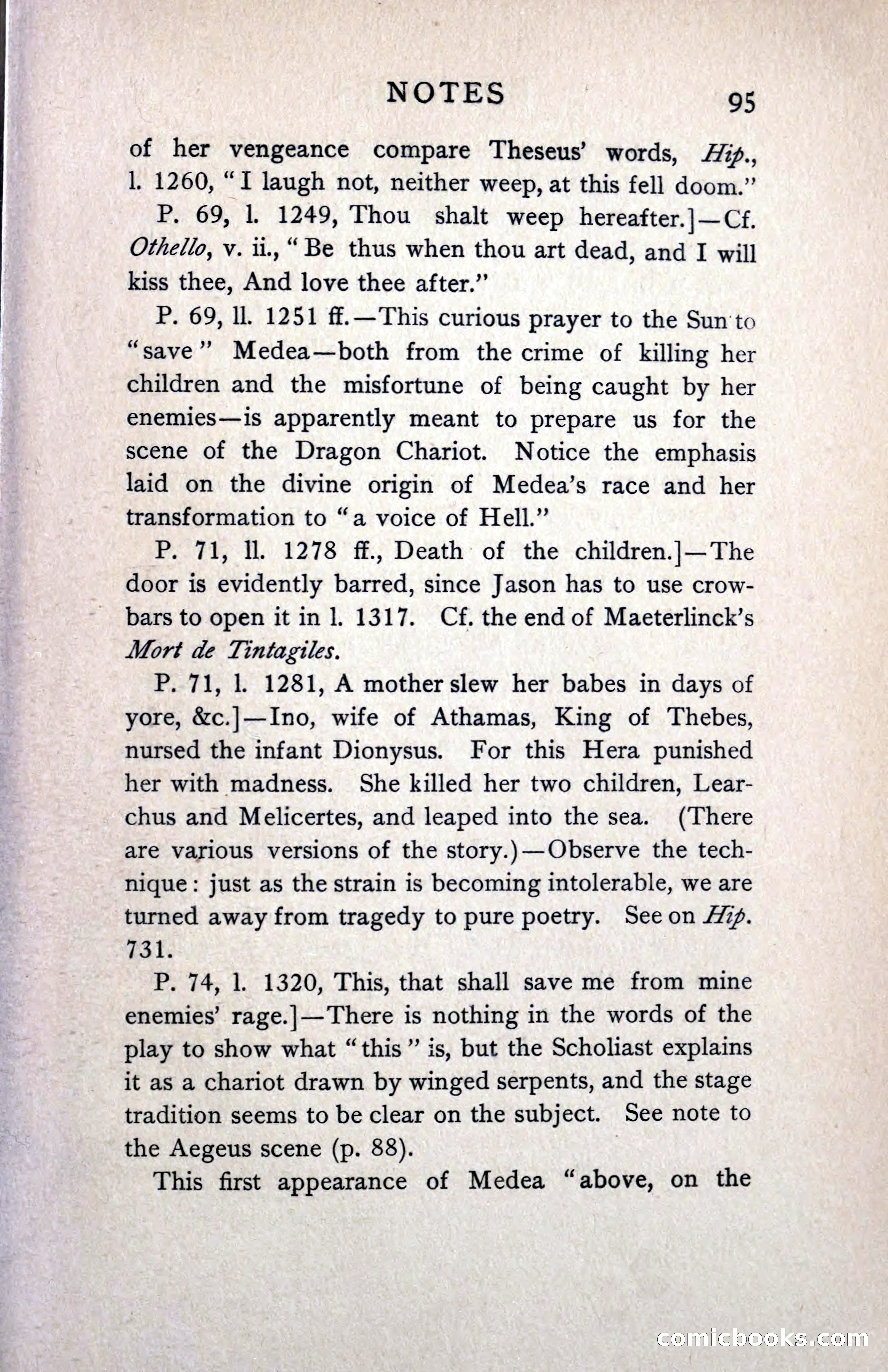
# Analysis of Page 95 This is a **notes/commentary page** from a scholarly edition, not a penny dreadful. The page contains numbered editorial annotations explaining passages from what appears to be a classical drama (likely Euripides' *Medea*). The notes discuss textual details and stage traditions: Medea's prayer to the Sun, the barred door during the children's death scene, a mythological parallel about Ino who killed her children, and clarification that "this" refers to a chariot drawn by winged serpents that rescues Medea. The page includes comparative references to Shakespeare's *Othello* and Maeterlinck's *Mort de Tintagiles*. The annotations appear scholarly rather than sensational in nature.
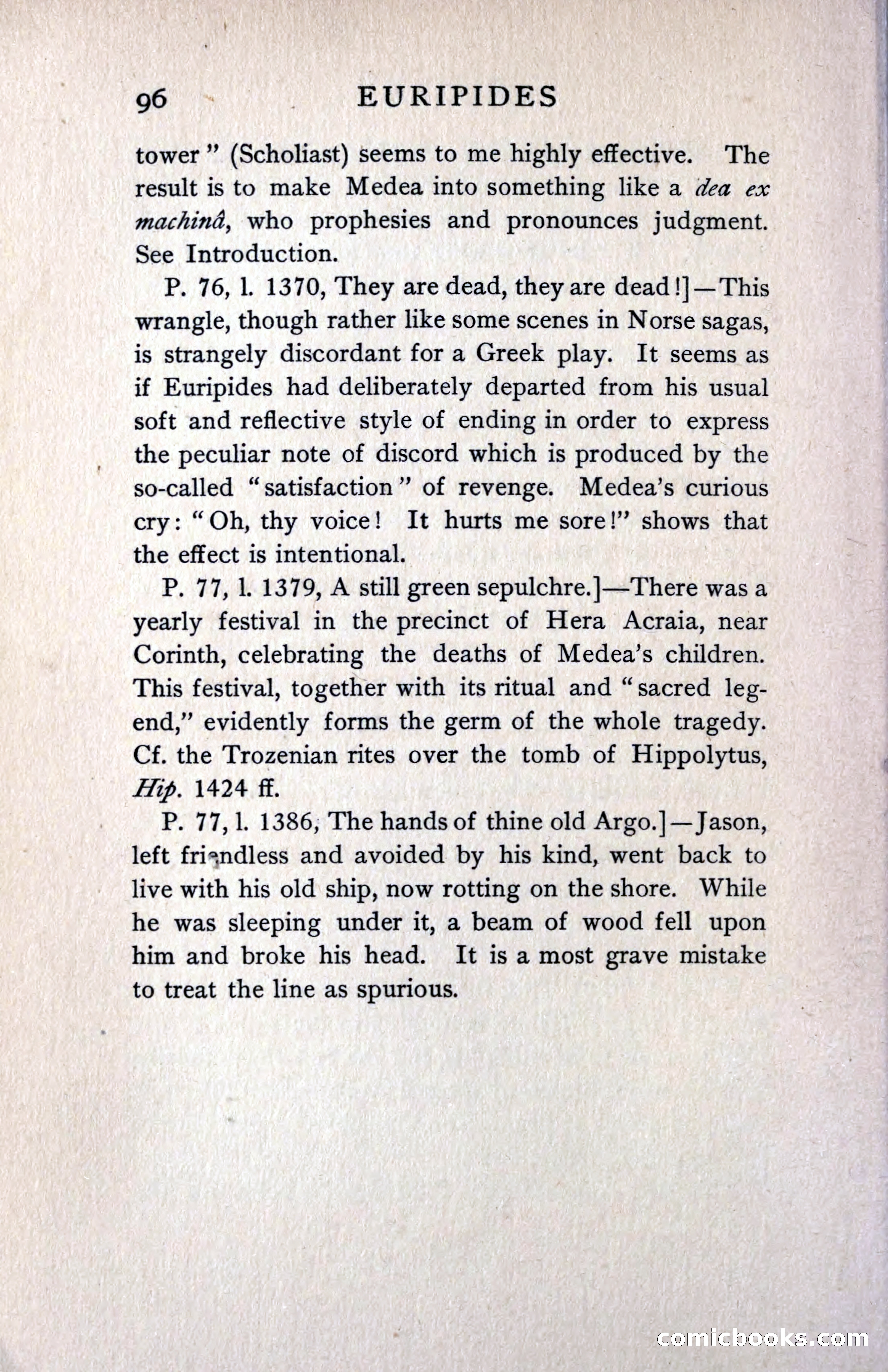
# Page Description This is a page of scholarly **annotated commentary** on Euripides' *Medea*, not a penny dreadful. The text consists of detailed scholarly notes explaining specific lines from the play (references like "P. 76, l. 1370"), discussing their theatrical effect, historical context, and textual authenticity. The commentary addresses Medea's transformation into a divine judge-like figure, the unusual discordant ending for a Greek play, a festival celebrating the deaths of Medea's children near Corinth, and Jason's eventual death beneath his rotting ship. The notes defend the authenticity of disputed lines and reference related classical texts.
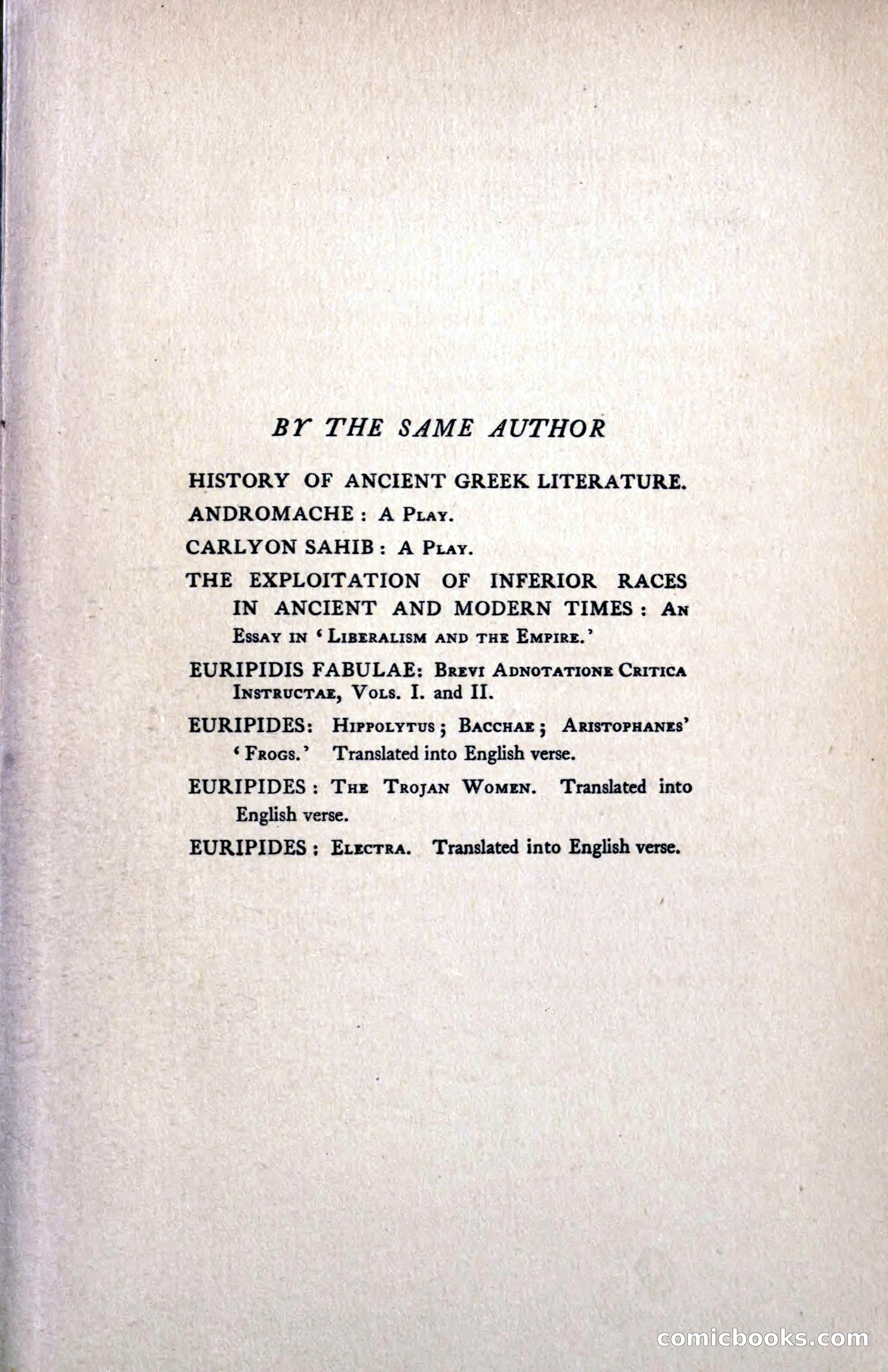
This is an advertisement page listing works by the same author. The page displays a catalog of scholarly and literary publications, including a history of ancient Greek literature, two plays (*Andromache* and *Carlyon Sahib*), an essay on the exploitation of inferior races, critical editions of Euripidis fabulae, and English verse translations of three Euripides works (*Hippolytus*, *Bacchae*, *Frogs*, *The Trojan Women*, and *Electra*). The text suggests this author was a classical scholar rather than a sensation fiction writer, making the Victorian penny dreadful attribution potentially incorrect.

This appears to be a blank or nearly blank page from a Victorian penny dreadful, with only minimal, illegible text visible—largely OCR artifacts and formatting symbols rather than coherent prose. The image shows what looks like aged paper with a mottled, textured surface in beige and gray tones, with a dark binding edge visible on the left side. No clear narrative text, title, illustration, or readable content is discernible. This may be a back matter page, separator, or a scanning error of an otherwise blank leaf from the publication.
This appears to be a back cover or inside back page of a Victorian penny dreadful, showing only archival notations rather than published content. The handwritten marks indicate cataloging information: "1995" at top (likely an acquisition date), "9 CSS642" (a catalog number), "929UN" (possibly a classification code), "PN-6147-" (a Library of Congress call number prefix for comics/graphic works), and "075-1992" (likely a date range or reference code). The page itself is blank except for these archival annotations, showing the aged, discolored state typical of nineteenth-century printed materials. No actual story text or illustrations are visible.
This appears to be a heavily aged and worn page, likely from the interior of a Victorian penny dreadful, containing handwritten notations rather than printed text. The page shows what seems to be mathematical or numerical notations, including references to "IN=2017" and "US$605" at the top, followed by various handwritten numbers and marks throughout. At the bottom, there are references to "IN=160199" and what appears to be "SHILLINGS" or similar currency notation. The extensive staining and deterioration make precise reading difficult, but this does not appear to be a title page or illustration page—rather, it seems to be a working manuscript page or archival document with annotations, though its exact original purpose remains unclear.
This is a library pocket page from the University of Toronto Library, not a penny dreadful page itself. The visible text shows cataloging information for a book: "PA 3975 M4M8 1912 cop.2" and the title "Euripides The Medea." The page includes a printed instruction reading "PLEASE DO NOT REMOVE SLIPS FROM THIS POCKET" and identifies this as belonging to the University of Toronto Library. The OCR text appears corrupted and does not correspond to readable content on the page.