
Penny Dreadfuls, 1912 · page 108 of 118
The Medea — page 108: what you’re looking at
What you’re looking at
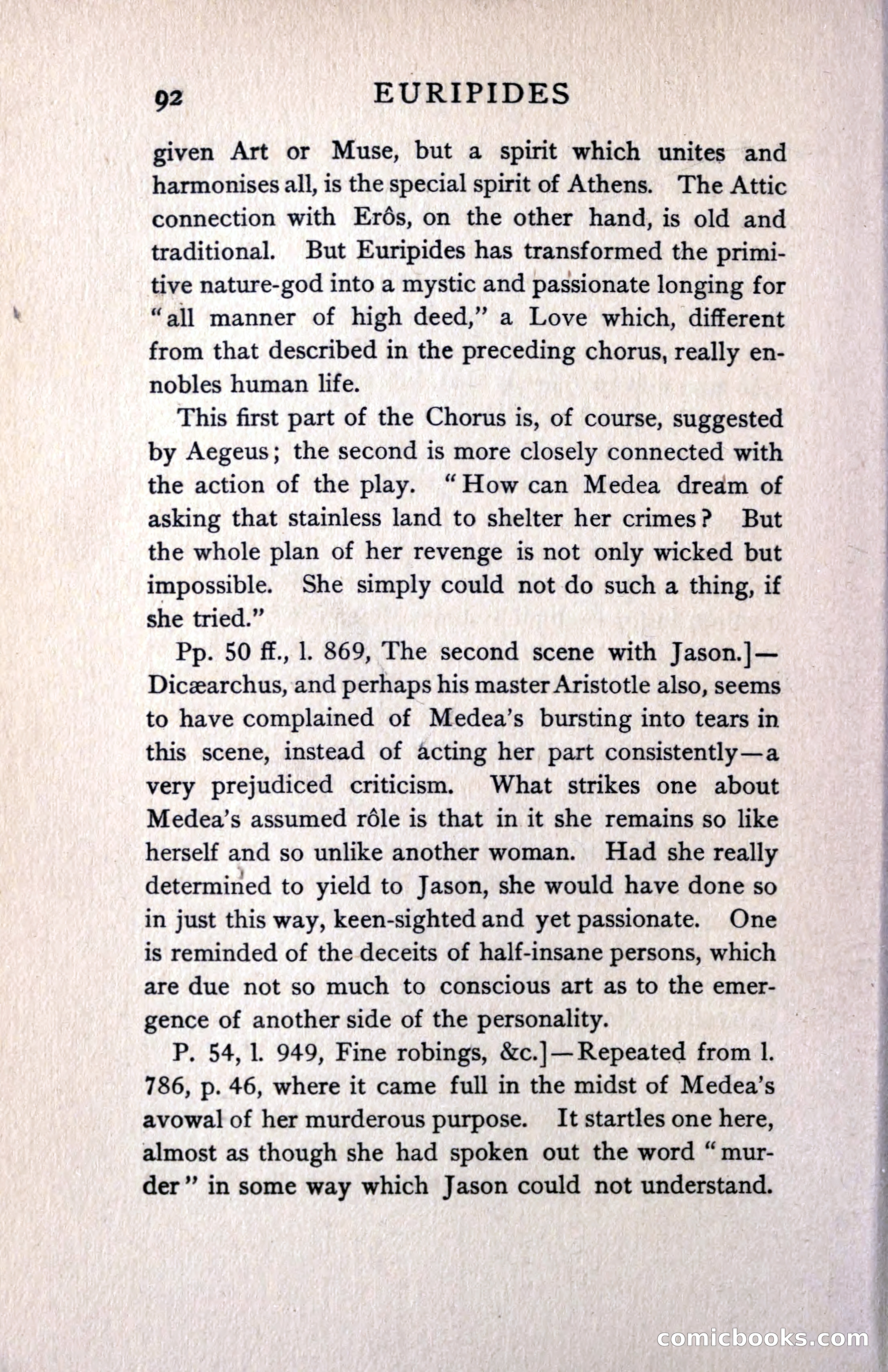
# Analysis of Page 92 This is a page of scholarly **running prose commentary**, not a penny dreadful but rather an annotated scholarly edition of Euripides. The text provides detailed literary analysis of *Medea*, discussing Euripides' portrayal of the goddess Eros and examining Medea's character, particularly her emotional complexity in a scene with Jason. The commentary critiques ancient critics (Dicaearchus and Aristotle) for finding fault with Medea's tears, arguing instead that her behavior—keen-sighted yet passionate—reflects authentic psychological depth. The page references specific line numbers and earlier passages, suggesting this is from an academic edition with textual notes rather than serialized popular fiction.
📄 Transcribed text from this page (OCR, searchable)
Machine-transcribed from the original scan — historical spelling and the odd misread are preserved.
92 EURIPIDES given Art or Muse, but a spirit which unites and harmonises all, is the special spirit of Athens. The Attic connection with Erdés, on the other hand, is old and traditional. But Euripides has transformed the primi- tive nature-god into a mystic and passionate longing for “all manner of high deed,” a Love which, different from that described in the preceding chorus, really en- nobles human life. This first part of the Chorus is, of course, suggested by Aegeus; the second is more closely connected with the action of the play. “How can Medea dream of asking that stainless land to shelter her crimes? But the whole plan of her revenge is not only wicked but impossible. She simply could not do such a thing, if she tried.” Pp. 50 ff., 1. 869, The second scene with Jason.]— Diczarchus, and perhaps his master Aristotle also, seems to have complained of Medea’s bursting into tears in this scene, instead of acting her part consistently—a very prejudiced criticism. What strikes one about Medea’s assumed réle is that in it she remains so like herself and so unlike another woman. Had she really determined to yield to Jason, she would have done so in just this way, keen-sighted and yet passionate. One is reminded of the deceits of half-insane persons, which are due not so much to conscious art as to the emer- gence of another side of the personality. P. 54, 1. 949, Fine robings, &c.]— Repeated from 1. 786, p. 46, where it came full in the midst of Medea’s avowal of her murderous purpose. It startles one here, almost as though she had spoken out the word “ mur- der” in some way which Jason could not understand. Eomichboo cS (E(0) =} 8 a ~~ -<_ — 4 -_ —_ 7 — » Sa. ee ma — $e “ .