
Penny Dreadfuls, 1912 · page 102 of 118
The Medea — page 102: what you’re looking at
What you’re looking at
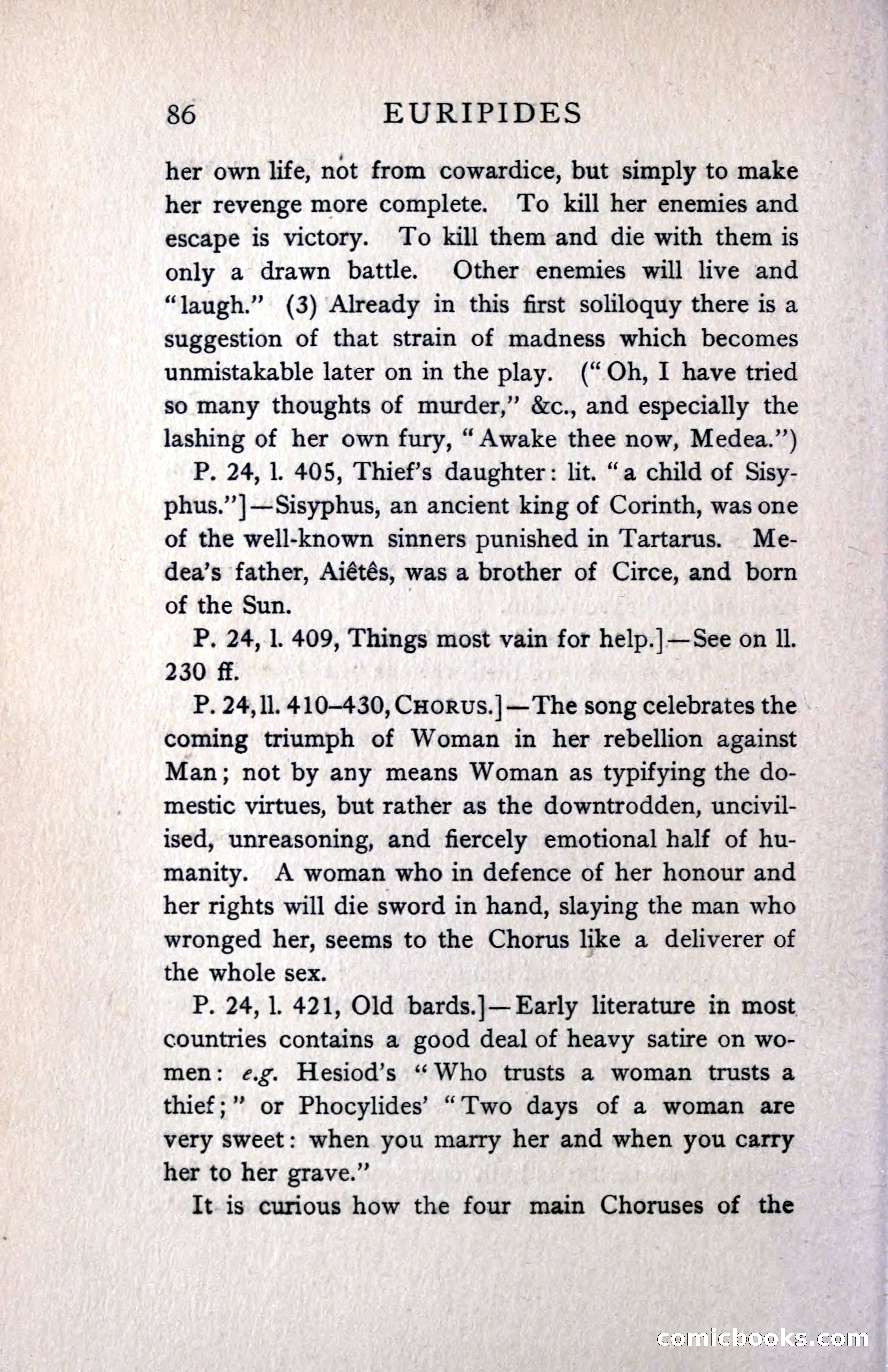
# Analysis of Page 86 This is a page of scholarly **running prose and annotations**—specifically, academic commentary on Euripides' *Medea*. The text consists of numbered footnotes and explanatory notes analyzing specific lines and passages from the play (pages and line numbers cited throughout). The visible content discusses Medea's murderous intentions, classical mythological references (Sisyphus, Aiétés, Circe), and the Chorus's celebration of woman's rebellion against man—notably depicting woman not as domestically virtuous but as "downtrodden, uncivilised, unreasoning, and fiercely emotional." The page concludes with examples of misogynistic satire from classical literature (Hesiod, Phocylides).
📄 Transcribed text from this page (OCR, searchable)
Machine-transcribed from the original scan — historical spelling and the odd misread are preserved.
86 EURIPIDES her own life, not from cowardice, but simply to make her revenge more complete. To kill her enemies and escape is victory. To kill them and die with them is only a drawn battle. Other enemies will live and “laugh.” (3) Already in this first soliloquy there is a suggestion of that strain of madness which becomes unmistakable later on in the play. (“Oh, I have tried so many thoughts of murder,” &c., and especially the lashing of her own fury, “ Awake thee now, Medea.’’) P. 24, 1. 405, Thief’s daughter: lit. “a child of Sisy- phus.’’|—Sisyphus, an ancient king of Corinth, was one of the well-known sinners punished in Tartarus. Me- dea’s father, Aiétés, was a brother of Circe, and born of the Sun. P, 24, 1. 409, Things most vain for help.|—See on Il. 230 ff. P. 24, ll. 410-430, CHorus.|— The song celebrates the coming triumph of Woman in her rebellion against Man; not by any means Woman as typifying the do- mestic virtues, but rather as the downtrodden, uncivil- ised, unreasoning, and fiercely emotional half of hu- manity. A woman who in defence of her honour and her rights will die sword in hand, slaying the man who wronged her, seems to the Chorus like a deliverer of the whole sex. P. 24, 1. 421, Old bards.|— Early literature in most countries contains a good deal of heavy satire on wo- men: ¢.g. Hesiod’s “Who trusts a woman trusts a thief;” or Phocylides’ “Two days of a woman are very sweet: when you marry her and when you carry her to her grave.” It-is curious how the four main Choruses of the Gomicbooks (E(0) =}