
Penny Dreadfuls, 1912 · page 111 of 118
The Medea — page 111: what you’re looking at
What you’re looking at
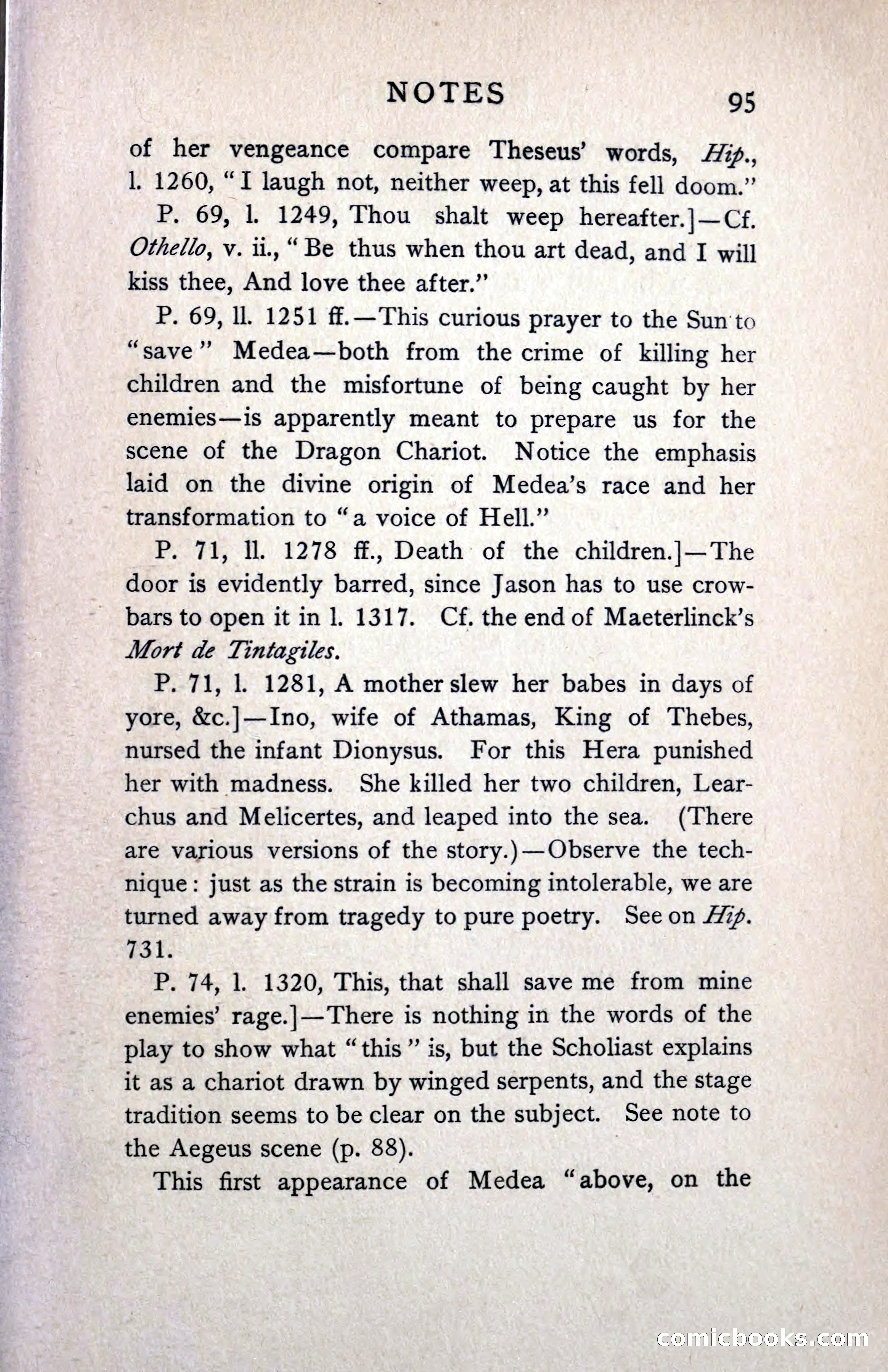
# Analysis of Page 95 This is a **notes/commentary page** from a scholarly edition, not a penny dreadful. The page contains numbered editorial annotations explaining passages from what appears to be a classical drama (likely Euripides' *Medea*). The notes discuss textual details and stage traditions: Medea's prayer to the Sun, the barred door during the children's death scene, a mythological parallel about Ino who killed her children, and clarification that "this" refers to a chariot drawn by winged serpents that rescues Medea. The page includes comparative references to Shakespeare's *Othello* and Maeterlinck's *Mort de Tintagiles*. The annotations appear scholarly rather than sensational in nature.
📄 Transcribed text from this page (OCR, searchable)
Machine-transcribed from the original scan — historical spelling and the odd misread are preserved.
NOTES 95 of her vengeance compare Theseus’ words, fiip., 1, 1260, “I laugh not, neither weep, at this fell doom.” P. 69, |. 1249, Thou shalt weep hereafter.]—Cf. Othello, v. ii., “ Be thus when thou art dead, and I will kiss thee, And love thee after.”’ P. 69, Il. 1251 ff.—This curious prayer to the Sun'to “save ’’ Medea—both from the crime of killing her children and the misfortune of being caught by her enemies—is apparently meant to prepare us for the scene of the Dragon Chariot. Notice the emphasis laid on the divine origin of Medea’s race and her transformation to “a voice of Hell.” P. 71, Il. 1278 ff., Death of the children.]|—The door is evidently barred, since Jason has to use crow- bars to open it in 1. 1317. Cf. the end of Maeterlinck’s Mort de Tintagiles. P. 71, 1. 1281, A mother slew her babes in days of yore, &c.]|—Ino, wife of Athamas, King of Thebes, nursed the infant Dionysus. For this Hera punished her with madness. She killed her two children, Lear- chus and Melicertes, and leaped into the sea. (There are various versions of the story.)—Observe the tech- nique: just as the strain is becoming intolerable, we are turned away from tragedy to pure poetry. Seeon //7z. 731. P. 74, 1. 1320, This, that shall save me from mine enemies’ rage.|—There is nothing in the words of the play to show what “this” is, but the Scholiast explains it as a chariot drawn by winged serpents, and the stage tradition seems to be clear on the subject. See note to the Aegeus scene (p. 88). : This first appearance of Medea “above, on the Eomichboo “S (E(@)