
Penny Dreadfuls, 1912 · page 34 of 118
The Medea — page 34: what you’re looking at
What you’re looking at
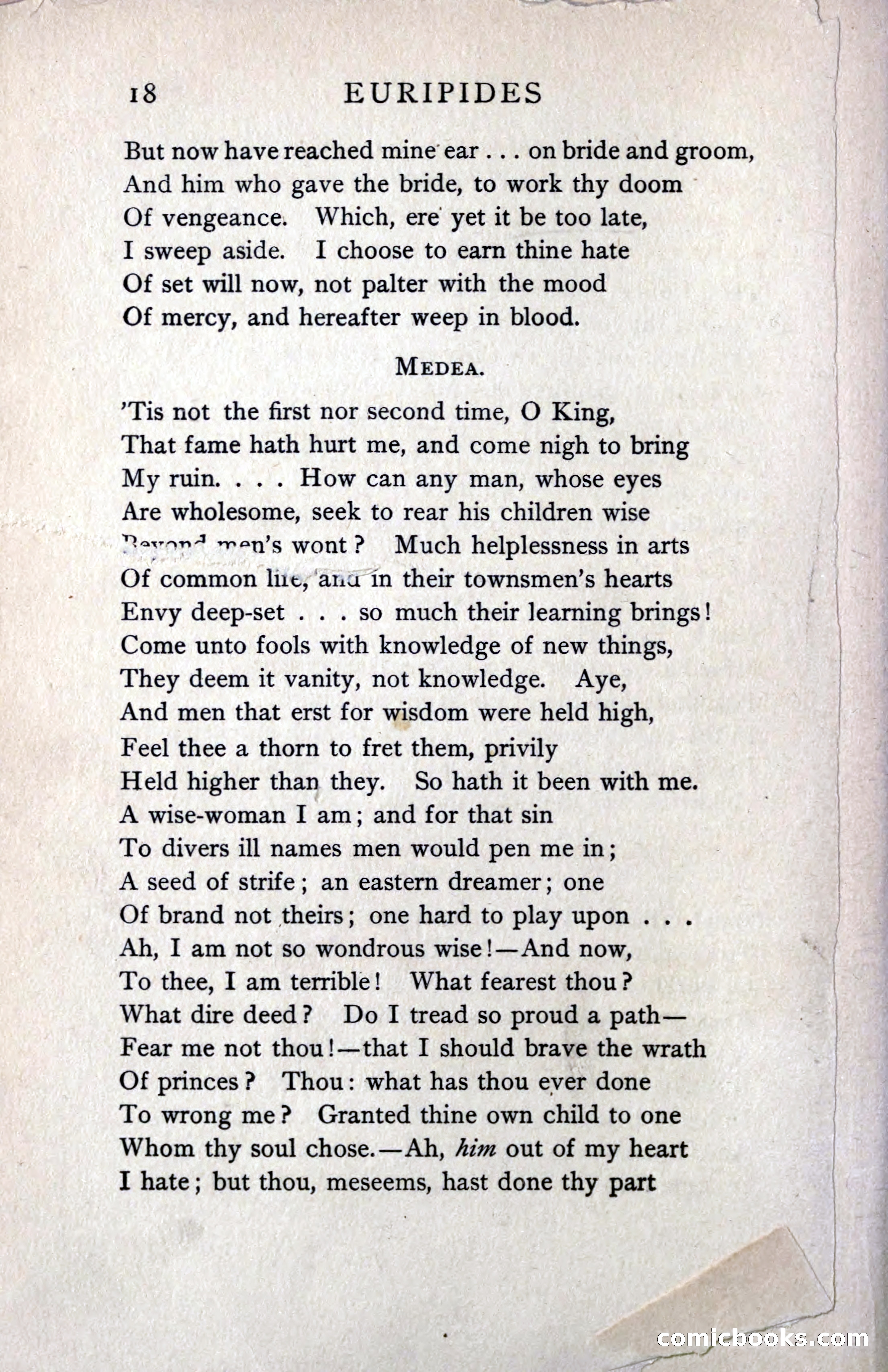
# Victorian Page Analysis This is a page of running prose from what appears to be a dramatic text. The page number is 18, and it contains dialogue attributed to "Euripides" at the top, followed by speeches by characters identified as "Medea" and apparently a King. The text presents Medea's lengthy monologue expressing her rage over a betrayal involving a bride and groom, her resentment of how society has treated her for her wisdom and foreign origins, and her accusation toward the King for giving his child to someone else. The language and style suggest this is a Victorian-era translation or adaptation of the classical Greek play *Medea*.
📄 Transcribed text from this page (OCR, searchable)
Machine-transcribed from the original scan — historical spelling and the odd misread are preserved.
18 EURIPIDES But now have reached mine’ear ... on bride and groom, And him who gave the bride, to work thy doom — Of vengeance. Which, ere yet it be too late, I sweep aside. I choose to earn thine hate Of set will now, not palter with the mood Of mercy, and hereafter weep in blood. MEDEA. ’Tis not the first nor second time, O King, That fame hath hurt me, and come nigh to bring My ruin. . . . How can any man, whose eyes Are wholesome, seek to rear his children wise Ravan men’s wont? Much helplessness in arts Of common lie,'anu in their townsmen’s hearts Envy deep-set . . . so much their learning brings! Come unto fools with knowledge of new things, They deem it vanity, not knowledge. Aye, And men that erst for wisdom were held high, Feel thee a thorn to fret them, privily Held higher than they. So hath it been with me. A wise-woman I am; and for that sin To divers ill names men would pen me in; A seed of strife; an eastern dreamer; one Of brand not theirs; one hard to play upon. . Ah, I am not so wondrous wise!—And now, To thee, I am terrible! What fearest thou? What dire deed? Do I tread so proud a path— Fear me not thou!—that I should brave the wrath Of princes? ‘Thou: what has thou ever done To wrong me? Granted thine own child to one Whom thy soul chose.—Ah, zm out of my heart I hate; but thou, meseems, hast done thy part a com nlcboe <S_GO i. Fe a