
Penny Dreadfuls, 1912 · page 104 of 118
The Medea — page 104: what you’re looking at
What you’re looking at
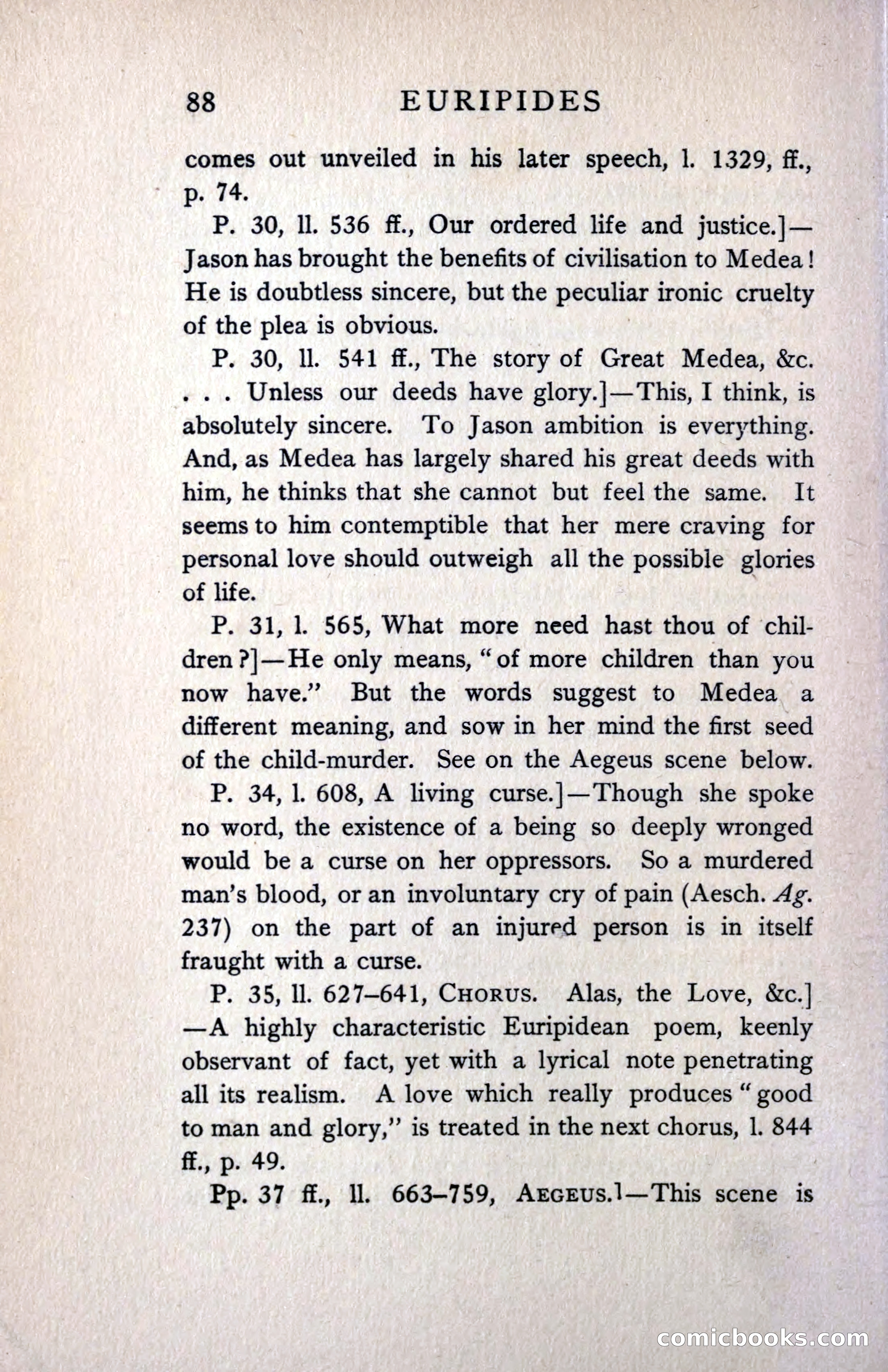
# Page Content Analysis This is a page of scholarly annotation and literary criticism, not a Victorian penny dreadful. It appears to be from an academic edition of Euripides' *Medea*, offering detailed commentary on specific lines and passages. The text analyzes Jason's dialogue with Medea, examining the irony and psychological implications of his statements about civilization, ambition, and children. The annotations reference specific line numbers and page numbers, and discuss how Jason's words inadvertently plant the "first seed of the child-murder" in Medea's mind. The commentary is interpretive and philosophical rather than narrative or sensational.
📄 Transcribed text from this page (OCR, searchable)
Machine-transcribed from the original scan — historical spelling and the odd misread are preserved.
88 EURIPIDES comes out unveiled in his later speech, 1. 1329, ff., p. 74. P. 30, ll. 536 ff., Our ordered life and justice.]— Jason has brought the benefits of civilisation to Medea! He is doubtless sincere, but the peculiar 1 Ironic cruelty of the plea is obvious. P. 30, ll. 541 ff., The story of Great Medea, &c. . Unless our deeds have glory.|— This, I think, is absolutely sincere. ‘To Jason ambition is everything. And, as Medea has largely shared his great deeds with him, he thinks that she cannot but feel the same. It seems to him contemptible that her mere craving for personal love should outweigh all the possible glories of life. P. 31, 1. 565, What more need hast thou of chil- dren ?]|—He only means, “of more children than you now have.” But the words suggest to Medea a different meaning, and sow in her mind the first seed of the child-murder. See on the Aegeus scene below. P. 34, 1. 608, A living curse.]|—Though she spoke no word, the existence of a being so deeply wronged would be a curse on her oppressors. So a murdered man’s blood, or an involuntary cry of pain (Aesch. Ag. 237) on the part of an injured person is in itself fraught with a curse. P. 35, ll. 627-641, Corus. Alas, the Love, &c.| —A highly characteristic Euripidean poem, keenly observant of fact, yet with a lyrical note penetrating all its realism. A love which really produces “ good to man and glory,” is treated in the next chorus, 1. 844 ff., p. 49. Pp. 37 ff., ll. 663-759, Arcrus.!—This scene is (e(aylaniicel ovevey <S (E(0) =}