
Penny Dreadfuls, 1912 · page 78 of 118
The Medea — page 78: what you’re looking at
What you’re looking at
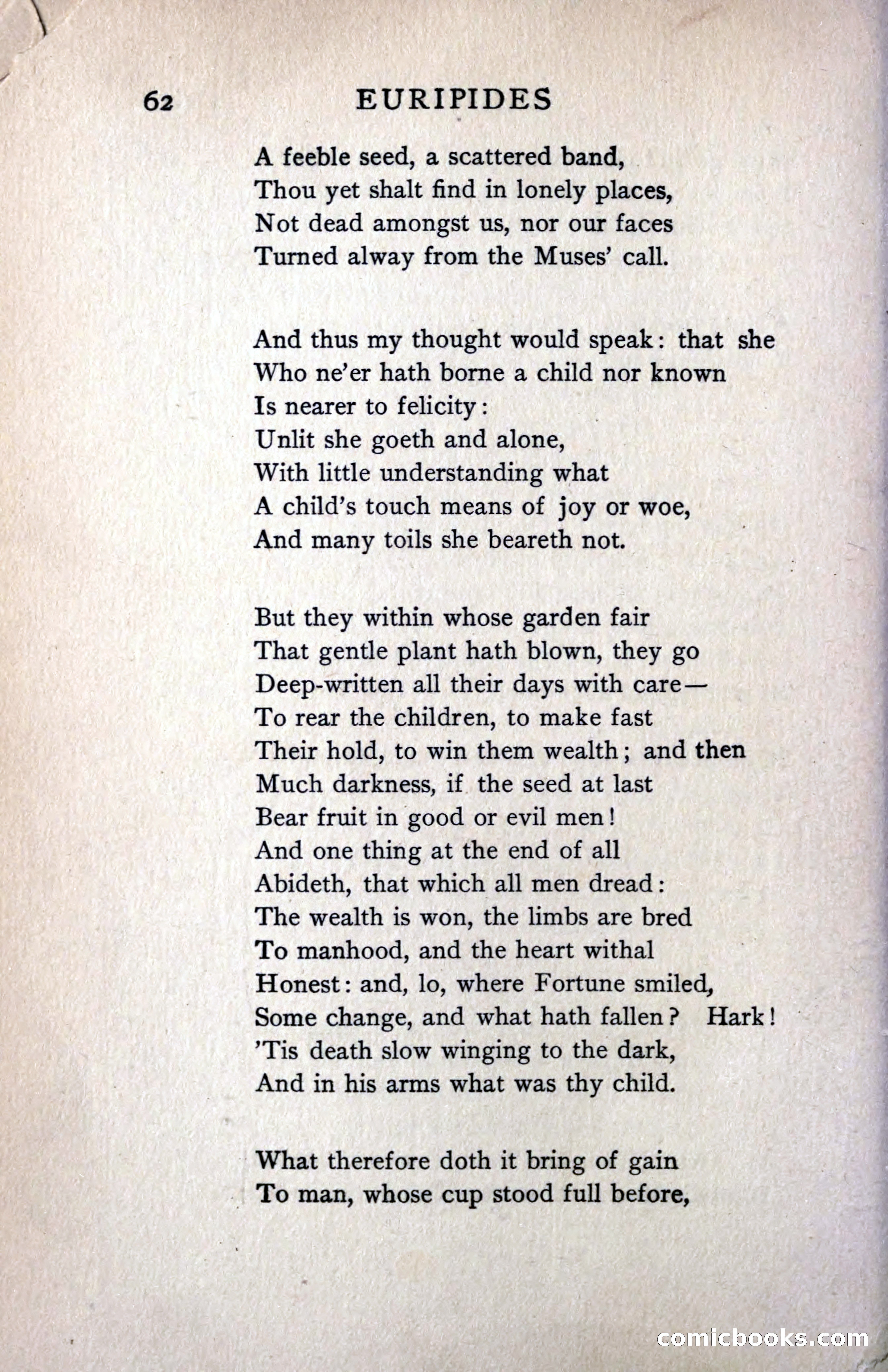
# Description of Page 62 This is a text page from what appears to be a Victorian edition, numbered 62 and headed "EURIPIDES." The page contains poetry in English—a philosophical meditation on childlessness versus parenthood. The speaker argues that women who never bear children live nearer to happiness, free from the cares and sorrows of raising offspring. The poem then shifts to contemplate those who do have children, describing the deep anxieties of parenthood and concluding with a dark reflection: that despite all effort to rear children to healthy, honest adulthood, death ultimately claims them. The final lines pose a rhetorical question about what benefit parenthood brings to someone whose life was once full.
📄 Transcribed text from this page (OCR, searchable)
Machine-transcribed from the original scan — historical spelling and the odd misread are preserved.
62 EURIPIDES A feeble seed, a scattered band, Thou yet shalt find in lonely places, Not dead amongst us, nor our faces Turned alway from the Muses’ call. And thus my thought would speak: that she Who ne’er hath borne a child nor known Is nearer to felicity: - Unlit she goeth and alone, With little understanding what A child’s touch means of joy or woe, And many toils she beareth not. But they within whose garden fair That gentle plant hath blown, they go Deep-written all their days with care— To rear the children, to make fast Their hold, to win them wealth; and then Much darkness, if the seed at last Bear fruit in good or evil men! And one thing at the end of all Abideth, that which all men dread: The wealth is won, the limbs are bred To manhood, and the heart withal Honest: and, lo, where Fortune smiled, Some change, and what hath fallen? Hark! "Tis death slow winging to the dark, And in his arms what was thy child. What therefore doth it bring of gain _ To man, whose cup stood full before, Eomicboo <S (E(0)