
Penny Dreadfuls, 1912 · page 15 of 118
The Medea — page 15: what you’re looking at
What you’re looking at
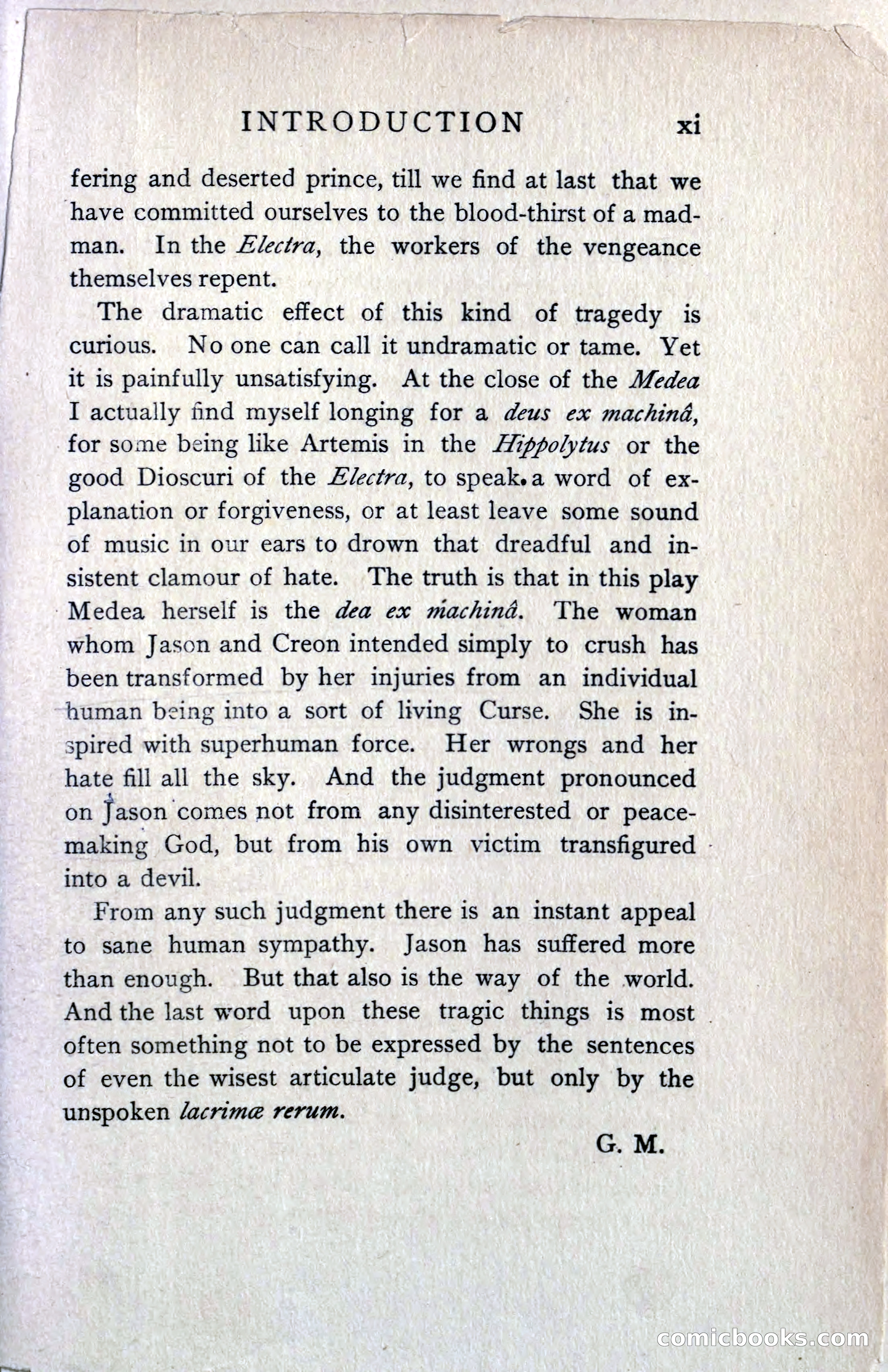
# What This Page Is This is an introduction page (marked "xi," indicating front matter) from what appears to be a scholarly or literary edition, not a penny dreadful. The page contains running prose commentary on Greek tragedy, specifically discussing Euripides' *Medea* and *Electra*. The text analyzes how these plays create dramatic tension through vengeance and suffering. The author argues that in *Medea*, the protagonist becomes a kind of supernatural curse rather than a human character—a "deus ex machina" herself—whose judgment on Jason comes not from a disinterested god but from his own victimized and transformed enemy. The passage concludes that such tragic events ultimately resist rational explanation and can only be expressed through the Latin phrase "lacrime rerum" (tears of things). The text is signed "G. M."
📄 Transcribed text from this page (OCR, searchable)
Machine-transcribed from the original scan — historical spelling and the odd misread are preserved.
INTRODUCTION | xi fering and deserted prince, till we find at last that we have committed ourselves to the blood-thirst of a mad- man. In the #éctra, the workers of the vengeance themselves repent. The dramatic effect of this kind of tragedy is curious. Noone can call it undramatic or tame. Yet it is painfully unsatisfying. At the close of the Medea I actually find myself longing for a deus ex machind, for some being like Artemis in the A/7fpolytus or the good Dioscuri of the “vectra, to speakea word of ex- planation or forgiveness, or at least leave some sound of music in our ears to drown that dreadful and in- sistent clamour of hate. The truth is that in this play -Medea herself is the dea ex machind. The woman whom Jason and Creon intended simply to crush has been transformed by her injuries from an individual human being into a sort of living Curse. She is in- spired with superhuman force. Her wrongs and her hate fill all the sky. And the judgment pronounced on Jason ‘comes not from any disinterested or peace- making God, but from his own victim transfigured - into a devil. From any such judgment there is an instant appeal to sane human sympathy. Jason has suffered more than enough. But that also is the way of the world. And the last word upon these tragic things is most | often something not to be expressed by the sentences of even the wisest articulate judge, but only by the unspoken lacrime rerum. G. M. e€oim 0 )(0 0) (C(O) gs)