
Penny Dreadfuls, 1912 · page 100 of 118
The Medea — page 100: what you’re looking at
What you’re looking at
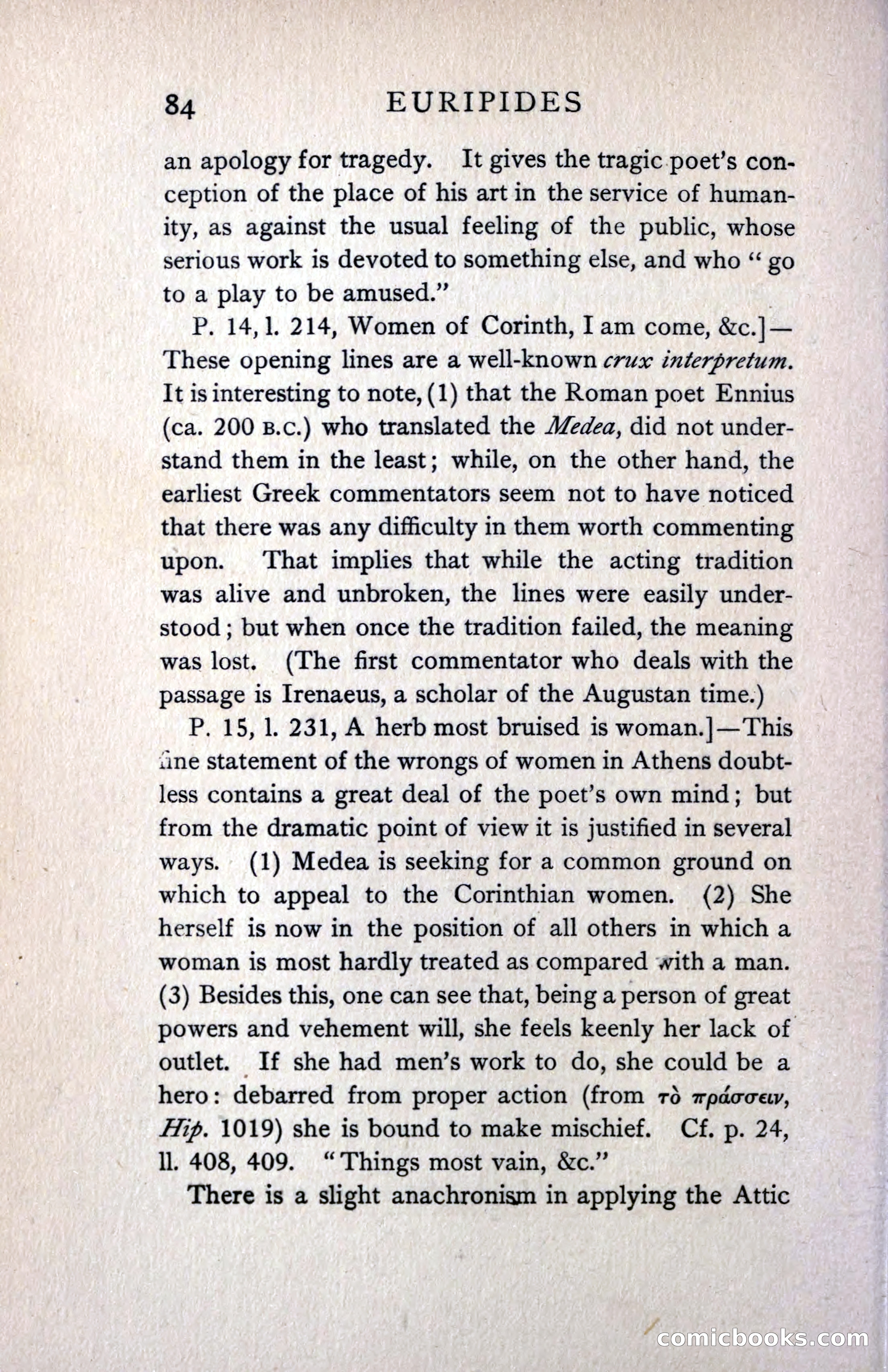
# Page Description This is a page of scholarly commentary (page 84) from a Victorian edition of Euripides, not a penny dreadful. It contains running prose—specifically, detailed textual annotations on Euripides' *Medea*. The commentary explains difficult passages, notes how ancient Roman and Greek scholars interpreted them differently, and discusses the dramatic justification for Medea's statements about women's oppression in Athens, arguing that her lack of proper action drives her toward mischief.
📄 Transcribed text from this page (OCR, searchable)
Machine-transcribed from the original scan — historical spelling and the odd misread are preserved.
84 EURIPIDES an apology for tragedy. It gives the tragic poet’s con- ception of the place of his art in the service of human- ity, as against the usual feeling of the public, whose serious work is devoted to something else, and who “ go to a play to be amused.” | P. 14,1. 214, Women of Corinth, Iam come, &c.]— These opening lines are a well-known crux interpretum. It is interesting to note, (1) that the Roman poet Ennius (ca. 200 B.c.) who translated the JZedea, did not under- stand them in the least; while, on the other hand, the earliest Greek commentators seem not to have noticed that there was any difficulty in them worth commenting upon. ‘That implies that while the acting tradition was alive and unbroken, the lines were easily under- stood ; but when once the tradition failed, the meaning was lost. (The first commentator who deals with the passage is Irenaeus, a scholar of the Augustan time.) P, 15, 1. 231, A herb most bruised is woman.|— This ine statement of the wrongs of women in Athens doubt- less contains a great deal of the poet’s own mind; but from the dramatic point of view it is justified in several ways. (1) Medea is seeking for a common ground on which to appeal to the Corinthian women. (2) She herself is now in the position of all others in which a woman is most hardly treated as compared with a man. (3) Besides this, one can see that, being a person of great powers and vehement will, she feels keenly her lack of outlet. If she had men’s work to do, she could be a hero: debarred from proper action (from 16 mpdocey, Hip. 1019) she is bound to make mischief. Cf. p. 24, ll. 408, 409. “Things most vain, &c.” There is a slight anachronism in applying the Attic Gomicbooks (E(0)