
Penny Dreadfuls, 1912 · page 110 of 118
The Medea — page 110: what you’re looking at
What you’re looking at
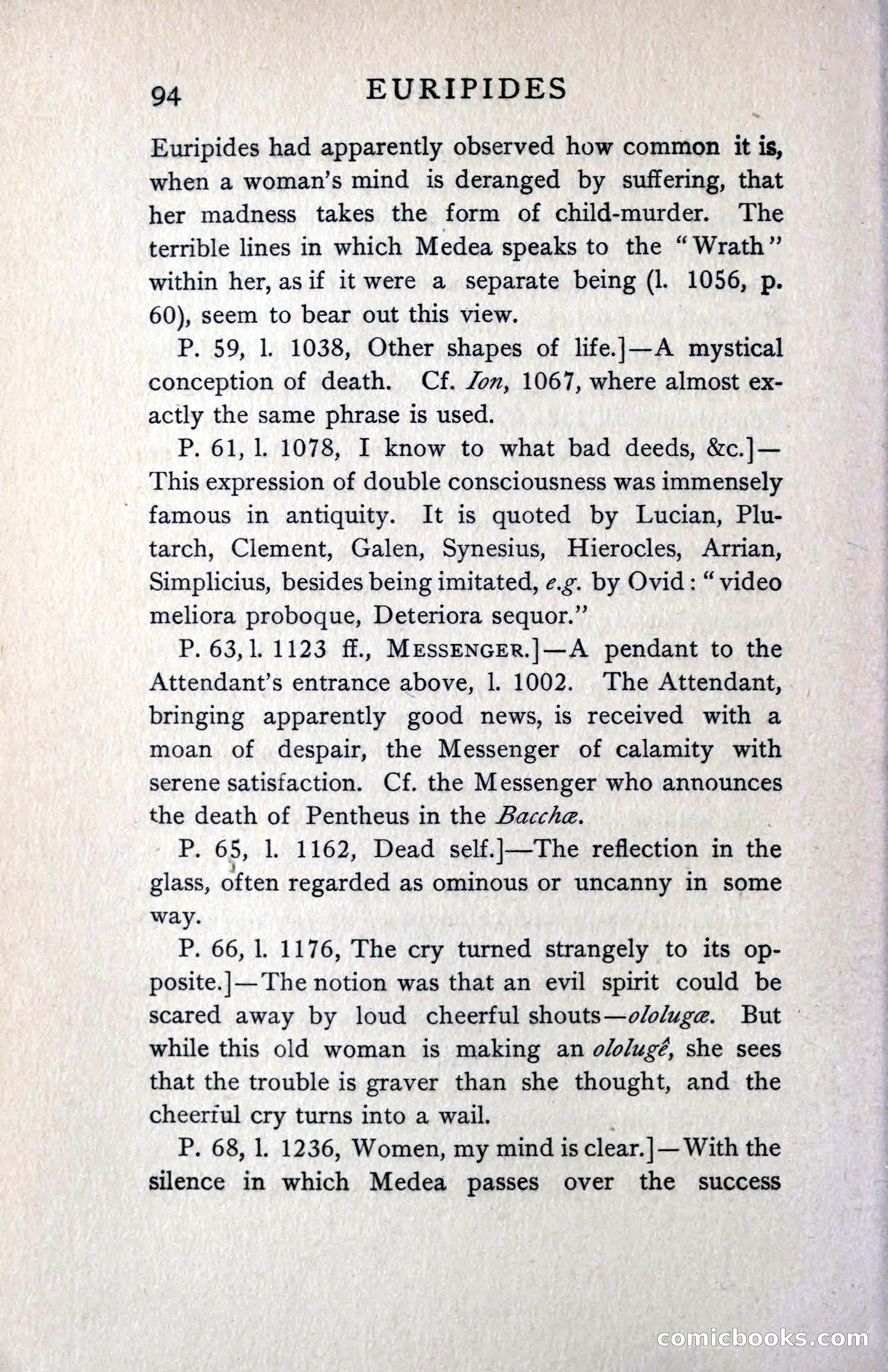
# Analysis This is a **scholarly annotations page**, not a penny dreadful. The page contains running prose in the form of footnotes or commentary on Euripides' *Medea*, explaining specific lines and classical references. The text discusses Medea's psychological state, the famous "double consciousness" passage, and various dramatic moments in the play—including messenger scenes and the significance of certain words. It appears to be from an annotated classical edition rather than sensation fiction, making the initial premise incorrect.
📄 Transcribed text from this page (OCR, searchable)
Machine-transcribed from the original scan — historical spelling and the odd misread are preserved.
94 EURIPIDES Euripides had apparently observed how common it is, when a woman’s mind is deranged by suffering, that her madness takes the form of child-murder. The terrible lines in which Medea speaks to the “Wrath” within her, asif it were a separate being (1. 1056, p. 60), seem to bear out this view. P. 59, 1. 1038, Other shapes of life.|—A mystical conception of death. Cf. /on, 1067, where almost ex- actly the same phrase is used. P. 61, l. 1078, I know to what bad deeds, &c.|]— This expression of double consciousness was immensely - famous in antiquity. It is quoted by Lucian, Plu- tarch, Clement, Galen, Synesius, Hierocles, Arrian, Simplicius, besides being imitated, e.g. by Ovid: “ video meliora proboque, Deteriora sequor.”’ P. 63,1. 1123 ff., MEssENGER.|—A pendant to the Attendant’s entrance above, 1. 1002. The Attendant, bringing apparently good news, is received with a moan of despair, the Messenger of calamity with serene satisfaction. Cf. the Messenger who announces the death of Pentheus in the Bacche. | P. 65, 1. 1162, Dead self.|—The reflection in the glass, often regarded as ominous or uncanny in some way. P. 66, l. 1176, The cry turned strangely to its op- posite.|— The notion was that an evil spirit could be scared away by loud cheerful shouts—o/o/uge. But — while this old woman is making an ololugé, she sees that the trouble is graver than she thought, and the cheertul cry turns into a wail. . P. 68, 1. 1236, Women, my mind is clear. ]— With the silence in which Medea passes over the success EGomicboo cS (E(0)