
Penny Dreadfuls, 1912 · page 99 of 118
The Medea — page 99: what you’re looking at
What you’re looking at
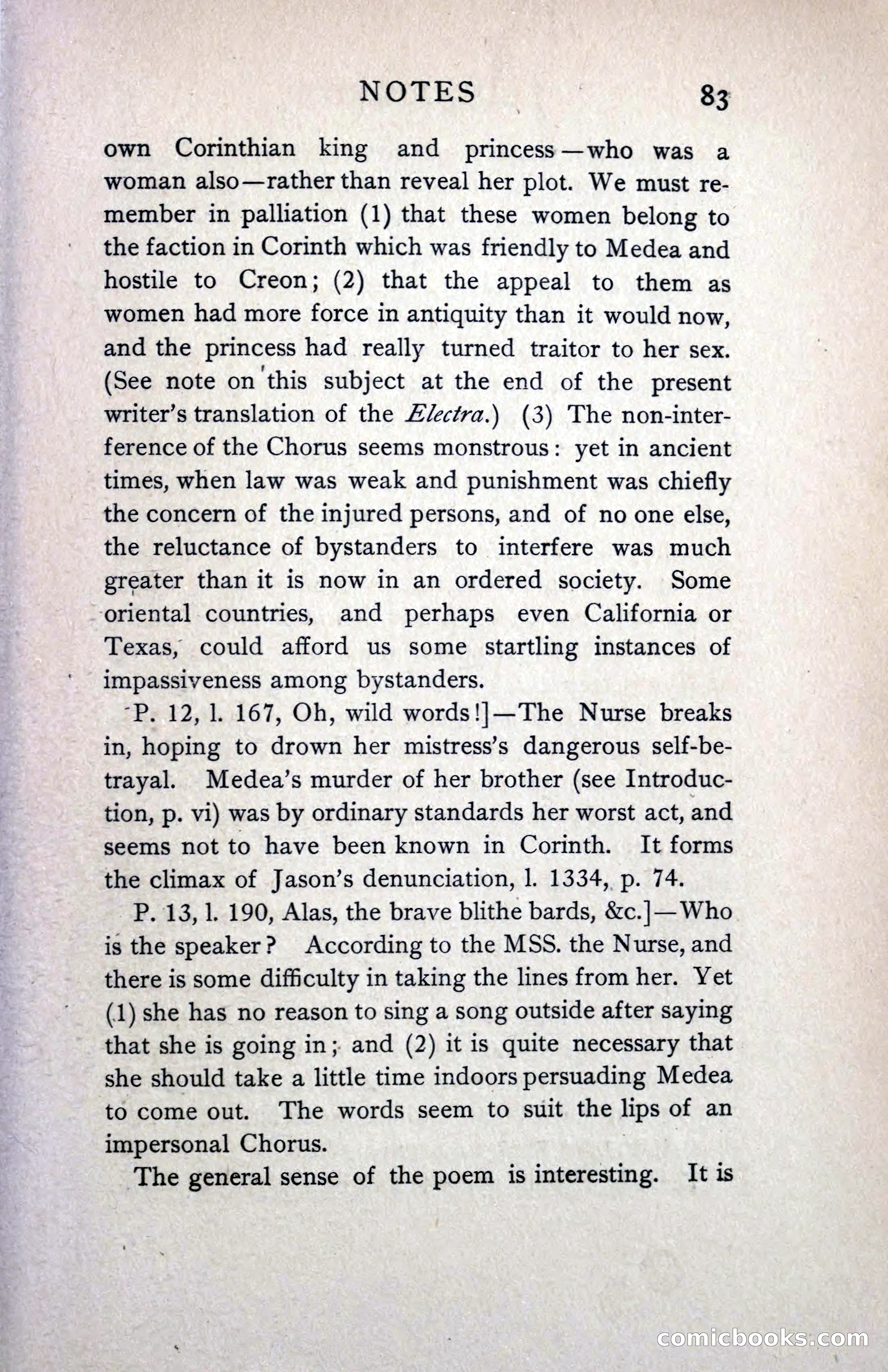
# This Page: Scholarly Notes on a Classical Text This is a notes page (page 83) from what appears to be a scholarly edition or translation of an ancient Greek play—specifically *Medea*. The text consists of numbered explanatory footnotes discussing textual and interpretative issues: the motivations of Corinthian women, the apparent inaction of the Chorus, the identity of speakers in particular lines, and references to murder, Jason's denunciation, and the Nurse character. The notes engage with manuscript variations and attempt to justify seemingly problematic dramatic choices through historical context. This is scholarly apparatus, not a penny dreadful.
📄 Transcribed text from this page (OCR, searchable)
Machine-transcribed from the original scan — historical spelling and the odd misread are preserved.
NOTES | | 83 own Corinthian king and princess—who was a woman also—rather than reveal her plot. We must re- member in palliation (1) that these women belong to the faction in Corinth which was friendly to Medea and hostile to Creon; (2) that the appeal to them as women had more force in antiquity than it would now, and the princess had really turned traitor to her sex. (See note on this subject at the end of the present writer’s translation of the vectra.) (3) The non-inter- ference of the Chorus seems monstrous: yet in ancient times, when law was weak and punishment was chiefly the concern of the injured persons, and of no one else, the reluctance of bystanders to interfere was much greater than it is now in an ordered society. Some oriental countries, and perhaps even California or Texas, could afford us some startling instances of impassiveness among bystanders. “P. 12, 1. 167, Oh, wild words!|—The Nurse breaks in, hoping to drown her mistress’s dangerous self-be- trayal. Medea’s murder of her brother (see Introduc- tion, p. vi) was by ordinary standards her worst act, and seems not to have been known in Corinth. It forms the climax of Jason’s denunciation, |. 1334, p. 74. P. 13, 1. 190, Alas, the brave blithe bards, &c.]—Who is the speaker? According to the MSS. the Nurse, and there is some difficulty in taking the lines from her. Yet (1) she has no reason to sing a song outside after saying that she is going in; and (2) it is quite necessary that she should take a little time indoors persuading Medea to come out. The words seem to suit the lips of an impersonal Chorus. aa I ‘The general sense of the poem is interesting. It is EGomicboo “S (E(0)