
Penny Dreadfuls, 1912 · page 101 of 118
The Medea — page 101: what you’re looking at
What you’re looking at
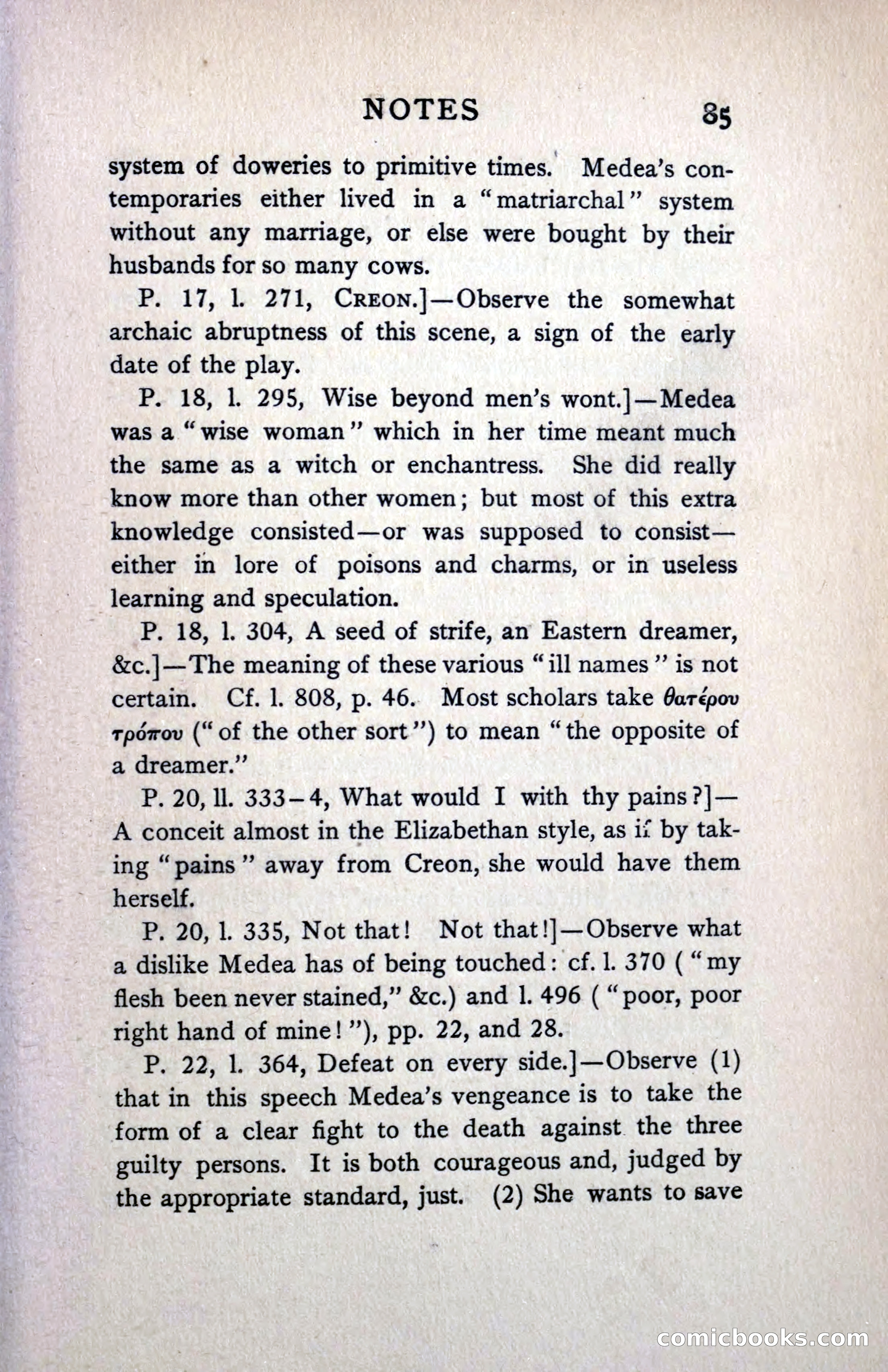
# Analysis This is a **notes/commentary page** from what appears to be a scholarly edition of a classical text—specifically annotations on Euripides' *Medea*. The page contains numbered textual notes explaining specific lines and passages from the play (referenced as "P." for page and "l." for line numbers). The notes discuss Medea's character traits (her knowledge of poisons and charms, her aversion to being touched) and interpret key dramatic moments, such as her declaration of vengeance against three guilty parties. The scholarly tone and classical references make clear this is **not** a penny dreadful, but rather an educational commentary, likely from a Victorian-era school or university edition of Greek drama.
📄 Transcribed text from this page (OCR, searchable)
Machine-transcribed from the original scan — historical spelling and the odd misread are preserved.
NOTES | 8s system of doweries to primitive times. Medea’s con- temporaries either lived in a “matriarchal” system without any marriage, or else were bought by their husbands for so many cows. P. 17, 1. 271, CrEon.]|—Observe the somewhat archaic abruptness of this scene, a sign of the early date of the play. P. 18, 1. 295, Wise beyond men’s wont.|— Medea was a “wise woman” which in her time meant much the same as a witch or enchantress. She did really know more than other women; but most of this extra knowledge consisted—or was supposed to consist— either in lore of poisons and charms, or in useless learning and speculation. P. 18, 1. 304, A seed of strife, an Eastern dreamer, &c.]|—The meaning of these various “ill names ”’ is not certain. Cf. 1. 808, p. 46. Most scholars take Oarépou tpomov (“of the other sort”) to mean “the opposite of a dreamer.” P, 20, ll. 333-4, What would I with thy pains ?|— - A conceit almost in the Elizabethan style, as ii by tak- ing “pains” away from Creon, she would have them herself, P, 20, 1. 335, Not that! Not that!]—Observe what a dislike Medea has of being touched: cf. 1. 370 ( “my flesh been never stained,” &c.) and |. 496 ( “poor, poor right hand of mine! ”’), pp. 22, and 28. P. 22, 1. 364, Defeat on every side.]|—Observe (1) that in this speech Medea’s vengeance is to take the form of a clear fight to the death against. the three guilty persons. It is both courageous and, judged by the appropriate standard, just. (2) She wants to save Eomichboo cS (E(0)