
Penny Dreadfuls, 1912 · page 112 of 118
The Medea — page 112: what you’re looking at
What you’re looking at
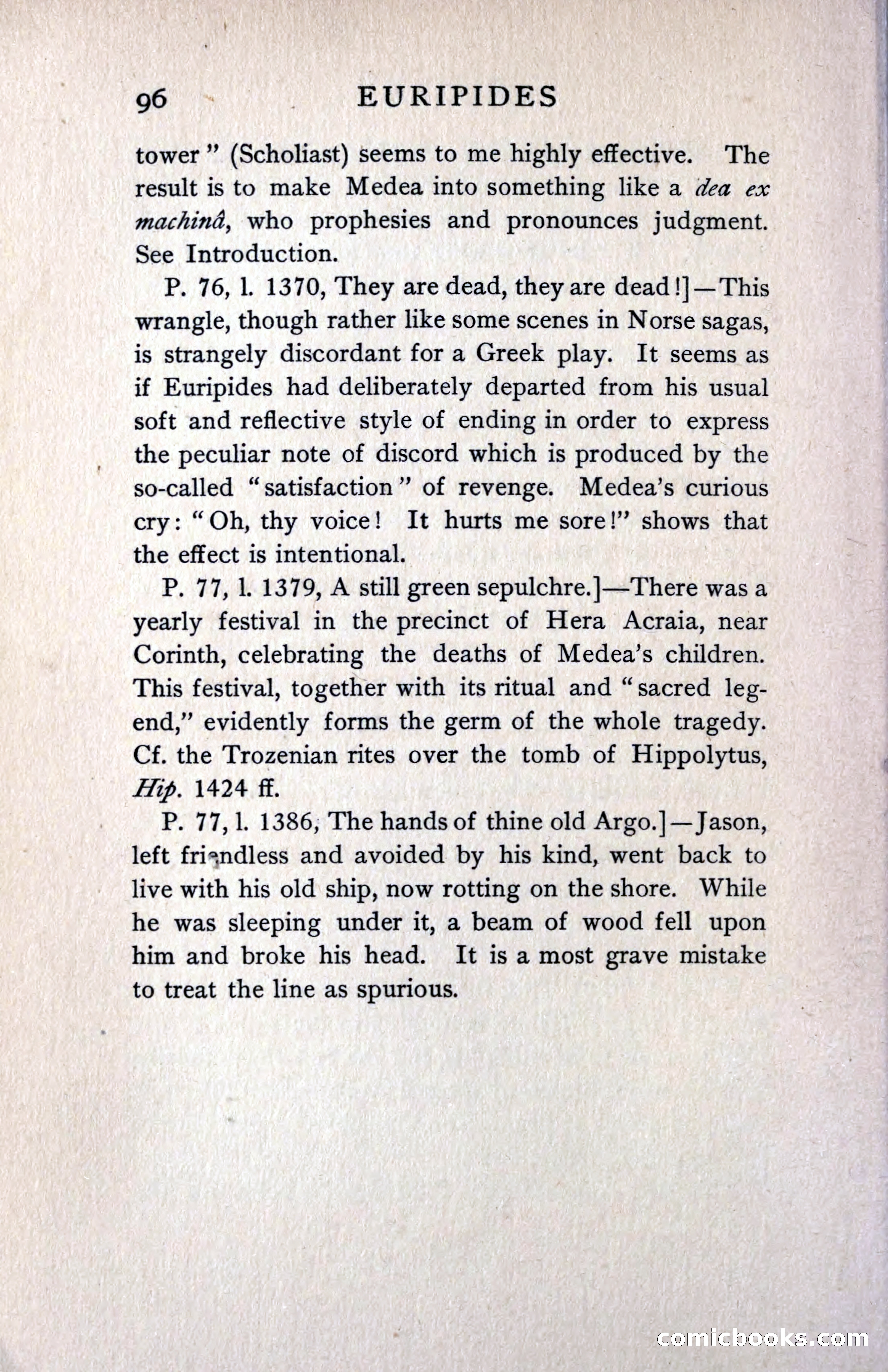
# Page Description This is a page of scholarly **annotated commentary** on Euripides' *Medea*, not a penny dreadful. The text consists of detailed scholarly notes explaining specific lines from the play (references like "P. 76, l. 1370"), discussing their theatrical effect, historical context, and textual authenticity. The commentary addresses Medea's transformation into a divine judge-like figure, the unusual discordant ending for a Greek play, a festival celebrating the deaths of Medea's children near Corinth, and Jason's eventual death beneath his rotting ship. The notes defend the authenticity of disputed lines and reference related classical texts.
📄 Transcribed text from this page (OCR, searchable)
Machine-transcribed from the original scan — historical spelling and the odd misread are preserved.
pO PUR Pes tower” (Scholiast) seems to me highly effective. The result is to make Medea into something like a dea ex machina, who prophesies and pronounces judgment. See Introduction. P. 76, 1. 1370, They are dead, they are dead!]— This wrangle, though rather like some scenes in Norse sagas, is strangely discordant for a Greek play. It seems as if Euripides had deliberately departed from his usual soft and reflective style of ending in order to express the peculiar note of discord which is produced by the so-called “satisfaction” of revenge. Medea’s curious cry: “Oh, thy voice! It hurts me sore!” shows that the effect is intentional. P, 77, 1. 1379, A still green sepulchre.|—There was a yearly festival in the precinct of Hera Acraia, near Corinth, celebrating the deaths of Medea’s children. This festival, together with its ritual and “sacred leg- end,” evidently forms the germ of the whole tragedy. Cf. the Trozenian rites over the tomb of Hippolytus, Flip. 1424 ff. P. 77, 1. 1386; The hands of thine old Argo.]—Jason, left frisndless and avoided by his kind, went back to live with his old ship, now rotting on the shore. While he was sleeping under it, a beam of wood fell upon him and broke his head. It is a most grave mistake to treat the line as spurious. cS (E(0) =} EGomichboo