
Penny Dreadfuls, 1912 · page 40 of 118
The Medea — page 40: what you’re looking at
What you’re looking at
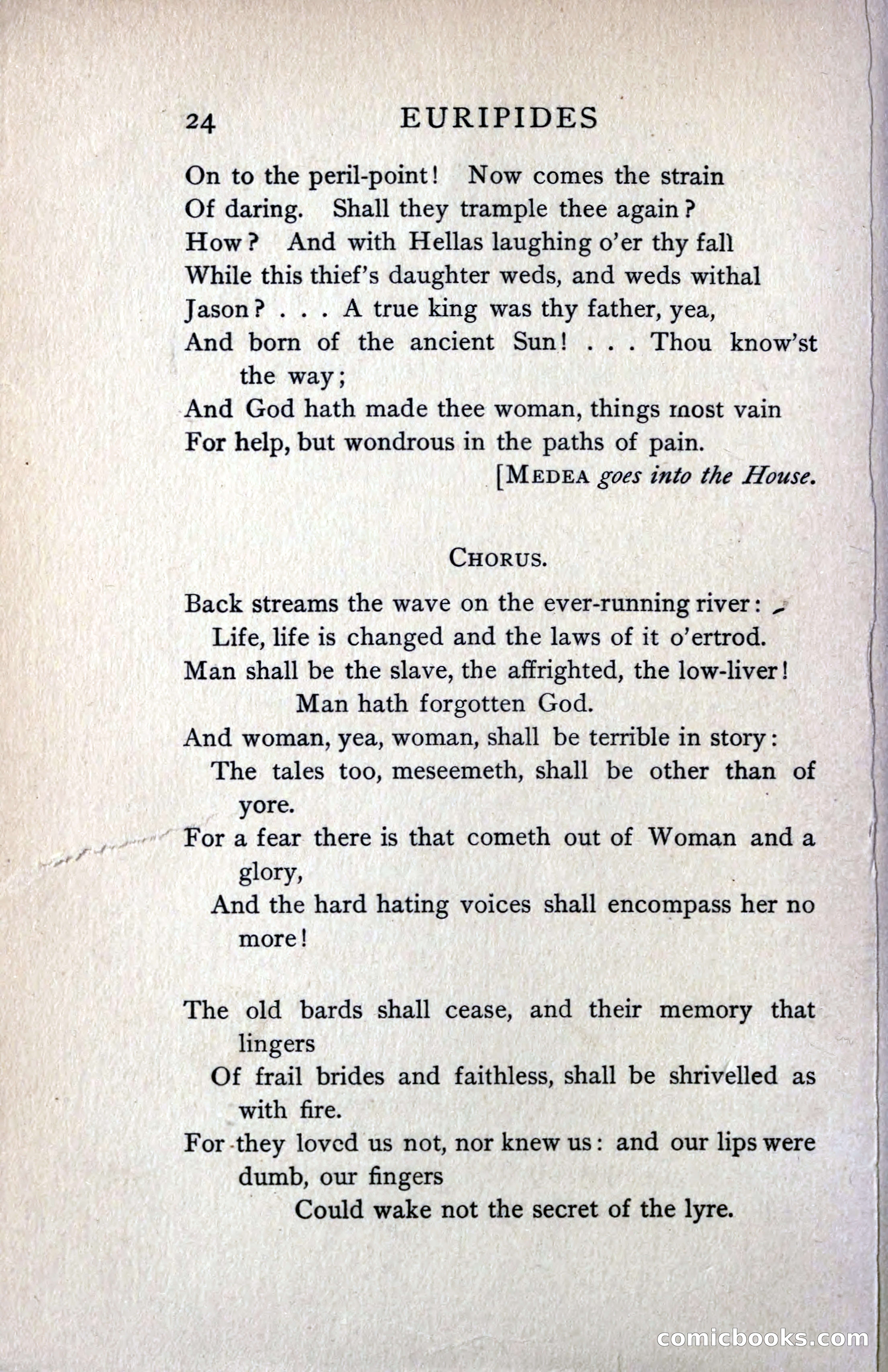
# Page Description This is a page of running dramatic verse from what appears to be a Victorian translation or adaptation of Euripides' *Medea*. The page contains the final lines of a character's speech (mentioning Jason and a thief's daughter), followed by the stage direction "[MEDEA goes into the House," and then an extended choral passage. The Chorus predicts a reversal of fortune: men will become enslaved and forgotten by God, while women—previously slandered in old tales—will become powerful and terrible. The old poets' stories of faithless women will be erased, since those bards never truly understood or loved women. The text suggests an impending transformation in how women's stories will be told.
📄 Transcribed text from this page (OCR, searchable)
Machine-transcribed from the original scan — historical spelling and the odd misread are preserved.
24 EURIPIDES On to the peril-point! Now comes the strain Of daring. Shall they trample thee again? How? And with Hellas laughing o’er thy fall While this thief’s daughter weds, and weds withal Jason? ... A true king was thy father, yea, And born of the ancient Sun! ... Thou know’st the way; And God hath made thee woman, things roost vain For help, but wondrous in the paths of pain. [MEDEA goes into the House. CHORUS. | Back streams the wave on the ever-running river: — j Life, life is changed and the laws of it o’ertrod. } Man shall be the slave, the affrighted, the low-liver! Man hath forgotten God. And woman, yea, woman, shall be terrible in story: -~ For a fear there is that cometh out of Woman anda glory, | And the hard hating voices shall encompass her no more! The old bards shall cease, and their memory that lingers Of frail brides and faithless, shall be shrivelled as with fire. For-they loved us not, nor knew us: and our lips were dumb, our fingers Could wake not the secret of the lyre. Eomicbooks: Go The tales too, meseemeth, shall be other than of yore. : f m