
Penny Dreadfuls, 1912 · page 107 of 118
The Medea — page 107: what you’re looking at
What you’re looking at
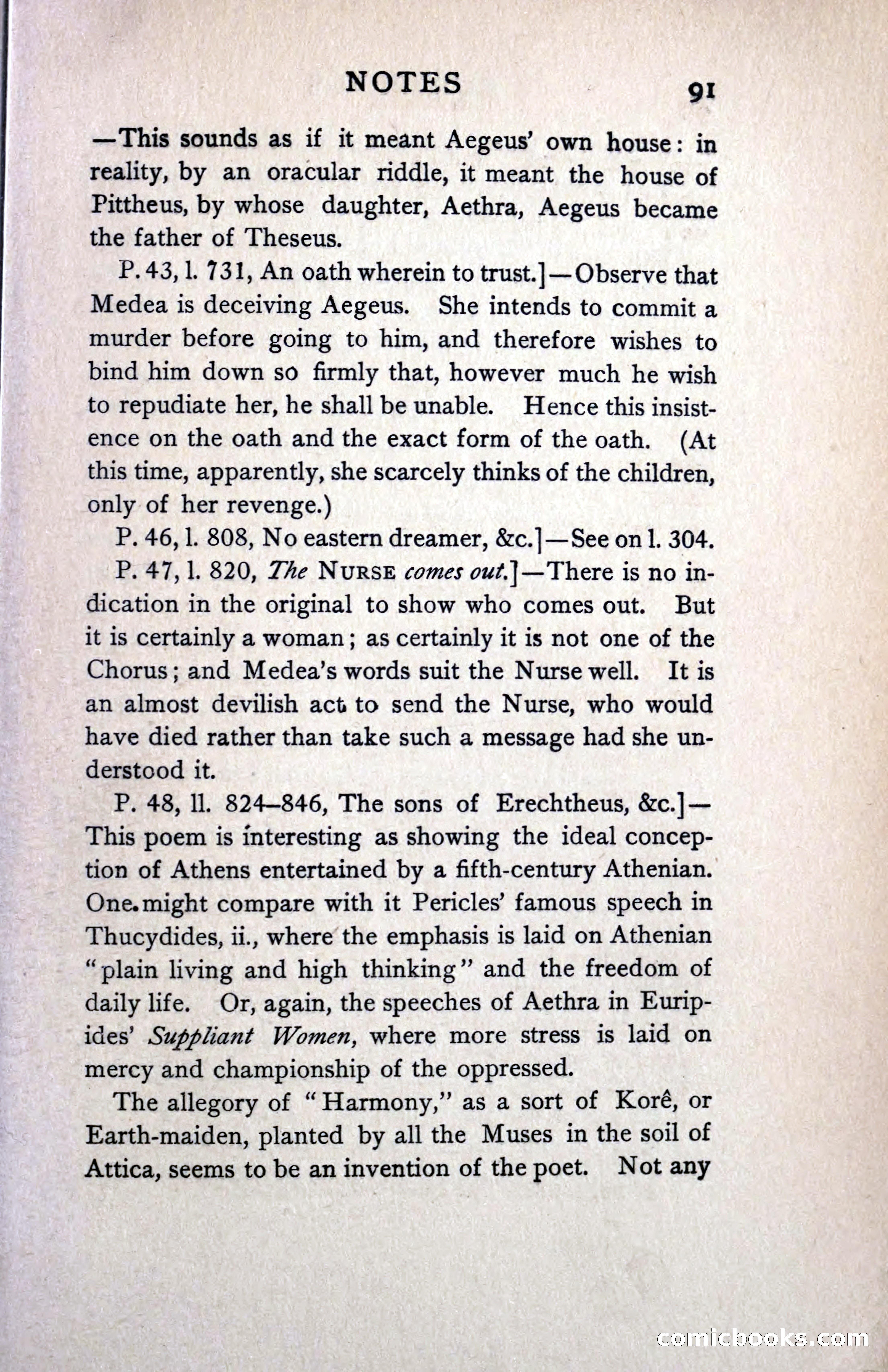
# Analysis This page contains scholarly **notes and commentary**, not a title page, illustration, or narrative fiction. The text consists of line-by-line textual annotations explaining passages from what appears to be Euripides' *Medea*. The notes discuss the plot mechanics of Medea's deception of Aegeus, analyze the character of the Nurse, and provide historical context comparing the play's portrayal of Athens to Pericles' famous funeral oration in Thucydides. The commentary treats the dramatic text as a classical work requiring scholarly explanation rather than as penny dreadful entertainment, suggesting this page comes from an annotated edition or study guide to the Greek play.
📄 Transcribed text from this page (OCR, searchable)
Machine-transcribed from the original scan — historical spelling and the odd misread are preserved.
NOTES ; gI —This sounds as if it meant Aegeus’ own house: in reality, by an oracular riddle, it meant the house of Pittheus, by whose daughter, Aethra, Aegeus became the father of Theseus. P. 43,1. 731, An oath wherein to trust.]|— Observe that Medea is deceiving Aegeus. She intends to commit a murder before going to him, and therefore wishes to bind him down so firmly that, however much he wish to repudiate her, he shall be unable. Hence this insist- ence on the oath and the exact form of the oath. (At this time, apparently, she scarcely thinks of the children, only of her revenge.) P. 46, 1. 808, No eastern dreamer, &c.|—See on 1. 304. P. 47, 1. 820, Zhe NuRSE comes out.|— There is no in- dication in the original to show who comes out. But it is certainly a woman; as certainly it is not one of the Chorus; and Medea’s words suit the Nurse well. It is an almost devilish act to send the Nurse, who would have died rather than take such a message had she un- derstood it. P. 48, ll. 824—846, The sons of Erechtheus, &c.]— This poem is interesting as showing the ideal concep- tion of Athens entertained by a fifth-century Athenian. One. might compare with it Pericles’ famous speech in Thucydides, ii., where the emphasis is laid on Athenian “plain living and high thinking” and the freedom of daily life. Or, again, the speeches of Aethra in Eurip- ides’ Suppliant Women, where more stress is laid on mercy and championship of the oppressed. | _ The allegory of “Harmony,” as a sort of Koré, or Earth-maiden, planted by all the Muses in the soil of Attica, seems to be an invention of the poet. Not any com 1 0)(0 6) “S (E(0)