
Penny Dreadfuls, 1912 · page 12 of 118
The Medea — page 12: what you’re looking at
What you’re looking at
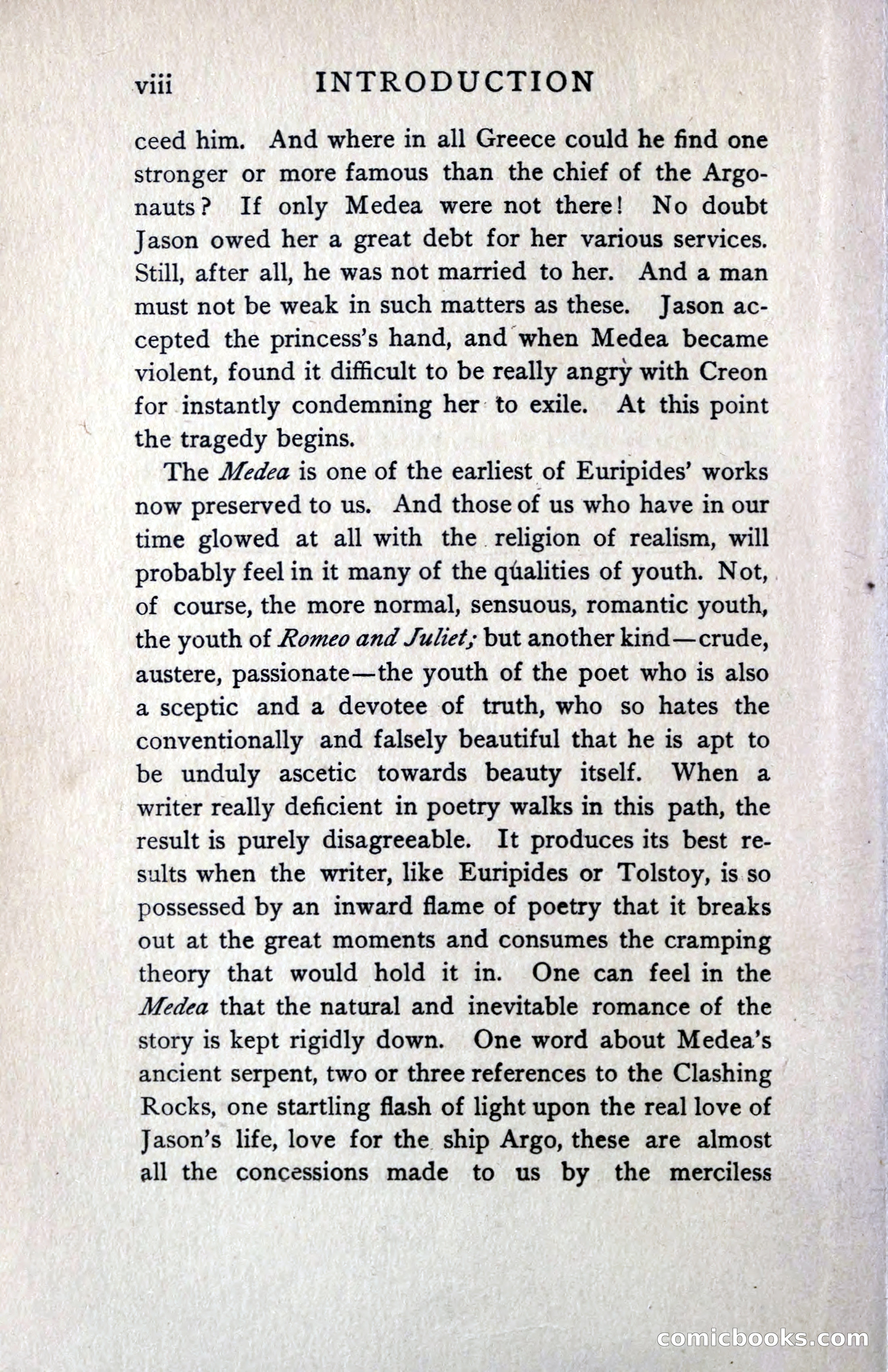
This is a page of running prose from an introduction to a classical text. The page discusses Euripides' *Medea*, analyzing the play's artistic approach and comparing its austere, truth-seeking style to the romantic conventions of works like *Romeo and Juliet*. The text explains how Euripides restrains the story's natural romance, offering minimal poetic concessions—a single reference to Medea's serpent, mentions of the Clashing Rocks, and a glimpse of Jason's true love (the ship Argo)—while maintaining a merciless commitment to realism and skeptical inquiry.
📄 Transcribed text from this page (OCR, searchable)
Machine-transcribed from the original scan — historical spelling and the odd misread are preserved.
Vill INTRODUCTION ceed him. And where in all Greece could he find one stronger or more famous than the chief of the Argo- nauts? If only Medea were not there! No doubt Jason owed her a great debt for her various services. Still, after all, he was not married to her. And aman must not be weak in such matters as these. Jason ac- cepted the princess’s hand, and when Medea became violent, found it difficult to be really angry with Creon for instantly condemning her to exile. At this point the tragedy begins. The Medea is one of the earliest of Euripides’ works now preserved to us. And those of us who have in our time glowed at all with the religion of realism, will probably feel in it many of the qualities of youth. Not, of course, the more normal, sensuous, romantic youth, the youth of Romeo and Juhet,; but another kind—crude, austere, passionate—the youth of the poet who is also a sceptic and a devotee of truth, who so hates the conventionally and falsely beautiful that he is apt to be unduly ascetic towards beauty itself. When a writer really deficient in poetry walks in this path, the result is purely disagreeable. It produces its best re- sults when the writer, like Euripides or Tolstoy, is. so possessed by an inward flame of poetry that it breaks out at the great moments and consumes the cramping theory that would hold it in. One can feel in the Medea that the natural and inevitable romance of the story is kept rigidly down. One word about Medea’s ancient serpent, two or three references to the Clashing Rocks, one startling flash of light upon the real love of Jason’s life, love for the ship Argo, these are almost all the concessions made to us by the merciless <s) (E(0) Eomicboo