
Penny Dreadfuls, 1912 · page 106 of 118
The Medea — page 106: what you’re looking at
What you’re looking at
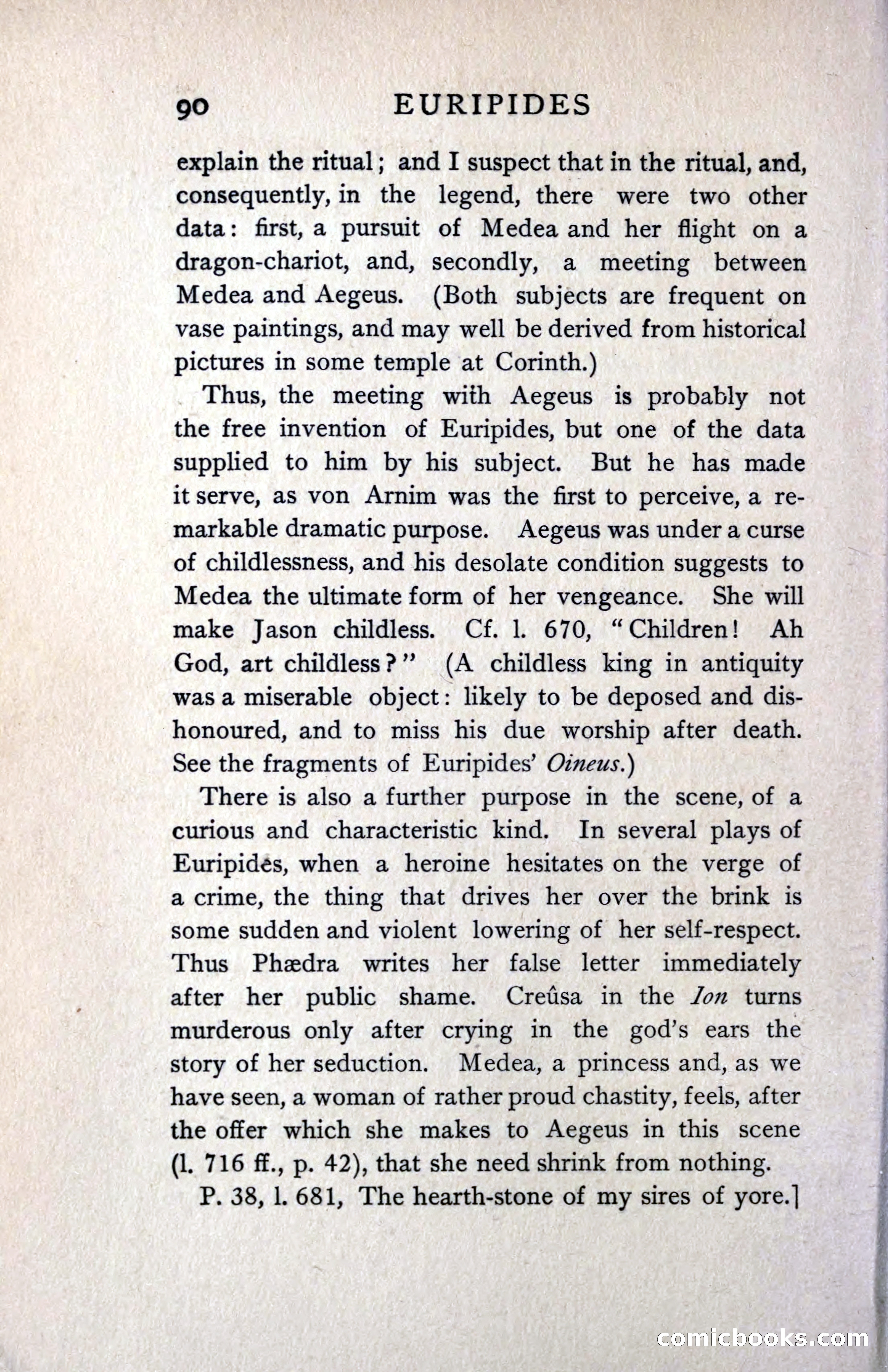
# Analysis This is a page of **running scholarly prose**, not a penny dreadful. The page number indicates this is from a critical academic text about Euripides' *Medea*. The visible text analyzes the dramatic function of Medea's meeting with Aegeus in the play, explaining how this encounter—likely derived from earlier sources rather than Euripides' invention—serves his dramatic purposes: it suggests to Medea a form of revenge (making Jason childless), and it wounds her pride, pushing her toward committing murder. The passage discusses how Euripidean heroines characteristically cross moral lines after experiencing sudden shame or humiliation.
📄 Transcribed text from this page (OCR, searchable)
Machine-transcribed from the original scan — historical spelling and the odd misread are preserved.
90 EURIPIDES explain the ritual; and I suspect that in the ritual, and, consequently, in the legend, there were two other data: first, a pursuit of Medea and her flight on a dragon-chariot, and, secondly, a meeting between Medea and Aegeus. (Both subjects are frequent on vase paintings, and may well be derived from historical pictures in some temple at Corinth.) — Thus, the meeting with Aegeus is probably not the free invention of Euripides, but one of the data supplied to him by his subject. But he has made it serve, as von Arnim was the first to perceive, a re- markable dramatic purpose. Aegeus was under a curse of childlessness, and his desolate condition suggests to Medea the ultimate form of her vengeance. She will make Jason childless. Cf. 1. 670, “Children! Ah God, art childless?” (A childless king in antiquity was a miserable object: likely to be deposed and dis- honoured, and to miss his due worship after death. See the fragments of Euripides’ Ozmeus.) There is also a further purpose in the scene, of a curious and characteristic kind. In several plays of Euripidés, when a heroine hesitates on the verge of a crime, the thing that drives her over the brink is some sudden and violent lowering of her self-respect. Thus Phedra writes her false letter immediately after her public shame. Cretsa in the /om turns murderous only after crying in the god’s ears the story of her seduction. Medea, a princess and, as we have seen, a woman of rather proud chastity, feels, after the offer which she makes to Aegeus in this scene (l. 716 ff., p. 42), that she need shrink from nothing. P. 38, 1.681, The hearth-stone of my sires of yore.| Eomicbooks.co