
Penny Dreadfuls, 1912 · page 103 of 118
The Medea — page 103: what you’re looking at
What you’re looking at
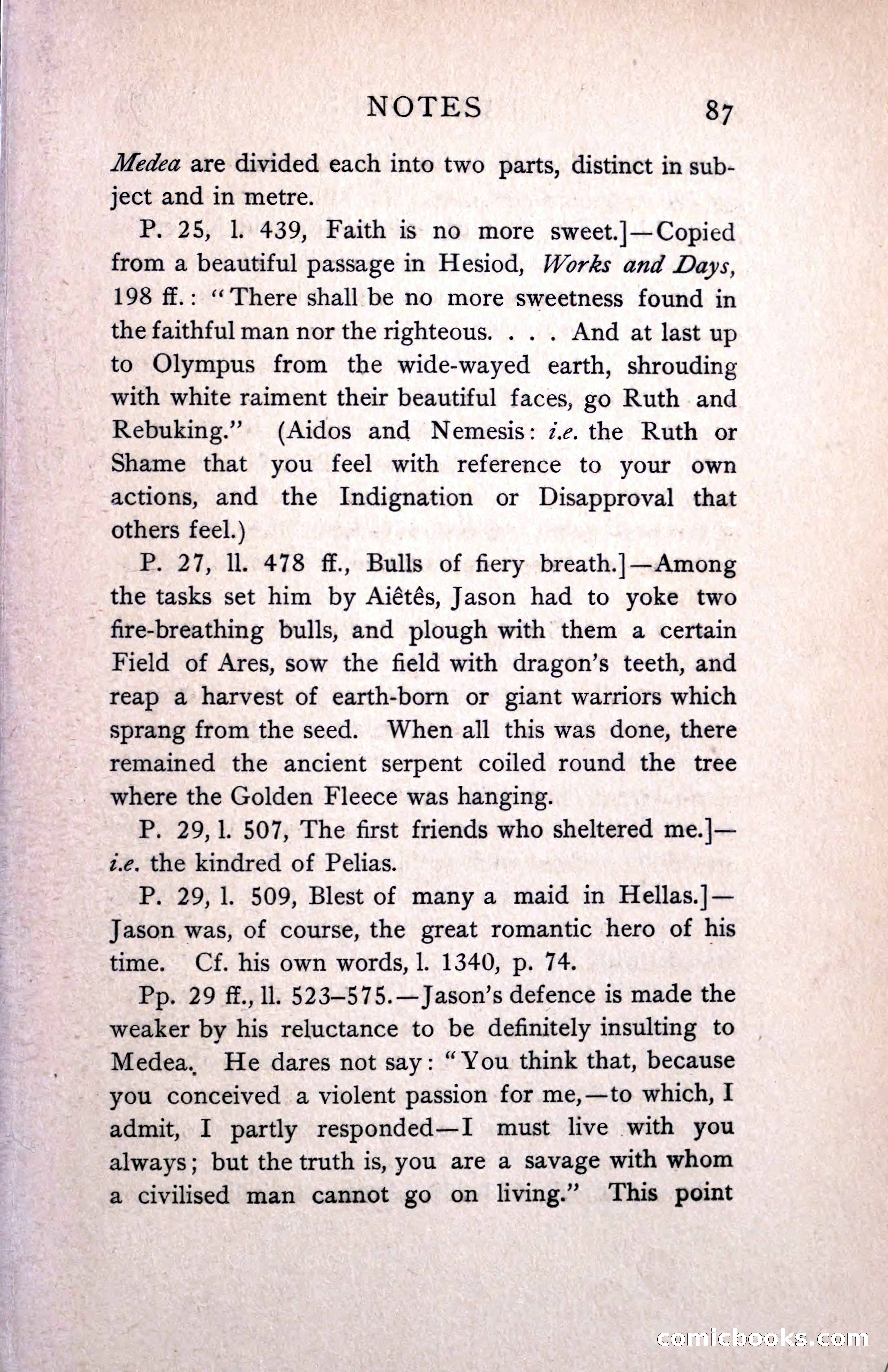
This is a notes page (page 87) from a scholarly edition, likely of a classical text. The page provides explanatory annotations for passages in what appears to be a dramatic work about Medea and Jason. The notes reference specific line numbers and pages, explaining classical allusions (to Hesiod's *Works and Days*, the myth of Jason and the Argonauts) and offering interpretive commentary on character motivations, particularly Jason's reluctance to directly insult Medea in his defense. This is academic apparatus rather than penny dreadful fiction.
📄 Transcribed text from this page (OCR, searchable)
Machine-transcribed from the original scan — historical spelling and the odd misread are preserved.
NOTES 87 Medea are divided each into two parts, distinct in sub- ject and in metre. P. 25, 1. 439, Faith is no more sweet.]|—Copied from a beautiful passage in Hesiod, Works and Days, 198 ff.: ‘“‘There shall be no more sweetness found in the faithful man nor the righteous. . . . And at last up to Olympus from the wide-wayed earth, shrouding with white raiment their beautiful faces, go Ruth and Rebuking.” (Aidos and Nemesis: ze. the Ruth or Shame that you feel with reference to your own actions, and the Indignation or Disapproval that others feel.) P. 27, ll. 478 ff., Bulls of fiery breath.|—Among the tasks set him by Aiétés, Jason had to yoke two fire-breathing bulls, and plough with them a certain Field of Ares, sow the field with dragon’s teeth, and reap a harvest of earth-born or giant warriors which sprang from the seed. When all this was done, there remained the ancient serpent coiled round the tree where the Golden Fleece was hanging. P. 29,1. 507, The first friends who sheltered me. |— z.e. the kindred of Pelias. P. 29,1. 509, Blest of many a maid in Hellas.]— Jason was, of course, the great romantic hero of his time. Cf. his own words, |. 1340, p. 74. Pp. 29 ff., ll. 523-—575.—Jason’s defence is made the weaker by his reluctance to be definitely insulting to Medea. He dares not say: “ You think that, because you conceived a violent passion for me,—to which, I admit, I partly responded—I must live with you always; but the truth is, you are a savage with whom a civilised man cannot go on living.” This point Gomicboo gs) (E(0)