
Penny Dreadfuls, 1912 · page 98 of 118
The Medea — page 98: what you’re looking at
What you’re looking at
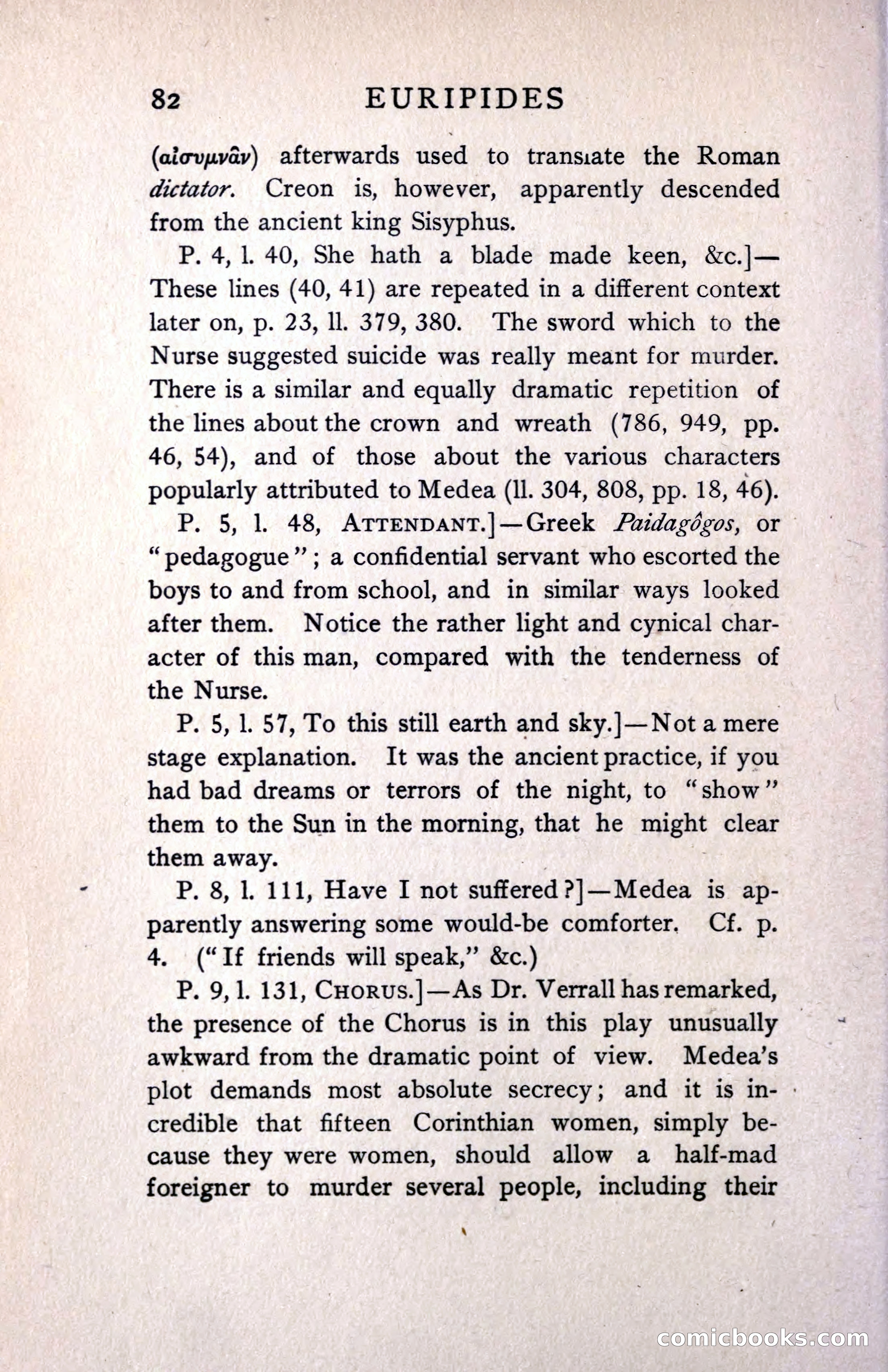
This page is running prose—scholarly annotations on Euripides' *Medea*. The text provides line-by-line commentary explaining textual details, character descriptions, and dramatic elements: the descent of Creon, repeated lines about a sword and crown, the role of the Greek pedagogue (attendant), an ancient practice of showing nightmares to the sun, and notably, Dr. Verrall's observation that the Chorus's presence is "unusually awkward" since Medea's murderous plot requires secrecy, yet fifteen Corinthian women inexplicably allow a "half-mad foreigner" to commit multiple murders.
📄 Transcribed text from this page (OCR, searchable)
Machine-transcribed from the original scan — historical spelling and the odd misread are preserved.
82 EURIPIDES (aicvpvay) afterwards used to transiate the Roman dictator. Creon is, however, apparently descended from the ancient king Sisyphus. P. 4, 1.40, She hath a blade made keen, &c.|— These lines (40, 41) are repeated in a different context later on, p. 23, ll. 379, 380. The sword which to the Nurse suggested suicide was really meant for murder. There is a similar and equally dramatic repetition of the lines about the crown and wreath (786, 949, pp. 46, 54), and of those about the various characters popularly attributed to Medea (Il. 304, 808, pp. 18, 46). P. 5, 1. 48, ATTENDANT.|—Greek /uidagégos, or “pedagogue”; a confidential servant who escorted the boys to and from school, and in similar ways looked after them. Notice the rather light and cynical char- acter of this man, compared with the tenderness of the Nurse. | P. 5, 1. 57, To this still earth and sky.|— Not a mere stage explanation. It was the ancient practice, if you had bad dreams or terrors of the night, to “show” them to the Sun in the morning, that he might clear them away. P. 8, 1. 111, Have I not suffered ?|— Medea is ap- parently answering some would-be comforter. Cf. p. 4. (“If friends will speak,” &c.) P. 9,1. 131, CHorus.]|—As Dr. Verrall has remarked, the presence of the Chorus is in this play unusually — awkward from the dramatic point of view. Medea’s plot demands most absolute secrecy; and it is in- » credible that fifteen Corinthian women, simply be- cause they were women, should allow a _half-mad foreigner to murder several people, including their \ cS (E(0)