
A complete issue · 80 pages · 1916
Life — April 6, 1916
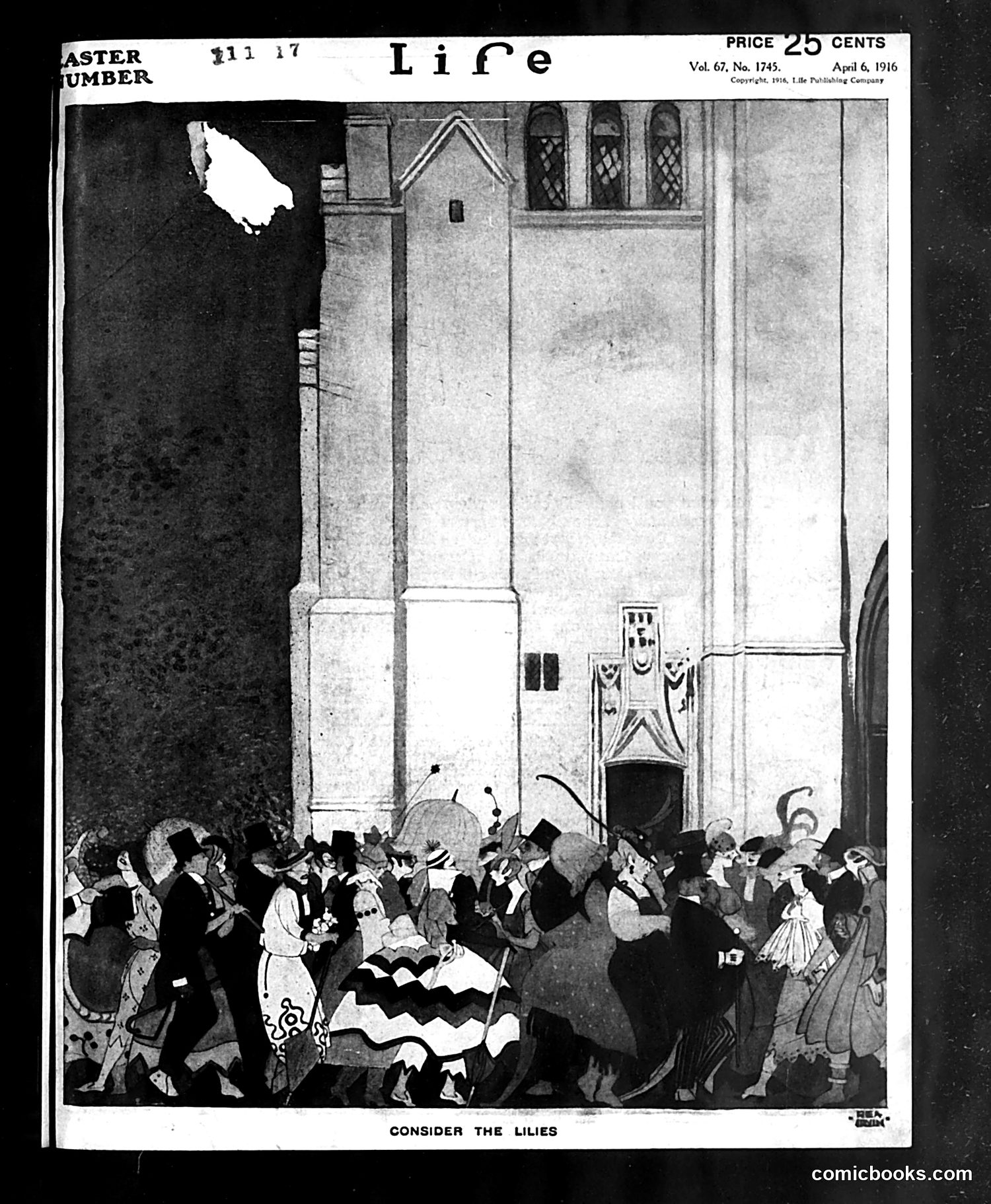
This April 1916 *Life* cartoon satirizes Easter observance among the wealthy and fashionable. The image shows an ornate church interior packed with elaborately dressed society people in formal attire and elaborate hats—the visual markers of upper-class Easter parade tradition. The caption "Consider the Lilies" references the Biblical passage (Matthew 6:28) where Jesus tells followers not to worry about fine clothing, saying even Solomon in his glory wasn't arrayed like the lilies of the field. The satire is direct: the cartoon mocks the contradiction between Christian humility taught on Easter and the ostentatious display of wealth and fashion dominating the actual holiday observance among the privileged classes.
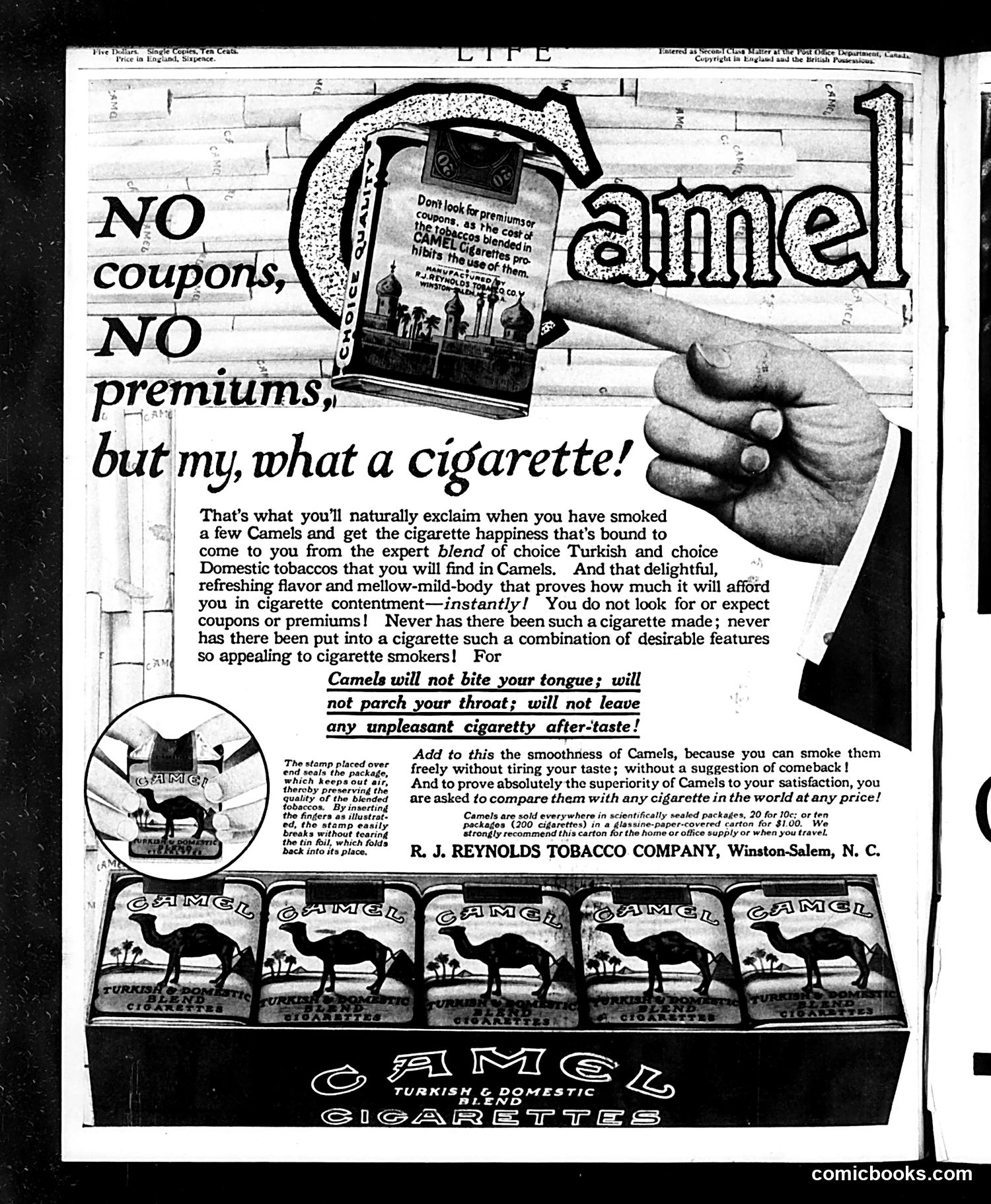
This is a **cigarette advertisement**, not satire or political commentary. The page promotes Camel brand cigarettes made by R.J. Reynolds Tobacco Company. The ad's hook is "NO coupons, NO premiums, but my, what a cigarette!"—claiming Camels need no gimmicks because the product itself is superior. The hand holding a lit cigarette emphasizes the smoking experience. The copy promises Camels won't "bite your tongue," "parch your throat," or leave "unpleasant cigaretty after-taste," highlighting smoothness from their "expert blend of choice Turkish and choice Domestic tobaccos." The bottom displays five Camel cigarette packs with the iconic camel logo. This represents straightforward product marketing typical of early 20th-century tobacco advertising, before health warnings were required.
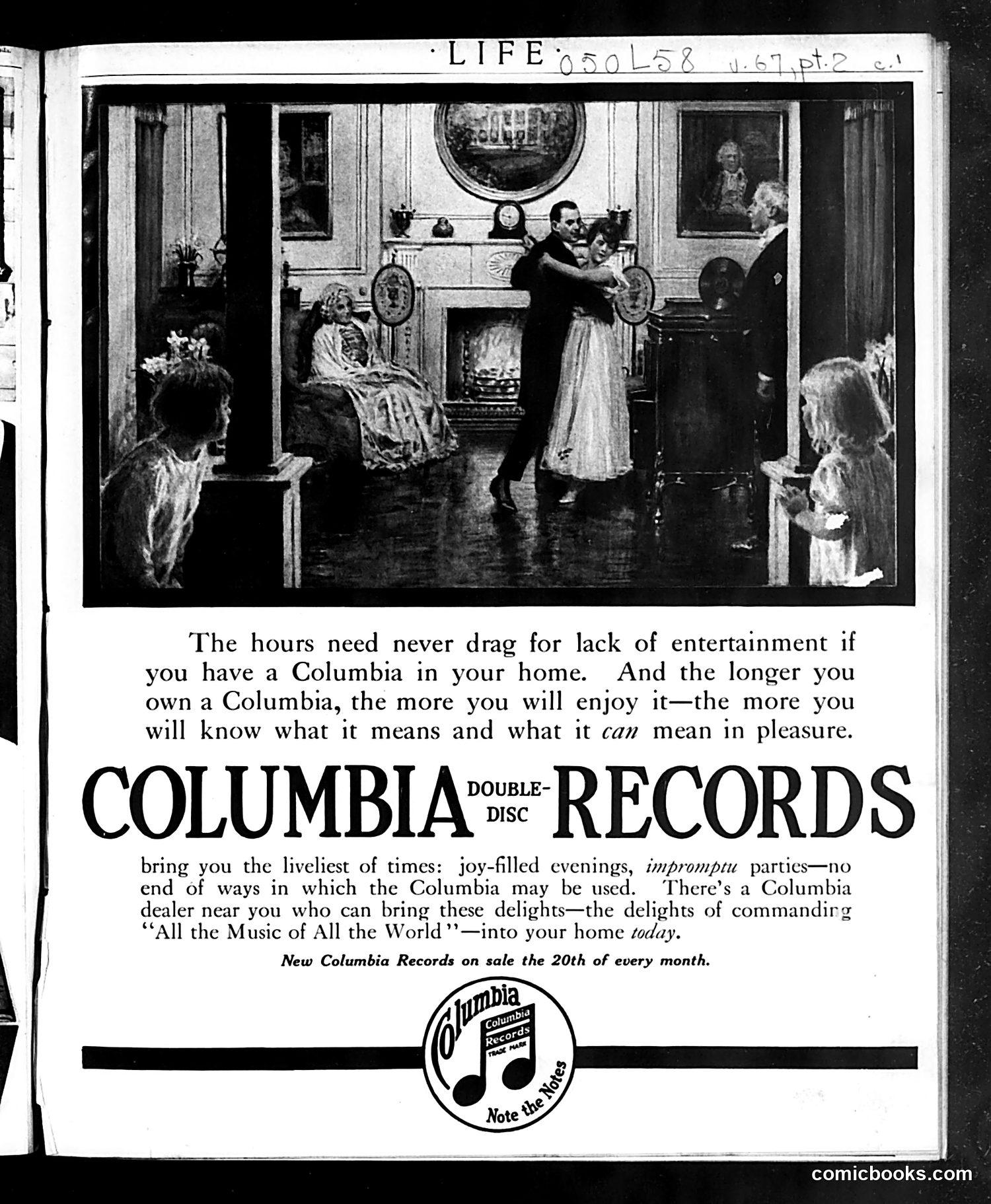
This is **not a political cartoon or satirical content** — it's a **commercial advertisement** for Columbia Records' double-disc phonographs. The image depicts an elegant home entertainment scene where a man operates a phonograph while well-dressed guests, including women and children, gather to listen and socialize. The ad copy emphasizes that owning a Columbia phonograph ensures "joy-filled evenings" and "impromptu parties" by providing "All the Music of All the World" for home entertainment. The advertisement targets middle-class families, positioning the phonograph as essential home technology that prevents "the hours" from dragging and enables sophisticated social gatherings. It notes that new Columbia Records were released monthly on the 20th. The messaging reflects early-20th-century consumer culture, promoting entertainment technology as a status symbol and social necessity.
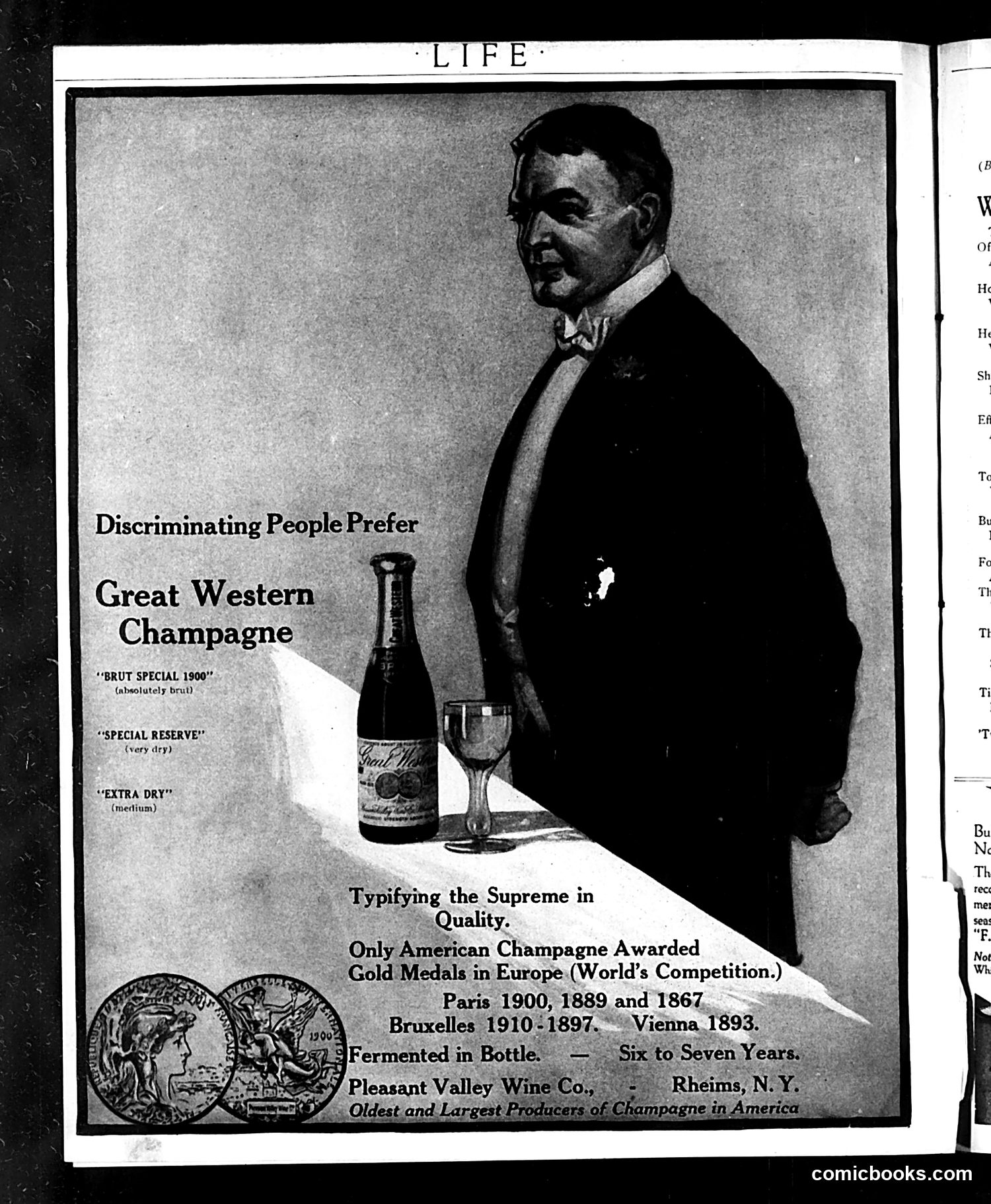
This page is primarily a **champagne advertisement**, not political satire. It promotes "Great Western Champagne" from Pleasant Valley Wine Co. in Rheims, N.Y. The ad uses a well-dressed man in formal evening wear as an aspirational figure, paired with champagne bottles and glasses. The headline "Discriminating People Prefer" suggests the product appeals to refined, upper-class consumers. The text emphasizes the champagne's awards and credentials—gold medals from international competitions (Paris, Bruxelles, Vienna) and claims it's "the only American Champagne" to achieve this recognition. The phrase "Typifying the Supreme in Quality" reinforces luxury positioning. This reflects early 1900s advertising strategy: associating a product with sophistication, wealth, and good taste to attract affluent buyers.
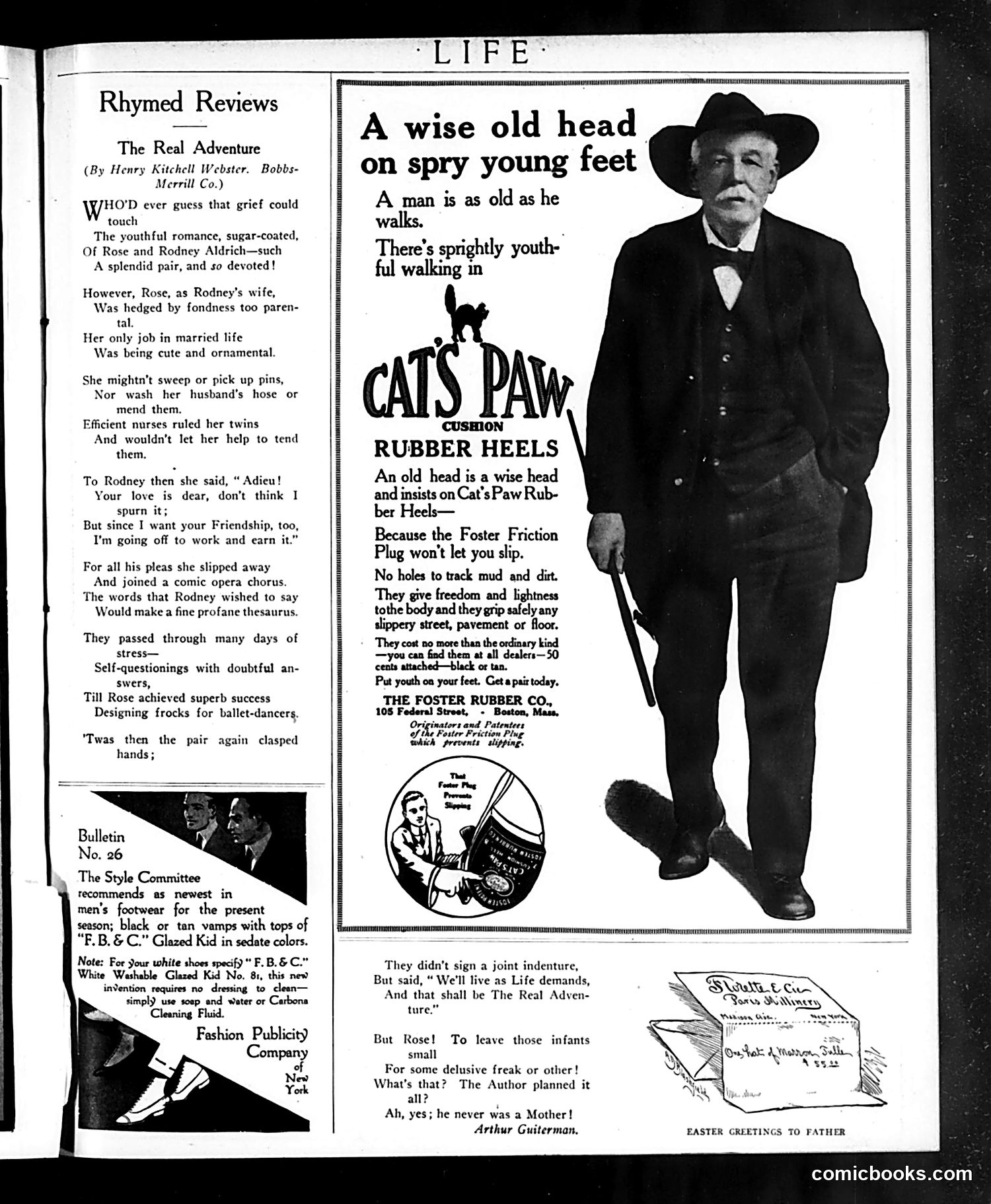
This page contains primarily **advertising content** rather than political satire. The dominant feature is a large advertisement for "Cat's Paw Cushion Rubber Heels" showing an elderly man in a cowboy hat and suit. The ad uses the slogan "A wise old head on spry young feet," emphasizing comfort and traction for urban walking. On the left, a "Rhymed Review" discusses *The Real Adventure* by Henry Kitchell Webster, a romantic novel about a woman who leaves domestic life to pursue work and independence. Below that is a fashion bulletin recommending men's footwear trends—black or tan vamps with "F.B.&C. Glazed Kid" soles. The page reflects early 20th-century consumer culture and gender role discussions, not political commentary.
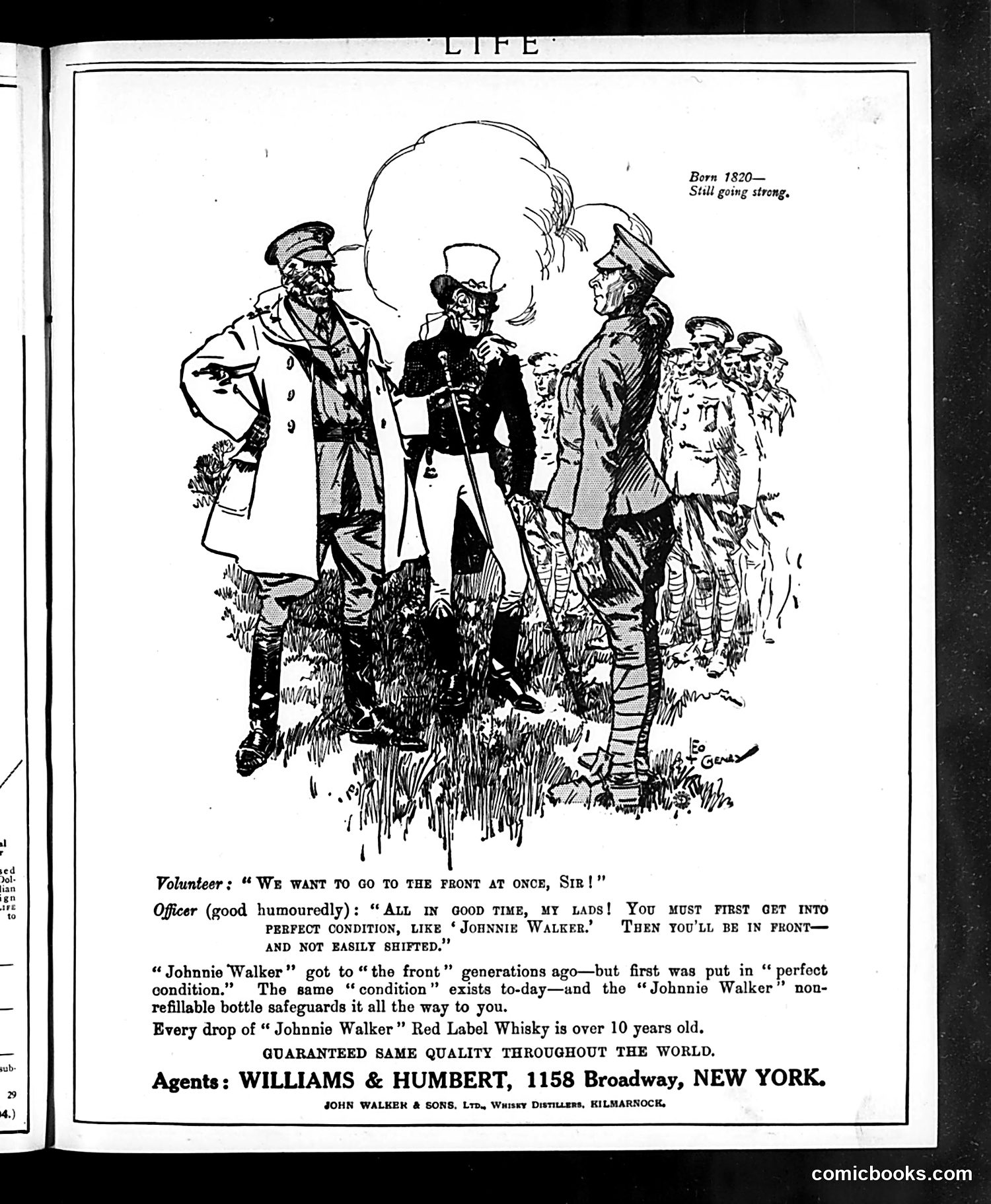
This is primarily a **Johnnie Walker Whisky advertisement** disguised as editorial content in Life magazine. The cartoon depicts a military officer (good-humouredly) telling eager volunteers they must first get into "perfect condition" before going to the front—comparing this to how Johnnie Walker whisky "got to 'the front' generations ago" after being put in perfect condition. The ad references WWI-era recruitment and military preparation. The joke leverages the phrase "go to the front" (reach the battlefield) to promote whisky as something reliable and battle-tested. The text emphasizes the whisky is "over 10 years old" with "guaranteed same quality throughout the world," appealing to patriotic soldiers and civilians during wartime by positioning the product as trustworthy.
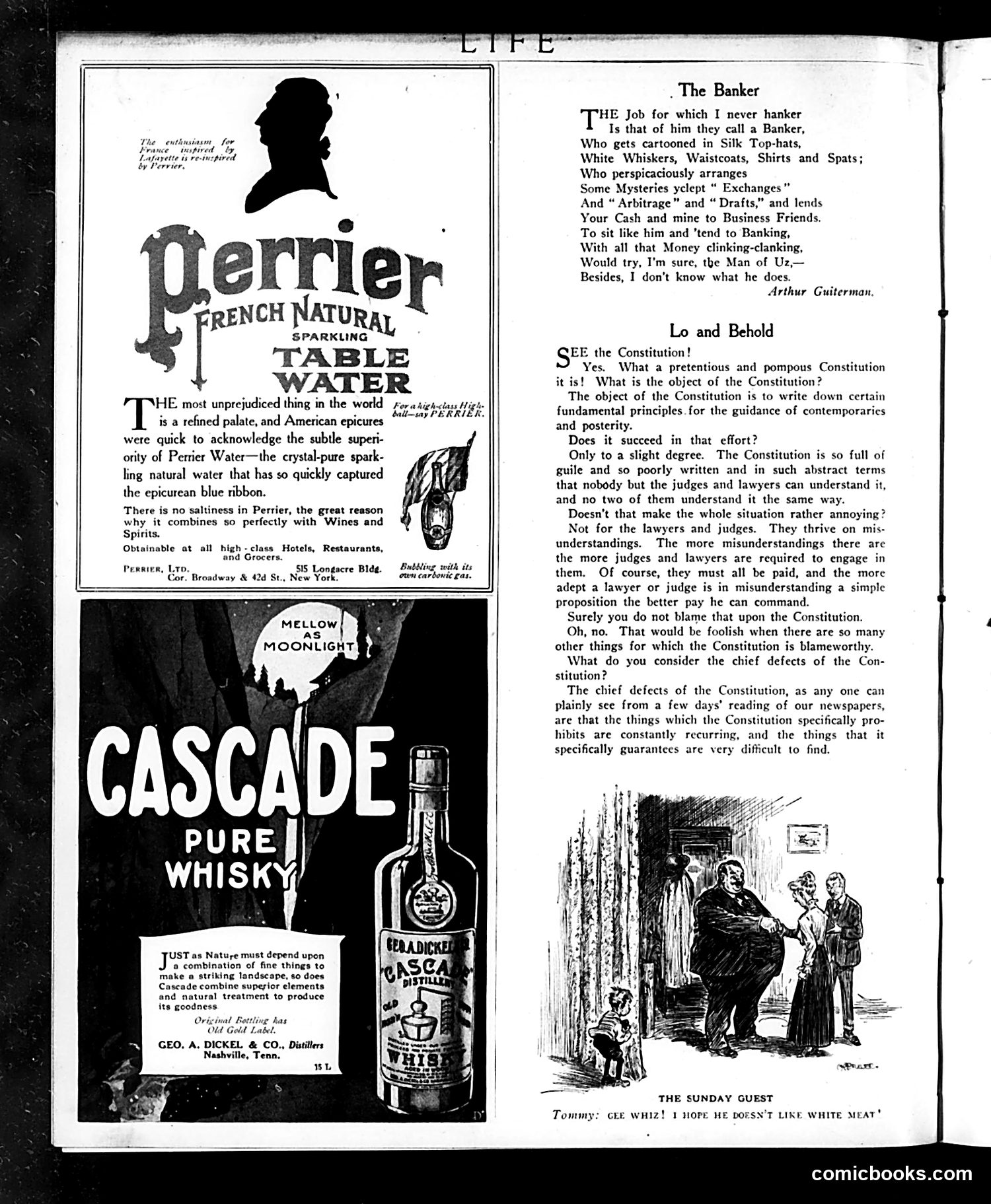
This page contains two advertisements (Perrier water and Cascade whisky) and two pieces of satirical content. **"The Banker"** is a humorous poem by Arthur Guiterman mocking bankers' mysterious work with money, exchanges, and arbitrage—suggesting even the poet doesn't understand what bankers actually do. **"Lo and Behold"** is a satirical commentary on the U.S. Constitution, arguing it's poorly written and overly complex. The author contends that the Constitution's actual guarantees are vague while its prohibitions are clear, forcing judges and lawyers into constant misinterpretation. This suggests the Constitution's design creates unnecessary legal confusion. **"The Sunday Guest"** cartoon shows a domestic scene where Tommy complains about being served white meat, saying he hopes it "doesn't like white meat"—likely a joke about children's typical food preferences.
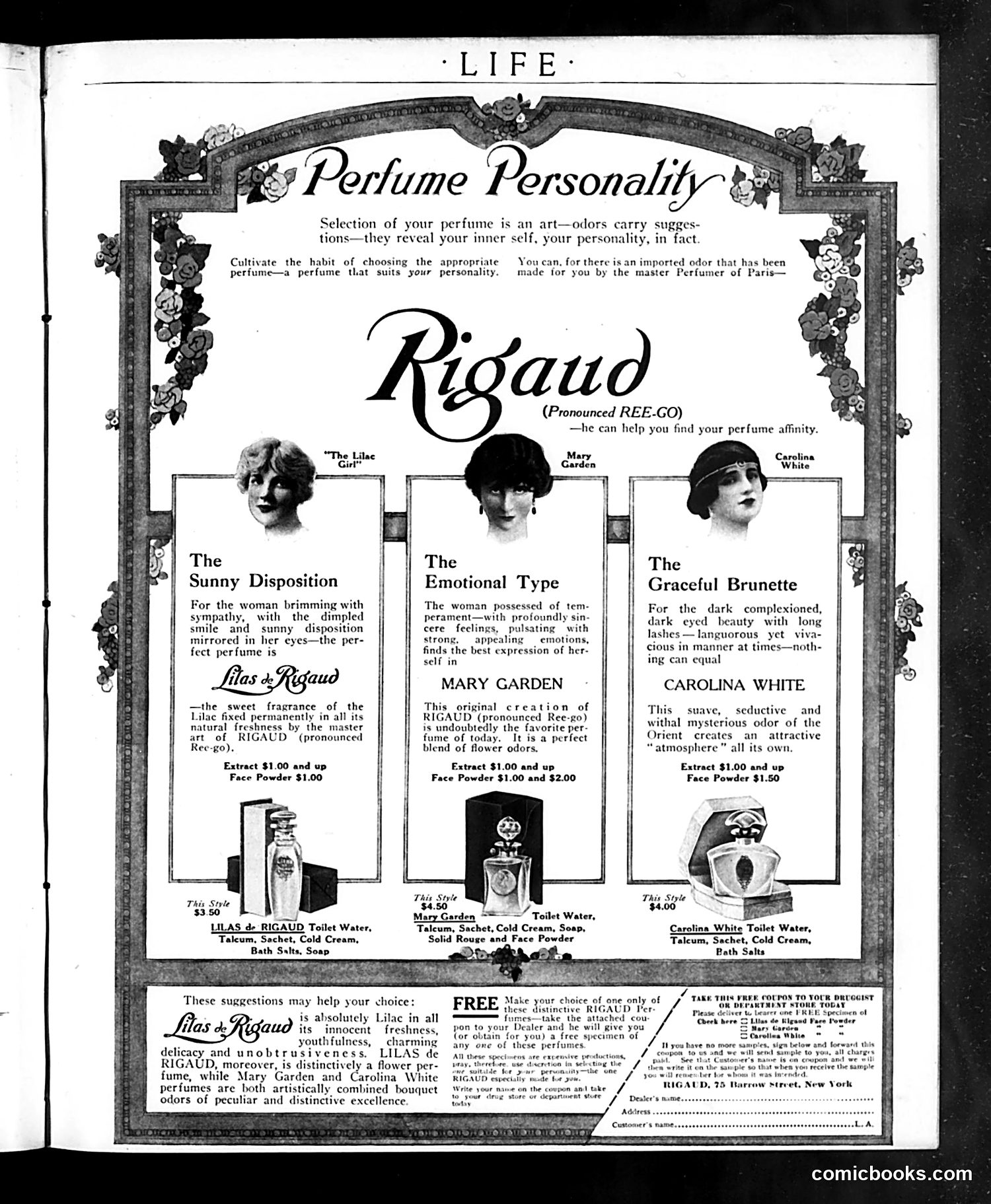
This is a **perfume advertisement**, not satire or political commentary. The page promotes Rigaud perfumes from Paris, featuring three distinct fragrance lines matched to female personality types: 1. **"The Sunny Disposition"** – *Lilas de Rigaud*, for sympathetic women 2. **"The Emotional Type"** – *Mary Garden*, the company's signature scent 3. **"The Graceful Brunette"** – *Carolina White*, described as "suave, seductive and withal mysterious" Each includes product photos, prices ($1.00–$4.00), and available formats (extract, face powder, toilet water, talcum). The advertisement uses early 20th-century marketing logic: linking perfume choice to female personality archetypes. A coupon offers free samples, a common sales tactic of the era. This reflects period assumptions about women's consumer choices and identity expression through fragrance.
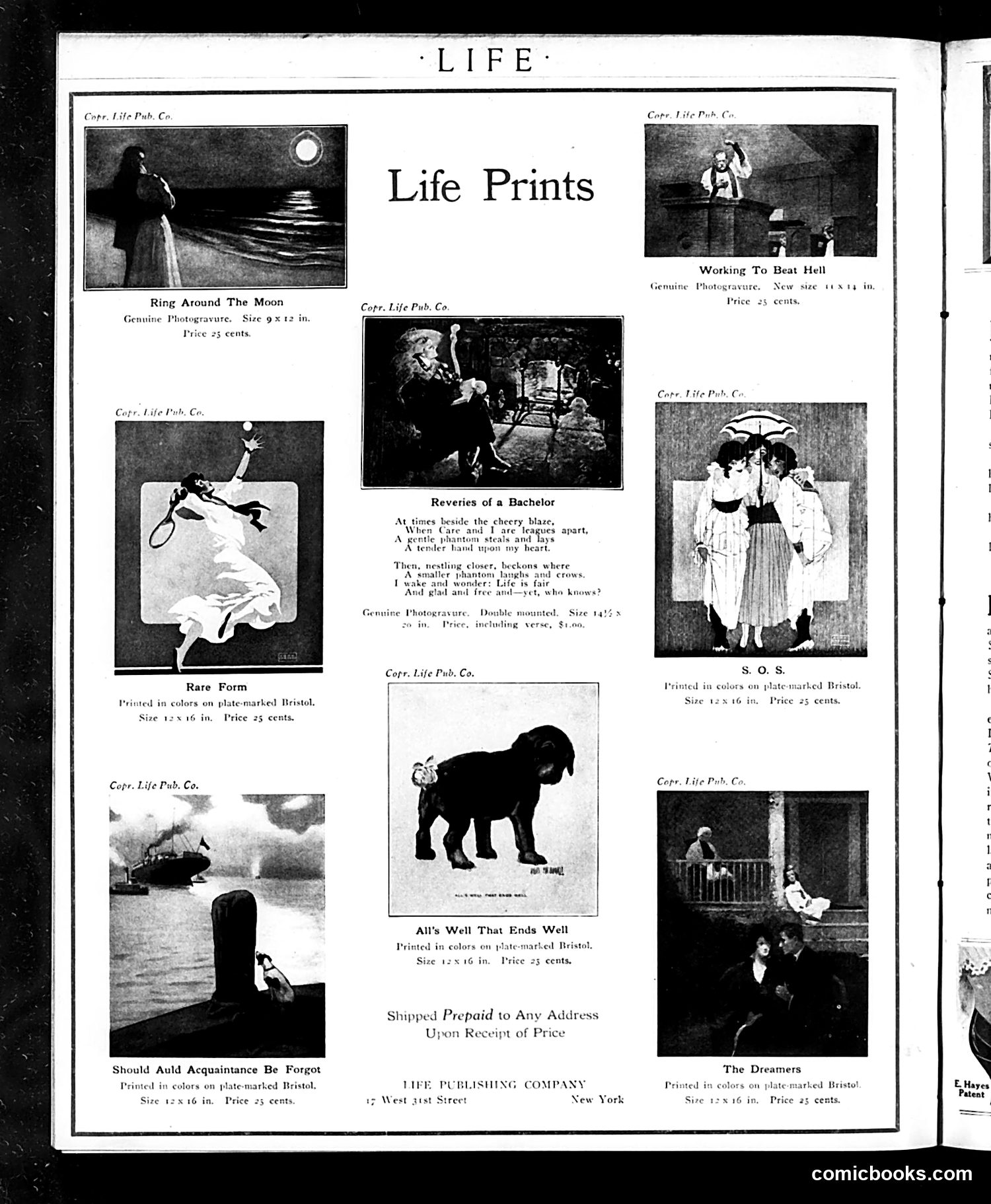
This is primarily an **advertising catalog page** for Life Publishing Company's art prints, rather than satirical content. The page displays eight available photographic prints for purchase, each priced at 23 cents and available in various sizes. The prints appear to be sentimental or dramatic scenes typical of early 20th-century popular art: moonlit romance ("Ring Around The Moon"), domestic scenes ("S.O.S.," "The Dreamers"), and whimsical imagery ("Rare Form" showing a woman with a tennis racket, "All's Well That Ends Well" featuring a dog). The page functions as a mail-order catalog, offering prints "Shipped Prepaid to Any Address / Upon Receipt of Price" from Life Publishing Company's New York office. The emphasis is commercial rather than satirical.
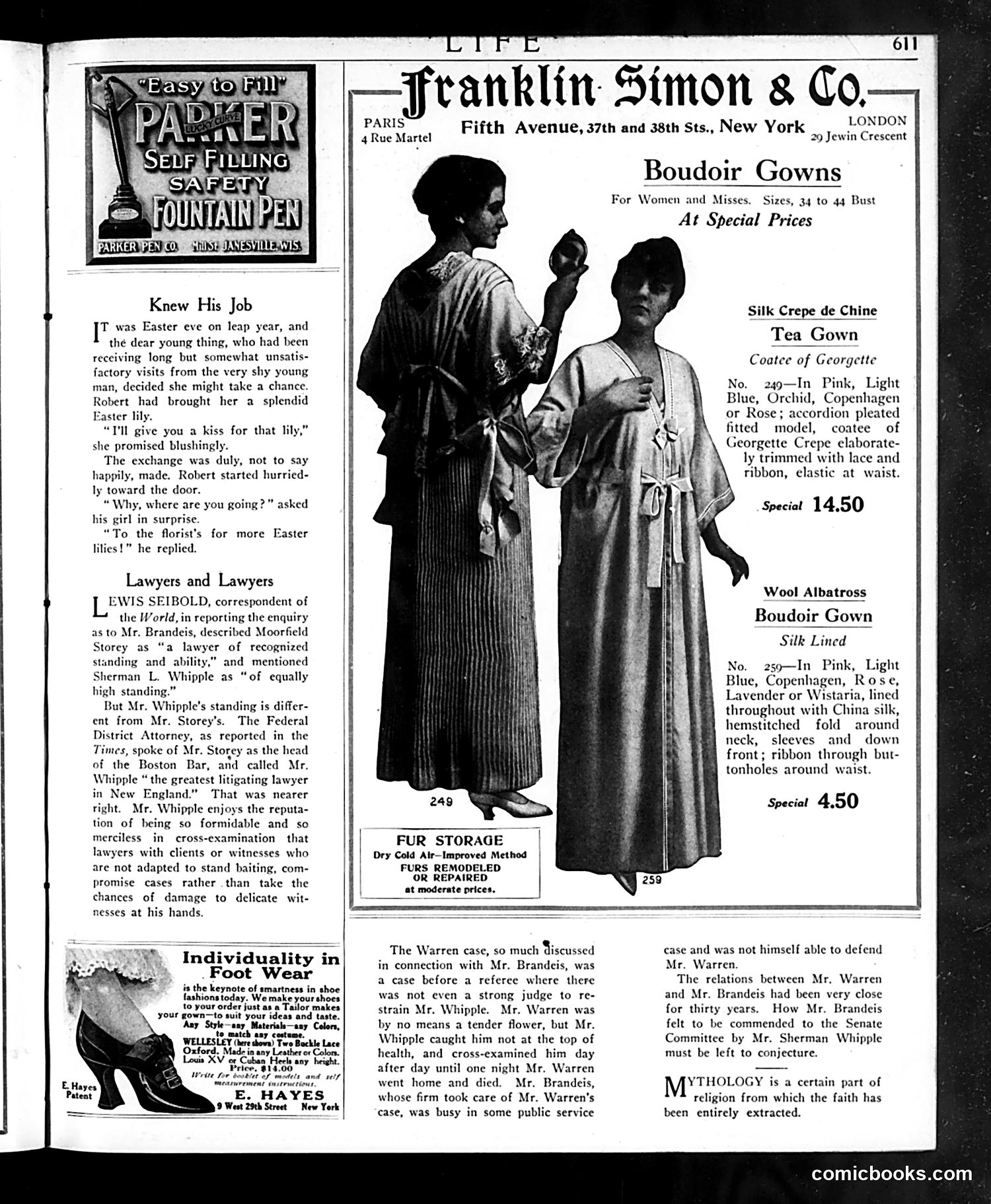
This page is primarily **advertising and fiction**, not political satire. The dominant content features Franklin Simon & Co. boudoir gowns with fashion illustrations (items 249 and 259). The left column contains two non-satirical pieces: a short romantic story titled "Knew His Job" about Easter lilies and a young couple, and an article "Lawyers and Lawyers" discussing legal figures including Lewis Seibold and Sherman L. Whipple. The article references a "Warren case" involving cross-examination practices. Additional advertisements include Parker fountain pens and E. Hayes shoes. **No political cartoons appear on this page.** The content reflects early 20th-century magazine formatting: fiction, legal commentary, and fashion advertising mixed together without apparent satirical intent toward contemporary politics.
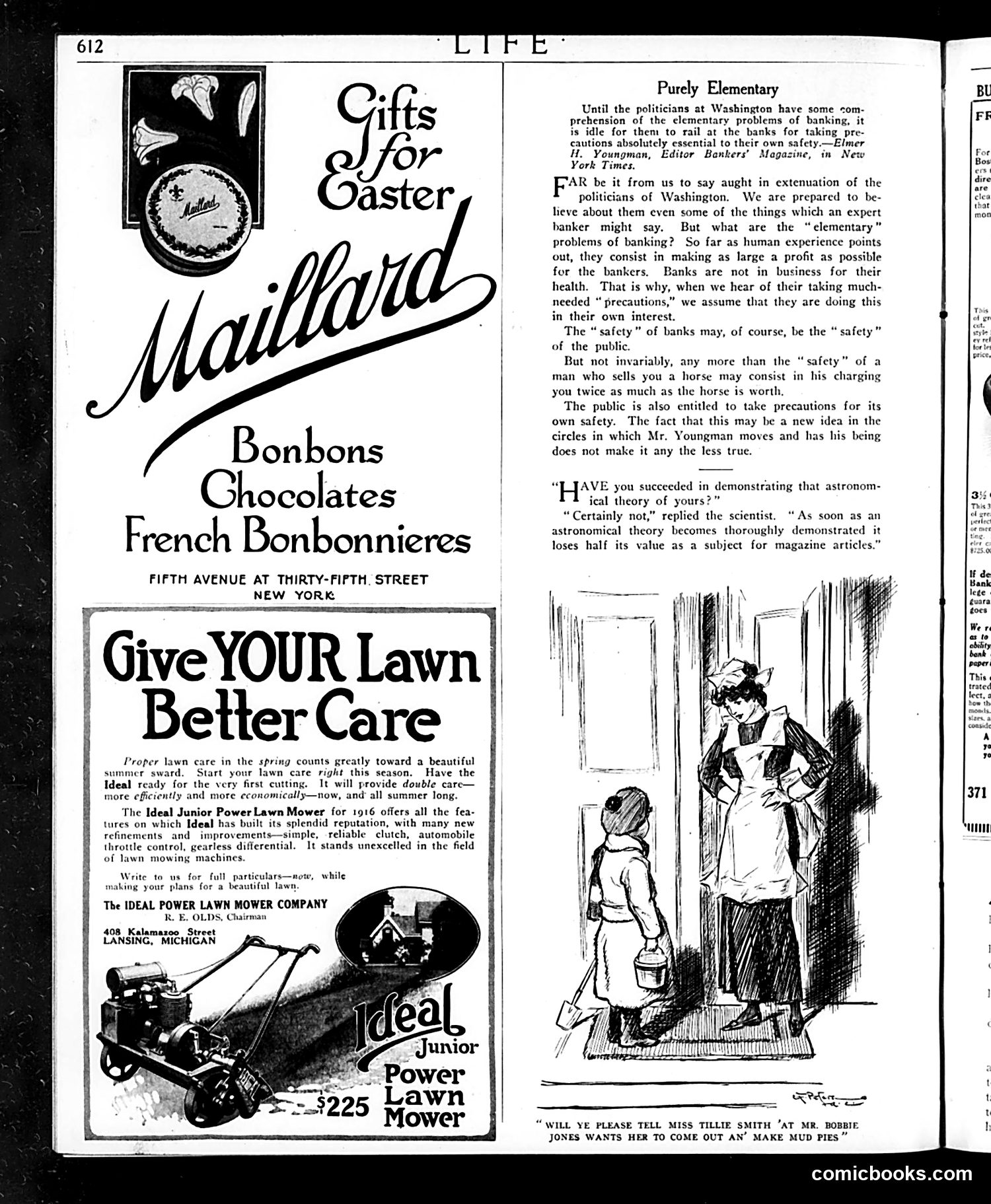
This page consists primarily of **advertisements** for Easter gifts (Maillard chocolates), lawn care (Ideal Power Lawn Mower), mixed with editorial content about banking safety. The **cartoon** at bottom shows a domestic scene: a woman at a doorway speaking to another woman, with the caption "WILL YE PLEASE TELL MISS TILLIE SMITH 'AT MR. BOBBIE JONES WANTS HER TO COME OUT AN' MAKE MUD PIES." This appears to be a **gentle humor sketch** about childhood and courtship—a boy asking a girl out to play, framed in working-class dialect ("'at" for "that," "'an'" for "and"). The joke likely plays on the contrast between innocent childhood games and romantic pursuit, though the exact satirical point is subtle by modern standards. The page is primarily commercial rather than political commentary.
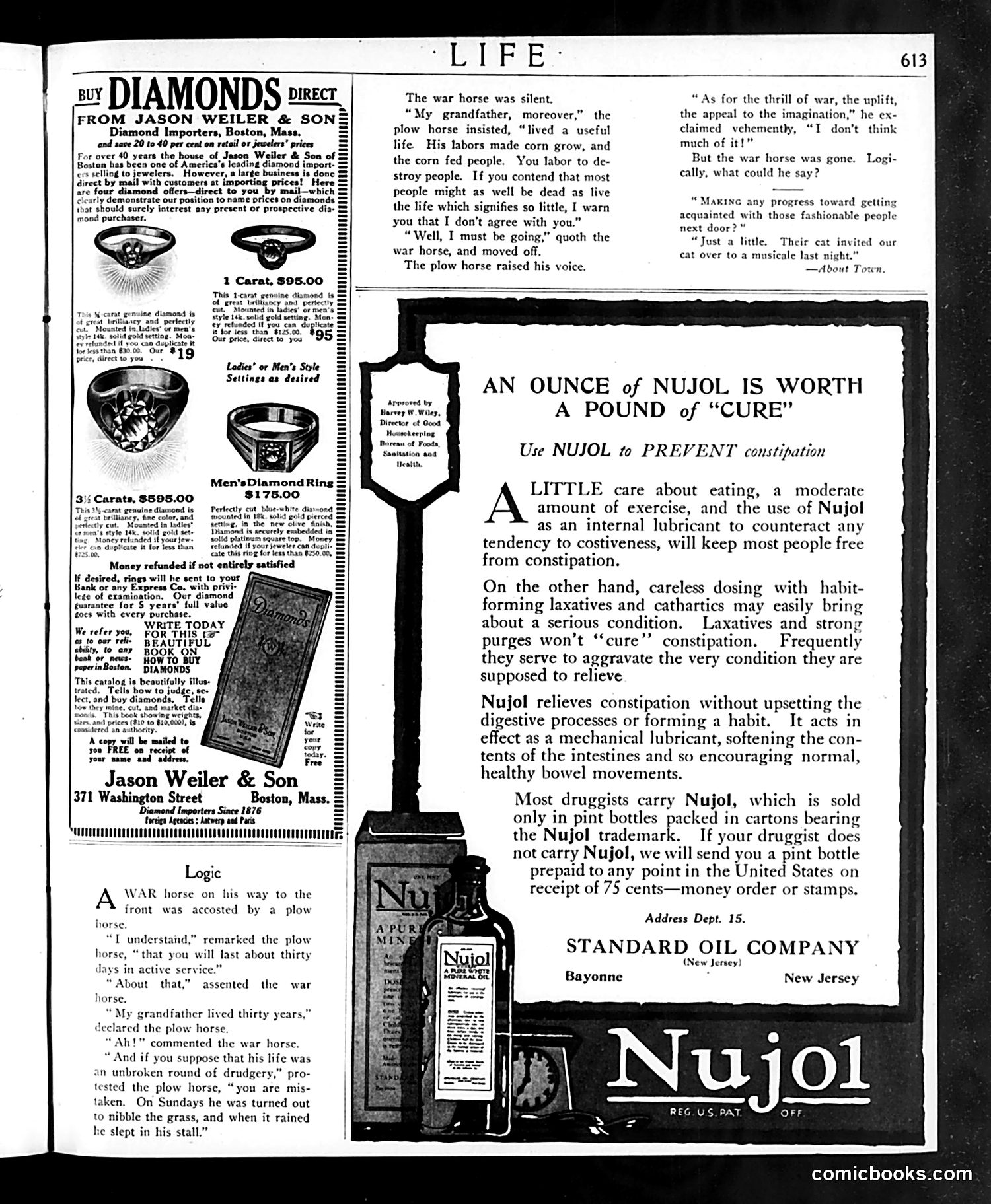
This page contains **mostly advertisements** with one short satirical piece titled "Logic." **The Cartoon/Story "Logic":** The piece depicts a dialogue between a war horse and a plow horse. The plow horse boasts that his grandfather lived thirty years through hard labor, suggesting the war horse will similarly endure. The war horse responds skeptically, noting that wartime service differs fundamentally—asking what value lies in mere survival compared to purposeful work. **The Satire:** The piece critiques romanticized notions of wartime service. While the plow horse sees longevity as success, the war horse questions whether simply lasting through conflict constitutes a meaningful life. This reflects **post-WWI disillusionment**—the suggestion that soldiers endured hardship without clear purpose or benefit, undermining propaganda celebrating military service. **Advertisements:** Diamond rings and Nujol laxative dominate the page, typical of 1920s Life magazine content.
This is a **full-page advertisement** for The Gorham Company, silversmiths and goldsmiths based in New York. There are no cartoons or satirical content on this page. The ad makes a marketing argument: "Family Silver" doesn't require expensive, ornate pieces—modest silverware of good quality counts too. The pitch emphasizes that Gorham silverware, having served American families for 85 years, deserves the title "Family Silver of the Nation." The closing line—"Silverware with the Gorham name costs no more than silverware without it"—is the core sales message: you're not paying extra for the prestigious brand name. This reflects early 20th-century advertising that positioned quality goods as accessible to middle-class families, not just the wealthy.
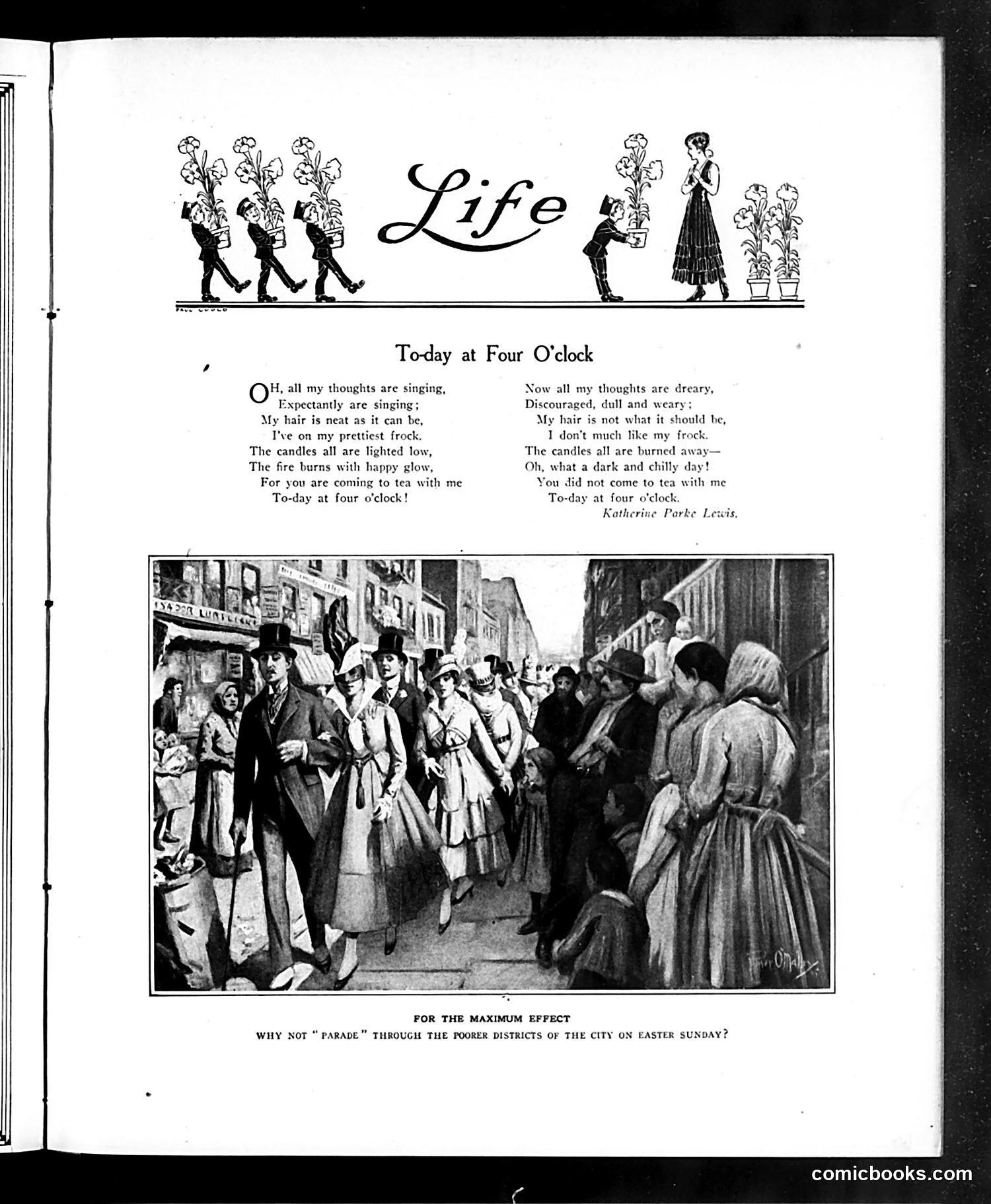
This page from *Life* magazine features a poem titled "To-day at Four O'clock" by Katherine Parke Lewis, contrasting anticipation with disappointment—someone stood up for a tea appointment. The satirical illustration below shows a crowded urban street scene with well-dressed people parading, likely meant ironically. The caption's question—"FOR THE MAXIMUM EFFECT / WHY NOT 'PARADE' THROUGH THE POORER DISTRICTS OF THE CITY ON EASTER SUNDAY?"—criticizes wealthy New Yorkers' Easter parade traditions. The satire suggests that fashionable people display their finest clothing on Easter, indifferent to economic inequality in nearby poor neighborhoods. This reflects Progressive Era social commentary on class divisions and conspicuous consumption during what should be a religious holiday.
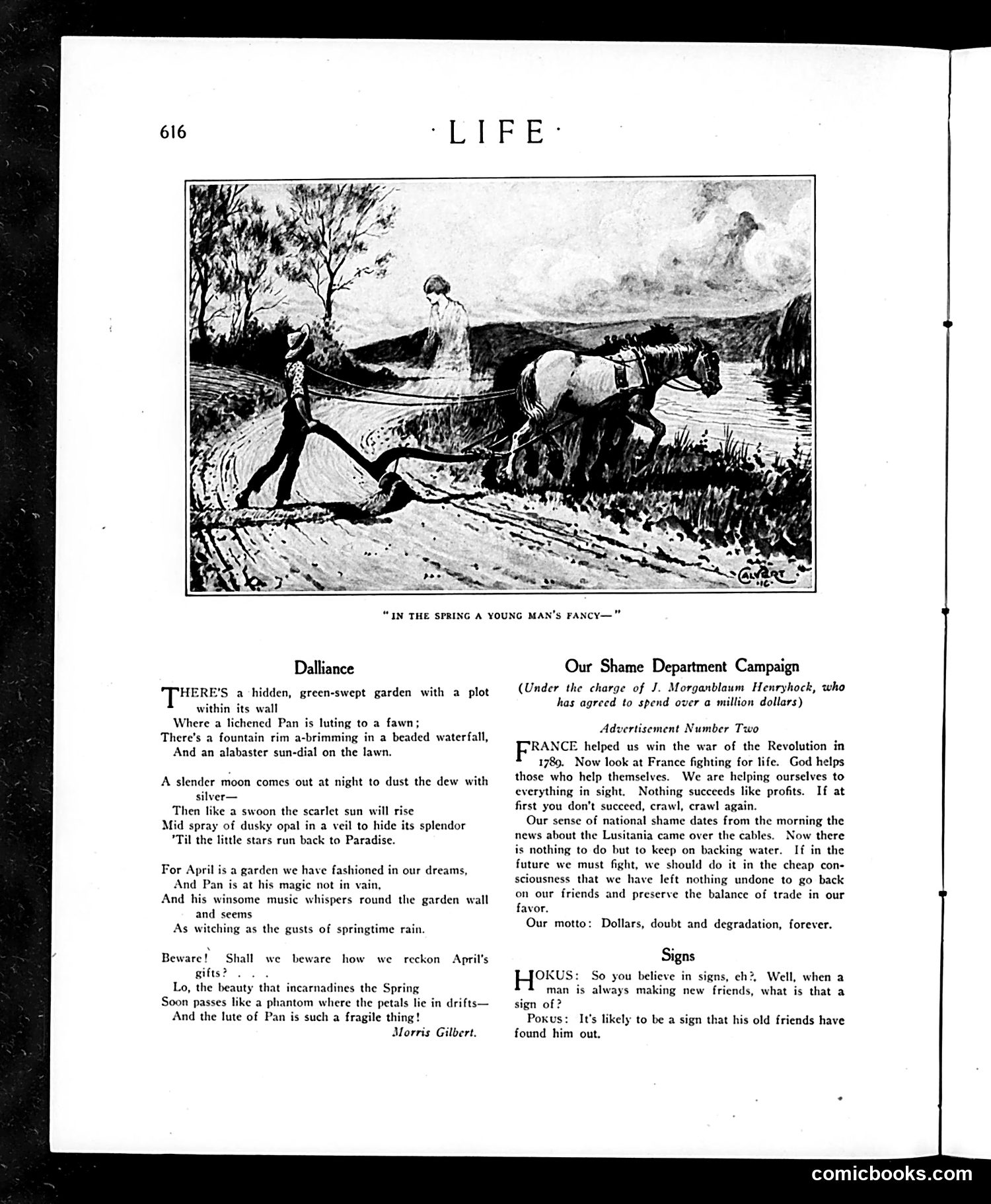
This page from *Life* magazine contains satirical political commentary on American foreign policy during World War I, likely from 1915-1917. **The Main Cartoon** ("In the Spring a Young Man's Fancy") illustrates a man fishing or net-casting by a river while a woman stands nearby—a romantic scene accompanying Morris Gilbert's romantic poem about April and springtime. **The Satirical Section** ("Our Shame Department Campaign") mocks American reluctance to aid France in WWI. It sarcastically suggests America is profiting from the war while refusing to directly assist France—who had helped America in the Revolutionary War. The fake "advertisement" cynically proposes the national motto should be "Dollars, doubt and degradation, forever," attacking American isolationism and war profiteering. **The "Signs" Joke** at bottom is unrelated political humor about making new friends as a sign old ones have "found you out" (discovered your faults). The page's satire targets American financial self-interest over military alliance obligations during WWI.
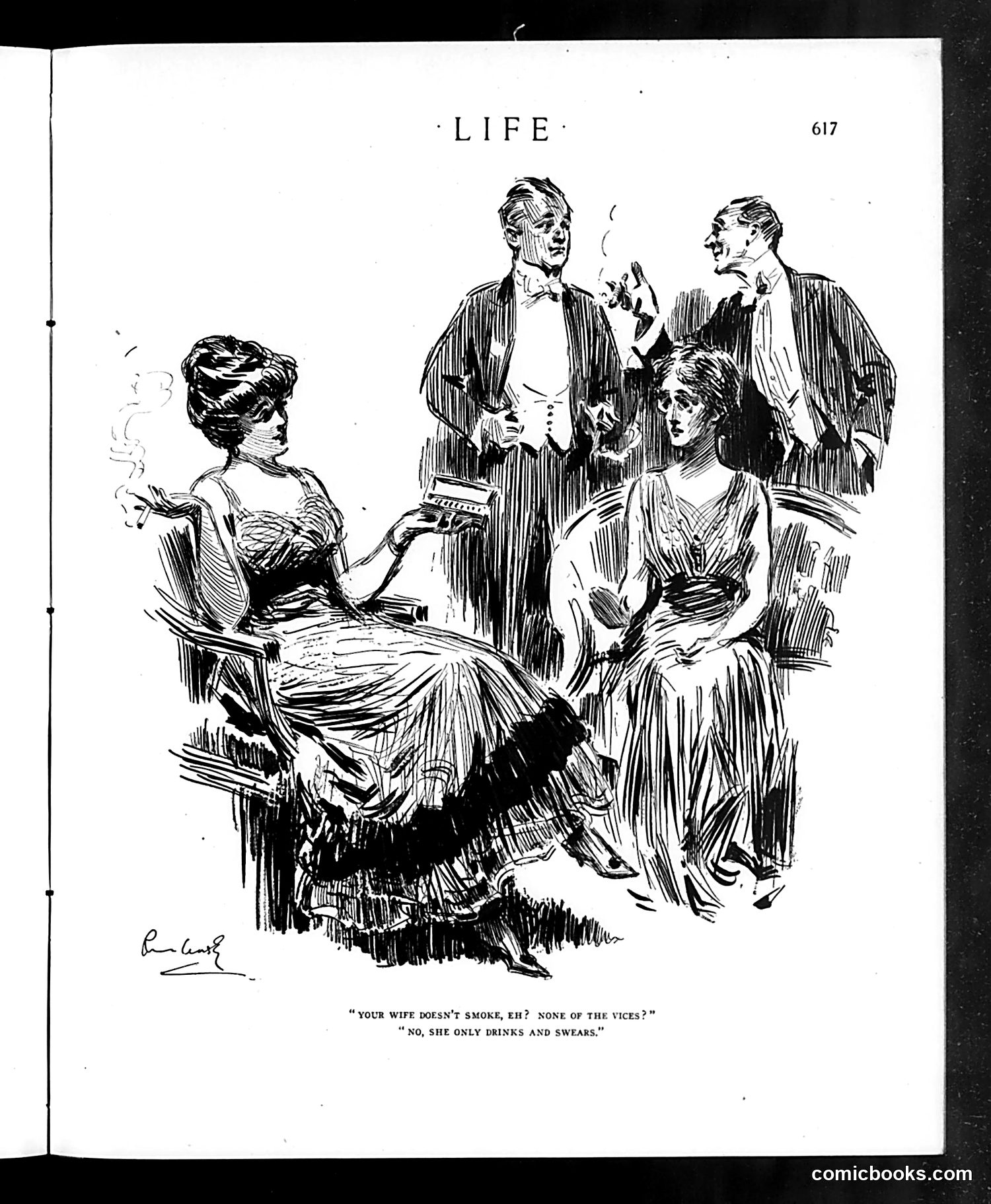
This is a single-panel cartoon satirizing gender and vice. The scene shows a social gathering where one man boasts to another about his wife's virtue, claiming she doesn't smoke or indulge in any vices. The punchline—"No, she only drinks and swears"—inverts the expected moral hierarchy of the era. The satire targets early 20th-century hypocrisy about women's "propriety." While smoking was considered scandalous for women, the cartoon suggests drinking and profanity were somehow acceptable or overlooked substitutes. The joke reflects contemporary anxiety about changing women's behavior and the gap between public respectability and private conduct. The artist's signature appears lower left, though the name is unclear in the image.
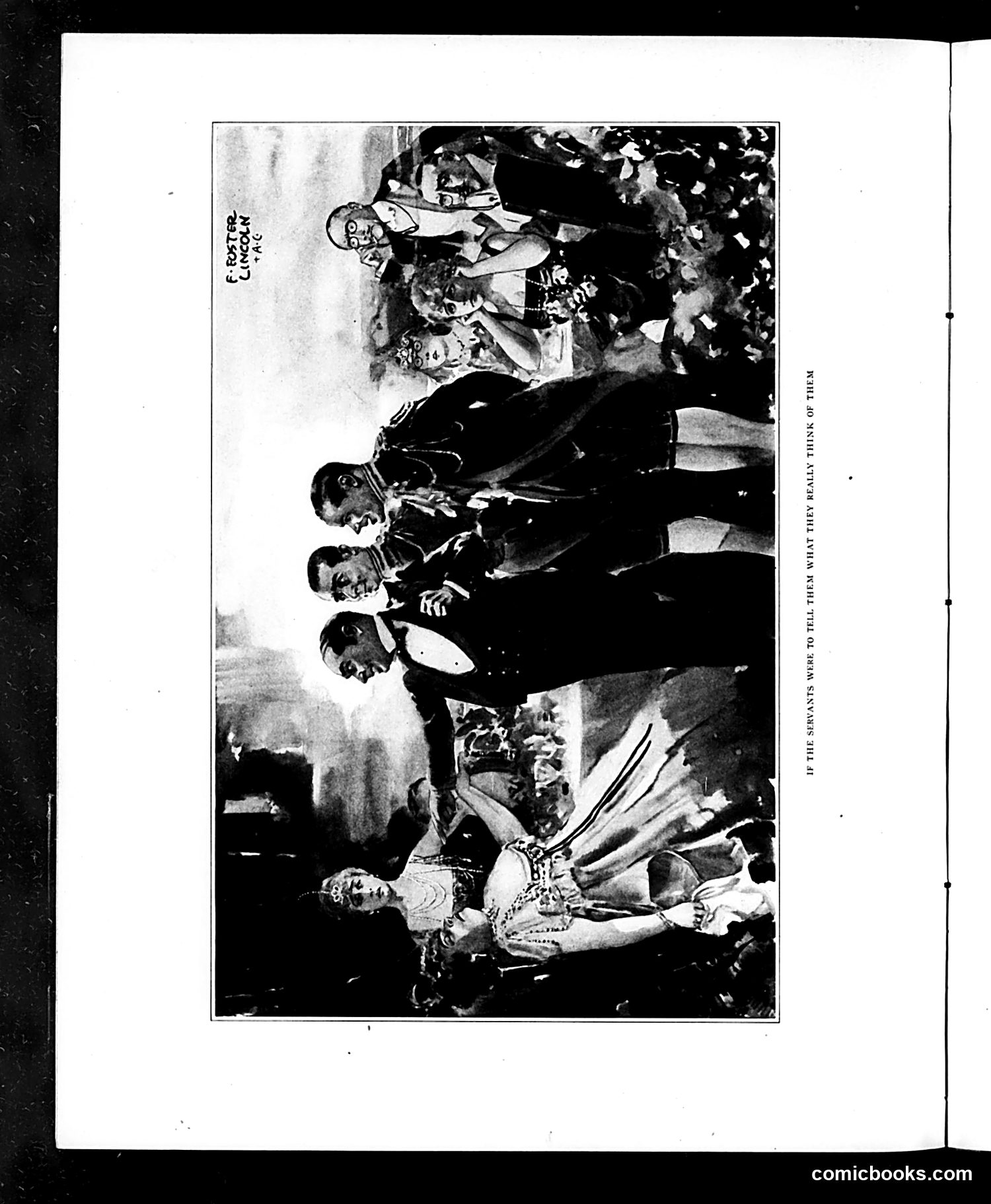
This is a satirical illustration imagining what household servants would say about their employers "if the servants were to tell them what they really think of them." The image shows what appears to be wealthy, well-dressed figures (likely representing the upper class) while servants or working people observe them. The satire critiques the class divide and suggests servants harbor critical, unflattering opinions of their employers that social convention prevents them from expressing. This reflects early 20th-century social commentary on class hierarchies, worker discontent, and the gap between public propriety and private sentiment. The humor comes from the implicit contrast between deferential servant behavior and their actual hidden judgments—a common satirical theme in *Life* magazine's social criticism.
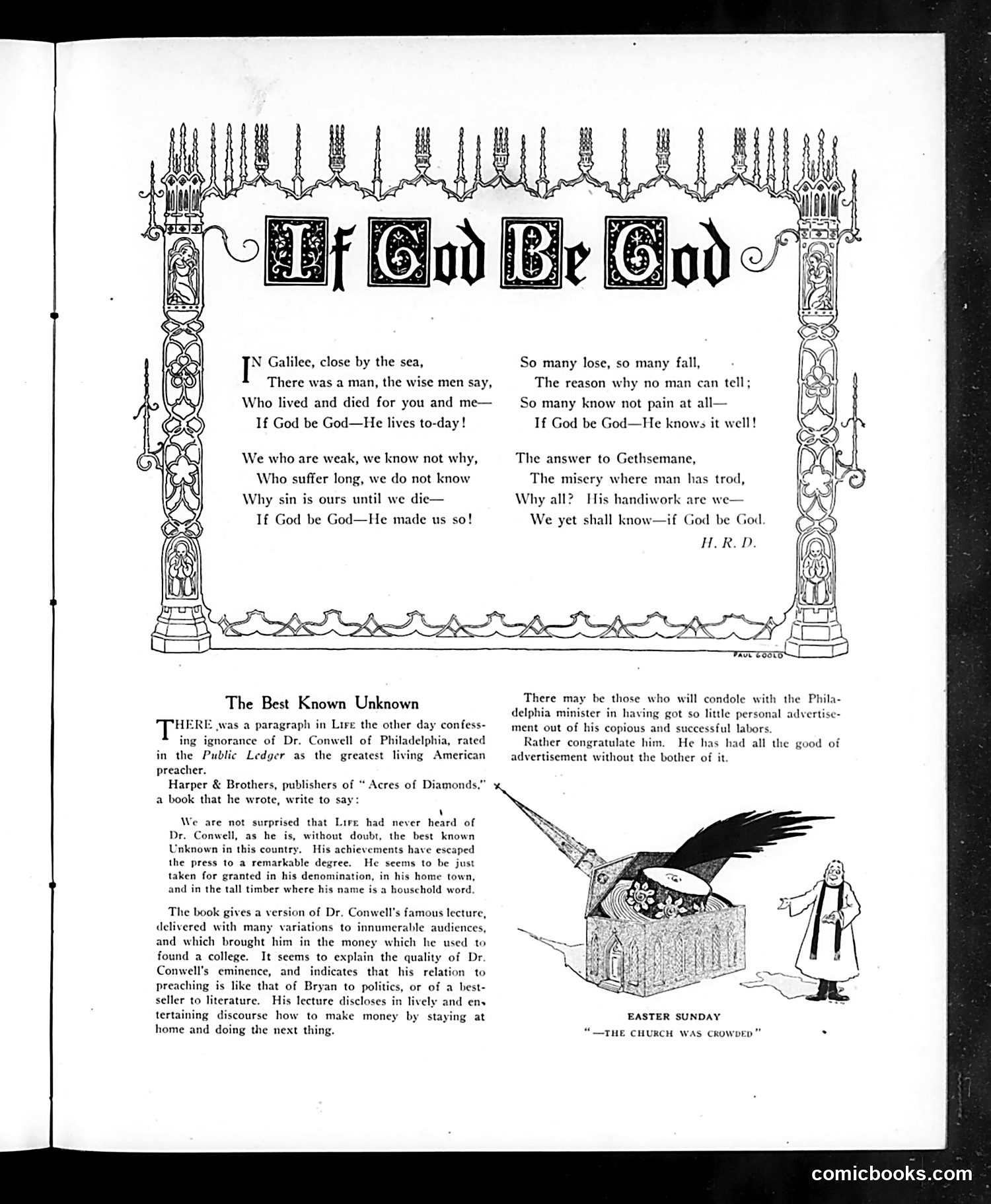
This page combines religious poetry with satirical commentary on Dr. Russell Conwell, a prominent Philadelphia preacher largely unknown to the general public despite his considerable achievements. **The Poetry:** A reverent Easter meditation questioning divine justice—why suffering exists, why some know pain while others don't—concluding that ultimate answers depend on whether "God be God." **The Satire:** Life magazine had confessed ignorance of Dr. Conwell, prompting his publisher (Harper & Brothers) to defend him as "the best known Unknown in this country." The piece mocks how Conwell, despite founding a college and delivering his famous lecture "Acres of Diamonds" (about making money through modest home industry) to countless audiences, remains relatively anonymous outside his denomination and hometown. **The Point:** The irony is that Conwell's obscurity is actually advantageous—he gains "advertisement without the bother of it." The cartoon captioned "The Church Was Crowded" (Easter Sunday) underscores the contrast between his genuine influence and his lack of public recognition.
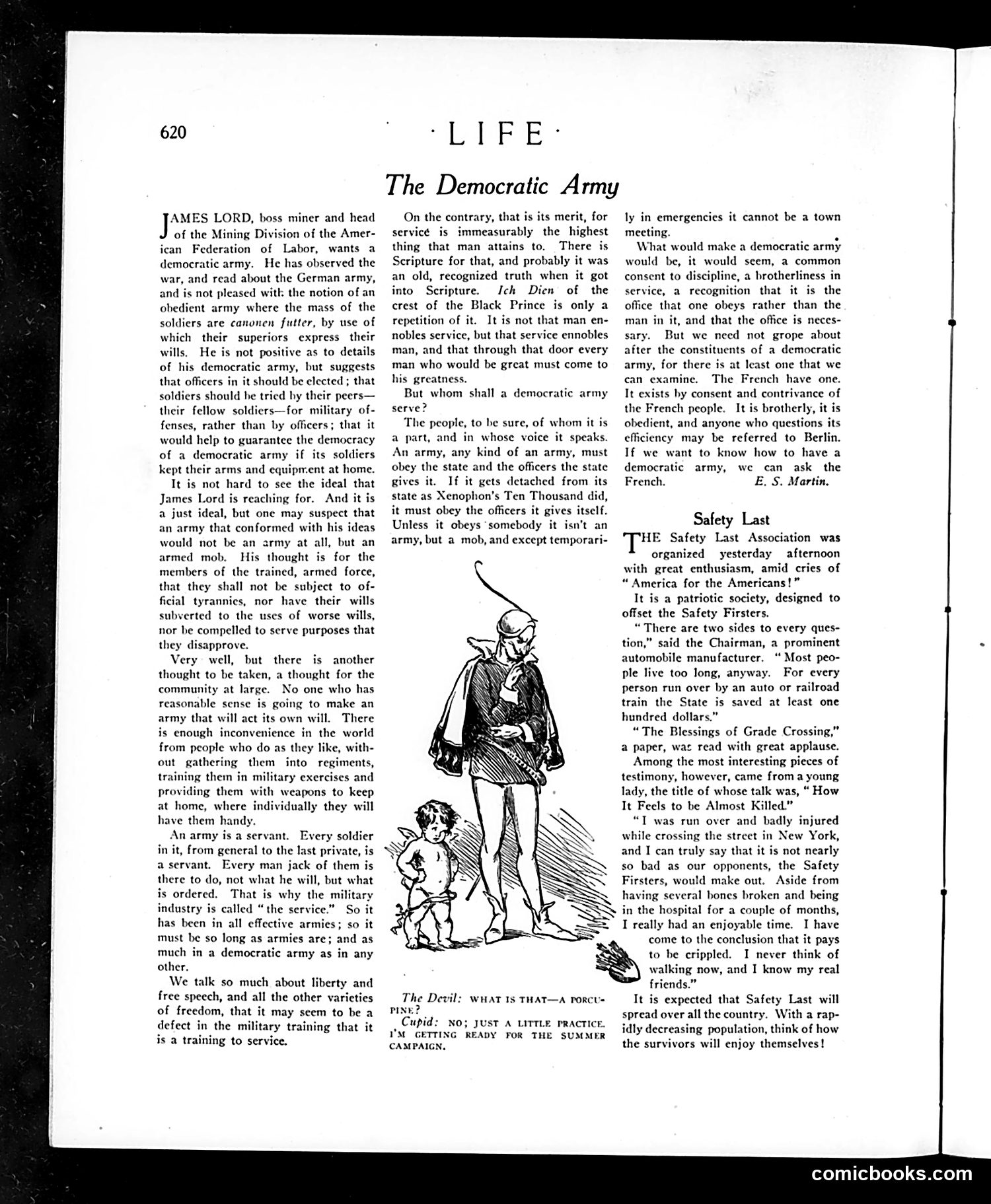
This page contains two distinct pieces of satire from Life magazine. **"The Democratic Army"** (main article): James Lord, a labor leader, advocates for a "democratic army" with elected officers and soldiers tried by peers. Life's editors argue this misunderstands military necessity. They contend armies must be hierarchical servants of the state—not democratic bodies—because undisciplined armed groups become dangerous mobs. The piece defends military obedience as noble service, citing the Black Prince's motto "Ich Dien" (I serve). **The cartoon** below shows Cupid practicing target practice with an arrow, labeled as preparation for "the summer campaign." The Devil objects, concerned about the weapon. This satirizes romantic entanglements during wartime—mocking how Cupid (love/romance) remains active even amid military preparations, with Cupid treating romance like a military campaign. Both pieces use humor to address serious WWI-era questions about military organization and social disruption.
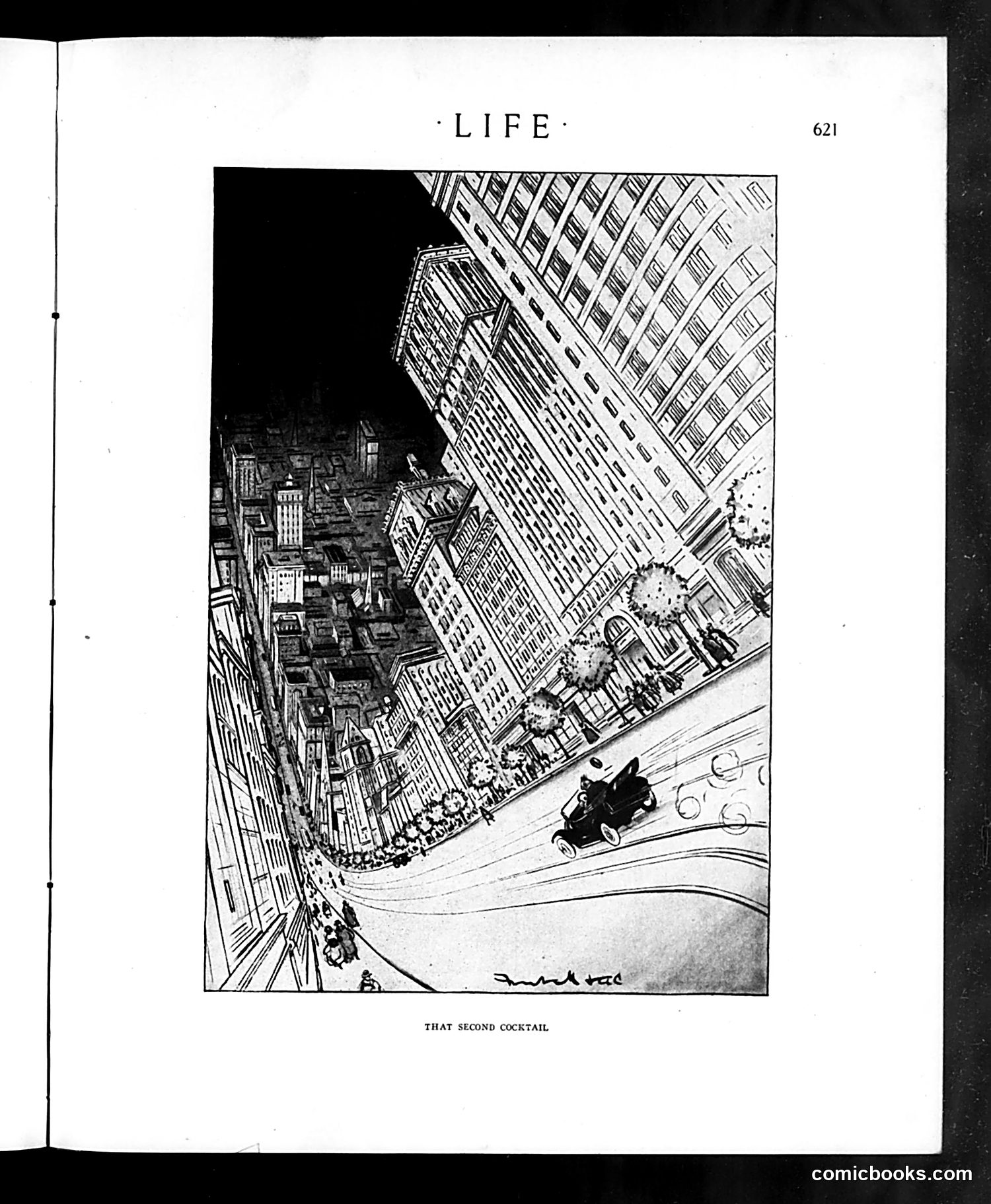
This is a bird's-eye view cartoon satirizing urban nightlife and the effects of alcohol during Prohibition era America. The image shows a dramatically foreshortened view looking down at a city street, with tall buildings flanking both sides and a motorcycle or car speeding recklessly through the center. The title "That Second Cocktail" suggests the cartoon mocks how alcohol impairs judgment and coordination—the driver appears to be operating the vehicle dangerously after consuming drinks. The exaggerated perspective emphasizes the dizzying, disorienting sensation of intoxication. This was a common Life magazine satirical theme: critiquing Americans' drinking habits and the dangers of the illegal alcohol trade during Prohibition (1920-1933).
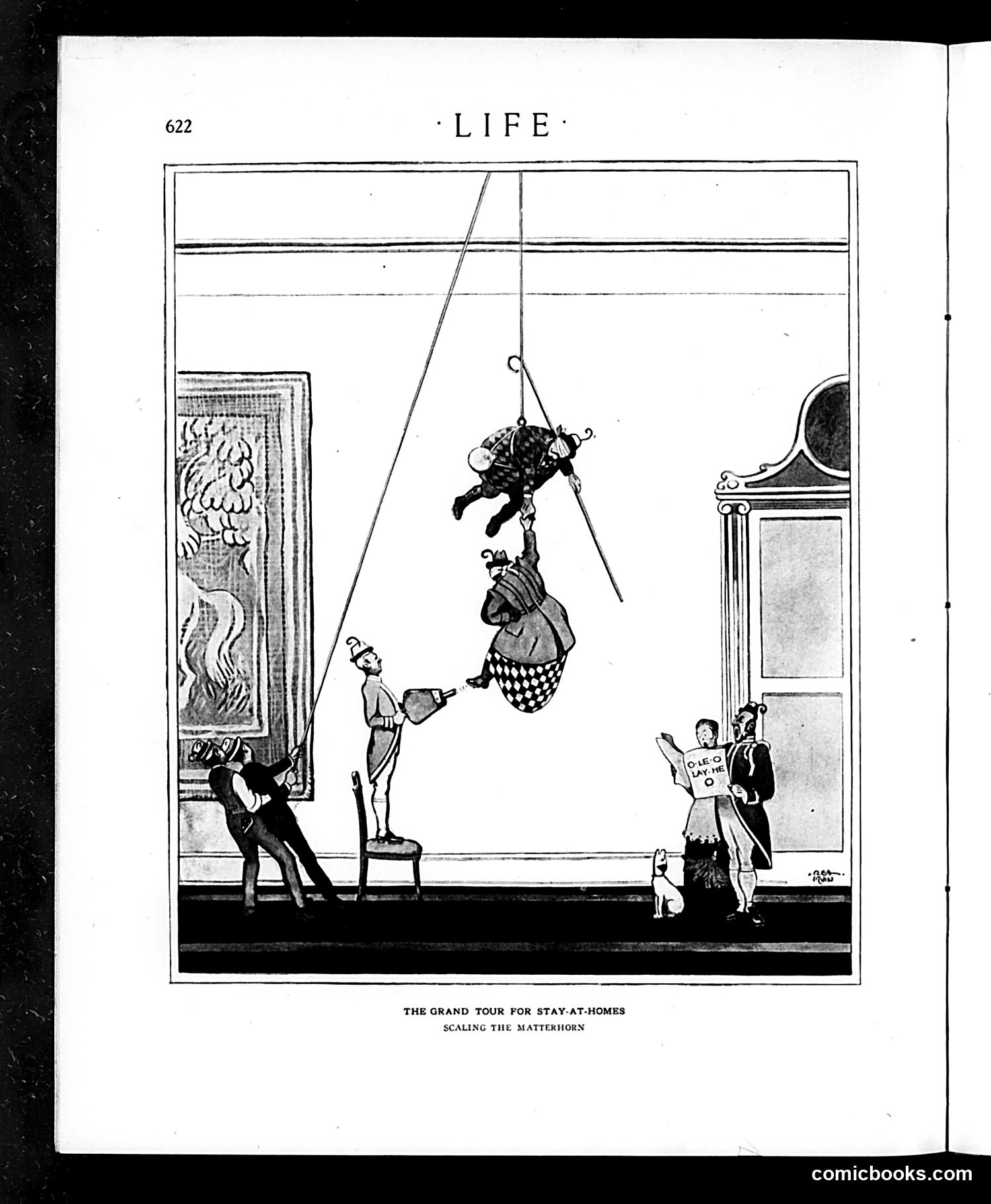
This satirical cartoon depicts wealthy domestic tourists experiencing an elaborate indoor recreation of climbing the Matterhorn mountain. Instead of traveling abroad, people are suspended by ropes in what appears to be a themed interior space, with decorative panels simulating an Alpine setting. The joke targets early 20th-century Americans who could afford leisure travel but preferred staying home—likely referencing tourist attractions that simulated exotic destinations indoors. The figure being hoisted represents a tourist "conquering" the mountain without leaving the room. The satire mocks both the commercialization of tourism and upper-class Americans' desire for adventure without actual effort or travel expense. The "stay-at-homes" subtitle suggests this was a common enough phenomenon to warrant satirical commentary.
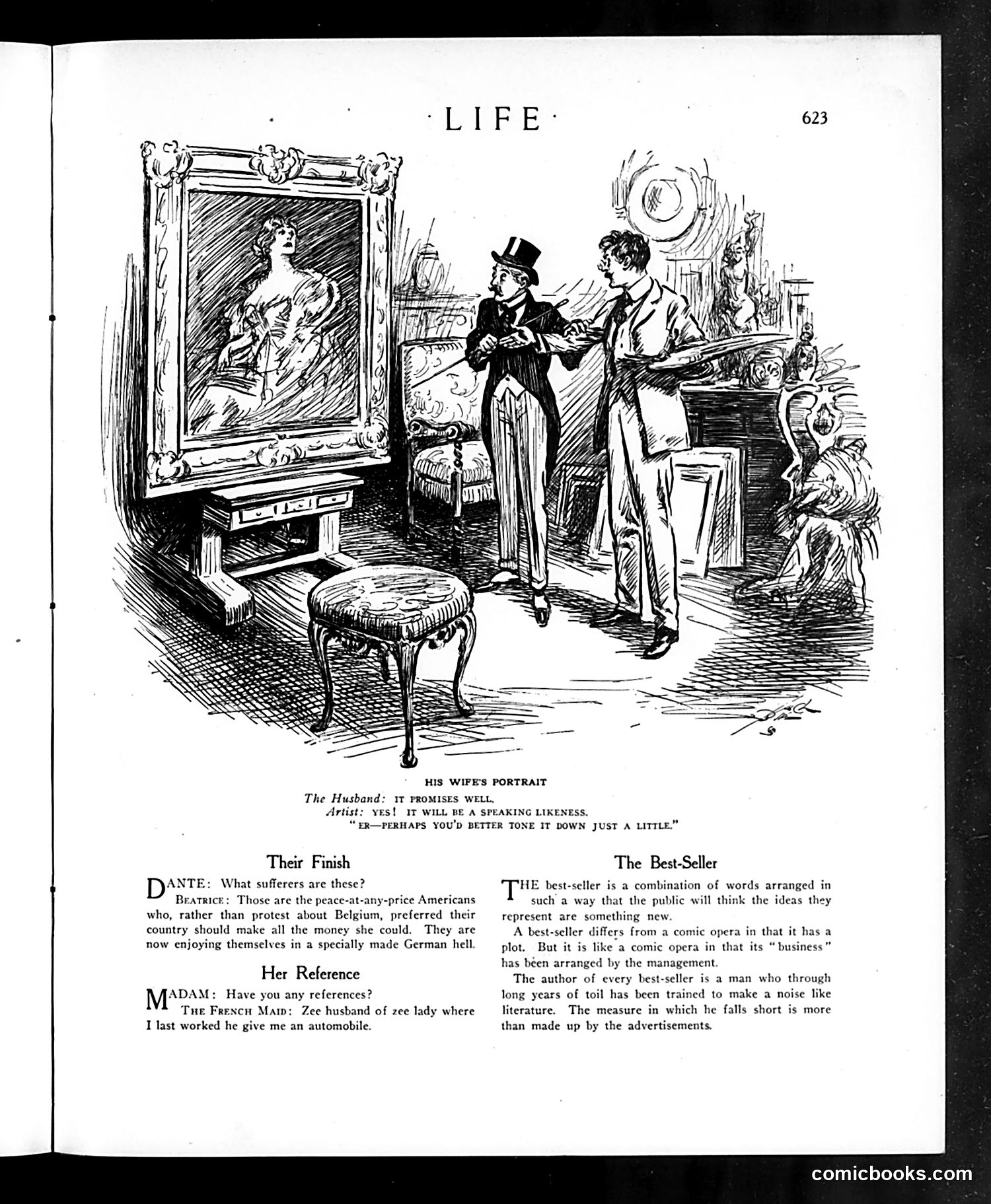
This page contains three separate satirical pieces from Life magazine (likely WWI era, based on Belgian references). **"His Wife's Portrait"**: A joke about an artist painting a woman's portrait so unflattering that the husband asks him to "tone it down"—the humor lies in the wife's implied ugliness. **"Their Finish"**: A darker piece referencing Dante's *Inferno*. It condemns "peace-at-any-price Americans" who prioritized profits over protesting Germany's invasion of Belgium, now suffering in a "specially made German hell"—satirizing American isolationism and profiteering during WWI as moral cowardice. **"Her Reference"** and **"The Best-Seller"**: Unrelated brief humorous pieces—one mocking French maids citing loose job references, the other criticizing best-selling authors as manufacturers of pseudo-intellectual noise dressed up by advertising rather than genuine literature. The page reflects Life's role as a vehicle for sophisticated social and political commentary mixed with lighter humor.
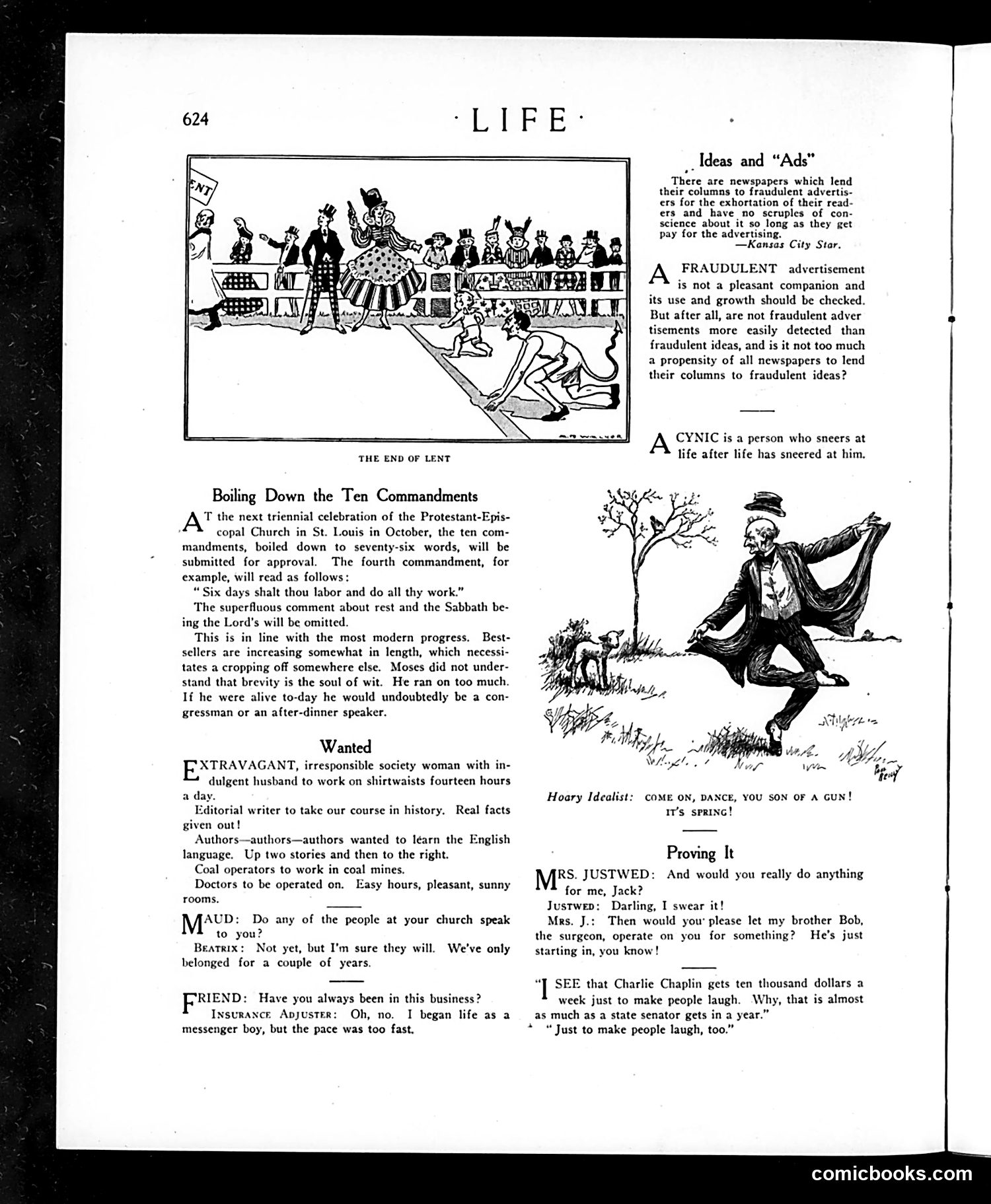
This page satirizes early 20th-century trends toward oversimplification and commercialism: **"The End of Lent" cartoon** depicts the end of the Lenten season with a circus-like crowd scene, likely commenting on how religious observance had become casual entertainment. **"Boiling Down the Ten Commandments"** mocks the Protestant Episcopal Church's plan to condense the commandments to 76 words for their St. Louis conference. The satire suggests that modern efficiency culture—where bestsellers grow longer requiring cuts elsewhere—is reducing sacred texts to business-like brevity. The jab at Moses becoming "a congressman or after-dinner speaker" if alive today ridicules contemporary politicians' verbose speechifying. **"Wanted" section** presents absurdist job postings (irresponsible society women, coal doctors "to be operated on") mocking classified advertising's dishonesty. The right side critiques **fraudulent newspaper advertising**, arguing that fraudulent *ideas* spread more easily than fraudulent products—a media ethics concern still relevant today. Smaller jokes mock social climbing, insurance salesmen's burnout, and the disparity between entertainers' and politicians' salaries.
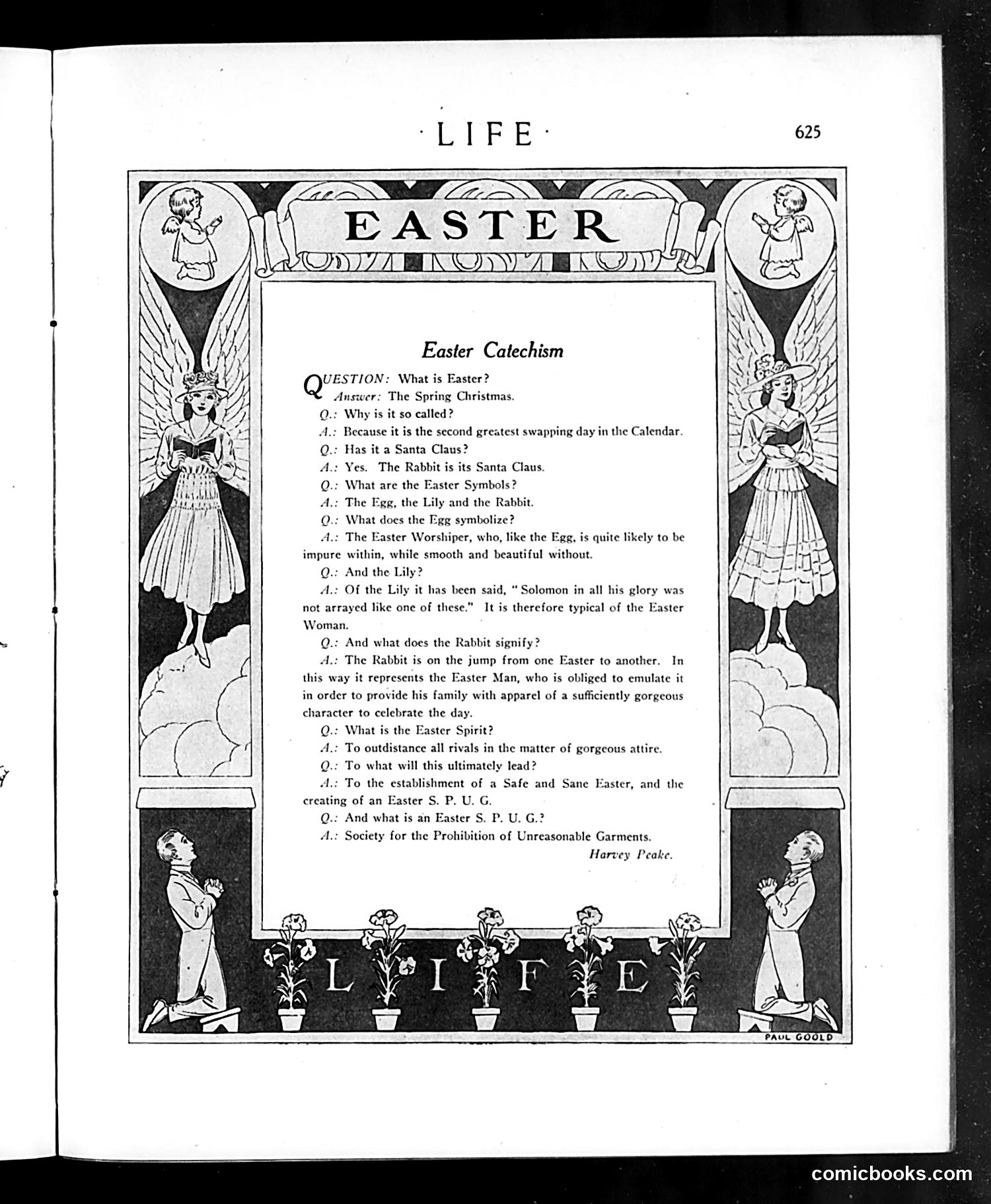
This satirical "catechism" mocks Easter's commercialization and excessive materialism in early 20th-century America. Using a mock-religious question-and-answer format, Harvey Peake ridicules: **The consumerism**: Easter is compared to Christmas as a "swapping day"—a shopping holiday. The Easter Rabbit replaces Santa Claus, obliging fathers to buy expensive clothes. **Hypocrisy**: The egg symbolizes worshippers who are "impure within, while smooth and beautiful without"—criticizing people who dress elaborately for Easter church attendance while lacking genuine piety. **Fashion excess**: The "Easter Spirit" is purely about "outdistance[ing] all rivals in gorgeous attire." Women are mocked as vain ("typical of the Easter Woman"). **The solution**: The joke proposes an "Easter S.P.U.G."—Society for the Prohibition of Unreasonable Garments—sarcastically suggesting reform movements to combat wasteful spending. The ornate Art Deco border and period illustrations emphasize the lavish aesthetics being critiqued.
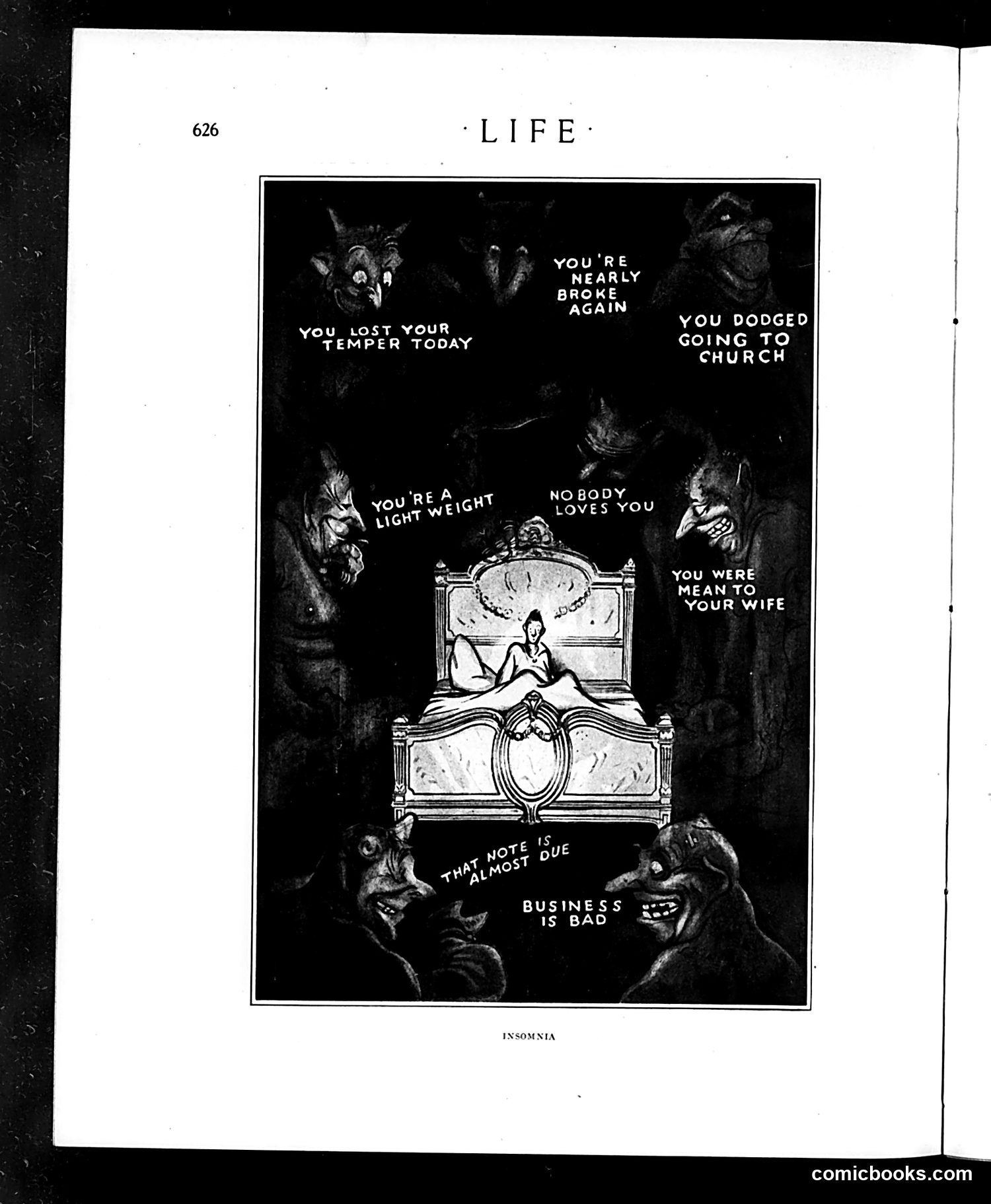
This cartoon depicts a man lying in bed at night, surrounded by demonic or grotesque figures—likely representing his own guilt and anxious thoughts. Each figure speaks a different accusation or worry: - Lost your temper - Nearly broke again - Dodged church - You're a lightweight - Nobody loves you - You were mean to your wife - That note is almost due - Business is bad The satire targets male anxiety and insomnia, humorously suggesting that a man's sleeplessness stems from accumulated personal failures and regrets—moral lapses, financial troubles, marital discord, and professional problems. Rather than depicting insomnia as a medical condition, Life satirizes it as the natural consequence of a guilty conscience. The demons visualize how his own mind torments him through the night, making the abstract anxiety concrete and darkly comedic.
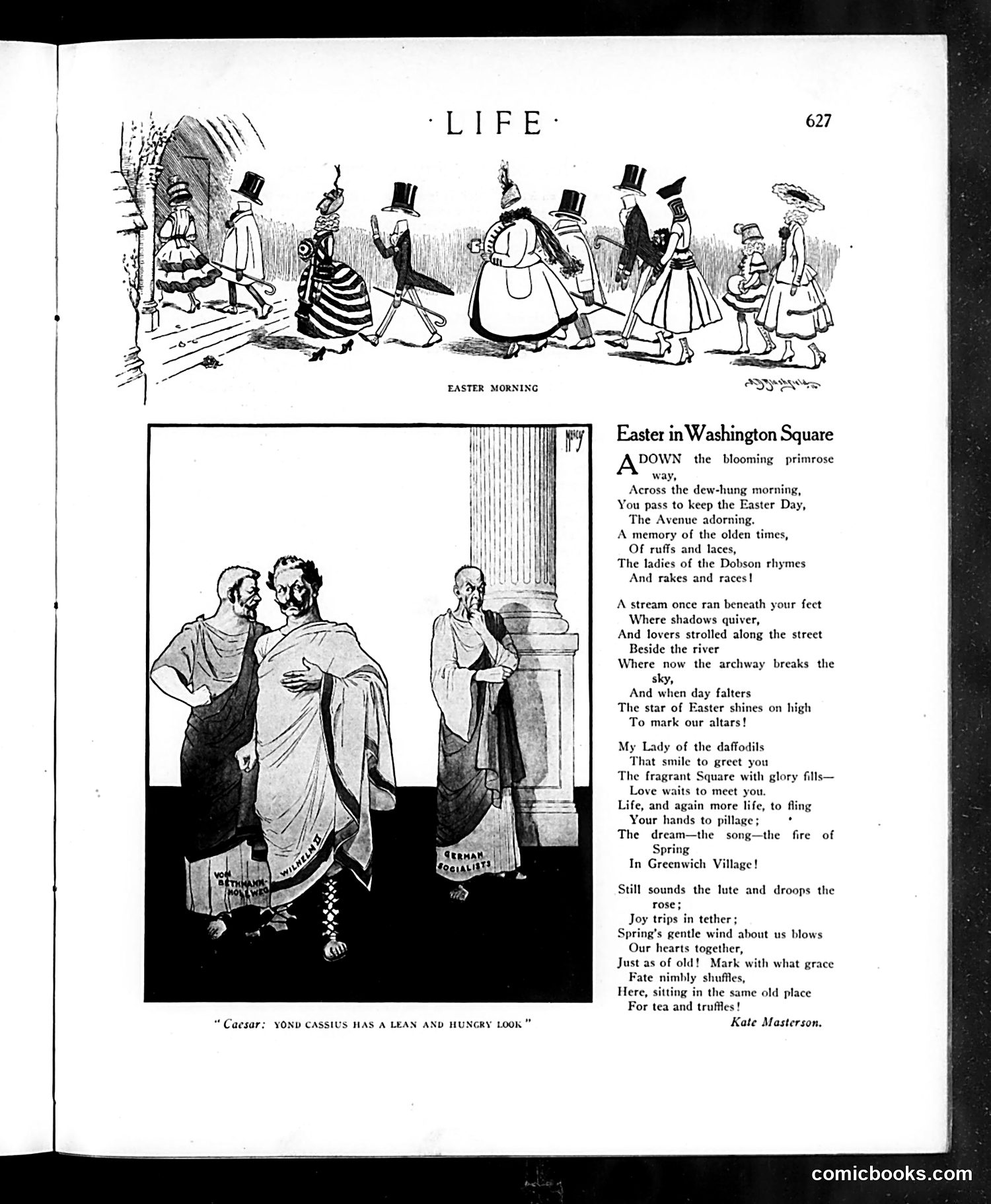
**Top Cartoon ("Easter Morning"):** A satirical scene of Easter promenading in fashionable dress. The figures wear top hats and elaborate clothing, depicting the social ritual of displaying wealth and status during the holiday in an urban setting. **Bottom Illustration & Caption:** References Shakespeare's *Julius Caesar* ("Yond Cassius has a lean and hungry look"). The caption suggests someone—likely a political or public figure—appears desperate or dangerous. Without additional context, the specific identity is unclear, but the quote implies treachery or ambition. **Poem ("Easter in Washington Square"):** Nostalgic verse romanticizing Greenwich Village's past, contrasting "olden times" of refined society with contemporary spring rituals. It celebrates Easter traditions while gently mocking the persistence of fashionable social gathering ("for tea and truffles"). **Overall Point:** The page satirizes bourgeois Easter traditions and fashionable display among New York's upper classes, mixing gentle mockery with literary and Shakespearean references typical of *Life* magazine's sophisticated humor.
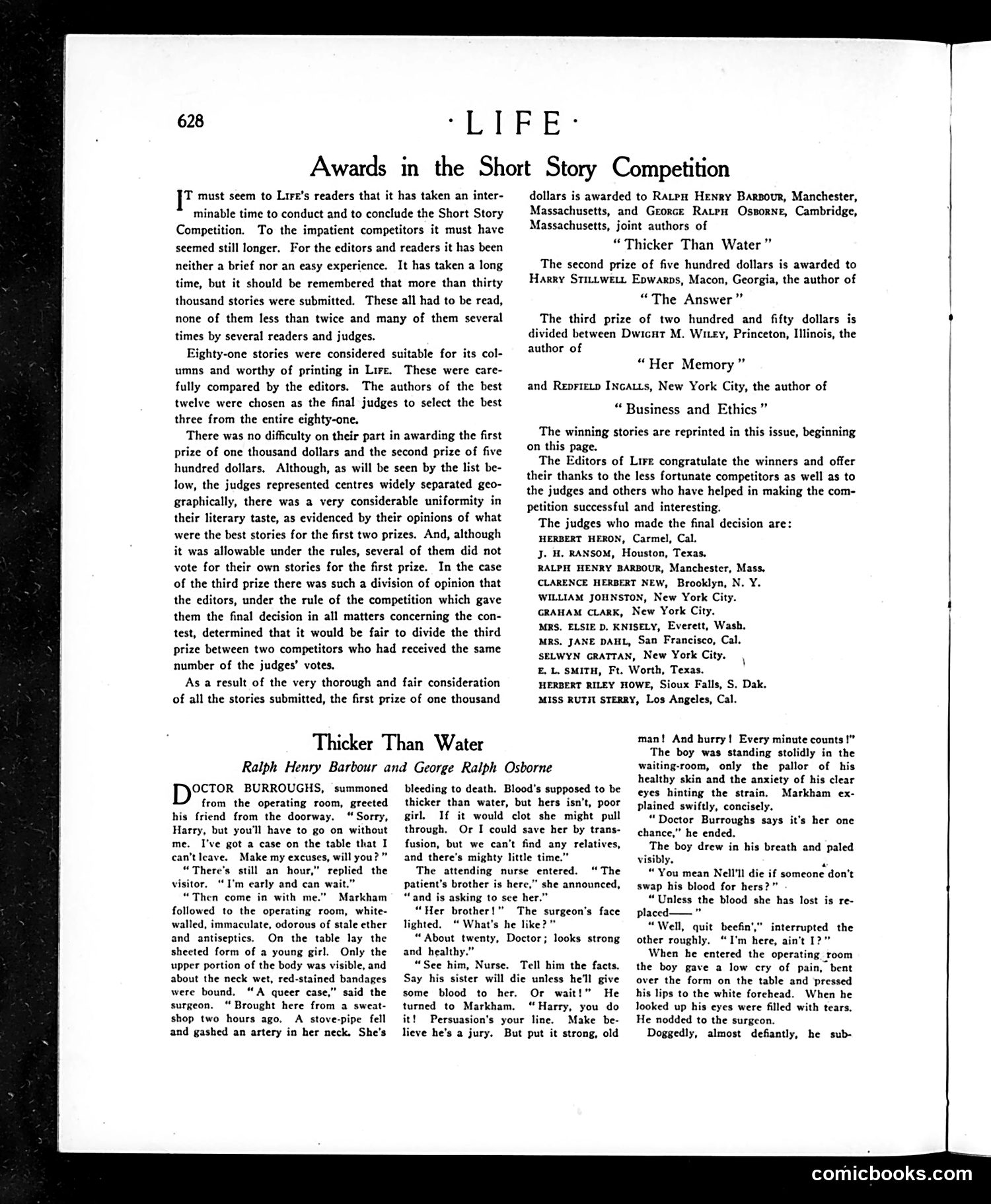
This is a **competition results announcement** page from Life magazine, not a political cartoon. The page announces winners of Life's Short Story Competition. The main content describes the judging process for 30,000+ submitted stories, narrowed to 81 finalists, then 3 winners selected by a panel of 12 judges representing different U.S. regions. Life notes the judges showed "considerable uniformity" in taste despite geographic separation. The page then begins printing the **first-prize winning story, "Thicker Than Water,"** co-authored by Ralph Henry Barbour and George Ralph Osborne. The story opening depicts a dramatic medical scenario: a young girl from a sweatshop with a severed neck artery needs a blood transfusion to survive. A surgeon asks her brother to donate blood to save her life—a literal dramatization of the story's title metaphor about family obligation. **No political satire or cartoon is present** on this page; it's an earnest literary competition announcement and story publication.
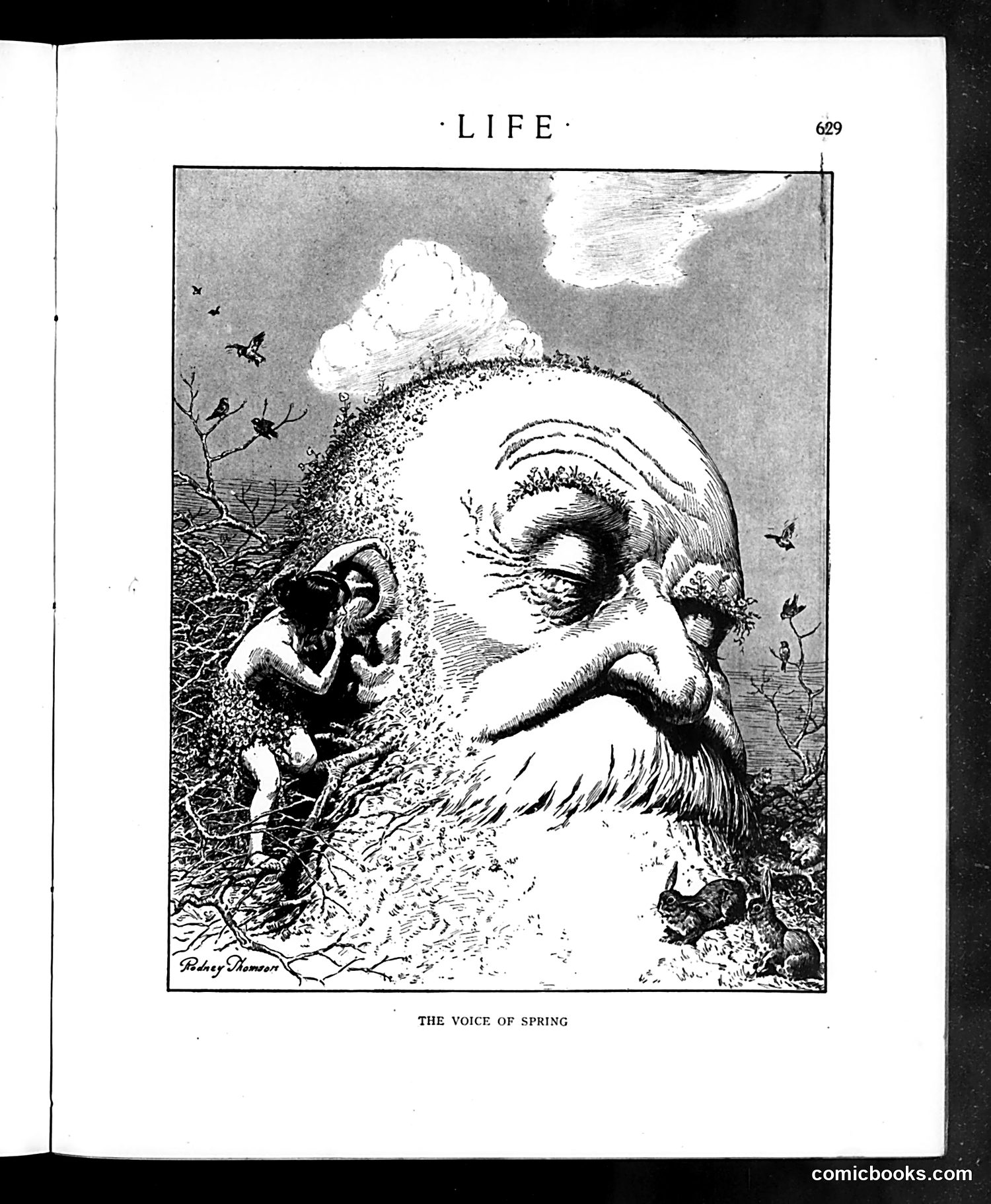
This illustration depicts a bearded man's profile merged with or emerging from a naturalistic landscape. The image is signed by what appears to be "Penley Damson" (artist attribution visible lower left). The title "The Voice of Spring" suggests personification—the man's face represents spring itself speaking through nature. Small figures and creatures populate the surrounding scenery, including what appears to be cherubs or putti, birds, and vegetation, emphasizing the season's generative and life-giving properties. The satirical or allegorical intent likely comments on spring as a creative or rejuvenating force, though without additional context from the magazine issue, the specific contemporary reference remains unclear. The romantic, nature-symbolic style was typical of Life magazine's editorial illustrations during this period.
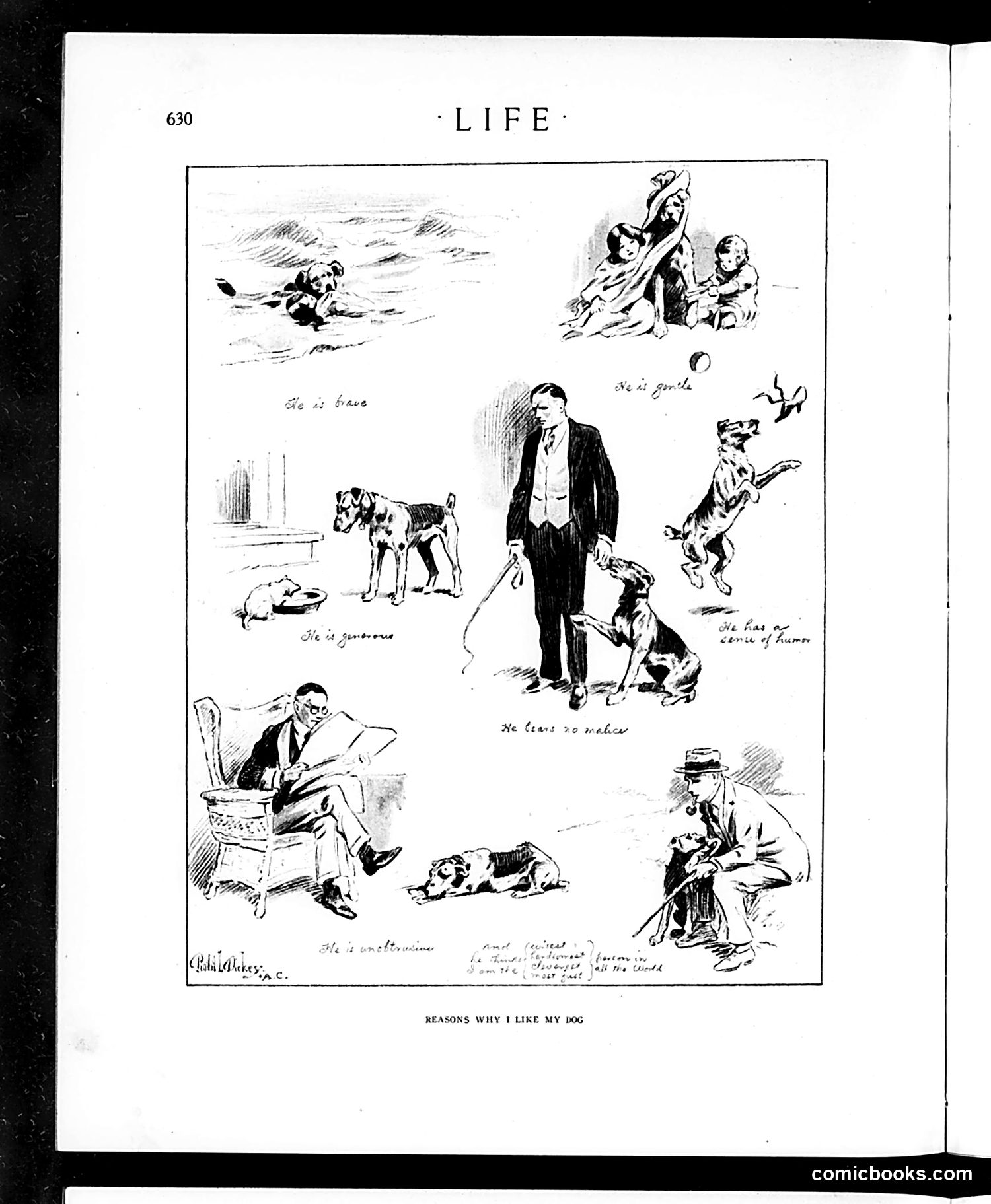
This is a humorous illustrated essay celebrating dogs' appealing qualities through various domestic scenarios. The cartoon shows a well-dressed man with several dogs in different situations, each labeled with a reason for dog appreciation. The vignettes depict dogs being: - Brave (swimming/water scene) - Gentle (with children) - Generous (sharing food) - A "sense of humor" (playful antics) - Faithful and protective The satire gently mocks human sentimentality about pets while acknowledging genuine dog virtues. Rather than political content, this reflects early 20th-century middle-class American attitudes toward dogs as beloved family members worthy of sentimental admiration. The work appears to be by a Life magazine illustrator (signature visible) and serves as light social commentary on pet ownership and human-animal bonds.
This page presents a short story rather than a political cartoon. "The Answer" depicts a dramatic encounter in a pawnbroker's shop between an impoverished Irish immigrant (described as "Celt") and a Jewish pawnbroker, interrupted by an authoritative third man. The narrative centers on the Irishman pawning his coat as a final act of sacrifice for his family's welfare—he's leaving permanently to ensure his daughter and "little man" (likely son) reach safety through the pawnbroker's assistance. The tension climaxes when an imperious gentleman in furs and diamonds interrupts, establishing himself as a figure of wealth and power. The story appears to explore themes of class struggle, ethnic identity, and dignity amid poverty. The visual and textual emphasis on the contrasting figures—the desperate working-class Irishman versus the wealthy authority figure—suggests social commentary on inequality and the human cost of economic disparity in early 20th-century America.
This story satirizes the casual amorality of early industrial business practices. The protagonist, A. Slivowitz—a dye manufacturer with a thick accent suggesting Eastern European immigrant wealth—represents the ruthless businessman who views ethics as an obstacle to profit. The satire centers on Slivowitz's proposition to his secretary Sloane: he'll fire him, then rehire him (with a bonus) if Sloane industrial espionage by stealing a competitor's mauve dye formula from the Domestic Dye Works. The joke is Slivowitz's breathtaking hypocrisy: he claims business success while explicitly stating "you can't mix business mit ethics"—yet he tries to justify the theft as normal practice ("skin the other guy before he skins you"). Sloane's refusal to accept marks him as the moral counterpoint. The satire suggests that while men like Slivowitz dominate commerce through ruthlessness, genuine integrity remains possible—and perhaps admirable—among working men. This reflects Progressive-era anxieties about unchecked corporate behavior.
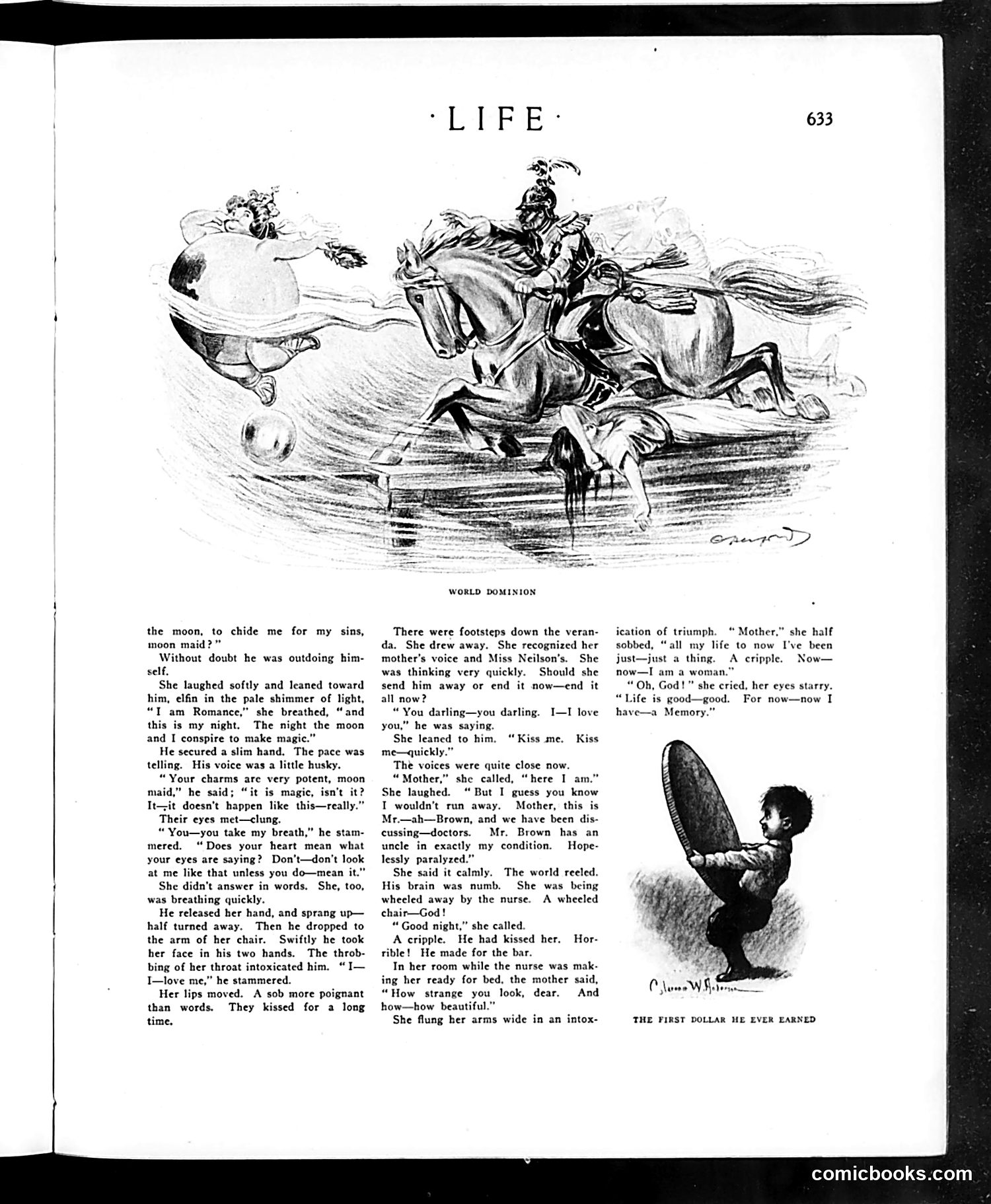
This page contains two distinct pieces of content: **The Main Story ("World Dominion"):** A romantic narrative about a man who meets a mysterious woman on a moonlit night. After an intimate encounter, he discovers she is paralyzed and uses a wheelchair. Horrified, he leaves. However, the story reveals her perspective: as a disabled woman, being desired and kissed made her feel, for the first time, like a complete person rather than "just a thing. A cripple." **The Cartoon (top):** Depicts a horseman in cavalry uniform riding wildly while a portly gentleman in civilian dress flies through the air—likely satirizing military ambition or imperial overreach, given the caption "World Dominion." **The Satirical Point:** The story ironically subverts the man's disgust by showing the woman's triumph—she manipulated him into treating her as desirable, proving disability doesn't negate femininity or worth. The juxtaposition with the "World Dominion" cartoon suggests themes of power, control, and unexpected reversals of expectation.
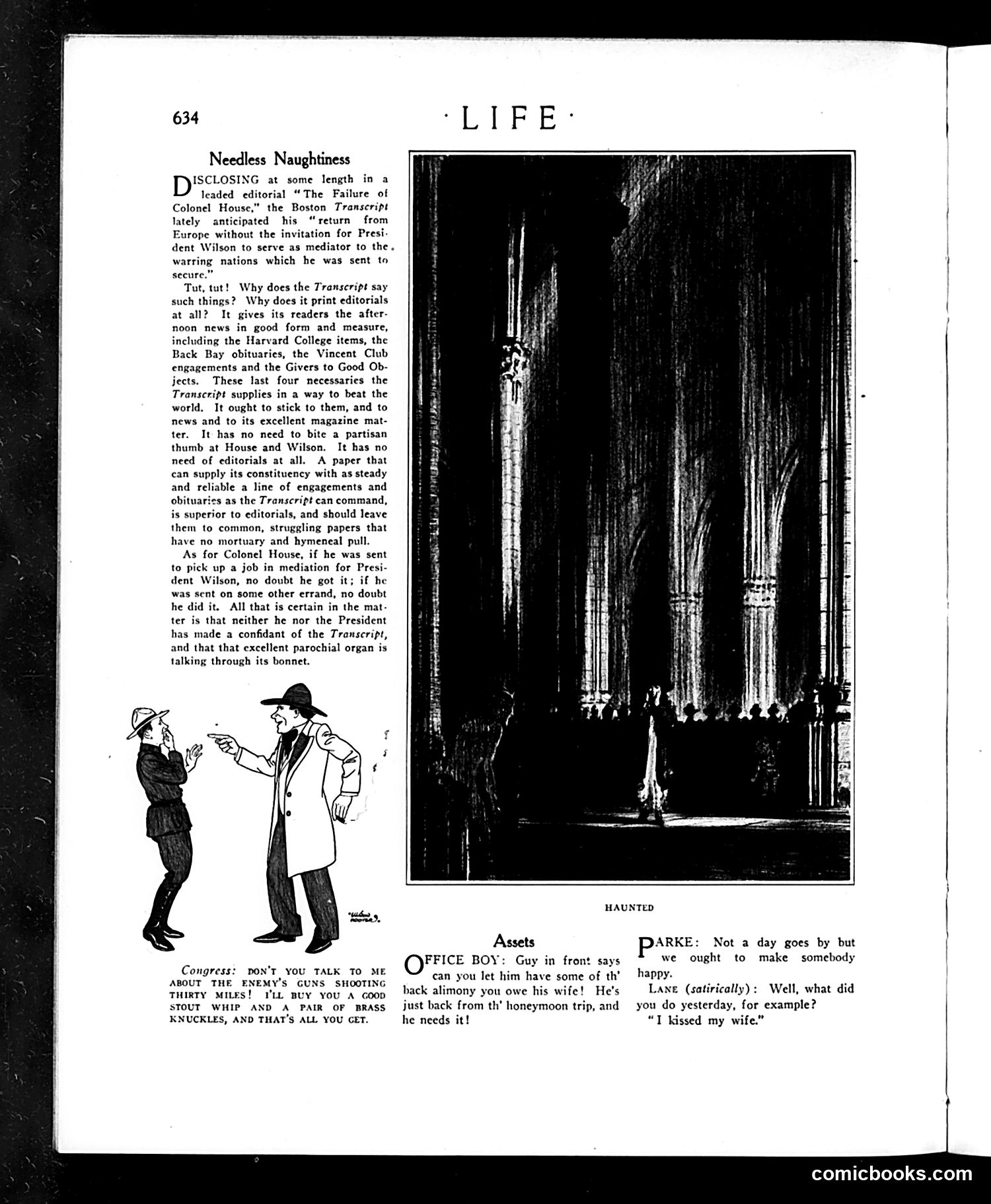
This page contains three separate satirical pieces: **"Needless Naughtiness"** criticizes the Boston Transcript newspaper for publishing editorials attacking Colonel House (President Wilson's envoy) regarding failed peace mediation efforts in Europe during World War I. The editorial argues the Transcript should stick to its strengths—society announcements and obituaries—rather than partisan commentary. **Congressional cartoon** shows Congress dismissing military concerns about enemy artillery with an offer of brass knuckles instead—satirizing perceived unpreparedness or reluctance to adequately fund military defense. **"Assets" comic** depicts an office boy telling his boss that someone's demanding back alimony from a wife, with a sardonic exchange about making people happy through kissing. The page reflects WWI-era political debate over American involvement and preparedness, while mocking both newspaper pretension and domestic financial troubles.
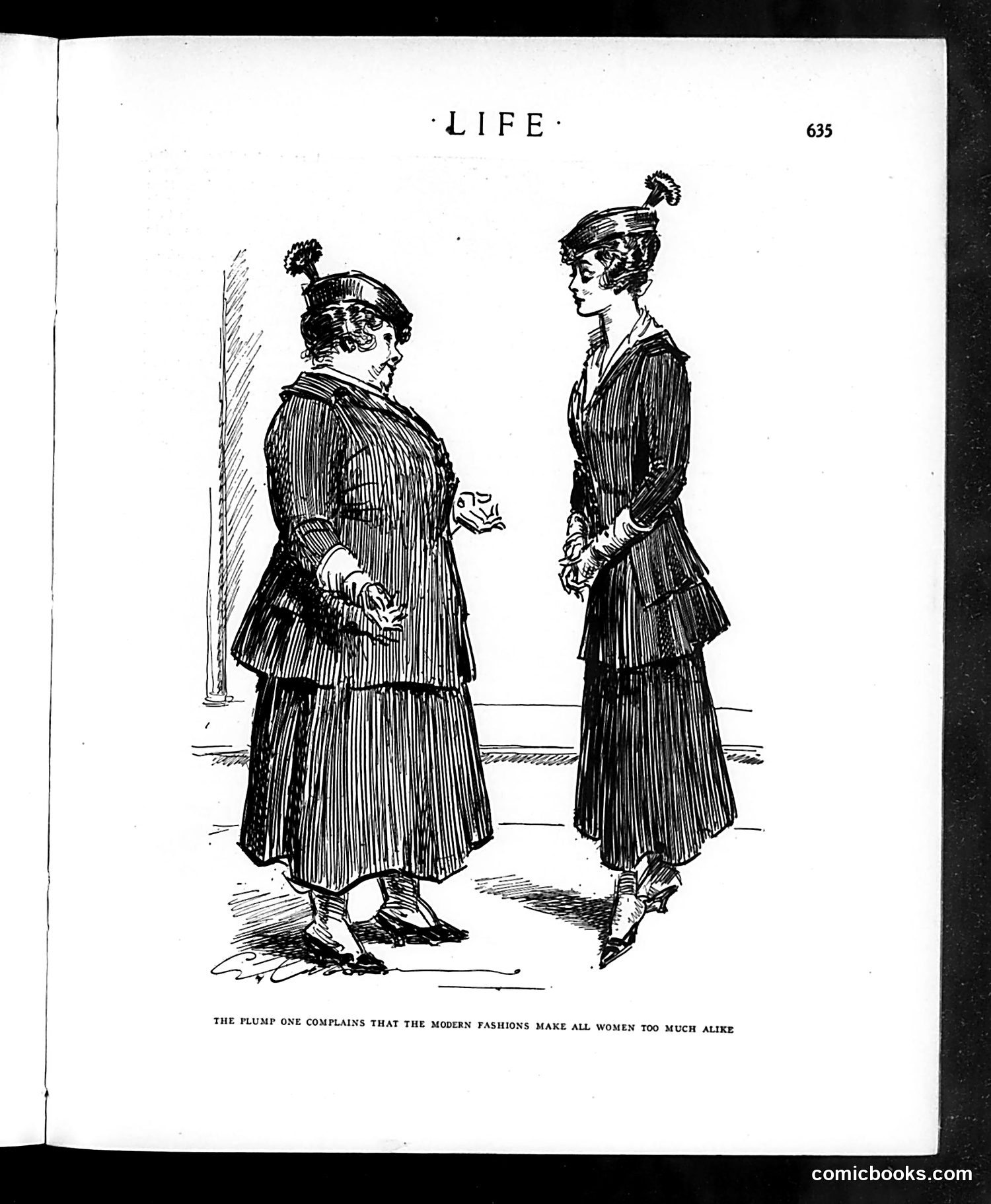
This is a single-panel cartoon from *Life* magazine (page 635) depicting two fashionably dressed women in conversation. The caption reads: "THE PLUMP ONE COMPLAINS THAT THE MODERN FASHIONS MAKE ALL WOMEN TOO MUCH ALIKE." The satire targets early 20th-century fashion standardization. The "plump one" (left figure) critiques how contemporary clothing styles—featuring similar silhouettes, fitted jackets, and tiered skirts—homogenize women's appearances regardless of body type. The cartoon suggests that modern fashion fails to accommodate or flatter different figures, making distinct women look identical. This reflects period anxieties about mass-produced clothing undermining individual distinction and femininity, particularly for women who didn't fit the prevailing slender ideal.
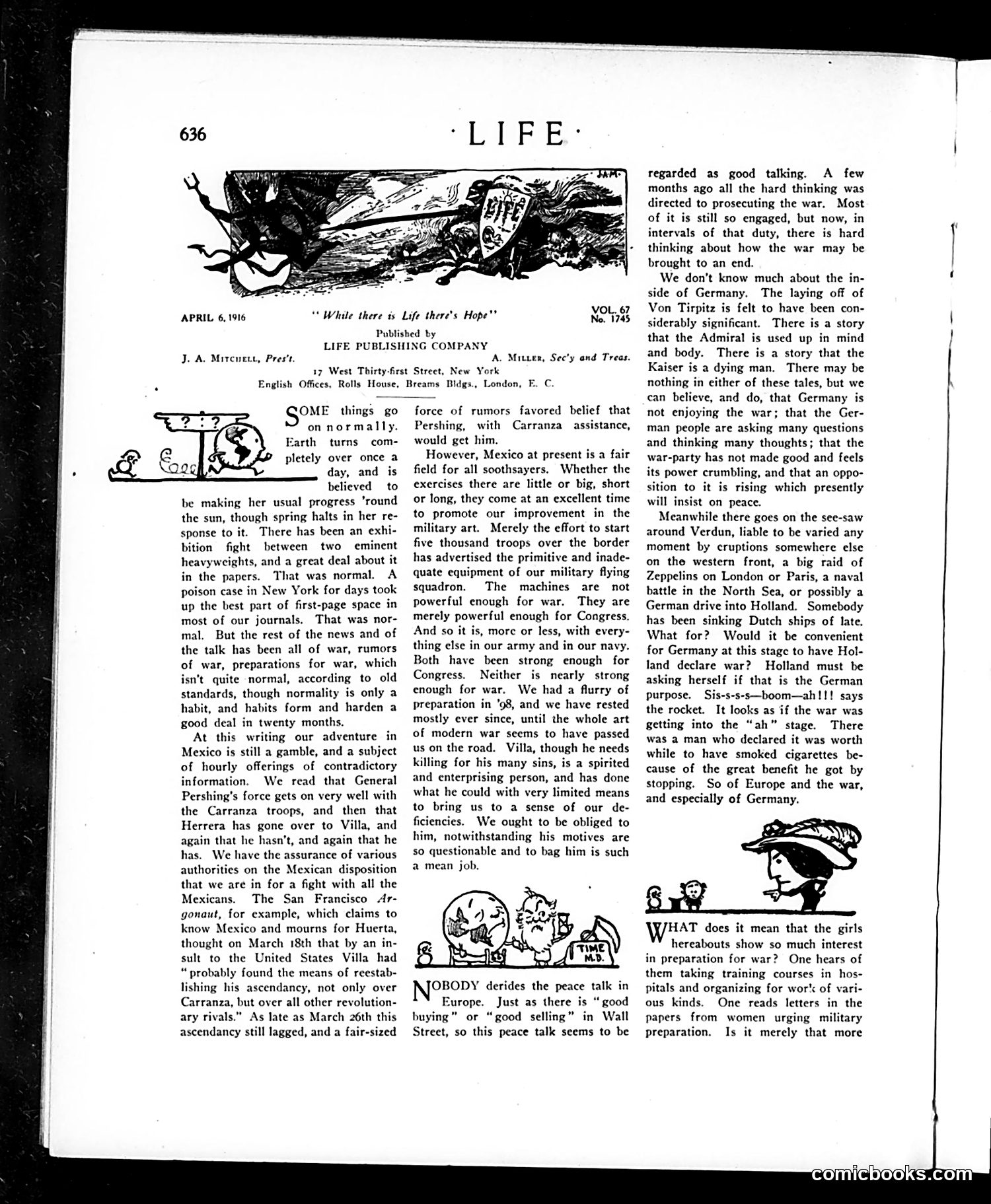
This editorial page satirizes American military unpreparedness and confusion surrounding the ongoing Mexican crisis. The main cartoon depicts a skeletal Death figure, titled "While there is Life there's Hope"—a darkly ironic commentary on the 1916 Pershing Expedition (American troops pursuing Pancho Villa across the Mexican border). The editorial criticizes how contradictory rumors dominate reporting about Mexican politics (Villa, Carranza, Herrera's shifting allegiances), making informed judgment impossible. More significantly, it mocks American military weakness: our flying squadrons lack powerful enough machines; our army and navy are adequate only for Congressional scrutiny, not actual modern warfare. The author argues Villa's raids, though despicable, usefully expose our military deficiencies. The piece also references European peace negotiations and German internal instability (Von Tirpitz's dismissal, rumors of the Kaiser's illness), suggesting war exhaustion even among belligerents. Overall: satire targeting American military complacency amid international instability.
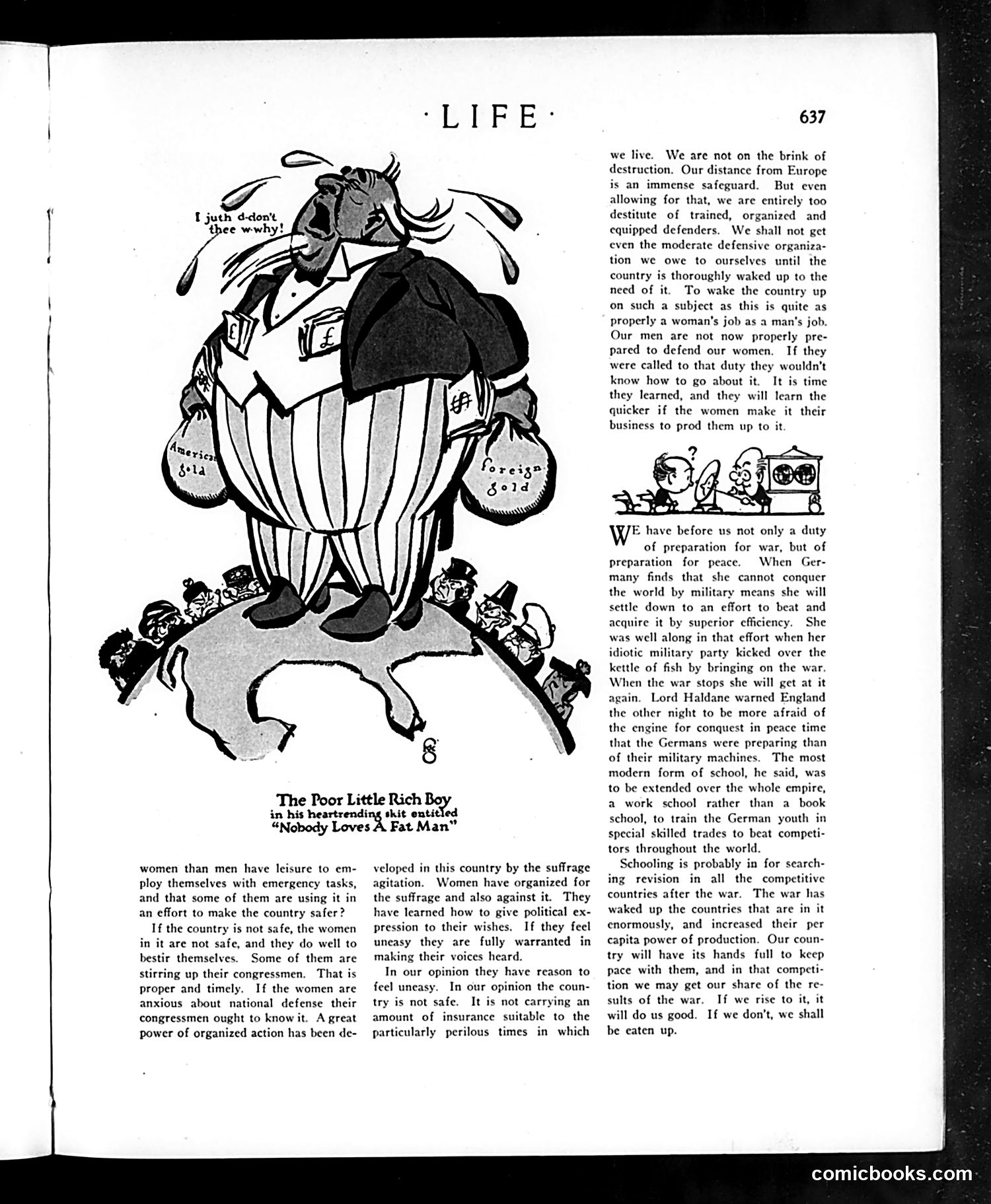
This political cartoon satirizes American military unpreparedness before World War I. The central figure—a bloated, pampered Uncle Sam labeled "The Poor Little Rich Boy"—sits atop a globe while crying "I juth d-don't thee wwhy!" (a baby's whine). Money bags labeled "American Gold" and "Foreign Gold" hang from his sides, while small figures (appearing to be politicians or military leaders) cower beneath him. The satire targets America's complacency: despite vast wealth and resources, the nation lacks trained defenders and adequate military organization. The accompanying text argues women should pressure congressmen to demand preparedness, comparing Germany's systematic training programs to America's neglect. The cartoon mocks privileged American isolation—wealthy but dangerously vulnerable—warning that post-war economic competition will demand the same aggressive efficiency Germany demonstrated militarily.
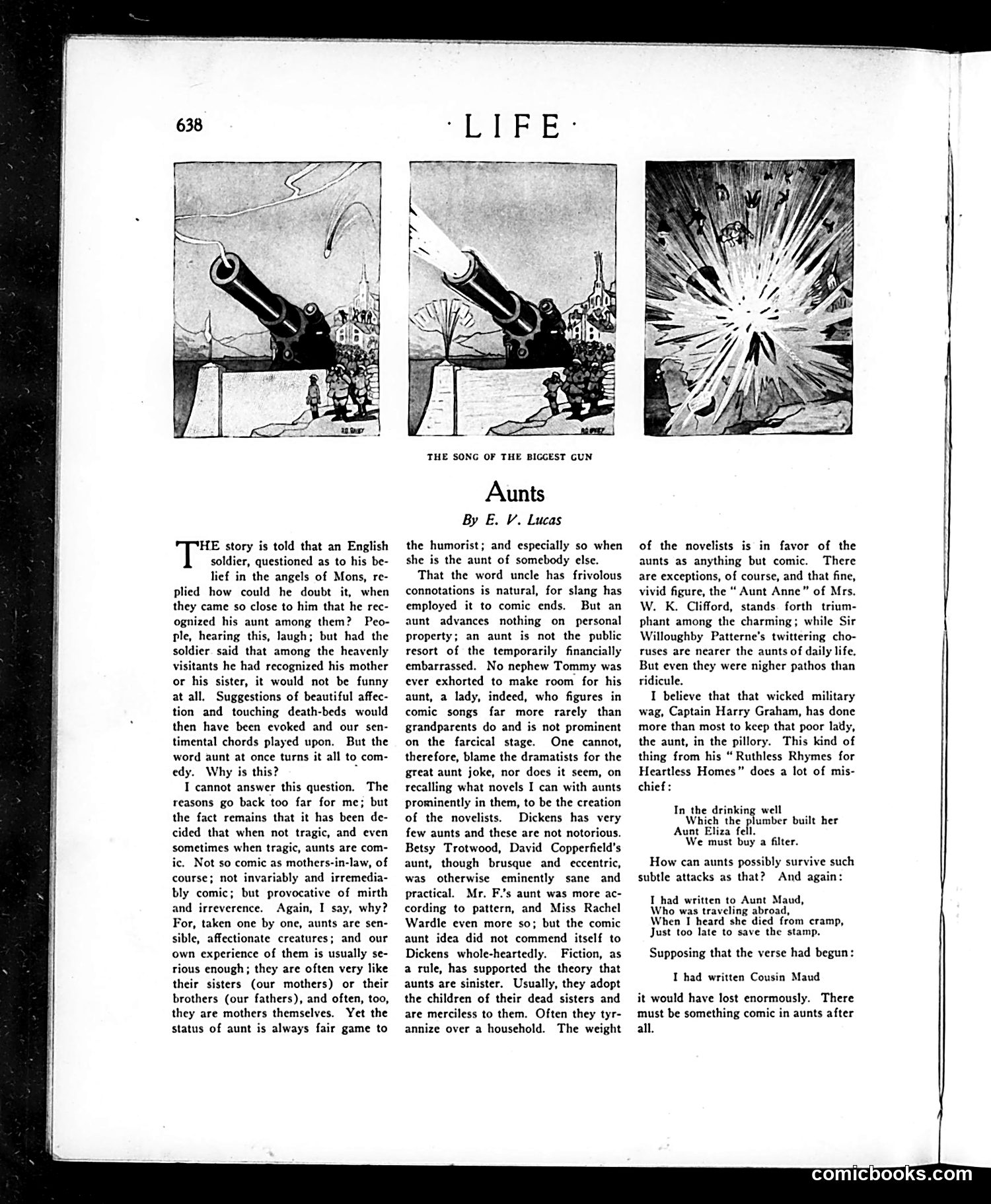
The three panels at top appear to depict WWI artillery in action—a cannon firing and its explosive result—titled "The Song of the Biggest Gun," likely satirizing the romanticization of warfare. Below, E.V. Lucas's essay "Aunts" humorously explores why aunts are culturally treated as comic figures while mothers and sisters are sentimental ones. Lucas notes that aunts appear prominently in humor and popular entertainment (citing military humorist Captain Harry Graham's darkly comic verses about aunts dying), yet observes that serious literature—Dickens, novels generally—treats aunts as sinister or tyrannical rather than funny. The piece's central paradox: aunts are individually sensible, affectionate people indistinguishable from mothers or sisters, yet their *status* as "aunt" automatically invites irreverence and mirth. Lucas cannot fully explain this cultural bias but documents its reality across Victorian and Edwardian literature and humor. The essay is a witty exploration of how social roles shape how we perceive the same person.
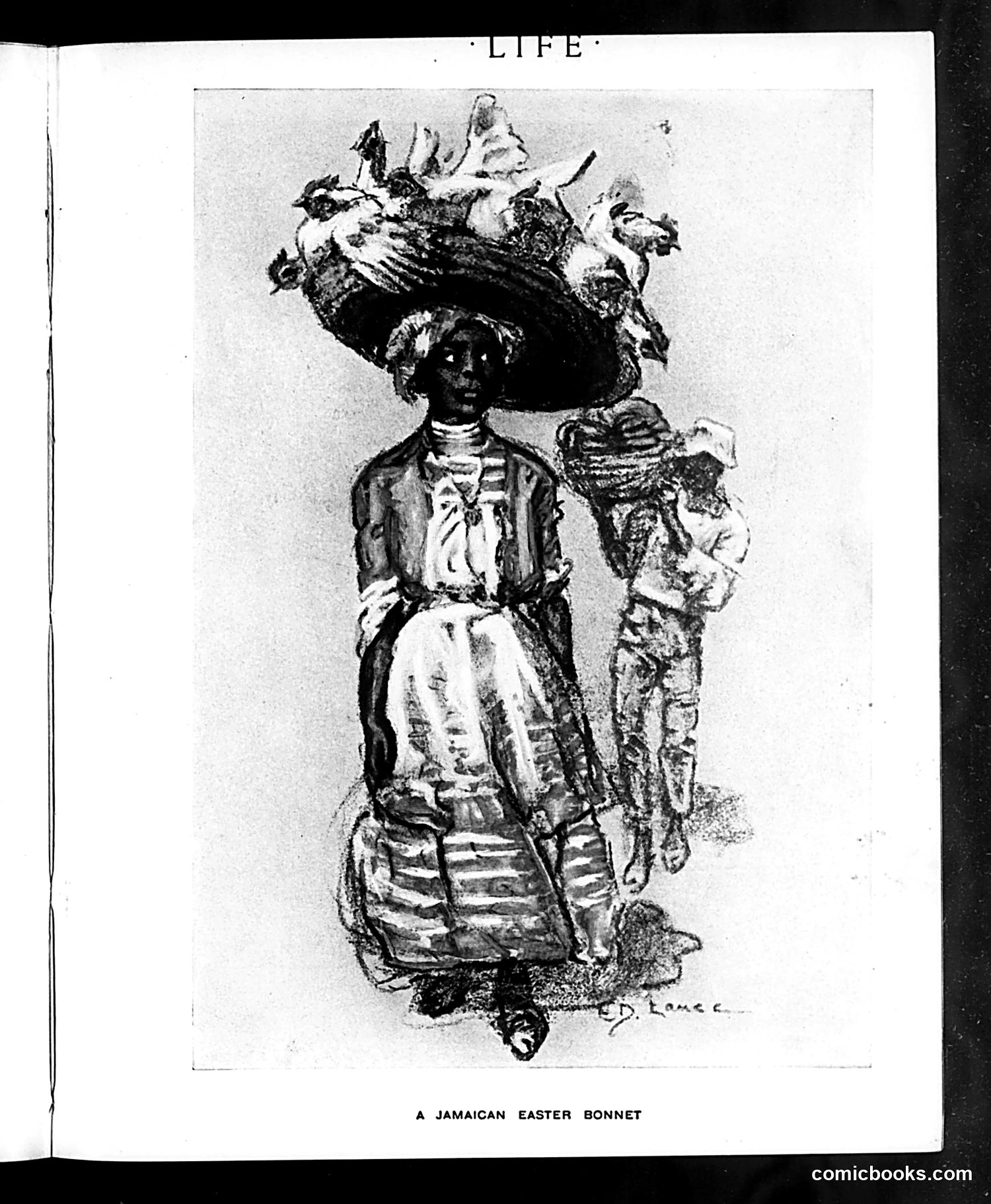
This illustration depicts a woman wearing an extraordinarily elaborate Easter bonnet—a towering, oversized hat decorated with numerous birds and ornate trimmings. The satire targets the excessive fashion of early 20th-century women's hats, which were notoriously large and lavishly adorned, often featuring real bird feathers and taxidermied specimens. By labeling it "Jamaican," the cartoon likely references exotic or tropical fashion influences popular among wealthy Americans. The exaggeration—with birds seemingly perched all over the massive construction—mocks the absurdity of contemporary hat fashion, particularly how women competed to wear the most ostentatious bonnets during Easter, a major social occasion for displaying fashionable dress. The humor lies in visualizing the ridiculous proportions these hats had actually reached.
This page from *Life* magazine shows a black and white photograph rather than a cartoon. The image depicts what appears to be a pastoral or rural scene with horses, a figure in the foreground, flowering trees, and a forested background. Without visible satirical elements, caricatures, or accompanying explanatory text on this particular page, I cannot definitively identify the political or social commentary intended. The photograph could be illustrating a humorous article, but the OCR text only provides a website credit with no article headline or caption visible. To accurately explain the satire or joke to a modern reader, I would need the original article text or caption that contextualizes this image. As presented, I can only confirm this is a photographic image from *Life* magazine, not a traditional political cartoon.
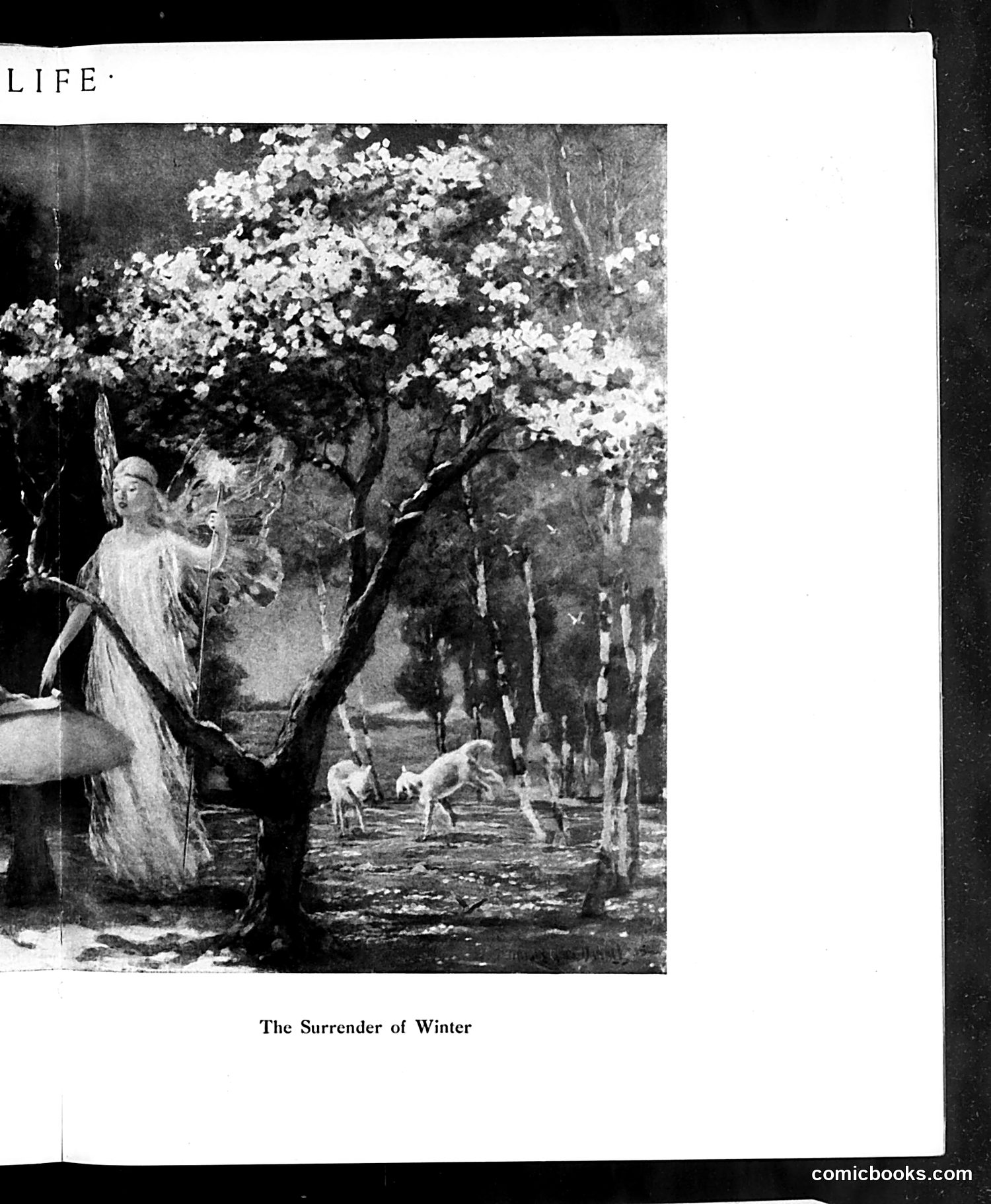
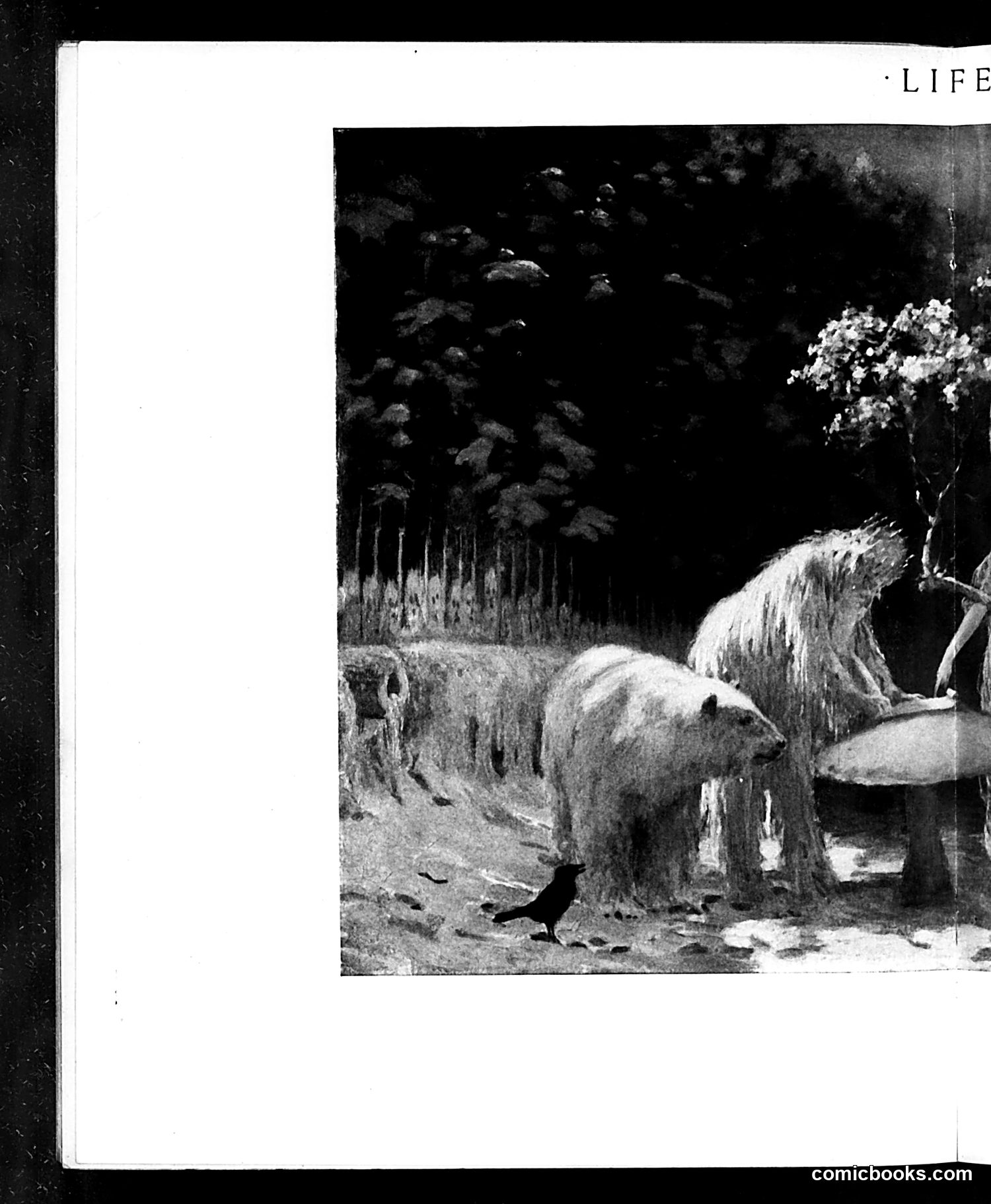
This illustration depicts an allegorical scene where Winter—personified as a classical female figure holding a staff—surrenders to Spring's arrival. The blooming tree with abundant white flowers overhead symbolizes nature's renewal and the season's transition. Small deer or similar animals in the background suggest the awakening of wildlife. The image employs classical artistic conventions common to early 20th-century Life magazine: personification of seasons, Greco-Roman aesthetic styling, and romantic naturalism. Rather than satirizing a specific political figure or event, this appears to be seasonal artwork celebrating the cyclical triumph of spring over winter—a timeless theme reflecting optimism and natural renewal that would resonate with readers regardless of current events.
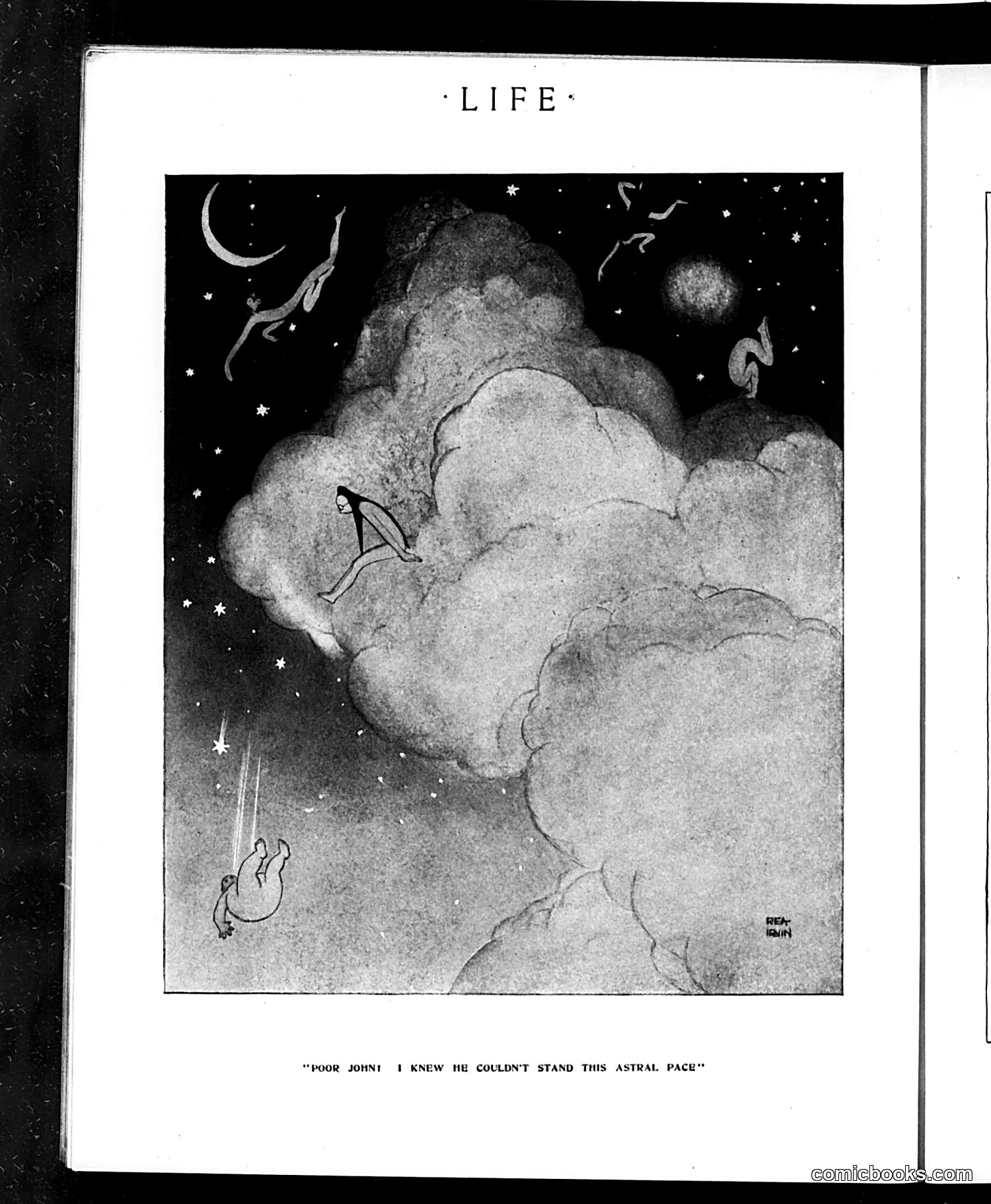
This illustration depicts a figure struggling in outer space among clouds and celestial bodies (moon, stars, planets). The caption reads: "Poor John! I knew he couldn't stand this astral pace." The cartoon appears to satirize someone named John who cannot handle the demands of a fast-paced, high-reaching lifestyle or career trajectory—represented metaphorically as "astral" or cosmic travel. The figure is depicted as overwhelmed, floating helplessly amid the vast expanse. Without additional context about *which* John this references or the publication date, the specific political or social target remains unclear. However, the satire likely mocks an individual's inability to cope with ambitious pursuits or elevated circumstances. The artwork style and "Life" magazine format suggest early-to-mid 20th century American commentary on contemporary figures or social trends.
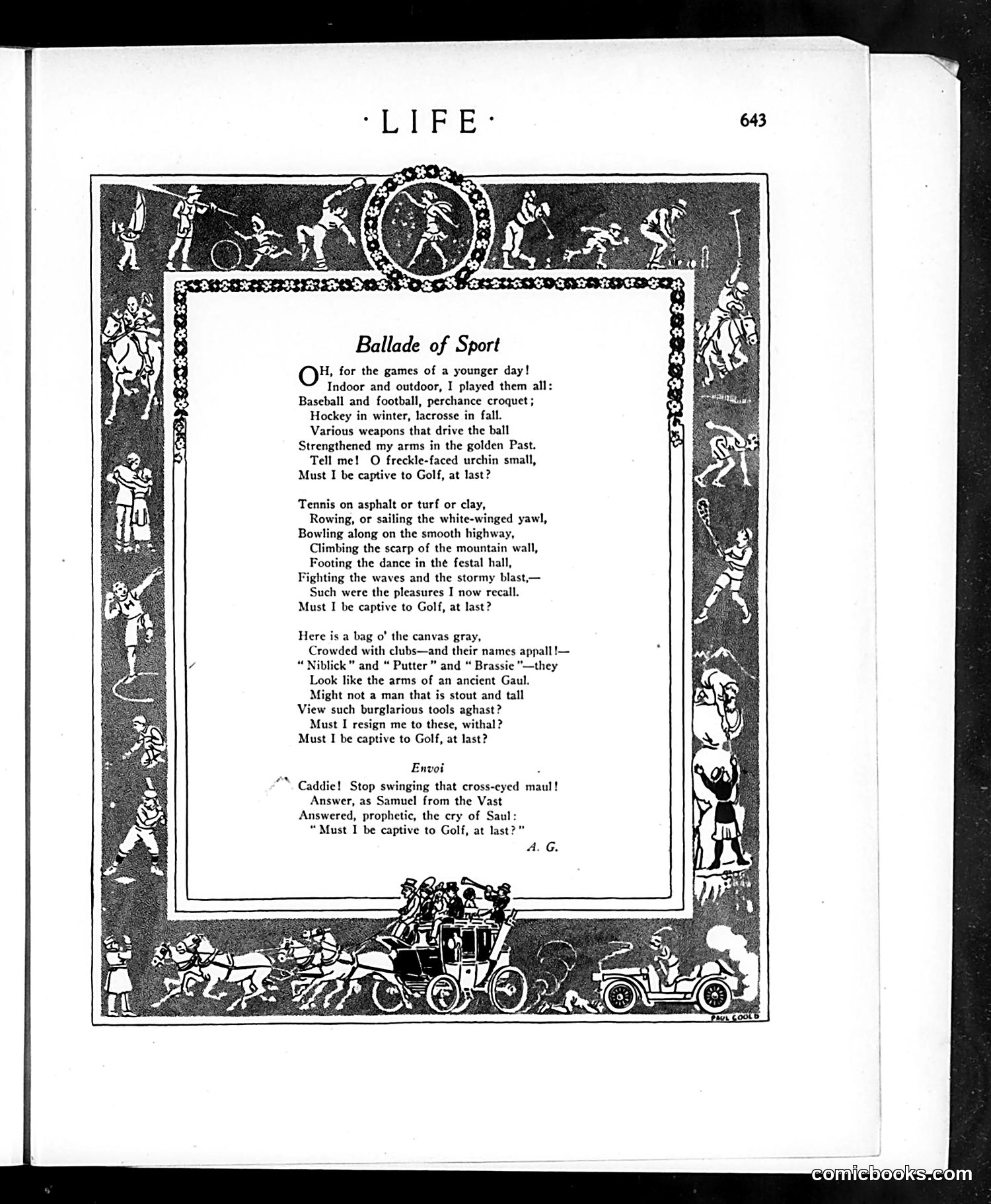
This poem humorously laments golf's dominance in early-20th-century leisure culture. The speaker nostalgically recounts youthful athletic pursuits—baseball, tennis, rowing, dancing, mountain climbing—before resignedly asking: "Must I be captive to Golf, at last?" The satire targets golf's obsessive grip on American society and the speaker's aging generation. The third stanza mocks golf equipment itself, describing clubs with unfamiliar names ("Niblick," "Putter," "Brassie") as resembling ancient weapons, suggesting the sport's strange, quasi-martial formality. The *envoi* (closing stanza) uses biblical allusion—Samuel answering Saul's call—to treat golf addiction almost religiously, as an inescapable fate. The poem gently ridicules both golf's trendiness among the elite and the resigned acceptance of middle-aged men surrendering to its popularity, even when they prefer livelier sports.
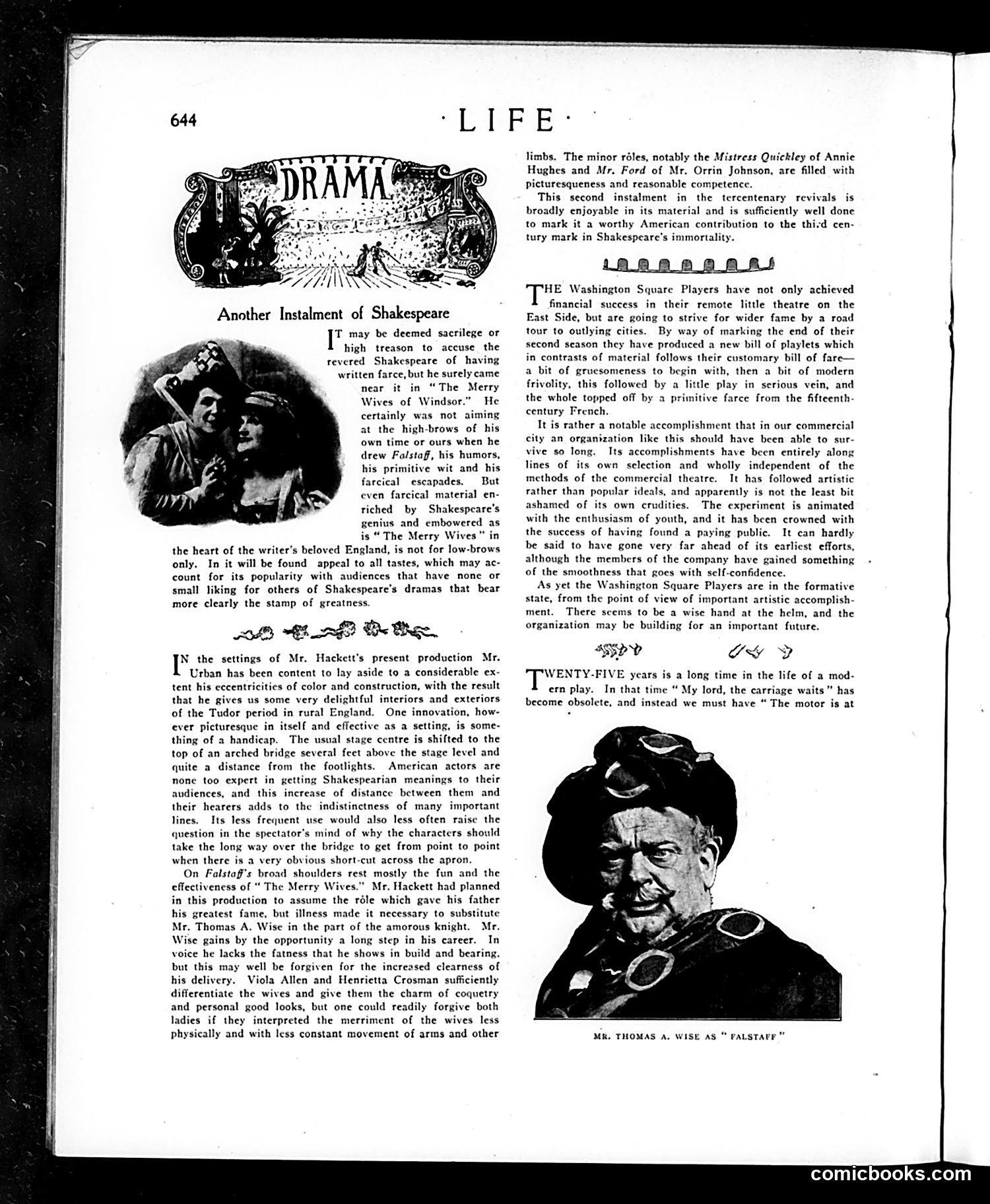
This page reviews a theatrical production of Shakespeare's *The Merry Wives of Windsor*, directed by Mr. Hackett. The critic discusses the play's status as "farce" rather than high art, yet notes its popular appeal across audiences. The review praises the Tudor-period set design by Mr. Urban but criticizes an innovative raised bridge stage that distances actors from audiences, making their dialogue unclear—a problem compounded by American actors' general difficulty conveying Shakespearean meaning. Thomas A. Wise (shown in the photograph as "Falstaff") substituted for the ailing Mr. Hackett in the lead role. The critic praises Wise's clear delivery and notes actresses Viola Allen and Henrietta Crosman as the wives, though finding their physical comedy excessive. The piece frames this as part of "tercentenary revivals"—celebrations of Shakespeare's legacy—and declares it a worthy American theatrical contribution.
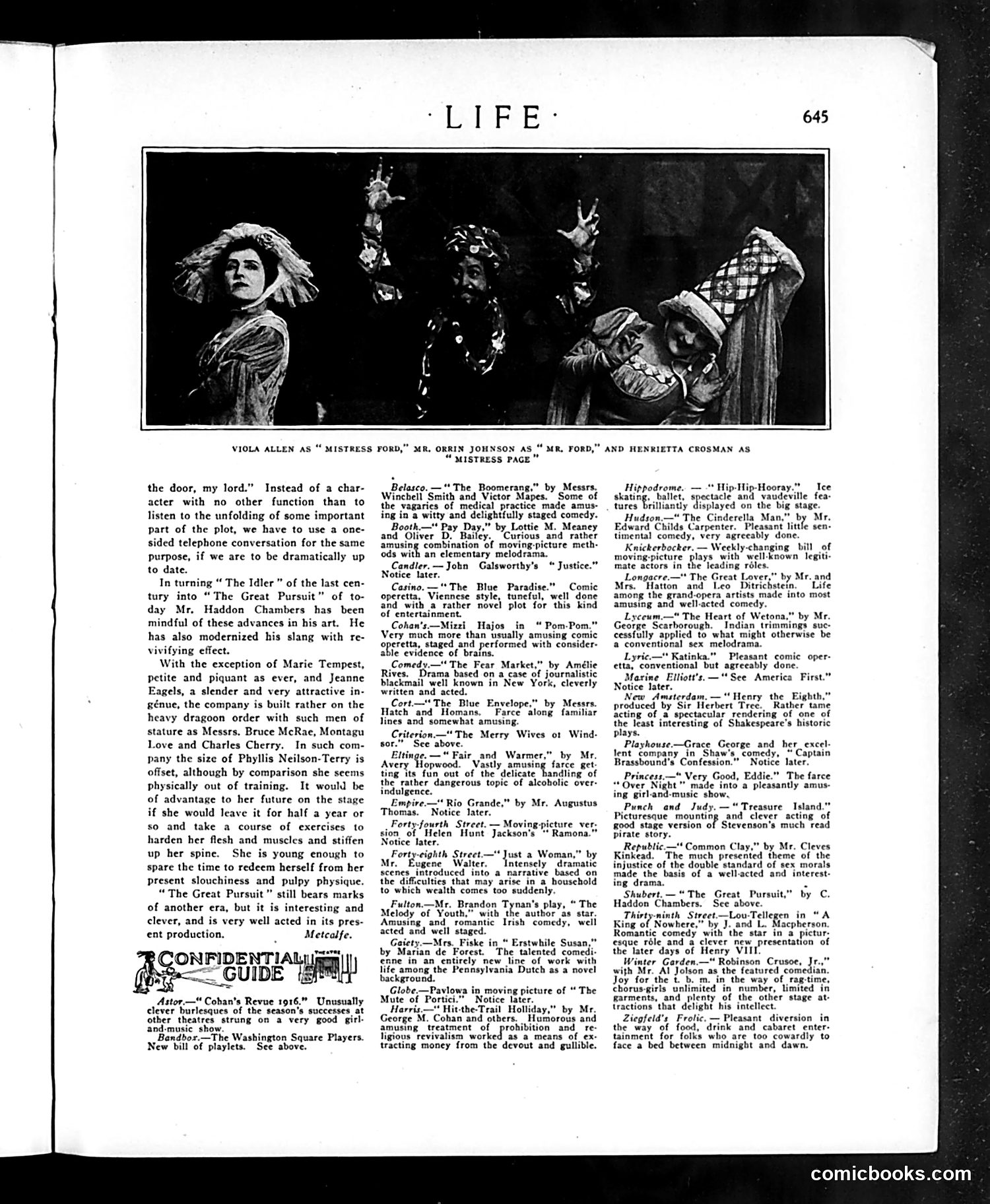
This page reviews a 1916 theatrical production modernizing an 18th-century play called "The Idler." The photograph shows the cast, including established actress Viola Allen as "Mistress Ford." The critic (Metcalfe) praises the script's contemporary updates—particularly its use of telephone conversations to advance plot, rather than relying on listening characters. He commends the wit and staging. However, he critiques the physical conditioning of young actress Phyllis Neilson-Terry, suggesting she appears "out of training" and recommends she take a break for exercise to improve her "slouchiness and pulpy physique." This reflects early 20th-century expectations that performers maintain specific physical standards. The surrounding text lists other current Broadway productions, indicating this is entertainment journalism for theatergoers seeking recommendations.
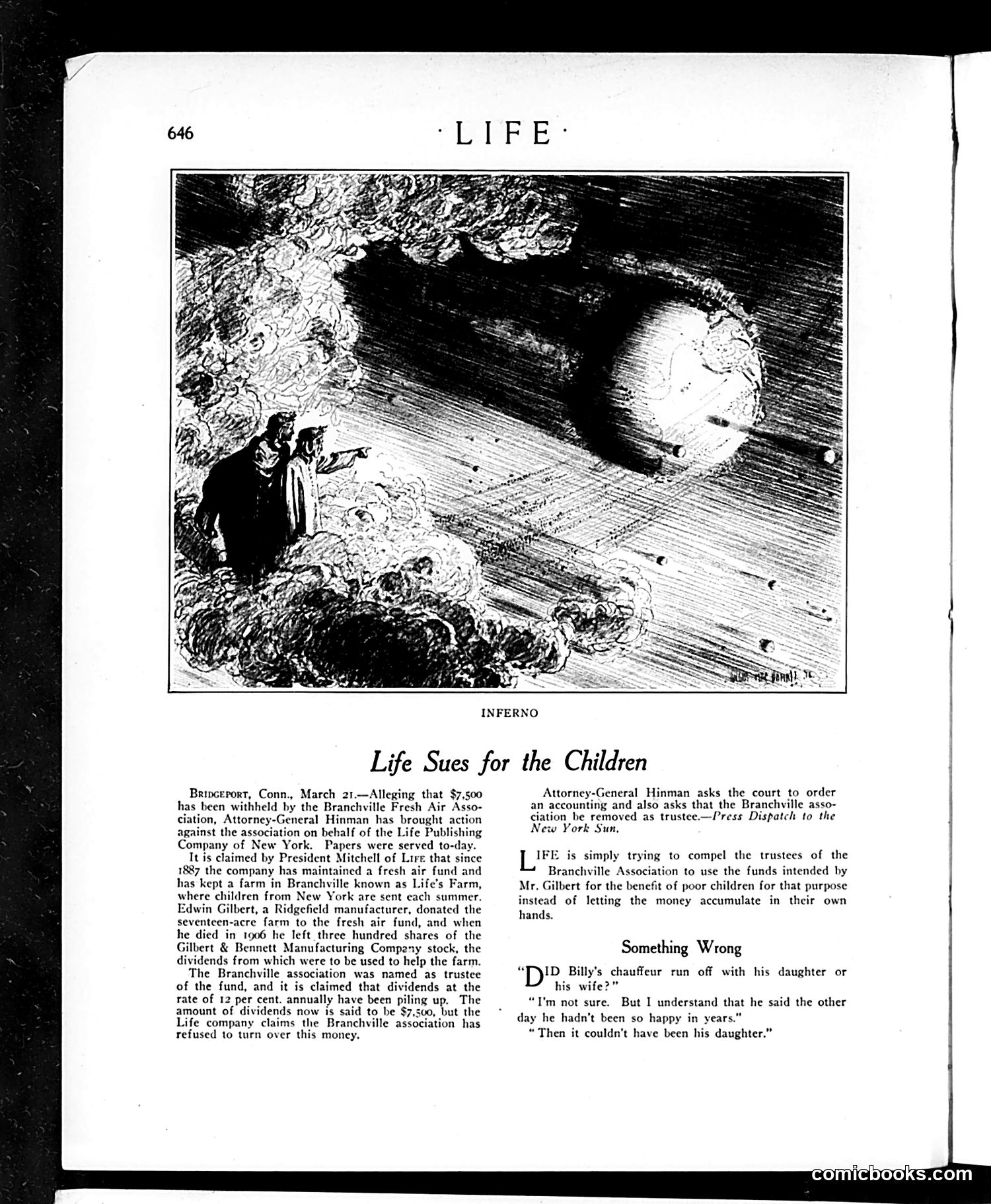
This page contains a lawsuit story and a brief joke. The main article reports that *Life* magazine's publishing company is suing the Branchville Fresh Air Association in Connecticut. Since 1887, *Life* had maintained a charitable fund sending poor New York children to a farm each summer. When a manufacturer donated the farm and stock dividends (worth $7,500 by 1912), the Branchville association became trustee but allegedly refused to distribute the accumulated money for its intended charitable purpose—helping poor children. The Attorney-General is seeking to force an accounting and remove the association as trustee. The accompanying illustration titled "INFERNO" likely depicts poverty or suffering children, visualizing the charitable cause at stake. Below is an unrelated joke about a chauffeur running away with someone's family member, where the punchline suggests the chauffeur's happiness proves it couldn't have been his employer's daughter (implying daughters are less desirable than wives).
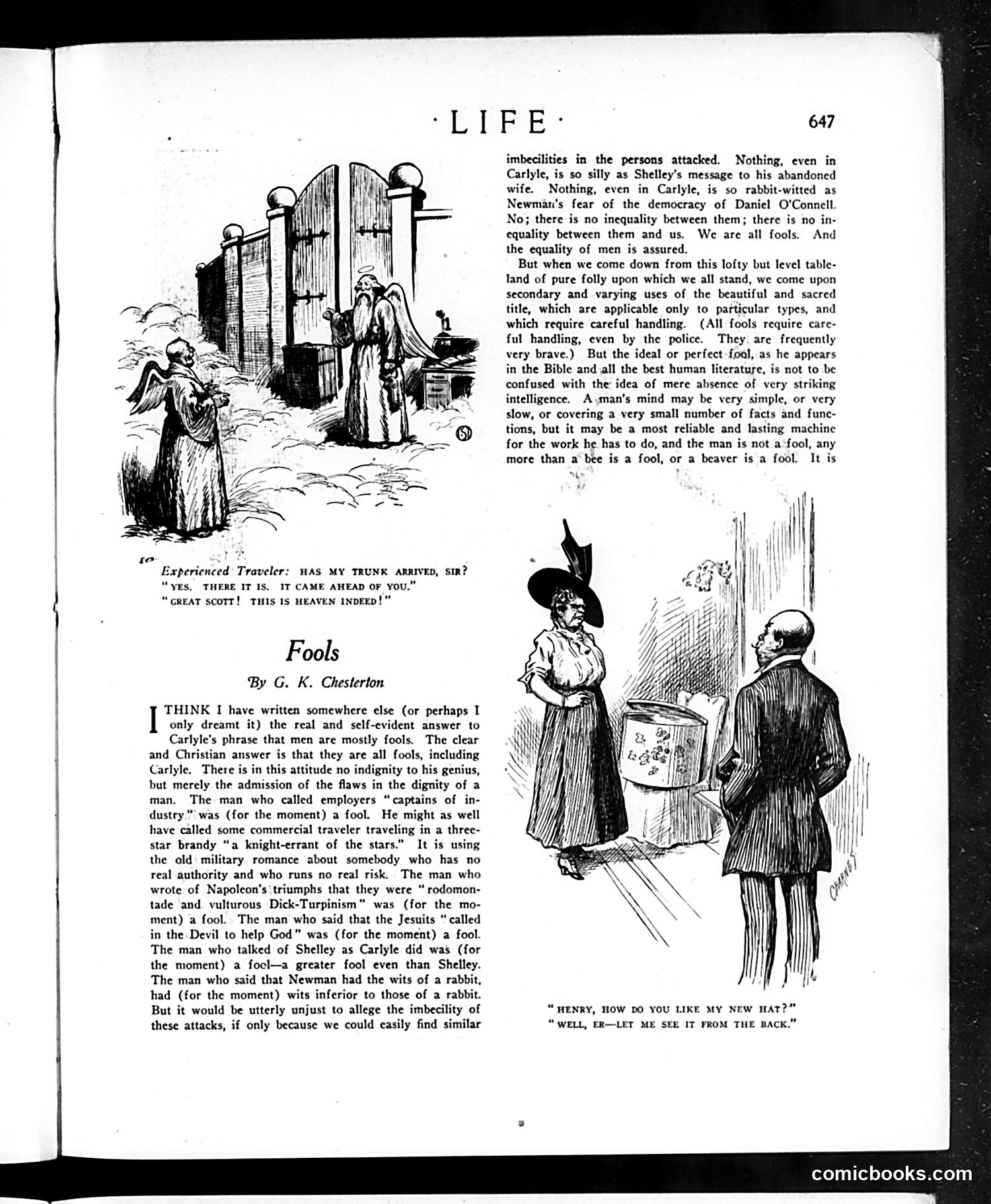
This is G.K. Chesterton's essay "Fools," arguing that all humans are fools in some way—a Christian humility—but this doesn't mean lacking intelligence or reliability. He defends figures like Shelley and Newman against harsh criticism by Carlyle, asserting that calling them fools reveals the *critic's* momentary foolishness, not permanent lack of wit. The cartoons illustrate foolishness through everyday situations: a traveler relieved his trunk arrived ahead (absurd luck), and Henry asking his wife to view his hat from behind (suggesting he can't properly judge it himself). These light sketches contrast with Chesterton's serious philosophical point—that we're all occasionally foolish, yet this universal condition shouldn't diminish respect for capable minds. The piece references 19th-century literary figures (Carlyle, Shelley, Newman, Daniel O'Connell) in an intellectual debate about character and judgment now largely forgotten.
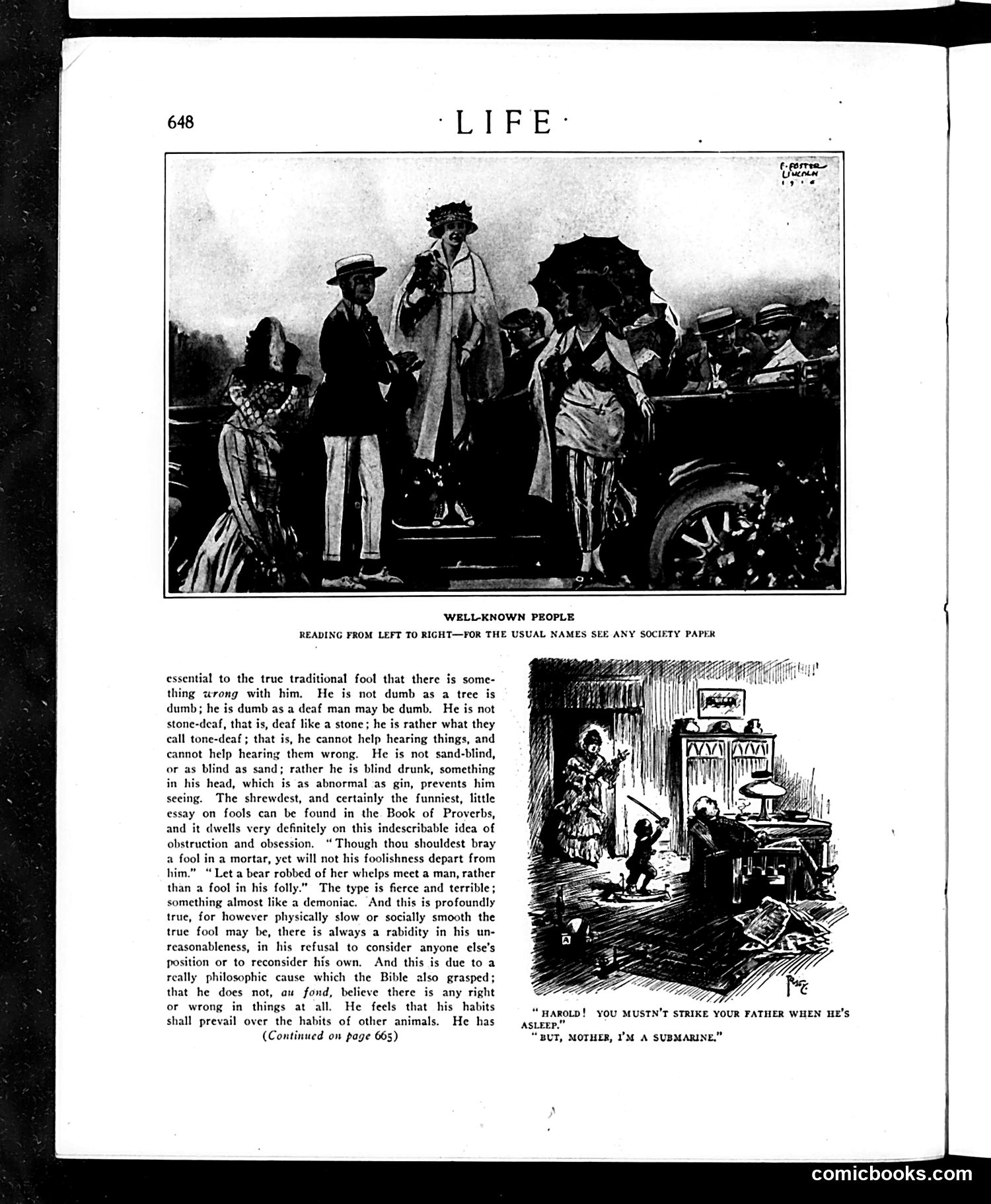
**Top Image:** "Well-Known People" shows a crowd scene with figures in period dress gathered around what appears to be a public event or announcement. The caption directs readers to "society papers" for identification, suggesting these are recognizable public figures of the era whose names Life's readers would know from society journalism. **Bottom Cartoon:** A domestic humor sketch depicting a child striking his father, with the mother scolding "Harold! You mustn't strike your father when he's asleep." The child responds, "But, mother, I'm a submarine." This is WWI-era satire—the joke hinges on the submarine as a weapon, with the child role-playing military violence. It satirizes both childhood war-play enthusiasm and perhaps the anxieties of wartime society. **Text Column:** A philosophical essay on foolishness, distinguishing between stupidity and a deeper inability to recognize others' perspectives—arguing fools are obstinate and amoral rather than merely slow-witted.
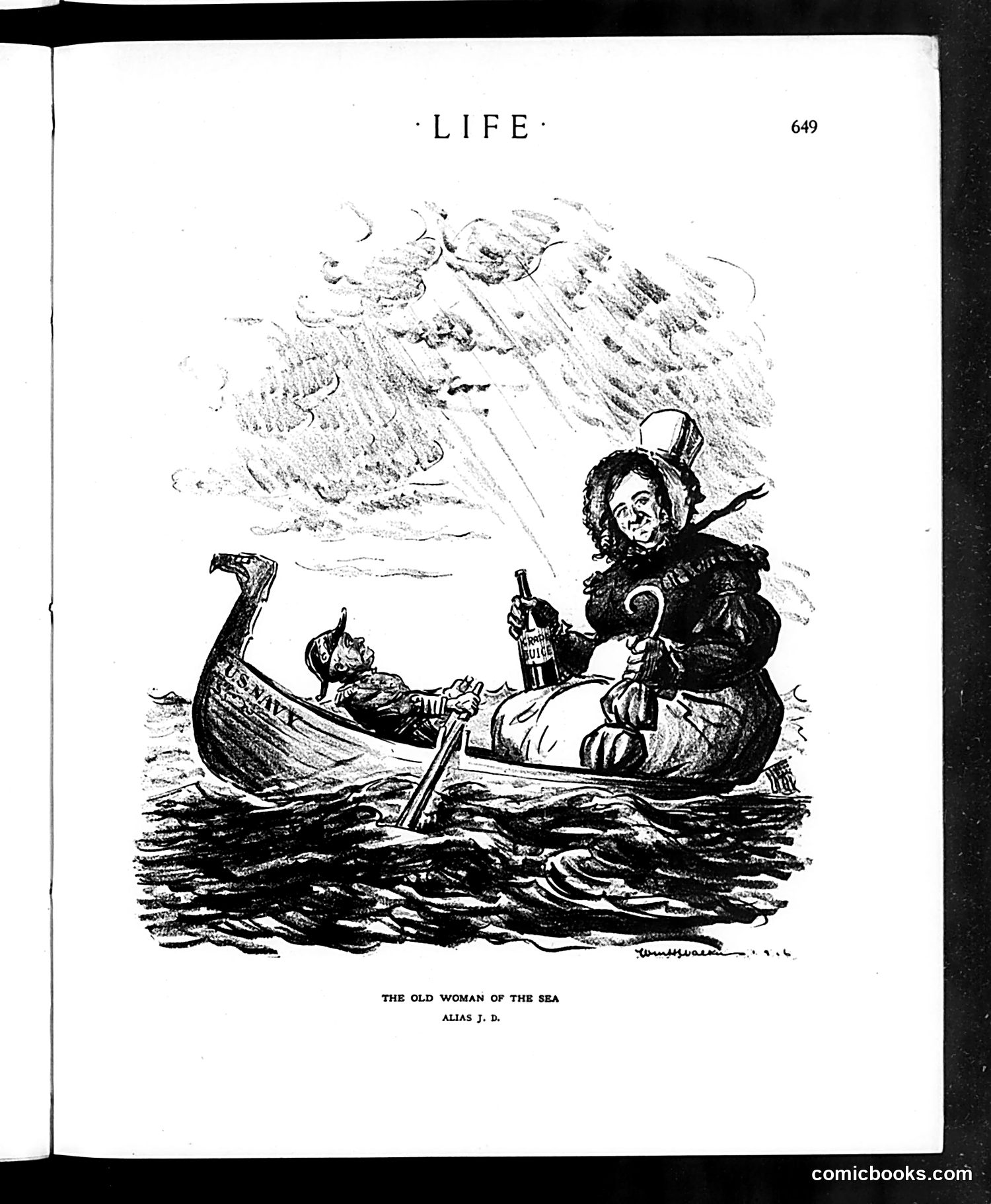
This appears to be a political cartoon depicting "The Old Woman of the Sea," identified as "J.D." (likely J. Pierpont Morgan or similar prominent businessman of the era, though the exact figure is unclear from the initials alone). The illustration shows an elderly woman in a gondola on water, styled as a caricature of wealth and excess. She holds what appears to be a bottle labeled "BUTLER" and displays exaggerated features typical of Gilded Age satire. The cartoon likely references the nursery rhyme "The Old Woman Who Lived in a Shoe," using that familiar reference to mock a wealthy industrialist—suggesting this figure controls vast resources ("the sea") and lives extravagantly. The satirical point appears to criticize monopolistic power or excessive wealth accumulation by a prominent capitalist figure of the period.
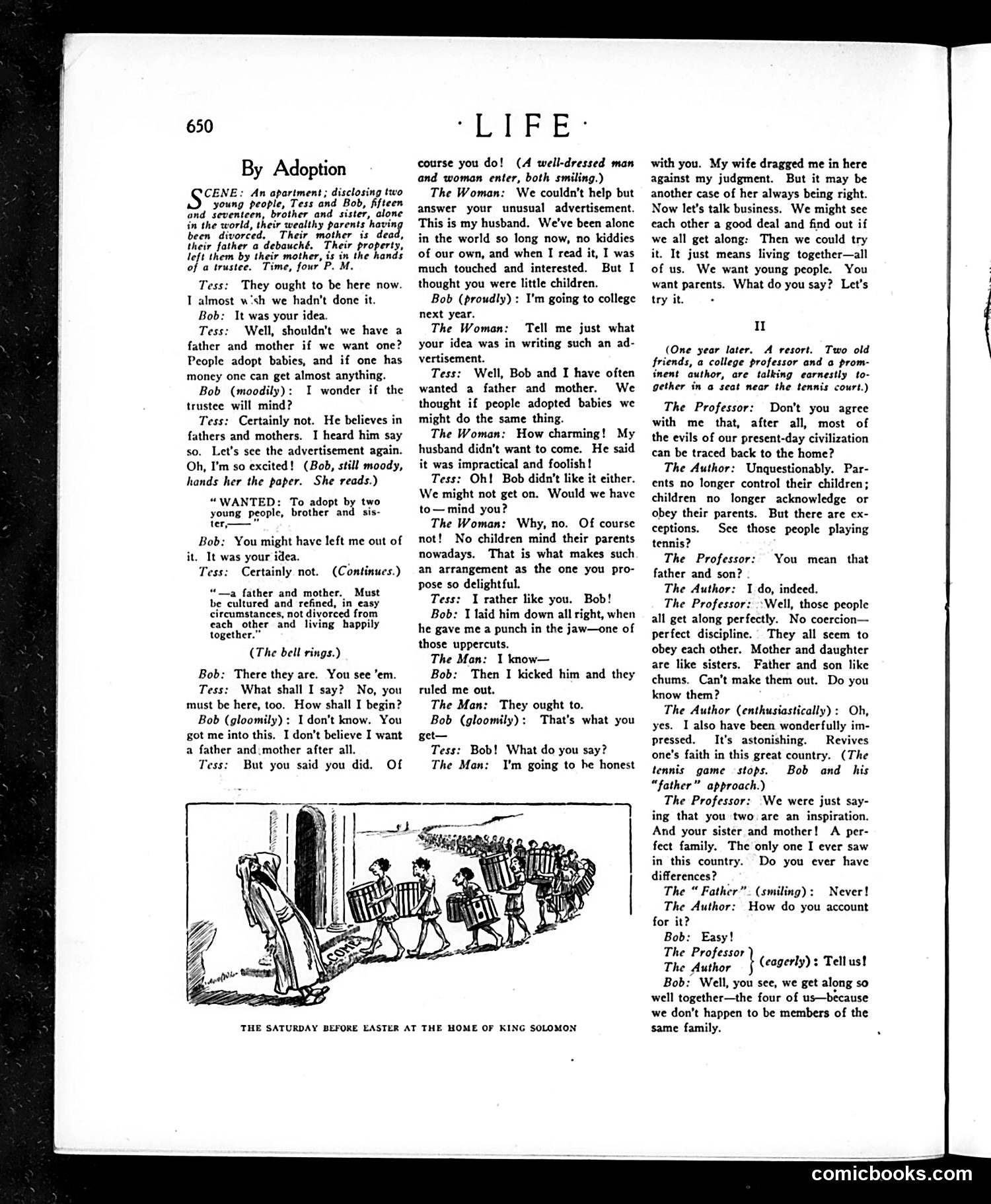
This is a satirical two-part dialogue about unconventional family formation. Two orphaned siblings, Tess and Bob, place a newspaper advertisement seeking to *adopt* parents—reversing the normal adoption process. They interview a cultured couple seeking children, and the arrangement succeeds. The satire targets early 20th-century anxieties about family breakdown. The dialogue emphasizes that modern children don't obey parents ("No children mind their parents nowadays"), divorced parents are common, and traditional family structures are collapsing. The second part (one year later) reveals the joke's punchline: the Professor considers this blended family a perfect exception to societal decline—proof that modern families *can* work. The satire mocks both the assumption that families are failing *and* the naive hope that unconventional arrangements might fix it. The illustration shows the foursome approaching—suggesting the experiment actually worked, which is the surprising, somewhat absurd resolution.
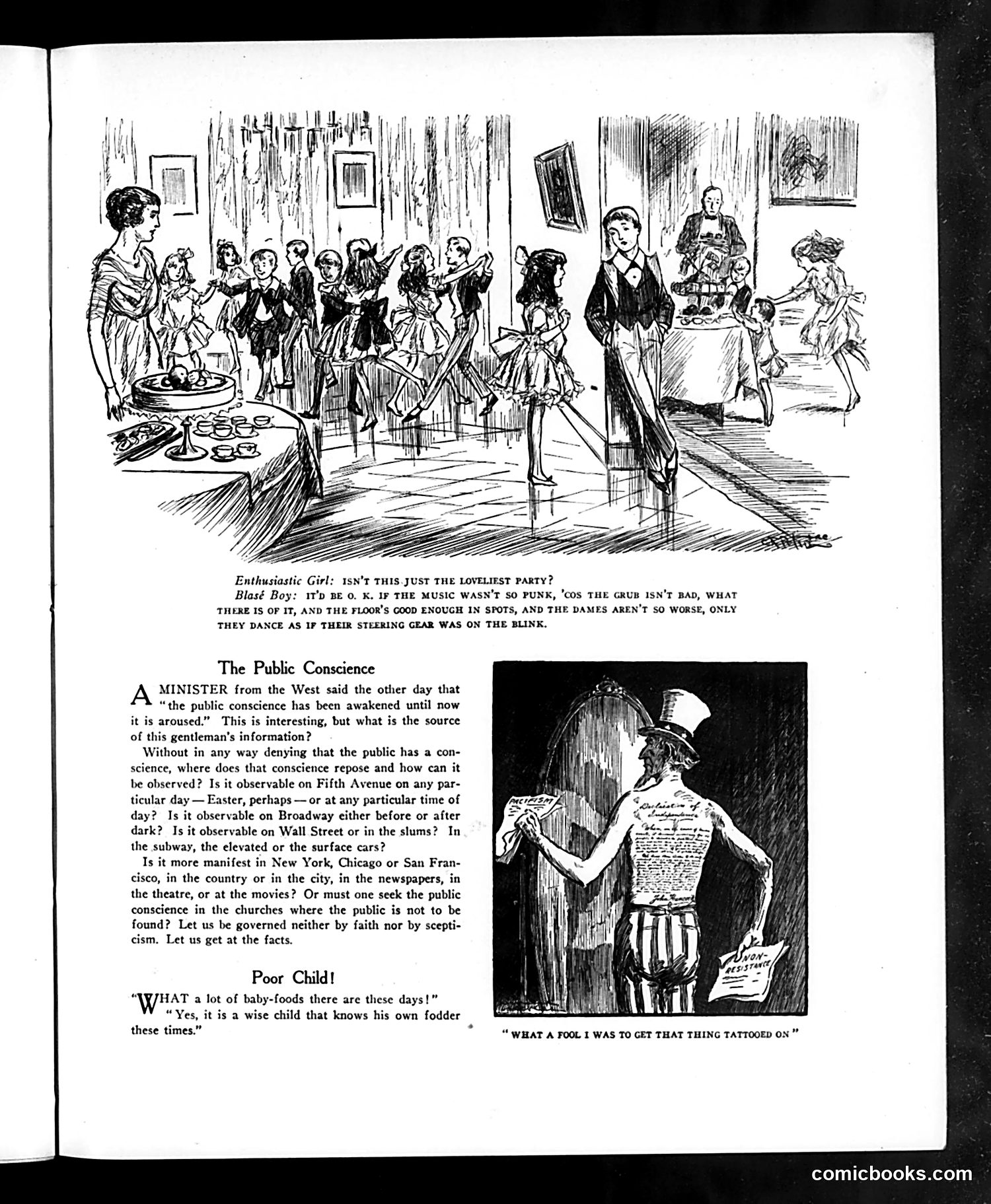
**Top Cartoon:** A social satire on youth manners. A young woman enthusiastically praises a party, while a jaded boy responds with exaggerated complaints about every detail—the music is "punk" (bad), the food mediocre, the dancing clumsy (their "steering gear" references automobiles, a modern joke). The satire targets the affected cynicism and affected world-weariness of young people trying to appear sophisticated. **"The Public Conscience" Essay:** A philosophical critique questioning a Western politician's claim that "the public conscience has been awakened." The author sardonically asks: where exactly is this conscience observable? On Fifth Avenue? Broadway? In churches people don't attend? The piece mocks vague moral pronouncements unsupported by observable evidence, arguing for facts over sentimentality. **"Poor Child!" Joke:** A pun on "fodder" (animal feed) versus "father." Parents complain about the proliferation of commercial baby foods; a child quips that a wise child knows his own "fodder"—mixing the homophone with paternal reference.
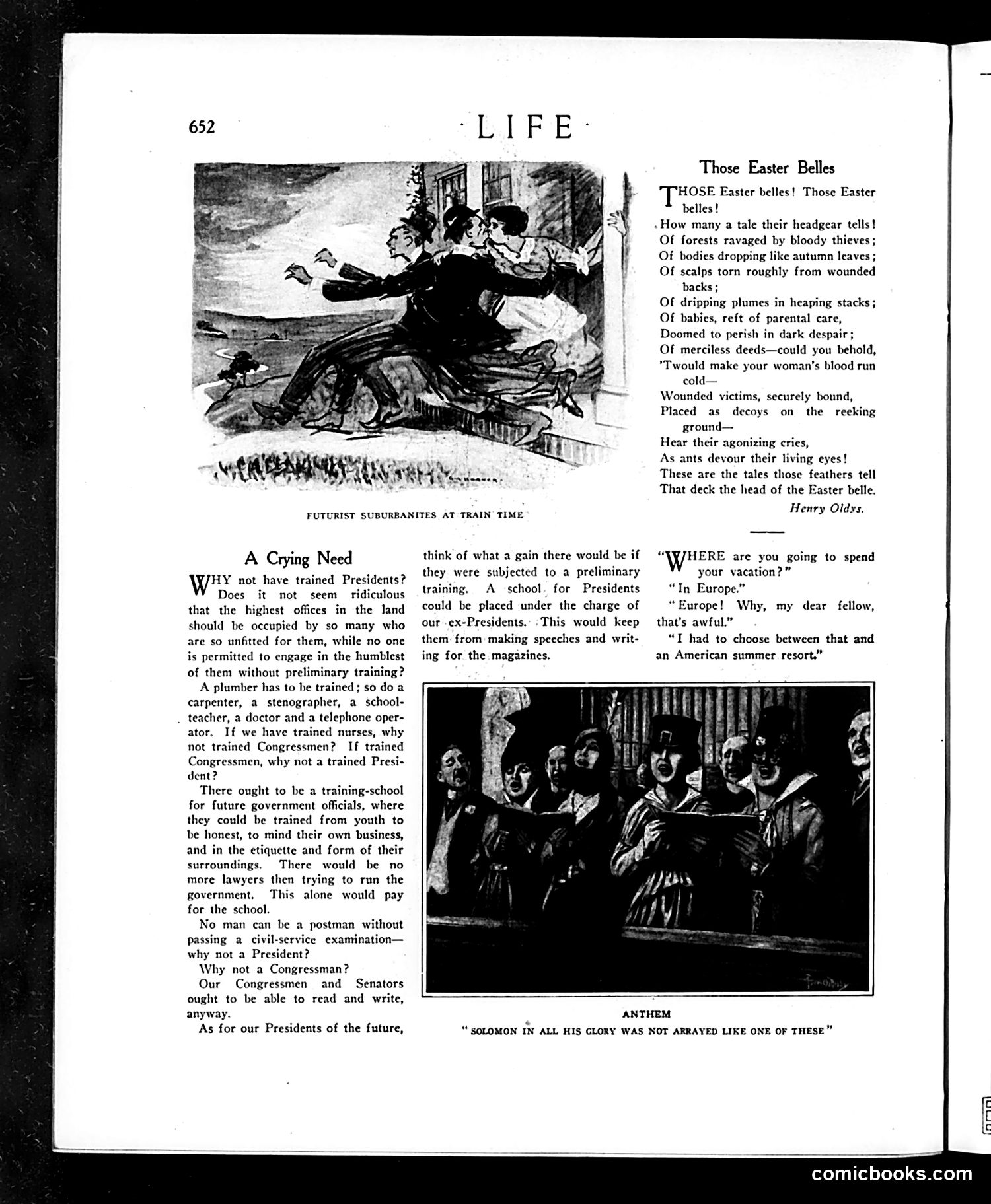
**"A Crying Need"** argues satirically that government officials should require training like other professions. The piece criticizes unqualified politicians occupying high office, suggesting a training school for Presidents run by ex-Presidents would prevent them from making speeches and writing for magazines—a jab at their self-promotion. **"Those Easter Belles"** is a darker satire by Henry Oldys condemning the fashion trend of wearing feathered hats. The poem details the violence behind decorative plumes: killed birds, wounded victims, scalped bodies, and orphaned babies—suggesting wealthy women's vanity comes at brutal cost. The implication appears to reference both wildlife slaughter and possible colonial/imperial violence. **The "Anthem" cartoon** shows elegantly dressed women, captioned with Solomon's biblical line about glory and raiment, sarcastically equating fashionable Easter bonnets with biblical splendor—mocking excess and materialism. These pieces mock American politicians' incompetence and women's frivolous fashion choices as socially irresponsible.
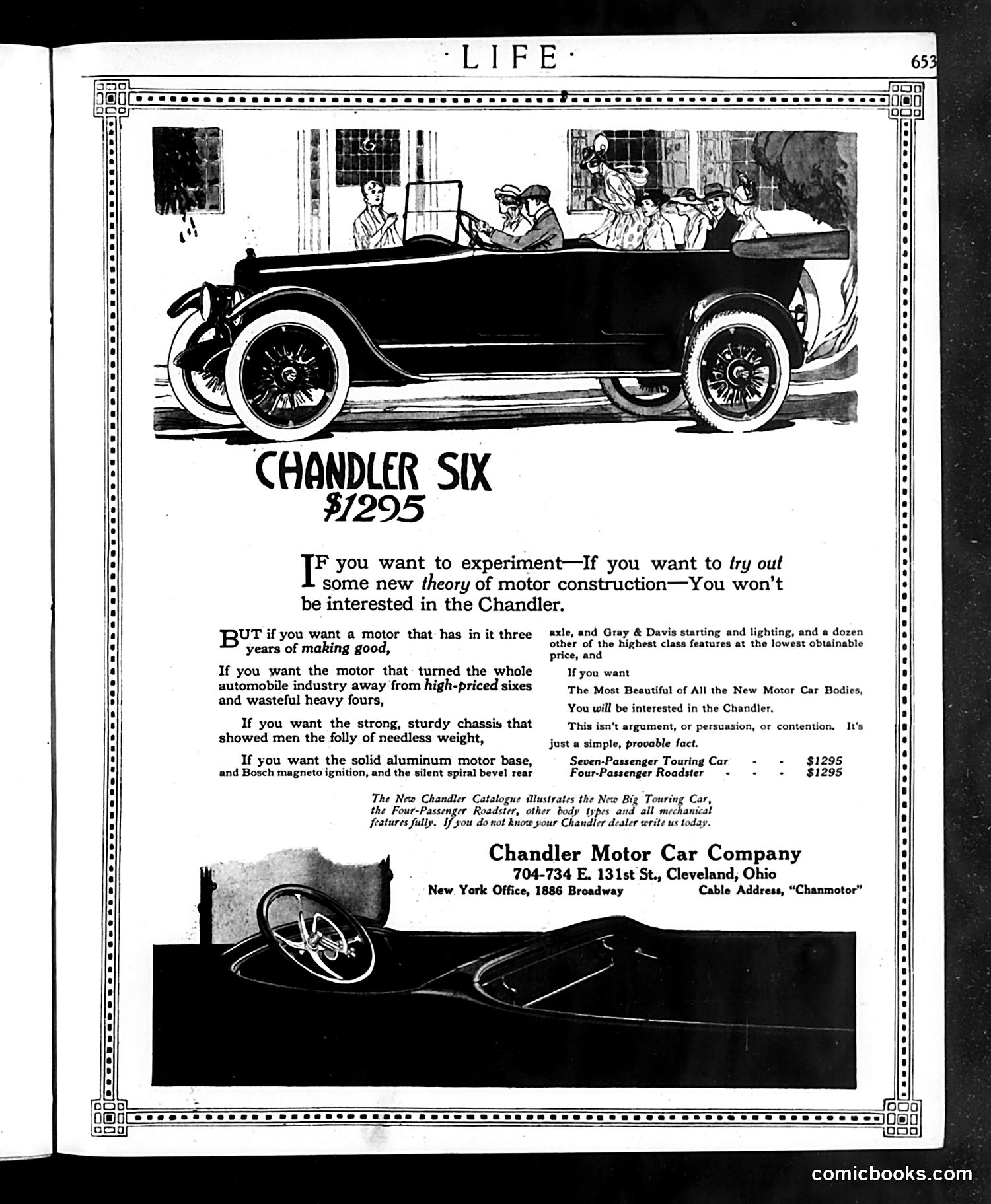
This is a **motor car advertisement**, not political satire. It promotes the Chandler Six automobile at $1,295, positioned as a practical alternative to experimental or luxury vehicles. The ad's rhetorical strategy contrasts two buyer types: those seeking to "experiment" with new motor theories (implicitly dismissing them as impractical) versus those wanting proven, reliable engineering. The copy emphasizes three years of manufacturing success, solid construction features (aluminum motor base, Bosch magneto ignition), and "the highest class features at the lowest obtainable price." The illustration shows the touring car with passengers; below are detail drawings of the steering wheel and chassis. The advertisement's implicit message reflects **1920s automotive marketing**: positioning mid-range cars as sensible compromises between experimental luxury and cheap economy models. The tone dismisses both extremes, appealing to practical middle-class buyers seeking established quality over novelty or status. This represents standard commercial advertising rather than satirical commentary.

This page contains **short humorous anecdotes** rather than political cartoons. The jokes satirize contemporary social attitudes: 1. **"Aut Scissors Aut Nullus"**: Jewish immigrant humor about a father teaching his son that marriage to a wealthy woman is "almost as good as a failure"—mocking both business cynicism and ethnic stereotypes common in early 20th-century comedy. 2. **"What's in a Name?"**: Mocks nouveau-riche pretension, where a wealthy family (the Byllingtons) confuses "vocabulary" with "escritoire" (writing desk), satirizing materialistic social climbers. 3. **"The Intelligent Cat"**: A cat sits atop a greenhouse to defy the gardener—simple absurdist humor about pet mischief. 4. **Military joke**: References the Anzac (Australian/New Zealand) forces in WWI, with dark humor about shelling Turkish soldiers. The page is primarily **advertising** for Yellowstone National Park via the Northern Pacific Railway, featuring a geyser photograph.

This page is primarily a **product advertisement**, not political satire. It advertises Thermoid Hydraulic Compressed Brake Lining, manufactured by the Thermoid Rubber Company in Trenton, New Jersey. The illustration depicts a dangerous scenario: a speeding automobile nearly collides with cattle on a rural road, with a farmer visible. The advertisement's headline—"Bad for the Cows, You Say?"—sarcastically acknowledges the hazard, then pivots to warn drivers that inadequate brake lining could prove fatal. The ad's core argument: drivers carelessly purchase cheap brake lining, which fails in emergencies ("when they're in a pinch—in danger"). The text emphasizes Thermoid's superior friction properties and durability, positioning it as the responsible choice that will "grip and hold your car." This reflects early automotive safety concerns when braking reliability was genuinely life-threatening. The ad uses fear and guilt (facing "a farmers' jury" if you killed livestock) to motivate purchasing decisions—a common advertising tactic of the era.
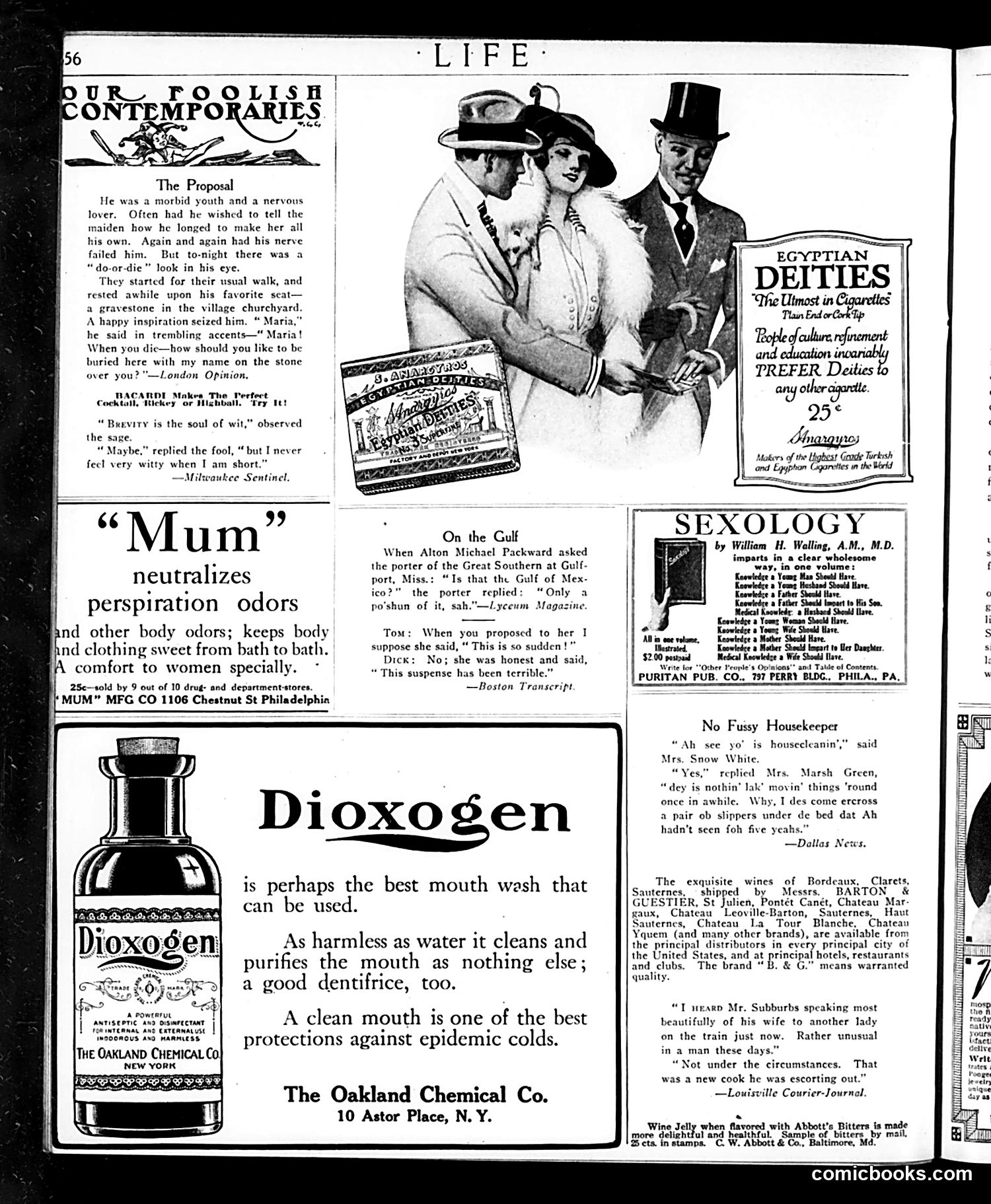
This page consists primarily of **advertisements and brief humorous anecdotes** rather than political cartoons. The main content includes: **"The Proposal"** — A comedic short story about an awkward young man who proposes to his girlfriend at a gravestone, asking if she'd like to be buried with his name on the stone. It's dark humor about romantic nervousness. **Other brief jokes** satirize social conventions: a porter's dialect humor about the Gulf of Mexico, exchanges about proposing, and domestic life observations (a housekeeper finding old slippers). **Advertisements dominate** — products like "Mum" deodorant, Dioxogen mouthwash, Bacardi rum, Egyptian Deities cigarettes, and a "Sexology" book emphasize consumer goods and changing social attitudes about hygiene and "modern" knowledge. The page reflects early 20th-century American humor: gentle, domestic comedy; class-based dialect jokes; and emerging consumer culture aimed at middle-class readers concerned with social propriety and personal grooming.
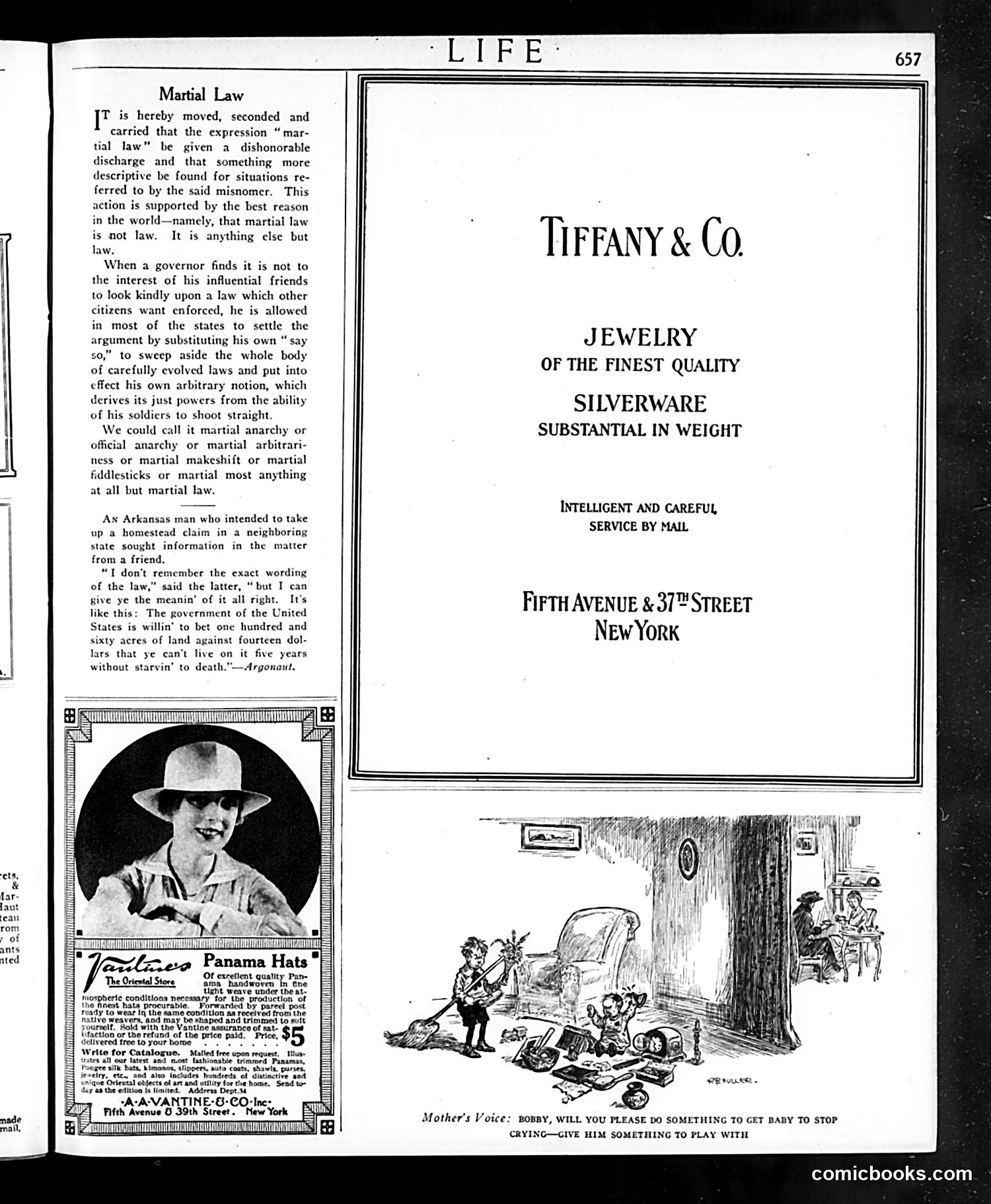
**Main Editorial Content:** The left column presents a scathing critique of "martial law," arguing it isn't law at all but rather arbitrary governmental power—governors suspending legal systems to favor influential friends. The author proposes renaming it "martial anarchy" or "martial fiddlesticks." A humorous sidebar anecdote follows: an Arkansas man learns homestead law means the government bets 160 acres you *can't* survive five years without starving. **The Cartoon:** The bottom illustration shows a mother desperately asking her husband Bobby to distract their crying baby. The visual humor stems from the irony of domestic chaos—the husband is surrounded by toys and possessions yet apparently helpless to console the child, satirizing male incompetence at childcare or parenting. **Advertisements:** The page includes luxury brand ads (Tiffany & Co. jewelry, A. A. Valentine Panama Hats), typical of Life's upscale readership. **Overall Theme:** This page juxtaposes serious political satire about governmental overreach with lighthearted domestic humor and aspirational advertising—characteristic of Life's mix of intellectual critique and popular culture.
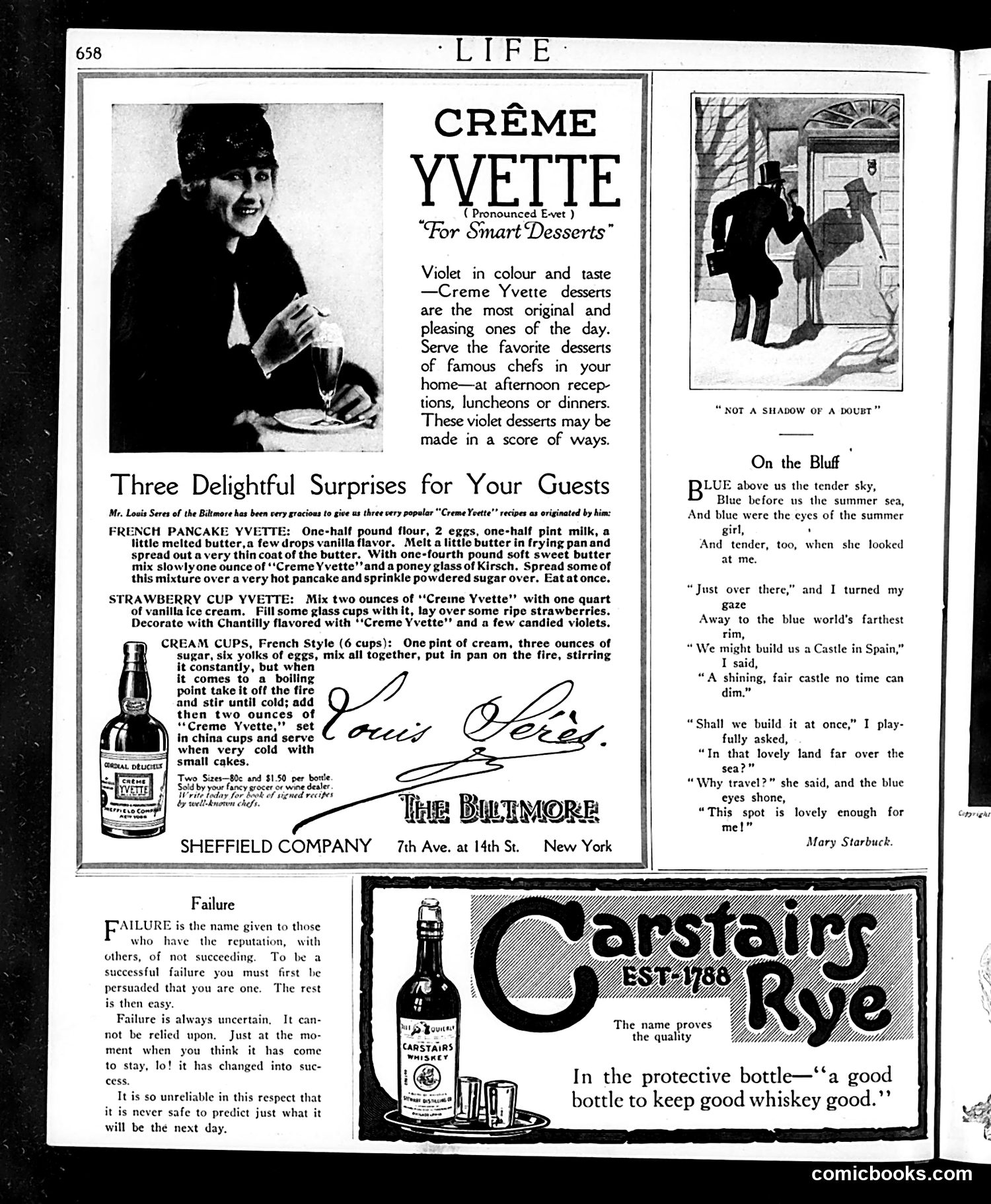
This page is primarily **advertising**, not satire or political commentary. It contains three distinct advertisements: 1. **Crème Yvette liqueur** (top): Promotes a violet-colored dessert liqueur with recipes attributed to Louis Seres of the Biltmore Hotel. It appeals to wealthy hosts serving "smart" afternoon receptions and dinners—aspirational content for upscale entertaining. 2. **"Failure" essay** (bottom left): A philosophical advertisement disguised as editorial content, likely promoting Carstairs whiskey. The text plays on paradox: failure is unreliable because it unpredictably transforms into success. 3. **Carstairs Rye whiskey** (bottom right): Uses the tagline "a good bottle to keep good whiskey good," emphasizing product quality and proper storage. The page also includes a romantic poem, "On the Bluff," about a couple contemplating building a castle in Spain. This editorial content fills space between advertisements. The overall tone reflects 1920s luxury marketing aimed at affluent readers.
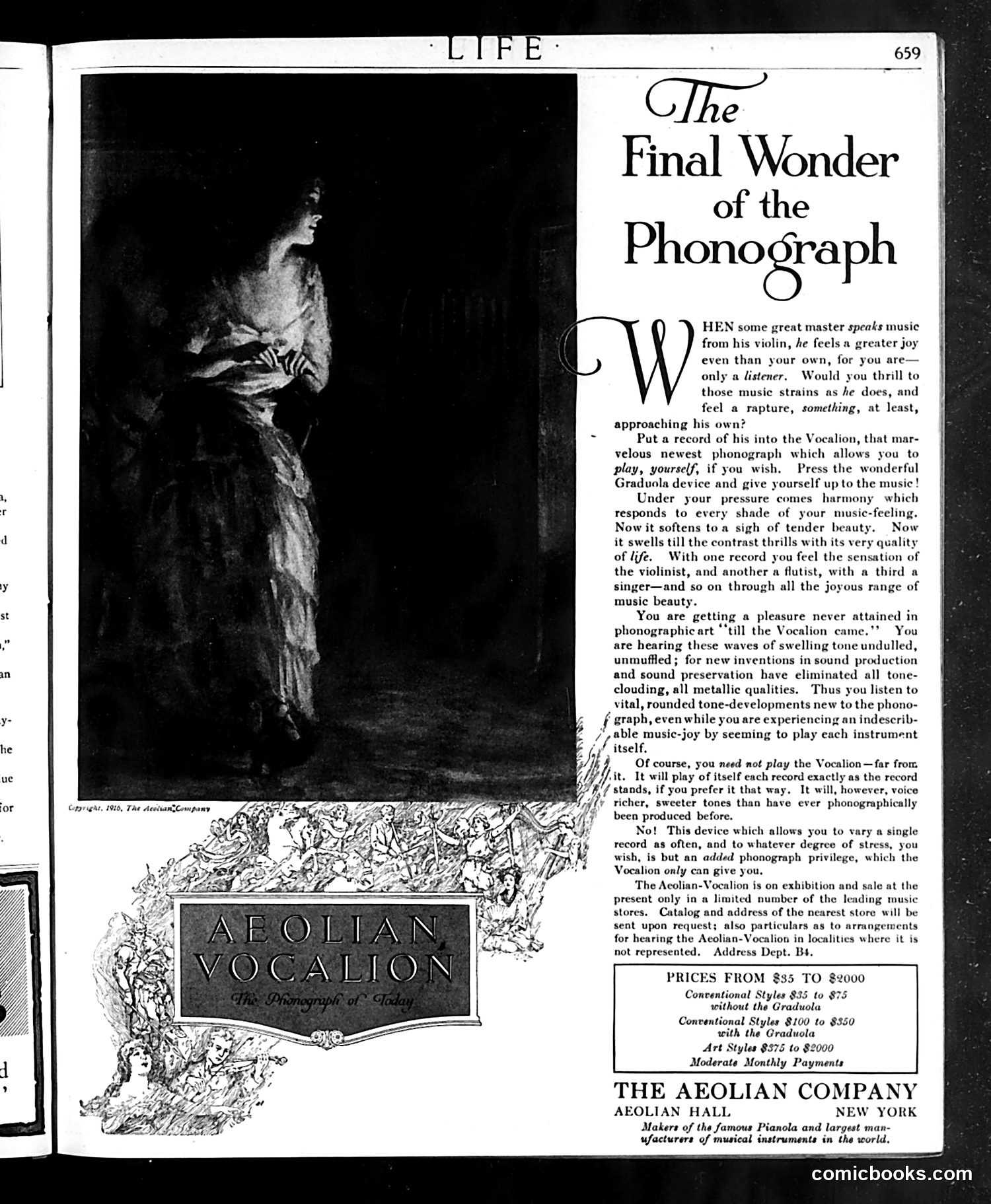
This page is primarily a **product advertisement**, not political satire. It promotes the Aeolian Vocalion phonograph, marketed as a revolutionary device that lets listeners actively participate in music rather than passively hear it. The image shows a woman in classical dress holding a violin, visually linking the phonograph to live musical performance. The ad's central pitch: the Vocalion's "Graduola device" allows users to control dynamics and expression—adjusting volume, softness, and intensity—to simulate the experience of performing music themselves. For modern readers, this reflects early-20th-century phonograph marketing's emphasis on **fidelity and interactivity**. The language ("vital, rounded tone," eliminating "metallic qualities") suggests phonographs were still perceived as tinny and inferior to live music. The ad positions the Vocalion as bridging that gap—offering unprecedented control and realism. Prices ranged from $35 to $2,000, with financing available, indicating this was aspirational consumer technology.
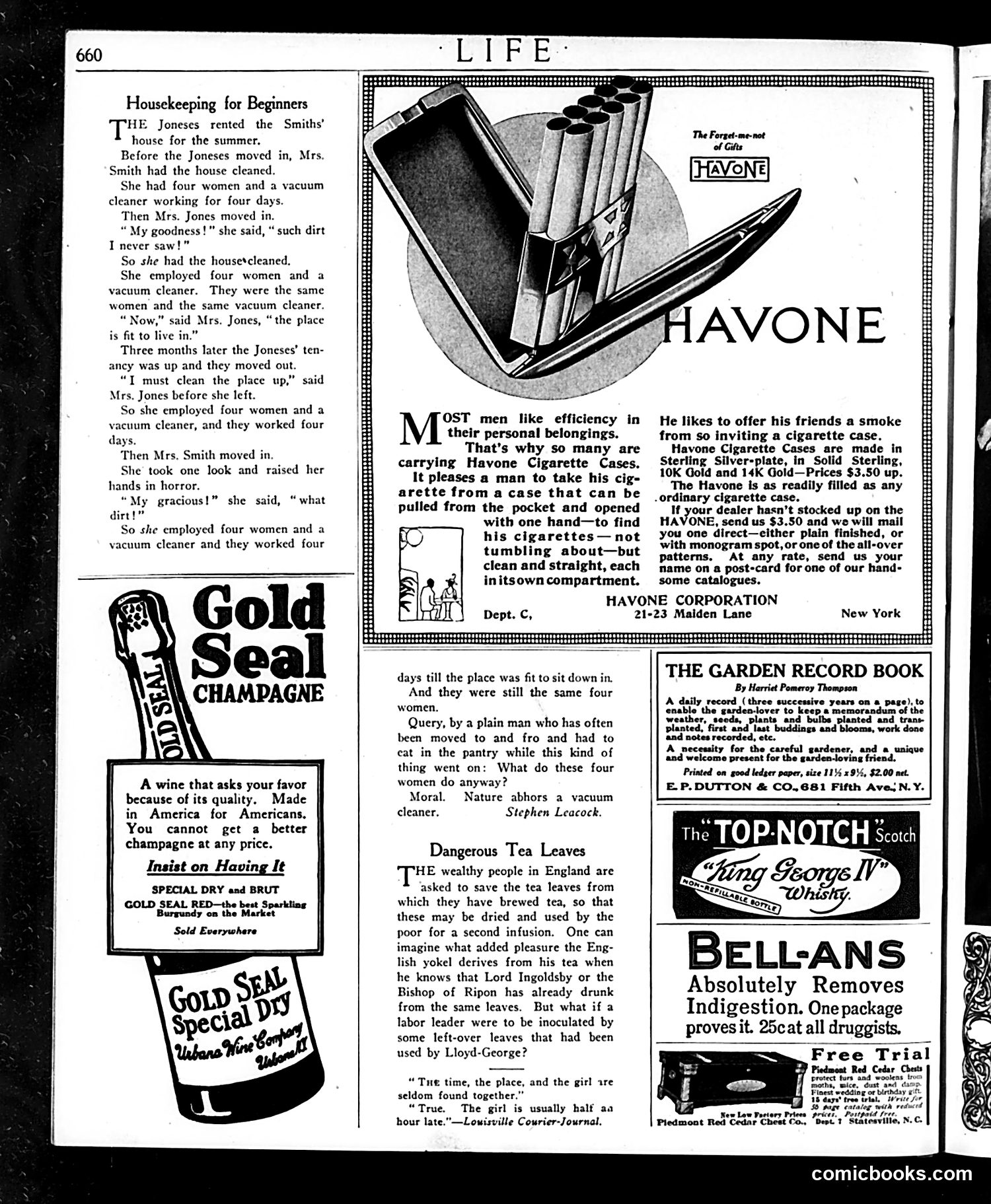
This satirical piece by Stephen Leacock mocks the absurdity of middle-class housekeeping standards. The joke: Mrs. Smith thoroughly cleans before the Joneses arrive, but Mrs. Jones finds it filthy and has it cleaned again with the *same four women and vacuum cleaner*. When Mrs. Jones leaves, Mrs. Smith is horrified by the dirt and cleans once more—again with the same workers. The humor lies in the circular futility: the same workers produce opposite results depending on whose standards judge them. Leacock's moral—"Nature abhors a vacuum cleaner"—is a pun suggesting that constant, obsessive cleaning is pointless. The real satire targets wealthy homeowners' neurotic perfectionism and their assumption that hired help can magically transform spaces, when the "dirt" is often merely a matter of perspective and class prejudice about cleanliness standards.
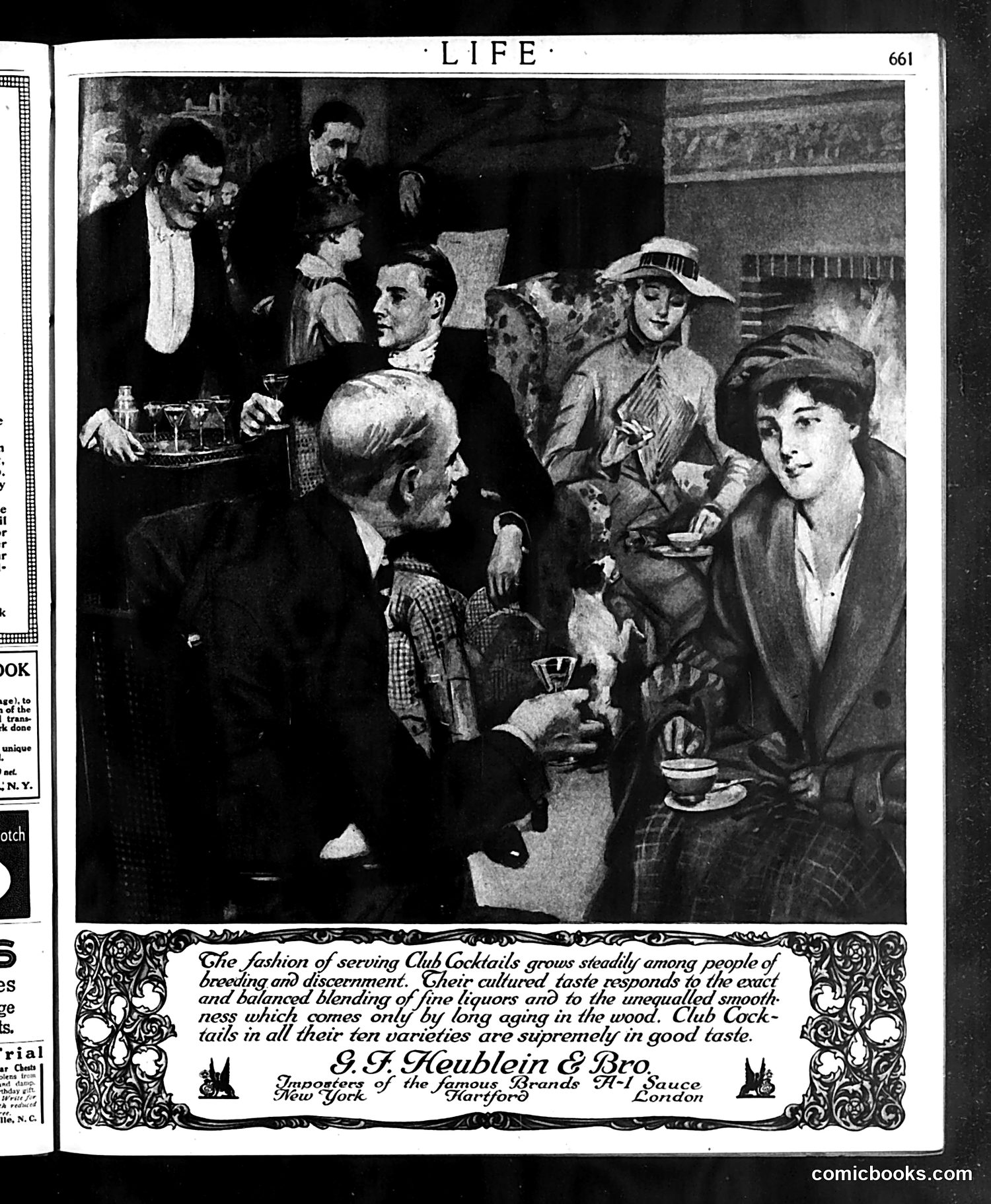
This is primarily an advertisement for Heublein & Bro.'s Club Cocktails, not a political cartoon. The image depicts a social gathering of well-dressed people enjoying cocktails in what appears to be an upscale club setting. The ad copy promotes cocktails as markers of refined taste and social status, targeting "people of breeding and discernment." It emphasizes the "cultured taste" and "good taste" associated with the product—positioning cocktail consumption as a sign of sophistication. The context is Prohibition-era marketing (likely 1920s-early 1930s), when alcohol was legally restricted in America. Heublein sold pre-mixed cocktails and sauces that technically complied with regulations while serving the wealthy clientele who could afford imported products. The ad subtly positions cocktail drinking as an aspirational upper-class practice, exploiting class anxieties about appearing refined.
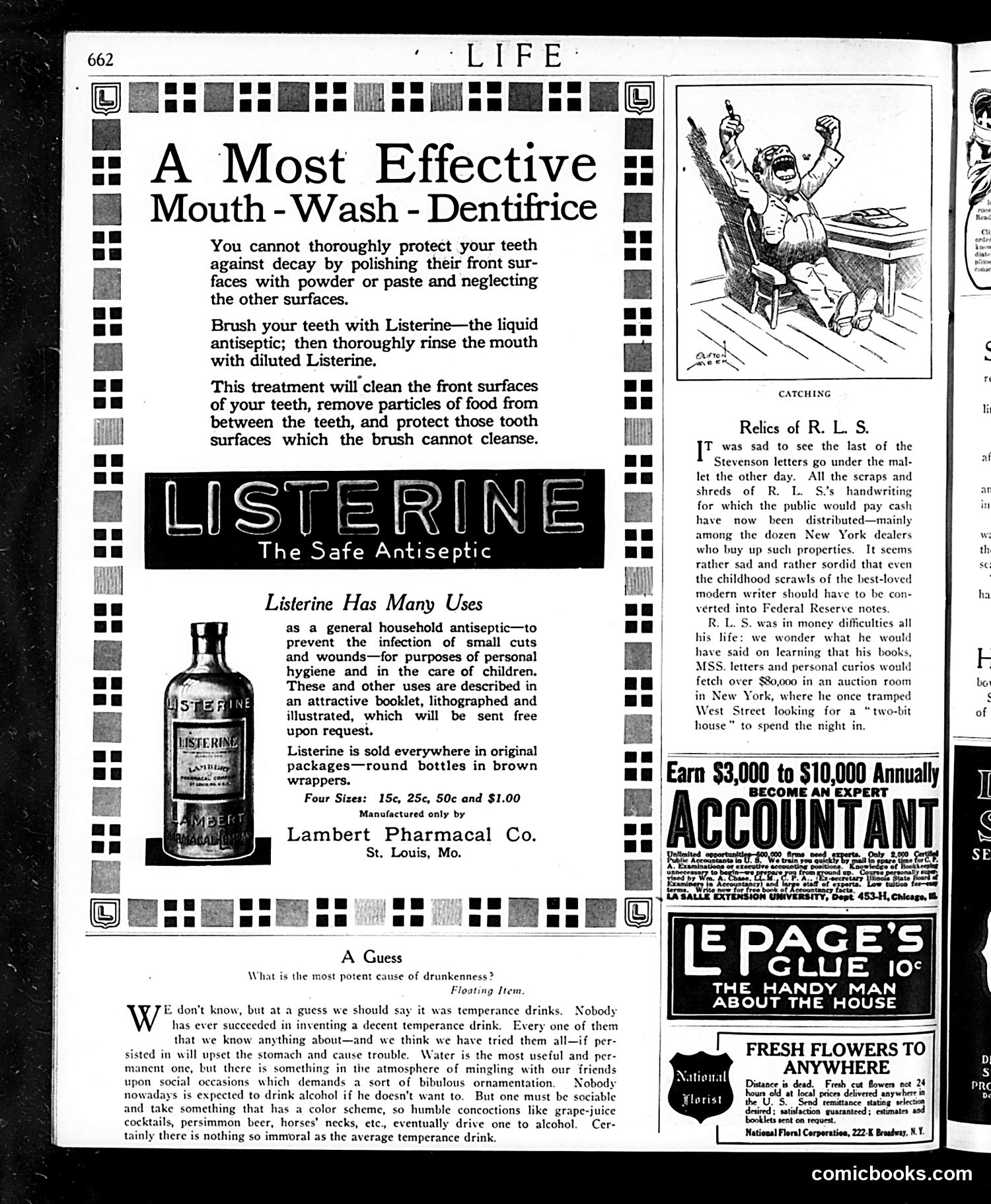
This page is primarily **advertising and editorial content** rather than political satire. The main cartoon titled "CATCHING" shows a jubilant figure with raised arms at a desk—likely depicting the excitement of acquiring valuable items, though the specific reference is unclear without additional context. The substantial editorial piece "Relics of R. L. S." discusses the recent auction of Robert Louis Stevenson's personal letters and manuscripts. The author laments that even the cherished childhood writings of this beloved modern author must be converted to currency, reflecting on Stevenson's lifelong financial struggles. The piece notes these items fetched over $80,000 at a New York auction—a considerable sum for the era. A separate humorous piece titled "A Guess" offers satirical commentary on temperance drinks, arguing that well-intentioned alcohol-free beverages are so unpalatable they actually *drive* people toward alcohol consumption. The remainder consists of period advertisements for Listerine mouthwash, accounting courses, glue, and flower delivery services.
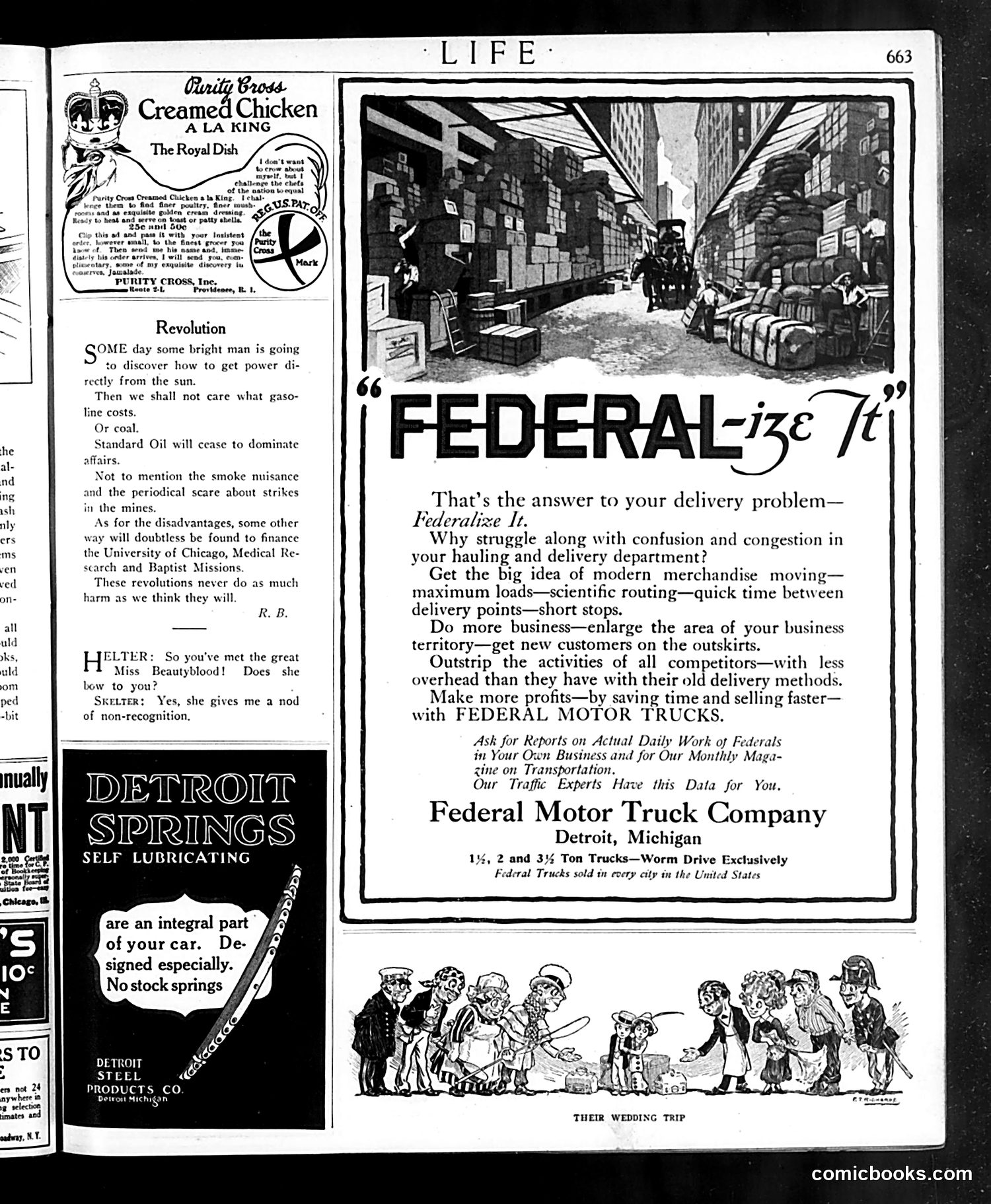
This page contains three distinct elements: **"Revolution" Essay (R.B.)**: A satirical piece predicting that solar power will eventually replace fossil fuels, eliminating concerns about gasoline costs, coal, and mining strikes. The joke's dark punchline suggests that while this revolution won't cause the harm people fear, society will simply find *other* ways to fund institutions like the University of Chicago and Baptist Missions—implying institutional fundraising needs are inevitable regardless of technological progress. **"Helter-Skelter" Joke**: A brief exchange where one character brags about meeting "Miss Beautyblood" and receiving acknowledgment, but the punchline reveals she merely gave "a nod of non-recognition"—a joke about social snubbing and failed expectations of status. **Federal Motor Truck Advertisement**: The bulk of the page promotes Federal trucks as solutions for efficient delivery operations, targeting business owners. The page is primarily **advertising-focused**, with the satirical content serving as filler between commercial messages typical of Life magazine's format.
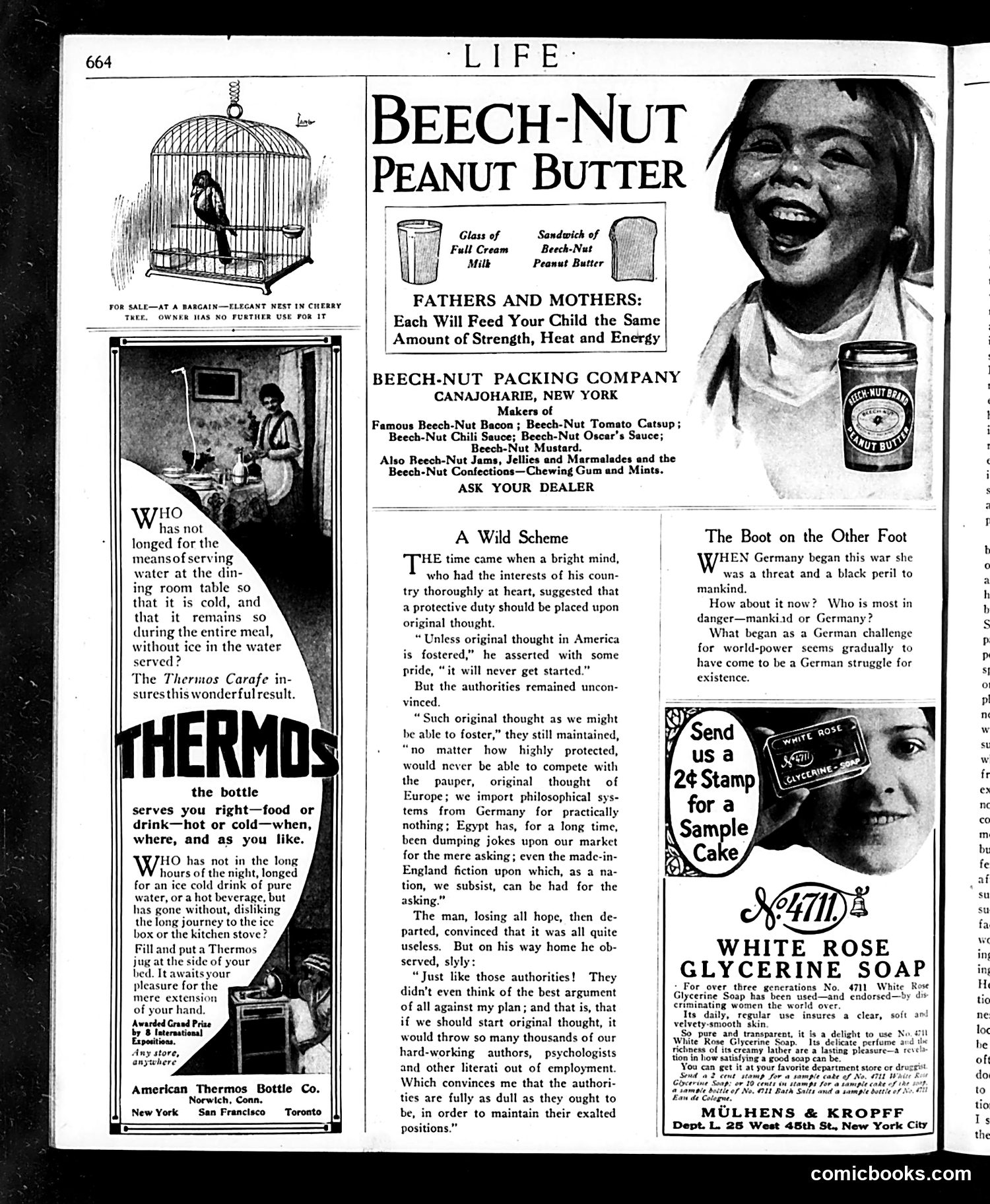
This page mixes advertisements with satirical commentary. The main cartoon, "A Wild Scheme," ridicules protectionist trade policy. A character proposes tariffs to protect American "original thought" from cheap European imports (German philosophy, Egyptian jokes, English fiction). Authorities reject the idea as uncompetitive. The satirist's joke: the real argument against the plan—that protecting domestic thought would put American authors and intellectuals out of work—went unnoticed by dull officials. The satire mocks both protectionism and the intellectual class. "The Boot on the Other Foot" comments on World War I: Germany, initially a threat to mankind, now faces existential danger itself—a reversal of fortunes. The advertisements (Thermos bottles, Beech-Nut peanut butter, White Rose soap) are standard period marketing, using testimonials and nutritional claims typical of early 20th-century advertising.
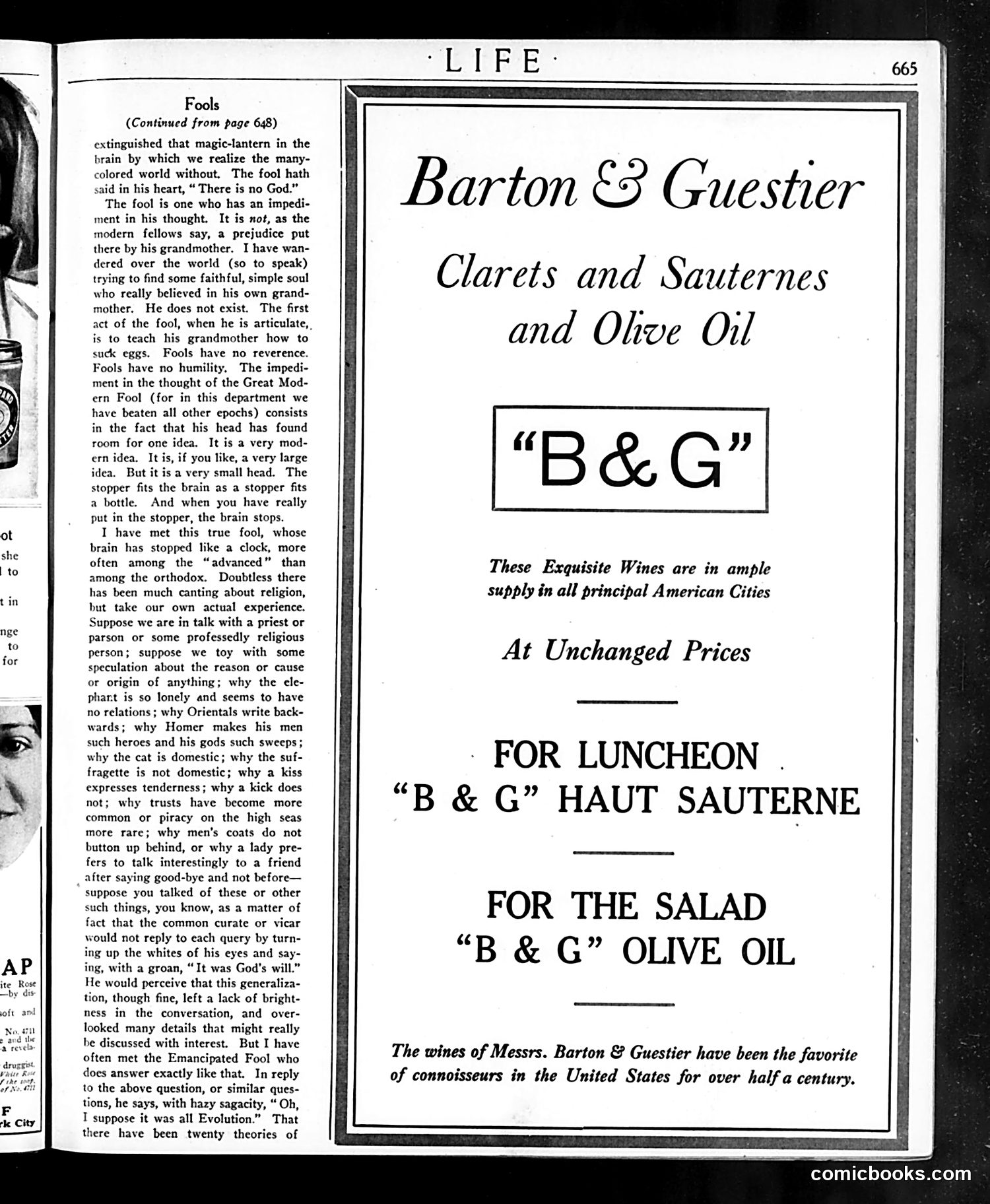
This page contains a philosophical essay (continued from page 648) critiquing modern foolishness, paired with a commercial advertisement. **The Essay's Satire:** The author attacks the "Great Modern Fool"—someone with a single, rigid idea that has stopped their thinking entirely. The specific target appears to be the "Emancipated Fool" who reflexively attributes everything to "Evolution," the way a religious person might say "God's will." The satire mocks intellectual pretension: modern "advanced" thinkers who reject traditional religion often replace it with equally thoughtless dogmatism, shutting down genuine inquiry rather than opening it up. **The Advertisement:** The facing page is a straightforward 1920s-era ad for Barton & Guestier wines and olive oil, claiming availability in American cities "at unchanged prices"—likely referencing post-WWI inflation concerns or Prohibition's economic disruption. The juxtaposition is ironic: a page attacking narrow-minded thinking appears opposite a commercial appeal to refined taste and connoisseurship.
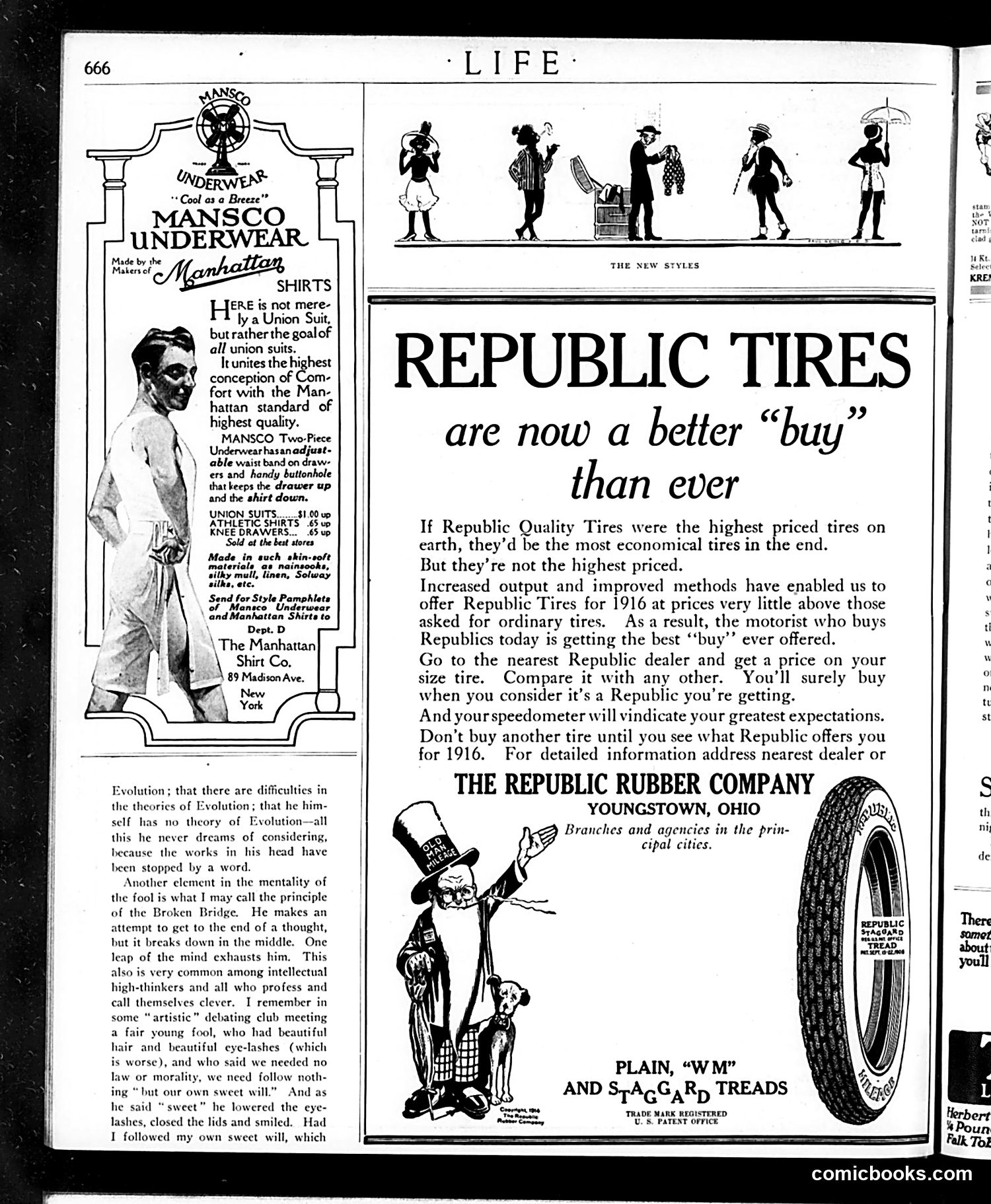
This page is primarily **advertising** with an editorial essay. The three ads promote: 1. **Mansco Underwear** (left): A union suit marketed for comfort and quality, emphasizing its "Manhattan standard" of craftsmanship. 2. **Republic Tires** (center/right): The main advertisement argues that Republic Tires offer the best value—not the cheapest price, but superior quality at reasonable cost compared to premium competitors. It appeals to motorists seeking economical reliability for 1916. 3. The editorial text (left column) appears to be satirical commentary on intellectual pretension, using "Evolution" and "the Broken Bridge" as metaphors for foolish thinking—people who adopt ideas without understanding them or abandon arguments midway. The cartoonish Uncle Sam figure with the tire represents the patriotic American consumer. The "New Styles" illustration at top depicts period clothing/fashion. These are **product advertisements**, not political satire, typical of Life's revenue model during this era.
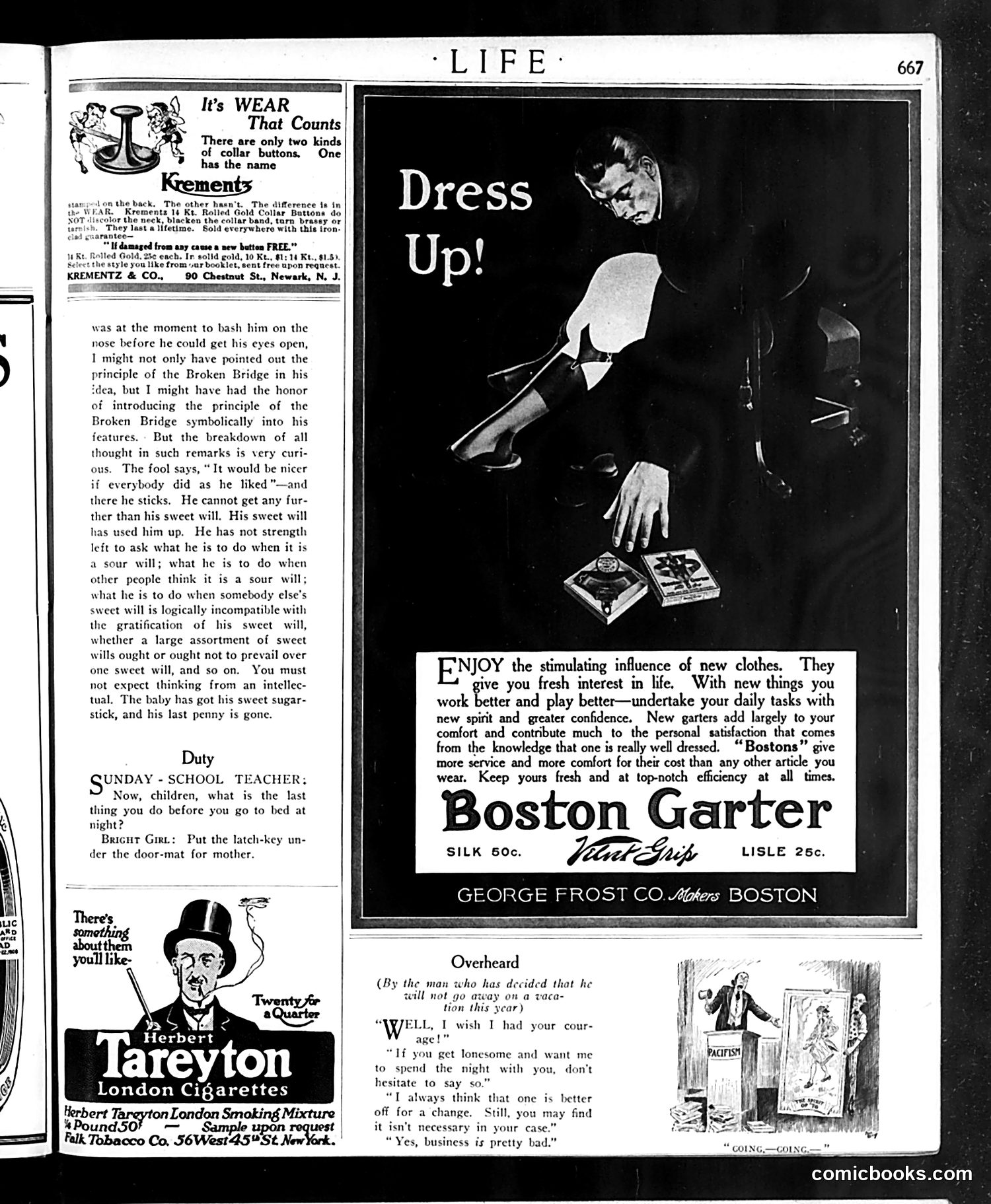
This page is primarily **advertising** with minimal editorial content. The main advertisement is for **Boston Garter** (elastic garters for men's socks), featuring a dramatic photograph of a man in formal wear adjusting his garter, with text promoting how new clothes boost confidence and productivity. Supporting ads include **Krementz collar buttons** (promoting durability), **Herbert Tareyton cigarettes**, and a brief **Sunday School joke** about a girl who leaves her latchkey under the doormat for her working mother—mildly satirizing modern urban life and parental improvisation. The "Overheard" section presents a dialogue between two men about vacation plans, with one declining a trip due to business troubles. This reflects Depression-era economic anxiety. Overall, this is a commercial page using gentle humor and aspirational messaging typical of 1920s-30s Life magazine advertising, emphasizing that appearance and preparedness matter for success.
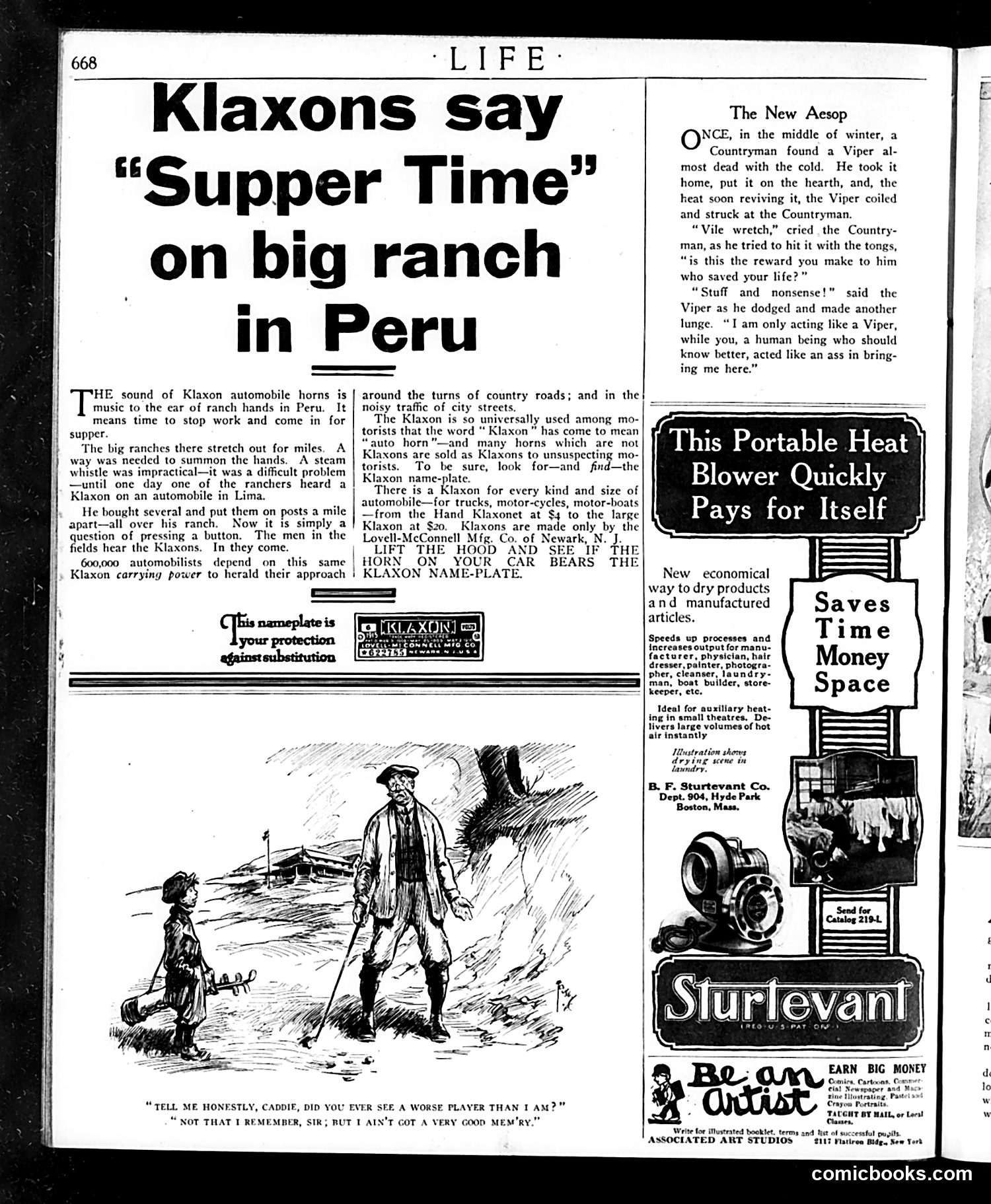
This page contains two distinct sections: **Main Article: "Klaxons say 'Supper Time' on big ranch in Peru"** A genuine marketing piece (not satire) describing how Peruvian ranchers use Klaxon automobile horns mounted on posts to call workers in from distant fields for supper. The article positions this as an efficient solution to ranch management. **"The New Aesop" Fable** A retelling of Aesop's classic "The Viper and the Countryman" parable. A countryman rescues a frozen viper, which then bites him. When he protests, the viper justifies itself by saying it's merely acting according to its nature—implying the countryman was foolish to expect gratitude from something inherently dangerous. The moral critiques human stupidity. **Advertisements** The right column features product ads (Sturlevant heat blower, Bean Artist opportunity). The page is primarily advertising/commercial content with a classic fable serving as editorial filler—typical LIFE magazine layout of the era.
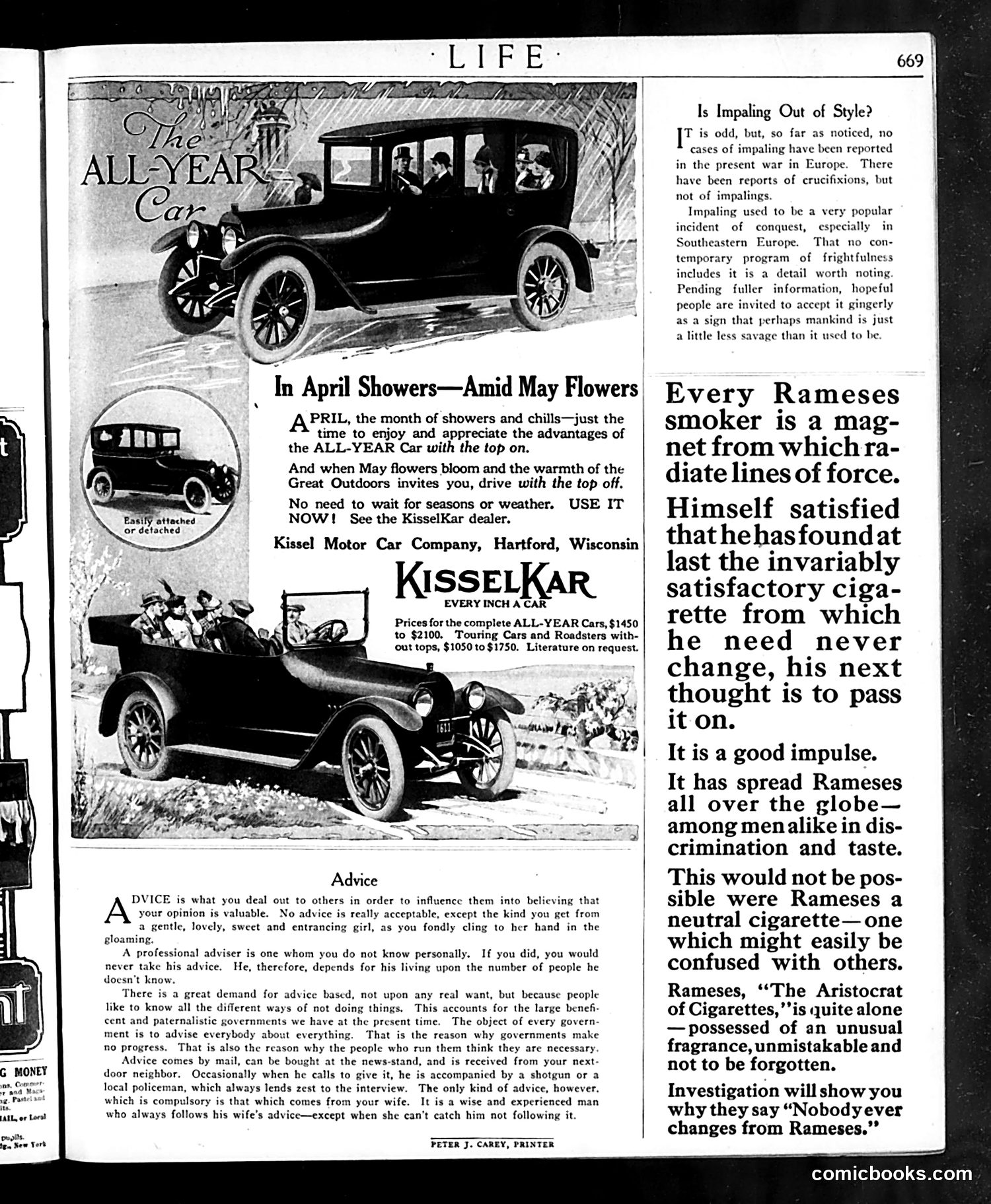
This page contains two distinct advertisements and a humorous essay, typical of Life's satirical format. **Left side:** A Kissel automobile advertisement emphasizing year-round versatility—its convertible top allows driving comfort in both April showers and May sunshine. The copy uses seasonal imagery to market the car's adaptability. **Right column:** A Rameses cigarette advertisement employing pseudo-scientific language ("magnet from which radiate lines of force") to suggest the product's compelling appeal and social influence. It implies smokers enthusiastically promote Rameses to others due to its distinctive, superior quality. **Center essay titled "Advice":** A satirical piece mocking both the universal human tendency to dispense unsolicited advice and governments' paternalistic nature. The humor stems from defining advice as worthless opinion from strangers, while advice from one's wife is "compulsory"—a domestic joke playing on marital dynamics familiar to contemporary readers. **"Is Impaling Out of Style?":** A brief, darkly humorous observation that World War I, despite its brutality, apparently hasn't revived medieval impalement as a warfare tactic, suggesting modest human progress.
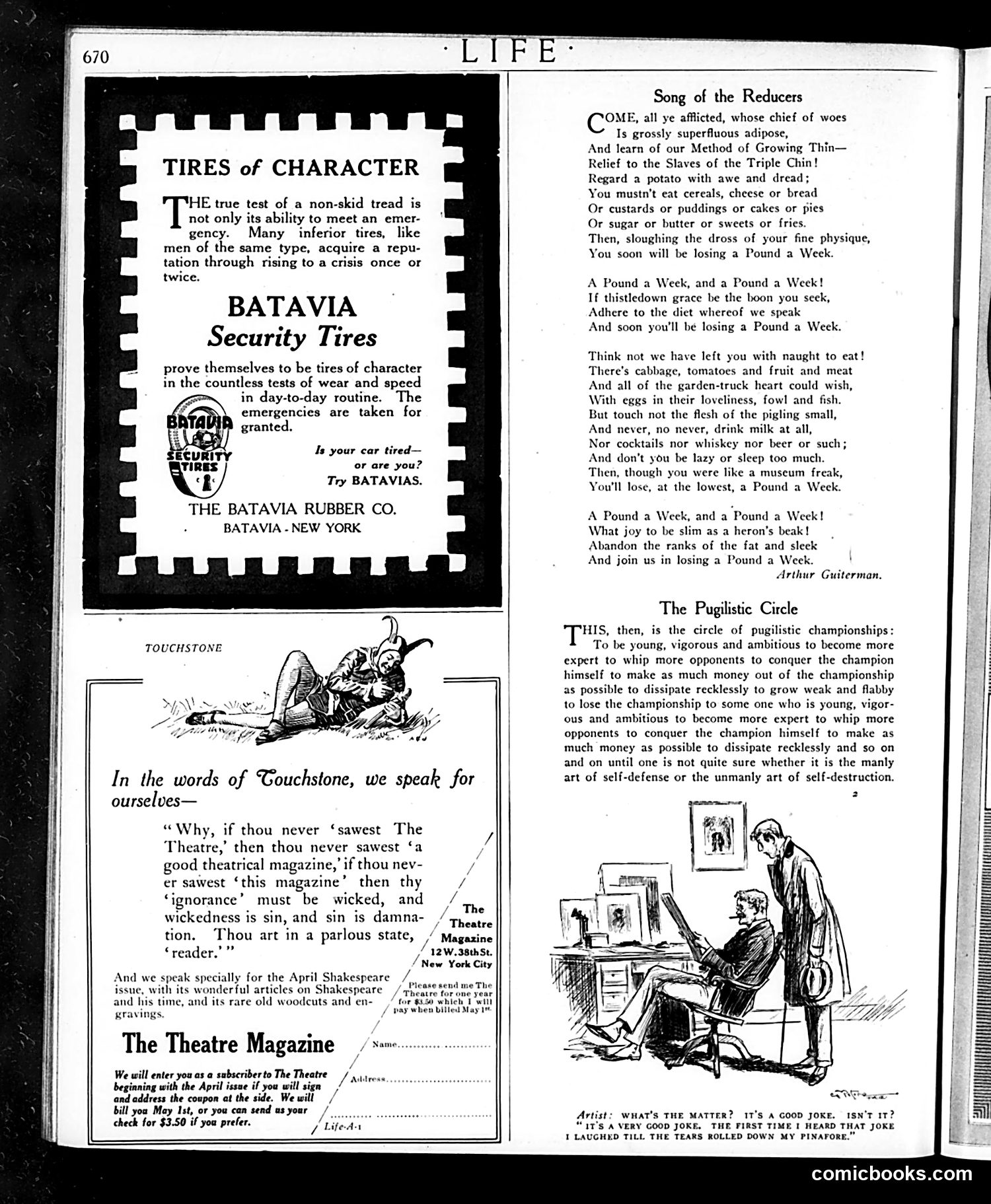
This page is primarily **advertising and light satirical content** rather than political commentary. **Top section:** A Batavia tire ad uses character metaphor—claiming tires, like people, prove themselves through daily routine, not just emergencies. **Middle:** *Touchstone* section promotes *The Theatre Magazine* via Shakespeare reference, urging subscription. **"Song of the Reducers":** A humorous poem by Arthur Guiterman mocking weight-loss dieting fads. It satirizes the restrictive diet industry by listing forbidden foods (bread, sugar, milk, alcohol) while offering minimal alternatives (cabbage, tomatoes), then promises "a Pound a Week" weight loss—the song's repetitive, almost cult-like refrain mockingly emphasizes the absurdity. **"The Pugilistic Circle":** A cynical commentary on boxing's economics: young fighters grow ambitious, earn money, then dissipate wealth and decline, replaced by younger fighters. It questions whether boxing represents "manly self-defense" or destructive self-destruction. **Bottom cartoon:** Shows an artist and patron discussing a joke, with the patron's outdated response suggesting she's hearing it for the first time—gentle mockery of cultural lag.
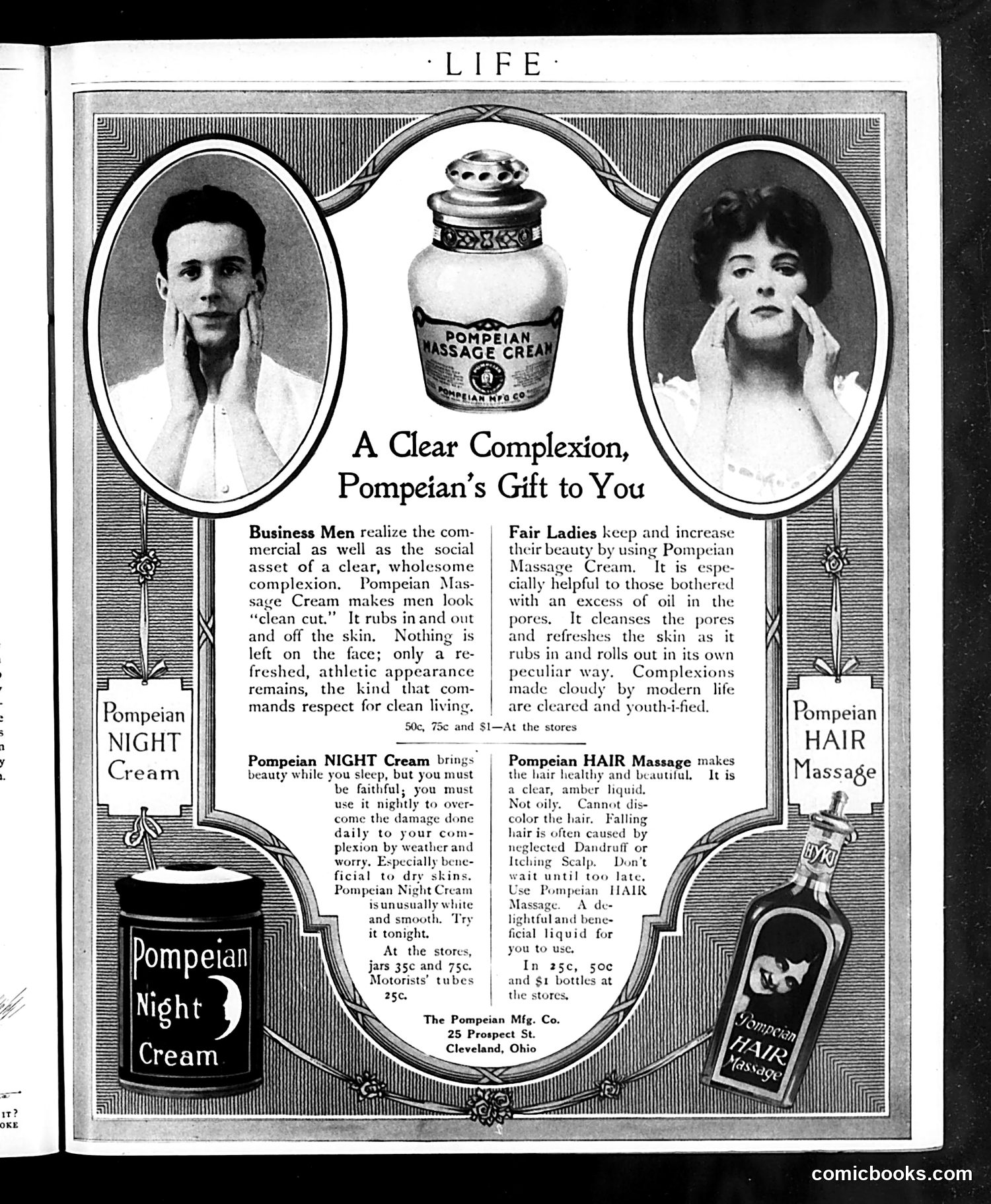
This is a **product advertisement**, not satire or political commentary. It promotes Pompeian brand cosmetics and skincare products (Night Cream, Massage Cream, Hair Massage) from Cleveland, Ohio. The page targets both men and women with gendered messaging: businessmen need clear complexions to appear "clean cut" and command respect; women should use the products to maintain beauty and counter effects of "modern life." The advertisement reflects early 20th-century beauty standards emphasizing youthful, oil-free skin and healthy hair. It's notable for marketing skincare to men as a professional asset—suggesting complexion care wasn't yet entirely feminized, though the messaging differs (men need respect; women need beauty). The two portrait photographs at top show before/after results, a common advertising technique of the era.
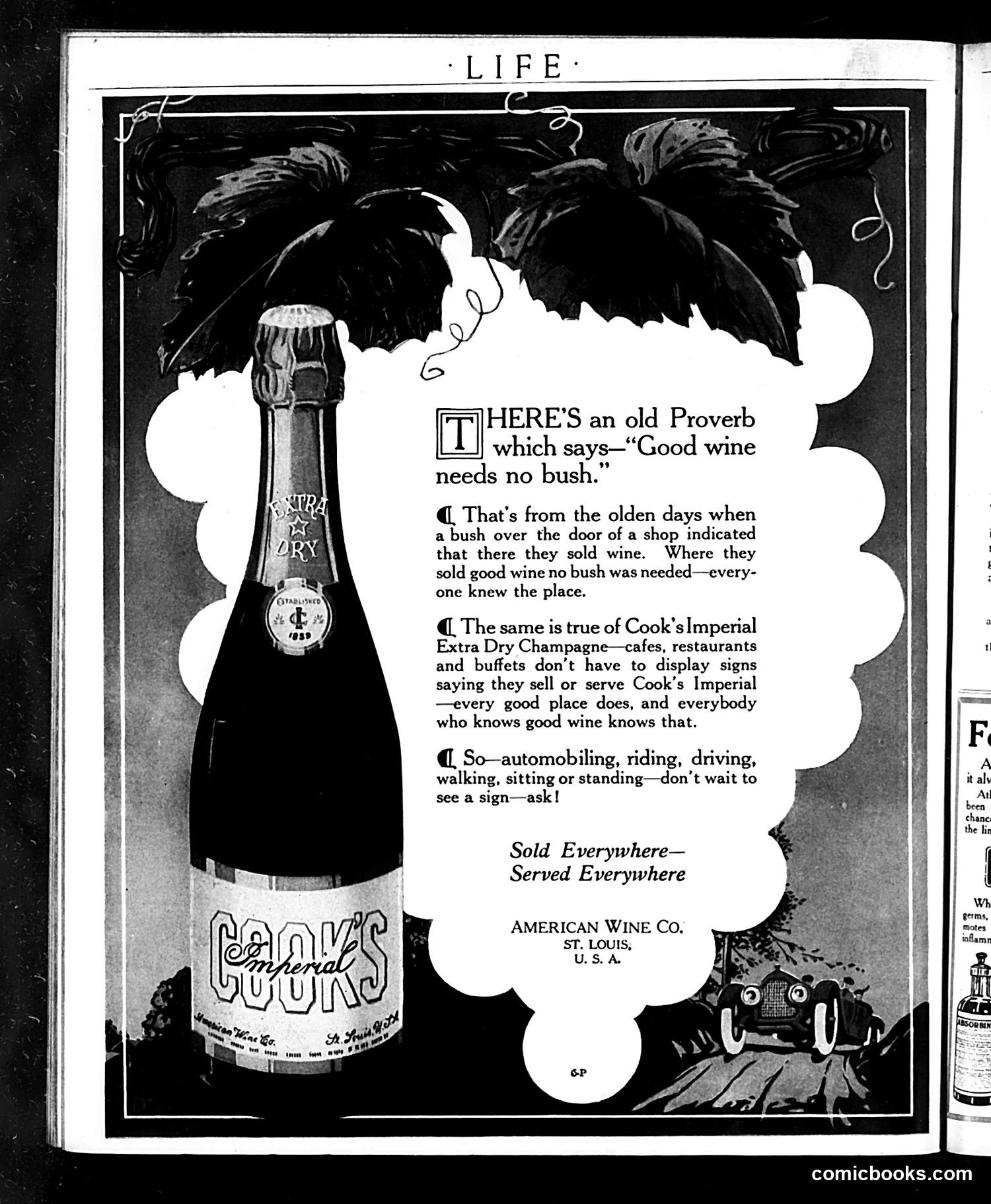
This is a **full-page advertisement**, not a cartoon or satire. It promotes Cook's Imperial Extra Dry Champagne from the American Wine Co. (St. Louis). The ad employs a medieval proverb—"good wine needs no bush"—referring to the historical practice of hanging a bush outside taverns selling quality wine, since customers already knew where to find it. The advertisement applies this logic to Cook's champagne: it claims the product is so well-known and respected at "every good place" that no advertising signage is necessary. The visual shows a champagne bottle with decorative Art Deco styling, surrounding a cloud-like text frame. A vintage automobile appears at the bottom right. The pitch is straightforward marketing: Cook's champagne is popular enough that you should simply ask for it wherever you go—"automobiling, riding, driving, walking"—without needing to see posted signs. This reflects early 20th-century advertising confidence in brand recognition.
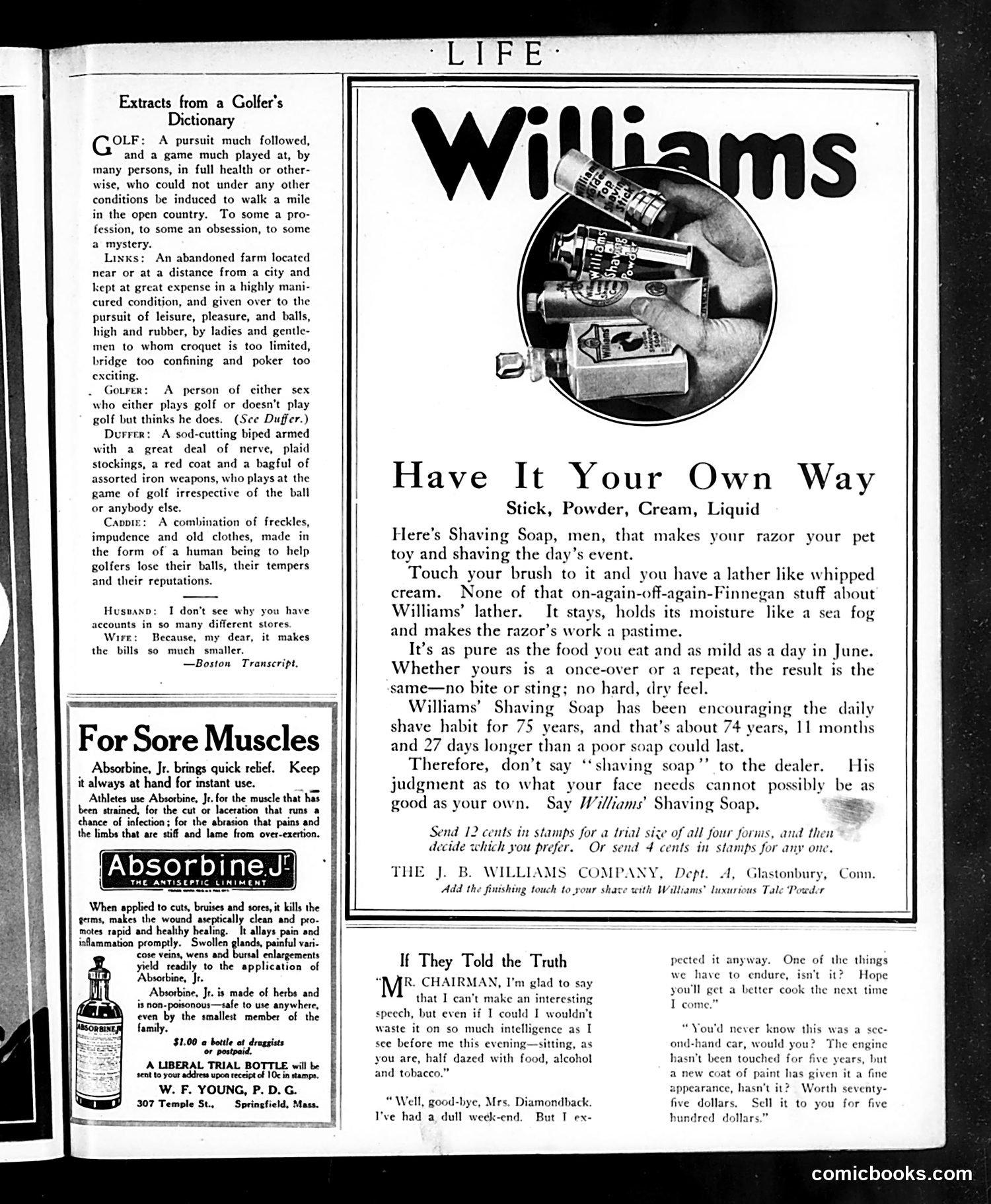
This page is primarily **advertising**, not political satire. The main content is a Williams' Shaving Soap advertisement featuring product claims and images of shaving implements. The left sidebar contains humorous "Extracts from a Golfer's Dictionary"—satirical definitions mocking golf culture and its practitioners. Terms like "Golfer" (someone who plays golf or pretends to) and "Duffer" (an incompetent player in gaudy attire) gently ridicule the sport's social pretensions. A brief joke about a wife's shopping accounts provides lighthearted domestic humor. The advertisement itself uses the common early-20th-century sales pitch: Williams' soap is superior because it produces excellent lather, feels mild, and has a 75-year history. The copy reassures men they needn't specify the product name—their face knows what it needs. The page also advertises Absorbine Jr., a medicinal liniment for sore muscles and minor injuries. No significant political content is present; this is consumer-focused magazine content typical of the 1920s-era Life magazine.

This is **automobile advertising**, not political satire or a cartoon. The page promotes the Chalmers automobile, specifically a new model with an 8400 r.p.m. engine, priced at $1050. The ad's rhetorical strategy targets middle-class buyers by claiming the car democratizes high performance—previously available only to the wealthy. The language is hyperbolic ("magic spell," "conquered 740 cities," "revolution"), using poetic exaggeration typical of early 20th-century car marketing. Key selling points: the engine's speed combined with fuel economy, safety (no "tire-burning burst of speed"), and acceleration. The "Quality First" seal suggests manufacturer credibility. For modern readers: this reflects when automobile technology was novel luxury, and when manufacturers needed to convince ordinary Americans that high performance and affordability could coexist. The gendered language ("she") was standard automotive advertising of the era.
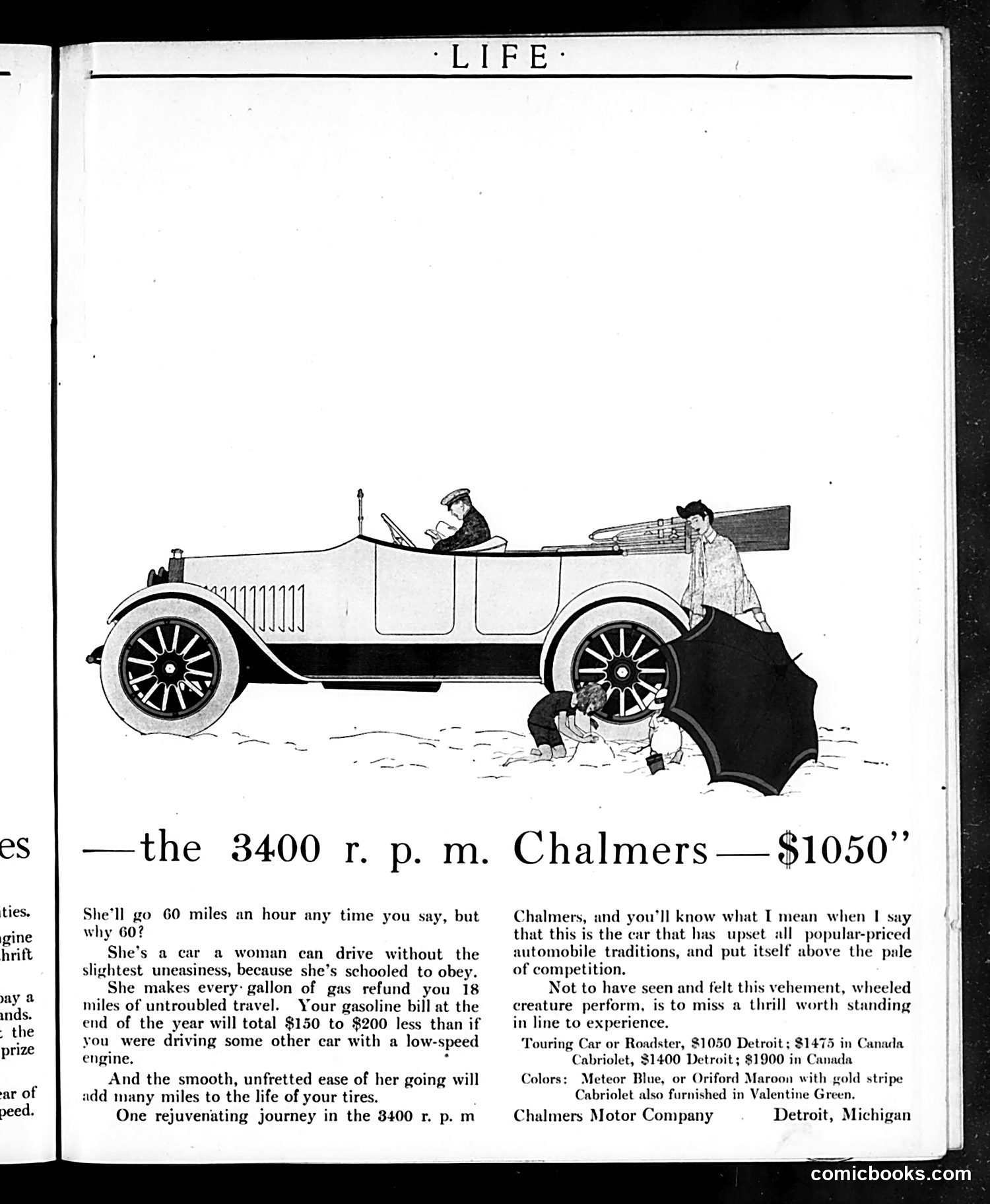
This is primarily an **automobile advertisement** for the Chalmers 3400 r.p.m. car ($1050), not a political cartoon or satire. However, the ad contains **significant social commentary** reflective of early 1900s attitudes: **The "satire"** is unintentional—the copy reveals period prejudices. It emphasizes the car is "a woman can drive without the slightest uneasiness, because she's schooled to obey," treating the automobile like an obedient servant or child. This reflects assumptions about women drivers needing "safe," easy-to-operate vehicles rather than complex machinery. The illustration shows people with the car in casual, leisure scenarios—a man with a rifle/gun, others with an umbrella—suggesting this is a car for recreation and pleasure rather than serious work. **For modern readers:** The ad's language about women needing an "obedient" car reveals how early 20th-century marketers viewed female competence and agency—patronizing by today's standards, but unremarkable advertising copy for the era.
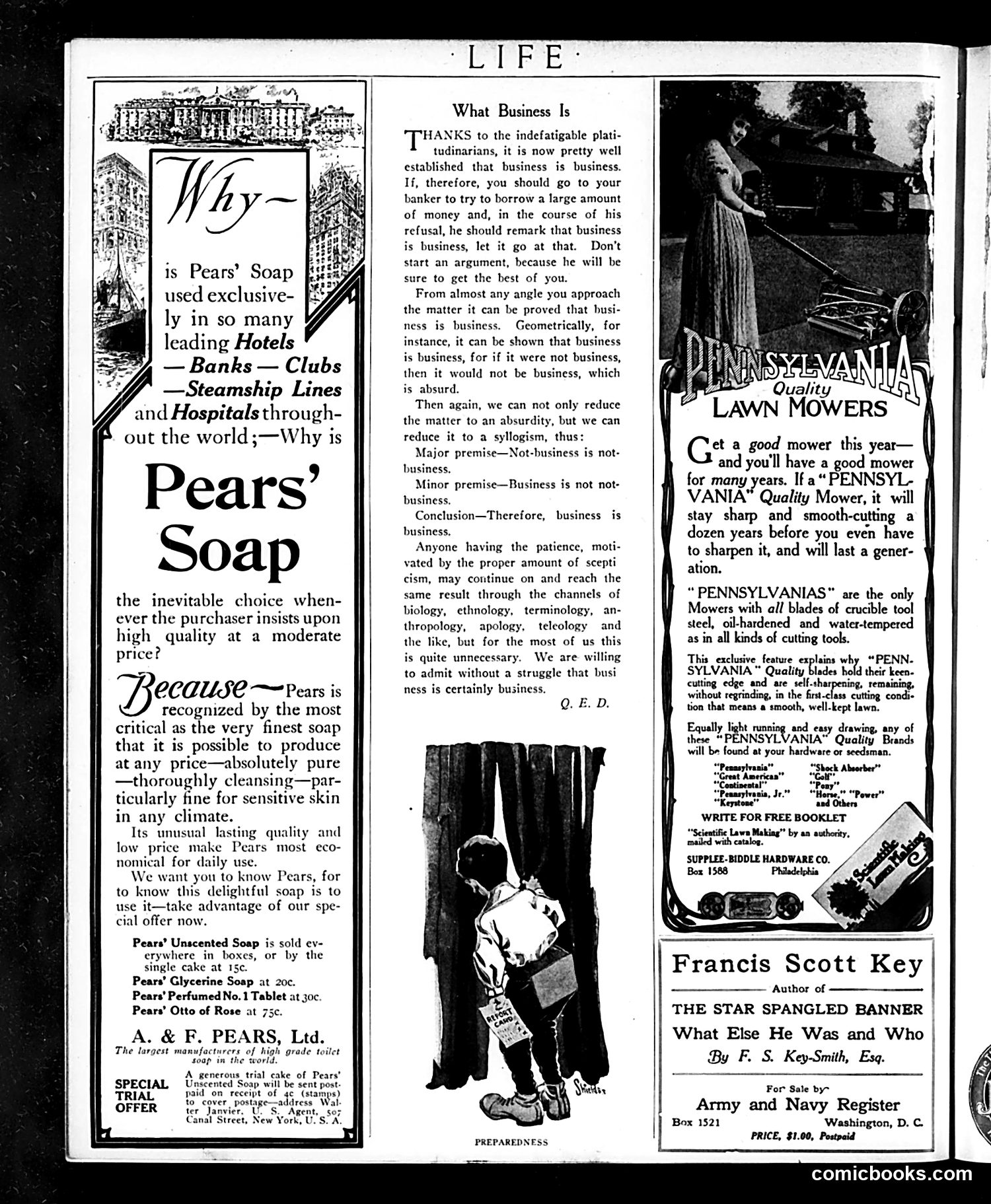
This page is primarily **advertising**, not political satire. It contains four distinct advertisements: 1. **Pears' Soap** (left): A luxury soap brand emphasizing purity and use in prestigious institutions (hotels, banks, steamships, hospitals). The appeal targets quality-conscious consumers willing to pay moderate prices. 2. **"What Business Is"** (center): A humorous essay satirizing corporate jargon and circular logic. It mocks how businessmen use the phrase "business is business" as an unassailable argument, then deconstructs it through absurdist reasoning (syllogisms, geometry) to show the phrase is logically meaningless—a gentle jab at pretentious business rhetoric. 3. **Pennsylvania Quality Lawn Mowers** (right): Emphasizes durability and superior steel construction for suburban homeowners. 4. **Francis Scott Key book** (bottom right): Promotes a biography of the national anthem's author. The page reflects early 20th-century consumer culture targeting middle and upper-class readers. No political figures or specific events are referenced; the satire is purely about business-speak pretension.
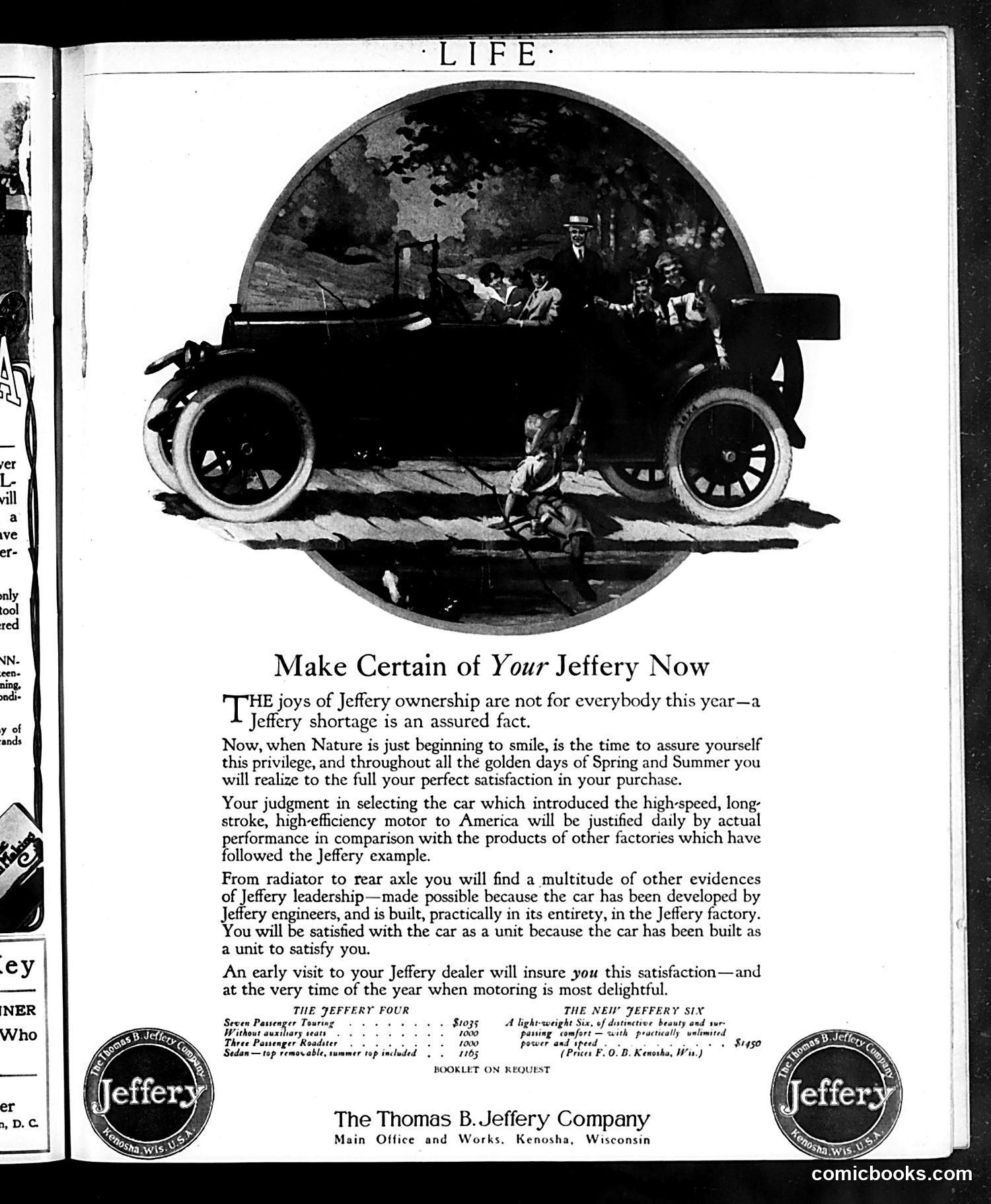
This is **not a political cartoon or satire**—it's a straightforward automobile advertisement from Life magazine's advertising section. The page promotes the **Jeffery automobile**, manufactured by the Thomas B. Jeffery Company of Kenosha, Wisconsin. The ad claims a shortage of Jeffery cars exists and urges potential buyers to purchase immediately before spring/summer driving season. The image shows a silhouetted early-1900s automobile filled with passengers, presented as aspirational. The text emphasizes the Jeffery's technical innovations (high-speed, long-stroke motor) and quality control ("built as a unit to satisfy you"), positioning it against unnamed competitors. **Historical context for modern readers**: This reflects pre-WWII American automotive competition when numerous now-defunct manufacturers (Jeffery, Packard, etc.) competed fiercely. The "shortage" claim is a common sales tactic. The Thomas B. Jeffery Company eventually became Nash Motors.
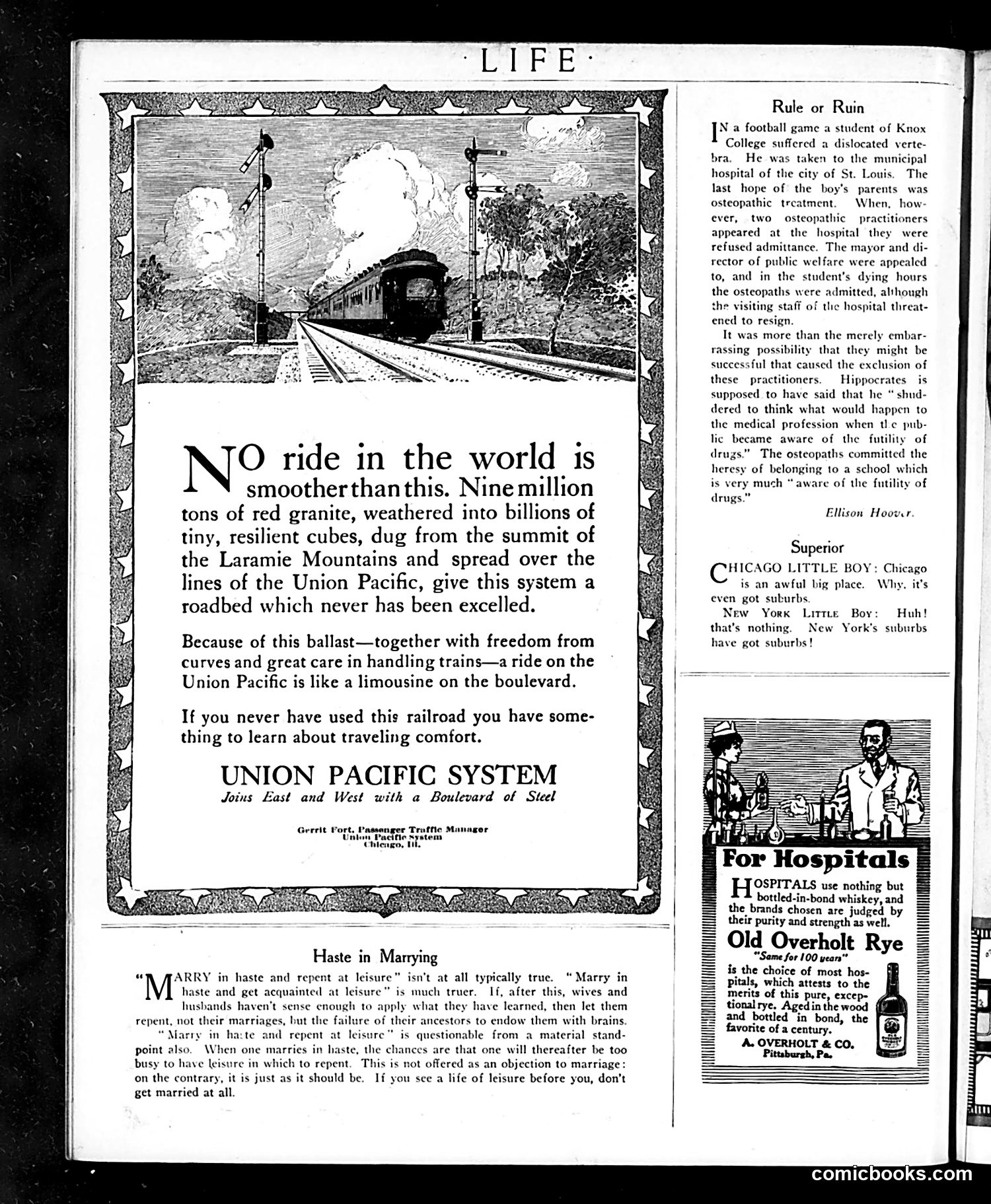
This page contains three distinct pieces: **Union Pacific Railroad Advertisement** (left): A large commercial ad promoting smooth rail travel. The image shows a train on tracks, and the copy emphasizes comfort, claiming nine million tons of granite ballast from the Laramie Mountains creates an exceptionally smooth ride—"like a limousine on the boulevard." **"Haste in Marrying"** (bottom left): A brief essay arguing that the proverb "marry in haste, repent at leisure" is false. The author suggests people who marry quickly stay too busy to repent, which he endorses as healthy for marriage. **"Rule or Ruin"** (right): A satirical commentary on medical gatekeeping. It describes a Knox College student denied osteopathic treatment at a St. Louis hospital, despite parents' hopes. The piece critiques the medical establishment's exclusion of osteopaths, suggesting organized medicine fears competition and wants to suppress alternative practitioners who challenge conventional drug-based treatment. **Two brief jokes** about city sizes and an advertisement for Old Overholt whiskey complete the page.

This is a **vintage tire advertisement**, not a political cartoon. It promotes Fisk Red Top tires, emphasizing their quality through claims of "metropolitan smartness, safety and mileage." The large illustration shows a stylized tire dominating the page. Below it, a decorative border depicts early automobiles at what appears to be a racing or touring event, suggesting the product's performance credentials. The ad highlights Fisk's "Free Service" network—over 100 branches nationwide offering free help and advice to motorists regardless of tire brand. This was a notable selling point in the early automotive era. The small icon on the right shows a cherubic figure (the "Fisk Boy," likely the brand's mascot) asking "Time to Re-tire? (Buy Fisk)"—an early example of brand mascot advertising. This reflects 1920s-era marketing strategies emphasizing service infrastructure and customer support as competitive advantages in the emerging automotive industry.
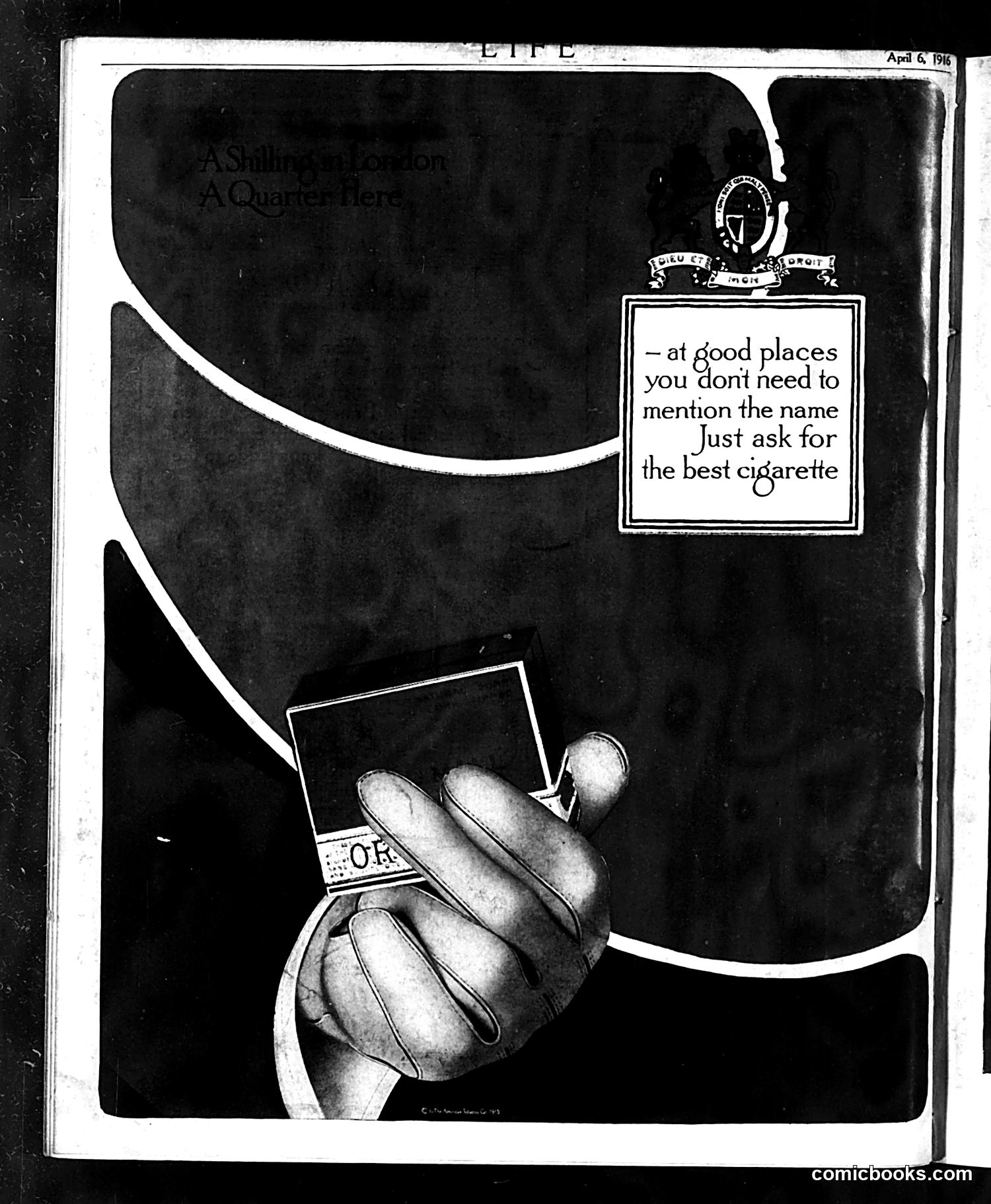
This is a cigarette advertisement from Life magazine (April 6, 1916). The ad shows a hand holding a cigarette pack with visible branding, accompanied by text claiming that at "good places" one need only "ask for the best cigarette" without naming it—implying the product's reputation speaks for itself. The ad employs a common early-20th-century marketing strategy: suggesting brand superiority through implication rather than explicit comparison. The prestigious imagery (formal hand, upscale setting) reinforces aspirational positioning. For modern readers: this represents an era when cigarette advertising was completely unrestricted and openly promoted smoking as a mark of sophistication and social status—a stark contrast to today's heavily regulated tobacco marketing.