
Life, 1916-04-06 · page 28 of 80
Life — April 6, 1916 — page 28: what you’re looking at
What you’re looking at
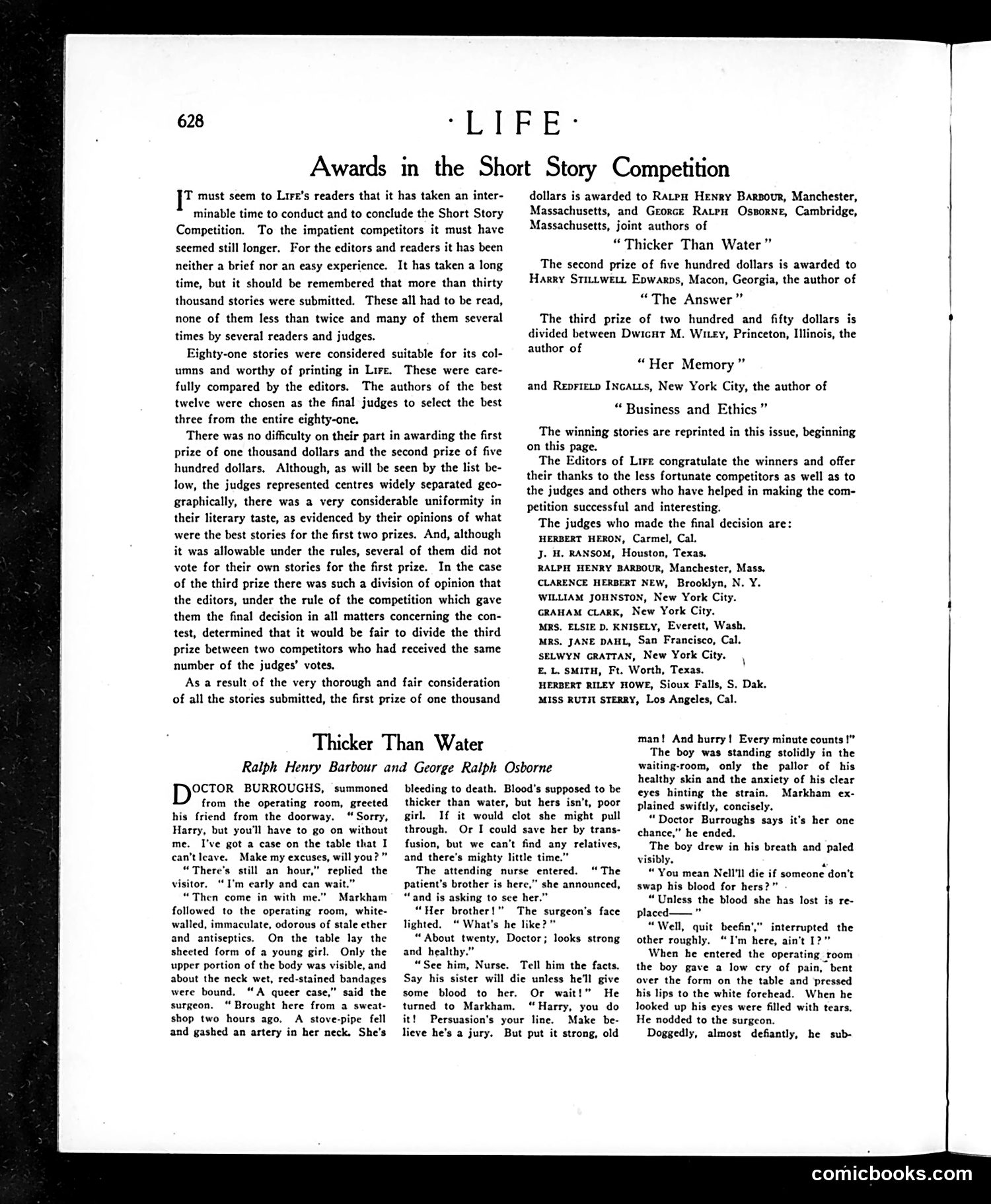
This is a **competition results announcement** page from Life magazine, not a political cartoon. The page announces winners of Life's Short Story Competition. The main content describes the judging process for 30,000+ submitted stories, narrowed to 81 finalists, then 3 winners selected by a panel of 12 judges representing different U.S. regions. Life notes the judges showed "considerable uniformity" in taste despite geographic separation. The page then begins printing the **first-prize winning story, "Thicker Than Water,"** co-authored by Ralph Henry Barbour and George Ralph Osborne. The story opening depicts a dramatic medical scenario: a young girl from a sweatshop with a severed neck artery needs a blood transfusion to survive. A surgeon asks her brother to donate blood to save her life—a literal dramatization of the story's title metaphor about family obligation. **No political satire or cartoon is present** on this page; it's an earnest literary competition announcement and story publication.
📄 Transcribed text from this page (OCR, searchable)
Machine-transcribed from the original scan — historical spelling and the odd misread are preserved.
LE TEE * Awards in the Short Story Competition T must seem to Lire’s readers that it has taken an inter- minable time to conduct and to conclude the Short Story Competition. To the impatient competitors it must have seemed still longer. For the editors and readers it has been neither a brief nor an easy experience. It has taken a long time, but it should be remembered that more than thirty thousand stories were submitted. These all had to be read, none of them less than twice and many of them several times by several readers and judges. Eighty-one stories were considered suitable for its col- umns and worthy of printing in Lire. These were care- fully compared by the editors. The authors of the best twelve were chosen as the final judges to select the best three from the entire eighty-one. There was no difficulty on their part in awarding the first prize of one thousand dollars and the second prize of five hundred dollars. Although, as will be seen by the list be- low, the judges represented centres widely separated geo- graphically, there was a very considerable uniformity in their literary taste, as evidenced by their opinions of what were the best stories for the first two prizes. And, although it was allowable under the rules, several of them did not vote for their own stories for the first prize. In the case of the third prize there was such a division of opinion that the editors, under the rule of the competition which gave them the final decision in all matters concerning the con- test, determined that it would be fair to divide the third prize between two competitors who had received the same number of the judges’ votes. As a result of the very thorough and fair consideration of all the stories submitted, the first prize of one thousand Thicker Than Water Ralph Henry Barbour and George Ralph Osborne OCTOR BURROUGHS, summoned from the operating room, grected his friend from the doorway. “Sorry, girl. Harry, but you'll have to go on without me. I've got a case on the table that I can'tleave. Make my excuses, will you?” “There's still an hour,” replied the visitor, “I'm early and can wait.” “Then come in with me.” Markham followed to the operating room, white- walled, immaculate, odorous of stale ether and antiseptics. On the table lay the sheeted form of a young girl. Only the upper portion of the body was visible, and about the neck wet, red-stained bandages were bound. “A queer case,” said the surgeon. “ Brought here from a sweat- shop two hours ago. A stove-pipe fell it! and gashed an artery in her neck. She's lieve he’s a jury. lighted. and healthy.” bleeding to death. Blood’s supposed to be thicker than water, but hers isn’t, poor If it would clot she might pull through. Or I could save her by trans- fusion, but we can’t find any relatives, and there's mighty little time.” The attending nurse entered. patient's brother is here,” “and is asking to sce her. “Her brother!" “ What's he like?” “ About twenty, Doctor; looks strong The surgeon's face “See him, Nurse. Tell him the facts. Say his sister will die unless he'll give some blood to her. turned to Markham. Persuasion’s your line. But put it strong, old dollars is awarded to Ratpn Henry Barnour, Manchester, Massachusetts, and Grorce RatpH Ossorne, Cambridge, Massachusetts, joint authors of “Thicker Than Water” The second prize of five hundred dollars is awarded to Harry StitLwett Epwarps, Macon, Georgia, the author of “The Answer” The third prize of two hundred and fifty dollars is divided between Dwicnt M. Witey, Princeton, Illinois, the author of “Her Memory” and Reprrevp INcAtts, New York City, the author of “Business and Ethics” The winning stories are reprinted in this issue, beginning on this page. The Editors of Lire congratulate the winners and offer their thanks to the less fortunate competitors as well as to the judges and others who have helped in making the com- petition successful and interesting. The judges who made the final decision are: HERBERT HERON, Carmel, Cal. J. H. RANSOM, Houston, Texas. RALPH HENRY BARBOUR, Manchester, Mass, CLARENCE HERBERT NEW, Brooklyn, N. Y. WILLIAM JOHNSTON, New York City. GRAHAM CLARK, New York City. MRS. ELSIE D. KNISELY, Everett, Wash. MRS. JANE DAHL, San Francisco, Cal. SELWYN GRATTAN, New York City. E. L. SMITH, Ft. Worth, Texas. HERBERT RILEY HOWE, Sioux Falls, S. Dak. MISS RUTIU STERRY, Los Angeles, Cal. man! And hurry! Every minute counts!” The boy was standing stolidly in the ing-room, only the pallor of his healthy skin and the anxiety of his clear eyes hinting the strain, Markham ex- plained swiftly, concisely. “Doctor Burroughs says it's her one chance,” he ended. The boy drew in his breath and paled visibly. 3 “ You mean Nell'll die if someone don’t swap his blood for hers?” “Unless the blood she has lost is re- placed — " “Well, quit beefin’,” interrupted the other roughly. “I'm here, ain't 1?” When he entered the operating room the boy gave a low cry of pain, bent over the form on the table and pressed his lips to the white forehead. When he looked up his eyes were filled with tears. He nodded to the surgeon. Doggedly, almost defiantly, he sub- “The he announced, Or wait!” He “Harry, you do Make be- comicbooks.com