
Life, 1916-04-06 · page 45 of 80
Life — April 6, 1916 — page 45: what you’re looking at
What you’re looking at
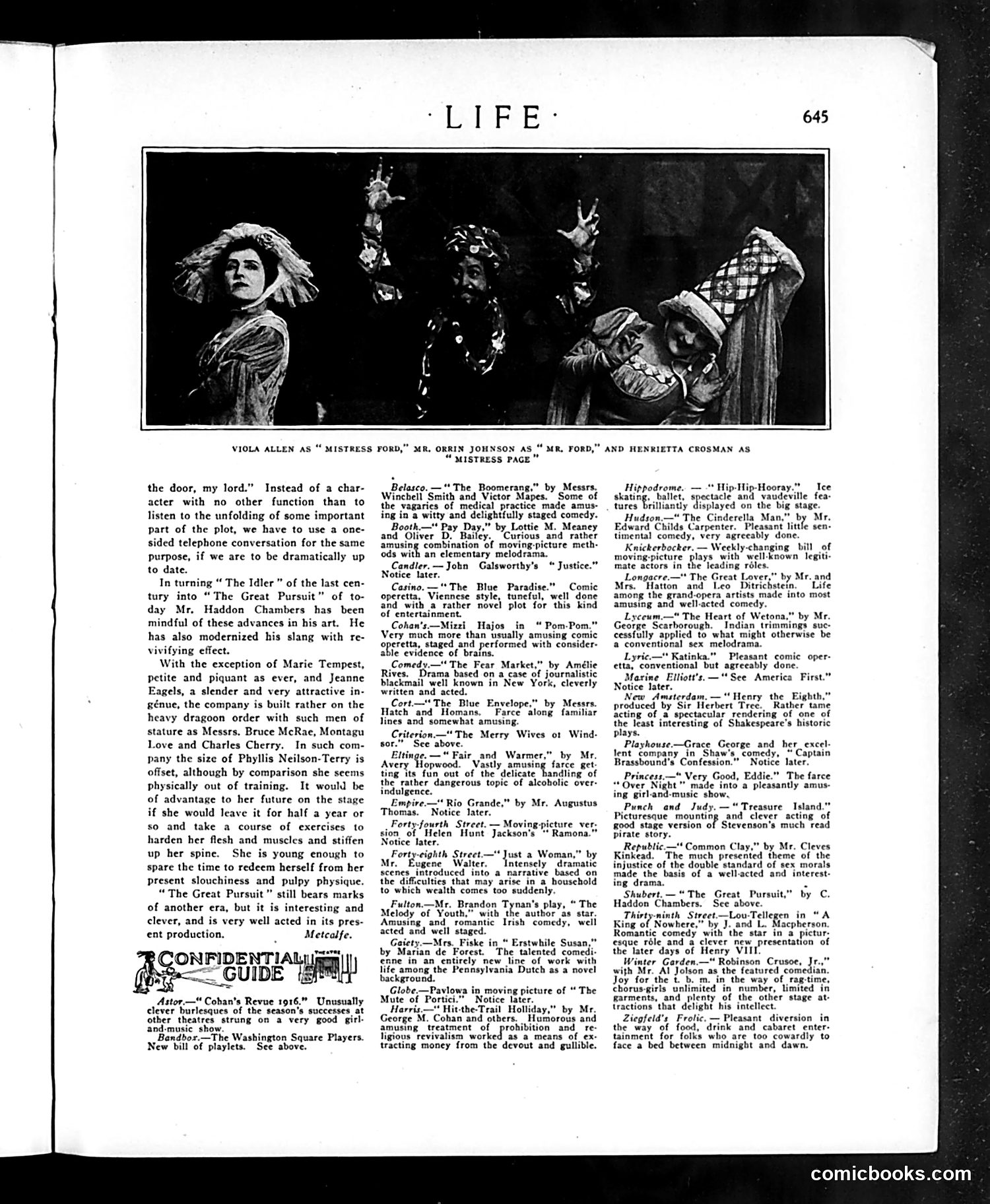
This page reviews a 1916 theatrical production modernizing an 18th-century play called "The Idler." The photograph shows the cast, including established actress Viola Allen as "Mistress Ford." The critic (Metcalfe) praises the script's contemporary updates—particularly its use of telephone conversations to advance plot, rather than relying on listening characters. He commends the wit and staging. However, he critiques the physical conditioning of young actress Phyllis Neilson-Terry, suggesting she appears "out of training" and recommends she take a break for exercise to improve her "slouchiness and pulpy physique." This reflects early 20th-century expectations that performers maintain specific physical standards. The surrounding text lists other current Broadway productions, indicating this is entertainment journalism for theatergoers seeking recommendations.
📄 Transcribed text from this page (OCR, searchable)
Machine-transcribed from the original scan — historical spelling and the odd misread are preserved.
VIOLA ALLEN AS “ MISTRESS FORD,” MR, ORRIN JOHNSON AS “ER, FORD,” the door, my lord.” Instead of a char- acter with no other function than to listen to the unfolding of some important part of the plot, we have to use a one- sided telephone conversation for the same purpose, if we are to be dramatically up to date. In turning “ The Idler” of the last cen- tury into “The Great Pursuit” of to- day Mr. Haddon Chambers has been mindful of these advances in his art. He has also modernized his slang with re- ing effect. With the exception of Marie Tempest, petite and piquant as ever, and Jeanne Eagels, a slender and very attractive in- génue, the company is built rather on the heavy dragoon order with such men of stature as Messrs. Bruce McRae, Montagu Love and Charles Cherry. In such com- pany the size of Phyllis Neilson-Terry is offset, although by comparison she seems physically out of training. It would be of advantage to her future on the stage if she would leave it for half a year or so and take a course of exercises to harden her flesh and muscles and stiffen up her spine. She is young enough to spare the time to redeem herself from her present slouchiness and pulpy physique. “The Great Pursuit” still bears marks of another era, but it is interesting and clever, and is very well acted in its pres- ent production. Metcalfe. ONFIDENTIALU = GUIDE ga! Astor.—“ Coban’s Revue 1916.” Unusually clever burlesques of the season's successes at other theatres strung on a very good girl- and-music show. Bandbox.—The Washington Square Players. New bill of playlets. See above. “ MISTRESS PAGE” Belasco. —"\ The Boomerang,” by Messrs. Winchell Smith and Victor Mapes. Some of the vagaries of medical practice made amus- ing in a witty and delightfully staged comedy. Booth Pay Day,” by Lottie M. Meaney and Oliver D. Bailey. Curious and rather amusing combination of moving-picture meth- ods with an elementary melodrama. Candler. — Jobn Notice later. Casino. —The Blue Paradise.” Comic operetta, Viennese style, tuneful, well done and with a rather novel plot for this kind of entertainment. Cohan’s—Mizzi_ Hajos_ in“ Pom-Pom.” Very much more than usually amusing comic operetta, staged and performed with consider- able evidence of brains. ‘Comedy.— The Fear Market,” by Amél Rives. Drama based on a case of journalistic blackmail well known in New York, cleverly written and acted. Cort— The Blue Envelope,” by Messrs. Hatch and Homans, Farce along familiar lines and somewhat amusing. Criterion.—" The Merry Wives ot Wind- Galsworthy’s “ Justice.” Eltinge. —" Fair, and W: Avery Hopwood. Vastly amusing farce get 1g its fun out of the delicate handling of rather dangerous topic of alcoholic over- indulgence. Empire.—* Rio Grande,” by Mr. Augustus Thomas. "Notice later. Forty-fourth Street. — Moving-picture ver: sion of Helen Hunt Jackson's "* Ramona.” Notice later. Forty-eighth Street —" Just a Woman,” by Mr. Eugene Walter. Intensely dramatic scenes introduced into a narrative based on the difficulties that may arise in a household to which wealth comes too suddenly, Fulton.—Mr. Brandon Tynan’s play, “ The Melody of Youth,” with the author as star. Amusing and romantic Irish comedy, well acted and well staged. Gaicty.—Mrs. Fiske in “ Erstwhile Susan,” by ‘Marian de Forest. The talented comedi- enne in an entirely new line of work with life among the Pennsylvania Dutch as a novel background. Globe.—Pavlowa in moving picture of “ The Mute of Portici.” Notice later. Harris—"' Hit-the-Trail Holliday,” by Mr. George M. Cohan and others. Humorous and amusing treatment of prohibition and re- Ni revivalism worked ae a means of ex- tracting money from the devout and gullible. mer,” by Mr. AND HENRIETTA CROSMAN AS Hippodrome. — “* Hip-Hip-Hooray.” Tee skating, Ballet, spectacle, and vaudeville fea: tures brilliantly displayed on the big stage. Hudson.—" The Cinderella Man,” by Mr. Edward Childs Carpenter. Pleasant little sen: timental comedy, very agreeably done. Knickerbocker. — Weekly-changing bill _of moving-picture plays with well-known legiti- mate actors in the leading rdéles. Longacre.—"* The Great Lover,” by Mr. and Mrs. Hatton and Leo Ditrichstein. “Life among the grand-opera artists made into most amusing and well-acted comedy. Lyceum.—" The Heart of Wetona,” by Mr. George Scarborough. Indian trimmings suc cessfully applied to what might otherwise be a conventional sex melodrama. Lyric.—"' Katinka.” Pleasant comic oper- etta, conventional but agreeably done. Marine Elliott's. —"See America First Notice later. New Amsterdam. —“ Henry the Eighth, produced by Sir Herbert Tree. Rather tame acting of a spectacular rendering of one of the least interesting of Shakespeare's historic plays. Playhouse—Grace George and her_excel- lent company in Shaw's comedy, "Captain Brassbound’s Confession.” Notice later. Princess.—" Very Good, Eddie.” The farce * Over Night” made into a pleasantly amus- ing girland-music show, Punch and Judy. —“ Treasure Island.” Picturesque mounting and clever acting of good stage version of Stevenson's much read Pirate story. Republic. —* Common Clay,” by Mr. Cleves Kinkead. The much presented theme of the injustice of the double standard of sex morals made the basis of a well-acted and interest: ing drama. 2 Shubert.—“The Great Pursuit," by C. Haddon Chambers. See above. Thirty-ninth Street—Lou-Tellegen in “A King of Nowhere,” by J. and L. Macpherson. Romantic comedy with the star in a pictur. esque réle and a clever new presentation of the later days of Henry VIII. Winter Garden.—" Robinson Crusoe, J with Mr. Al Jolson as the featured comedi: Joy for the tb. m. in the way of ragtime, chorus-girls unlimited in number, limited in garments, and plenty of the other stage at- tractions ‘that delight his intellect. Ziegfeld’s Frolic. — Pleasant diversion in the way of food, drink and cabaret enter- tainment for folks who are too cowardly to face a bed between midnight and dawn. comicbooks.com