
Life, 1916-04-06 · page 47 of 80
Life — April 6, 1916 — page 47: what you’re looking at
What you’re looking at
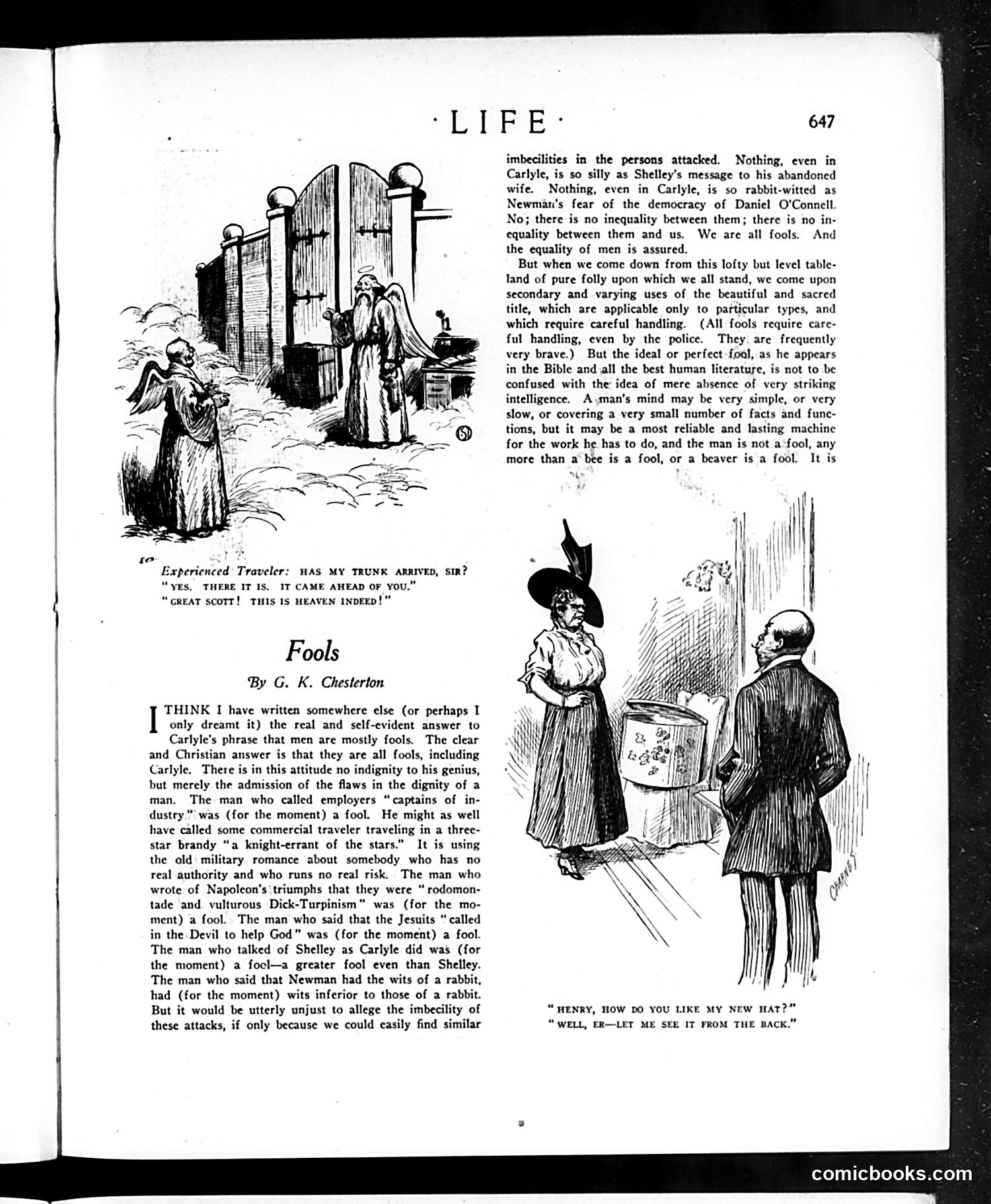
This is G.K. Chesterton's essay "Fools," arguing that all humans are fools in some way—a Christian humility—but this doesn't mean lacking intelligence or reliability. He defends figures like Shelley and Newman against harsh criticism by Carlyle, asserting that calling them fools reveals the *critic's* momentary foolishness, not permanent lack of wit. The cartoons illustrate foolishness through everyday situations: a traveler relieved his trunk arrived ahead (absurd luck), and Henry asking his wife to view his hat from behind (suggesting he can't properly judge it himself). These light sketches contrast with Chesterton's serious philosophical point—that we're all occasionally foolish, yet this universal condition shouldn't diminish respect for capable minds. The piece references 19th-century literary figures (Carlyle, Shelley, Newman, Daniel O'Connell) in an intellectual debate about character and judgment now largely forgotten.
📄 Transcribed text from this page (OCR, searchable)
Machine-transcribed from the original scan — historical spelling and the odd misread are preserved.
“hbo E* 647 imbecilities in the persons attacked. Nothing, even in Carlyle, is so silly as Shelley’s message to his abandoned wife. Nothing, even in Carlyle, is so rabbit-witted as Newman's fear of the democracy of Daniel O'Connell. No; there is no inequality between them; there is no in- equality between them and us. We are all fools. And the equality of men is assured. But when we come down from this lofty but level table- land of pure folly upon which we all stand, we come upon secondary and varying uses of the beautiful and sacred title, which are applicable only to particular types, and which require careful handling. (All fools require care- ful handling, even by the police. They are frequently very brave.) But the ideal or perfect foal, as he appears in the Bible and all the best human literature, is not to be confused with the idea of mere absence of very striking intelligence. Aman's mind may be very simple, or very slow, or covering a very small number of facts and func- tions, but it may be a most reliable and lasting machine for the work he has to do, and the man is not a’fool, any more than a bee is a fool, or a beaver is a fool. It is are Experienced Traveler: WAS MY TRUNK ARRIVED, SIR? YES, THERE IT 1S, IT CAME AHEAD OF YOU.” “GREAT ScoTT! THIS 1S HEAVEN INDEED!” Fools By G. K. Chesterton i THINK I have written somewhere else (or perhaps I j only dreamt it) the real and self-evident answer to | Carlyle’s phrase that men are mostly fools. The clear j and Christian answer is that they are all fools, including | Carlyle. There is in this attitude no indignity to his genius, but merely the admission of the flaws in the dignity of a man. The man who called employers “captains of in- dustry." was (for the moment) a fool. He might as well have called some commercial traveler traveling in a three- star brandy “a knight-errant of the stars.” It is using the old military romance about somebody who has no real authority and who runs no real risk. The man who wrote of Napoleon’s triumphs that they were “ rodomon- tade and vulturous Dick-Turpinism” was (for the mo- ment) a fool. The man who said that the Jesuits “called in the Devil to help God” was (for the moment) a fool. The man who talked of Shelley as Carlyle did was (for the moment) a focl—a greater fool even than Shelley. The man who said that Newman had the wits of a ral had (for the moment) wits inferior to those of a rabbit. But it would be utterly unjust to allege the imbecility of “HENRY, HOW DO YOU LIKE MY NEW HAT?” these attacks, if only because we could easily find similar “WELL, ER—LET ME SEE IT FROM THE BACK.” comicbooks.com