
Life, 1916-04-06 · page 37 of 80
Life — April 6, 1916 — page 37: what you’re looking at
What you’re looking at
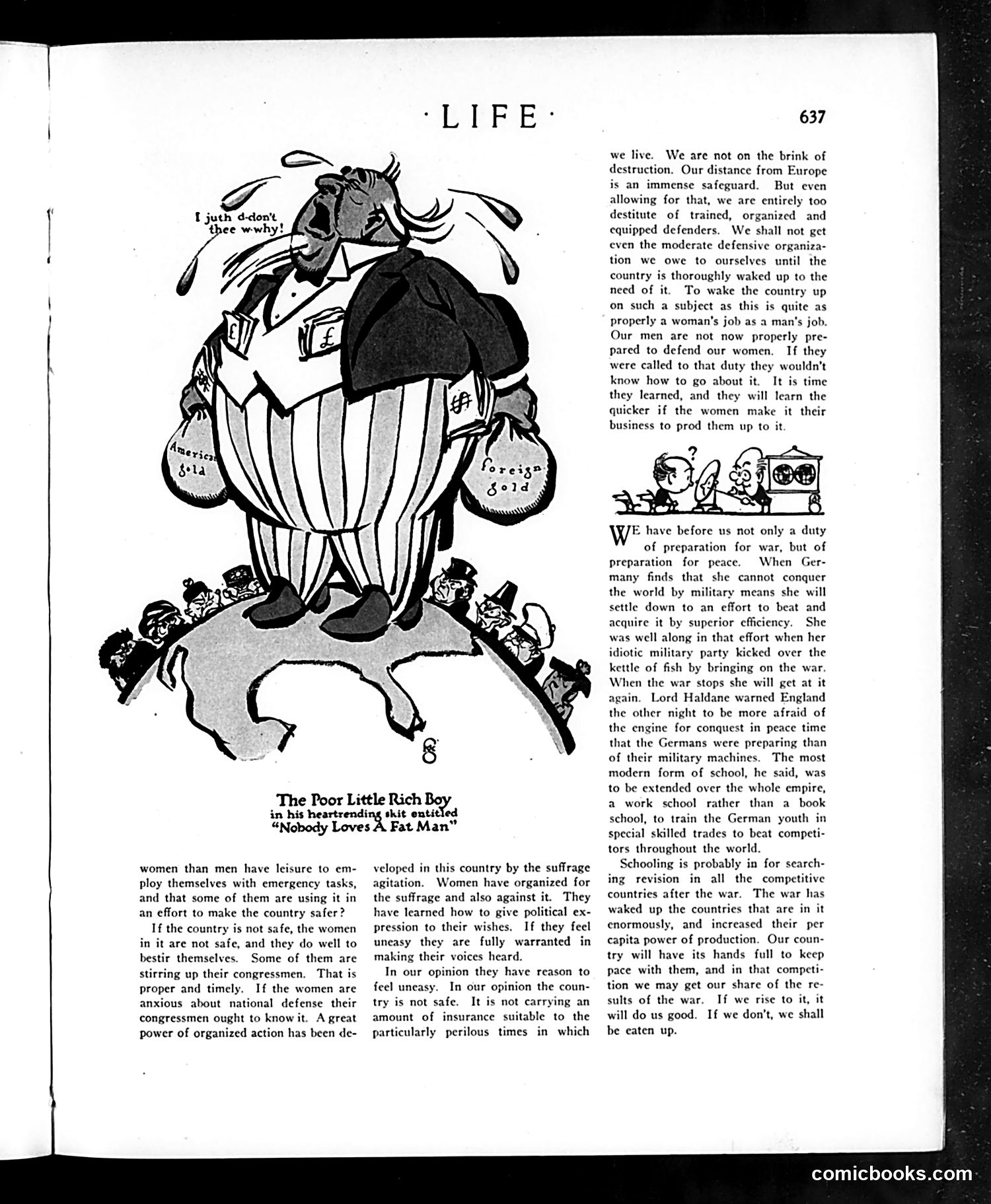
This political cartoon satirizes American military unpreparedness before World War I. The central figure—a bloated, pampered Uncle Sam labeled "The Poor Little Rich Boy"—sits atop a globe while crying "I juth d-don't thee wwhy!" (a baby's whine). Money bags labeled "American Gold" and "Foreign Gold" hang from his sides, while small figures (appearing to be politicians or military leaders) cower beneath him. The satire targets America's complacency: despite vast wealth and resources, the nation lacks trained defenders and adequate military organization. The accompanying text argues women should pressure congressmen to demand preparedness, comparing Germany's systematic training programs to America's neglect. The cartoon mocks privileged American isolation—wealthy but dangerously vulnerable—warning that post-war economic competition will demand the same aggressive efficiency Germany demonstrated militarily.
📄 Transcribed text from this page (OCR, searchable)
Machine-transcribed from the original scan — historical spelling and the odd misread are preserved.
Mm I juth d-don't thee wwhy 8 The Poor Little Rich in his heartrendi “Nobody Loves women than men have leisure to em- ploy themselves with emergency tasks, and that some of them are using it in an effort to make the country safer? If the country is not safe, the women in it are not safe, and they do well to bestir themselves. Some of them are stirring up their congressmen. That is proper and timely. If the women are anxious about national defense their congressmen ought to know it. A great power of organized action has been de- shit entitled Fat Man” veloped in this country by the suffrage agitation. Women have organized for the suffrage and also against it. They have learned how to give political ex- pression to their wishes. If they feel uneasy they are fully warranted in making their voices heard. In our opinion they have reason to feel uneasy. In our opinion the coun- try is not safe. It is not carrying an amount of insurance suitable to the particularly perilous times in which 637 we live. We are not on the brink of destruction. Our distance from Europe is an immense safeguard. But even allowing for that, we are entirely too destitute of trained, organized and equipped defenders. We shall not get even the moderate defensive organiza- tion we owe to ourselves until the country is thoroughly waked up to the need of it. To wake the country up on such a subject as this is quite as properly a woman's job as a man’s job. Our men are not now properly pre- pared to defend our women. If they were called to that duty they wouldn't know how to go about it. It is time they learned, and they will learn the quicker if the women make it their business to prod them up to it E have before us not only a duty of preparation for war, but of Preparation for peace. When Ger- many finds that she cannot conquer the world by military means she will settle down to an effort to beat and acquire it by superior efficiency. She as well along in that effort when her idiotic military party kicked over the kettle of fish by bringing on the war. When the war stops she will get at it again. Lord Haldane warned England the other night to be more afraid of the engine for conquest in peace time that the Germans were preparing than of their military machines. The most modern form of school, he said, was to be extended over the whole empire, a work school rather than a book school, to train the German youth in special skilled trades to beat competi- tors throughout the world. Schooling is probably in for search- ing revision in all the competitive countries after the war. The war has waked up the countries that are in it enormously, and increased their per capita power of production. Our coun- try will have its hands full to keep pace with them, and in that competi- tion we may get our share of the re- sults of the war. If we rise to it, it will do us good. If we don’t, we shall be eaten up. comicbooks.com