
Life, 1916-04-06 · page 50 of 80
Life — April 6, 1916 — page 50: what you’re looking at
What you’re looking at
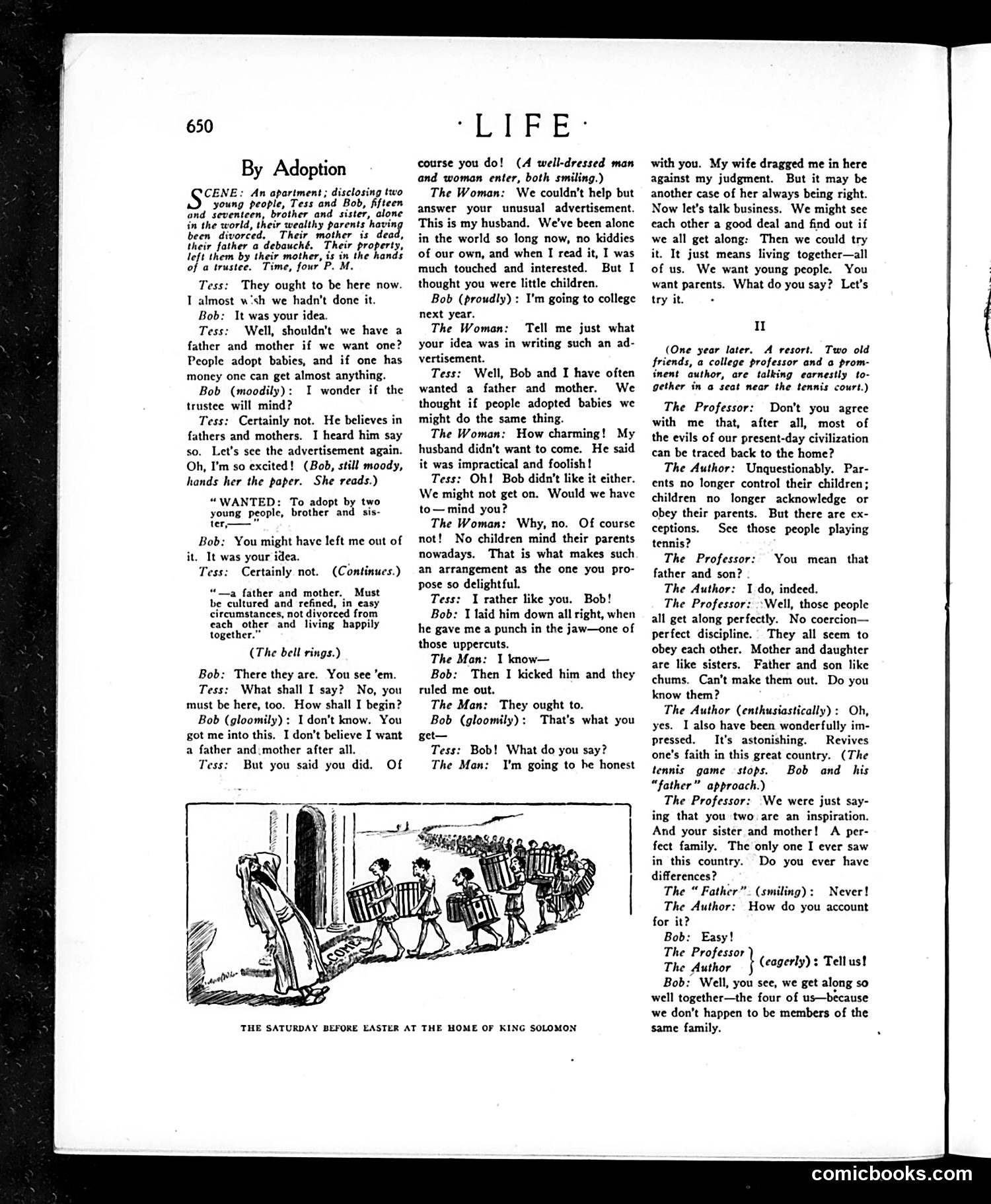
This is a satirical two-part dialogue about unconventional family formation. Two orphaned siblings, Tess and Bob, place a newspaper advertisement seeking to *adopt* parents—reversing the normal adoption process. They interview a cultured couple seeking children, and the arrangement succeeds. The satire targets early 20th-century anxieties about family breakdown. The dialogue emphasizes that modern children don't obey parents ("No children mind their parents nowadays"), divorced parents are common, and traditional family structures are collapsing. The second part (one year later) reveals the joke's punchline: the Professor considers this blended family a perfect exception to societal decline—proof that modern families *can* work. The satire mocks both the assumption that families are failing *and* the naive hope that unconventional arrangements might fix it. The illustration shows the foursome approaching—suggesting the experiment actually worked, which is the surprising, somewhat absurd resolution.
📄 Transcribed text from this page (OCR, searchable)
Machine-transcribed from the original scan — historical spelling and the odd misread are preserved.
650 By Adoption CENE: An apartment; disclosing two young people, Tess and Bob, fifteen and seventeen, brother and sister, alone in the world, their wealthy parents havin; been divorced. Their mother is dead, their father a debauché, Their property, left them by their mother, is in the hands of a trustee. Time, four P. M. Tess: They ought to be here now. T almost wish we hadn't done it. Bob: It was your idea Tess: Well, shouldn't we have a father and mother if we want one? People adopt babies, and if one has money one can get almost anything. Bob (moodily): I wonder if the trustee will mind? Tess: Certainly not. He believes in fathers and mothers. I heard him say so. Let's see the advertisement again. Oh, I'm so excited! (Bob, still moody, hands her the paper. She reads.) “WANTED: To adopt by two young people, brother and sis- ter, Bob: You might have left me out of it. It was your idea. Tess: Certainly not. (Continues.) “—a father and mother. Must be cultured and refined, in easy circumstances, not divorced from each other and living happily together.” (The bell rings.) Bob: There they are. You see 'em. Tess: What shall I say? No, you must be here, too. How shall I begin? Bob (gloomily): I don't know. You got me into this. I don’t believe I want a father and.mother after all. Tess: But you said you did. Of “TES * course you do! (A well-dressed man and woman enter, both smiling.) The Woman: We couldn't help but answer your unusual advertisement. This is my husband. We've been alone in the world so long now, no kiddies of our own, and when I read it, I was much touched and interested. But I thought you were little children. Bob (proudly) : I'm going to college next year. The Woman: Tell me just what your idea was in writing such an ad- vertisement. Tess: Well, Bob and I have often wanted a father and mother. We thought if people adopted babies we might do the same thing. The Woman: How charming! My husband didn't want to come. He said it was impractical and foolish! Tess: Oh! Bob didn’t like it either. We might not get on. Would we have to— mind you? The Woman: Why, no. Of course not! No children mind their parents nowadays. That is what makes such an arrangement as the one you pro- pose so delightful. Tess: I rather like you. Bob! Bob: I laid him down all right, when he gave me a punch in the jaw—one of those uppercuts. The Man: 1 know— Bob: Then I kicked him and they tuled me out. The Man: They ought to. Bob (gloomily): That's what you get— Tess: Bob! What do you say? The Man: I'm going to he honest THE SATURDAY BEFORE EASTER AT THE HOME OF KING SOLOMON with you. My wife dragged me in here against my judgment. But it may be another case of her always being right. Now let’s talk business. We might see each other a good deal and find out if we all get along: Then we could try it. It just means living together—all of us. We want young people. You want parents. What do you say? Let’s try it. . I (One year later. A resort. Two old friends, a college professor and a prom- inent author, are talking earnestly to- gether in a seat near the tennis court.) The Professor: Don't you agree with me that, after all, most of the evils of our present-day civilization can be traced back to the home? The Author: Unquestionably. Par- ents no longer control their children; children no longer acknowledge or obey their parents. But there are ex- ceptions. See those people playing tennis? The Professor: father and son? The Author: 1 do, indeed. The Professor: Well, those people all get along perfectly. No coercion— perfect discipline. They all seem to obey each other. Mother and daughter are like sisters. Father and son like chums. Can't make them out. Do you know them? The Author (enthusiastically): Oh, yes. I also have been wonderfully im- pressed. It's astonishing. Revives one’s faith in this great country. (The tennis game stops. Bob and his “father” approach.) The Professor: We were just say- ing that you two. are an inspiration. And your sister and mother! A per- fect family. The only one I ever saw in this country. Do you ever have differences? The “ Father”. (smiling): Never! The Author: How do you account for it? Bob: Easy! He heeled } (eagerly): Tell ust Bob: Well, you see, we get along so well together—the four of us—because we don’t happen to be members of the same family. You mean that comicbooks.com