
Life, 1916-04-06 · page 44 of 80
Life — April 6, 1916 — page 44: what you’re looking at
What you’re looking at
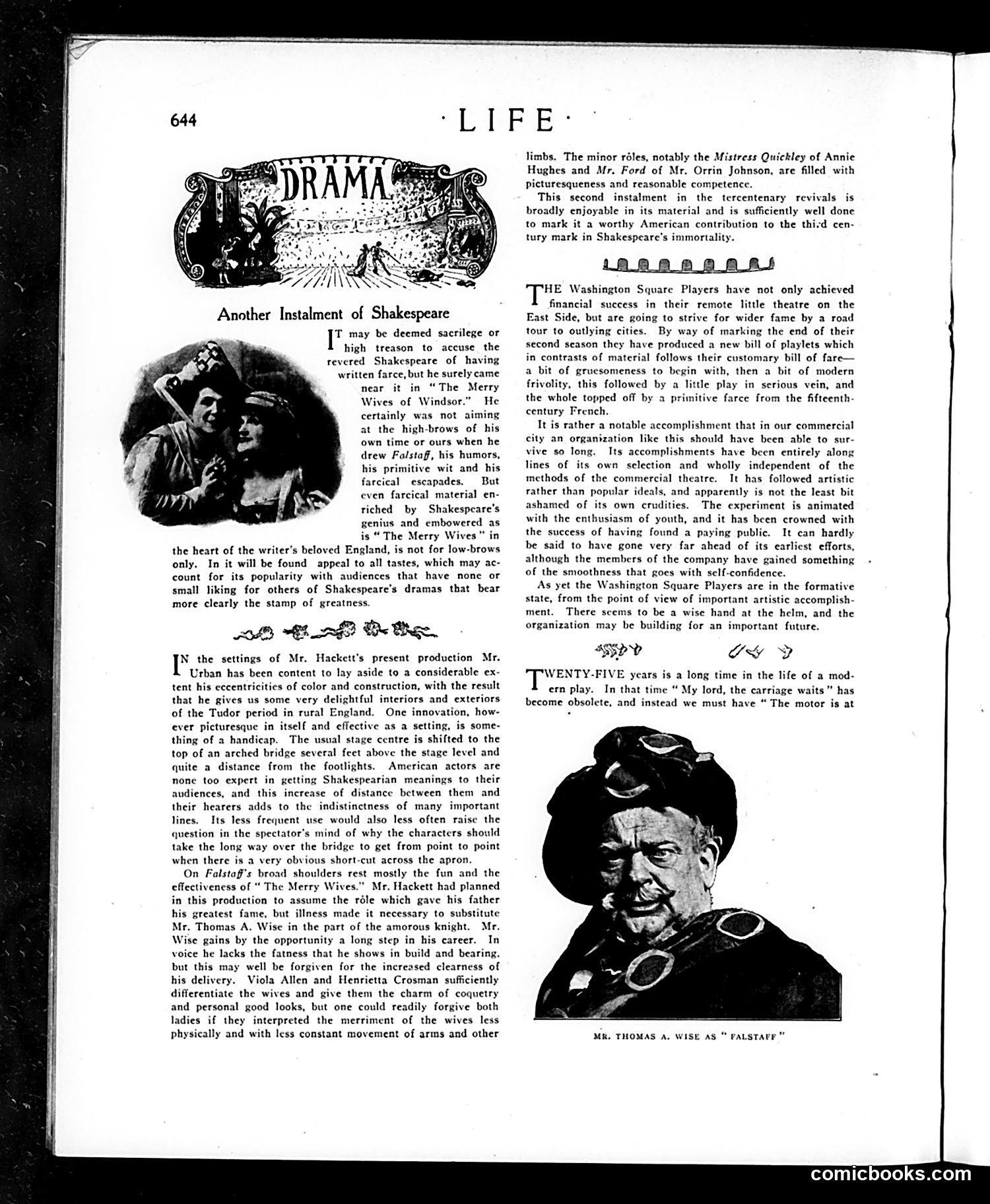
This page reviews a theatrical production of Shakespeare's *The Merry Wives of Windsor*, directed by Mr. Hackett. The critic discusses the play's status as "farce" rather than high art, yet notes its popular appeal across audiences. The review praises the Tudor-period set design by Mr. Urban but criticizes an innovative raised bridge stage that distances actors from audiences, making their dialogue unclear—a problem compounded by American actors' general difficulty conveying Shakespearean meaning. Thomas A. Wise (shown in the photograph as "Falstaff") substituted for the ailing Mr. Hackett in the lead role. The critic praises Wise's clear delivery and notes actresses Viola Allen and Henrietta Crosman as the wives, though finding their physical comedy excessive. The piece frames this as part of "tercentenary revivals"—celebrations of Shakespeare's legacy—and declares it a worthy American theatrical contribution.
📄 Transcribed text from this page (OCR, searchable)
Machine-transcribed from the original scan — historical spelling and the odd misread are preserved.
“EEE * Another Instalment of Shakespeare T may be deemed sacrilege or high treason to accuse the revered Shakespeare of having written farce, but he surely came near it in “The Merry Wives of Windsor.” He certainly was not aiming at the high-brows of his own time or ours when he drew Falstaf, his humors, his primitive wit and his farcical escapades, But even farcical material en- tiched by Shakespeare's genius and embowered as is “ The Merry Wives” in the heart of the writer's beloved England, is not for low-brows only, In it will be found appeal to all tastes, which may ac- count for its popularity with audiences that have none or small liking for others of Shakespeare's dramas that bear more clearly the stamp of greatness. A EAE Bx Bh, the settings of Mr. Hackett's present production Mr. Urban has been content to lay aside to a considerable ex- tent his eccentricities of color and construction, with the result that he gives us some very delightful interiors and exteriors of the Tudor period in rural England. One innovation, how- ever picturesque in itself and effective as a setting, is some- thing of a handicap. The usual stage centre is shifted to the top of an arched bridge several feet above the stage level and quite a distance from the footlights. American actors are none too expert in getting Shakespearian meanings to their audiences, and this increase of distance between them and their hearers adds to the indistinctness of many important lines. Its less frequent use would also less often raise the question in the spectator’s mind of why the characters should take the long way over the bridge to get from point to point when there is a very obvious short-cut across the apron. On Falstaff’s broad shoulders rest mostly the fun and the effectiveness of “ The Merry Wives.” Mr. Hackett had planned in this production to assume the rdle which gave his father his greatest fame, but illness made it necessary to substitute Mr. Thomas A. Wise in the part of the amorous knight. Mr. Wise gains by the opportunity a long step in his career. In voice he lacks the fatness that he shows in build and bearing, but this may well be forgiven for the increased clearness of his delivery. Viola Allen and Henrietta Crosman sufficiently differentiate the wives and give them the charm of coquetry and personal good looks, but one could readily forgive both ladies if they interpreted the merriment of the wives less physically and with less constant movement of arms and other limbs. The minor réles, notably the Mistress Quickley of Annie Hughes and Mr. Ford of Mr. Orrin Johnson, are filled with picturesqueness and reasonable competence. This second instalment in the tercentenary revivals is broadly enjoyable in its material and is sufficiently well done to mark it a worthy American contribution to the third cen- tury mark in Shakespeare's immortality. IAA MO 9 A BS HE Washington Square Players have not only achieved financial success in their remote little theatre on the East Side, but are going to strive for wider fame by a road tour to outlying cities. By way of marking the end of their second season they have produced a new bill of playlets which in contrasts of material follows their customary bill of fare— a bit of gruesomeness to begin with, then a bit of modern frivolity, this followed by a little play in serious vein, and the whole topped off by a primitive farce from the fifteenth- century French. It is rather a notable accomplishment that in our commercial city an organization like this should have been able to sur- vive so long. Its accomplishments have been entirely along lines of its own selection and wholly independent of the methods of the commercial theatre. It has followed artistic rather than popular ideals, and apparently is not the least bit ashamed of its own crudities. The experiment is animated with the enthusiasm of youth, and it has been crowned with the success of having found a paying public. It can hardly be said to have gone very far ahead of its earliest efforts, although the members of the company have gained something of the smoothness that goes with self-confidence. As yet the Washington Square Players are in the formative state, from the point of view of important artistic accomplish- ment. There scems to be a wise hand at the helm, and the organization may be building for an important future. Sv oy ? WENTY-FIVE years is a long time in the life of a mod- ern play. In that time “ My lord, the carriage waits” has become obsolete, and instead we must have “ The motor is at MR. THOMAS A. WISE AS “ FALSTAFF” comicbooks.com