
Life, 1916-04-06 · page 24 of 80
Life — April 6, 1916 — page 24: what you’re looking at
What you’re looking at
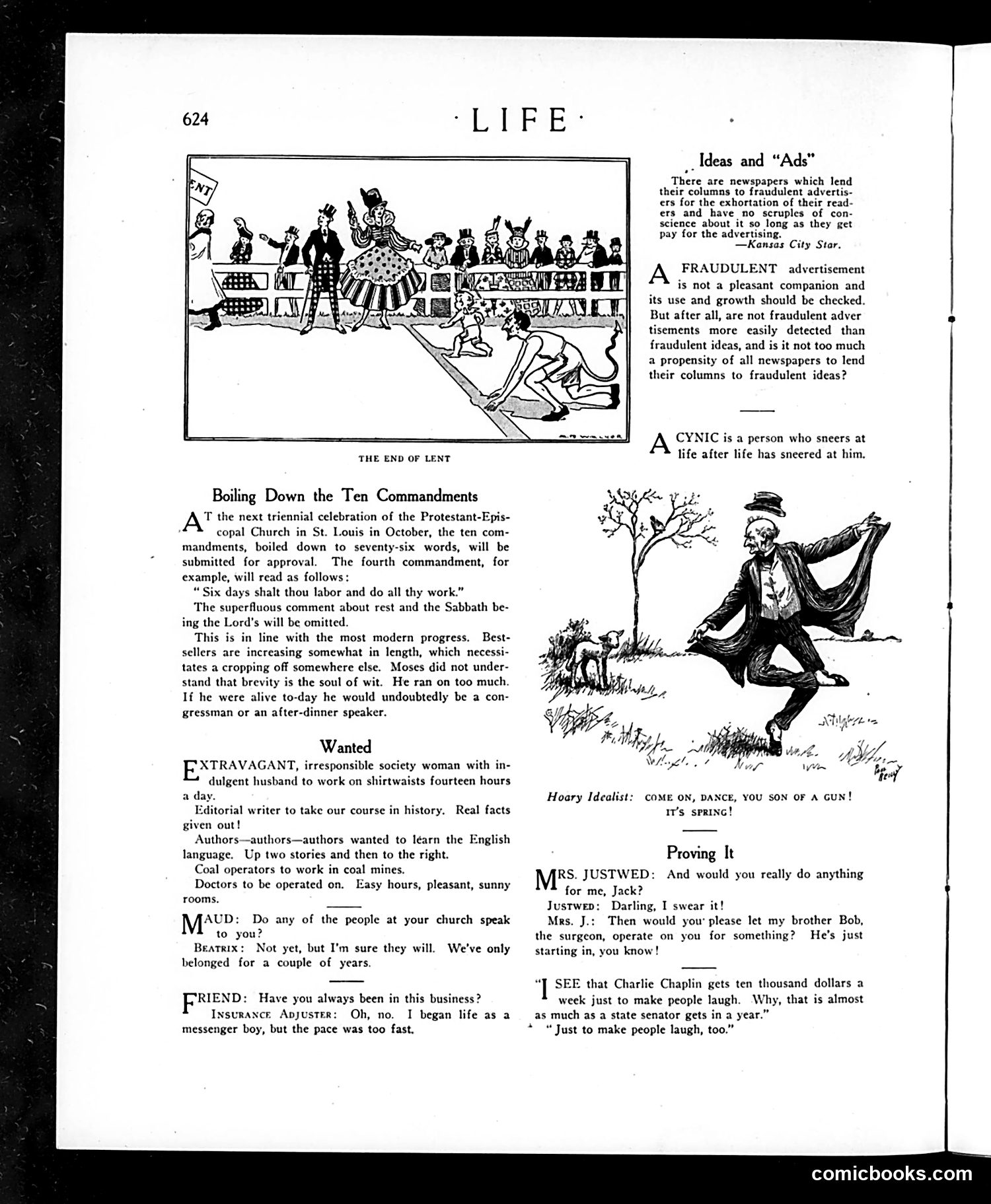
This page satirizes early 20th-century trends toward oversimplification and commercialism: **"The End of Lent" cartoon** depicts the end of the Lenten season with a circus-like crowd scene, likely commenting on how religious observance had become casual entertainment. **"Boiling Down the Ten Commandments"** mocks the Protestant Episcopal Church's plan to condense the commandments to 76 words for their St. Louis conference. The satire suggests that modern efficiency culture—where bestsellers grow longer requiring cuts elsewhere—is reducing sacred texts to business-like brevity. The jab at Moses becoming "a congressman or after-dinner speaker" if alive today ridicules contemporary politicians' verbose speechifying. **"Wanted" section** presents absurdist job postings (irresponsible society women, coal doctors "to be operated on") mocking classified advertising's dishonesty. The right side critiques **fraudulent newspaper advertising**, arguing that fraudulent *ideas* spread more easily than fraudulent products—a media ethics concern still relevant today. Smaller jokes mock social climbing, insurance salesmen's burnout, and the disparity between entertainers' and politicians' salaries.
📄 Transcribed text from this page (OCR, searchable)
Machine-transcribed from the original scan — historical spelling and the odd misread are preserved.
THE END OF LENT Boiling Down the Ten Commandments T the next triennial celebration of the Protestant-Epis- copal Church in St. Louis in October, the ten com- mandments, boiled down to seventy-six words, will be submitted for approval. The fourth commandment, for example, will read as follows: “Six days shalt thou labor and do all thy work.” The superfluous comment about rest and the Sabbath be- ing the Lord's will be omitted. This is in line with the most modern progress. Best- sellers are increasing somewhat in length, which necessi- tates a cropping off somewhere else. Moses did not under- stand that brevity is the soul of wit. He ran on too much. If he were alive to-day he would undoubtedly be a con- gressman or an after-dinner speaker. Wanted XTRAVAGANT, irresponsible society woman with in- dulgent husband to work on shirtwaists fourteen hours ad. litorial writer to take our course in history. Real facts given out! Authors—authors—authors wanted to l¢arn the English language. Up two stories and then to the right. Coal operators to work in coal mines. Doctors to be operated on. Easy hours, pleasant, sunny rooms. M*: Do any of the people at your church speak to you? Beatrix: Not yet, but I'm sure they will. We've only belonged for a couple of years. RIEND: Have you always been in this business? Insurance Apjuster: Oh, no. I began life as a messenger boy, but the pace was too fast. __ Ideas and “Ads” There are newspapers which lend their columns to fraudulent advertis- ers for the exhortation of their read- ers and have no scruples of con- science about it so long as they get pay for the advertising. —Kansas City Star. FRAUDULENT advertisement is not a pleasant companion and its use and growth should be checked. But after all, are not fraudulent adver tisements more easily detected than fraudulent ideas, and is it not too much a propensity of all newspapers to lend their columns to fraudulent ideas? CYNIC is a person who sneers at life after life has sneered at him. Hoary Idealist: coME ON, DANCE, YOU SON OF A GUN! 17's sprinc! Proving It RS. JUSTWED: And would you really do anything for me, Jack? Justwep: Darling, I swear it! Mrs. J.: Then would you please let my brother Bob, the surgeon, operate on you for something? He’s just starting in, you know! “] SEE that Charlie Chaplin gets ten thousand dollars a week just to make people laugh. Why, that is almost as much as a state senator gets in a year.” “ Just to make people laugh, too.” comicbooks.com