
Life, 1916-04-06 · page 32 of 80
Life — April 6, 1916 — page 32: what you’re looking at
What you’re looking at
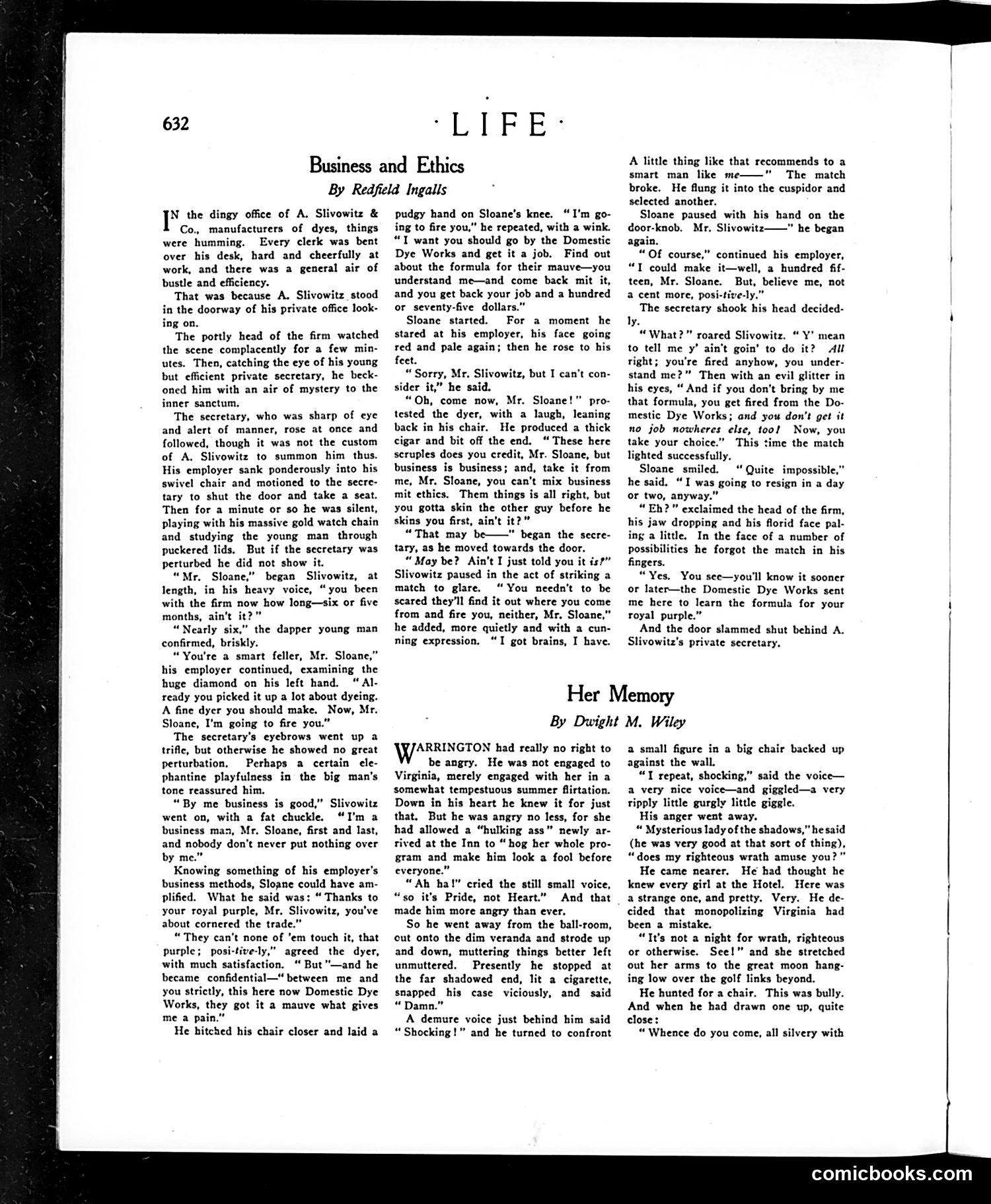
This story satirizes the casual amorality of early industrial business practices. The protagonist, A. Slivowitz—a dye manufacturer with a thick accent suggesting Eastern European immigrant wealth—represents the ruthless businessman who views ethics as an obstacle to profit. The satire centers on Slivowitz's proposition to his secretary Sloane: he'll fire him, then rehire him (with a bonus) if Sloane industrial espionage by stealing a competitor's mauve dye formula from the Domestic Dye Works. The joke is Slivowitz's breathtaking hypocrisy: he claims business success while explicitly stating "you can't mix business mit ethics"—yet he tries to justify the theft as normal practice ("skin the other guy before he skins you"). Sloane's refusal to accept marks him as the moral counterpoint. The satire suggests that while men like Slivowitz dominate commerce through ruthlessness, genuine integrity remains possible—and perhaps admirable—among working men. This reflects Progressive-era anxieties about unchecked corporate behavior.
📄 Transcribed text from this page (OCR, searchable)
Machine-transcribed from the original scan — historical spelling and the odd misread are preserved.
‘LIFE: Business and Ethics By Redfield Ingalis N the dingy office of A. Slivowitz & Co, manufacturers of dyes, things were humming. Every clerk was bent over his desk, hard and cheerfully at work, and there was a general air of bustle and efficiency. That was because A. Slivowitz stood in the doorway of his private office look- ing on. The pottly head of the firm watched the scene complacently for a few min- utes. Then, catching the eye of his young but efficient private secretary, he beck- oned him with an air of mystery to the inner sanctum. The secretary, who was sharp of eye and alert of manner, rose at once and followed, though it was not the custom of A. Slivowitz to summon him thus. His employer sank ponderously into his swivel chair and motioned to the secre- tary to shut the door and take a seat. Then for a minute or so he was silent, playing with his massive gold watch chain and studying the young man through puckered lids, But if the secretary was perturbed he did not show it. “Mr, Sloane,” began Slivowitz, at length, in his heavy voice, “you been with the firm now how long—six or five months, ain't it “Nearly six,” the dapper young man confirmed, briskly. “You're a smart feller, Mr. Sloane,” his employer continued, examining the huge diamond on his left hand. “ Al- ready you picked it up a lot about dyeing. A fine dyer you should make. Now, Mr. Sloane, I'm going to fire you.” The secretary's eyebrows went up a trifle, but otherwise he showed no great perturbation, Perhaps a certain ele- phantine playfulness in the big man’s tone reassured him. “By me business is good,” Slivowitz went on, with a fat chuckle. “I'm a business man, Mr. Sloane, first and last, and nobody don’t never put nothing over by me.” Knowing something of his employer's business methods, Sloane could have am- plified. What he said was: “ Thanks to your royal purple, Mr, Slivowitz, you've about cornered the trade.” “ They can’t none of ‘em touch it, that purple; posi-tive-ly,” agreed the dyer, with much satisfaction. “ But "—and he became confidential—“ between me and you strictly, this here now Domestic Dye Works, they got it a mauve what gives me a pain.” He hitched his chair closer and laid a pudgy hand on Sloane's knee. “I'm go- ing to fire you,” he repeated, with a wink. “TI want you should go by the Domestic Dye Works and get it a job. Find out about the formula for their mauve—you understand me—and come back mit it, and you get back your job and a hundred or seventy-five dollars.” Sloane started. For a moment he stared at his employer, his face going red and pale again; then he rose to his feet. “ Sorry, Mr. Slivowitz, but I can’t con- sider it,” he said. “Oh, come now, Mr. Sloane!” pro- tested the dyer, with a laugh, leaning back in his chair. He produced a thick cigar and bit off the end. “ These here scruples does you credit, Mr. Sloane, but business is business; and, take it from me, Mr, Sloane, you can’t mix business mit ethics. Them things is all right, but you gotta skin the other guy before he skins you first, ain't it?” “That may be——” began the secre- tary, as he moved towards the door. “ May be? Ain’t I just told you it is?” Slivowitz paused in the act of striking a match to glare. “You needn't to be scared they'll find it out where you come from and fire you, neither, Mr. Sloane,” he added, more quietly and with a cun- ning expression. “I got brains, I have. A little thing like that recommends to a smart man like me——" The match broke. He flung it into the cuspidor and selected another. Sloane paused with his hand on the door-knob. Mr. Slivowitz——” he began again. “Of course,” continued his employer, “T could make it—well, a hundred fif- teen, Mr. Sloane. But, believe me, not a cent more, posi-tive-ly.” The secretary shook his head decided- ly. “What?” roared Slivowitz. “ Y’ mean to tell me y’ ain't goin’ to do it? All right; you're fired anyhow, you under- stand me?” Then with an evil glitter in his eyes, “And if you don't bring by me that formula, you get fired from the Do- mestic Dye Works; and you don’t get it no job nowheres else, too! Now, you take your choice.” This time the match lighted successfully. Sloane smiled. “Quite impossible,” he said. “I was going to resign in a day or two, anyway.” “Eh?” exclaimed the head of the firm, his jaw dropping and his florid face pal- ing a little, In the face of a number of possibilities he forgot the match in his fingers. “Yes, You see—you'll know it sooner or later—the Domestic Dye Works sent me here to learn the formula for your royal purple.” And the door slammed shut behind A. Slivowitz’s private secretary, Her Memory By Dwight M. Wiley ARRINGTON had really no right to be angry. He was not engaged to Virginia, merely engaged with her in a somewhat tempestuous summer flirtation. Down in his heart he knew it for just that, But he was angry no less, for she had allowed a “hulking ass” newly ar- rived at the Inn to “hog her whole pro- gram and make him look a fool before everyone.” “Ah hal” cried the still small voice, “so it’s Pride, not Heart.” And that made him more angry than ever. So he went away from the ball-room, out onto the dim veranda and strode up and down, muttering things better left unmuttered. Presently he stopped at the far shadowed end, lit a cigarette, snapped his case viciously, and said “ Damn.” A demure voice just behind him said “ Shocking!” and he turned to confront a small figure in a big chair backed up against the wall. “T repeat, shocking,” said the voice— a very nice voice—and giggled—a very ripply little gurgly little giggle. His anger went away. “ Mysterious lady of the shadows,” he said (he was very good at that sort of thing), “does my righteous wrath amuse you?” He came nearer. He had thought he knew every girl at the Hotel. Here was a strange one, and pretty. Very. He de- cided that monopolizing Virginia had been a mistake. “Tr’s not a night for wrath, righteous or otherwise. See!” and she stretched out her arms to the great moon hang- ing low over the golf links beyond. He hunted for a chair. This was bully. And when he had drawn one up, quite close: “Whence do you come, all silvery with comicbooks.com