
Life, 1916-04-06 · page 31 of 80
Life — April 6, 1916 — page 31: what you’re looking at
What you’re looking at
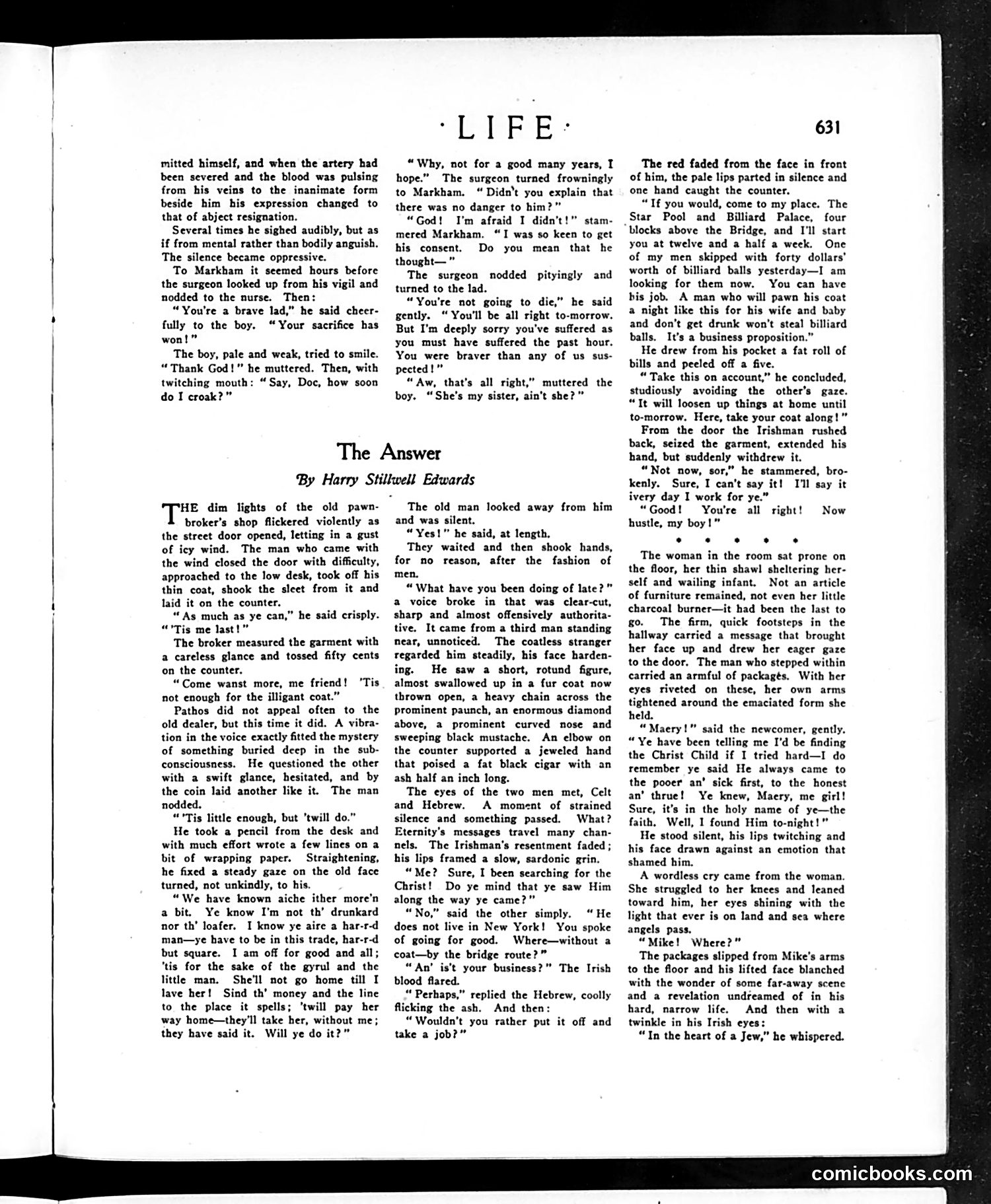
This page presents a short story rather than a political cartoon. "The Answer" depicts a dramatic encounter in a pawnbroker's shop between an impoverished Irish immigrant (described as "Celt") and a Jewish pawnbroker, interrupted by an authoritative third man. The narrative centers on the Irishman pawning his coat as a final act of sacrifice for his family's welfare—he's leaving permanently to ensure his daughter and "little man" (likely son) reach safety through the pawnbroker's assistance. The tension climaxes when an imperious gentleman in furs and diamonds interrupts, establishing himself as a figure of wealth and power. The story appears to explore themes of class struggle, ethnic identity, and dignity amid poverty. The visual and textual emphasis on the contrasting figures—the desperate working-class Irishman versus the wealthy authority figure—suggests social commentary on inequality and the human cost of economic disparity in early 20th-century America.
📄 Transcribed text from this page (OCR, searchable)
Machine-transcribed from the original scan — historical spelling and the odd misread are preserved.
mitted himself, and when the artery had been severed and the blood was pulsing from his veins to the inanimate form beside him his expression changed to that of abject resignation. Several times he sighed audibly, but as if from mental rather than bodily anguish. The silence became oppressive. To Markham it seemed hours before the surgeon looked up from his vigil and nodded to the nurse. Then: “You're a brave lad,” he said cheer- fully to the boy. “Your sacrifice has won!” The boy, pale and weak, tried to smile. “Thank God!" he muttered. Then, with twitching mouth: “Say, Doc, how soon do I croak?” TEE. “Why, not for a good many years, I hope.” The surgeon turned frowningly to Markham. “Didn't you explain that there was no danger to him?” “God! I'm afraid I didn’t!" stam- mered Markham. “I was so keen to get his consent. Do you mean that he thought— ” The surgeon nodded pityingly and turned to the lad. “You're not going to die,” he said gently. “You'll be all right to-morrow. But I’m deeply sorry you've suffered as you must have suffered the past hour. You were braver than any of us sus- pected!” “ Aw, that’s all right,” muttered the boy. “She's my sister, ain't she?” The Answer By Harry Stillwell Edwards HE dim lights of the old pawn- broker’s shop flickered violently as the street door opened, letting in a gust of icy wind. The man who came with the wind closed the door with difficulty, approached to the low desk, took off his thin coat, shook the sleet from it and laid it on the counter. “As much as ye can,” he said crisply. “Tis me last!” The broker measured the garment with a careless glance and tossed fifty cents on the counter. “Come wanst more, me friend! not enough for the illigant coat.” Pathos did not appeal often to the old dealer, but this time it did. A vibra- tion in the voice exactly fitted the mystery of something buried deep in the sub- consciousness. He questioned the other with a swift glance, hesitated, and by the coin laid another like it. The man nodded. “'Tis little enough, but ‘twill do.” He took a pencil from the desk and with much effort wrote a few lines on a bit of wrapping paper. Straightening, he fixed a steady gaze on the old face turned, not unkindly, to his. “We have known aiche ither more’n a bit. Ye know I'm not th’ drunkard nor th’ loafer. I know ye aire a har-r-d man—ye have to be in this trade, har-r-d but square. I am off for good and all; ‘tis for the sake of the gyrul and the little man. She'll not go home till I lave her! Sind th’ money and the line to the place it spells; ‘twill pay her ‘Tis way home—they’ll take her, without me; they have said it. Will ye do it?” The old man looked away from him and was silent. “Yes!” he said, at length, They waited and then shook hands, for no reason, after the fashion of men. “What have you been doing of late?” a voice broke in that was clear-cut, sharp and almost offensively authorita- tive. It came from a third man standing near, unnoticed. The coatless stranger regarded him steadily, his face harden- ing. He saw a short, rotund figure, almost swallowed up in a fur coat now thrown open, a heavy chain across the Prominent paunch, an enormous diamond above, a prominent curved nose and sweeping black mustache. An elbow on the counter supported a jeweled hand that poised a fat black cigar with an ash half an inch long. The eyes of the two men met, Celt and Hebrew. A moment of strained silence and something passed. What? Eternity’s messages travel many chan- nels. The Irishman’s resentment faded ; his lips framed a slow, sardonic grin. “Me? Sure, I been searching for the Christ! Do ye mind that ye saw Him along the way ye came?” “No,” said the other simply. “He does not live in New York! You spoke of going for good. Where—without a coat—by the bridge route?” “An’ is't your business?” The Irish blood flared. “ Perhaps,” replied the Hebrew, coolly flicking the ash. And then: “Wouldn't you rather put it off and take a job?” 631 The red faded from the face in front of him, the pale lips parted in silence and one hand caught the counter. “If you would, come to my place. The Star Pool and Billiard Palace, four blocks above the Bridge, and I'll start you at twelve and a half a week. One of my men skipped with forty dollars’ worth of billiard balls yesterday—I am looking for them now. You can have bis job. A man who will pawn his coat a night like this for his wife and baby and don’t get drunk won't steal billiard balls. It’s a business proposition.” He drew from his pocket a fat roll of bills and peeled off a five. “Take this on account,” he concluded, studiously avoiding the other’s gaze. “It will loosen up things at home until to-morrow. Here, take your coat along!” From the door the Irishman rushed back, seized the garment, extended his hand, but suddenly withdrew it. “Not now, sor,” he stammered, bro- kenly. Sure, I can’t say it! I'll say it ivery day I work for ye.” “Good! You're all right! Now hustle, my boy!” o 8 © © 6 The woman in the room sat prone on the floor, her thin shawl sheltering her- self and wailing infant. Not an article of furniture remained, not even her little charcoal burner—it had been the last to go. The firm, quick footsteps in the hallway carried a message that brought her face up and drew her eager gaze to the door. The man who stepped within carried an armful of packagts. With her eyes riveted on these, her own arms tightened around the emaciated form she held. “Maery!” said the newcomer, gently. “Ye have been telling me I'd be finding the Christ Child if I tried hard—I do remember ye said He always came to the pooer an’ sick first, to the honest an’ thrue! Ye knew, Maery, me girl! Sure, it’s in the holy name of ye—the faith, Well, 1 found Him to-night!" He stood silent, his lips twitching and his face drawn against an emotion that shamed him. A wordless cry came from the woman. She struggled to her knees and leaned toward him, her eyes shining with the light that ever is on land and sea where angels pass. “Mike! Where?” The packages slipped from Mike's arms to the floor and his lifted face blanched with the wonder of some far-away scene and a revelation undreamed of in his hard, narrow life. And then with a twinkle in his Irish eyes: “Tn the heart of a Jew, he whispered. comicbooks.com