
Life, 1916-04-06 · page 38 of 80
Life — April 6, 1916 — page 38: what you’re looking at
What you’re looking at
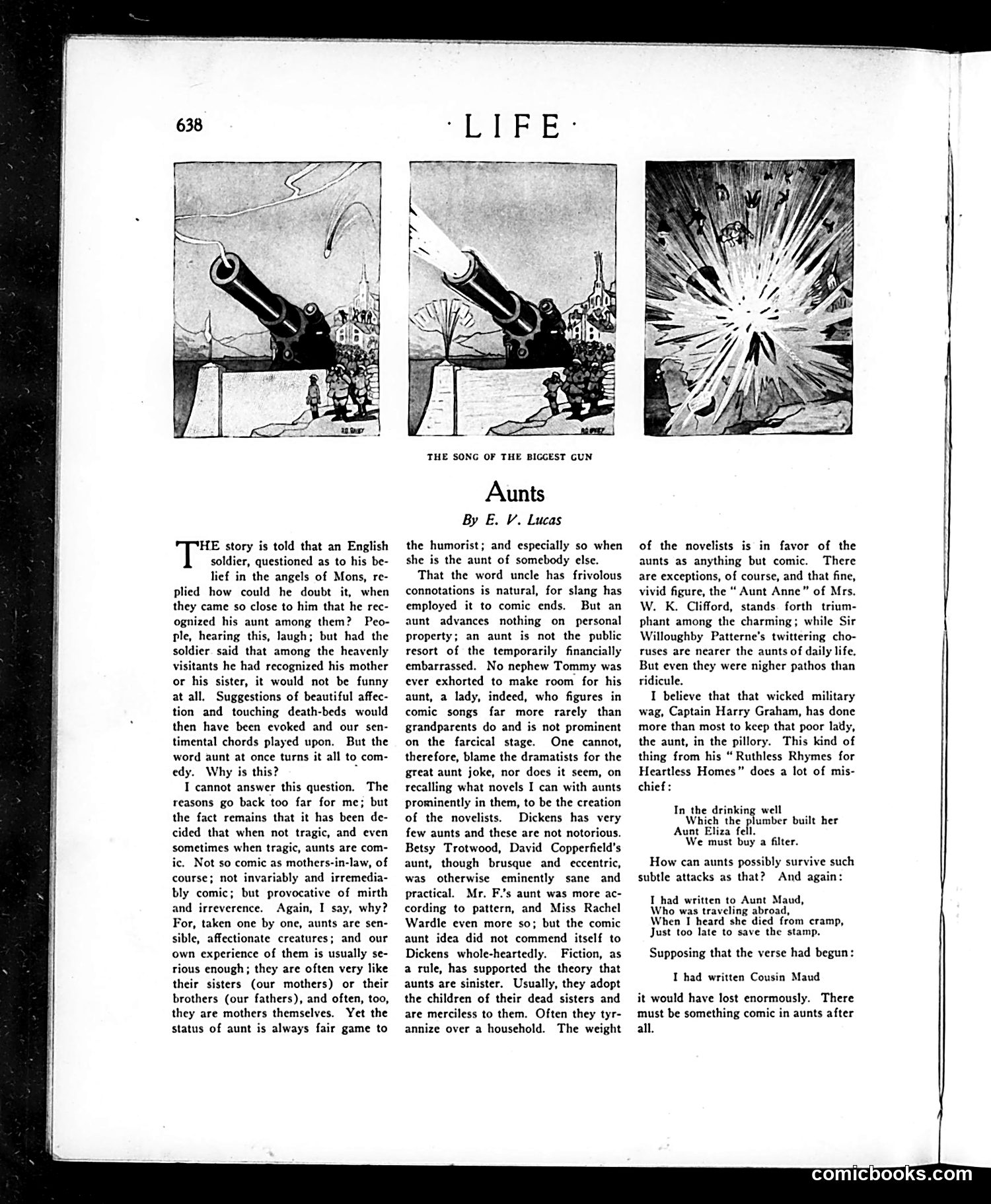
The three panels at top appear to depict WWI artillery in action—a cannon firing and its explosive result—titled "The Song of the Biggest Gun," likely satirizing the romanticization of warfare. Below, E.V. Lucas's essay "Aunts" humorously explores why aunts are culturally treated as comic figures while mothers and sisters are sentimental ones. Lucas notes that aunts appear prominently in humor and popular entertainment (citing military humorist Captain Harry Graham's darkly comic verses about aunts dying), yet observes that serious literature—Dickens, novels generally—treats aunts as sinister or tyrannical rather than funny. The piece's central paradox: aunts are individually sensible, affectionate people indistinguishable from mothers or sisters, yet their *status* as "aunt" automatically invites irreverence and mirth. Lucas cannot fully explain this cultural bias but documents its reality across Victorian and Edwardian literature and humor. The essay is a witty exploration of how social roles shape how we perceive the same person.
📄 Transcribed text from this page (OCR, searchable)
Machine-transcribed from the original scan — historical spelling and the odd misread are preserved.
HE story is told that an English soldier, questioned as to his be- lief in the angels of Mons, re- plied how could he doubt it, when they came so close to him that he rec- ognized his aunt among them? Peo- ple, hearing this, laugh; but had the soldier said that among the heavenly visitants he had recognized his mother or his sister, it would not be funny at all. Suggestions of beautiful affec- tion and touching death-beds would then have been evoked and our sen- timental chords played upon. But the word aunt at once turns it all to com- edy. Why is this? . T cannot answer this question. The reasons go back too far for me; but the fact remains that it has been de- cided that when not tragic, and even sometimes when tragic, aunts are com- ic. Not so comic as mothers-in-law, of course; not invariably and irremedia- bly comic; but provocative of mirth and irreverence. Again, I say, why? For, taken one by one, aunts are sen- sible, affectionate creatures; and our own experience of them is usually se- rious enough; they are often very like their sisters (our mothers) or their brothers (our fathers), and often, too, they are mothers themselves. Yet the status of aunt is always fair game to THE SONG OF THE BIGGEST GUN Aunts By E. V. Lucas the humorist; and especially so when she is the aunt of somebody else. That the word uncle has frivolous connotations is natural, for slang has employed it to comic ends. But an aunt advances nothing on personal property; an aunt is not the public resort of the temporarily financially embarrassed. No nephew Tommy was ever exhorted to make room for his aunt, a lady, indeed, who figures in comic songs far more rarely than grandparents do and is not prominent on the farcical stage. One cannot, therefore, blame the dramatists for the great aunt joke, nor does it seem, on recalling what novels I can with aunts prominently in them, to be the creation of the novelists. Dickens has very few aunts and these are not notorious. Betsy Trotwood, David Copperfield’s aunt, though brusque and eccentric, was otherwise eminently sane and practical. Mr. F.’s aunt was more ac- cording to pattern, and Miss Rachel Wardle even more so; but the comic aunt idea did not commend itself to Dickens whole-heartedly. Fiction, as a rule, has supported the theory that aunts are sinister. Usually, they adopt the children of their dead sisters and are merciless to them. Often they tyr- annize over a household. The weight of the novelists is in favor of the aunts as anything but comic. There are exceptions, of course, and that fine, vivid figure, the “ Aunt Anne” of Mrs. W. K. Clifford, stands forth trium- phant among the charming; while Sir Willoughby Patterne’s twittering cho- ruses are nearer the aunts of daily life. But even they were nigher pathos than ridicule. I believe that that wicked military wag, Captain Harry Graham, has done more than most to keep that poor lady, the aunt, in the pillory. This kind of thing from his “ Ruthless Rhymes for Heartless Homes” does a lot of mis- chief: In the drinking well Which the plumber built her Aunt Eliza fell. We must buy a filter. How can aunts possibly survive such subtle attacks as that? And again: I had written to Aunt Maud, Who was traveling abroad, When I heard she died from cramp, Just too late to save the stamp, Supposing that the verse had begun: IT had written Cousin Maud it would have lost enormously. There must be something comic in aunts after all. comicbooks.com