
Life, 1916-04-06 · page 59 of 80
Life — April 6, 1916 — page 59: what you’re looking at
What you’re looking at
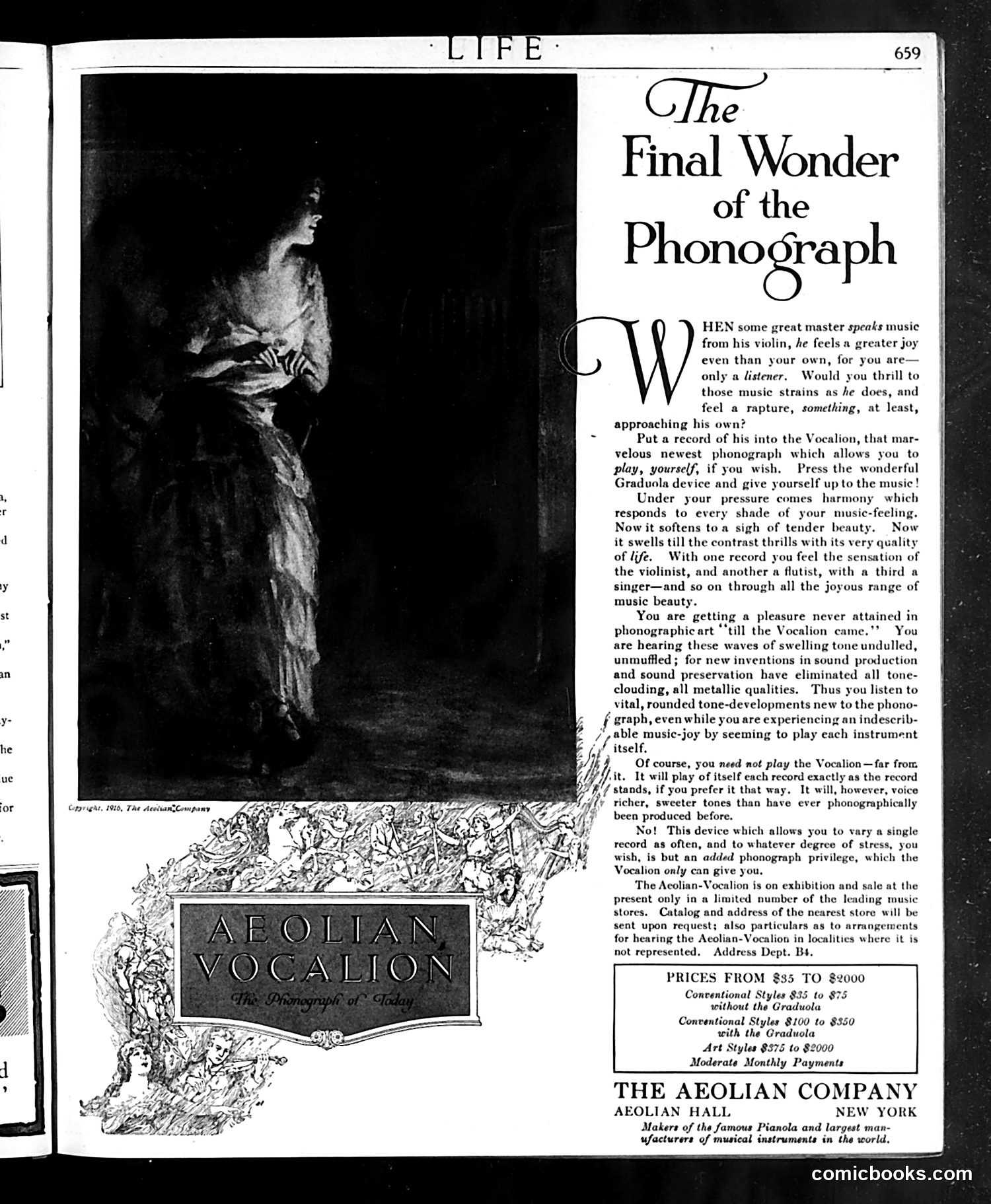
This page is primarily a **product advertisement**, not political satire. It promotes the Aeolian Vocalion phonograph, marketed as a revolutionary device that lets listeners actively participate in music rather than passively hear it. The image shows a woman in classical dress holding a violin, visually linking the phonograph to live musical performance. The ad's central pitch: the Vocalion's "Graduola device" allows users to control dynamics and expression—adjusting volume, softness, and intensity—to simulate the experience of performing music themselves. For modern readers, this reflects early-20th-century phonograph marketing's emphasis on **fidelity and interactivity**. The language ("vital, rounded tone," eliminating "metallic qualities") suggests phonographs were still perceived as tinny and inferior to live music. The ad positions the Vocalion as bridging that gap—offering unprecedented control and realism. Prices ranged from $35 to $2,000, with financing available, indicating this was aspirational consumer technology.
📄 Transcribed text from this page (OCR, searchable)
Machine-transcribed from the original scan — historical spelling and the odd misread are preserved.
659 e Final Wonder of the Phono graph HEN some great master speaks music from his violin, he feels a greater joy even than your own, for you are— only a listener. Would you thrill to those music strains as he does, and feel a rapture, something, at least, approaching his own? Put a record of his into the Vocalion, that mar- velous newest phonograph which allows you to play, yourself, if you wish. Press the wonderful Graduola device and give yourself upto the music! Under your pressure comes harmon: responds to every shade of your music-f Now it softens toa sigh of tender beauty it swells till the contrast thrills with its very quality of life. With one record you feel the sensation of the violinist, and another a flutist, with a third a singer—and so on through all the joyous range of music beauty. You are getting a pleasure never attained in phonographic art ‘‘till the Vocalion came.’? You are hearing th waves of swelling tone undulled, unmuffed; for new inventions in sound production and sound preservation have eliminated all tone- clouding, all metallic qualities. Thus you listen to vital, rounded tone-developments new to the phono- f graph, even while you are experiencing an indescrib- joy by seeming to play each instrument Of course, you need not play the Vocalion—far from it. It will play of itself each record exactly as the record It will, however, voice richer, sweeter tones than have ever phonographically been produced before. No! This device which allows you to vary a single record as often, and to whatever degree of stress, you wish, is but an added phonograph privilege, which the Vocalion only can give you. The Acolian-Vocalion is on exhibition and sale at the present only in a limited number of the leading music R stores. Catalog and address of the nearest store will be sent upon request; also particulars as to arrangements for hearing the Aeolian-Vocalion in localitics where it is not represented. Address Dept. Bs. FROM $35 TO $2000 Conventional Styles $35 to $75 without the Graduola Conventional Styles $100 to $: it Graduola Art Styles $875 to $2000 Moderate Monthly Payments THE AEOLIAN COMPANY AEOLIAN HALL NEW YORK Makers of the famous Pianola and largest man- facturers of musical instruments in the world. comicbooks.com