
Life, 1916-04-06 · page 36 of 80
Life — April 6, 1916 — page 36: what you’re looking at
What you’re looking at
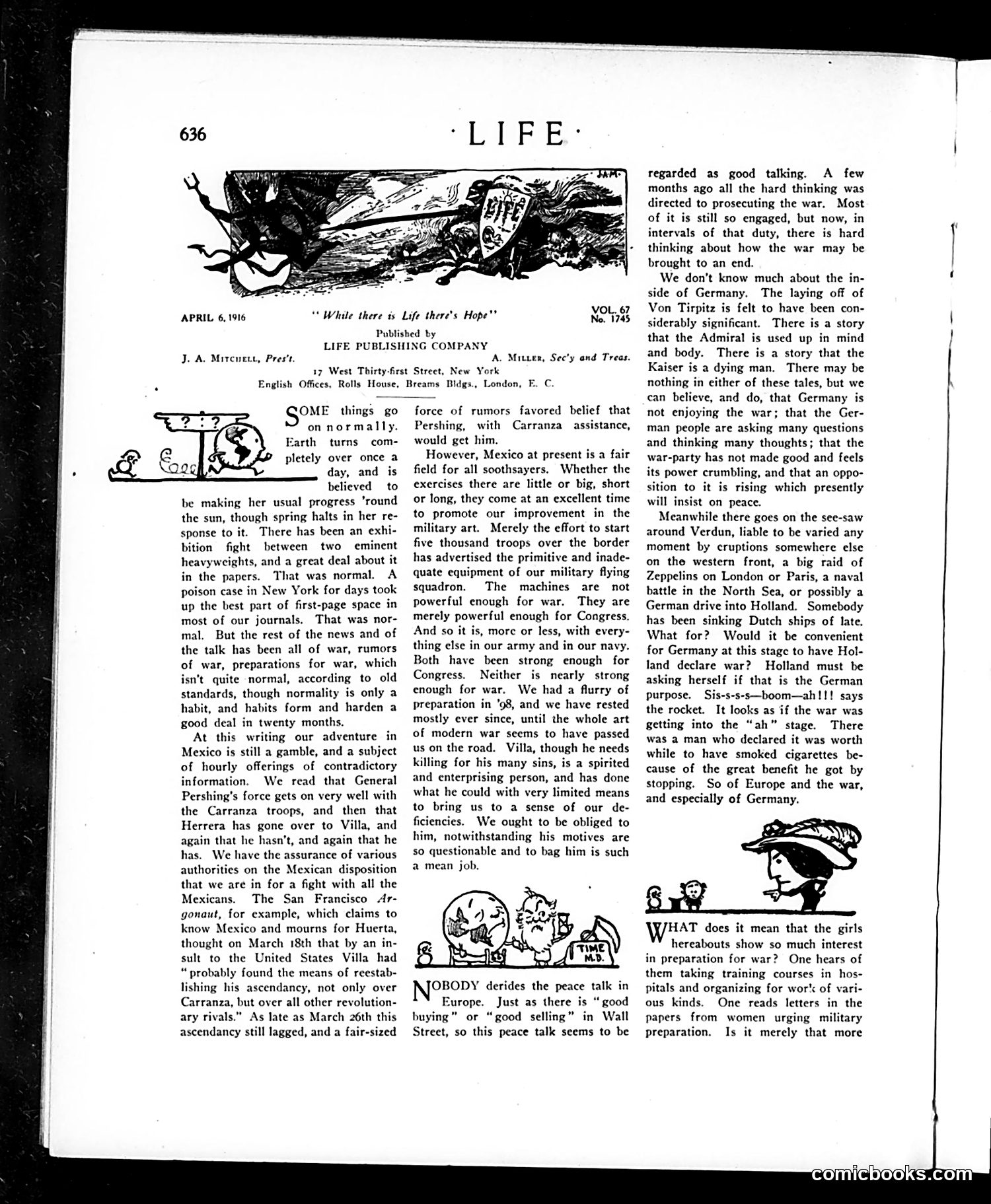
This editorial page satirizes American military unpreparedness and confusion surrounding the ongoing Mexican crisis. The main cartoon depicts a skeletal Death figure, titled "While there is Life there's Hope"—a darkly ironic commentary on the 1916 Pershing Expedition (American troops pursuing Pancho Villa across the Mexican border). The editorial criticizes how contradictory rumors dominate reporting about Mexican politics (Villa, Carranza, Herrera's shifting allegiances), making informed judgment impossible. More significantly, it mocks American military weakness: our flying squadrons lack powerful enough machines; our army and navy are adequate only for Congressional scrutiny, not actual modern warfare. The author argues Villa's raids, though despicable, usefully expose our military deficiencies. The piece also references European peace negotiations and German internal instability (Von Tirpitz's dismissal, rumors of the Kaiser's illness), suggesting war exhaustion even among belligerents. Overall: satire targeting American military complacency amid international instability.
📄 Transcribed text from this page (OCR, searchable)
Machine-transcribed from the original scan — historical spelling and the odd misread are preserved.
APRIL 6, 1916 J. A. Mitcuete, Pres’t. “* While there is Life there's Hope” Mere Published by LIFE PUBLISHING COMPANY A. Miter, Sec'y and Treas. 17 West Thirty-first Street, New York English Offices, Rolls House, Breams Bldgs, London, F. C. OME things go on normally. Earth turns com- pletely over once a day, and is believed to be making her usual progress ‘round the sun, though spring halts in her re- sponse to it. There has been an exhi- bition fight between two eminent heavyweights, and a great deal about it in the papers. That was normal. A poison case in New York for days took up the best part of first-page space in most of our journals. That was nor- mal, But the rest of the news and of the talk has been all of war, rumors of war, preparations for war, which isn't quite normal, according to old standards, though normality is only a habit, and habits form and harden a good deal in twenty months. At this writing our adventure in Mexico is still a gamble, and a subject of hourly offerings of contradictory information. We read that General Pershing's force gets on very well with the Carranza troops, and then that Herrera has gone over to Villa, and again that he hasn’t, and again that he has. We have the assurance of various authorities on the Mexican disposition that we are in for a fight with all the Mexicans. The San Francisco Ar- gonaut, for example, which claims to know Mexico and mourns for Huerta, thought on March 18th that by an in- sult to the United States Villa had “probably found the means of reestab- lishing his ascendancy, not only over Carranza, but over all other revolution- ary rivals.” As late as March 26th this ascendancy still lagged, and a fair-sized force of rumors favored belief that Pershing, with Carranza assistance, would get him. However, Mexico at present is a fair field for all soothsayers. Whether the exercises there are little or big, short or long, they come at an excellent time to promote our improvement in the military art. Merely the effort to start five thousand troops over the border has advertised the primitive and inade- quate equipment of our military flying squadron. The machines are not powerful enough for war. They are merely powerful enough for Congress. And so it is, more or less, with every- thing else in our army and in our navy. Both have been strong enough for Congress. Neither is nearly strong enough for war. We had a flurry of preparation in 98, and we have rested mostly ever since, until the whole art of modern war seems to have passed us on the road. Villa, though he needs killing for his many sins, is a spirited and enterprising person, and has done what he could with very limited means to bring us to a sense of our de- ficiencies. We ought to be obliged to him, notwithstanding his motives are so questionable and to bag him is such a mean job. OBODY derides the peace talk in Europe. Just as there is “good buying” or “good selling” in Wall Street, so this peace talk seems to be regarded as good talking. A few months ago all the hard thinking was directed to prosecuting the war. Most of it is still so engaged, but now, in intervals of that duty, there is hard thinking about how the war may be brought to an end. We don’t know much about the in- side of Germany. The laying off of Von Tirpitz is felt to have been con- siderably significant. There is a story that the Admiral is used up in mind and body. There is a story that the Kaiser is a dying man. There may be nothing in either of these tales, but we can believe, and do, that Germany is not enjoying the war; that the Ge man people are asking many questions and thinking many thoughts; that the war-party has not made good and feels its power crumbling, and that an oppo- sition to it is rising which presently will insist on peace. Meanwhile there goes on the see-saw around Verdun, liable to be varied any moment by cruptions somewhere else on the western front, a big raid of Zeppelins on London or Paris, a naval battle in the North Sea, or possibly a German drive into Holland. Somebody has been sinking Dutch ships of late. What for? Would it be convenient for Germany at this stage to have Hol- land declare war? Holland must be asking herself if that is the German purpose. Sis-s-s-s—boom—ah!!! says the rocket. It looks as if the war was getting into the “ah” stage. There was a man who declared it was worth while to have smoked cigarettes be- cause of the great benefit he got by stopping. So of Europe and the war, and especially of Germany. Wt does it mean that the girls hereabouts show so much interest in preparation for war? One hears of them taking training courses in hos- pitals and organizing for wor’ of vari- ous kinds. One reads letters in the papers from women urging military preparation. Is it merely that more