
A complete issue · 52 pages · 1912
Life — May 16, 1912
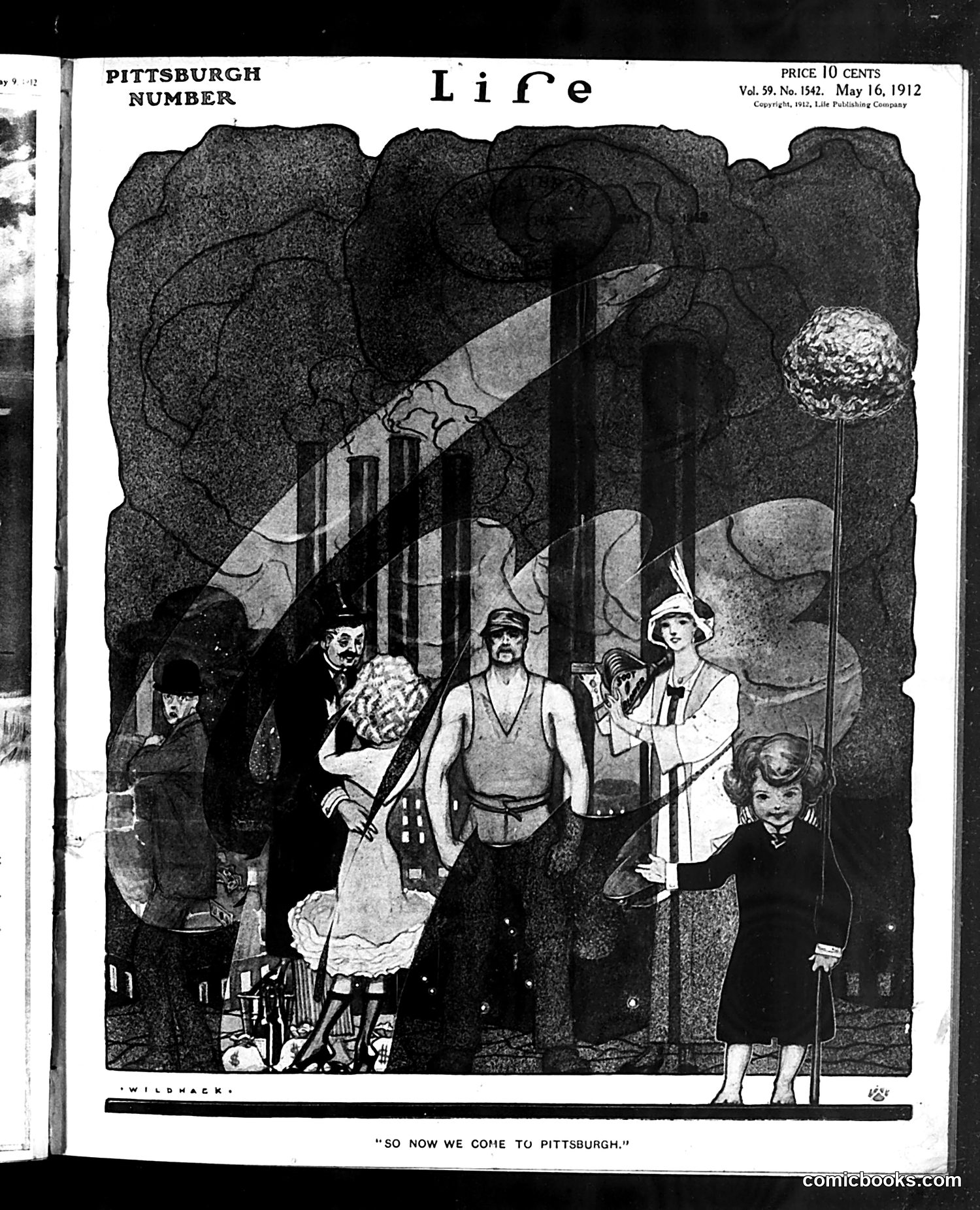
This Life magazine cover from May 16, 1912, depicts a group of people arriving in Pittsburgh, with the caption "SO NOW WE COME TO PITTSBURGH." The cartoon appears to satirize immigrants or newcomers to Pittsburgh during the industrial era. The figures include what appears to be people of various backgrounds and classes—a man in a sleeveless undershirt (likely representing a laborer), well-dressed figures, and children. The dark, industrial setting with smokestacks looming overhead emphasizes Pittsburgh's identity as a major steel and manufacturing hub. The satire likely comments on the waves of immigration fueling Pittsburgh's industrial growth, possibly mocking both the newcomers and the city's industrial character. The contrast between different social classes and the ominous industrial backdrop suggests commentary on working conditions, urbanization, or the immigrant experience during America's industrial boom.
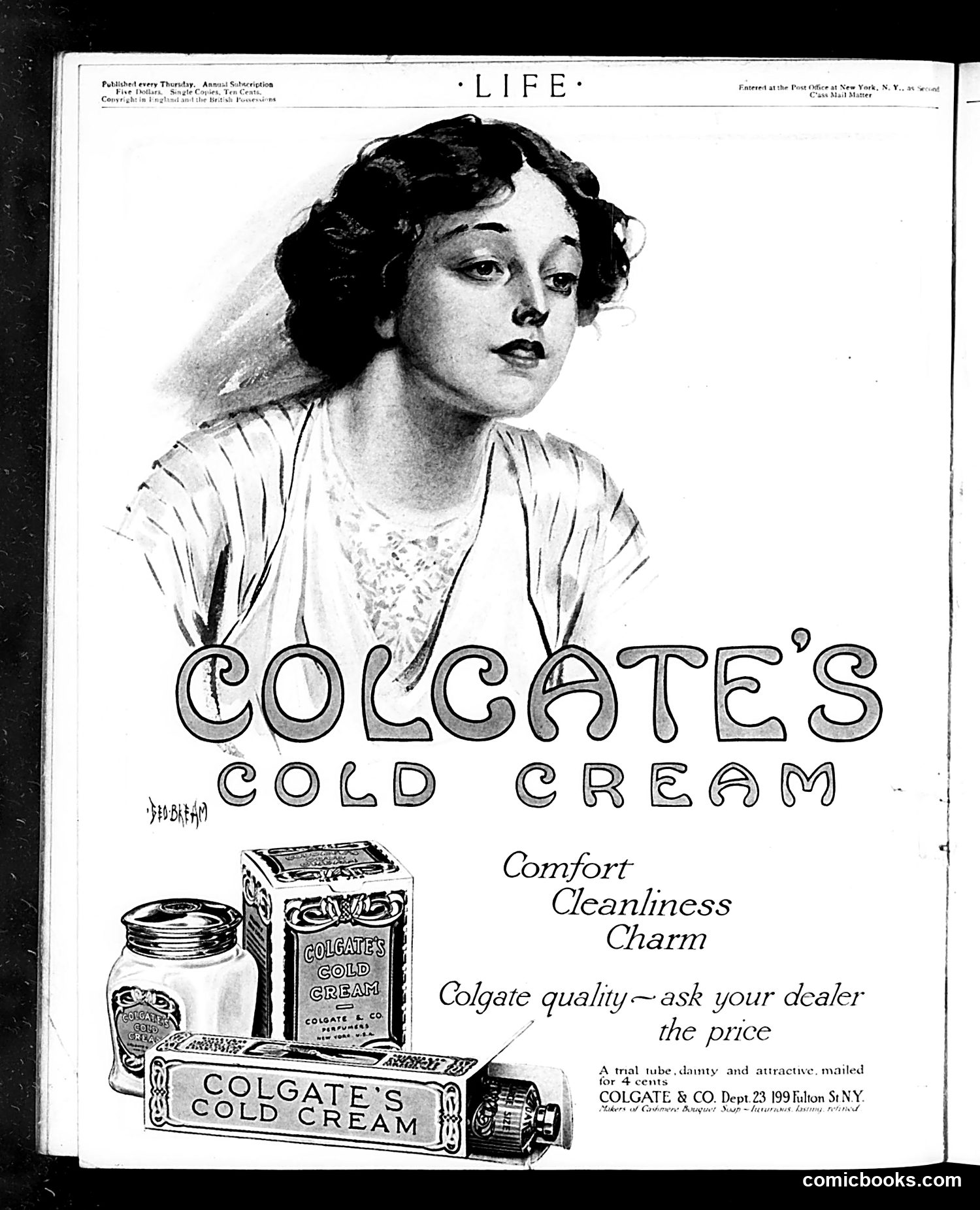
This page is **primarily an advertisement**, not political satire. It promotes Colgate's Cold Cream product in *Life* magazine. The image shows a stylized portrait of a woman from approximately the 1920s-30s era, featuring period-appropriate bobbed hair and makeup. The advertisement emphasizes three selling points: "Comfort, Cleanliness, Charm." The copy suggests the product offers cosmetic and skincare benefits, appealing to modern women concerned with grooming. The phrase "Colgate quality—ask your dealer the price" indicates competitive positioning in an era when beauty products were becoming mass-market commodities. A trial tube was offered for 4 cents, suggesting accessible pricing. This represents typical early-twentieth-century beauty advertising targeting women's appearance standards and self-improvement through consumer products.
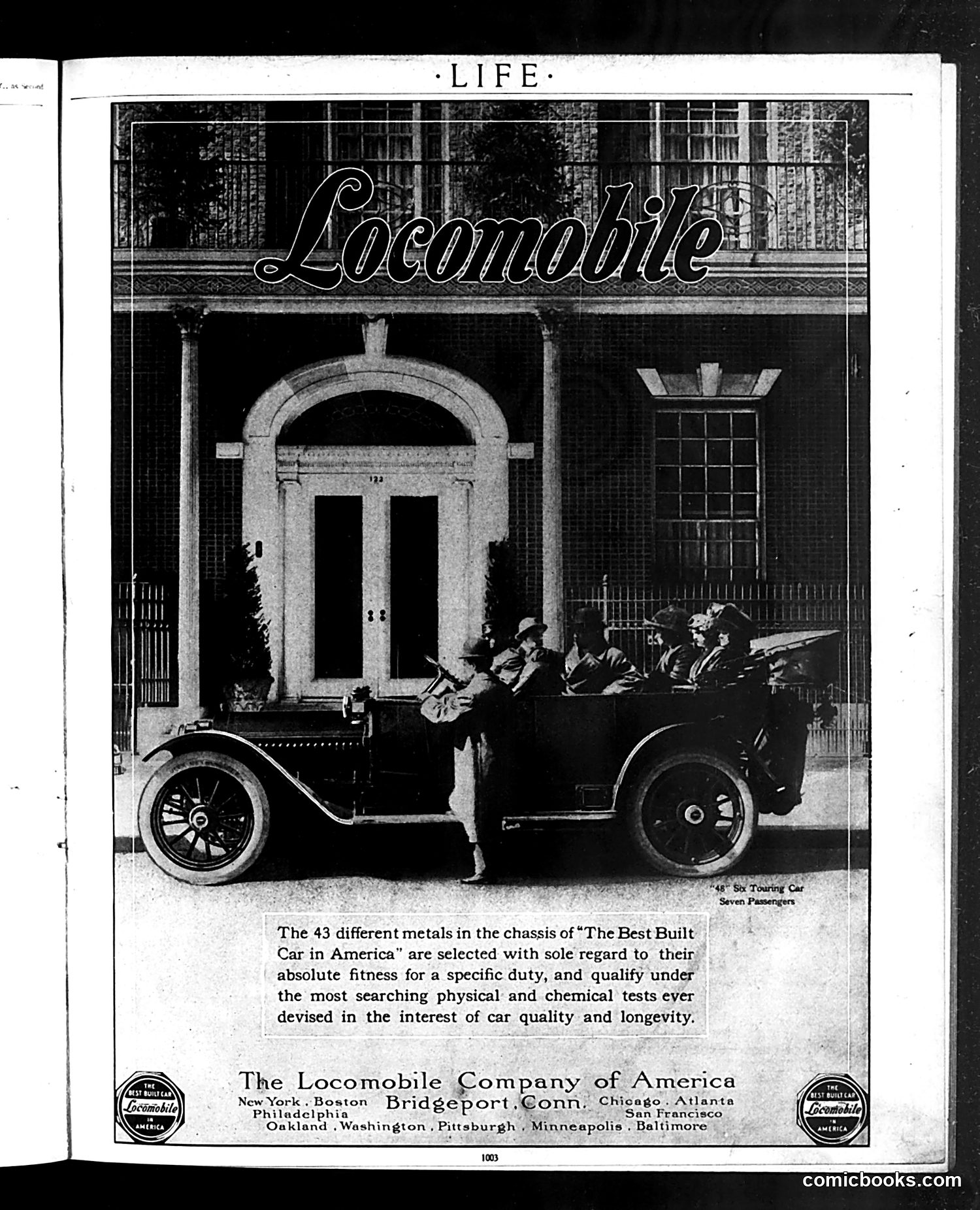
This is **not satire or political cartoon** — it's a straightforward advertisement for the Locomotile automobile, published in *Life* magazine. The image shows a 1908 "Six Touring Car" carrying seven passengers in front of an elegant building entrance. The ad emphasizes quality manufacturing: "43 different metals in the chassis" are "selected with sole regard to their absolute fitness for a specific duty" and tested rigorously. The Locomotile Company of America lists numerous cities (New York, Boston, Chicago, etc.), suggesting national distribution and prestige. The message targets affluent buyers by highlighting engineering sophistication and durability — positioning the Locomotile as "The Best Built Car in America." This represents early automotive advertising's focus on technical specifications rather than style or performance.
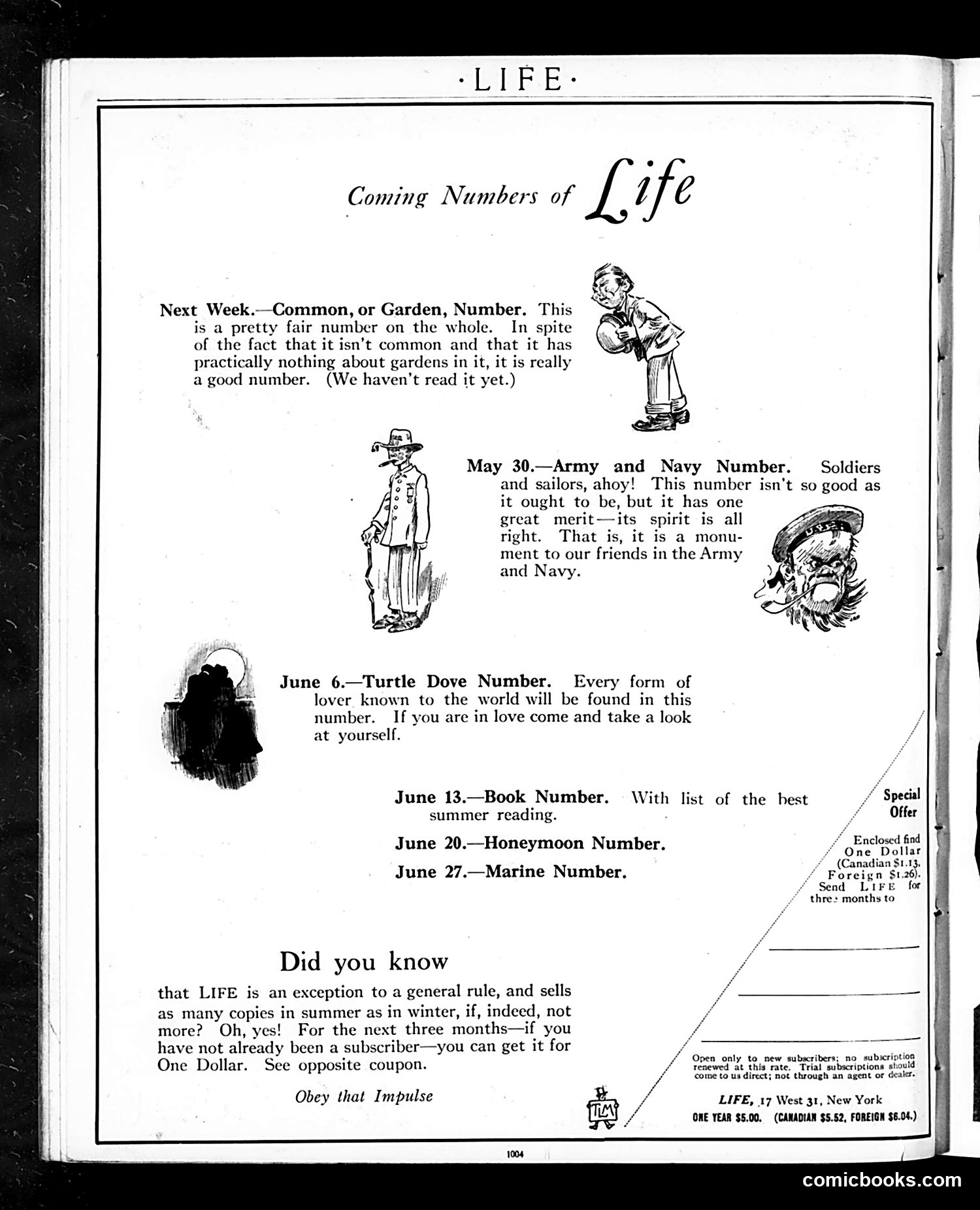
This page advertises upcoming special issues of Life magazine, a satirical weekly popular in the early 1900s. The content promotes themed issues for May through June, each with illustrations: - **Army and Navy Number** (May 30): Features a soldier and sailor, positioned as a tribute to military service - **Turtle Dove Number** (June 6): Appeals to romantic readers with love-themed content - **Book Number** (June 13): Focuses on summer reading recommendations - **Honeymoon and Marine Numbers** follow The page includes a subscription pitch offering one-year access for one dollar—positioned as exceptional value since Life typically sells more copies in summer than winter. The satirical tone appears in the playful, self-aware copy ("Obey that Impulse"), typical of Life's humorous marketing style of this era.
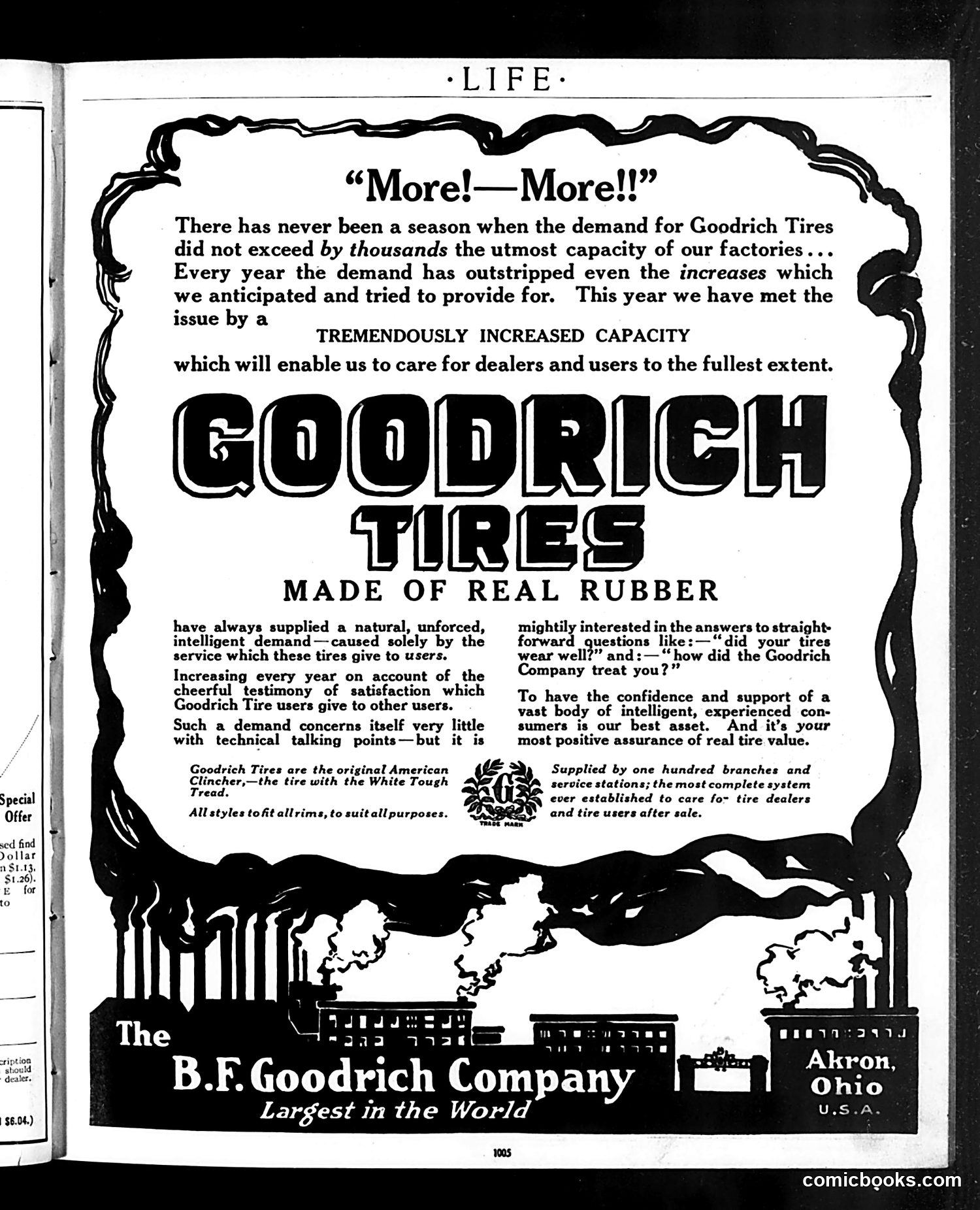
This is **not a political cartoon or satire**—it's a full-page **advertisement** for B.F. Goodrich Company tires, published in *Life* magazine. The ad emphasizes that Goodrich Tires are experiencing unprecedented demand that exceeds factory capacity. It highlights their product as "made of real rubber" and stresses quality through customer testimonials and satisfaction. The dramatic industrial imagery at the bottom (factory buildings and smokestacks in Akron, Ohio) underscores manufacturing scale. The opening phrase "More!—More!!!" frames high demand as a selling point. The ad claims nationwide distribution through "one hundred branches and service stations." This is straightforward commercial messaging typical of early 20th-century tire industry advertising, not editorial satire.
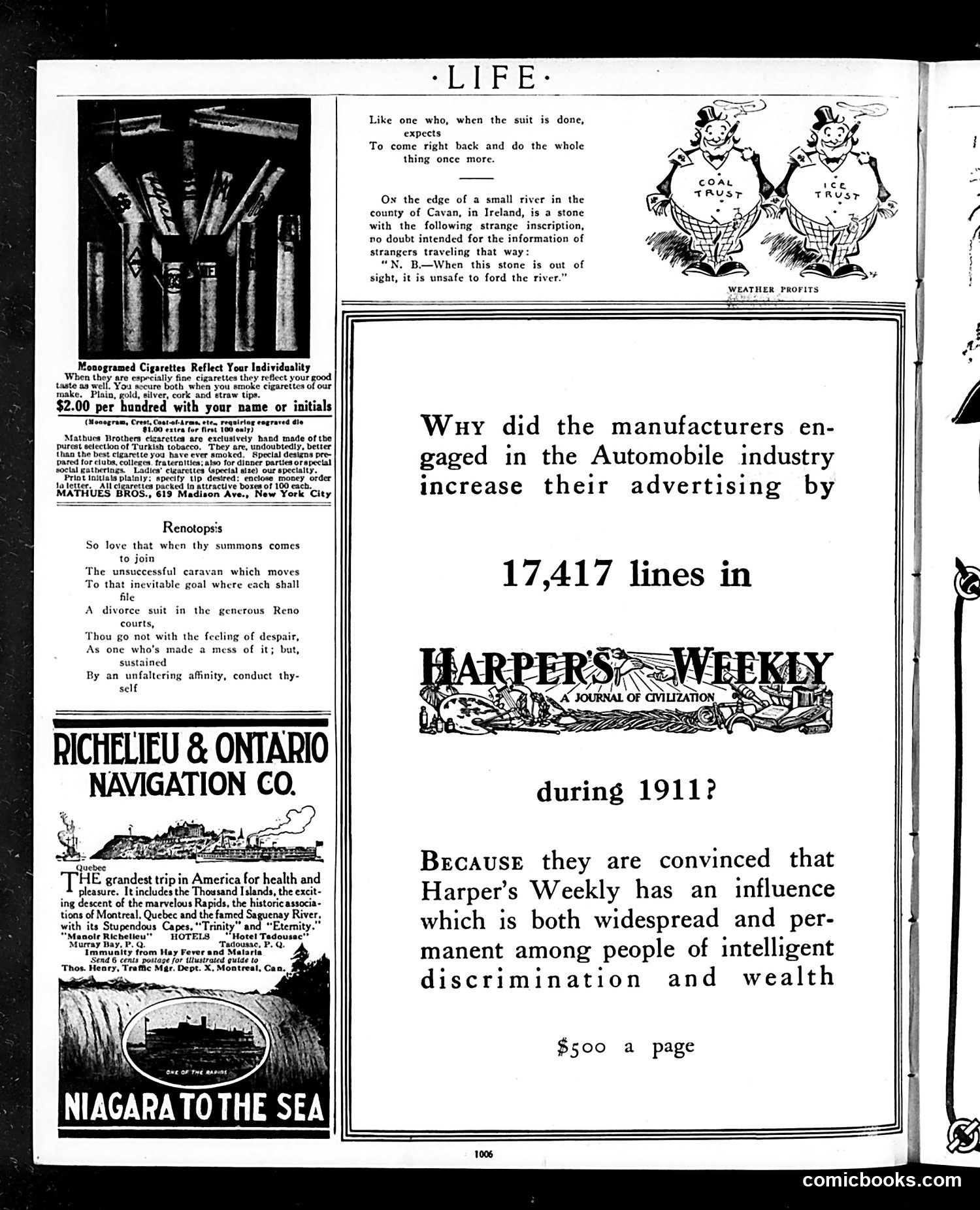
This page is primarily **advertising**, not editorial content or political satire. The main advertisement promotes Harper's Weekly magazine to potential advertisers, claiming that automobile manufacturers increased their advertising by 17,417 lines in that publication during 1911. The pitch targets wealthy readers: Harper's Weekly reaches "people of intelligent discrimination and wealth," justifying the $500-per-page advertising rate. The surrounding ads include cigarette personalization services and a Richelieu & Ontario Navigation Company cruise ("Niagara to the Sea"). The small poem "Rendezvous" and weather-profit cartoon are filler content typical of early-1900s magazine layouts. The page reflects early-twentieth-century advertising practices and consumer targeting strategies.
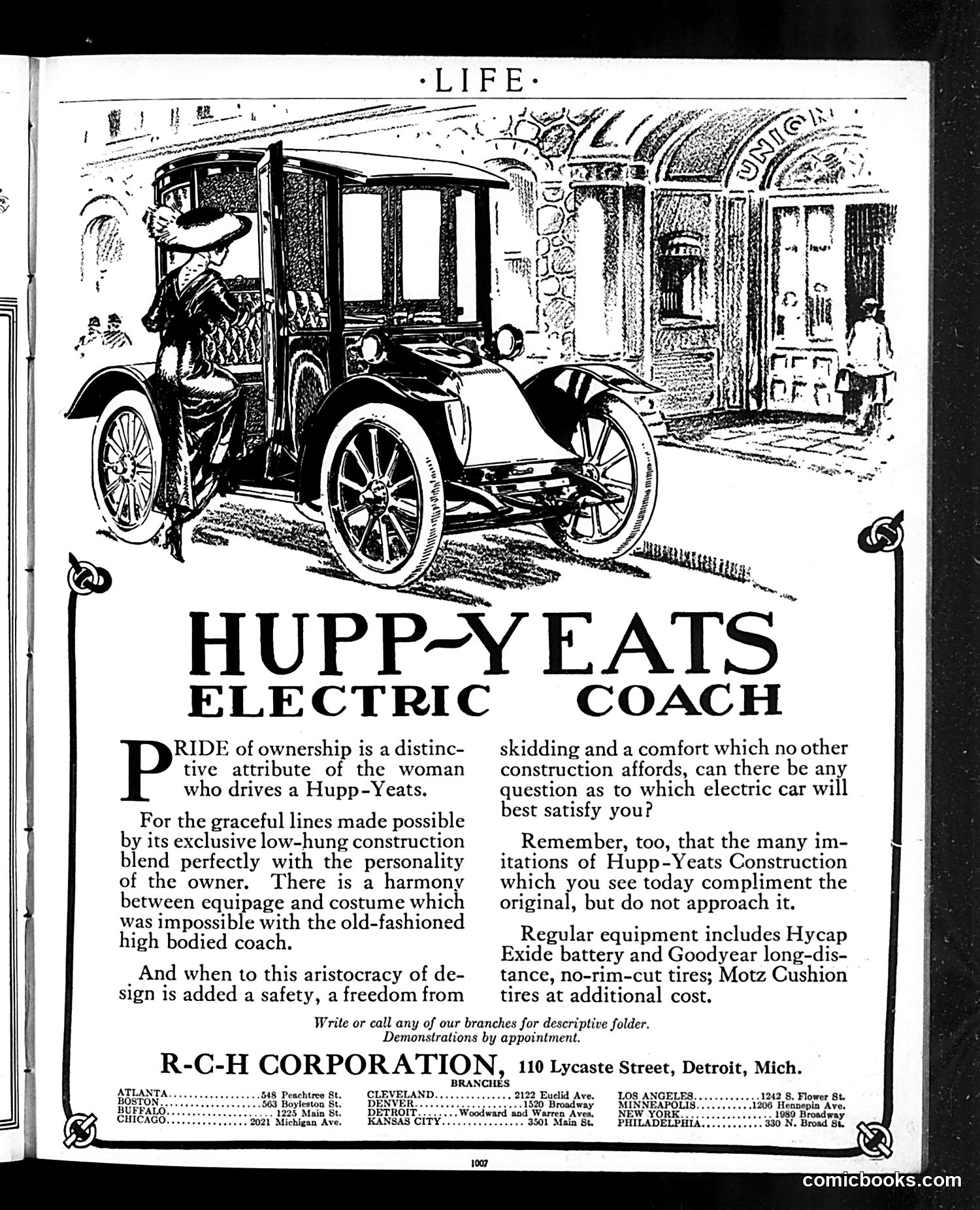
This is a **full-page advertisement**, not satire or political commentary. It promotes the Hupp-Yeats electric automobile, marketed specifically to women drivers. The ad emphasizes luxury and femininity: "graceful lines" and "aristocracy of design" appeal to female ownership. The illustration shows a well-dressed woman in a hat entering an elegant electric coach parked on a fashionable street. The copy contrasts electric cars favorably with older "high-bodied coach" designs, highlighting safety, comfort, and freedom from the mess of gasoline engines—practical advantages marketed as suitable for female drivers of the era. The R-C-H Corporation lists Detroit headquarters and multiple branch locations, suggesting this was a significant manufacturer of early 1900s electric vehicles.
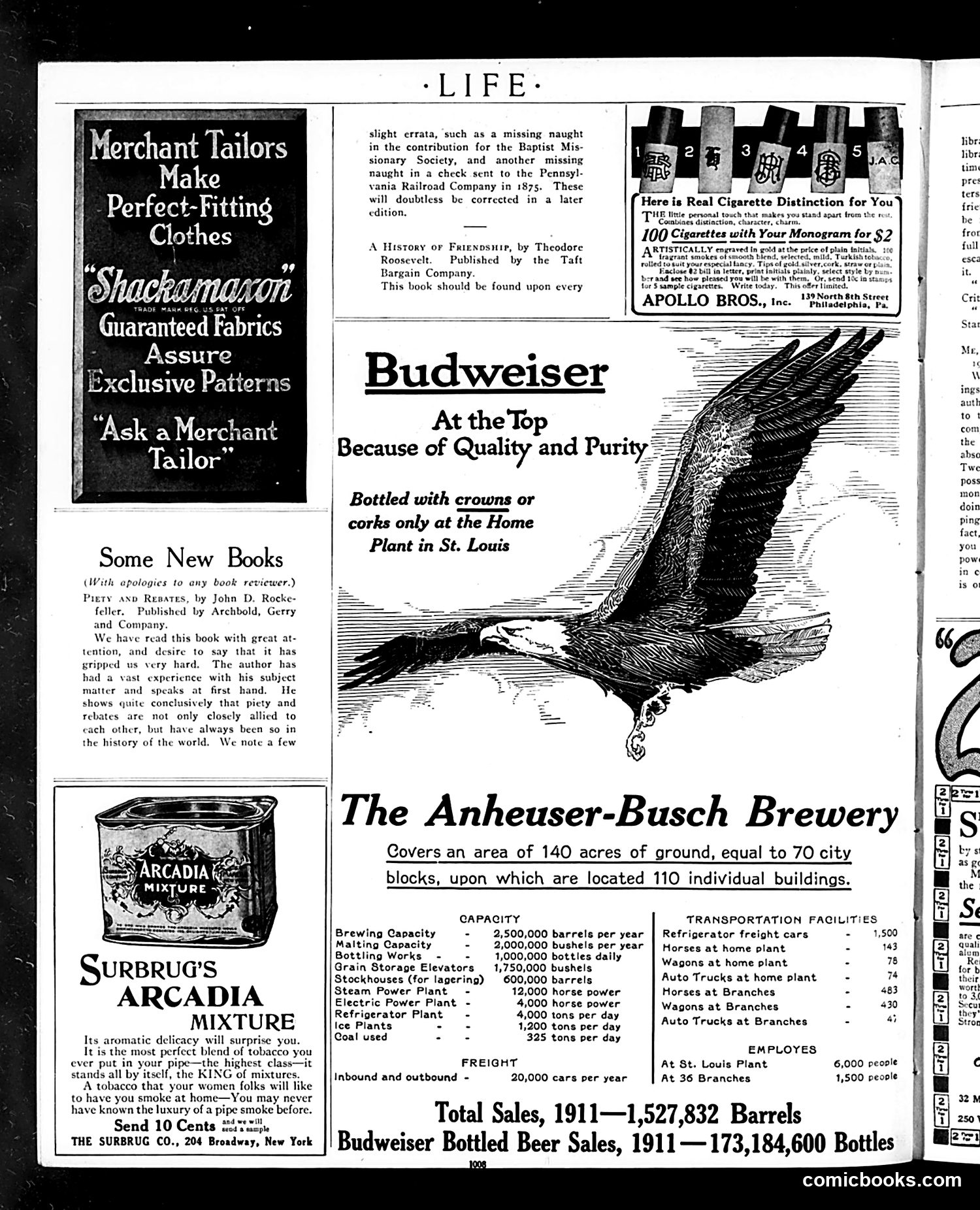
This page is primarily **advertising content** rather than satire or political commentary. It contains: 1. **Shackamazon Fabrics ad** - promoting merchant tailors and fabric patterns 2. **Book review section** - discussing "Piety and Rebates" by John D. Rockefeller 3. **Budweiser ad** - featuring an eagle and emphasizing the brewery's scale (140 acres, 110 buildings) 4. **Anheuser-Busch Brewery statistics** - detailed capacity, transportation, and employment figures 5. **Surburg's Arcadia Mixture tobacco ad** - promoting pipe tobacco The Budweiser content highlights industrial achievement through impressive numbers—a common advertising approach of the era. The eagle symbolizes American quality and dominance. There is no apparent satire; this represents straightforward early-20th-century commercial promotion in a magazine that mixed editorial content with paid advertisements.
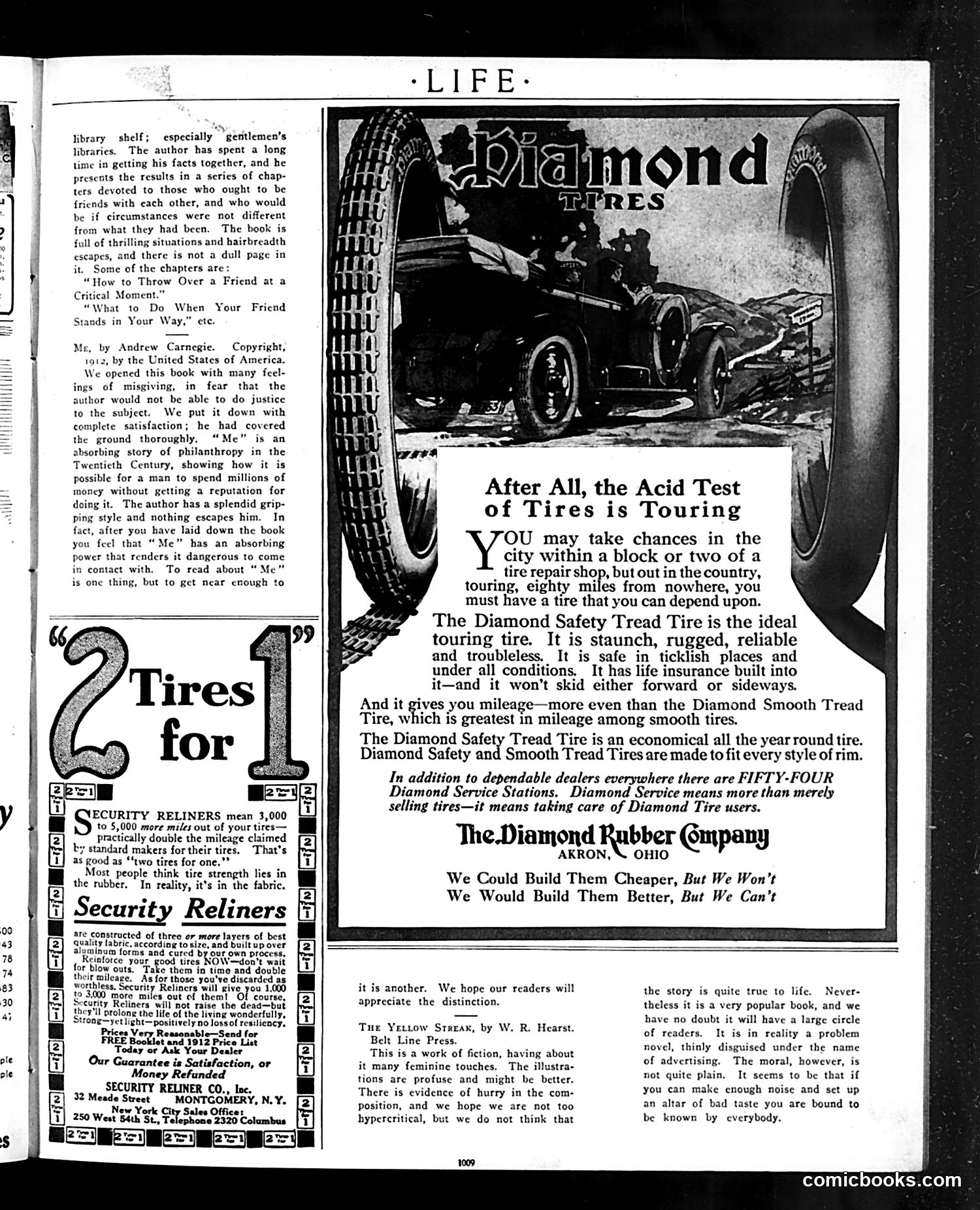
This page is primarily **advertising, not satire**. The dominant content is a Diamond Rubber Company advertisement featuring a dramatic photograph of a wrecked automobile, with text emphasizing that Diamond Safety Tread tires are reliable for long-distance touring. On the left are smaller ads for Security Reliners tires (promoting "2 for $1") and the Security Rubber Company. The page also contains brief book reviews, including discussion of Andrew Carnegie's "Me" and W.R. Hearst's "The Yellow Streak." There is no political cartoon here. The wrecked car image is purely commercial—meant to sell tires by implying their safety prevents such accidents. This reflects early 1900s advertising style emphasizing product reliability through dramatic visual evidence of dangers.
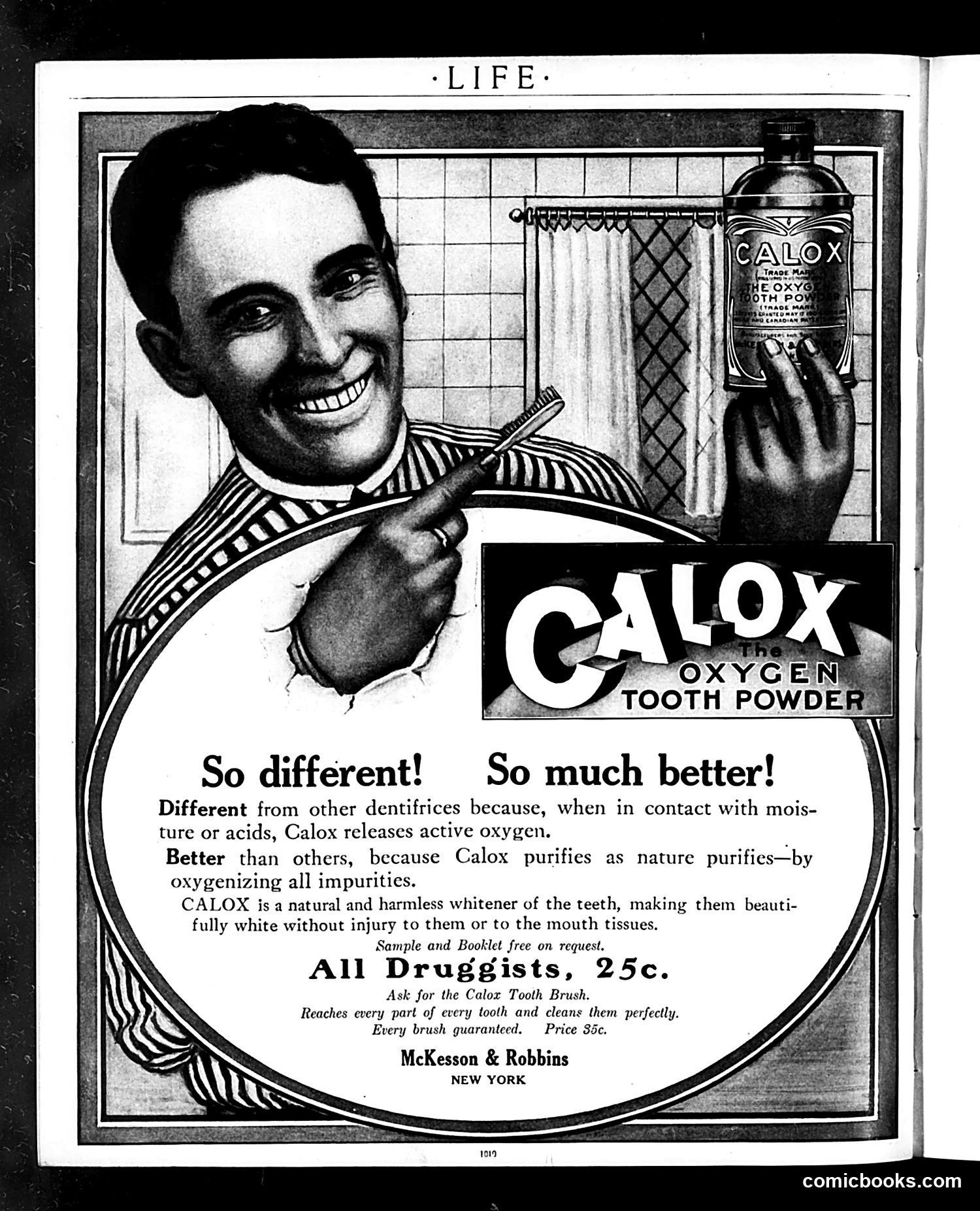
This page is **primarily a product advertisement**, not satire or political commentary. It advertises **Calox Oxygen Tooth Powder**, manufactured by McKesson & Robbins of New York. The ad features a smiling man in striped clothing holding a bottle of the product, positioned in what appears to be a bathroom setting. The advertisement's claims emphasize that Calox is "different" and "better" because it releases oxygen when mixed with moisture, allegedly purifying teeth naturally. It promises to whiten teeth without harm and costs 25 cents at drugstores. The ad also promotes a companion **Calox Tooth Brush** for 35 cents. This represents early-20th-century patent medicine advertising typical of *Life* magazine, before modern FDA regulations restricted such health claims.
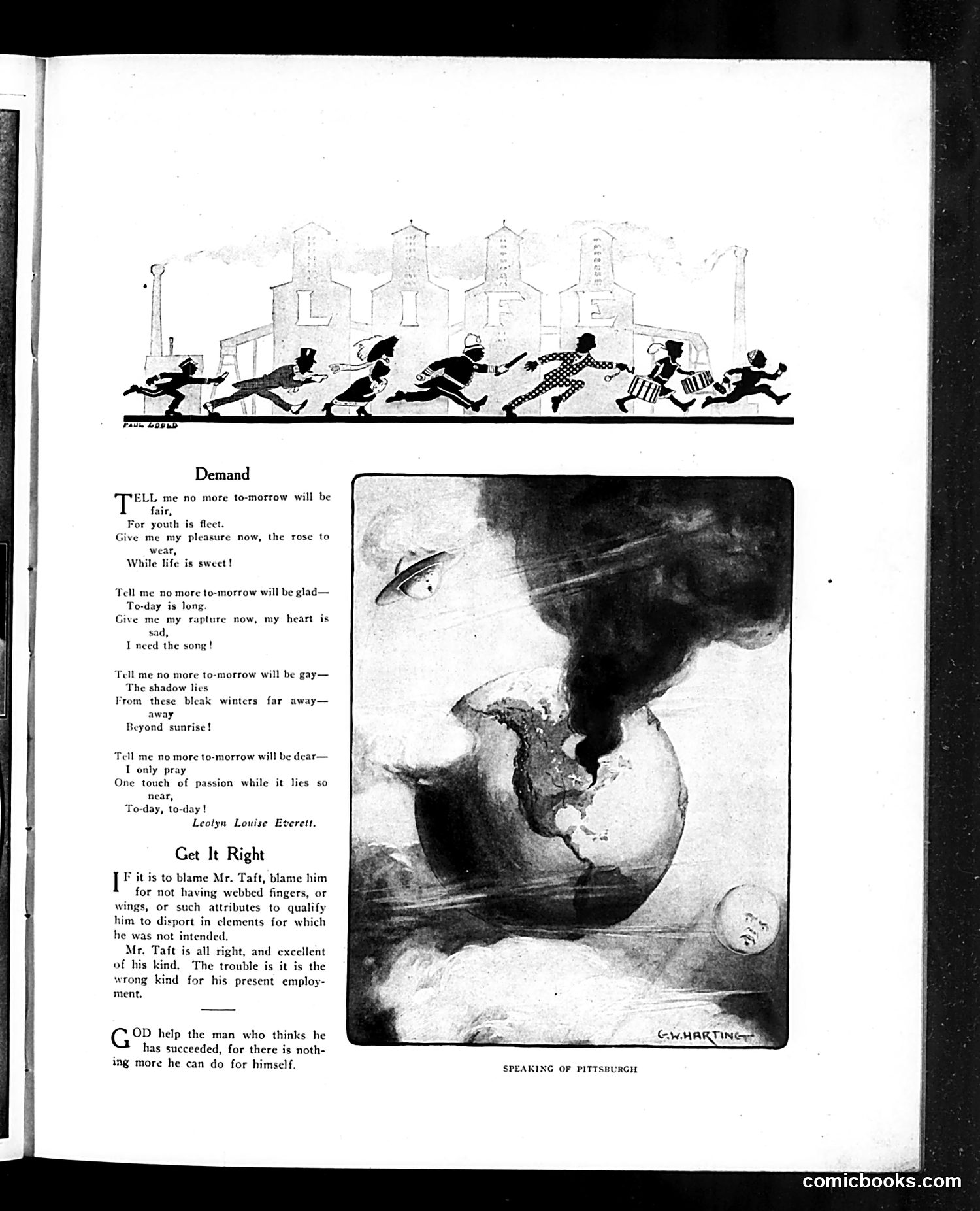
**Top Cartoon**: A comedic strip showing figures in formal attire fleeing from what appears to be a cityscape with prominent buildings (possibly skyscrapers). The sequence suggests panic or rapid escape. **"Demand" Poem**: By Leonid Louise Everett, urging carpe diem—seizing present pleasures rather than postponing them. **"Get It Right" Article**: Critiques Mr. Taft, apparently defending his character while acknowledging his unsuitability for his current position. The piece suggests Taft possesses good qualities but lacks what his employment requires. **"Speaking of Pittsburgh" Image**: A portrait-style illustration (signed G.W. Harting) showing someone in profile. **Overall Context**: The page appears to satirize President William Howard Taft, criticizing his fitness for office despite his personal merit—a common theme during his contentious presidency (1909-1913).
This page contains an editorial letter responding to criticism from "Erring Brother Brisbane" about Life's earlier remarks. The text debates whether intelligence should rule society, with the editor arguing that true intelligence includes sympathy and self-abnegation—not mere capacity. The small cartoon illustrations appear to be decorative rather than central to the argument. The editorial references the Titanic disaster (which occurred April 15, 1912) and the deaths of wealthy passengers, using it as evidence that civilization wrongly prioritizes the powerful. The author criticizes both Brisbane's philosophy and society's treatment of class inequality. This is primarily a written editorial piece rather than a satirical cartoon page.
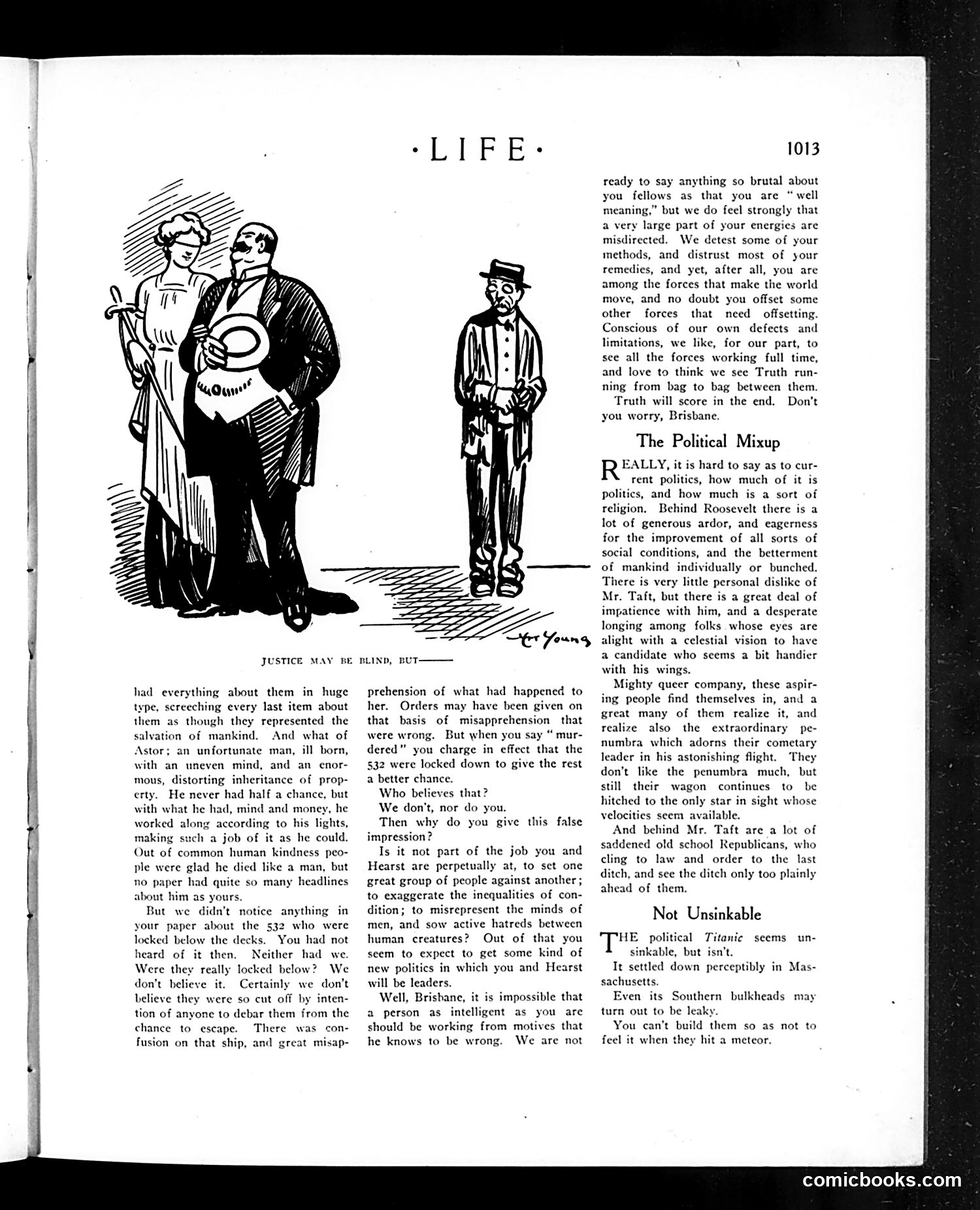
This editorial cartoon satirizes the mishandling of a political scandal involving 532 locked-up prisoners. The illustration shows Lady Justice (blindfolded, traditional symbol of impartial law) flanked by two well-dressed men, while a thin, ragged figure stands apart—likely representing the common person or accused party. The accompanying text criticizes how authorities gave contradictory orders based on "misapprehension," then locked away 532 people to cover up the mistake. The cartoon's point: Justice is supposed to be blind to corruption, but in reality, the powerful manipulate the system while ordinary people suffer the consequences. The satire attacks governmental incompetence and the selective application of justice.
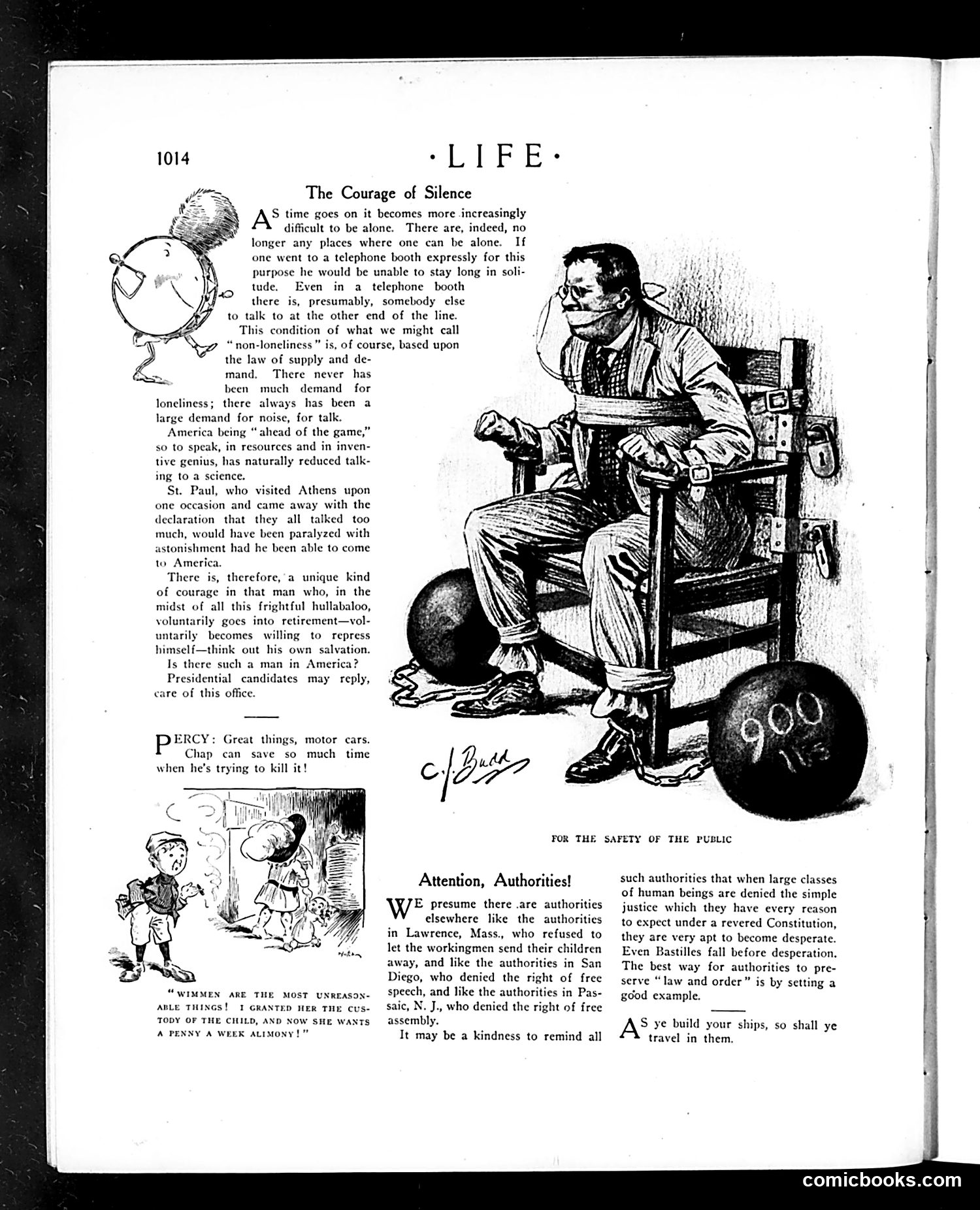
This satirical piece critiques modern American society's obsession with noise and constant communication. The main article argues that true courage lies in voluntarily embracing silence and solitude—increasingly rare in contemporary life, even in telephone booths. The cartoon depicts a man in a chair with a wrecking ball labeled "$900" about to destroy him, illustrating the hazards of reckless behavior or negligence. The caption "FOR THE SAFETY OF THE PUBLIC" suggests this is commentary on dangerous individuals or practices requiring removal. The secondary section "Attention, Authorities!" criticizes government bodies (referencing Lawrence, Massachusetts; San Diego; and Passaic, New Jersey) for suppressing free speech and assembly rights, calling for authorities to maintain "law and order" through moral example rather than authoritarian suppression.
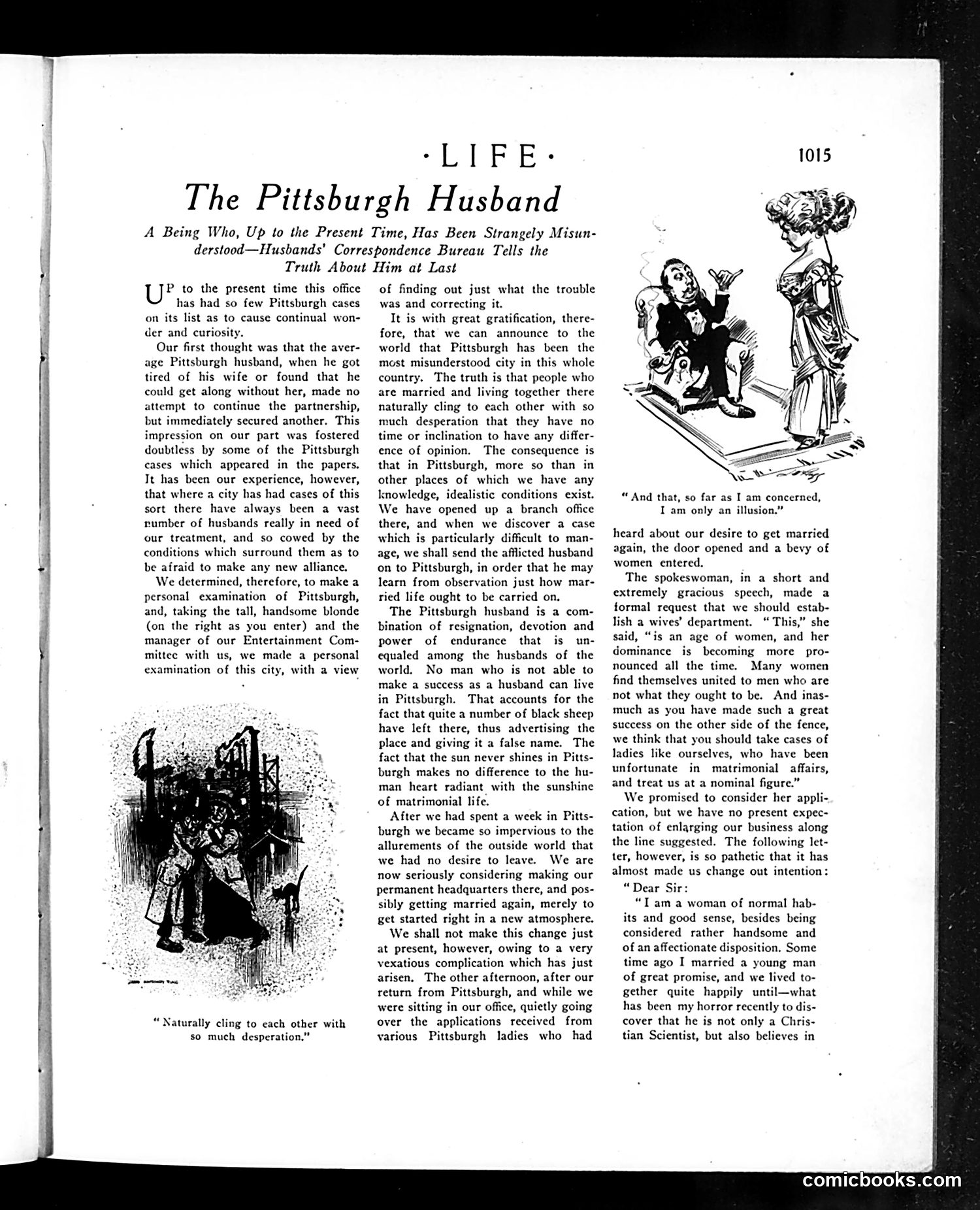
This article satirizes the "Husbands' Correspondence Bureau"—apparently a fictional matchmaking service—that claims to have discovered Pittsburgh husbands are uniquely devoted and resigned to marriage, making the city an ideal model for matrimonial harmony. The satire works through exaggeration: the Bureau's representatives visit Pittsburgh and return convinced the city's perpetually gloomy weather somehow produces husbands of exceptional patience and devotion. They praise Pittsburgh husbands' "resignation, devotion and power of endurance"—qualities presented ironically as virtues. The cartoons show domestic scenes: one depicts a couple's desperation (captioned "cling to each other with so much desperation"), and another shows a woman dismissing herself as "only an illusion," hinting at wives' invisibility or irrelevance in this supposed matrimonial paradise. The joke ultimately satirizes both unrealistic marriage advice and Pittsburgh itself—the sun "never shines," yet husbands remain cheerful. The piece mocks sentimental marriage ideology while poking fun at Pittsburgh's notorious industrial gloom.
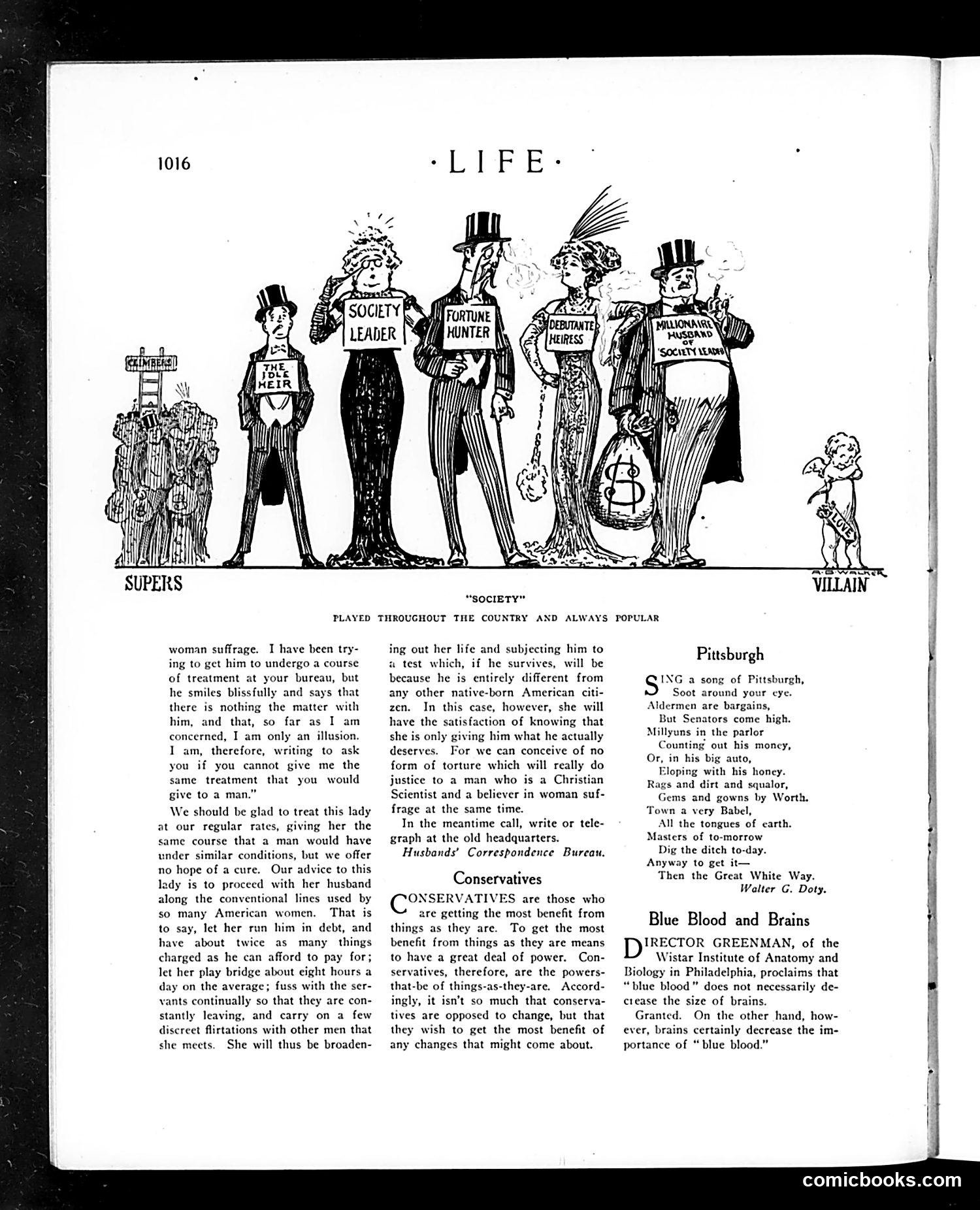
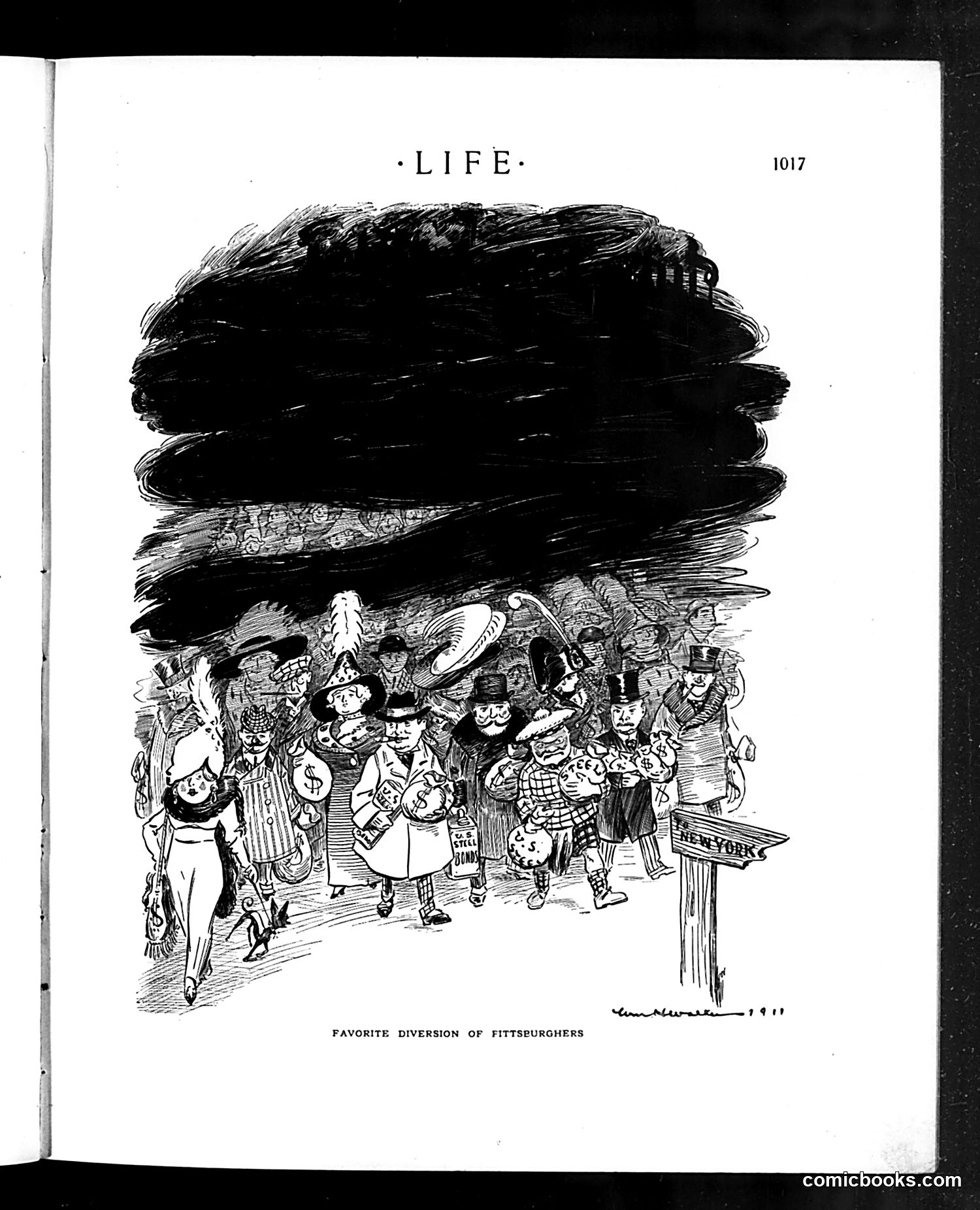
This political cartoon depicts a large silhouetted head filled with caricatured figures representing Pittsburgh residents engaged in various activities. The figures appear to be wealthy industrialists and citizens, many holding money bags marked with dollar signs, suggesting themes of wealth and capitalism. The cartoon satirizes Pittsburgh's reputation as an industrial, profit-driven city obsessed with money-making. The "favorite diversion" caption implies that accumulating wealth and conducting business are the primary pastimes of Pittsburgh's citizens, rather than cultural, artistic, or philanthropic pursuits. The style—a head-shaped composition filled with busy commercial figures—was a common editorial cartooning technique of the era to represent a city's character or collective mindset. This appears to be gentle satire targeting industrial cities' perceived materialism during the early 20th century.
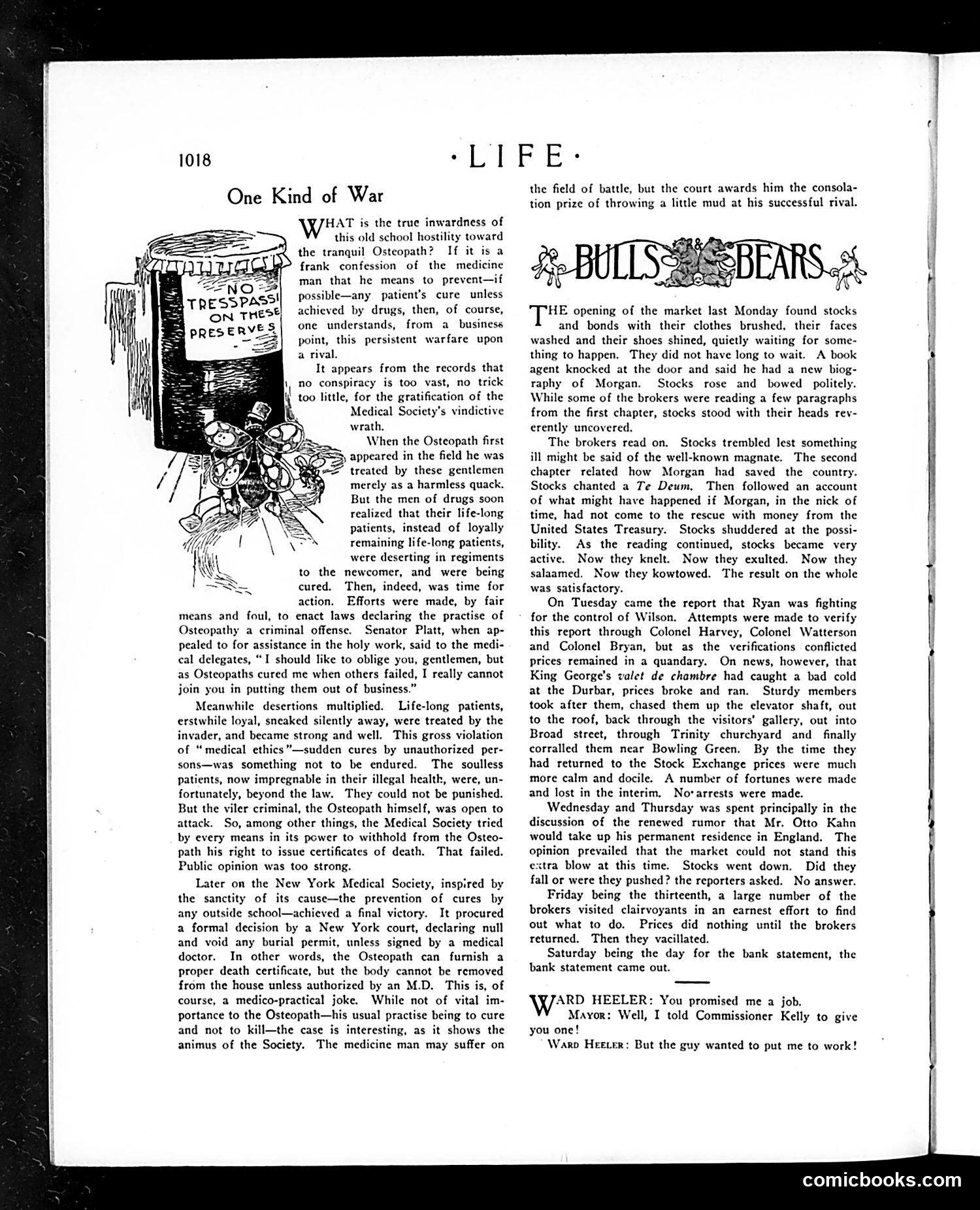
**Left cartoon:** Satirizes the American Medical Association's hostility toward osteopathy, a then-emerging alternative medicine practice. The text lampoons doctors' attempts to suppress osteopaths through legislation and legal barriers—not from genuine concern for patients, but from fear of losing profitable customers. The joke is that the AMA's "warfare" backfires: osteopaths actually cure people, so patients desert traditional medicine anyway. Even Senator Platt reportedly refused to help because osteopaths had cured him. The satire attacks organized medicine's hypocrisy: they claim ethical concern while actually protecting profits. **Right section ("Bulls & Bears"):** Financial satire depicting stock market volatility tied to J.P. Morgan's reputation. When brokers read a biography praising Morgan as the nation's financial savior, stocks react emotionally—bowing, kneeling, exulting—like worshippers. The mockery suggests markets are irrationally dependent on powerful individuals' perceived heroism rather than actual economic fundamentals. It's political commentary on wealth concentration and financial manipulation during the Gilded Age.
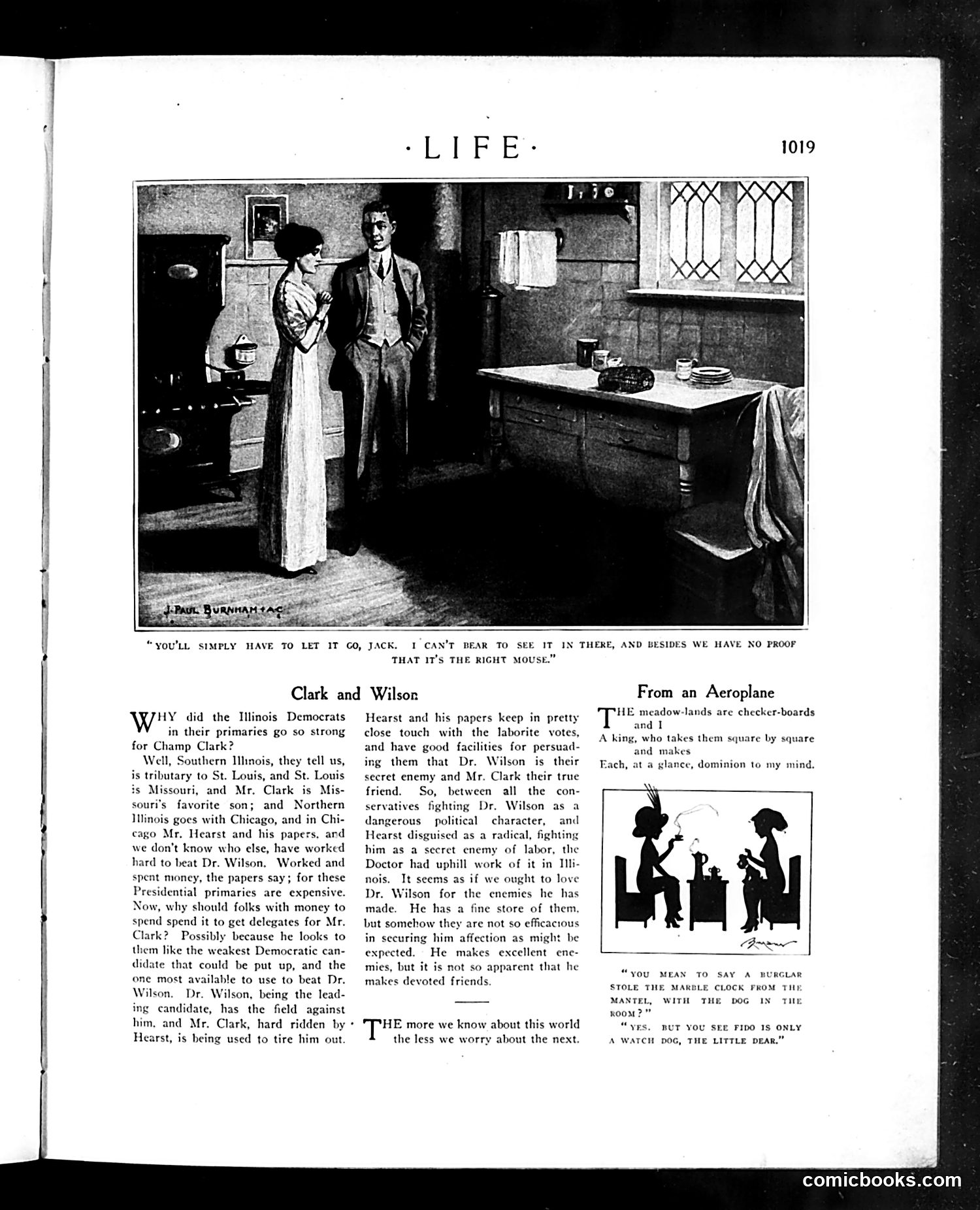
This page critiques the 1912 Democratic primary contest between **Woodrow Wilson** (the leading candidate) and **Champ Clark** (backed by William Randolph Hearst and conservative interests). The main article explains that wealthy Democratic opponents—Southern interests, Chicago's Hearst machine, and conservatives—united to support Clark as a weaker alternative to Wilson, whom they viewed as dangerous. The satire's point: they're using Clark to exhaust Wilson, not because they genuinely support Clark. Hearst particularly disguised himself as a "radical" ally of labor while secretly opposing Wilson. The photograph illustrates a scene from a play titled "Clark and Wilson," likely dramatizing this political conflict. The sidebar jokes ("From an Aeroplane," the burglar/watchdog pun) are unrelated humor filler typical of Life magazine's format—satirical but not politically pointed. **The core message**: Wilson's many enemies prove his integrity, yet they ironically make him fewer devoted friends through their coordinated opposition.
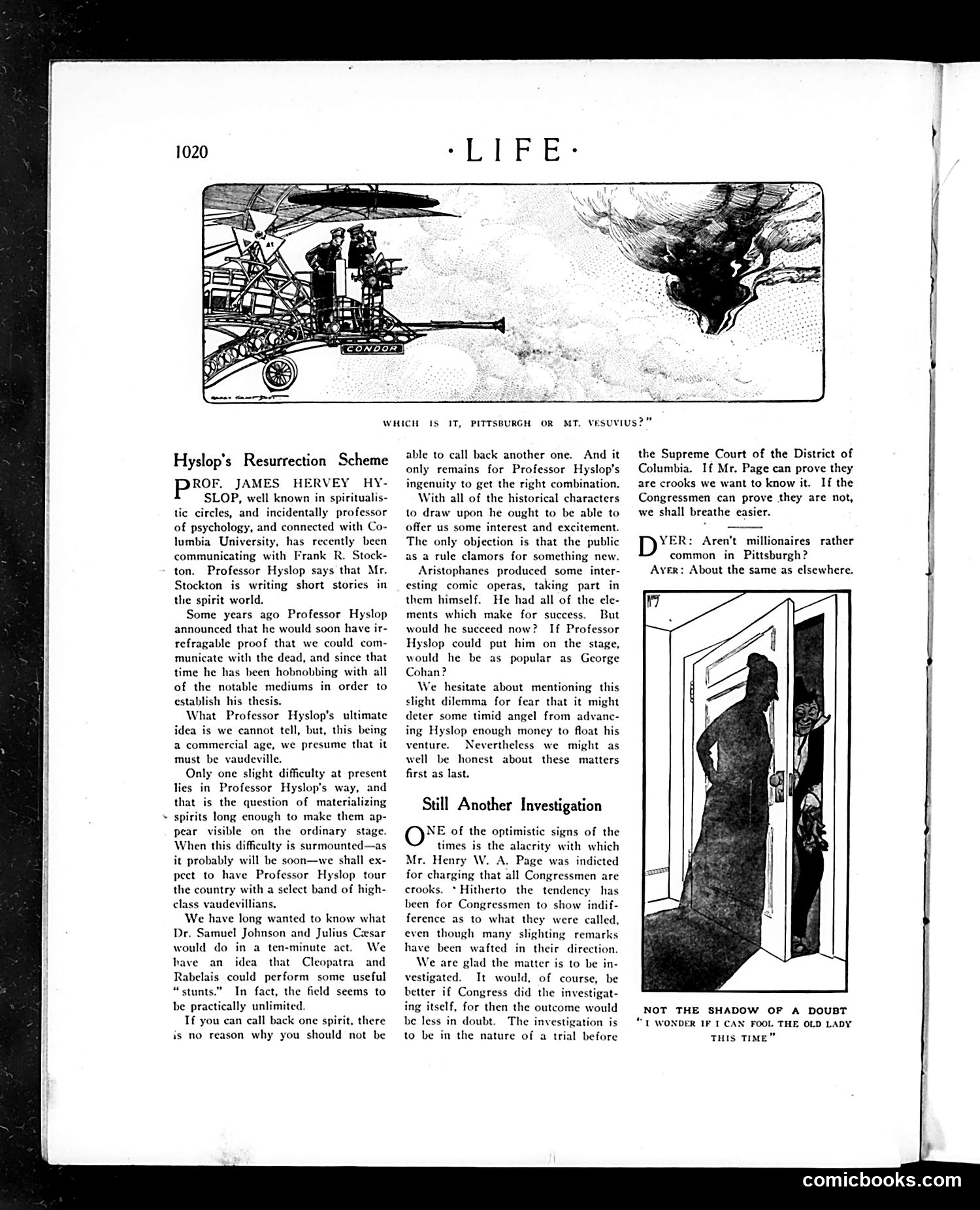
This page contains two satirical pieces mocking contemporary figures and ideas: **"Hyslop's Resurrection Scheme"** ridicules Professor James Hervey Hyslop, a Columbia University psychologist claiming to communicate with the dead. Life sarcastically suggests his real goal is vaudeville entertainment—materializing famous historical spirits (Cleopatra, Julius Caesar, Samuel Johnson) as stage acts. The satire targets both spiritualism's pseudoscientific pretensions and the commercialization of occult claims. The joke hinges on the absurdity: why would famous dead figures perform in ten-minute variety acts, and would audiences prefer them to contemporary entertainers like George Cohan? **"Still Another Investigation"** comments on Henry W. A. Page's indictment for publicly calling Congressmen crooks. Life's satire is biting: they mock Congress's typical indifference to criticism while suggesting it would be better if Congress investigated itself rather than Page—implying Congress won't honestly examine corruption charges. The page header cartoon shows a spiritualist séance scene, visually supporting the Hyslop critique.
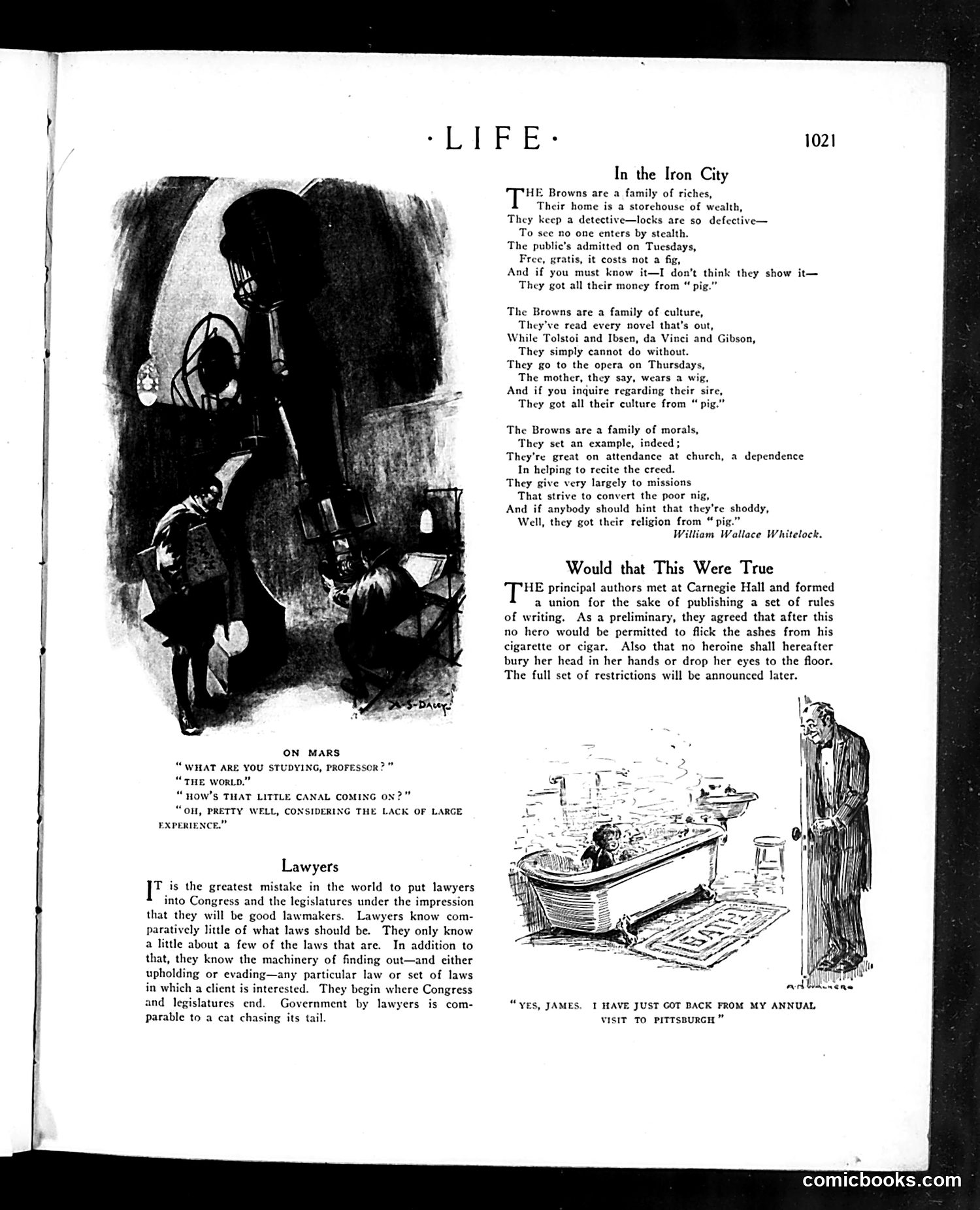
This page contains three satirical pieces: **"On Mars"**: A joke about a professor studying Earth's canals—likely referencing the then-popular belief in Martian canals, using this as absurdist humor about observing the world from a distance. **"Lawyers"**: A pointed editorial critique arguing that lawyers make poor legislators because they understand *how* to manipulate laws rather than what laws *should* be. The comparison to "a cat chasing its tail" suggests lawyers create circular, self-serving government. **"In the Iron City"**: A poem by William Wallace Whitelock satirizing wealthy industrialists (the "Browns") who hide their origins in pig iron production behind displays of culture, opera attendance, and religious charity. The repeated refrain "they got all their money from 'pig'" mocks their pretense—their wealth comes from unglamorous industrial manufacturing, yet they perform sophistication. **"Would that This Were True"**: A humorous piece about authors' unions proposing to ban clichéd writing tropes (heroes flicking cigarette ash, heroines burying their heads in hands)—lamenting that such restrictions don't actually exist.
This page discusses two contemporary novels about university life: Owen Johnson's *Stover at Yale* and an unnamed work by Max Beerbohm about Oxford (likely *Zuleika Dobson*). The text playfully compares Johnson and Beerbohm as rival "weapons" in literary debate—Johnson wielding the "oaken stave of argument" (direct, forceful criticism) versus Beerbohm with his "thin blade of irony" (sophisticated wit). The metaphor references actual fencing rivalries between single-stick and rapier combat styles. Both novels examine undergraduate life's tensions: *Stover at Yale* depicts a student caught between conformity to social pressures and personal independence. The passage suggests American readers divide into two camps—those favoring Johnson's blunt, vigorous style versus those preferring Beerbohm's refined, ironic approach—with neither camp likely to "settle" the rivalry. The page is primarily a book review column, not primarily satirical cartooning.
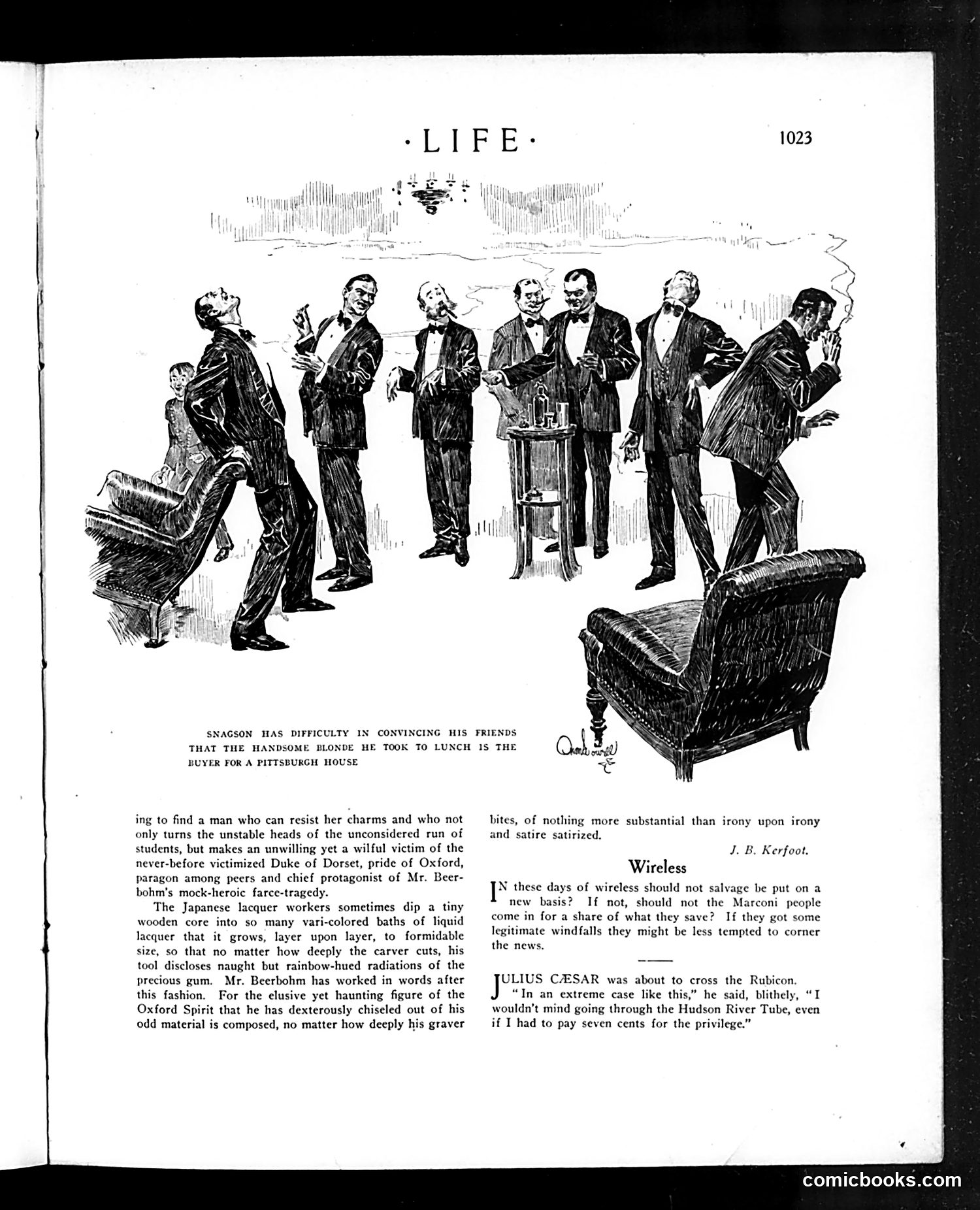
The main cartoon depicts a social comedy about class assumptions and appearances. "Snagson" has taken an attractive blonde woman to lunch, but his friends struggle to believe she's actually a real estate buyer for a Pittsburgh firm—they assume she must be something else entirely (likely a romantic interest or woman of questionable reputation). The joke satirizes early-20th-century gender and class prejudices: a conventionally beautiful woman in professional business capacity seems implausible to these men, who can't reconcile her appearance with her actual role. The page also includes unrelated literary commentary on an author (appears to be Max Beerbohm based on context) and two brief humorous pieces about wireless technology and Julius Caesar. These are typical of *Life* magazine's miscellaneous satirical content format—quick social jabs at contemporary technology, business practices, and pretension.
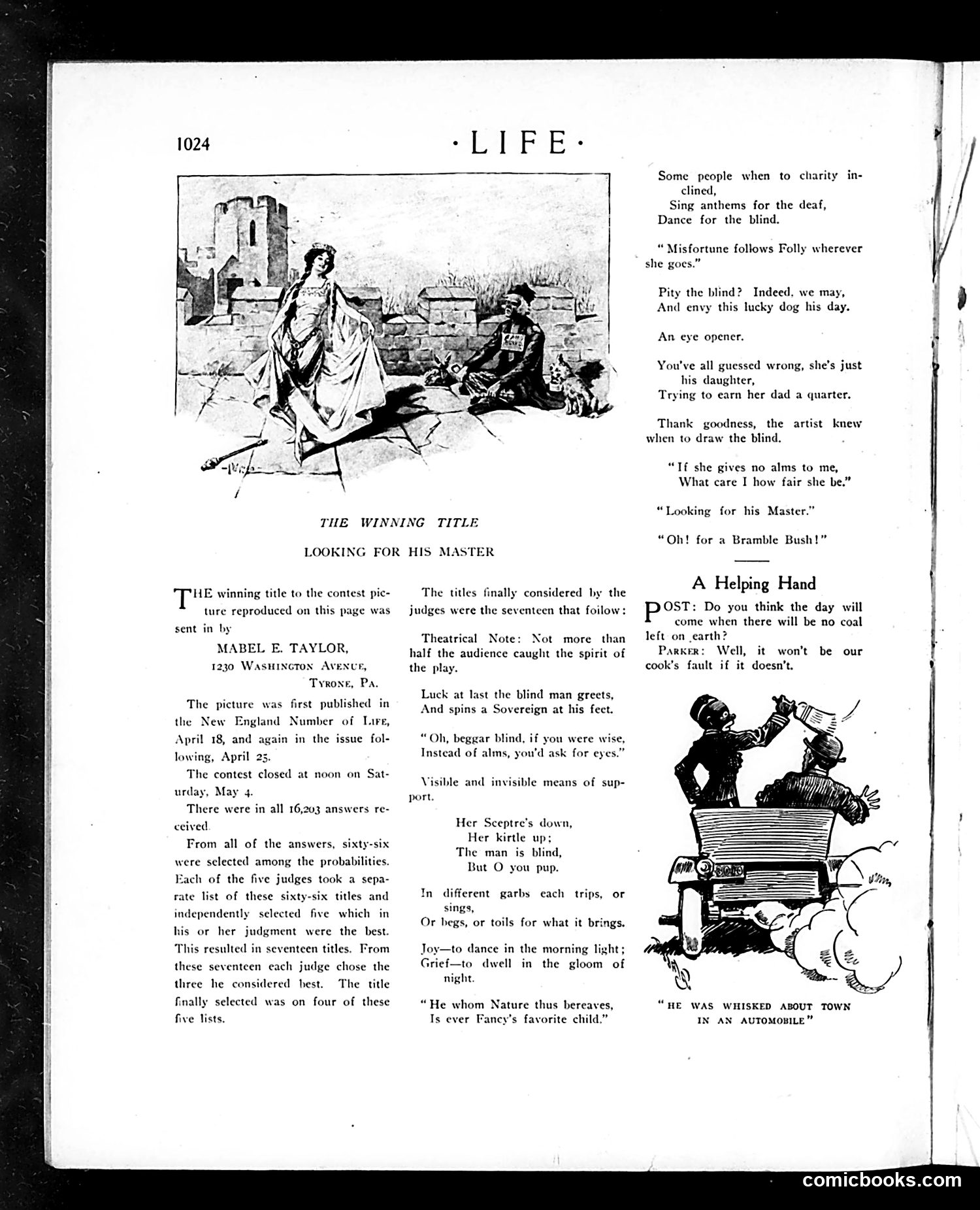
This page documents a caption-writing contest from Life magazine (circa 1910s). The winning cartoon shows a well-dressed woman dropping a coin to a blind beggar with a dog, titled **"Looking for His Master"** by Mabel E. Taylor. The satire works on multiple levels: the title's double meaning suggests the dog—not the blind man—is the real object of charity, implying the woman's pity is misdirected or performative. The page lists seventeen alternate captions submitted by contestants, many offering social commentary on charity itself. Captions like "Sing anthems for the deaf, / Dance for the blind" mock performative charitable gestures, while "Misfortune follows Folly wherever she goes" suggests moral judgment of the beggar's circumstances. The contest reflects early 20th-century attitudes toward poverty and disability, with humor often derived from the blind man's condition and questions about whether charity was genuinely helpful or merely self-serving performance by the wealthy.
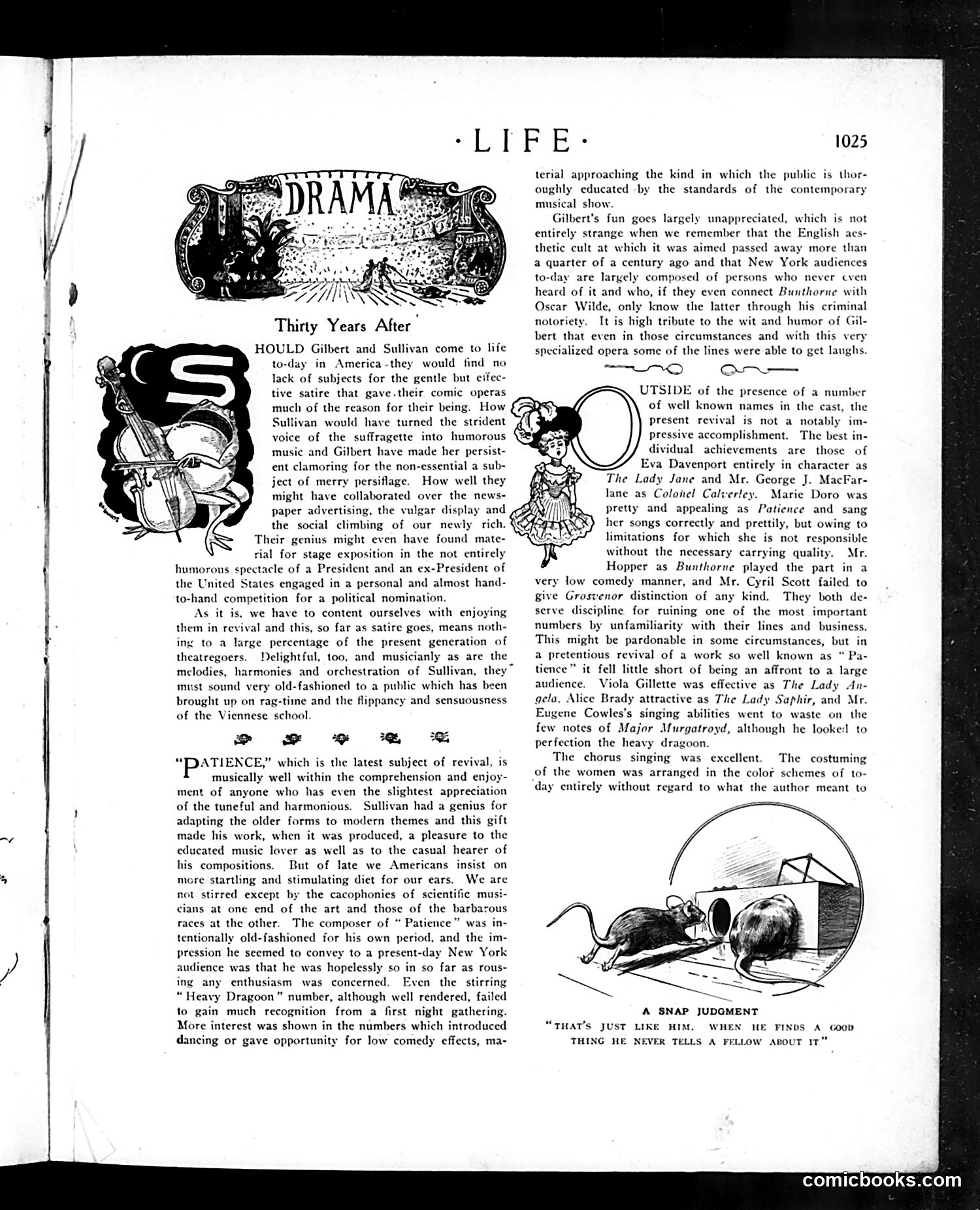
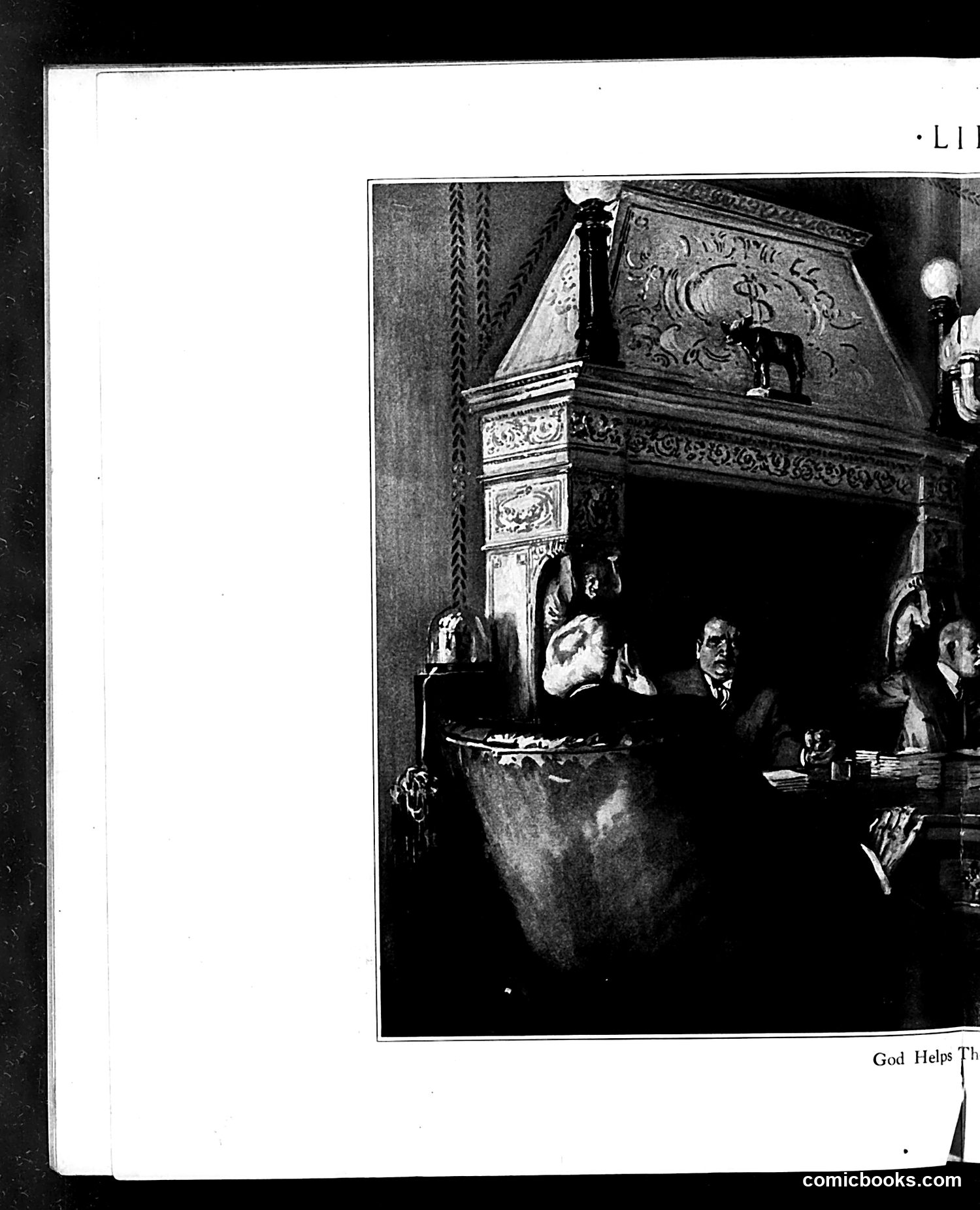
This appears to be a black and white illustration from *Life* magazine showing an ornate pulpit or lectern scene. A figure stands elevated at the pulpit while several men in suits listen below. The decorative architectural elements—elaborate carved details and what appears to be a dollar sign symbol on the upper panel—suggest this is satirizing wealth and religious authority. The partial caption "God Helps Th[e]..." (cut off) combined with the dollar sign imagery indicates this likely mocks the relationship between religion and money—perhaps satirizing wealthy clergy, commercialized faith, or the phrase "God helps those who help themselves" in an ironic economic context. Without the complete caption or date, the specific target remains unclear, though the composition criticizes the intersection of religious authority and financial interests.
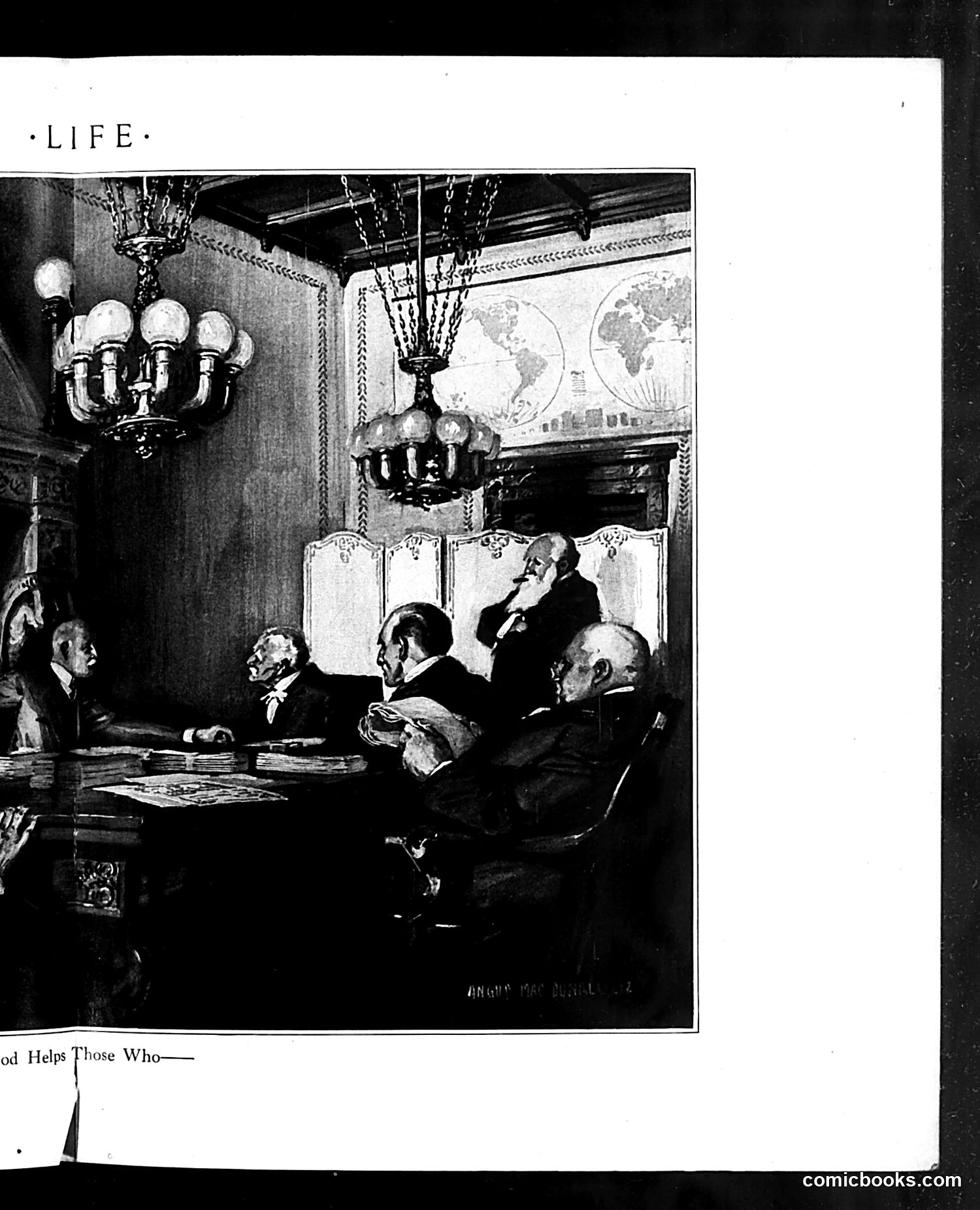
This page from *Life* magazine shows a black and white illustration depicting five well-dressed men in what appears to be an elegant interior room with chandeliers, maps on the wall, and decorative furnishings. The men appear to be in discussion or a business meeting. The partial text visible reads "od Helps Those Who—" which likely completes the phrase "God Helps Those Who Help Themselves," a common proverb about self-reliance. Without complete caption text or clearer identification of the figures, the specific satirical target is unclear. The scene suggests commentary on wealthy or powerful men's activities, possibly business dealings or political meetings, but the precise historical reference and intended joke cannot be reliably determined from the visible evidence alone.
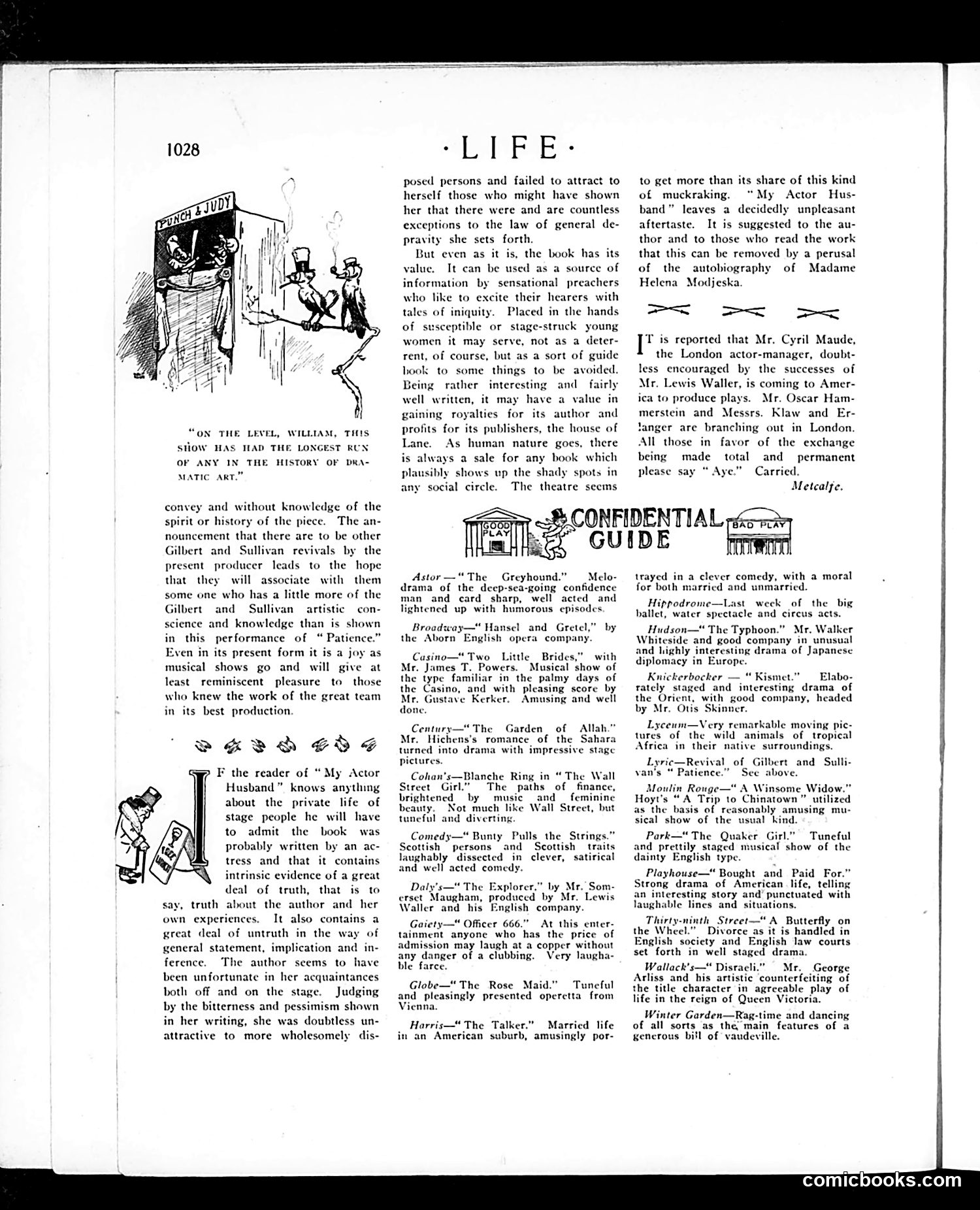
The single cartoon depicts two figures in theatrical dress standing on what appears to be a stage or platform labeled "Drastic Jody." One figure addresses the other as "William," saying the show "has had the longest run of any in the history of dramatic art." The satire targets theatrical productions that achieve longevity through sensationalism rather than artistic merit. The page's accompanying text discusses "My Actor Husband," a book critiquing stage life's seedier aspects. The cartoon likely mocks plays that succeed commercially by exploiting scandal and muckraking rather than genuine theatrical quality—much like the book being reviewed. The joke suggests that even poor-quality theatrical productions enjoy extended runs if they appeal to audiences' appetite for lurid content about backstage immorality. The "longest run" boast becomes ironic commentary on public taste and theatrical standards during this period.
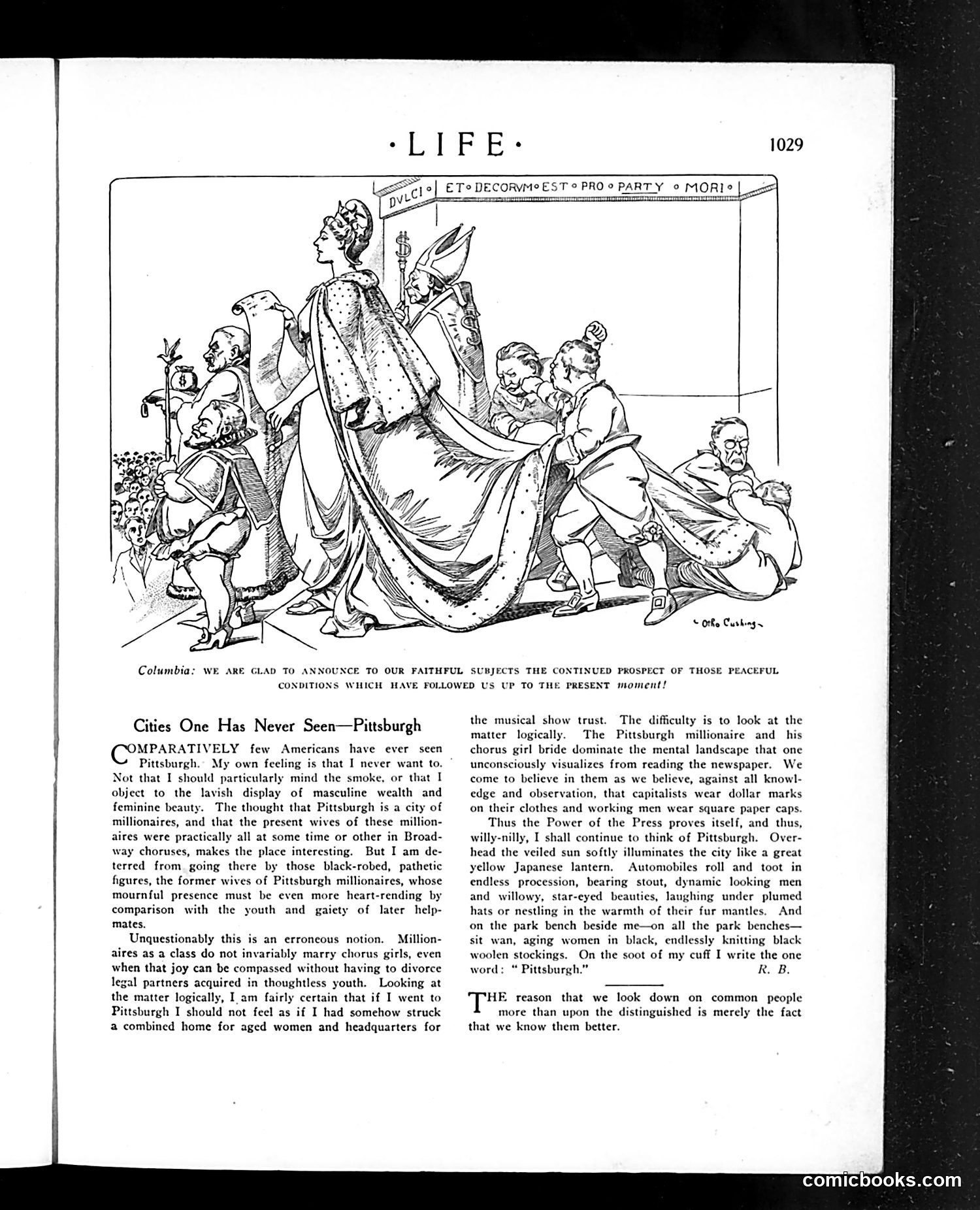
**The Main Cartoon:** The top illustration shows "Columbia" (female personification of America) as a regal, crowned figure announcing continued "peaceful conditions" to her subjects. She's surrounded by cherubs and soldiers, with Latin inscriptions referencing decorousness and duty to the state. This appears to be satirizing official government propaganda or patriotic announcements—mocking their grandiose, flowery language about national prosperity and peace, likely during a period of actual social tension. **The Article:** The accompanying essay satirizes Pittsburgh's reputation as a wealthy industrial city where rich millionaires (made from steel/industry) marry young Broadway chorus girls, then discard them. The author notes how newspaper coverage creates false impressions—we believe stereotypes (capitalists wearing dollar signs, workers in paper caps) rather than reality. The final paragraph's aphorism suggests we despise "common people" simply because we know them better than the idealized "distinguished," implying hypocrisy in social hierarchies. **Overall Point:** Satire of American pretension, media influence, and class prejudice.
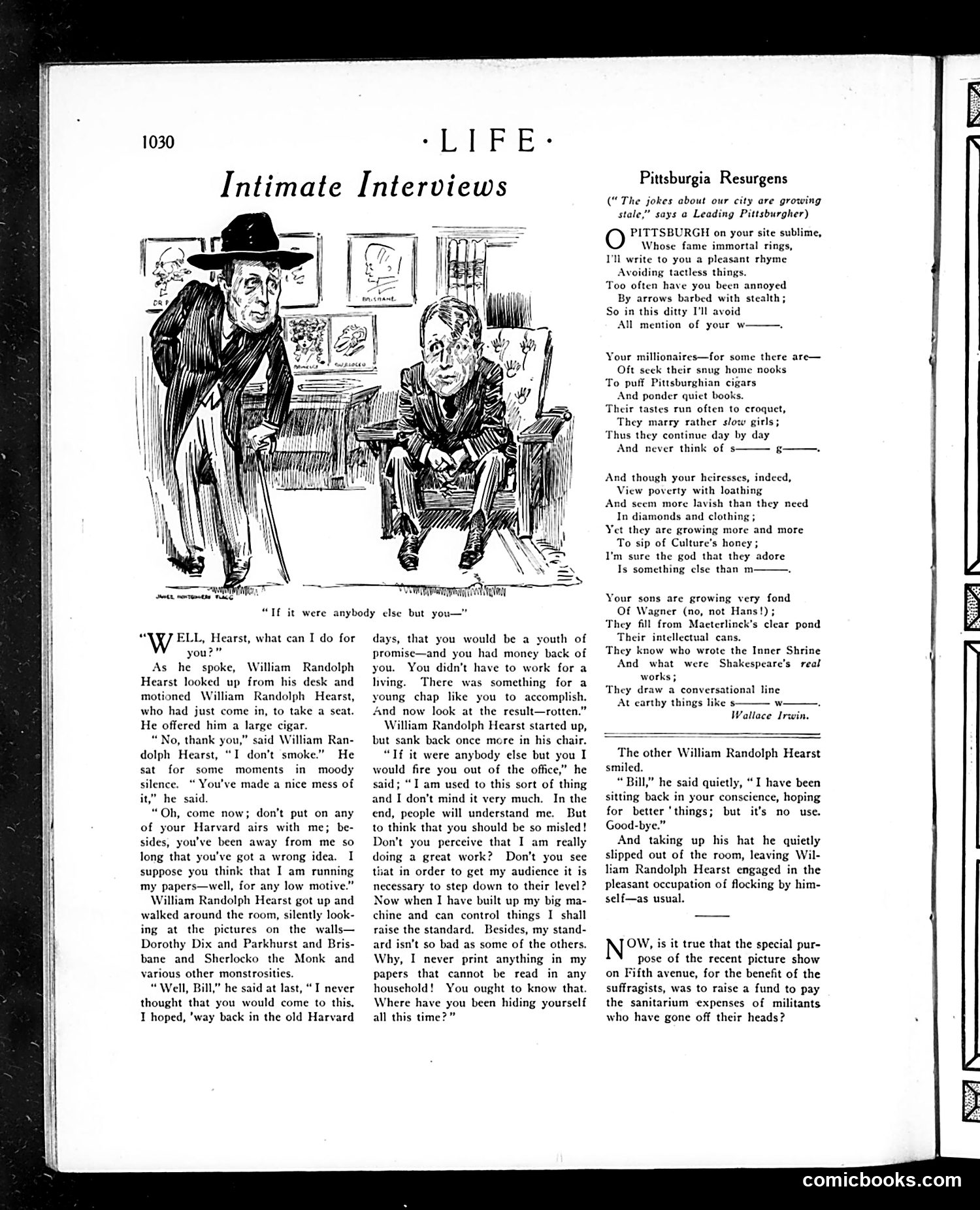
This page satirizes **William Randolph Hearst**, the powerful newspaper magnate, through a surreal "Intimate Interview" where Hearst confronts himself—literally two versions of the same person in conversation. The joke critiques Hearst's journalistic compromises: one Hearst (representing his conscience) accuses him of running sensationalist papers for profit, while the other Hearst defensively justifies "stepping down to their level" to build his audience, promising to "raise the standard" once he has power. This captures contemporary criticism of Hearst's yellow journalism tactics. The accompanying poem mocks **Pittsburgh**, a wealthy industrial city, by deliberately avoiding the city's notorious problems (pollution, labor strife) while sarcastically praising its millionaires' refined cultural tastes—a backhanded compliment suggesting Pittsburgh's wealth masks uglier realities. Both pieces use humor to critique powerful figures: Hearst for ethical compromise, Pittsburgh's elite for superficial respectability masking industrial exploitation.
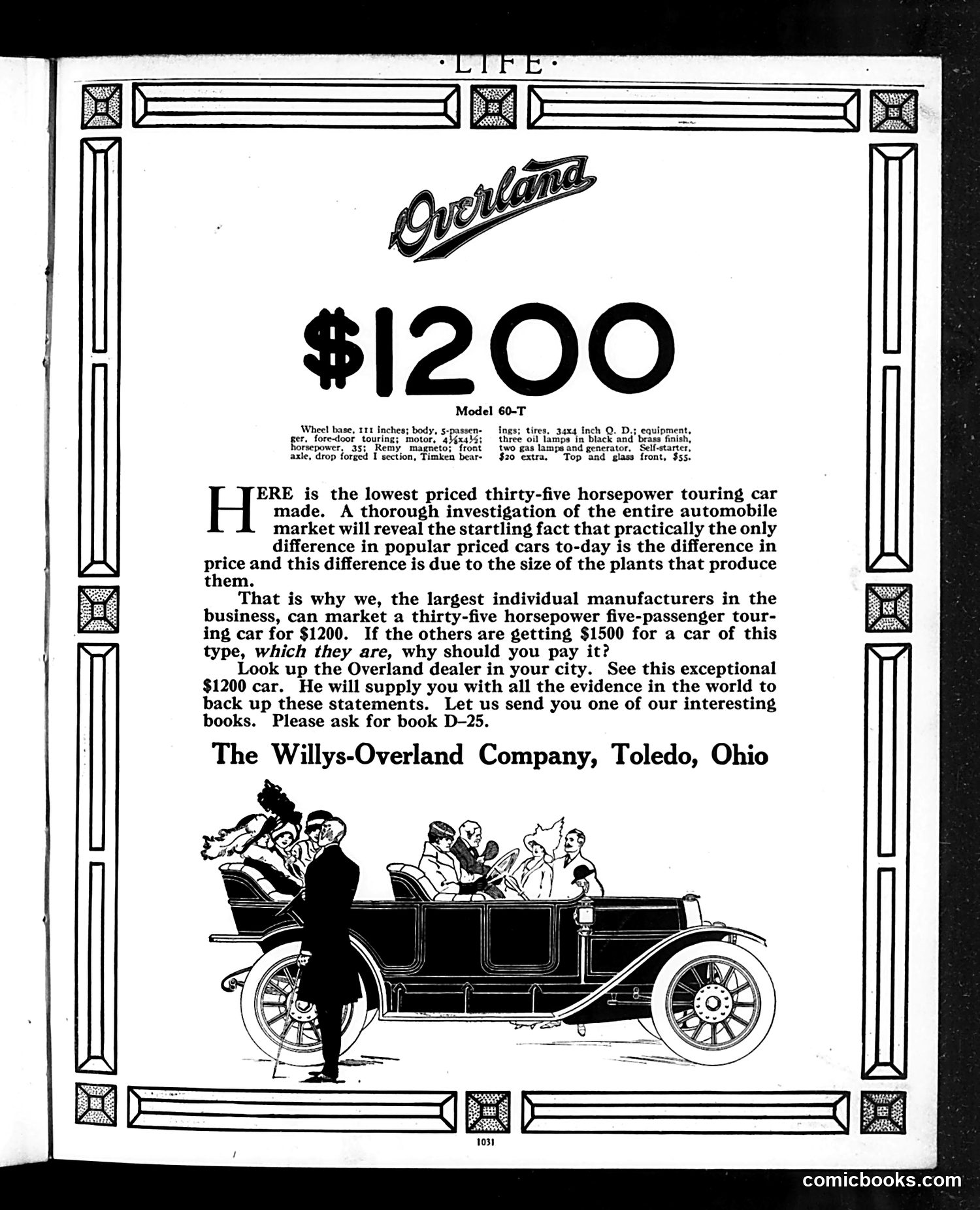
This is primarily an **automobile advertisement**, not political satire. It promotes the Overland Model 60-T touring car manufactured by the Willys-Overland Company for $1,200. The ad's rhetorical strategy claims this is "the lowest priced thirty-five horsepower touring car made," arguing that price differences among competitors reflect only manufacturing scale, not quality. It challenges consumers: if competitors charge $1,500 for identical vehicles, "why should you pay it?" The illustration shows an elegant touring car with fashionably dressed passengers—typical early-1900s advertising imagery emphasizing status and leisure. The ad encourages readers to visit local dealers for "evidence" supporting these claims and request promotional materials. This reflects the competitive early automotive market when manufacturers constantly battled over pricing and standardization. No political figures or satirical commentary are present; this is straightforward commercial promotion appearing in *Life* magazine.
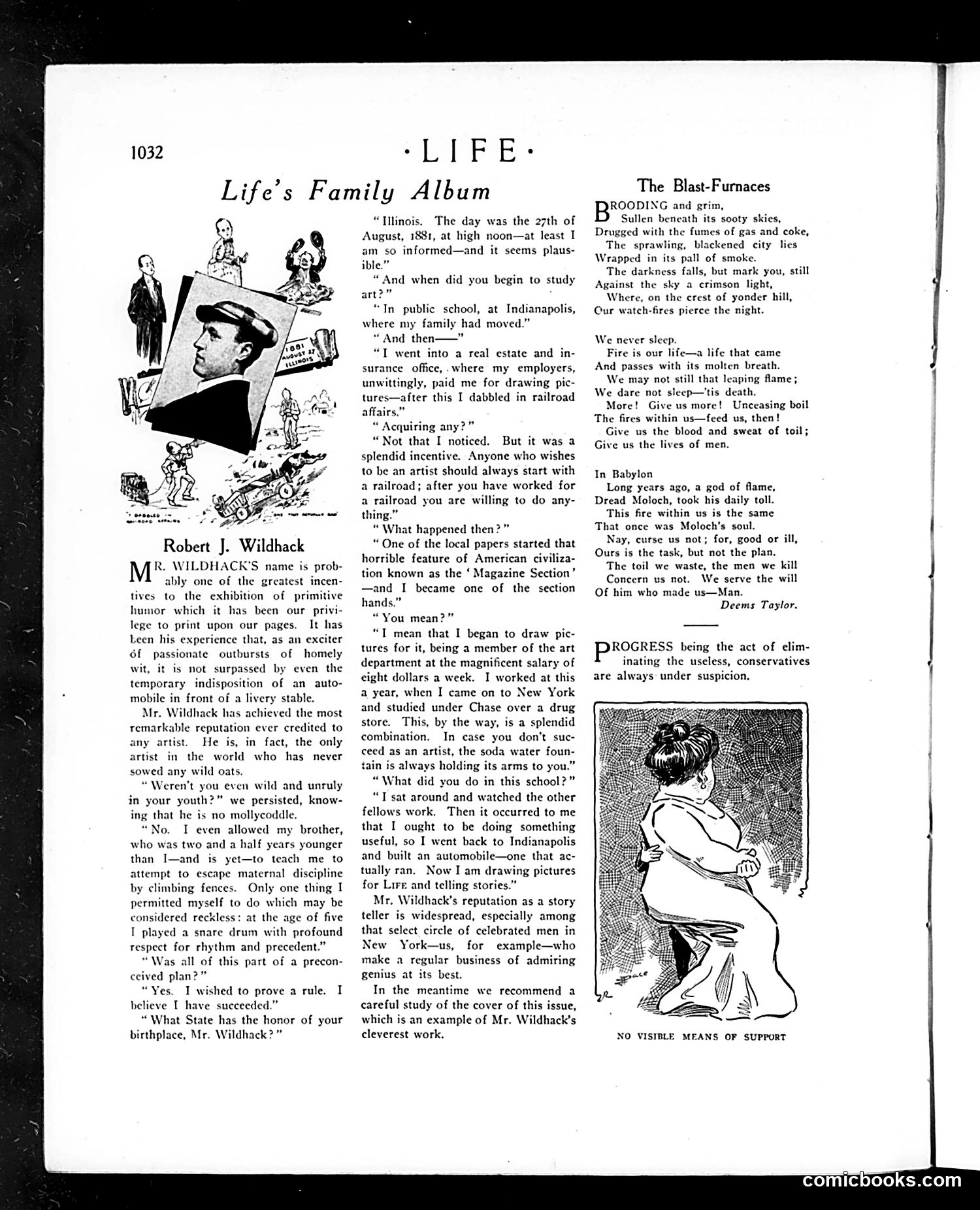
This page features a satirical profile interview with Robert J. Wildhack, a cartoonist and illustrator for Life magazine. The humor relies on gentle mockery of Wildhack's unusually *disciplined* character—the joke being that an artist famous for primitive humor is personally extraordinarily proper and rule-following. The interview recounts his deliberately boring biography: born in Illinois (1881), worked in real estate and railroads before becoming a newspaper illustrator at eight dollars weekly, studied under the painter Chase, built an automobile that "actually ran," and now draws for Life. The satire suggests that despite this conventional path, he's achieved artistic success—contradicting the stereotype that artists must be wild and undisciplined. The page also includes a serious poem, "The Blast-Furnaces," depicting industrial labor and foundry work with romantic intensity—contrasting sharply with the light biographical humor above. The illustration shows a worker in minimal clothing, captioned "NO VISIBLE MEANS OF SUPPORT."
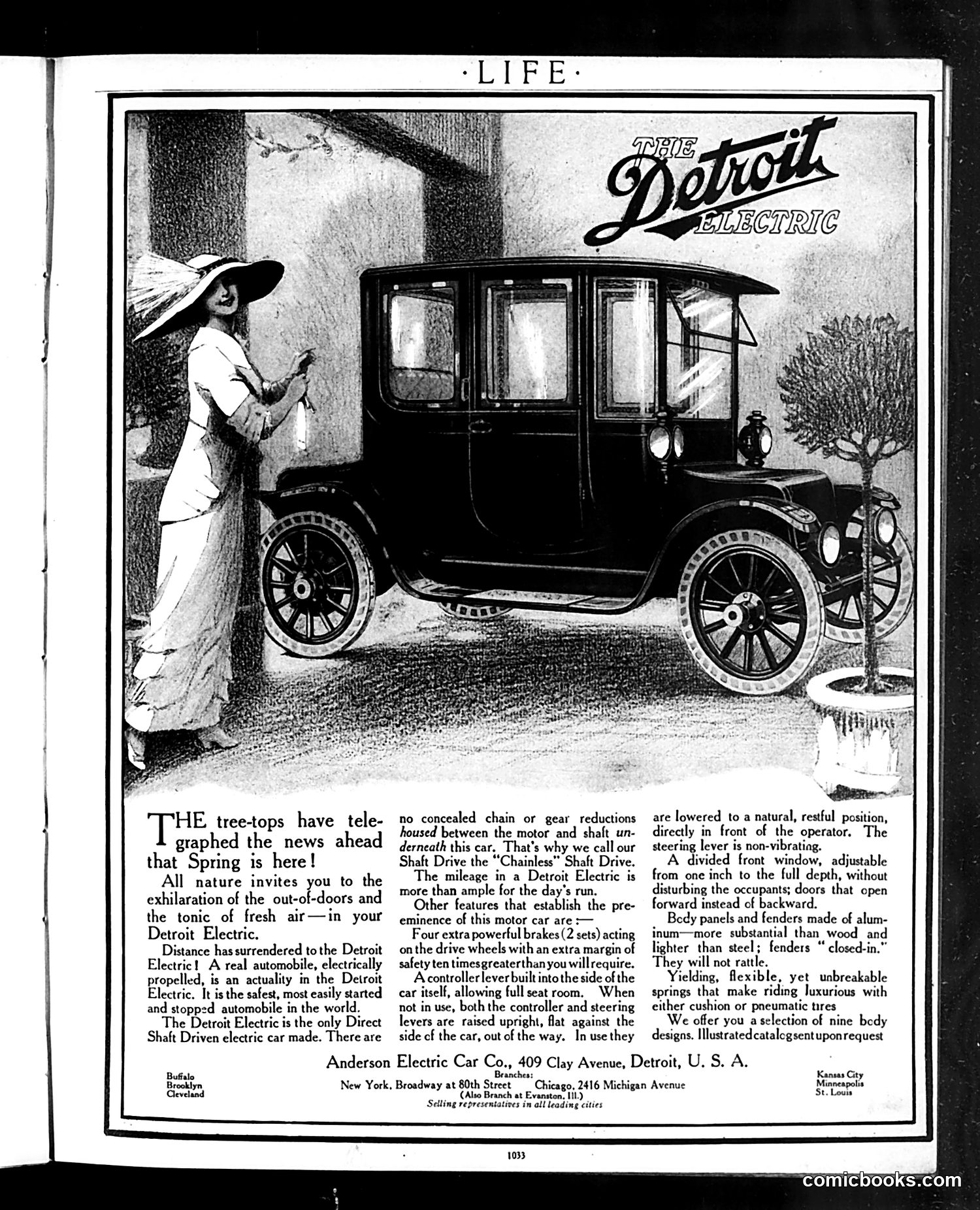
This is primarily a **Detroit Electric automobile advertisement**, not a political cartoon. The ad features a woman in early 1900s attire (large hat, light dress) standing beside the car, which appears to be a luxury electric vehicle. The copy emphasizes the Detroit Electric's advantages: it's reliable, easy to start and stop, has no gear reductions (the "Chainless Shaft Drive"), and travels significant distances on a single charge. The ad highlights features appealing to wealthy buyers—powerful brakes, flexible body construction, and closed-in design—suggesting this was marketed toward affluent women and families as a practical, safe alternative to gasoline vehicles. This reflects the early automotive era when electric cars competed seriously with gas-powered engines before eventually being displaced.
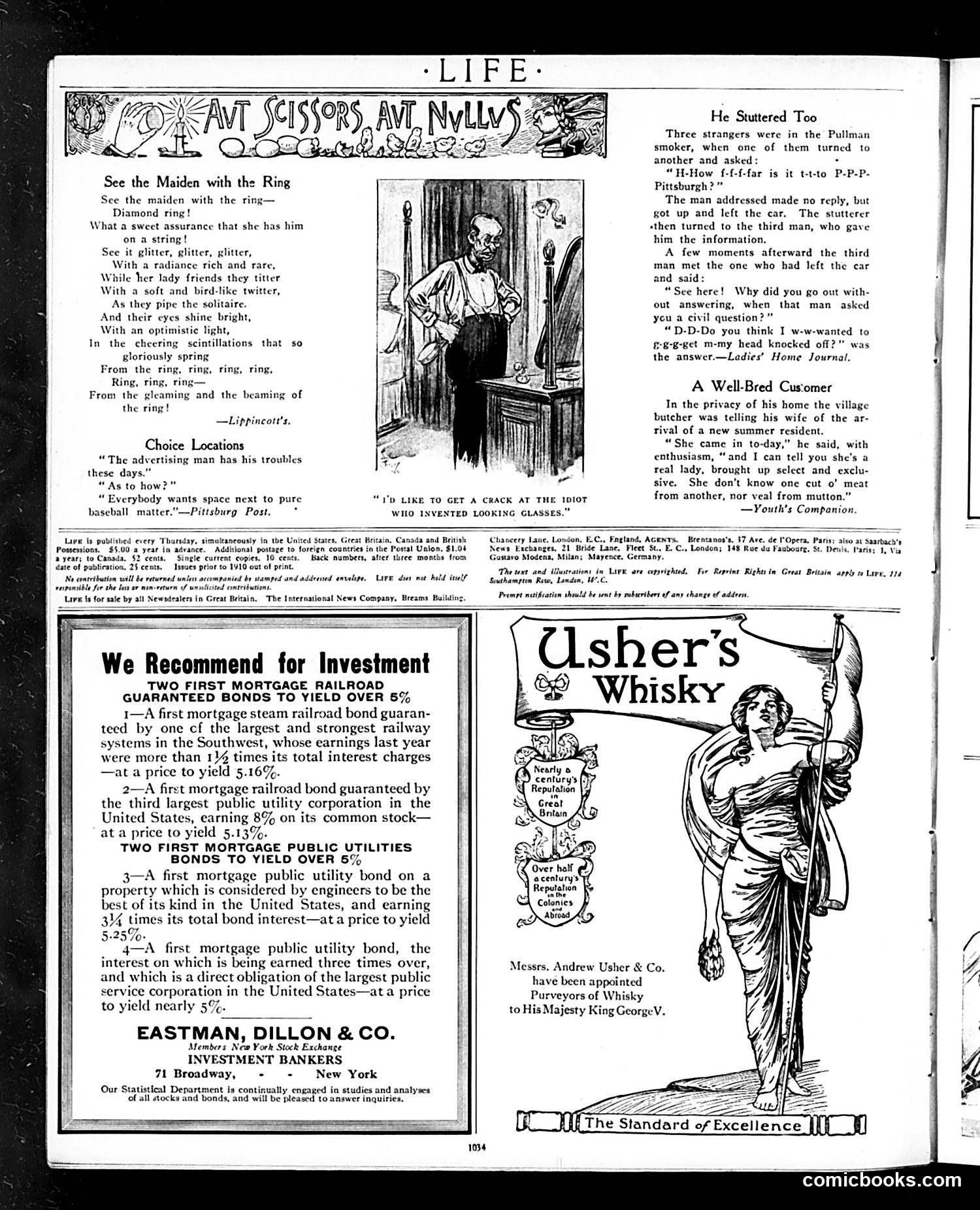
This page contains three separate humorous items typical of Life's satirical content: **"See the Maiden with the Ring"** is a poetic piece mocking women's obsession with engagement rings as symbols of marital security. The repeated "ring, ring, ring" emphasizes materialism and female vanity—how women gleefully display diamonds to impress peers. **"Choice Locations"** is a brief joke about advertising space competition, playing on how newspapers want premium placement near baseball coverage (then extremely popular). **"He Stuttered Too"** tells of a man with a severe stutter who asks about Pittsburgh's distance. When another passenger leaves without answering, the stutterer learns the man feared getting mocked for his own speech impediment—a sympathetic joke about social shame around disabilities. The page is primarily filled with **financial advertisements** promoting railroad and utility bonds. These were common in early-20th-century magazines targeting wealthy readers seeking investments. The overall tone reflects Life's satirical approach to contemporary society: mocking consumerism, social pretension, and human awkwardness while maintaining genteel humor appropriate for middle/upper-class readers.
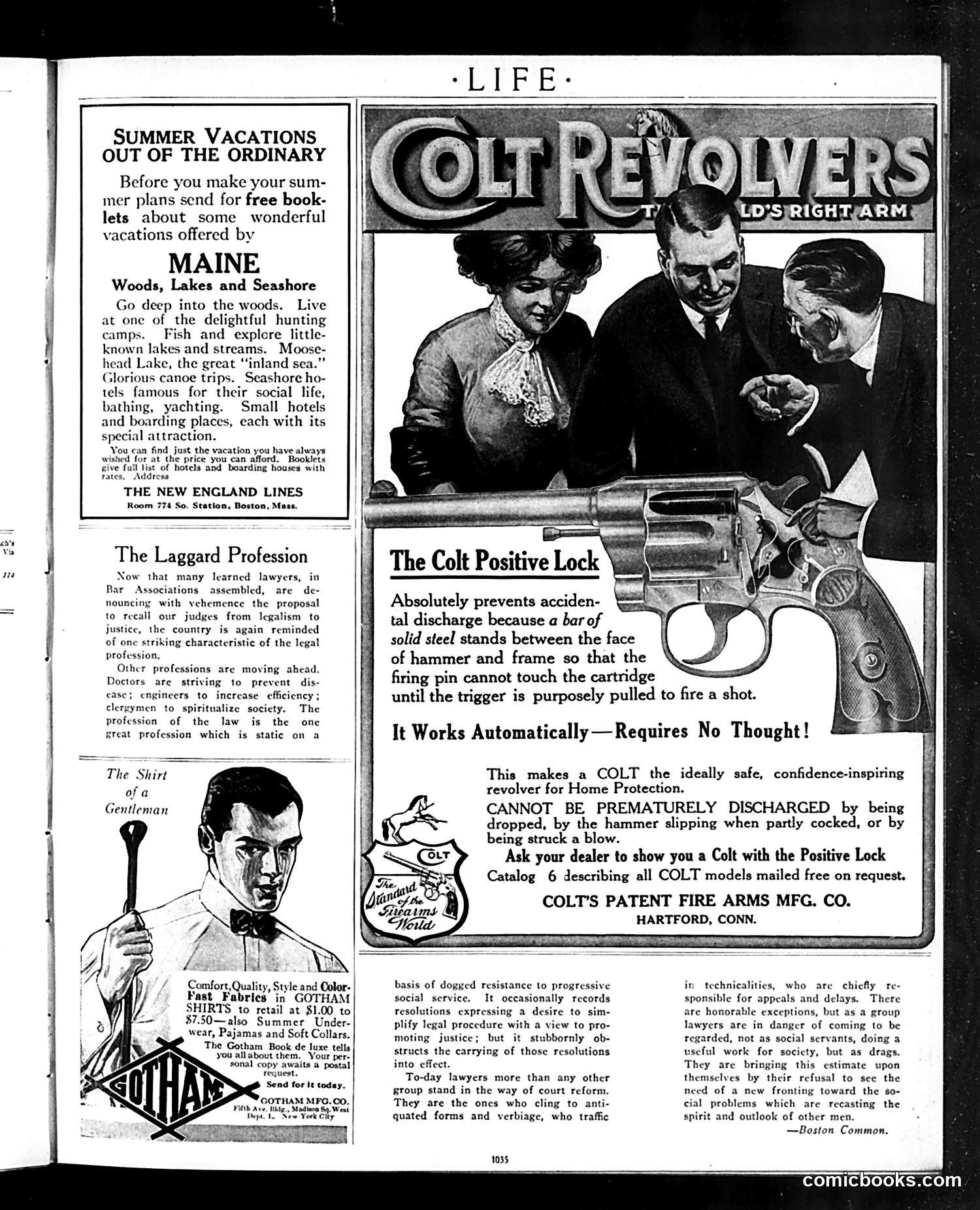
This page is primarily **advertising**, with one editorial essay. The main content is ads for Maine vacations, Gotham shirts, and prominently, a **Colt revolver's "Positive Lock"** safety feature—a mechanical bar preventing accidental discharge. The Colt ad emphasizes the gun is "ideally safe" for "Home Protection," requiring "No Thought." The sole editorial piece, "The Laggard Profession," **critiques lawyers and the legal profession**. It argues that while doctors, engineers, and clergy advance their fields toward progress and social benefit, lawyers resist reform. The essay claims lawyers obstruct court modernization, cling to "antiquated forms and verbiage," and prioritize technical delays over justice. The author (attributed to "Boston Common") concludes lawyers are becoming viewed not as "social servants" but as "drags" on society, because they refuse to address modern social problems reshaping other institutions. The critique reflects early 20th-century Progressive Era concerns about legal obstruction of social reform.
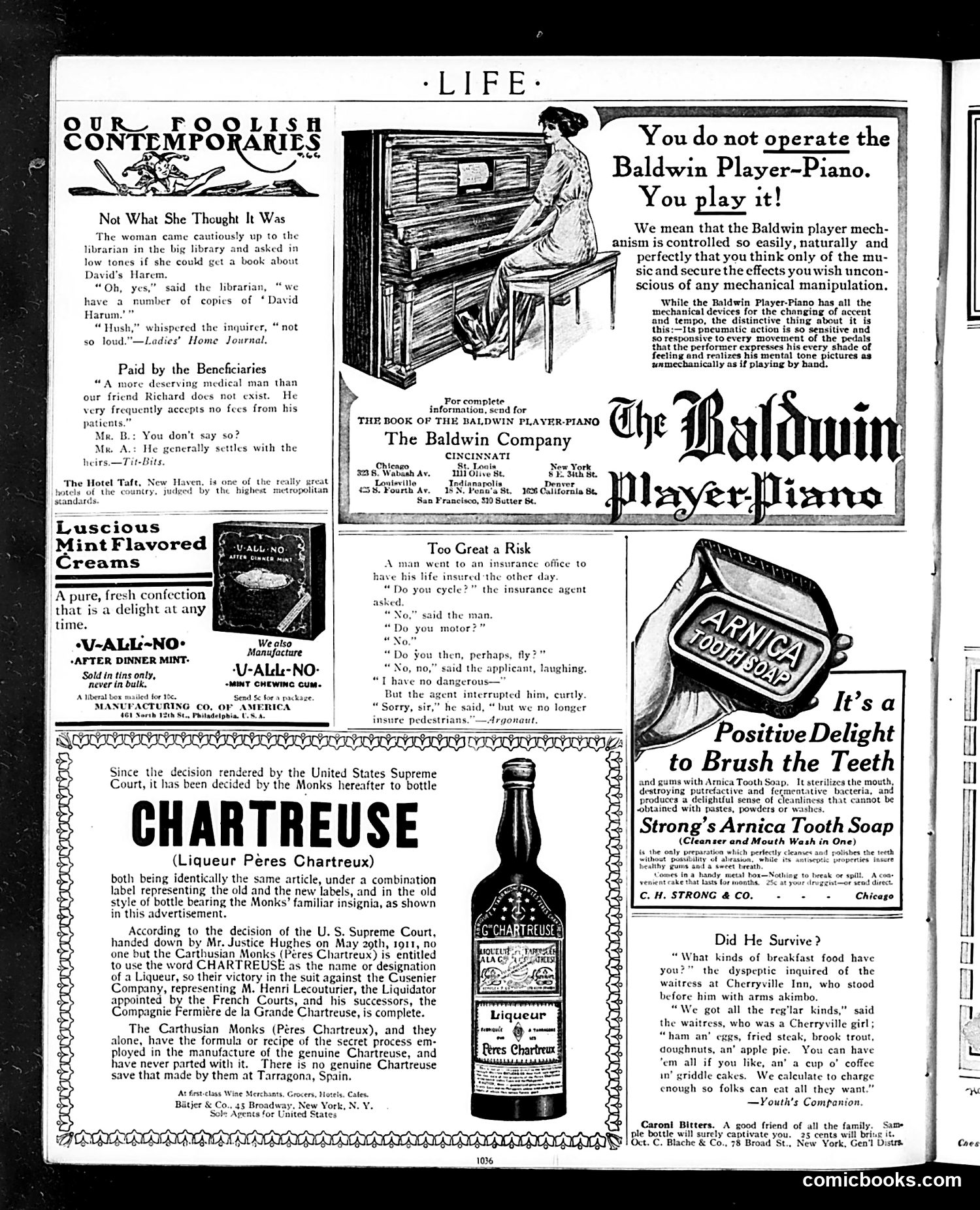
This page presents brief satirical anecdotes mocking human folly: **"Not What She Thought It Was"**: A librarian's joke about a woman asking for a book on "David's Harem," mishearing it as "David Harum" (likely referencing a popular novel). The humor relies on the woman's embarrassment at her misunderstanding. **"Paid by the Beneficiaries"**: A darker joke where a doctor "generously" treats patients without fees—but actually profits by waiting for them to die and collecting from their heirs. **"Too Great a Risk"**: An insurance agent refuses to insure a pedestrian, ironically suggesting that merely walking is now too dangerous. This reflects early-20th-century anxieties about rapidly modernizing society with automobiles and airplanes. The remaining content comprises **period advertisements** (Baldwin Player-Piano, U-All-No mints, Chartreuse liqueur, tooth soap), with a brief joke about a man seeking disability insurance. These vignettes exemplify Life's satirical formula: short, punchy jokes highlighting contemporary social absurdities and modern risks.
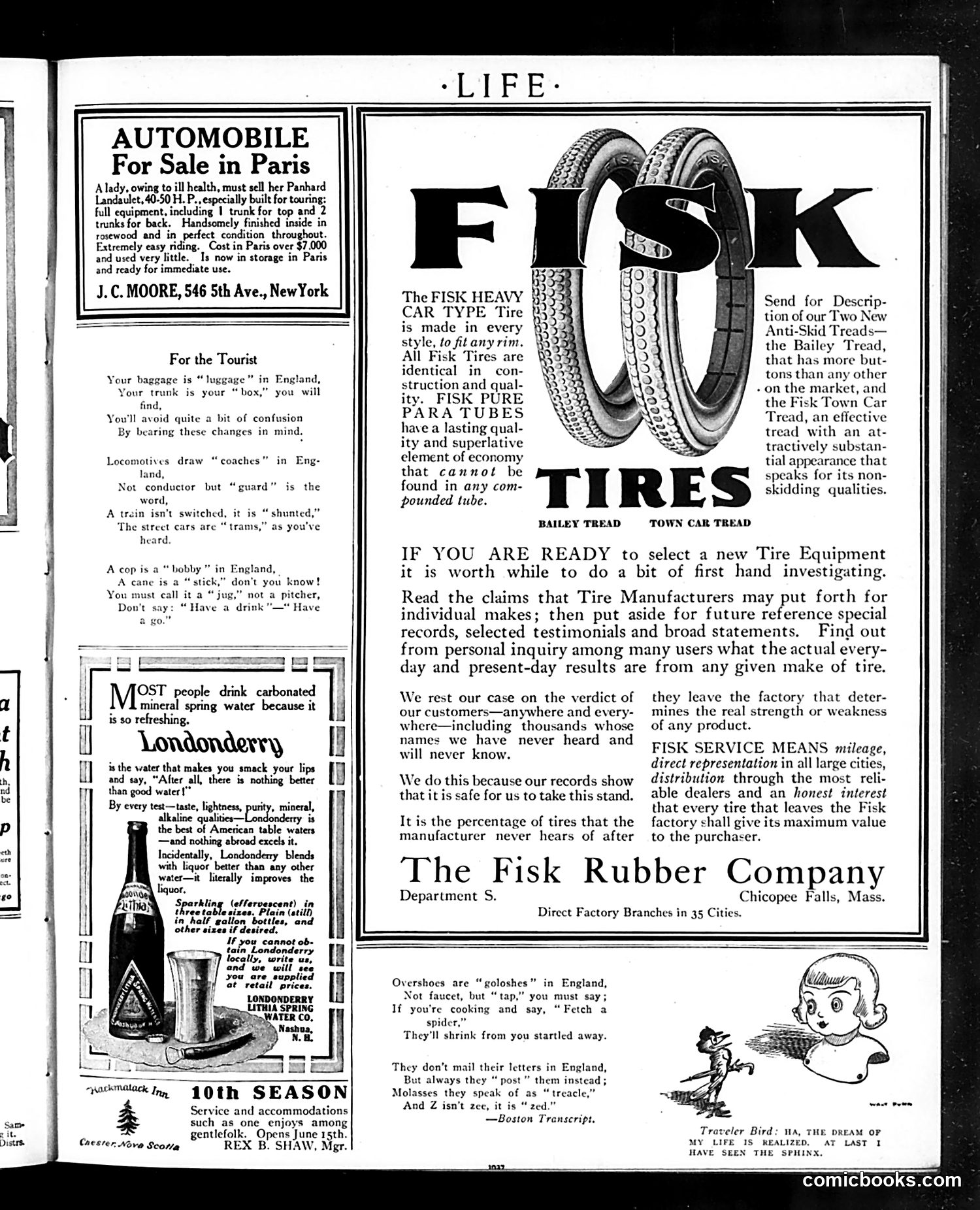
This is primarily an **advertising page** rather than satirical content. The main elements are: **Major Advertisements:** - **Fisk Tires** (center): A large tire company ad emphasizing quality, durability, and customer satisfaction through direct representation and honest dealer networks. - **Londonderry Mineral Spring Water** (left): Claims superiority over other American table waters, noting it "blends with liquor better." - **Automobile for sale** (top left): A wealthy woman's luxury Panhard Landaulet in Paris. **"For the Tourist" Section:** This offers humorous English-language translations for American travelers—calling luggage "baggage," conductors "guards," trains "shunted," and cabs "trams." It's lighthearted cultural orientation, not political satire. **Bottom cartoon**: A small "Traveler Bird" comic about realizing one's life dream. The page reflects early 1900s consumer culture targeting affluent, international travelers and automobile owners—content designed to appeal to Life's educated, wealthy readership.
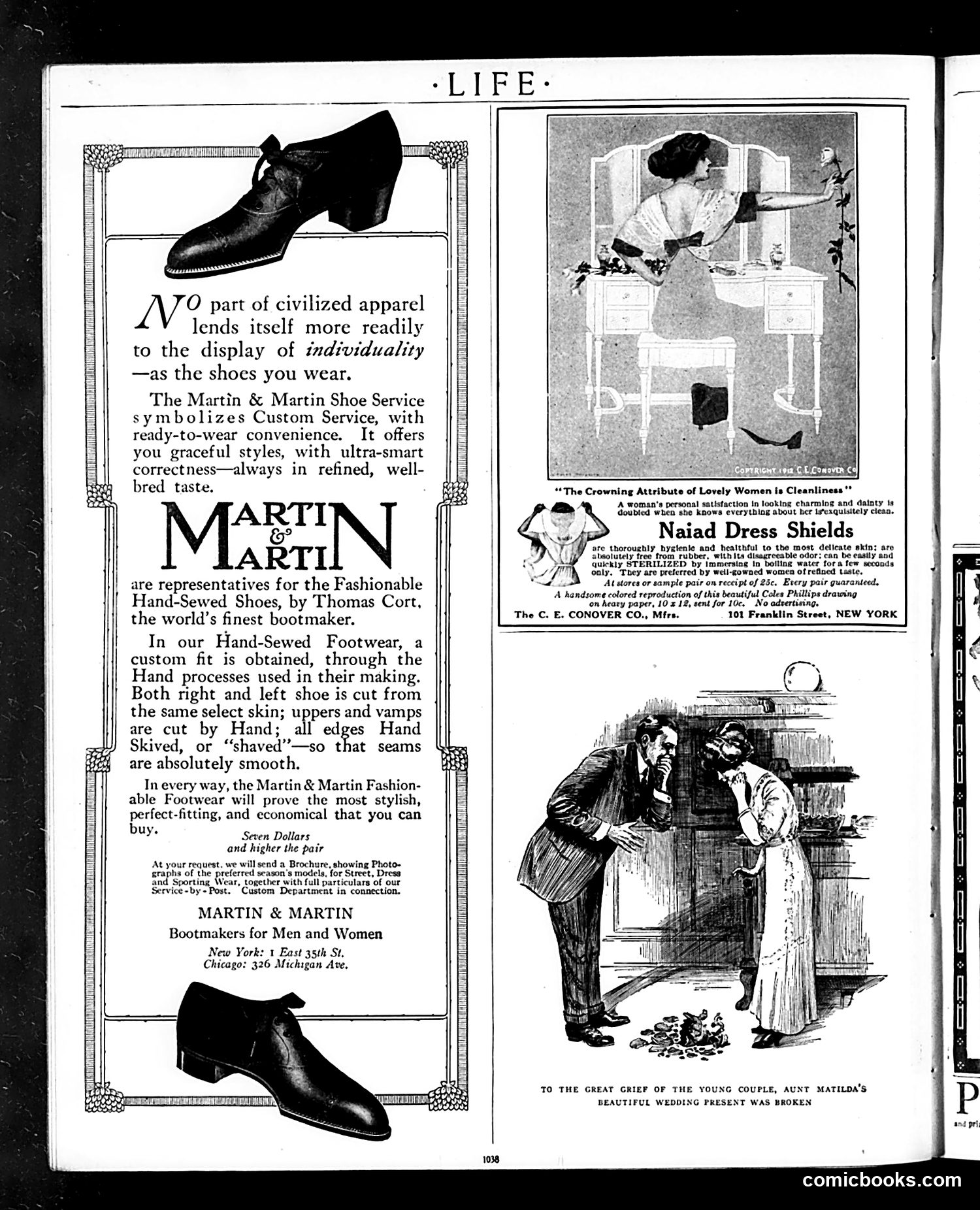
This page is primarily **advertising**, not political satire. It contains three distinct ads: 1. **Martin & Martin Shoes** (left): A luxury bootmaker advertisement emphasizing hand-crafted custom footwear as a marker of refined taste and individuality. 2. **Naiad Dress Shields** (top right): Promotes underarm shields as essential for hygiene and cleanliness—reflecting early 20th-century anxieties about perspiration and social propriety for women. 3. **Illustration** (bottom right): A sentimental domestic scene captioned "To the great grief of the young couple, Aunt Matilda's beautiful wedding present was broken." This appears to be decorative storytelling rather than satire—depicting a common domestic mishap with gentle humor. The page reflects **period concerns about consumer goods, cleanliness standards, and social respectability** rather than political commentary. The tone emphasizes that proper appearance and hygiene signify civilization and refinement.
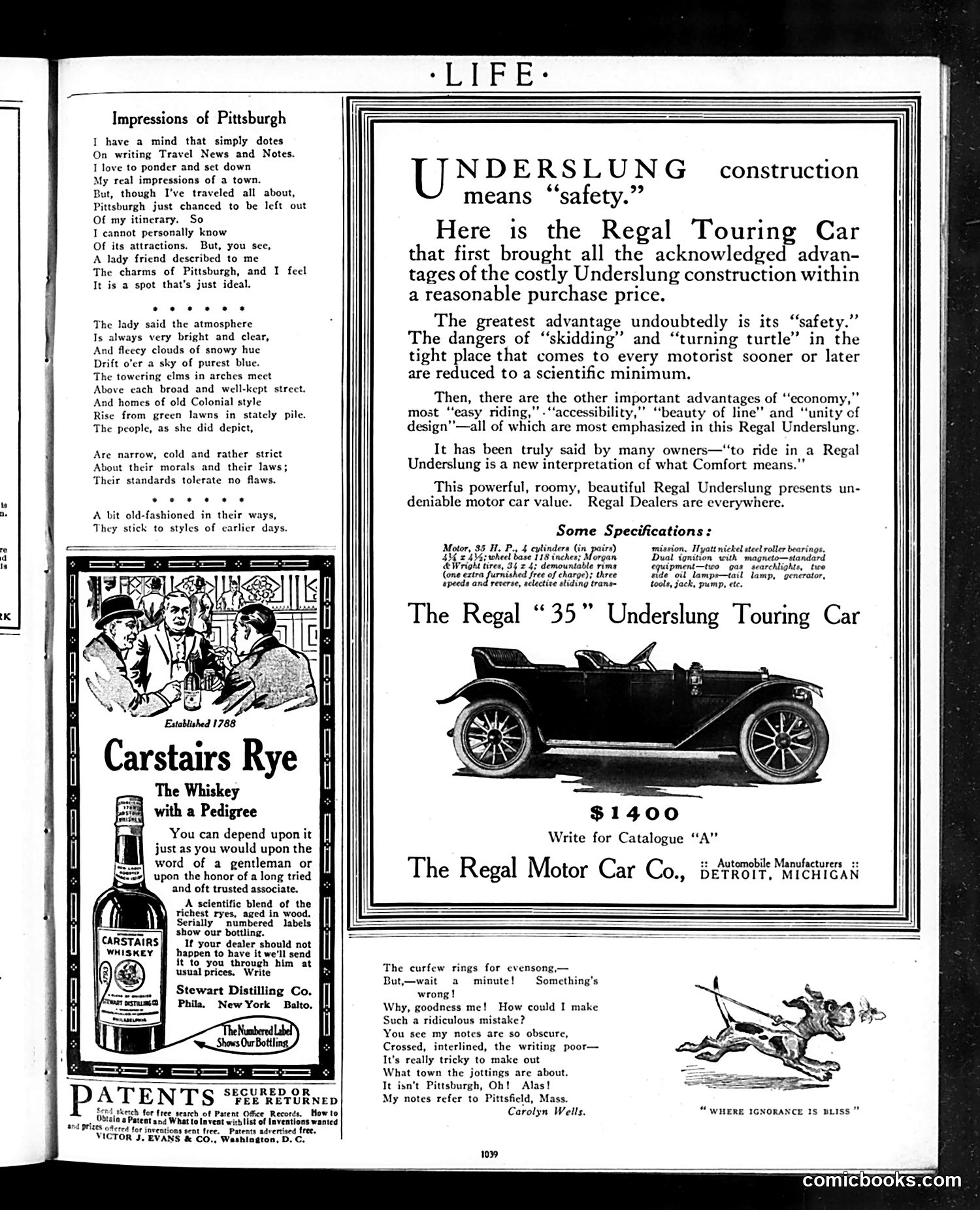
This page combines poetry, automotive advertising, and editorial humor from an early 1900s Life magazine. **The Satirical Content:** The left column presents "Impressions of Pittsburgh" — a poem that satirizes travel writing. The joke: the narrator admits he's never actually visited Pittsburgh but is writing about it anyway, based solely on a lady friend's description. The friend describes Pittsburgh in idealized terms (bright atmosphere, stately Colonial homes, upright moral citizens). **The Punchline:** At the bottom, the author (Carolyn Wells) reveals she's made a massive error: her notes actually refer to **Pittsfield, Massachusetts**, not Pittsburgh at all. Her handwriting is so poor and notes so jumbled that she confused the two towns entirely. This mocks careless travel writers who produce content without proper research or attention to detail. **Supporting Content:** The page also includes advertisements (Carstairs Rye whiskey, Regal automobiles) typical of Life's commercial content, plus a patent notice. The satirical cartoon/illustration at bottom right ("Where Ignorance is Bliss") visually reinforces the theme of mistaken identity.
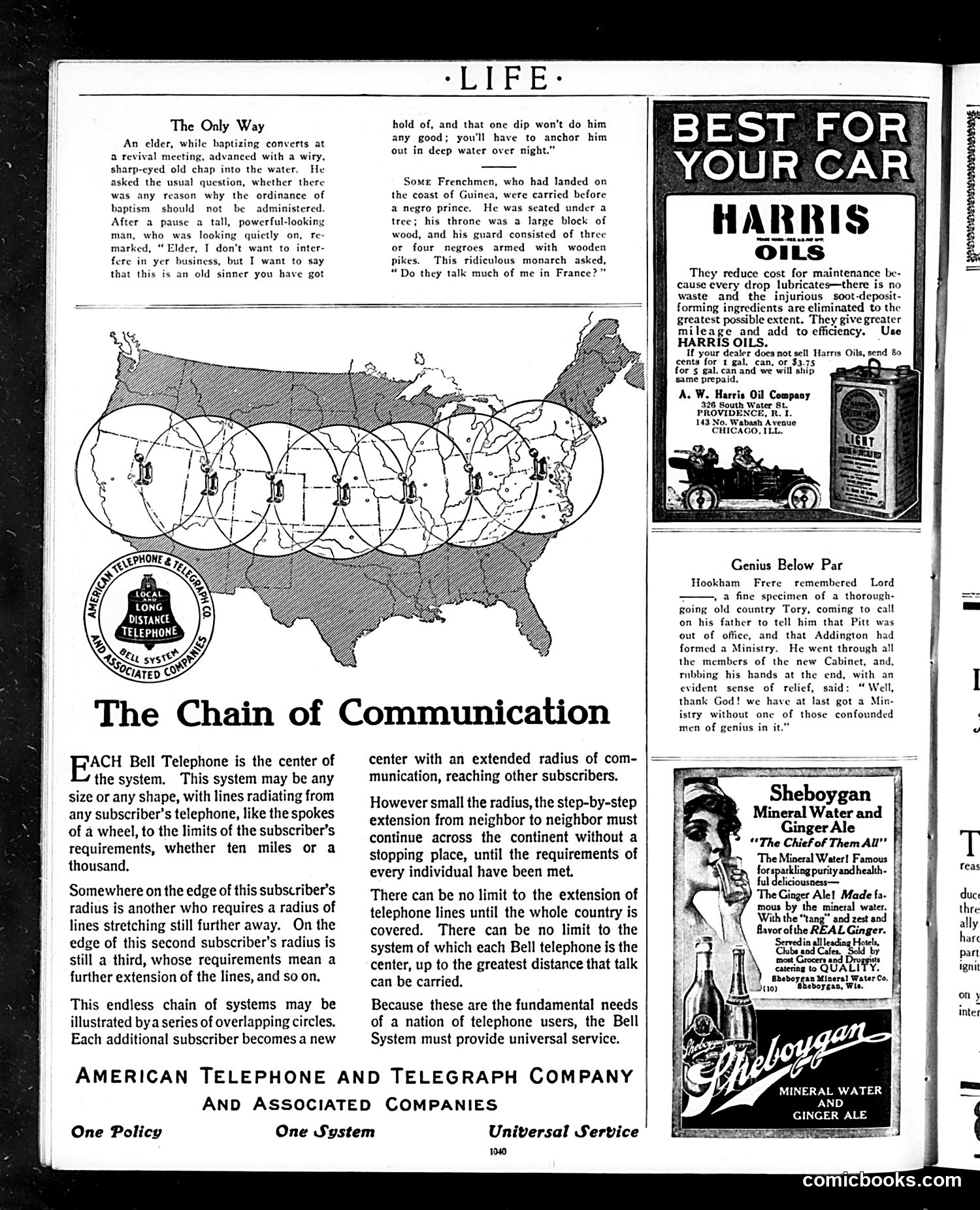
This page contains three distinct humor pieces typical of Life magazine's satirical format: **"The Only Way"** presents two brief anecdotes mocking religious and colonial pretension. The first jokes about a revival preacher needing to fully submerge a hardened sinner. The second ridicules an African prince's vanity—a "ridiculous monarch" asking French visitors if he's famous in Europe, reflecting period stereotypes about non-European rulers. **"The Chain of Communication"** is a serious AT&T advertisement disguised as educational content, using overlapping circles on a US map to explain telephone infrastructure expansion. It argues for universal service coverage across the entire country. The right column contains period advertisements for Harris Oils and Sheboygan Mineral Water. The page primarily serves commercial purposes (advertising telephone service and automotive products) while using light satirical content as editorial padding—standard practice for Life magazine of this era.
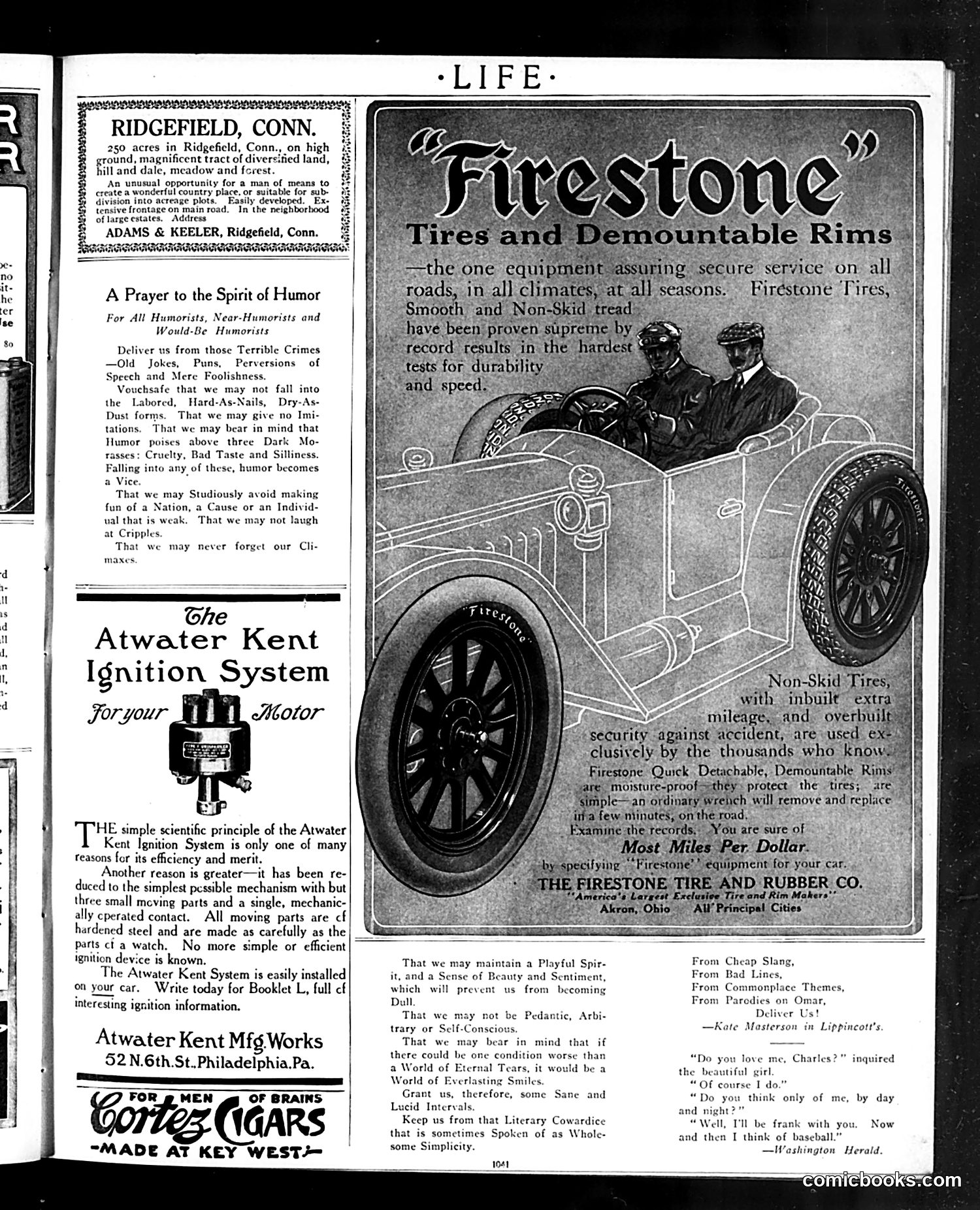
This page is primarily **advertisements and filler content** rather than satirical cartoons. The main elements are: 1. **Real estate ad** (Ridgefield, Connecticut property) 2. **"A Prayer to the Spirit of Humor"** — a tongue-in-cheek manifesto for humorists, warning against lazy comedy techniques (old jokes, puns, cruelty toward the weak, laughing at disabled people). This reflects *Life* magazine's self-conception as a sophisticated satirical publication with standards, not a purveyor of cheap laughs. 3. **Automotive advertisements** for Atwater Kent ignition systems and Firestone tires — typical early-1900s car marketing emphasizing reliability and durability. 4. **Small romantic joke** at bottom (man admits he thinks about baseball, not just his girlfriend) — gentle, era-appropriate humor about male distraction. The page reflects *Life's* mixed identity: serious satire intermixed with commercial advertising and light domestic humor.
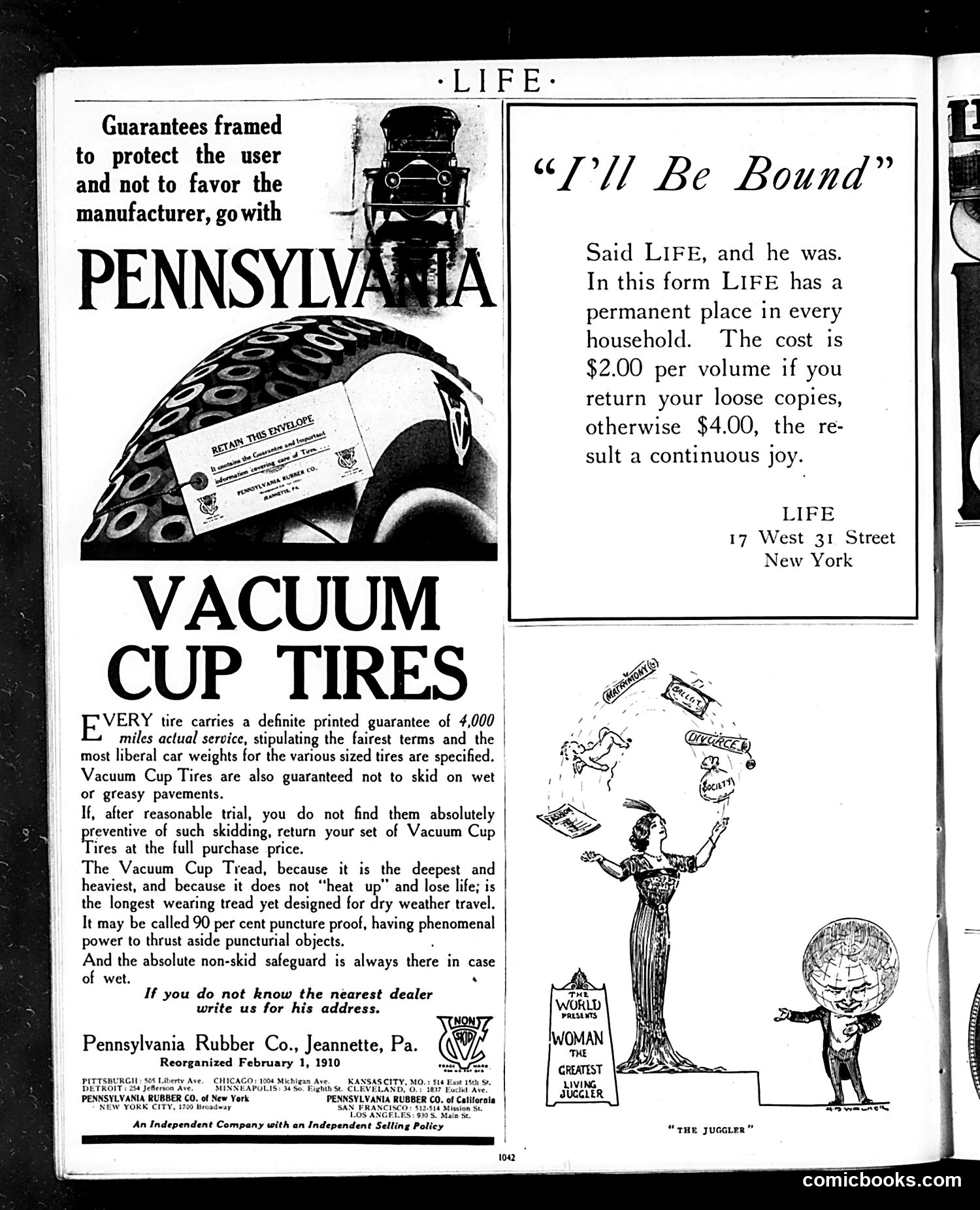
This page consists primarily of **advertising**, not satire or political commentary. The left side features a Pennsylvania Rubber Company ad for "Vacuum Cup Tires," emphasizing consumer-protective guarantees (4,000 miles of service, non-skid performance, puncture resistance). The imagery shows a tire and an envelope marked "REPAIR THIS ENVELOPE," illustrating the company's customer service promise. The right side advertises **Life magazine itself**—a bound annual volume costing $2.00 if readers return loose copies, otherwise $4.00. The accompanying illustrations ("The Woman, The Greatest Living Juggler" and "The Juggler") appear to be unrelated decorative vignettes typical of Life's satirical style, but they're promotional material for the magazine's binding service rather than commentary on anything specific. This is a straightforward commercial page mixing product advertising with magazine promotion—common in early 20th-century publications.
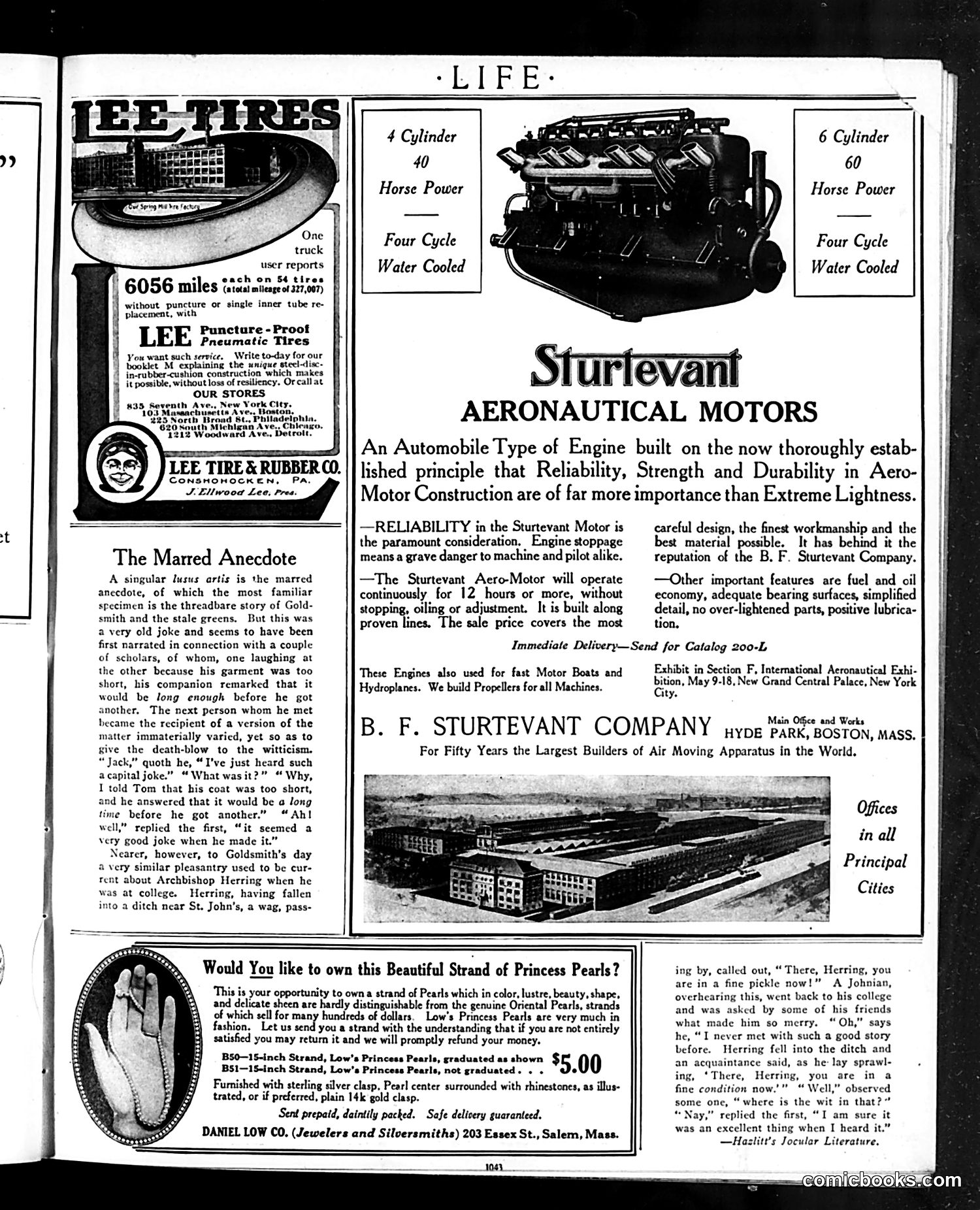
This page is primarily **advertising**, not satire or political commentary. The content includes: 1. **Lee Tires ad** (left): promoting "Puncture-Proof Pneumatic Tires" with a user's testimonial of 6,056 miles without tire replacement. 2. **"The Married Anecdote"** (left column): a humorous essay about how jokes deteriorate when retold. It traces an old anecdote about a scholar mocking another's short coat, then mentions Archbishop Herring (an 18th-century church figure) as another version's subject—this is *commentary on humor*, not satire. 3. **Sturtevant Aeronautical Motors** (center/right): advertising aircraft engines emphasizing reliability for aviation use, reflecting early 1900s aviation industry growth. 4. **Princess Pearls ad** (bottom): costume jewelry marketed as indistinguishable from genuine pearls, priced affordably at $5. The page reflects early-20th-century consumer culture and emerging aviation technology, but contains no political cartoons or satirical commentary.
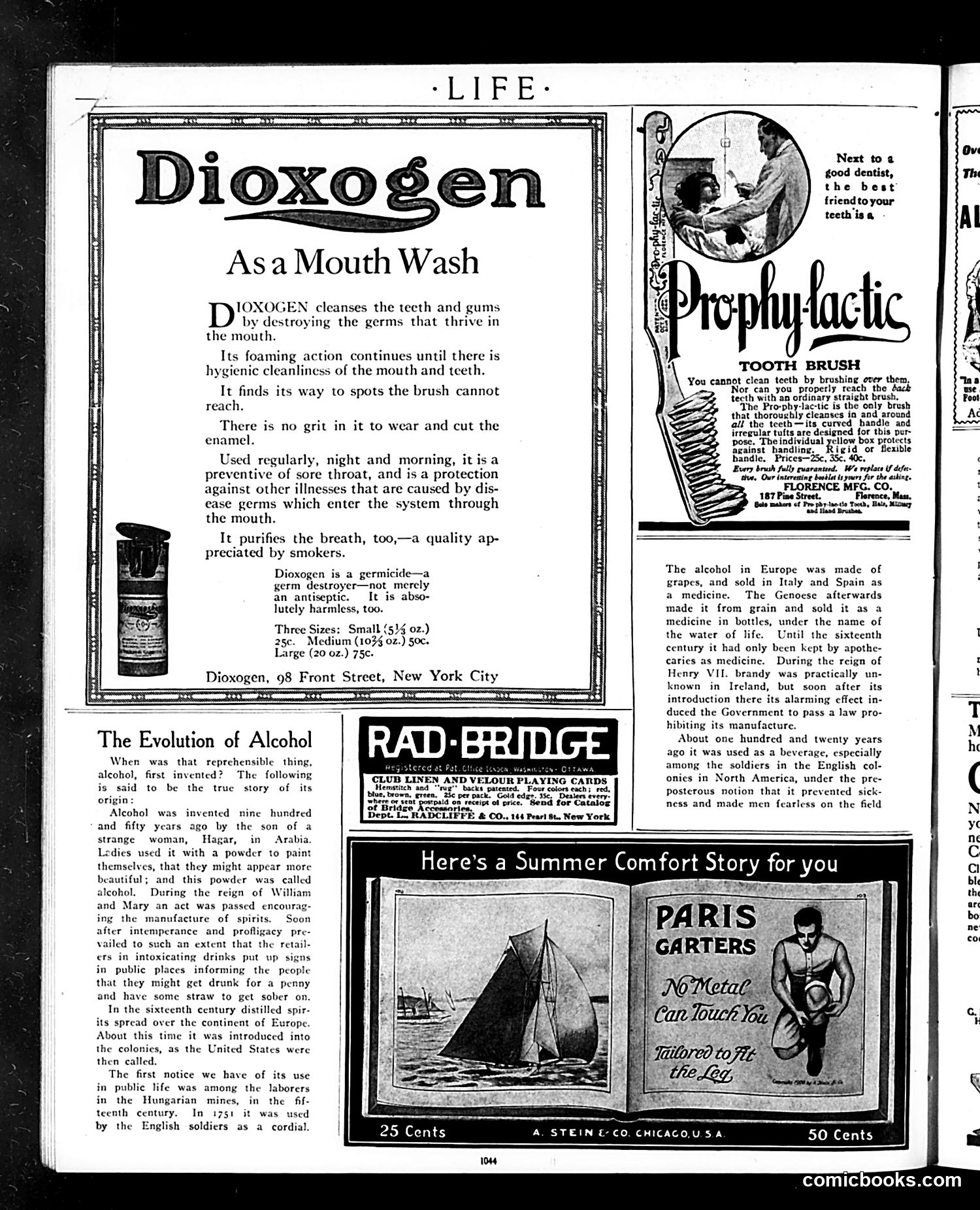
This page from Life magazine (1904, based on comicbooks.com watermark) is primarily **advertising and historical content**, not political satire. **Main Content:** The page features advertisements for dental hygiene products (Dioxogen mouthwash and Prophylactic toothbrush) alongside an article titled "The Evolution of Alcohol." **The Alcohol Article:** This is a humorous, pseudo-historical piece claiming alcohol was "invented" 950 years ago by "the son of a strange woman, Hagar, in Arabia." It traces alcohol's uses from cosmetics to a 16th-century European commodity to colonial America. The tone is satirical and tongue-in-cheek—claiming it was used as a "beverage" among English soldiers in North America under the "preposterous notion" it prevented sickness. **The Satire:** The joke appears to be mocking the absurd justifications people used for drinking alcohol, particularly its supposed medicinal properties. The article's mock-serious historical tone ridicules how societies rationalized alcohol consumption. **Other advertisements** (Rad-Bridge playing cards, Paris Garters) occupy the remainder of the page.
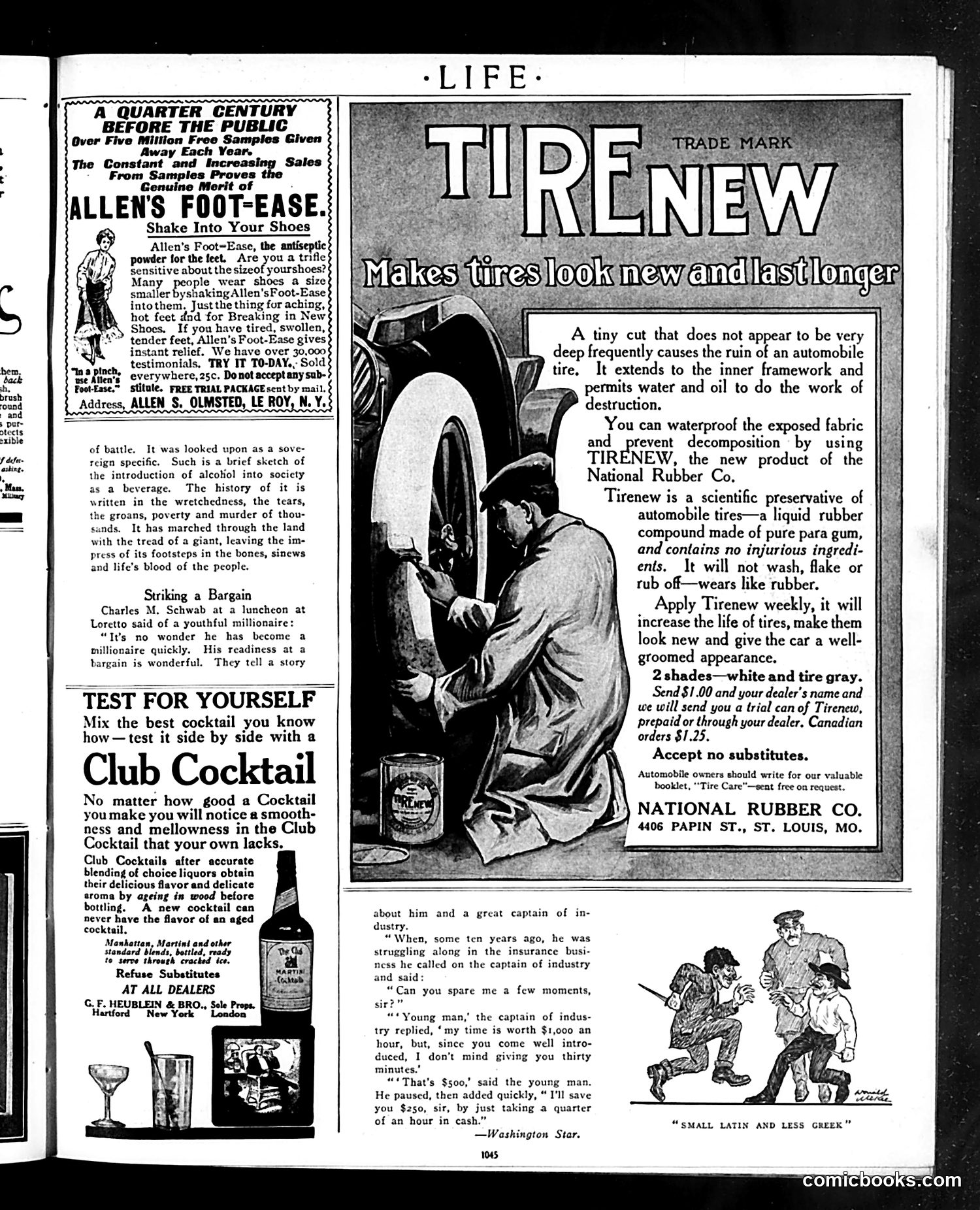
This page is primarily **advertising**, with minimal editorial content. The main elements are product advertisements for Allen's Foot-Ease (foot powder), Tirenew (tire preservative), and Club Cocktail, interspersed with filler text. The only identifiable satire appears in the brief anecdote "Striking a Bargain," which attributes a quote to **Charles M. Schwab** (steel industrialist). The joke mocks a young millionaire's negotiation tactics—he saves his wealthy contact $250 by taking only 15 minutes of a $1,000/hour businessman's time instead of 30 minutes. The humor relies on readers' familiarity with Schwab's reputation for shrewd dealing. The small cartoon illustration labeled "SHALL LATIN AND LESS GREEK" appears unrelated to the page's content and its meaning is unclear from context. This appears to be from **1945** (marked at bottom), likely a wartime issue when paper constraints meant magazines relied heavily on advertising revenue.
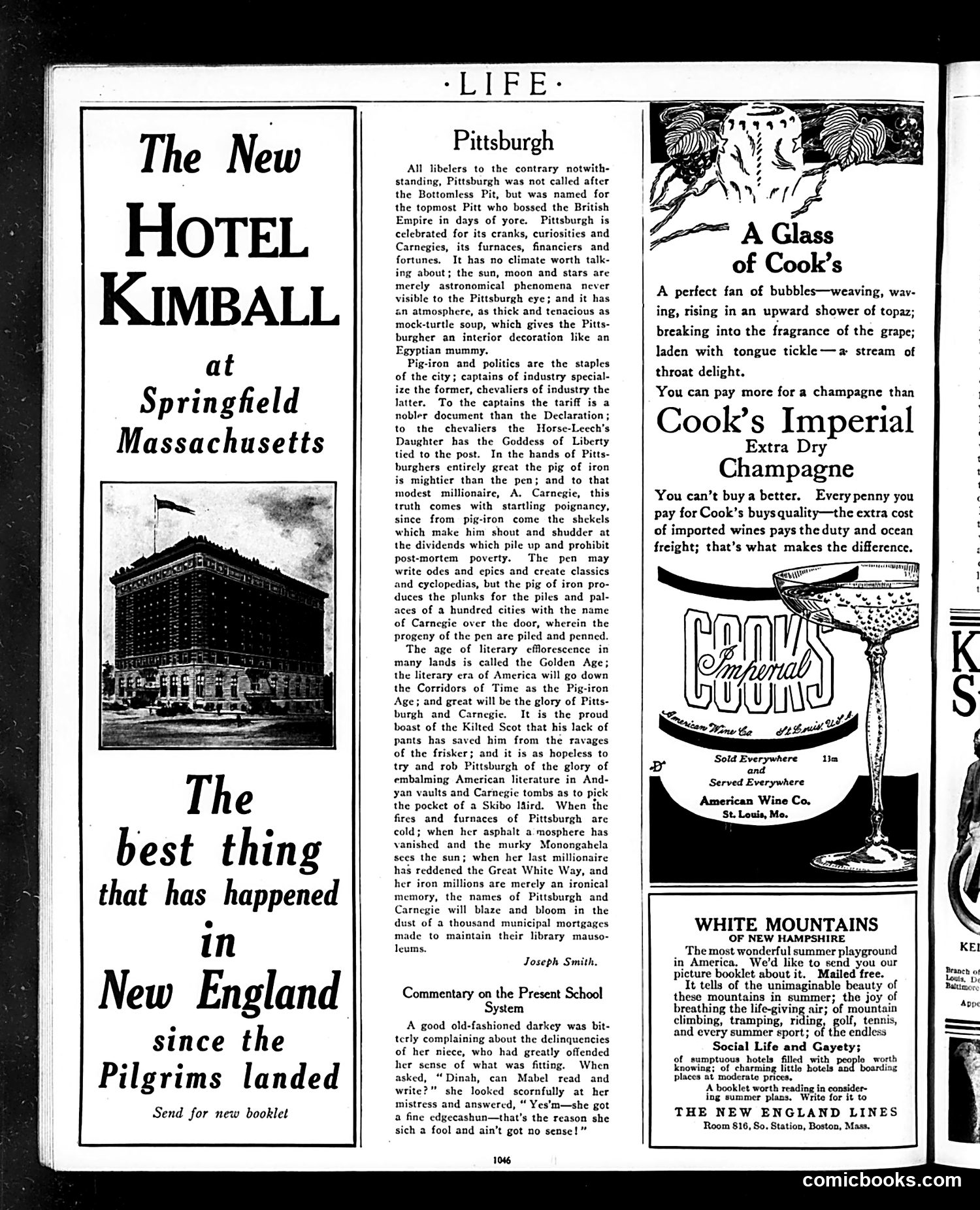
This page contains **advertising and satirical commentary**, not political cartoons. The left side promotes the Hotel Kimball in Springfield, Massachusetts with hyperbolic claims ("best thing...since the Pilgrims landed"). The center features **"Pittsburgh,"** a satirical essay by Joseph Smith mocking the industrial city and Scottish industrialist **Andrew Carnegie**. The piece uses heavy irony, contrasting Pittsburgh's polluted reality with Carnegie's philanthropic legacy. It argues that pig-iron production has overshadowed literary achievement in America's "Golden Age"—Carnegie's iron wealth built libraries, but industrial wealth, not art, defines the era. Below this is a **racist "dialect joke"** featuring a Black woman ("darkey") criticizing her niece's education, suggesting schooling makes people foolish. This reflects period prejudices common in early 20th-century American magazines. The right side advertises **Cook's Imperial Champagne** and White Mountains tourism. The satire targets Carnegie's self-aggrandizing philanthropy and industrial dominance, though the commentary is dated and problematic by modern standards.
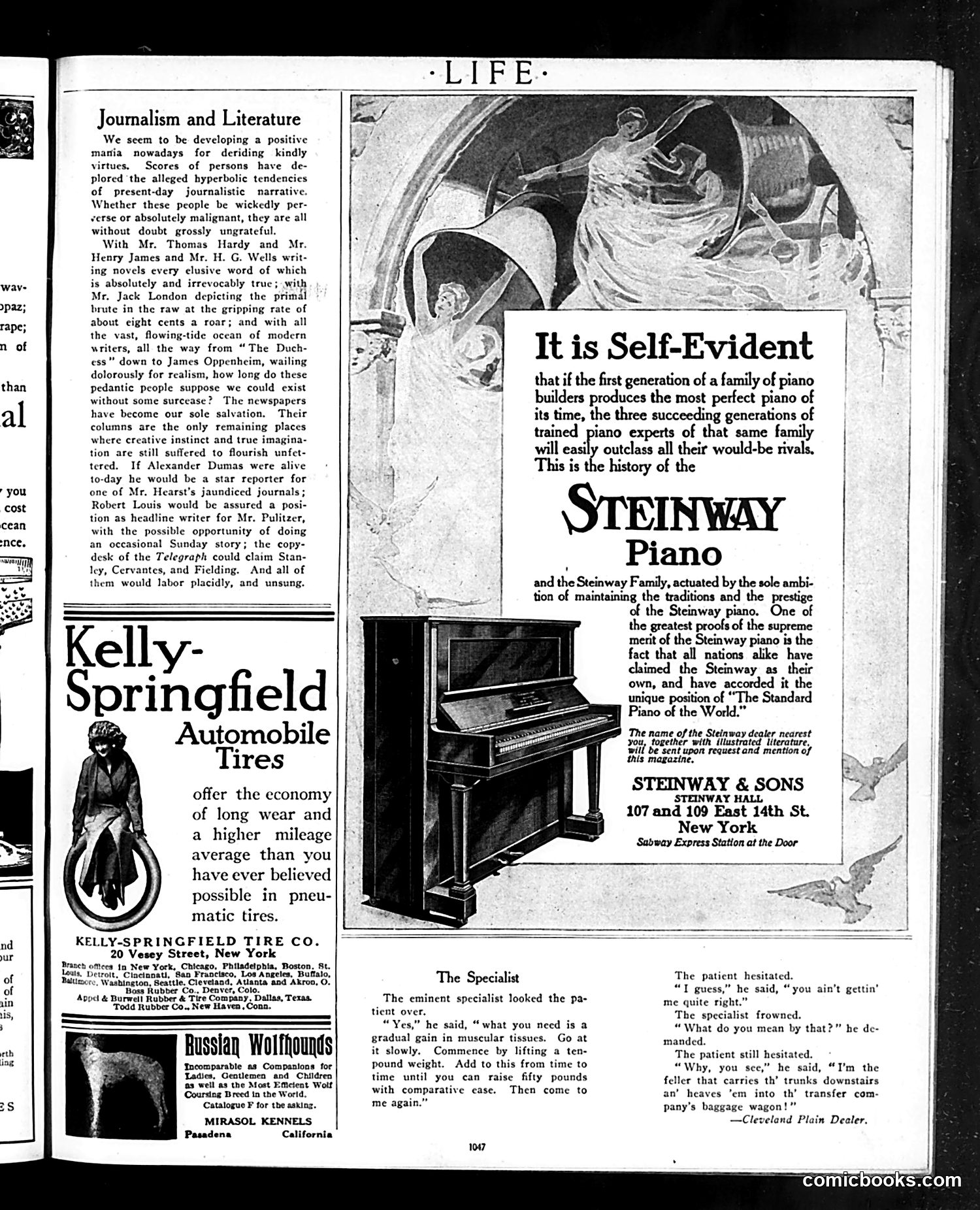
This page from Life magazine (a satirical publication) contains primarily **advertisements and a brief joke**, not political cartoons. The **"Journalism and Literature" column** critiques contemporary writers (Hardy, James, Wells, London) for pursuing "realism," arguing that newspapers—despite their sensationalism—serve a vital creative function that serious literature lacks. The satire suggests that journalistic exaggeration is preferable to tedious literary realism. The main content includes ads for **Steinway pianos**, **Kelly-Springfield automobile tires**, and **Russian Wolfhounds**, along with a brief humor piece titled "The Specialist" about a patient resisting a doctor's exercise regimen. There are **no political cartoons** on this page. The satirical content is limited to the literary commentary, which reflects early 20th-century debates about realism in fiction versus the entertainment value of journalism.
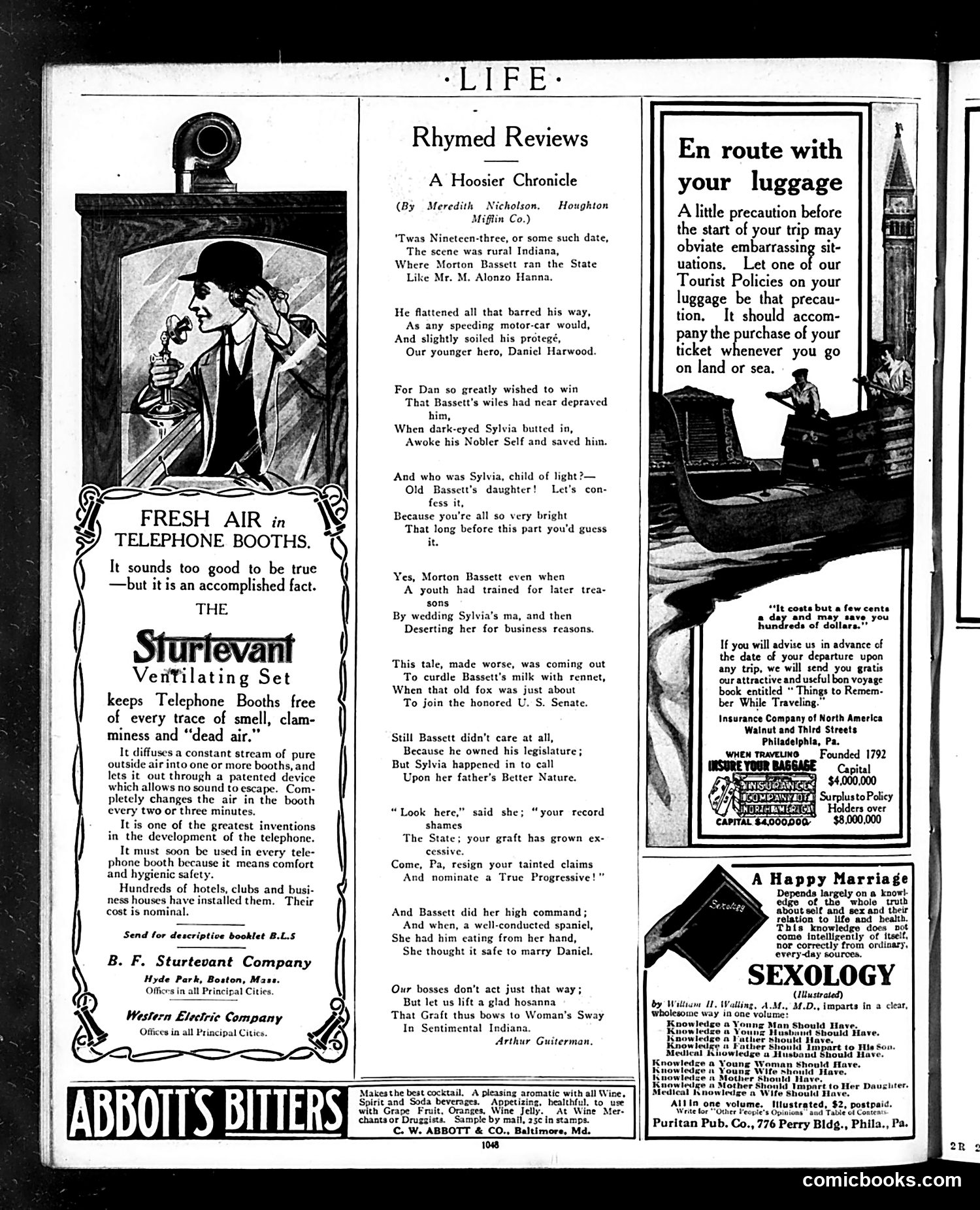
This page contains primarily **advertisements and book reviews** rather than political cartoons. The main content is a rhymed book review of "A Hoosier Chronicle" by Meredith Nicholson. The review satirizes **early 1900s Indiana politics**, mocking corrupt state politician Morton Bassett (likely inspired by real political boss Albert J. Beveridge or similar figures). The satire targets: - Machine politics and legislative corruption ("he owned his legislature") - Grafting officials seeking Senate seats - The notion that a politician's moral reformation depends on his daughter's intervention The joke's punch line—that real bosses don't actually reform through women's moral persuasion—acknowledges the book's sentimentality while implying actual corruption was far more entrenched. The surrounding advertisements (telephone booth ventilation, luggage insurance, bitters, marriage guidance) reflect period concerns: sanitation in public spaces, travel safety, and matrimonial advice.
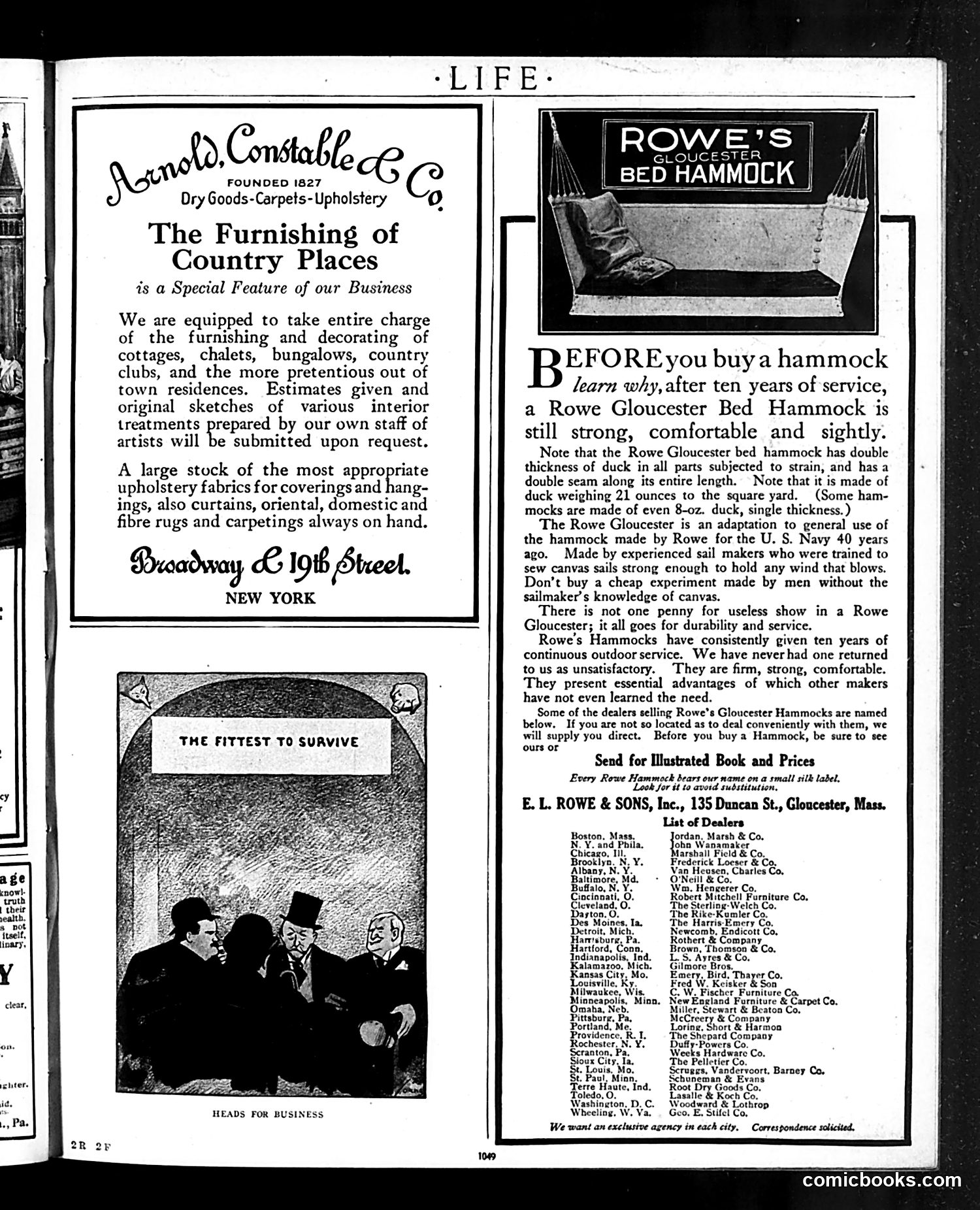
This page consists primarily of **advertisements** rather than editorial satire content. The left side features an ad for Arnold Constable & Co., a New York furnishing company (founded 1827), highlighting their specialty in decorating country estates. Below this is a small cartoon titled "Heads for Business" depicting four men in formal dress (top hats) huddled together around what appears to be a globe or sphere. The caption "The Fittest to Survive" suggests a Darwinian reference—likely satirizing wealthy businessmen as evolved specimens competing in the commercial world, though the specific business or context isn't clarified by the page. The right side is dominated by a detailed product advertisement for Rowe's Gloucester Bed Hammock, emphasizing its durability, naval heritage, and superior construction compared to cheaper alternatives. It includes an extensive list of department stores across America selling the product. The satire on this page is minimal and secondary to commercial messaging.
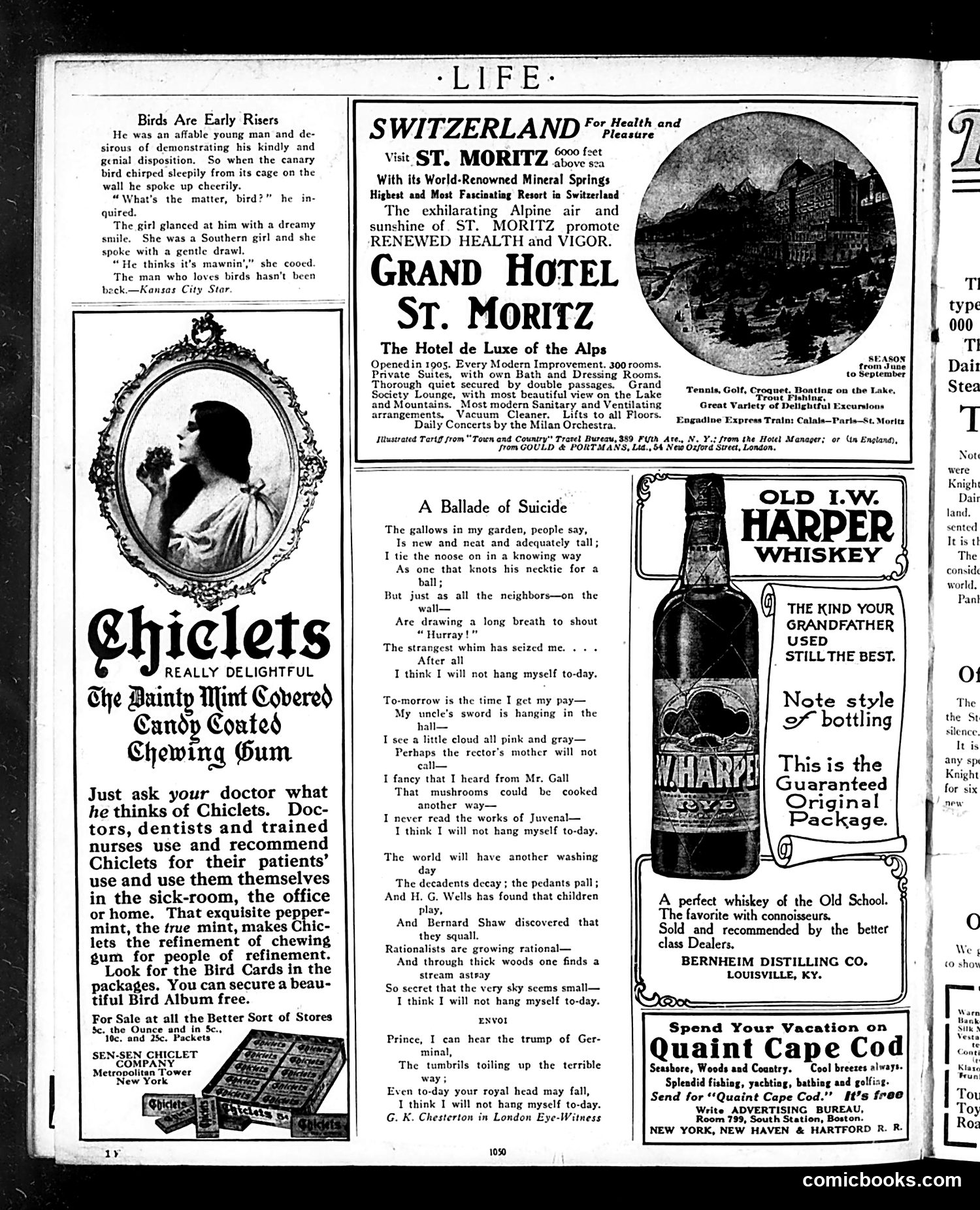
This page is primarily **advertisements and light humor** rather than political satire. The content includes: **Main Elements:** 1. **"Birds Are Early Risers"** – A gentle joke about a Southern woman mishearing a bird's chirp as "morning" (playing on dialect humor popular in early 1900s publications). 2. **"A Ballade of Suicide"** by G.K. Chesterton – A whimsical poem about someone contemplating suicide but repeatedly deciding against it for mundane reasons (upcoming payday, unread books, mushroom recipes). It's philosophical dark humor rather than political commentary. 3. **Advertisements** for Chiclets gum, Grand Hotel St. Moritz (Swiss resort), Old I.W. Harper Whiskey, and Cape Cod vacations—typical period luxury marketing. The page reflects **early 20th-century sensibilities**: mild racial/regional humor, Chesterton's intellectual wit, and aspirational advertising targeting affluent readers. There is no apparent political cartoon or sharp satire—simply entertainment and product promotion typical of *Life* magazine's lighter content.
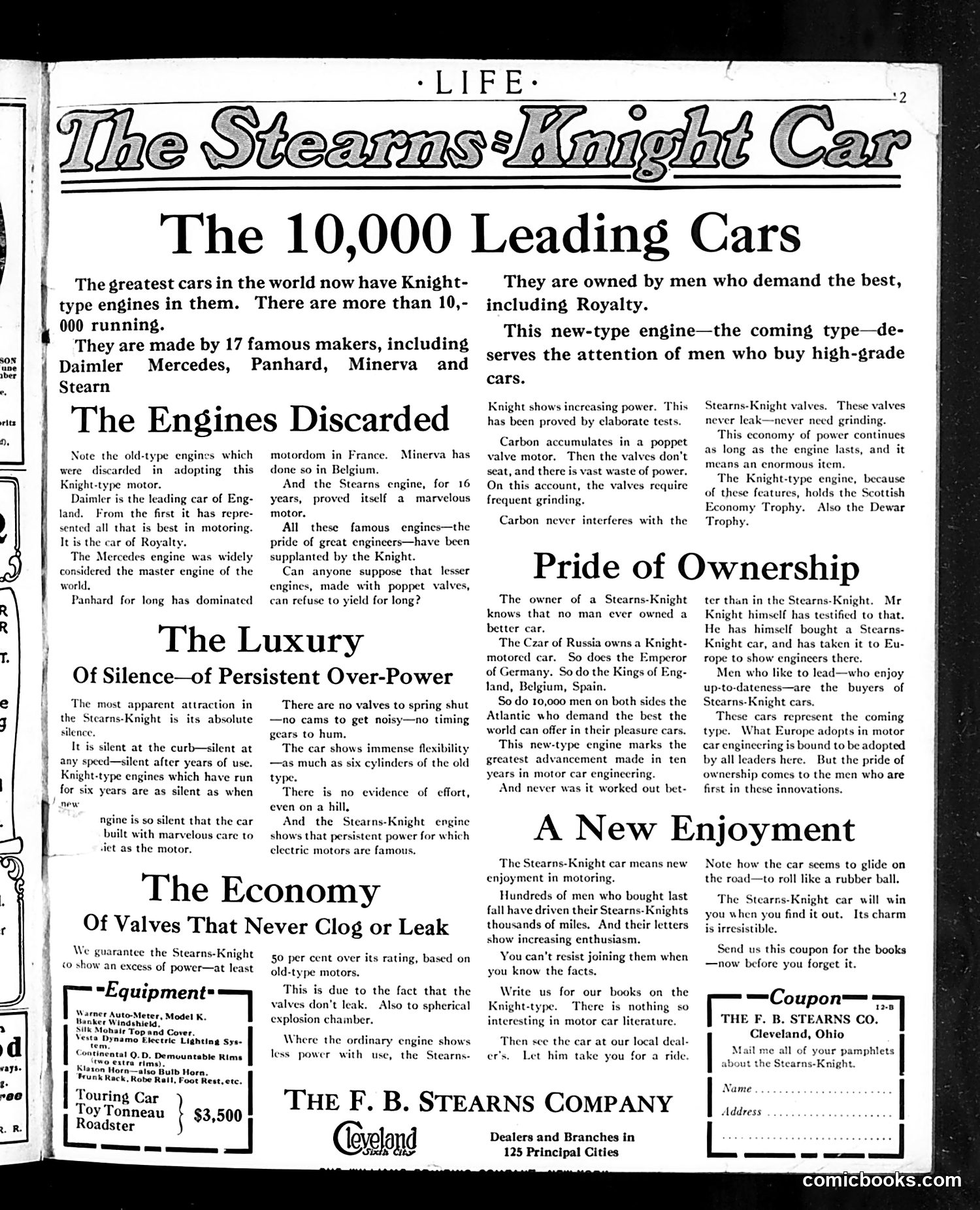
This is primarily a **car advertisement**, not a political cartoon. It promotes the Stearns-Knight automobile, emphasizing its revolutionary Knight-type engine technology. The ad's persuasive strategy relies on **appeals to prestige and exclusivity**: it claims 10,000 "leading cars" worldwide use Knight engines, and notably name-drops royal owners—the Czar of Russia, the German Emperor, and European kings. This positioning suggests that buying a Stearns-Knight aligns the buyer with global aristocracy and the wealthy elite. The technical claims focus on **silence, power, and durability**—revolutionary features for early automobiles. The ad contrasts the Knight engine against older "poppet valve" designs used by previously famous manufacturers (Daimler, Mercedes, Panhard), implying technological obsolescence. For modern readers: this reflects early-1900s **luxury marketing**, where associating products with royalty conveyed quality. The technical boasting about engine valves and spherical chambers would have impressed motorists accustomed to noisy, unreliable vehicles. The coupon offers free literature—a standard advertising tactic of the era.
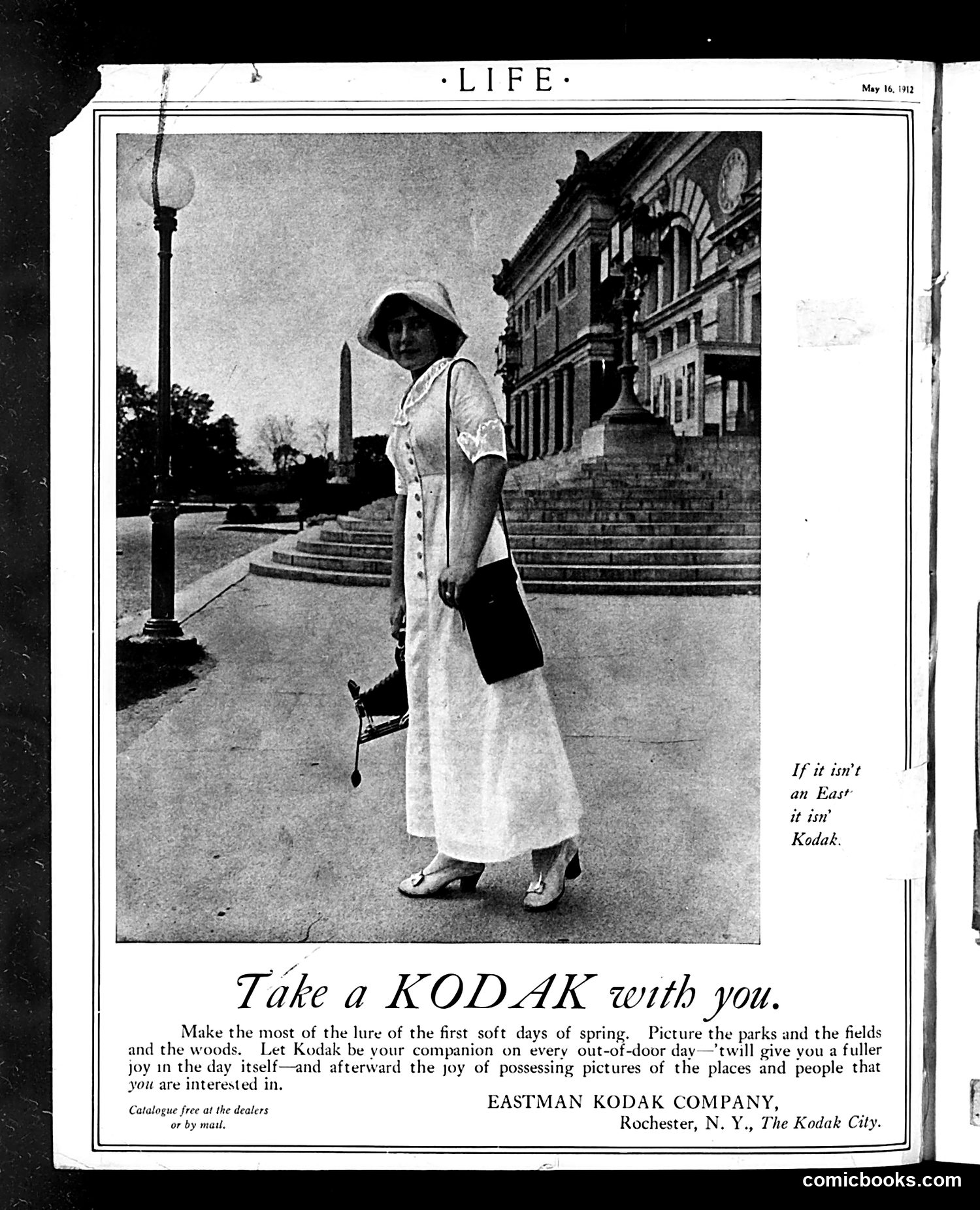
This is **not a cartoon or satire**—it's a straightforward **Kodak advertisement** from *Life* magazine (May 16, 1912). The image shows a woman in early 1900s attire (white dress, hat, shoulder bag) posing outdoors near what appears to be a government building, holding a camera. The ad encourages readers to photograph spring outings in parks and nature. The tagline "If it isn't an East it isn't Kodak" (likely "Eastman" with OCR error) emphasizes brand dominance—suggesting Kodak cameras were the standard for amateur photography. The copy appeals to leisure and memory-preservation, positioning Kodak as essential for capturing life's moments. This reflects the early camera era when portable photography was becoming accessible to general consumers, and *Life* magazine featured both satirical content and advertisements targeting middle-class readers.