
Life, 1912-05-16 · page 32 of 52
Life — May 16, 1912 — page 32: what you’re looking at
What you’re looking at
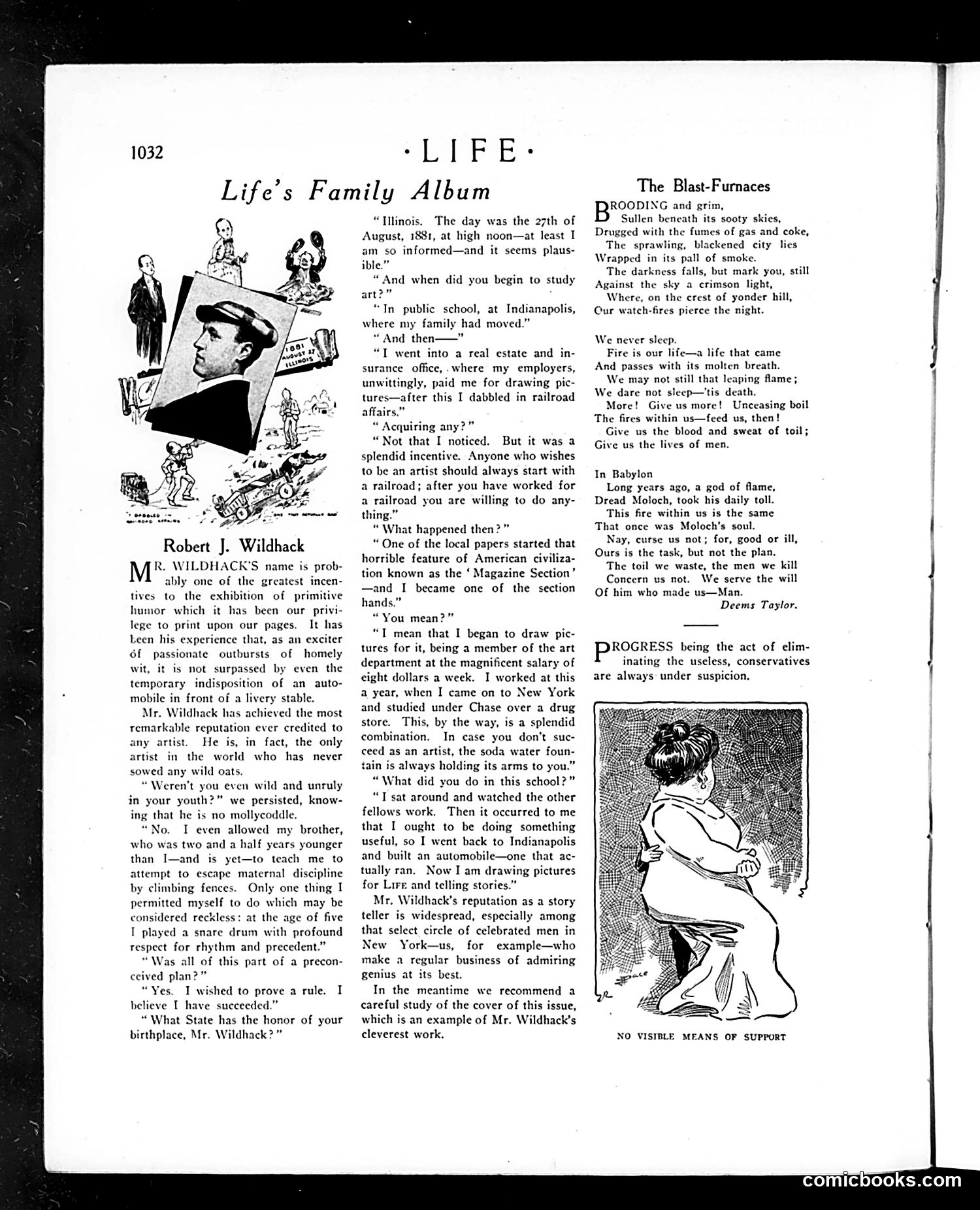
This page features a satirical profile interview with Robert J. Wildhack, a cartoonist and illustrator for Life magazine. The humor relies on gentle mockery of Wildhack's unusually *disciplined* character—the joke being that an artist famous for primitive humor is personally extraordinarily proper and rule-following. The interview recounts his deliberately boring biography: born in Illinois (1881), worked in real estate and railroads before becoming a newspaper illustrator at eight dollars weekly, studied under the painter Chase, built an automobile that "actually ran," and now draws for Life. The satire suggests that despite this conventional path, he's achieved artistic success—contradicting the stereotype that artists must be wild and undisciplined. The page also includes a serious poem, "The Blast-Furnaces," depicting industrial labor and foundry work with romantic intensity—contrasting sharply with the light biographical humor above. The illustration shows a worker in minimal clothing, captioned "NO VISIBLE MEANS OF SUPPORT."
📄 Transcribed text from this page (OCR, searchable)
Machine-transcribed from the original scan — historical spelling and the odd misread are preserved.
MER e * Life’s Family Album Robert J. Wildhack M! WILDHACK’S name is prob- ably one of the greatest incen- tives to the exhibition of primitive humor which it has been our privi- lege to print upon our pages. It has Leen his experience that, as an exciter Gf passionate outbursts of homely wit, it is not surpassed by even the temporary indisposition of an auto- mobile in front of a livery stable. Mr. Wildhack has achieved the most remarkable reputation ever credited to any artist. He is, in fact, the only artist in the world who has never sowed any wild oats. “Weren't you even wild and unruly in your youth?” we persisted, know- ing that he is no mollycoddle. I even allowed my brother, who was two and a half years younger than I—and is yet—to teach me to attempt to escape maternal discipline by climbing fences. Only one thing I permitted myself to do which may be considered reckless: at the age of five I played a snare drum with profound respect for rhythm and precedent.” “Was all of this part of a precon- ceived plan?” “Yes. I wished to prove a rule. I believe I have succeeded.” “What State has the honor of your birthplace, Mr. Wildhack?” “Tilinois. The day was the 27th of August, 1881, at high noon—at least I am so informed—and it seems plaus- ible.” “And when did you begin to study art?” “In public school, at Indianapolis, where my family had moved.” “And then—” “T went into a real estate and in- surance office,.where my employers, unwittingly, paid me for drawing pic- tures—after this I dabbled in railroad affairs.” “ Acquiring any?” “Not that I noticed. But it was a splendid incentive. Anyone who wishes to be an artist should always start with a railroad; after you have worked for a railroad you are willing to do any- thing.” “What happened then?” “One of the local papers started that horrible feature of American civiliza- tion known as the ‘ Magazine Section’ —and I became one of the section hands.” “You mean?” “T mean that I began to draw pic- tures for it, being a member of the art department at the magnificent salary of eight dollars a week. I worked at this a year, when I came on to New York and studied under Chase over a drug store. This, by the way, is a splendid combination. In case you don’t suc- ceed as an artist, the soda water foun- tain is always holding its arms to you.” “What did you do in this school?” “T sat around and watched the other fellows work. Then it occurred to me that I ought to be doing something useful, so I went back to Indianapolis and built an automobile—one that ac- tually ran. Now I am drawing pictures for Lire and telling stories.” Mr. Wildhack’s reputation as a story teller is widespread, especially among that select circle of celebrated men in New York—us, for example—who make a regular business of admiring genius at its best. In the meantime we recommend a careful study of the cover of this issue, which is an example of Mr. Wildhack’s cleverest work. The Blast-Furnaces ROODING and grim, Sullen beneath its sooty skies, Drugged with the fumes of gas and coke, The sprawling, blackened city lies Wrapped in its pall of smoke. The darkness falls, but mark you, still Against the sky a crimson light, Where, on the crest of yonder hill, Qur watch-fires pierce the night. We never sleep. Fire is our life—a life that came And passes with its molten breath. We may not still that leaping flame; We dare not sleep—'tis death. More! Give us more! Unceasing boil The fires within us—feed us, then! Give us the blood and sweat of toil; Give us the lives of men. In Babylon Long years ago, a god of flame, Dread Moloch, took his daily toll. This fire within us is the same That once was Moloch’s soul. Nay, curse us not; for, good or ill, Ours is the task, but not the plan. The toil we waste, the men we kill Concern us not. We serve the will Of him who made us—Man. Deems Taylor. ROGRESS being the act of elim- inating the useless, conservatives are always: under suspicion. St TE, NO VISIBLE MEANS OF SUPPORT comicbooks.com