
Life, 1912-05-16 · page 25 of 52
Life — May 16, 1912 — page 25: what you’re looking at
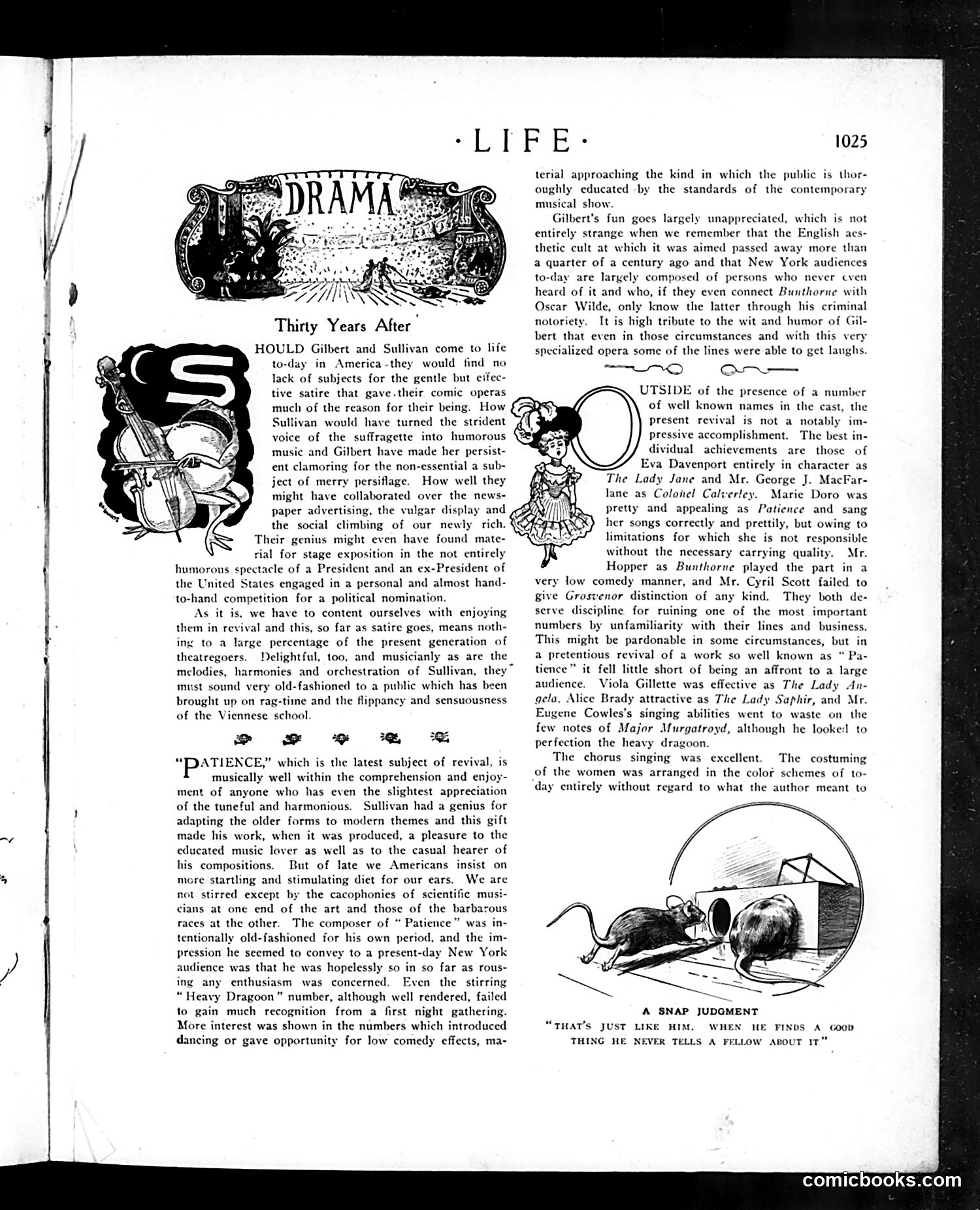
A restored page from Life, 1912-05-16. Page through the whole issue in the reader above.
📄 Transcribed text from this page (OCR, searchable)
Machine-transcribed from the original scan — historical spelling and the odd misread are preserved.
Thirty Years After’ HOULD Gilbert and Sullivan come to life to-day in America -they would find no lack of subjects for the gentle but cifec- tive satire that gave.their comic operas much of the reason for their being. How Sullivan would have turned the strident voice of the suffragette into humorous music and Gilbert have made her persist- ent clamoring for the non-essential a sub- ject of merry persiflage. How well they might have collaborated over the news- paper advertising, the vulgar display and the social climbing of our newly rich. Their genius might even have found mate- rial for stage exposition in the not entirely | humorous spectacle of a President and an ex-President of the United States engaged in a personal and almost hand- | to-hand competition for a political nomination. As it is, we have to content ourselves with enjoying ° them in revival and this, so far as satire goes, means noth- ing to a large percentage of the present generation of theatregoers. Delightful, too, and musicianly as are the melodies must sound very old-fashioned to a public which has been brought up on rag-time and the flippancy and sensuousness of the Viennese school = SF SF ATIENCE,” which is the latest subject of revival, is musically well within the comprehension and enjoy- ment of anyone who has even the slightest appreciation ' of the tuneful and harmonious. Sullivan had a genius for adapting the older forms to modern themes and this gift made his work, when it was produced, a pleasure to the od educated music lover as well as to the casual hearer of his compositions. But of late we Americans insist on 4 more startling and stimulating diet for our ears. We are not stirred except by the cacophonies of scientific musi- cians at one end of the art and those of the barbarous races at the other. The composer of “ Patience” was in- tentionally old-fashioned for his own period, and the im- pression he seemed to convey to a present-day New York audience was that he was hopelessly so in so far as rous- ing any enthusiasm was concerned. Even the stirring “Heavy Dragoon” number, although well rendered, failed in much recognition from a first ht gathering. More interest was shown in the numbers which introduced dancing or gave opportunity for low comedy effects, ma- “LIP E= harmonies and orchestration of Sullivan, they” 1025 terial approaching the kind in which the public is thor- oughly educated -by the standards of the contemporary musical show. Gilbert’s fun goes largely unappreciated, which is not entirely strange when we remember that the English aes- thetic cult at which it was aimed passed away more than a quarter of a century ago and that New York audiences to-day are largely composed of persons who never cven heard of it and who, if they even connect Bunthorne with Oscar Wilde, only know the latter through his criminal notoriety, It is high tribute to the wit and humor of Gil- bert that even in those circumstances and with this very specialized opera some of the lines were able to get laughs. OOO UTSIDE of the presence of a number of well known names in the cast, the present revival is not a notably im- sive accomplishment, The best in- dividual achievements are those of Eva Davenport entirely in character as The Lady Jane and Mr. George J. MacFar- lane as Colonel Calverley. Marie Doro was pretty and appealing as Patience and sang her songs correctly and prettily, but owing to limitations for which she is not responsible without the necessary carrying quality. Mr. Hopper as Bunthorne played the part in a very low comedy manner, and Mr. Cyril Scott failed to give Grosvenor distinction of any kind. They both de- serve discipline for ruining one of the most important numbers by unfamiliarity with their lines and business. This might be pardonable in some circumstances, but in a pretentious revival of a work so well known as “ Pa- tience” it fell little short of being an affront to a large audience. Viola Gillette was effective as The Lady An- gela, Alice Brady attractive as The Lady Saphir, and Mr. Eugene Cowles’s singing abilities went to waste on the few notes of Major Murgatroyd, although he looked to perfection the heavy dragoon The chorus singing was excellent. The costuming of the women was arranged in the color schemes of to- day entirely without regard to what the author meant to A SNAP JUDGMENT “THAT'S JUST LIKE HIM, THING HE NE WHEN HE FINDS A GooD VER TELLS A FELLOW ABOUT IT” comicbooks.com