
Life, 1912-05-16 · page 12 of 52
Life — May 16, 1912 — page 12: what you’re looking at
What you’re looking at
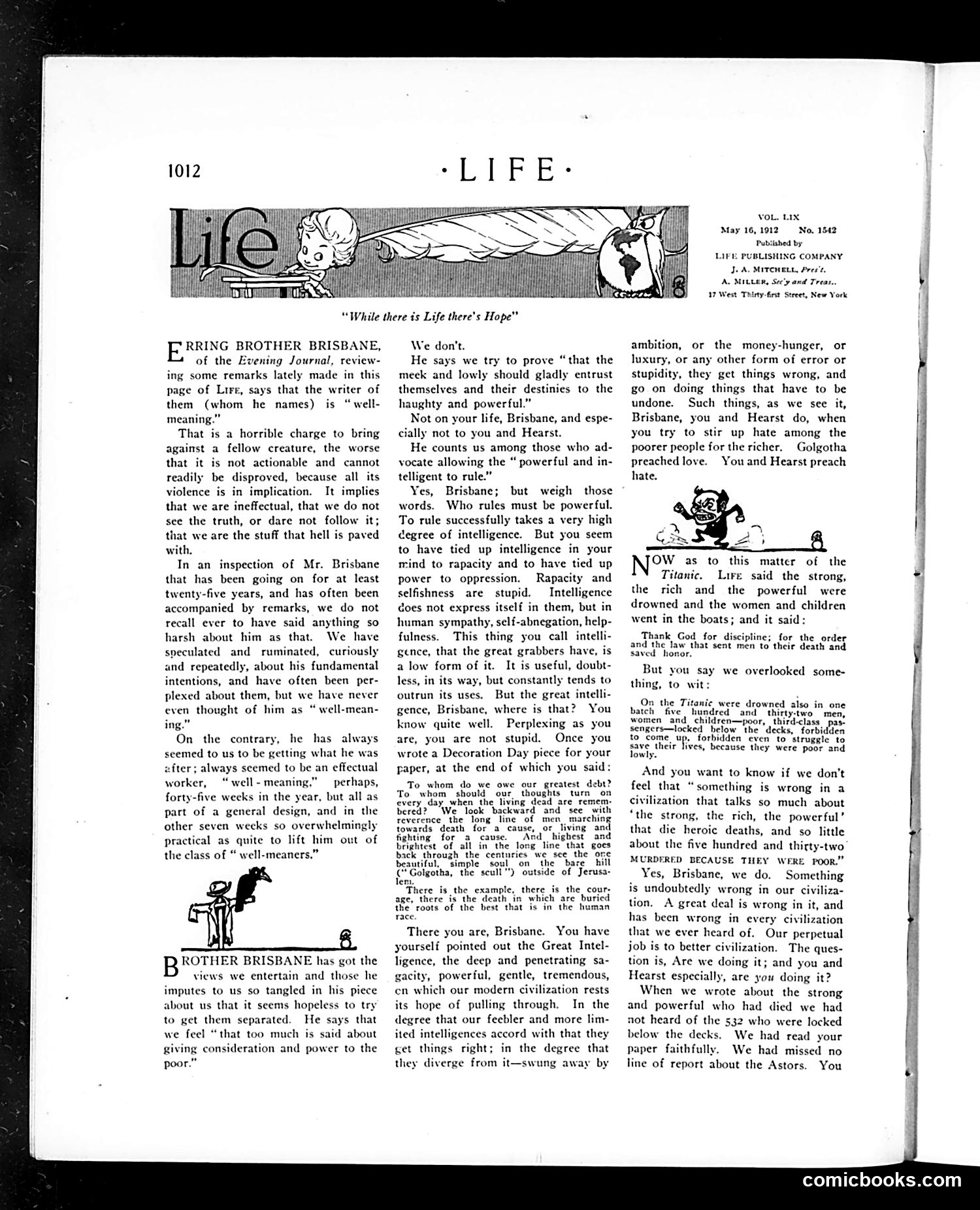
This page contains an editorial letter responding to criticism from "Erring Brother Brisbane" about Life's earlier remarks. The text debates whether intelligence should rule society, with the editor arguing that true intelligence includes sympathy and self-abnegation—not mere capacity. The small cartoon illustrations appear to be decorative rather than central to the argument. The editorial references the Titanic disaster (which occurred April 15, 1912) and the deaths of wealthy passengers, using it as evidence that civilization wrongly prioritizes the powerful. The author criticizes both Brisbane's philosophy and society's treatment of class inequality. This is primarily a written editorial piece rather than a satirical cartoon page.
📄 Transcribed text from this page (OCR, searchable)
Machine-transcribed from the original scan — historical spelling and the odd misread are preserved.
VOL. 11x, May 16,1912 No, 1542 Pubtished by LIFE PUBLISHING COMPANY “While there is Life there's Hope” RRING BROTHER BRISBANE, of the Evening Journal, review: ing some remarks lately made in this page of Lire, says that the writer of them (whom he names) is “well- meaning.” That is a horrible charge to bring against a fellow creature, the worse that it is not actionable and cannot readily be disproved, because all its violence is in implication. It implies that we are ineffectual, that we do not see the truth, or dare not follow it; that we are the stuff that hell is paved with, In an inspection of Mr. Brisbane that has been going on for at least twenty-five years, and has often been accompanied by remarks, we do not recall ever to have said anything so harsh about him as that. We have speculated and ruminated, curiously and repeatedly, about his fundamental intentions, and have often been per- plexed about them, but we have never even thought of him as “ well-mean- ing.” On the contrary, he has always cemed to us to be getting what he was fter; always scemed to be an effectual worker, “well-meaning,” perhaps, forty-five weeks in the year, but all as part of a general design, and in the other seven weeks so overwhelmingly practical as quite to lift him out of the class of “ well-meaners.” ROTHER BRISBANE has got the views we entertain and those he imputes to us so tangled in his piece about us that it seems hopeless to try to get them separated. He says that we feel “that too much is said about giving consideration and power to the poor.” We don't He says we try to prove “that the meek and lowly should gladly entrust themselves and their destinies to the haughty and powerful.” Not on your life, Brisbane, and espe- cially not to you and Hearst. He counts us among those who ad- vocate allowing the “ powerful and in- telligent to rule.” Yes, Brisbane; but weigh those words. Who rules must be powerful. To rule successfully takes a very high degree of intelligence. But you seem to have tied up intelligence in your mind to rapacity and to have tied up power to oppression. Rapacity and selfishness are stupid. Intelligence does not express itself in them, but in human sympathy, self-abnegation, help- fulness. This thing you call intelli- gence, that the great grabbers have, is a low form of It is useful, doubt- less, in its way, but constantly tends to outrun its uses. But the great intelli- gence, Brisbane, where is that? You know quite well. Perplexing as you are, you are not stupid. Once you wrote a Decoration Day piece for your paper, at the end of which you said: To whom do we owe our greatest debt? To whom should our thoughts turn on every day when the living dead are remem- bered? We look backward and see with reverence the long line of men_ marchin; towards death for a cause, or living and fighting for a cause. And highest and brightest of all in the long line that goes back through the centuries we see the one beautiful, ‘simple soul on the bare hill ("Golgotha, the seull") outside of Jeruss- jer. There is the example, there is the cour age, there is the death in which are buried the roots of the best that is in the human race. There you are, Brisbane. You have yourself pointed out the Great Intel- ligence, the deep and penetrating sa- gacity, powerful, gentle, tremendous, cn which our modern civilization rests its hope of pulling through. In the degree that our feebler and more lim- ited intelligences accord with that they get things right; in the degree that they diverge from it—swung away by Jed. Mivenent, Press, A. MILLER, Sec'y and Tre: 17 West Thirty-first Street, New York ambition, or the money-hunger, or luxury, or any other form of error or stupidity, they get things wrong, and go on doing things that have to be undone. Such things, as we see it, Brisbane, you and Hearst do, when you try to stir up hate among the poorer people for the richer. Golgotha preached love. You and Hearst preach hate. OW as to this matter of the Titanic, Lire said the strong, the rich and the powerful were drowned and the women and children went in the boats; and it said: Thank God for discipline; for the order and the law that sent men to their death and saved honor. But you say we overlooked some- thing, to wit: tateh ‘Ave tageased “ake sbieag es eee women and, children—poor, third-class pas: sengers—locked below the ‘decks, forbidden to come up, forbidden even to struggle to fave their ives, because they were poor and And you want to know if we don't feel that “something is wrong in a civilization that talks so much about ‘the strong, the rich, the powerful’ that die heroic deaths, and so little about the five hundred and thirty-two MURDERED BECAUSE THEY WERE POOR.” Yes, Brisbane, we do. Something is undoubtedly wrong in our civiliza- tion. A great deal is wrong in it, and has been wrong in every civilization that we ever heard of. Our perpetual job is to better civilization. The ques- tion is, Are we doing it; and you and Hearst especially, are you doing it? When we wrote about the strong and powerful who had died we had not heard of the 532 who were locked below the decks. We had read your paper faithfully. We had missed no line of report about the Astors. You comicbooks.com