
Life, 1912-05-16 · page 23 of 52
Life — May 16, 1912 — page 23: what you’re looking at
What you’re looking at
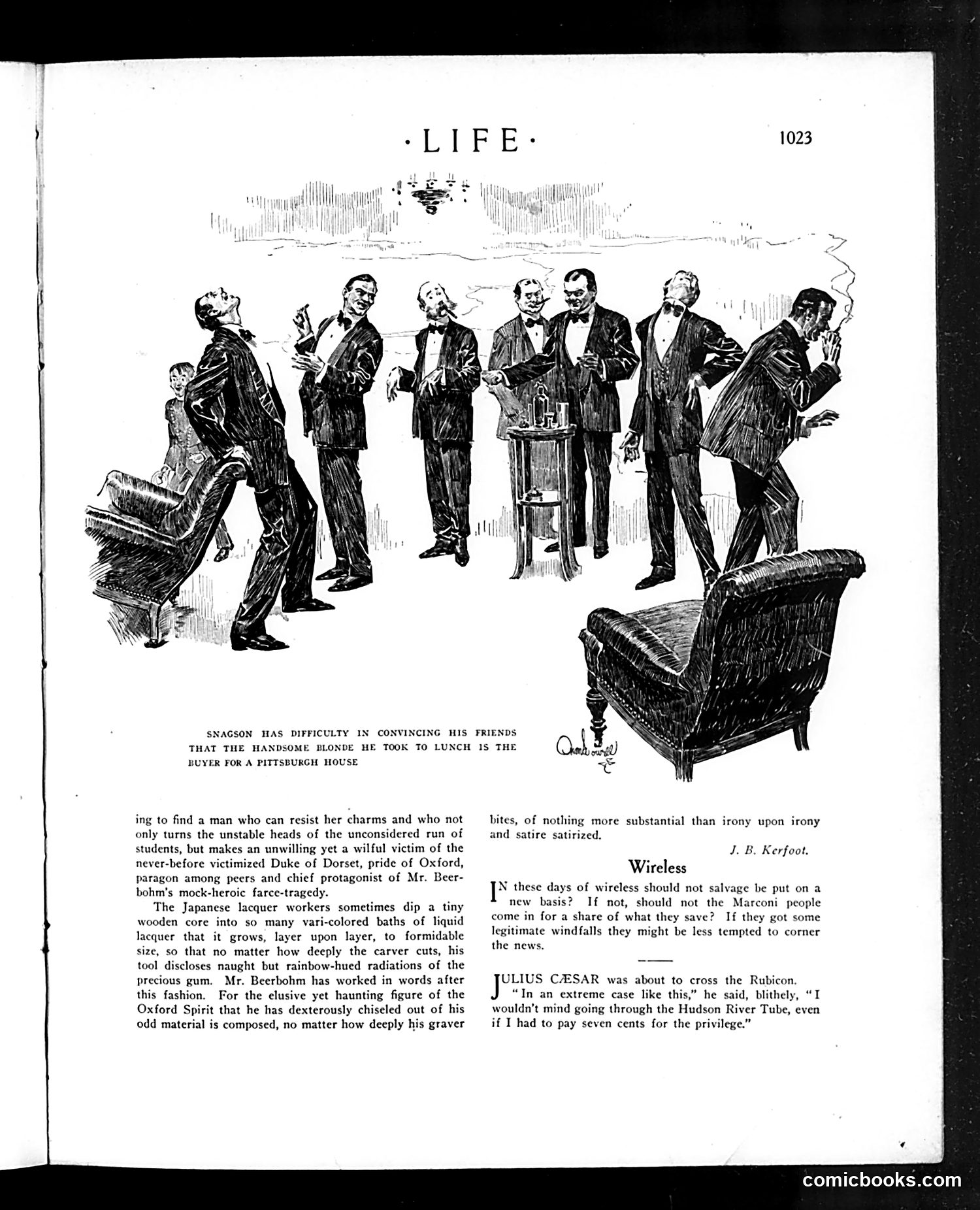
The main cartoon depicts a social comedy about class assumptions and appearances. "Snagson" has taken an attractive blonde woman to lunch, but his friends struggle to believe she's actually a real estate buyer for a Pittsburgh firm—they assume she must be something else entirely (likely a romantic interest or woman of questionable reputation). The joke satirizes early-20th-century gender and class prejudices: a conventionally beautiful woman in professional business capacity seems implausible to these men, who can't reconcile her appearance with her actual role. The page also includes unrelated literary commentary on an author (appears to be Max Beerbohm based on context) and two brief humorous pieces about wireless technology and Julius Caesar. These are typical of *Life* magazine's miscellaneous satirical content format—quick social jabs at contemporary technology, business practices, and pretension.
📄 Transcribed text from this page (OCR, searchable)
Machine-transcribed from the original scan — historical spelling and the odd misread are preserved.
SNAGSON HAS DIFFICULTY IN CONVINCING HIS FRIENDS THAT THE HANDSOME BLONDE HE TOOK 10 LUNCH 1S THE BUYER FOR A PITTSBURGH HOUSE ing to find a man who can resist her charms and who not only turns the unstable heads of the unconsidered run of students, but makes an unwilling yet a wilful victim of the never-before victimized Duke of Dorset, pride of Oxford, paragon among peers and chief protagonist of Mr. Beer- bohm’s mock-heroic farce-tragedy. The Japanese lacquer workers sometimes dip a tiny wooden core into so many vari-colored baths of liquid lacquer that it grows, layer upon layer, to formidable size, so that no matter how deeply the carver cuts, his tool discloses naught but rainbow-hued radiations of the precious gum. Mr. Beerbohm has worked in words after this fashion. For the elusive yet haunting figure of the Oxford Spirit that he has dexterously chiseled out of his odd material is composed, no matter how deeply his graver bites, of nothing more substantial than irony upon irony and satire satirized. J.B. Kerfoot. Wireless N these days of wireless should not salvage be put on a new basis? If not, should not the Marconi people come in for a share of what they save? If they got some legitimate windfalls they might be less tempted to corner the news. ULIUS CESAR was about to cross the Rubicon. “In an extreme case like this,” he said, blithely, wouldn't mind going through the Hudson River Tube, even. if I had to pay seven cents for the privilege.” comicbooks.com