
Life, 1912-05-16 · page 30 of 52
Life — May 16, 1912 — page 30: what you’re looking at
What you’re looking at
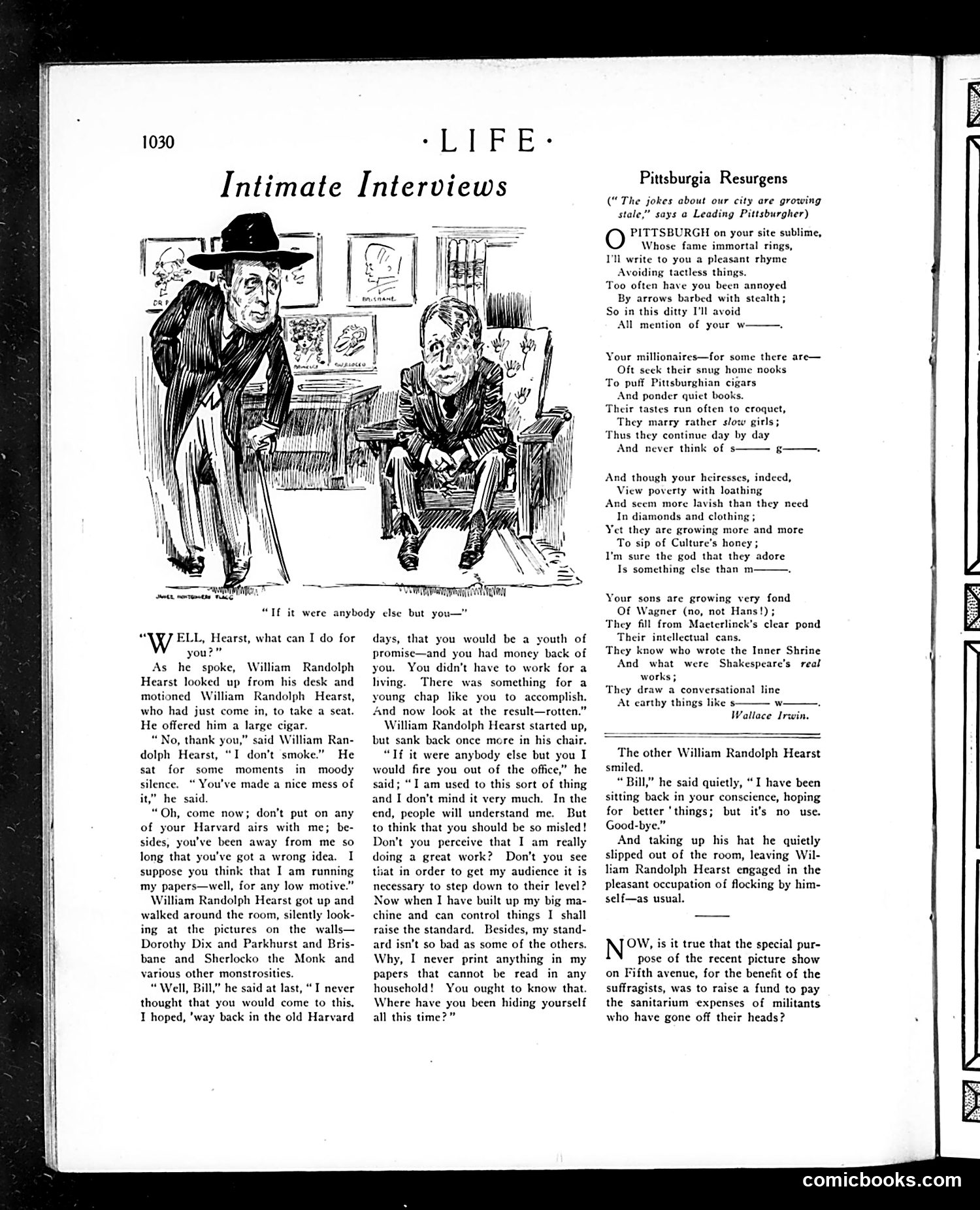
This page satirizes **William Randolph Hearst**, the powerful newspaper magnate, through a surreal "Intimate Interview" where Hearst confronts himself—literally two versions of the same person in conversation. The joke critiques Hearst's journalistic compromises: one Hearst (representing his conscience) accuses him of running sensationalist papers for profit, while the other Hearst defensively justifies "stepping down to their level" to build his audience, promising to "raise the standard" once he has power. This captures contemporary criticism of Hearst's yellow journalism tactics. The accompanying poem mocks **Pittsburgh**, a wealthy industrial city, by deliberately avoiding the city's notorious problems (pollution, labor strife) while sarcastically praising its millionaires' refined cultural tastes—a backhanded compliment suggesting Pittsburgh's wealth masks uglier realities. Both pieces use humor to critique powerful figures: Hearst for ethical compromise, Pittsburgh's elite for superficial respectability masking industrial exploitation.
📄 Transcribed text from this page (OCR, searchable)
Machine-transcribed from the original scan — historical spelling and the odd misread are preserved.
-LIFE- Intimate Interviews _ - cS ~ SOOHATPSMAATTTT TEN “Tf it were anybody else but you—” a“ ELL, Hearst, what can I do for you?” As he spoke, William Randolph Hearst looked up from his desk and motioned William Randolph Hearst, who had just come in, to take a seat. He offered him a large cigar. “No, thank you,” said William Ran- dolph Hearst, “I don’t smoke.” He sat for some moments in moody silence. “ You've made a nice mess of it,” he said. “Oh, come now; don’t put on any of your Harvard airs with me; be- sides, you've been away from me so long that you've got a wrong idea. I suppose you think that I am running my papers—well, for any low motive.” William Randolph Hearst got up and walked around the room, silently look- ing at the pictures on the walls— Dorothy Dix and Parkhurst and Bris- bane and Sherlocko the Monk and various other monstrosities. “ Well, Bill,” he said at last, “I never thought that you would come to this, I hoped, 'way back in the old Harvard days, that you would be a youth of promisc—and you had money back of you. You didn’t have to work for a living. There was something for a young chap like you to accomplish. And now look at the result—rotten.” William Randolph Hearst started up, but sank back once more in his chair. “Tf it were anybody else but you I would fire you out of the office,” he said; “Iam used to this sort of thing and I don’t mind it very much. In the end, people will understand me. But to think that you should be so misled! Don't you perceive that I am really doing a great work? Don’t you see that in order to get my audience it is necessary to step down to their level? Now when I have built up my big ma- chine and can control things I shall raise the standard. Besides, my stand- ard isn’t so bad as some of the others. Why, I never print anything in my papers that cannot be read in any household! You ought to know that. Where have you been hiding yourself all this time?” Pittsburgia Resurgens (“The jokes about our city are growing stale,” says a Leading Pittsburgher) PITTSBURGH on your site sublime, Whose fame immortal rings, I'll write to you a pleasant rhyme Avoiding tactless things. Too often have you been annoyed By arrows barbed with stealth; So in this ditty I'll avoid All mention of your w. Your millionaires—for some there Oft seck their snug home nooks To puff Pittsburghian cigars And ponder quict books. Their tastes run often to croquet, They marry rather slow gitls; Thus they continue day by day And never think of s & And though your hciresses, indeed, View poverty with loathing And scem more lavish than they need In diamonds and clothing ; Yet they are growing more and more To sip of Culture’s honey; I'm sure the god that they adore Is something clse than m Your sons are growing very fond Of Wagner (no, not Hans!) ; They fill from Macterlinck’s clear pond Their intellectual cans. They know who wrote the Inner Shrine And what were Shakespeare's real works; They draw a conversational line At carthy things like s. w. Wallace Irwin. The other William Randolph Hearst smiled. “Bill,” he said quietly, “I have been sitting back in your conscience, hoping for better ‘things; but it’s no use. Good-bye.” And taking up his hat he quietly slipped out of the room, leaving Wil- liam Randolph Hearst engaged in the pleasant occupation of flocking by him- self—as usual. No. is it true that the special pur- pose of the recent picture show on Fifth avenue, for the benefit of the suffragists, was to raise a fund to pay the sanitarium expenses of militants who have gone off their heads? comicbooks.com