
Life, 1912-05-16 · page 22 of 52
Life — May 16, 1912 — page 22: what you’re looking at
What you’re looking at
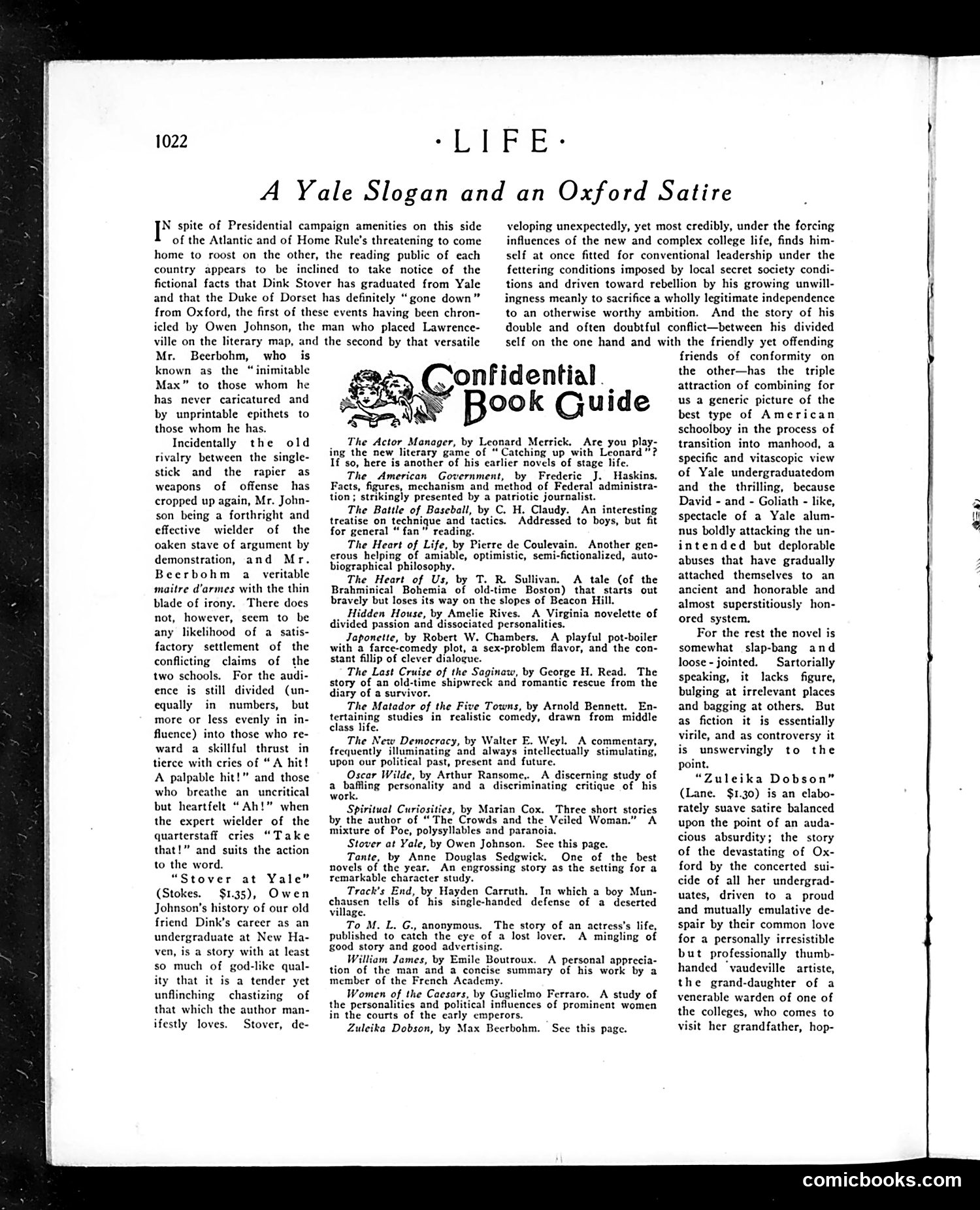
This page discusses two contemporary novels about university life: Owen Johnson's *Stover at Yale* and an unnamed work by Max Beerbohm about Oxford (likely *Zuleika Dobson*). The text playfully compares Johnson and Beerbohm as rival "weapons" in literary debate—Johnson wielding the "oaken stave of argument" (direct, forceful criticism) versus Beerbohm with his "thin blade of irony" (sophisticated wit). The metaphor references actual fencing rivalries between single-stick and rapier combat styles. Both novels examine undergraduate life's tensions: *Stover at Yale* depicts a student caught between conformity to social pressures and personal independence. The passage suggests American readers divide into two camps—those favoring Johnson's blunt, vigorous style versus those preferring Beerbohm's refined, ironic approach—with neither camp likely to "settle" the rivalry. The page is primarily a book review column, not primarily satirical cartooning.
📄 Transcribed text from this page (OCR, searchable)
Machine-transcribed from the original scan — historical spelling and the odd misread are preserved.
*LTP E * A Yale Slogan and an Oxford Satire I spite of Presidential campaign amenities on this side of the Atlantic and of Home Rule's threatening to come home to roost on the other, the reading public of each country appears to be inclined to take notice of the fictional facts that Dink Stover has graduated from Yale and that the Duke of Dorset has definitely “gone down” from Oxford, the first of these events having been chron- icled by Owen Johnson, the man who placed Lawrence- ville on the literary map, and the second by that versatile veloping unexpectedly, yet most credibly, under the forcing influences of the new and complex college life, finds him- self at once fitted for conventional leadership under the fettering conditions imposed by local secret society condi- tions and driven toward rebellion by his growing unwill- ingness meanly to sacrifice a wholly legitimate independence to an otherwise worthy ambition. And the story of his double and often doubtful conflict—between his divided self on the one hand and with the friendly yet offending Mr. Beerbohm, who is known as the “inimitable Max” to those whom he has never caricatured and by unprintable epithets to those whom he has. Incidentally the old rivalry between the single- stick and the rapier as weapons of offense has cropped up again, Mr. John- son being a forthright and effective wielder of the oaken stave of argument by demonstration, and Mr. veritable maitre d’armes with the thin blade of irony. There does not, however, seem to be any likelihood of a satis- factory settlement of the conflicting claims of the two schools. For the audi- ence is still divided (un- equally in numbers, but more or less evenly in in- fluence) into those who re- ward a skillful thrust in tierce with cries of “A hit! A palpable hit!" and those who breathe an uncritical but heartfelt “Ah!” when the expert wielder of the quarterstaff cries “Take that!” and suits the action to the word. “Stover at Yale” (Stokes. $1.35), Owen Johnson's history of our old friend Dink’s career as an undergraduate at New Ha- ven, is a story with at least so much of god-like qual- ity that it is a tender yet unflinching chastizing of that which the author man- ifestly loves. Stover, de- Beerbohm a ‘onfidential. Book Guide The Actor Manager, by Leonard Merrick. Are you play- ing the new literary game of “Catching up with Leonard”? If so, here is another of his earlier novels of stage life. The American Government, by Frederic J. Haskins, Facts, figures, mechanism and method of Federal administra- tion; strikingly presented by a patriotic journalist. The Battle of Baseball, by C. H. Claudy. An interesting treatise on technique and tactics. Addressed to boys, but fit for general “ fan" reading. The Heart of Life, by Pierre de Coulevain. Another gen- erous helping of amiable, optimistic, semi-fictionalized, auto- biographical philosophy. The Heart of Us, by T. R. Sullivan. A tale (of the Brahminical Bohemia of old-time Boston) that starts out bravely but loses its way on the slopes of Beacon Hill. Hidden House, by Amelie Rives. A Virginia novelette of divided passion and dissociated personalities. Japonette, by Robert W. Chambers. A playful pot-boiler with a farce-comedy plot, a sex-problem flavor, and the con- stant fillip of clever dialogue. The Last Cruise of the Saginaw, by George H. Read. The story of an old-time shipwreck and romantic rescue from the diary of a survivor. The Matador of the Five Towns, by Arnold Bennett. En- tertaining studies in realistic comedy, drawn from middle class life. The New Democracy, by Walter E. Weyl. A commentary, frequently illuminating and always intellectually stimulating, upon our political past, present and future. Oscar Wilde, by Arthur Ransome, A discerning study of a baffling personality and a discriminating critique of his work, Spiritual Curiosities, by Marian Cox. Three short stories by the author of “The Crowds and the Veiled Woman.” A mixture of Poe, polysyllables and paranoia. Stover at Yale, by Owen Johnson. Sce this page. Tante, by Anne Douglas Sedgwick. One of the best novels of the year. An engrossing story as the setting for a remarkable character study. Track’s End, by Hayden Carruth. In which a boy Mun- chausen tells of his single-handed defense of a deserted village. To M. L. G., anonymous. The story of an actress's life, published to catch the eye of a lost lover. A mingling of good story and good advertising. William James, by Emile Boutroux. A personal apprecia- tion of the man and a concise summary of his work by a member of the French Academy. Women of the Caesars, by Guglielmo Ferraro. A study of the personalities and political influences of prominent women in the courts of the early emperors. Zuleika Dobson, by Max Beerbohm. See this page. friends of conformity on the other—has the triple attraction of combining for us a generic picture of the best type of American schoolboy in the process of transition into manhood, a specific and vitascopic view of Yale undergraduatedom and the thrilling, because David - and - Goliath - like, spectacle of a Yale alum- nus boldly attacking the un- intended but deplorable abuses that have gradually attached themselves to an ancient and honorable and almost superstitiously hon- ored system. For the rest the novel is somewhat slap-bang and loose - jointed. Sartorially speaking, it lacks figure, bulging at irrelevant places and bagging at others. But as fiction it is essentially virile, and as controversy it is unswervingly to the point. “Zuleika Dobson” (Lane. $1.30) is an clabo- rately suave satire balanced upon the point of an auda- cious absurdity; the story of the devastating of Ox- ford by the concerted sui- cide of all her undergrad- uates, driven to a proud and mutually emulative de- spair by their common love for a personally irresistible but professionally thumb- handed vaudeville artiste, the grand-daughter of a venerable warden of one of the colleges, who comes to visit her grandfather, hop- comicbooks.com